Category Archives: World Opinion

DOWN MEMORY LANE – Prayers and flowers for Shah Jahan

ShahJehanMPos29may2015

The observance of the death anniversary of Shah Jahan and Mumtaz Mahal still fascinates people

The 360th Urs or death anniversary of Shah Jahan was observed at the Taj Mahal last week, but there were ripples of it in Delhi too with a busload of people reaching there to pay homage to the Emperor. Mohammad Saquib of Suiwalan was one of them. He has been attending the Urs for years as one of his ancestors was among the artisans who worked on the inlay work at the mausoleum, or so he claims. Another interested visitor was Shahnawaz Khan of Basti Nizamuddin who went for the first time to offer fateha in observance of a vow. Earlier Khan Abdul Haye Khan was a regular Delhiwallah who never missed the Urs. Abdul Haye was a Pathan who was very fond of fishing. One remembers that in 1966 during the monsoon he sat down on the rear side of Etmad-ud-Daulah to fish in the Yamuna, which was in flood and whose waters were beating against the mausoleum where rests the father of Nur Jahan and grandfather of Mumtaz Mahal. A rohu caught by Abdul Haye was so big that it sufficed for dinner for the whole family when cooked in Matia Mahal.

Shah Jahan like the unlucky Mohammad bin Tughlak was fond of Yamuna fish and so also presumably Mumtaz Mahal, but he did not drink wine till the age of 23 when he was persuaded by his father, Jahangir to do so. He however, never drank after the death of Mumtaz at Burhanpur on 16th June 1631. Accordingto Dr Ishwari Prasad, Shah Jahan died in January 1666 aged 74. Why his Urs was celebrated in mid-May is not understandable unless the date is fixed according to its proximity to Mumtaz Mahal’s death or some lunar calculation or as per the convenience of the khadims (caretakers). One remembers attending an Urs in 1958 when among those who prayed for the Emperor’s soul was Nawabzada Farouqur Rehman Khan of Datoli. Earlier the Nawab of Chhatarhi, Chief Scout of India and Freemason Grandmaster, had offered his obeisance. The first Urs of Shah Jahan, a year after his death, was presided over by Prince Muezzim, eldest son of Aurangzeb, who came from Delhi partly on horseback and partly in a horse-driven carriage, past Akbar’s Tomb at Sikandra, where he dismounted to offer fateha at the grave of his great-great grandfather. Aurangzeb came a month later. The same thing happened at the first Urs of Mumtaz Mahal at the Taj after Shah Jahan’s death.

A special feature of the Urs of Shah Jahan, which was later merged with the Urs of Mumtaz Mahal, is the laying of a gigantic multi-coloured Hindustani Chadar at the grave. This was offered on Friday May 17, with the Urs continuing on the subsequent Saturday and Sunday. Entry to the Taj was free from the afternoon of Friday (which is usually a closed day for visitors). The shehnai was played, along with the naqarra drum, at the top of the main entrance to the monument and on the following days the big kettle drums were beaten to mark the occasion, as in Mughal times when Shah Jahan is believed to have once remarked to Mumtaz: “Naqqare tumhari amadh ka ailan karenge aur tum Manno Malika kehlaugi” (The drums will announce your arrival and you dear will be called Emperess). Not much information is available of the first Urs of Shah Jahan but the one for Mumtaz Mahal is recorded, as follows, by father in his 1977 memoirs: “The celebrations traditionally begin with the washing of the tombs of the Emperor and his wife with rose water and the lighting of ‘agarbattis’. Prayers are offered with and flowers and cloth ‘chadars’ — one of them on behalf of the Department of Archaeology — are placed on the graves.

Occasionally a visitor whose prayers have been heard sends a ‘chadar’ as a token of thanksgiving. Atop the gate facing the mausoleum sit shehnai players and as evening advances, qawwalis in praise of the dead couple attract a big audience from neighbouring Tajganj, where reside the descendants of the builders of the monument. In keeping with tradition, food is distributed to the poor. The entire cost of the Urs is borne by the khadims from offerings made at the tombs. The first Urs of Mumtaz Mahal was performed by Shah Jahan himself in 1631. The Emperor wore a white dress and the nobles were in mourning habit. A covering with strings of pearls worth several lakhs of rupees was spread over the tomb. Prayers were offered for the soul of the queen and fateha was performed. Asif Khan, father of Mumtaz Mahal, was assigned a prominent place at the ceremony. A lakh of rupees was sanctioned for the ceremony, Rs 50,000 of it was given in alms to the poor.”

This time the Urs followed the recent earthquake which did not have any significant effect on the monument, except Sahilion-ki-Burj. Believe it or not, Mufti Ehsan Sahib of Mehrauli thinks Shah Jahan and Mumtaz Mahal always protect those who come to offer homage to them.

source: http://www.thehindu.com / The Hindu / Home> Features> MetroPlus> Society> Down Memory Lane / by R.V. Smith / May 24th, 2015

New zarih for Bibi Sakina is replica of Syria shrine

Lucknow :

One-of-its-kind silver ‘zarih’ is being made in Lucknow to commemorate the ‘wiladat’ (birth anniversary) of Bibi Sakina, great grand daughter of Prophet Muhammad and daughter of Imam Hussain, the martyr of Karbala, celebrated on 19 Rajab, falling this year on May 9. Zarih is lattice work, often gilded, that encloses an Islamic tomb. Handcrafted by 10 skilled artisans for past six months, it is replica of the original zarih in Syria.

The estimated cost of the lattice made of 25kg pure silver is Rs 15 lakh, an amount collected from donation at Hazrat Abbas dargah. It is 3 feet wide, 4.5 long and 3.5 feet high and has Quran verses and story of Bibi Sakina’s pilgrimage carved on it in Arabic.

Once construction work is complete the existing zarih made of plain iron will be replaced with the silver one to enclose the holy shrine of Bibi Sakina situated on the premises of Dargah Hazrat Abbas in Rustam Nagar.

One of the most revered shrines in Lucknow built in 1819 this Dargah is perhaps the oldest shrine of the Shia Muslims in the city, popular among non-Muslims too.

Speaking to TOI, member Hazrat Abbas Dargah committee Arif Hasan said, “Donation was received from members of all communities.”

Artisan Nisar Hussain said, “Though original zarih in Syria is placed on a stone we will be installing the zari on a wooden platform.”

Plan is to make a 100gram gold crown embellished with multicolored semi-precious stones to be placed next to the zarih.

source: http://www.timesofindia.indiatimes.com / The Times of India / Home> City> Lucknow / by Uzma Talha, TNN / May 01st, 2015

Tipu Sultan killed at Seringapatam

The Indian ruler and resister of the East India Company was killed by the British on May 4th, 1799.

Tipu Sultan, ruler of Mysore from 1782 to 1799

Tipu Sultan, the Tiger of Mysore, or Tippoo Sahib as the British called him, was the Indian ruler who resisted the East India Company’s conquest of southern India. Public opinion in England considered him a vicious tyrant, while modern Indian nationalists have hailed him as a freedom fighter, but both views are the products of wishful thinking. A small, plump man with a round face and black moustache, who wore clothes glittering with jewels, Tipu was vigorous, forceful, brave, warlike and cruel; a devout Muslim ruling a mainly Hindu population. He had inherited the throne from his father Haidar Ali, who had driven out the previous Hindu dynasty.

Tipu used to say it was better to live for two days like a tiger than drag out an existence like a sheep for two hundred years. He had a special reverence for tigers. He kept six in his fortress-city of Seringapatam (now Sriringapatna), 200 miles west of Madras, where his throne was shaped and striped like a tiger. His elite troops wore tiger badges, the hilt of his sword was in the form of a snarling tiger, and his favourite toy was a mechanical tiger straddling a British officer while the victim squealed in terror (it is now in the Victoria & Albert Museum). Tipu was determined to build a rich and powerful state and he was feared with reason by his subjects, his neighbours and other Indian princes, who joined forces with the British against him. He tried to build up an alliance to drive the British – ‘those oppressors of the human race’ – out of India and intrigued with the French in Paris and Mauritius. In dealings with them Tipu improbably donned a cap of liberty and expressed his sympathy with French Revolutionary ideals.

The British feared an invasion of India by Napoleon, and Lord Mornington, arriving in Calcutta as British Governor-General in 1798, decided to settle accounts with Citoyen Tipu. An army of East India Company sepoys and cavalry was assembled in Madras under General Harris with a contingent from the Nizam of Hyderabad, and the British Thirty-Third Regiment of Foot under Mornington’s younger brother, Colonel Arthur Wellesley (the future Duke of Wellington). In February 1799 the order to invade Mysore came, and the motley array toiled across the border accompanied by elephants and camels, thousands of baggage bullocks and flocks of sheep and goats to provide meat for the officers, as well as hordes of camp followers and a travelling market selling food and drink for the soldiery. Officers took along cooks, grooms, laundrymen and cleaning wallahs, and senior officers like Wellesley, who brought his silver-plated tableware with him, had thirty or more servants in their train. Moving ponderously in the burning heat, the army covered an area of eighteen square miles and on a good day managed to advance ten miles.

Tipu’s initial resistance was pushed aside and the British army sat down around the limewashed walls of Seringapatam which bristled with cannon. Soldiers captured by the sultan’s men were taken into the fortress and killed. Nails were driven into their heads or they were strangled by Tipu’s jettis, professional strongmen–executioners. Tipu sent placatory messages to the enemy commanders, hoping to delay matters until the monsoon arrived, but they continued with their siege works and cannonades.

When the morning of May 4th came, Tipu was told that the omens were not propitious. He tried to ward off misfortune by presenting the Hindu priests and Brahmins with a purse of gold, an elephant, a black bullock and two buffalo, a black nanny goat and a black coat and hat, but in vain.

The assault was launched soon after one o’clock by troops equipped with bamboo ladders for scaling the walls. Within minutes a British flag was planted in the breach as the defenders fled. Tipu himself fought bravely, dressed in his finest, loading and firing muskets handed him by his servants as if he was at a sporting shoot, but the odds were too great. He was wounded and his staff tried to hurry him away in a palanquin, but he was killed for his jewellery by an unidentified British soldier. As night was falling a British party found the sultan’s body under a heap of corpses. He was given honourable burial in his family mausoleum in the city.

The news of Tipu’s defeat and death caused excitement in England and his treasure-hoard provided ample prize money for the British senior officers. Harris was given a peerage and Mornington was made Marquess Wellesley. Arthur Wellesley was put in charge in Mysore and moved into Tipu’s palace, while the throne was bestowed on an infant member of the previous Hindu dynasty. The tigers were shot.

source: http://www.historytoday.com / History Today / Home> The Archive> India – Empire / by Richard Cavendish / Published in History Today – Volume 49, Issue 5 – May 1999

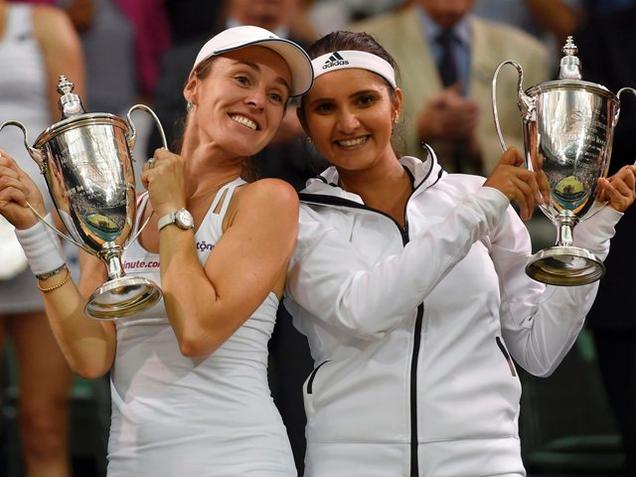
Sania Mirza-Martina Hingis win Miami Open, lift their second title together

In individual doubles rankings, Sania Mirza is now only 145 points away from becoming world number one. (Source: Twitter)

Sania Mirza achieved yet another career milestone by capturing her 25th WTA doubles title as the Indian ace continued her dream start with Martina Hingis to win the Miami Open trophy on Sunday.

The top seeded Indo-Swiss pair overcame a sluggish start to take the title with a 7-5 6-1 scoreline against second seeded Russian team of Ekaterina Makarova and Elena Vesnina.

Sania and Hingis were trailing 2-5 in the opening set but regrouped and turned the tables on their fierce opponents by reeling off eight games in a row.

They had the beaten the same Russian team to win the Indian Wells to win their first title together.

It has been an absolute dream start for Sania and Hingis as they are yet to lose a set since they began their partnership.

“We just tried to keep telling each other to enjoy the struggle. Last week everything came very, very easily to us – we didn’t lose more than four games in a set. Over here we were down, and we were panicking. It was like, ‘Oh my God, we’re not playing well.’ We just weren’t used to that,” Sania said after the match.

Hingis credited the win to tips provided by Sania’s farther Imran Mirza during the match.

“Today the coaching really turned it around – your dad came on court,” Hingis said to Sania.

“The most important thing is that we never stopped believing we’re a great team. They played a great set to get us to that position, 5-2 down. Then we just tried to stay in there and get our chances. We just built on every point, which is what we did well last week too,” the Swiss great, who now has 43 doubles title, said.

With this win, Sania and Hingis now will move to number three from nine in the Road To Singapore doubles leaderboard.

In individual doubles rankings, Sania is now only 145 points away from becoming world number one.

source: http://www.indianexpress.com / The Indian Express / Home> Sports> Tennis  / by Press Trust of India / Miami – April 06th, 2015

Off to English teachers’ meet in Britain

Two teachers from the district will fly to the city of Manchester in the U.K. next week to a participate in the International English Teachers’ conference being organised by the International Association of Teachers of English as a Foreign Language (IATEFL), a forum working for linking, developing and supporting English language teaching professionals from across the world.

K.T. Muhammed Hashim

“We are the only two from the State to attend the conference this time, as far as we know,” said K.T. Muhammed Hashim, one of the invited teachers. While Mr. Hashim is working with the Government Girls Higher Secondary School, Koyilandy, A.K. Syke, is a teacher with the Government Higher Secondary School Chorode, Vadakara.

A.K. Syke
A.K. Syke

The conference will be held from April 10 to 14.th. The teachers will be provided free admission to the conference besides food and shared accommodation. The duo was selected from many IATEFL member teachers who applied for the event after due screening process and presentation of assignments, said the teachers. “Both of us have earlier presented papers at international conferences, including the Teacher Educators’ conference (TEC) of British Council held at Hyderabad,” said Mr. Hashim.

The conference, a major English Language Teaching (ELT) event comprising pre-conference sessions, symposiums, interactive sessions and exhibitions will have over 500 talks, workshops and seminars. “

source: http://www.thehindu.com / The Hindu / Home> National> Karnataka / by Jabir Mushthari / Kozhikode – April 02nd, 2015

Asif Iqbal to head South India Chapter of Indo-Arab chamber in Bangalore

AsifIqbalMPOs05apr2015

Bangalore:

The 32-year-old Indo-Arab Chamber of Commerce and Industries (IACCI) has set up its South India chapter in the city with Asif Iqbal as its Executive Director and singer-actor Lucky Ali as the Cultural Director. “The chapter will identify new areas of mutual cooperation to ensure the smooth flow of trade, investments, joint ventures, and technology between Indian and Arab industries,” Mr. Iqbal said in a statement on Aug. 4. The chapter will cover Karnataka, Andhra Pradesh, Tamil Nadu, Kerala, and Goa. In the Arab world, it will cover 18 countries.

Established in 1980, the IACCI aims to provide a link for promotion of commercial and economic relations between India and the Arab world. It is also an active forum for Indian businessmen who have close contacts with the Arab world.

The IACCI has supplied manpower and made a breakthrough in construction and project exports, thus ensuring the economic development of the Arab world. The Gulf chapter of the IACCI is in Muscat, Oman. The Bangalore office is located at World Trade Centre, 22nd Floor, Unit 2201A, Brigade Gateway, 26/1. Ph: +91 80-49365431, 98455-84891. Fax:+91 80 49365301. E-mail: asif@indoarabchamber.org

source: http://www.karnatakamuslims.com / Karnataka Muslims / Home> District> Bangalore / by Staff Reporter, KMNM / August 05th, 2012

Malala friend gets healing touch

Kolkata :

Nobel laureate Malala Yousafzai chose Kolkata — after running a web check of a number of cities worldwide — for the treatment of a close friend who was suffering from a heart ailment.

The girl, Syeda Gulalay Jahid, is a former classmate of Malala in Peshawar. She had been advised surgery for a congenital cardiac problem but Malala’s homework proved spot-on. Doctors in Kolkata said Syeda need not get under the scalpel and she was sent home with a course of medication — and plenty of blessings and good wishes.

Malala was overjoyed by the quick recovery of her friend and plans to find out more about Kolkata, said her father from the UK. “Doctors in Kolkata and members of the Rotary Club were truly helpful. We had not expected such whole-hearted support from Kolkata when we called them for help. But they went out of their way to help Gulalay, who is just as touched as Malala and myself. Kolkata is truly a friendly city and Malala might be sending more such patients to Kolkata,” Ziauddin Yousafzai told TOI from UK on Tuesday.

It was in August last year that Rotary Club South City president Tapas Mukherjee got a call that set his nerves tingling. A soft-spoken man identified himself as Ziauddin Yousafzai and asked for help to get her daughter’s friend Syeda treated in Kolkata.

Before Mukherjee could get over the thrill of the name ‘Yousafzai’, the man said Malala would like to talk to him and passed the phone to the teenage Nobel laureate. “I was really excited when she came on the line. In fact, I couldn’t believe it for a few seconds. She was extremely courteous and spoke very softly. Malala sounded extremely worried about her friend who had a complicated congenital heart ailment that couldn’t be treated in Pakistan. She told me that she would be grateful if we could arrange for the treatment. It was to be sponsored by The Malala Fund in Pakistan,” said Mukherjee.

“Malala zeroed in on Kolkata after a thorough research . She told me that Kolkata would be the right place,” said Yousafzai. She had learnt of other Pakistani children being treated here, some of whom were helped by the Rotary Club.

More phone calls followed as preparations were made for the treatment. The city Rotary Club sought a formal communication from the Rotary Club of Swat, Peshawar. Syeda’s medical reports were sent to AMRI Hospital, Dhakuria. A panel of doctors was formed to recommend a line of treatment and she got admitted on March 11.

The panel was headed by cardiac surgeon P K Hazra. After four days in hospital, Syeda walked out without having to undergo a surgery. According to Hazra, Gulalay can lead a normal life on medicines alone.

“The pulmonary valve in her right ventricle is shut. It hinders the flow of blood to her lungs, but she has developed channels from her left ventricle that manages to carry the blood. With medication, she would be fine for the rest of her life. A surgery will be too risky at this stage,” said Hazra.

Malala personally wrote to AMRI Hospital, Dhakuria, and thanked the doctors. “I am truly touched by your kind gesture of overseeing Syeda’s admission,” she wrote, ending the letter by saying that she will remain “forever indebted to you and Rotarian Tapas Mukherjee”. .

Malala, the youngest Nobel laureate, is now studying in UK and preparing for an exam in June. “She is at the school hostel and won’t be back till June. She would be extremely happy to interact with people from Kolkata once she is back,” said Yousafzai.

Syeda will return to the city next year for a check-up. “We will be happy to arrange her treatment again and hope she is accompanied by Malala. It will then be a truly great occasion,” said Utpal Majumdar, a former trustee of East India Rotary Welfare Trust.

source: http://www.timesofindia.indiatimes.com / The Times of India / Home> City> Kolkata / by Prithvijit Mirta, TNN / April 01st, 2015

Dr. Abdul Kalam coming to city

To deliver valedictory address of Golden Jubilee celebration at SJCE on Mar.31

DrKalamMPOs31mar2015

Mysuru :

Former President of India Dr. A.P.J. Abdul Kalam will be arriving in city to take part in the valedictory of the Golden Jubilee celebrations of Sri Jayachamarajendra College of Engineering (SJCE) on Mar. 31. He will deliver the valedictory address at 10.30 am.

Maj. Gen. Nasser Al Sayed Abdul Razak Al Razooqi, Chairman of Al Razooqi Group, Dubai, will be the guest of honour.

Sri Shivaratri Deshikendra Swamiji of Suttur Mutt will grace the occasion.

B.N. Betkerur, Executive Secretary of JSS Mahavidyapeetha, Prof. M.H. Dhananjaya, Director (Technical) and Dr. B. Suresh, Vice-Chancellor of JSS University, will be present as guests. Minister for Higher Education and Tourism R.V. Deshpande will preside.

Later, Dr. Kalam will interact with the students.

source: http: //www.starofmysore.com / Star of Mysore / Home> General News / March 26th, 2015

Poop to perfume: The rose crop of Khitoli

RoseMPOs30mar2015

Aligarh :

At Khitoli village, Hasayn, Hathras district, mid-March is when the process for extracting rose essence (ruh) begins. The process will go on till the end of April, over a period of 40 days. There is a big rose mandi here. Ask farmers what the secret of the rich aroma of the roses of this region is, and the answer is unanimous – human poop.

The rose of this region is called “Noorjehan” – jewel of the world — after the wife of Mughal emperor Jahangir. The air in the village at this time year is laden with the aroma of roses.

Workers are seen plucking roses early in the morning, while dewdrops are still on the buds. They measure the roses, add bunches of them into water to steam in a large copper container called degh to extract ruh. About 250 kg of flowers yield just 40 gm of ruh.

Work on the floriculture crop begins in October each year, with the sowing of seeds.

“The good yield of the rose is because of fertile land – and if you are thinking what makes the soil here especially fertile, it is human poop,” says Mahesh Pal Singh, former pradhan of the village whose father Veer Pal Singh started the work of rose essence extraction some 65 years ago in Khatoli. Veer Pal Singh died at the age of 108 last week.

“The farmer is also a scientist,” Singh says. “He knows what is good, what is not. Most of us avoid cow dung and prefer human poop in our fields as manure. Almost 95% of our villagers don’t have toilets at home. All the men, women and children answer the call of nature in the fields. That is why the produce in the village is far better than what is grown in farms away from human habitation.”

One cannot then help wonder if toilets in village homes is at all a good idea then, in this part of Hathras district.

“The toilets are only part of the big houses here. Just about five village homes here have toilets – the rest go to the field. That is what is best, not just for the rose crop, but also for potatoes. We need bijli (electricity) and sadak (roads) rather more urgently that toilets. It would save us the bother of going out of the way to transport our produce,” farmer Bahadur Singh says.

“And what when every house has a toilet?”

“There will be no roses then,” the farmer says, with quiet conviction.

The essence extracted from the rose is later used in tobacco, perfume and soap manufacturing.

Horticulture officer Kaushal Kumar of Aligarh says, “Yes, there is truth to the belief that human excrement is good manure – there is a good quantity of micro-nutrients in excrement, as well as nitrogen, potassium and potash. But for the sake of hygiene, it should first be treated well.”

It is human poop that also breeds earthworms, farmers say. “They make the land fertile, dig the ground and make soil breathe,” Bahadur Singh says.

Kaushal, however, said it was not as if there was a direct link between foul-smelling human excrement and sweet-smelling roses: “The excrement makes the land fertile and aids in growth. Without it, some nutrients would be lost to the soil. Even the farmers are aware that the transition is no direct one, he says.

Besides poop and earthworms, the rose crop also needs moisture-laden easterly winds at the beginning of the growing season – rain in that time could damage the crop, farmers say.

source: http://www.timesofindia.indiatimes.com / The Times of India / Home> City> Agra / by Eram Agha, TNN / March 29th, 2015

What Urdu has; what it still needs…

UrduMPos30mar2015

When Intizar Hussain writes, everyone pays attention. The India-born-Pakistani writer, well-known even beyond the boundaries of the sub-continent, recently wrote about the Jashn-e-Rekhta — the two-day Urdu literary festival held in Delhi earlier this month.

He said: “I am returning (to Pakistan) after witnessing the biggest literary festival. This festival of Urdu was celebrated under the title Jashn-e-Rekhta and held at the India International Center, a central place in the Indian capital.”

He added: “Friends and others believed that the tradition of Urdu has come to an end in Delhi. Oh! no. This is not the case. Like the sun, Urdu went down here and has reemerged there. It is the magic of Urdu that is mesmerizing the public. Such big gathering; such big crowds might not have been seen at the India International Centre before. The crowd was not that of the traditional Urdu audience that are seen at mushairas trying to bring down the roof with their wah wah, subhanalla and repetition demand. This crowd was that of the sons and daughters of Delhi who have got introduced to the thrill of Urdu through Hindi and English.”

Clearly, from the tone of his two-part article published by a Pakistani daily, it is certain that the Man Booker nominee of 2013 was suitably impressed with the language gathering new admirers.

A Hyderabad-based academic Shams Imran who attended the festival is baffled at the response the event received. “While there is no denying the fact that hordes of people from Gen X are flocking to Urdu for its emotional quotient, the event became a roaring success not merely because of the celebrity participants but because of the imaginative public-friendly planning,” he said.

But why name it Jashn-e-Rekhta (a name that preceded Urdu, the language as it is known today) and not Jashn-e-Urdu? 

While the answer could be there in the tombs of information available on the popular Rekhta website, what comes to mind on hearing it is the history of Urdu, the language that represents one of the finest examples of the fusion of Indo-Islamic cultures.

According to some scholars, the first seeds of Urdu were sown with the arrival of Muslim groups from Arabia to India some 1,300 years ago, who brought with them the Arabic language. The later groups came from Afghanistan and Central Asia who carried with them the Persian language and Turkic dialects. It took a distinct form during the last phase of the Sultanate that coincides with the era of Amir Khusrau who used a language that had words from Sanskrit, Bhasha, Persian, Turkish, Arabic and Persian. As Persian or Farsi was taking roots during the Mughal era in Delhi, down in the Deccan, Mohammed Quli Qutb Shah was writing poetry-Piya baaj pyala piya jayena…It was called Deccani in the South then.

The Rekhta or an initial variant of Urdu was still not considered a language to pen poetry. It was merely the lingo of the common folk in bazaars, streets and lanes. Two men from the Deccan, Wali Deccani and Siraj Aurangabadi, discovered the potential of Rektha to be used as the medium of poetry. The popularity of their poetry reached the doorsteps of the North, especially Delhi. Rekhta was no more a language that could be looked down upon. Meer, Sauda and later Ghalib began writing in this language and in the process created a treasure trove of new words, compound words and adage. But by then, Rekhta had graduated to be called Urdu.

So Rektha, according to some, has returned as the language of all those who had felt some connection with Urdu.

The question here is this: When Hyderabad organised a literary festival with Urdu as the language in focus in January, only two months before Jashn-e-Rekhta in Delhi, why it did not click?

According to some observers the reason lies in the fact that except for Javed Akhtar and Rakshanda Jaleel, there were hardly any other popular names in the festival that could help in attracting crowds. The organisers had not even bothered to invite the two award winning writers from within HyderabadPadmashri Jeelani Bano and Padmashree Mujhtaba Hussain.

Guess the organisers back home need to take a leaf out of Sanjiv Saraf’s book – the man who made Jashn-e-Rekhta such a huge success.’

source: http://www.timesofindia.indiatimes.com / The Times of India / Home> City> Hyderabad / by Mir Ayoob Ali Khan, TNN / March 29th, 2015