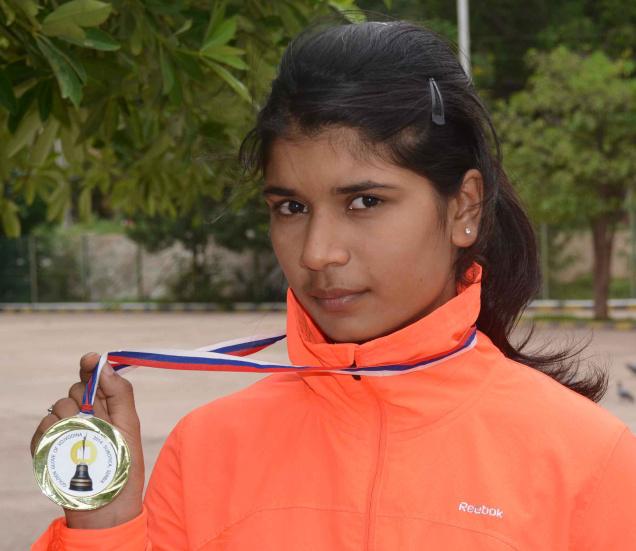
Boxer Nikhat Zareen displays the gold medal which she won in the Golden Gloves international youth women boxing meet held in Serbia in July. Photo: V.V. Subrahmanyam / The Hindu
To create awareness on road safety among people, international boxer Nikhat Zareen has been appointed brand ambassador by district Collector D. Ronald Ross, according to Deputy Transport Commissioner G.C. Rajatnam.
Henceforth, Ms. Zareena will take part in all programmes conducted by the transport authorities to impart education on road safety and measures to be taken to avoid accidents among students and general public.
Thus Nizamabad district became the lone district in the State to have had a brand ambassador on road safety.
As part of creating more awareness on the subject, some more celebrities are likely to be declared brand ambassadors, said Mr. Rajaratnam.
He also said all taxi cabs, maxi cabs, Toofan vehicles and autorickshaws must follow the RTA conditions and get permission from the said authority besides having driving licence and owner identity card in the vehicles. That apart, only those vehicles which secure permission will ply as taxis and must be parked at the taxi stand and if any private vehicle is parked at the earmarked place, penalty will be imposed on the owners, he said.
source: http://www.thehindu.com / The Hindu / Home> News> National> Telangana / by Special Correspondent / Nizamabad – December 13th, 2014
Governor Vajubhai Vala congratulated the top athletes and coaches of Karnataka including Asiad gold medalists Ashwini Akkunji (athletics) and Sushmitha Pawar (kabaddi) on Wednesday for winning the Karnataka Olympic Association (KOA) awards 2014 and said more laurels could be won through the combined efforts of state government and KOA.
Addressing the gathering in Raj Bhavan, Vala said the state can be proud of its achievements in sports. “I’m happy to note that there are seven players in the Indian hockey team from Karnataka. Likewise, there are many others from the state who have done well at the international level,” the governor said after giving away KOA’s special awards to hockey players SV Sunil, Nikkin Thimmaiah, VR Raghunath, discus thrower Vikas Gowda, badminton player Ashwini Ponnappa, pistol shooter PN Prakash and other medal winners at the Incheon Asian Games.
The governor also recalled the Gujarat model of sports development which is now rated highly. “There is competition at the village, district and zonal level before they reach the state level and winners at all these levels are rewarded,” said Vala, who also served as the finance minister of Gujarat.
He also exhorted all youngsters to take up sports. “Today we see the absence of good character in many youngsters and that’s why sport is important as it helps in character building,” he said.
Chief minister Siddaramaiah stayed clear of committing anything more on the sports cess, despite being prodded by KOA president Govindaraj, but reaffirmed the government’s commitment to support sportspersons. “I’ve never said no whenever the sportspersons have come to me for help. We are improving the infrastructure in all the districts and that will help athletes from rural areas,” he said.
Ace badminton doubles player Ashwini Ponnappa was happy to receive the award in what was a big year for her. “It was a satisfying year as we have improved a lot winning medals in ABC, Uber Cup and Commonwealth Games. It is going to be another busy season from January with the World Championship in August,” Ashwini said.
Middle distance runner Ashwini was all smiles after collecting two awards. The lanky athlete said the awards are a big motivation to improve further. “This was a big surprise I was never expecting it,” she said.
The KOA also honoured several coaches including N Lingappa (athletics), DY Biradar (athletics), Manoharan G (boxing), Aslam Khan (football), Jude Felix (hockey) and Vasant Madhav (tennis). TOI’s principal photographer Syed Asif also received the honour.
Earlier, Govindaraj said the government has cleared the proposal for the construction of the Olympic Bhawan at the Sree Kanteerava stadium. “Karnataka will only be the second state after Andhra Pradesh to have their Olympic Bhawan,” he said.
source: http://www.timesofindia.indiatimes.com / The Times of India / Home> Sports> More Sports / by Biju Babu Cyriac, TNN / November 28th, 2014
A.R. Rahman won the award for his fight against polio — Photo. M. Moorthy / The Hindu
Rotary International presented the polio ambassador award to music director A.R. Rahman at a meeting held in Guindy on Saturday.
Accepting the award, Mr. Rahman spoke of helping fight polio through social media.
“I used to think Facebook was a waste of time. But when it was suggested that I open a Facebook page and upload videos of my rehearsals, it helped me reach out to a huge user base of 22 million. It was through this page I began sharing awareness messages on polio,” he said.
Pianist Anil Srinivasan played some of Mr. Rahman’s hits songs from Hindi and Tamil cinema and asked him questions based on them.
Speaking about the influences behind Jai Ho, Mr. Rahman said, “I just wanted to approach the song like an anthem, uniting the musical influences of various cultures: Chinese, Japanese, Spanish. The song has all these influences.”
On working with Mani Ratnam, he said he was given the space to experiment beyond what the script required. “There have been occasions when I have tried something out for myself, even if it seemed outside the scope of the film in the beginning. Sometimes, Mani included them in his film. Deivam thanda poove was one such song,” he said.
Having just landed in Chennai from Berlin, Mr. Rahman was in no mood to sing. But the audience was in no mood to let him go without a song. The maestro left with a promise to sing the next time.
Singer Naresh Iyer entertained the audience afterwards.
source: http://www.thehindu.com / The Hindu / Home> News> Cities> Chennai / by Staff Reporter / Chennai – December 14th, 2014
Partha Varanashi from Puttur becomes first Austswim presenter, aims to boost standards
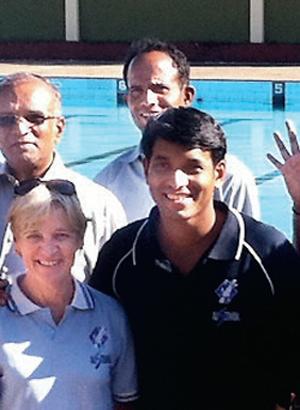
Partha Varanashi, a 29-year-old from the state, has become India’s first Austswim presenter for swimming and water safety.
With this accreditation under his belt, Partha can coach swimmers in India, instead of a representative from Australia visiting the country. This achievement is part of an initiative by former Indian Olympian Hakimuddin Shabbir Habibulla to improve swimming training standards .
Under the programme Winning Matters, Austwim, Australia’s national organisation for the teaching of swimming and water safety provided professional and systematic training to swimming teachers from across India.
Ceri Weeks, a representative from Austswim, conducted the courses in Mumbai, Bengaluru and Mangaluru.
“With Austswim making its presence felt in India, swimming training is expected to get a whole new dimension. Training is going to be holistic and systematic with a strong foundation. The curriculum is vast, which includes child psychology, behaviour patterns and safety and candidates have to under go online tests. There is a 200page manual and there is an option to interact online,” said Partha, who has received a soft copy of the accreditation and will travel to Australia for the actual presentation.
Partha who trains about 40 budding competitive swimmers at the Balavana swimming pool in Puttur and who was responsible to teach 900 students of a swim school in South Australia before returning to India two years ago, said this was just the first lap.
“Since I worked in Australia, I know the standards. The journey has just begun. In India, the focus is only on competitions, while Austswim focuses on technique. The change will not happen overnight. It may take years like it did in Australia, but I am confident that Austswim will bring in changes in swimming standards of India,” he said.
Partha was the Mangalore University’s champion swimmer for three years (20032005). He was also a threetime national Indian swimming finalist, South Australian Masters Swimming record holder (2009) and has over ten gold medals won in Aussie Masters, SA event in the year 2009 and 2010 and coached and trained over 900 swimmers in Australia.
source: http://www.bangaloremirror.com / Bangalore Mirror / Home> Sport> Others / by Deepthi Sanjiv, Bangalore Mirror Bureau / November 26th, 2014
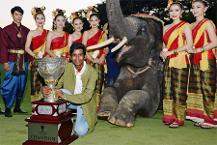
Rashid Khan posing with the winner’s trophy after his victory on the final day in the Chiangmai Golf Classic at the Alpine Golf Resort. (AFP Photo)
Mumbai :
Delhi boy Rashid Khan, who has showed immense promise in home conditions, on Sunday proved that he has come of age by clinching his first overseas victory in Thailand.
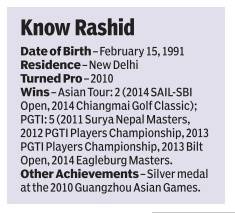
Rashid won the $750,000 Chiangmai Golf Classic by one stroke, surpassing fellow Indian Jyoti Randhawa and local lad Thanyakon Khrongpha at Bangkok’s Alpine Golf Resort. This was also Rashid’s second Asian Tour title, which propelled him to the eighth place from last week’s 22nd spot in the continental Order of Merit. Rashid won his first Asian Tour trophy at the SAIL-SBI Open this February in a playoff against Bangladesh’s Siddikur Rehman.
Rashid became the second golfer after India’s highest-ranked pro Anirban Lahiri to get a breakthrough win this year. Anirban clinched his first title on foreign turf in April.
“I had confidence that I am going to win my second tournament on the Asian Tour but I didn’t expect it to be so soon.Both my wins are important. Sail-SBI Open, because it was my first win and Chiangmai is special, because it is my first win abroad so both have their own relevance,” Rashid told TOI just before boarding a plane for the flight back home. Jyoti Randhawa (68-65-70-69) seemed to be back at the top of his game as he earned a creditable runner-up finish after a final round of 69 that saw him make five birdies and two bogeys.
The nine-time Asian Tour winner had a slow start with a bogey on the first but then made a charge with birdies on the fourth, sixth and eighth. He sank a mammoth 50-footer on the sixth. A poor tee shot resulted in a bogey on the 11th. Jyoti tried to come back in the game with birdies on the 14th and 15th but could not catch up with Rashid till the end.
Rashid began his golfing journey at the age of nine as a caddie at the Delhi Golf Club with equipment borrowed from his uncle Mohd Maqbool Khan. But it was in 1999 that his enrolment for DGC’s Junior Golf Development program changed his fate. In 2006, Rashid won Indian Golf Union’s (IGU) All India Juniors after which there was no looking back. In fact, it was after his silver-medal winning effort at the 2010 Guangzhou Asian Games that prompted him to turn pro. And it didn’t take much time for him to clinch his first pro title the very next year, at the Surya Nepal Masters.
But he was unable to win a single title competing against Asia’s best and even lost to compatriots -Anirban Lahiri and S Chikkarangappa – in playoffs for the SAIL-SBI Open and CG Open respectively last year.
An aerial view of the national flag formed by volunteers who created a Guinness record in Chennai on Sunday / PTI
30,000 Chennaiites break record with ‘human Tricolour’
At 4 a.m. on Sunday, Chennaiites started gathering at the YMCA grounds here; a few hours later, a Guinness World Record was broken. Over 30,000 people came together to create the world’s largest human formation of a national flag, surpassing Pakistan in this feat.
Nine months ago, a sports club in Lahore made the first attempt to create a human national flag of Pakistan with 28,957 people and held the record for the largest formation till Sunday.
Seyda Subasi-Gemici, adjudicator of Guinness World Records Ltd., said, “It is a big historical day for India. I was very touched when I saw people gather around 5 a.m. and wait till noon in this heat to be a part of this event. They have truly showed their unity today.”
India is prepared to create such huge records and they can recreate this at any point in time, she added.
She recollected how she visited Chennai last year for “Parle Golu Galatta 2011,” the largest doll collection.
Isak Nazar, Governor of Rotary Club International 3230 that organised the event, said, “This achievement that people of Chennai have made is special. We organised this event to instil patriotism among the people and let future generations know about the importance of national flag.”
Planning for the event started 10 months ago.
“We mobilised people from colleges and corporate firms over a period of time. We had a set of architects who planned this,” Mr. Nazar said.
source: http://www.thehindu.com / The Hindu / Home> News> Cities> Chennai / by Staff Reporter / Chennai – December 08th, 2014
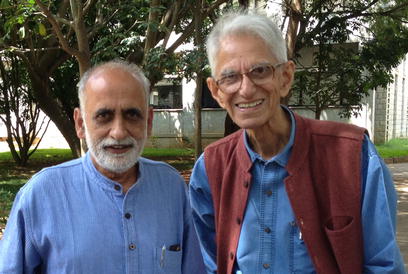
Obaid Siddiqi passed away on July 26, 2013, succumbing to injuries from an accident in Bangalore.
In more than half a century of work in India, Obaid built institutions and inspired many young minds. The Department of Biological Sciences (DBS) at the Tata Institute of Fundamental Research (TIFR), Mumbai, and the National Centre for Biological Sciences (NCBS), Bangalore, stand today as the finest examples of his vision and approach to science. In the process, he became the tallest (literally as well) Indian biologist of his generation, yet he remained modest, friendly and scientifically intense in his association with his peers and students.
At the DBS, TIFR, then known as the Molecular Biology Unit, Obaid pioneered the study of neurogenetics in India using the fruit fly, Drosophila melanogaster, as a model organism. Obaid was closely connected to the stars of bacterial and phage genetics. Returning from a sabbatical with one of them, Seymour Benzer at Caltech, he pushed the transformation of the Molecular Biology Unit into a new area. Drosophilaneurogenetics as a field was born in the 1970s with the idea of identifying mutants that affected neural function and behaviour. Obaid took up the challenge of using the fruit fly as a genetic system to understand chemosensory behaviour. Using elegant behavioural and electrophysiological assays, his group identified the very first set of taste and olfactory mutants in Drosophila, which have subsequently helped understand the complexity of chemosensory perception in insects. In NCBS he went on to develop a group that studied learning and memory in the context of olfactory behaviour. These studies in a relatively simple organism have implications for understanding brain function at all levels.
When we decided to organize this Special Section of the Journal of Biosciences for Obaid’s first death anniversary, many of his friends readily agreed despite earlier contributions to the Journal of Neurosciencesissue in 2012 on Obaid’s 80th birthday. The collection of articles is indeed impressive and a testament to his science and his popularity with people across generations.
We start with Maurice Fox’s brief “Commentary” on how biology came to TIFR, and follow this with temperature-sensitive paralytic mutants (Ganetzy and Wu), odorant receptors (Ray et al.), taste neuron projections (Kwon et al.), air-puff-stimulated flight circuit (Sadaf and Hasan), Pdf clock mutant (Seki and Tanimura), and Drosophila-derived insights into brain development and disease (Reichert).
Obaid was a mentor and an inspiration for the three of us, either directly or indirectly. He showed us how science is done without shouting from rooftops, and his death remains a personal loss to each of us.
During the last days of this Special Section, Obaid’s long-time associate and a friend to the three of us, KS Krishnan, also passed away suddenly. But KSK contributed to this tribute by reading all invited articles and providing his comments. He did this on the weekend prior to his death. We owe our gratitude to KSK and mourn this loss to the Indian biologist community. So long, dear friend. We hope the reader will enjoy this labour of love.
By: Shahid Jameel1, 2 , Utpal Banerjee3 and K VijayRaghavan1, 4
(1)
New Delhi, India
(2)
Hyderabad, India
(3)
Los Angeles, CA, USA
(4)
Bangalore, India
source: http://www.link.springer.com / Springer Link / Journal of Biosciences – Published by Indian Academy of Sciences / Published Online / July 26th, 2014
Seen in the picture are the medal winners and participants of championships (standing from left) Madhusudhan, L. Srihari, Suleman, N. Vinay, M. Rakesh, Coach Vikram, C. Chethan, Naveen Shetty, Aditya Bhat, M.J. Chethan and Mohammed Zulkharnain. (Front row from left): Sidhan Changappa, Naveen Kumar, Prakyath Bhat, G. Rajesh, Nachappa, Chidambaram and Amit.
Mysuru (KS) :
15 grapplers and mixed martial arts fighters attached to the Academy of Martial Science, Mysore, affiliated to Mysore District Muay Thai Association and Associacao Fernando Pacheco De Brazilian Jiu Jitsu, Brazil, won three gold, three Silver and three Bronze medals at the Sub-continental Brazilian Jiu Jitsu (BJJ) and Submission Wrestling championships held at Bangalore recently.
Results : Chidambaram: 55 kg class: 1 Silver and 1 Bronze Medal, Naveen Shetty: 55 kg class: 1 Gold and 1 Silver Medal, Bhasur Sharma: 60 kg class: Bronze Medal, Krishna: 77 kg class: Bronze Medal, C. Chethan: 85 kg class: Silver Medal and Sumanth Subrahmanya: 85 kg class: 1 Gold and 1 Silver Medal.
source: http://www.starofmysore.com / Star of Mysore / Home> Sports News / Wednesday , November 26th, 2014
Musa Sherif, ace navigator on the Indian rally circuit, talks about his journey to the top in Indian motorsport
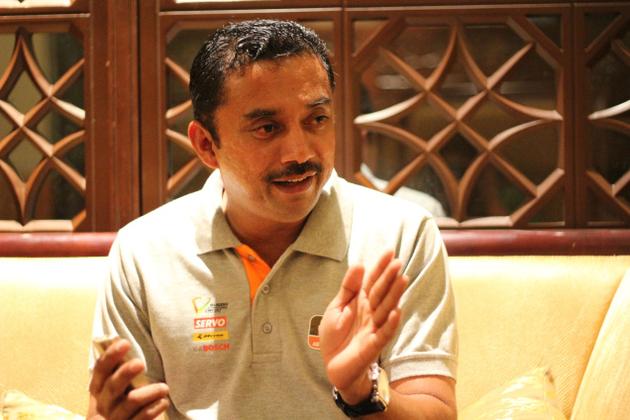
It’s hard for most people to be as driven as Musa Sherif. And that’s a pun intended. The soft-spoken 39-year-old from Kumbla, a small town in Kasaragod district, is arguably the most experienced, and by most accounts, the most respected professional navigator on the Indian rally circuit, having piloted for over 63 different drivers in an incredibly successful career spanning 19 years. In August this year, when he navigated for his long-time teammate – ace driver Gaurav Gill of Team MRF – in the first round of the Indian National Rally Championship (INRC) at Nasik, Musa became the first Indian to have participated in 200 rallies. It stands at 206 as of last week whenMetro Pluscaught up with him when he had come to the city to organise The Mahindra Great Escape off-road rally.
Musa has also cruised into this year’sLimca Book of Recordsfor being the first person to navigate for and win three championship titles – the Malaysian Group N Championship, the Malaysian 4WD SUV Championship and the INRC – in a year (2009).
“Being a navigator is a challenging job. In a rally, the navigator functions as the eyes of the driver – literally. The driver would be driving totally blind; driving just on the strength of what a navigator is telling him about the terrain, the speed, the curves, the angles… It requires a lot of concentration and commitment on my part for one error can send the car crashing!” explains Musa, who adds that he’s been involved in only a handful of crashes so far. “A few bruised ribs, a couple of broken bones… that’s about it. There’s really not much cause to worry about because these days rally cars and their crew are fully kitted with all kinds of safety features. Besides, before we rally in competition, we do a recee of the circuit. That’s when I write down my pace notes, which is kind of like a detailed storyboard about the circuit, from which I relay info to my driver,” he adds.
Viable profession
And his family had no objections to him taking up such a risky sport? “Actually, they did. My father, Zainuddin, is a businessman and I have three brothers and three sisters, and none of them or my extended family is into motorsport, or any sport, for that matter. Naturally, they were a bit apprehensive when I started out, worrying too much about the risk factor. It’s only when I started winning races and coming back home in one piece that they started accepting that motorsport can be a viable profession,” says Musa, with a laugh.
Although, he’d been interested in bikes since he was a child, learning to ride his father’s scooter at age eight, Musa’s journey to the top began only when he was 20 years old, in 1993, when he was studying for a management degree Mangalore.
“I used to hang around the Karavalli Automotive Sports Club in Mangalore, and on a lark I entered a two-wheeler race. Needless to say, I was hooked,” recalls the ace navigator who was a rider for the first three years of his career, racing motorbikes at local events in Mangalore.
“When I was a rider, I used to find it difficult to get good navigators and so I thought it would be prudent to start learning about navigation. Soon I began to enjoy it so much that I got others to ride my bike while I navigated. Thus with each race I gained experience, and experience is what counts in navigation. Besides, I realised that if I want to continue in rallying, being a navigator would suit me better. Unlike drivers/riders who have a sort of an age limit for competition, navigators just get better with age and experience,” adds Musa.
This adrenalin junkie’s first major break into rallying came in 1996 when he was invited to navigate for veteran driver Satish Bhat of Team JK Tyres. Then, it was rally by rally into the big leagues, where he navigated for the likes of V.R. Naren Kumar (six-time INRC champion), Lohit Urrs, Nikhil Taneja, Samir Thapar, Vijayant Chaudhury, among others.
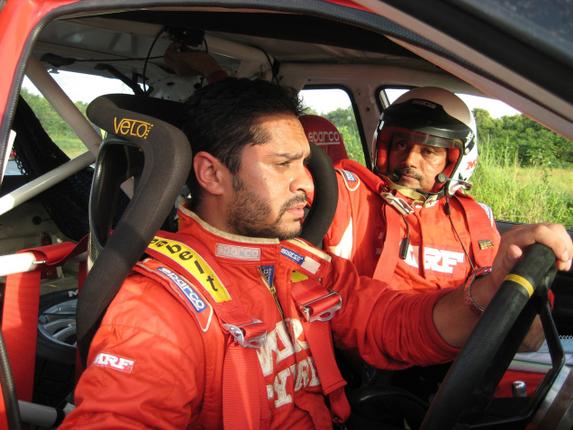
MRF rally driver Gaurav Gill (left) and his co-driver Musa Sherif Photo:Stan Rayan / The Hindu
Setting records
Since 2001, Musa has been with Team MRF. He’s been partnering with Gaurav Gill since 2007. In all Musa has won 68 rallies, including INRC Championships in 2007 and 2009. The INRC 2011 title too is all but in the bag, as Musa and Gaurav start the Chikmaglur rally this weekend with a lead of 52 points.
“These days, every time I win, or for that matter, take part in a rally, it seems to be a record!” says the down-to-earth navigator with all the confidence of a man who knows that he is well on course to becoming a legend in his own right.
Keep on going
For a man who’s every breath is a record, what new challenges does he have? “Keep on rallying, of course! And win some more championships with Gaurav – we make a good team. In 2015 along with driver Sanjay Takle, I’m planning to take part in the 15-day Dakar rally, a 10,000 km race across Argentina and Chile. My immediate aim, though, is to race in the upcoming 2012 Asia-Pacific rally championship, racing through New Zealand, Australia, Japan, Indonesia, and Thailand,” says Musa, who says he draws inspiration for his drive from legendary drivers such as Leela Krishnan and Jagat Nanjappa. When not racing, Musa likes to spend time at home with his family – his wife, Safeena, and his kids, Zainulsalah and Mohammad Falah.
source: http://www.thehindu.com / The Hindu / Home> Features> MetroPlus / by Nita Sathyendran / November 18th, 2011
President of Hyderabad Rose Society Ahmed Alam Khan has been elected vice-president (Central Asia) of the World Federation of Rose Societies, at 16th World Rose Convention held at Sandton City, South Africa, a press release informed on Wednesday.
In yet another achievement, five members of the Society have been elected to the Indian Rose Federation. They include Vijay Kant, A. Veerbhadra Rao, Khader Alam Khan, and Mohd. Minhajul Hussain, apart from Mr. Khan, the press release informed.
source: http://www.thehindu.com / The Hindu / Home> National> Andhra Pradesh / by Staff Reporter / Hyderabad – February 07th, 2013