While the Indian Women Hockey team won the bronze medal at the 17th Asian Games 2014 yesterday, the Indian Hockey Umpire Javed Shaikh gave India another proud moment at the international platform by umpiring in his 100th international match between Korea and Malaysia for the bronze medal at the ongoing Games.
39-year old Javed Shaikh started officiating hockey matches in the year 2003 and has dedicated over a decade of hard work to the game.
Congratulating Javed on his celebratory achievement, Dr. Narinder Batra, Secretary General, Hockey India said, “Umpire Javed Shaikh has brought recognition to the country in the field of hockey by umpiring his 100th match today at the 17th Asian Games 2014. His remarkable achievement gives me immense delight and I congratulate him on behalf of Hockey India and look forward to seeing more of him on the field.”
FIH World Development Panel Umpire Javed, currently works with the Mumbai Port Trust Sports Club, Mumbai (Maharashtra). He has umpired matches in the Rabobank Hockey World Cup this year at The Hague, Netherlands. Javed has also officiated in the FIH Junior Men World Cup 2013 in New Delhi, FIH World League Round 2 in 2013 in New Delhi, FIH Champions Challenge 1 held in Argentina, 2012 Olympic Qualifiers held in New Delhi 2012, Asia Cup 2009, Commonwealth Games 2006 and Asian Games played at Doha in the year 2006.
source: http://www.hockeyindia.org / Hockey India / Home> News / New Delhi – October 02nd, 2014
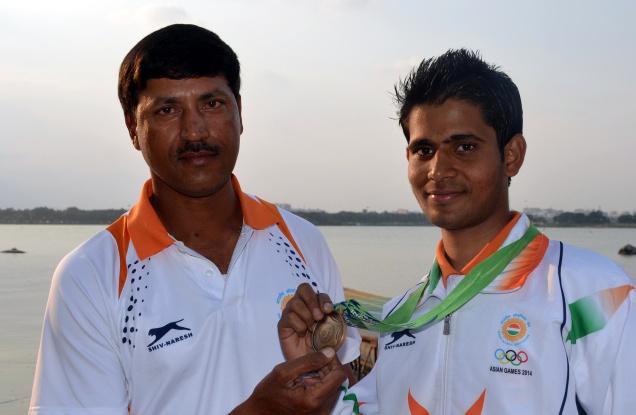
Mohammed Ahmed with his coach Ismail Baig. Photo: V.V. Subrahmanyam / The Hindu
The 20-year-old Mohammad Ahmed has every reason to look back with a sense of pride after winning the bronze medal being part of the Indian coxed eights team in the Asian Games in his very first appearance.
“It was an unforgettable experience for me. To win a medal in my first Asiad is something which I never dreamt off. I am grateful to Ismail Sir (pointing to coach),” exclaims the young CPRF constable.
“We all enjoyed every moment of the race. It could have been great if only we had won a gold for which we were all confident,” says Ahmed, who incidentally picked his third medal at the Asian level.
‘My dream’
“My dream is to be part of the Indian rowing team for the 2016 Olympics. I am confident I will realise that goal too,” says the smiling young rower, who loves watching soccer and also plays gully cricket whenever he finds time.
The youngest of all the Indian rowers in the Incheon Asian Games is born in a family which survives on his father Mohammad Ismail’s meat shop in the by-lanes of Kavadiguda.
This enterprising young rower took to the sport during one of the routine trips with his father who supplies meat to the rowing contingent as part of their daily diet.
India’s chief national coach and Dronacharya Ismail Baig was quick to spot the spark in the young boy and coaxed him to rowing.
The rest is history. Ahmed won gold in the Kolkata Senior Nationals in the coxed four event, bronze in the Hyderabad Nationals in the coxed eight team and later a silver in the Asian championship later on in Korea.
Later on, he has been groomed as the ‘cox’ in the Indian eights team which also has the 2010 Asiad gold medallist Bajrang Lal Thakkar. Technically, he is supposed to give direction to the team to be straight and keep track of the wind conditions and guide the rowers accordingly.
source: http://www.thehindu.com / The Hindu / Home> News> Cities> Hyderabad / by V.V.Subrahmanyam / Hyderabad – September 29th, 2014
The grand construction of General Claude Martin, the Constantia, served as a lodge for Freemasons, a secret society, as many of the English officers including Martin were Freemasons.
Many such lesser known facets pertaining to the life and times of Claude Martin were brought to light by celebrated British historian, Dr Rosie Llewellyn Jones at La Martiniere College on Sunday. The talk was organised by Indian National Trust for Art and Cultural heritage (INTACH), Lucknow Chapter.
After being attacked by the Raja of Banaras invading Lucknow through Farhat Baksh Kothi, General Claude Martin began residing in the Constantia which he built as a fort. Constructed with four spiral columns that go right up to the terrace, cleverly with a lone staircase, Gen Martin made sure the building he liked to show off to his fellow Englishmen was secure with iron doors made from imported English iron. These doors could then be shut once a single man defending the building from the top took position upstairs.
Constantia was safeguarded by cannons on the first floor of the building next to lion statues with lamps within them. “Its construction as a defensive structure to frighten people, basically its attackers, is one of the least known features of the Constantia, which prior to being an educational institution, was a fort,” shared Dr Jones.
INTACH’s convenor Vipul Varshney talked about the axial symmetry and architectural genius of the gigantic structure with pioneering ventilation. Dr Jones also spoke about many paintings of Claude Martin.
Iron girders in the basement of the Constantia go deep down to its foundation. Dr Jones denied presence of any such tunnels opening into the Gomti against a popular myth.
Convernor Vipul Varshney talking about the architectural skyline of Lucknow said, “the heterogeneity of cultural conceptions and artistic styles triumphed to strike a harmony between the many buildings of Lucknow getting along the Nawabi and English architecture successfully in Lucknow’s skyline, and so in that order we decided to educate and inform Lucknowites about one such magnificent structure, the Constantia.”
Gen Martin a self taught man had as many as 5000 books and the presence of certain books on creating electricity have made historians like Dr Jones believe that he might have attempted to create electricity as well in the lower rooms of the Constantia. The result of his trial and error techniques on it though are yet to be studied further.
Heritage conservationist and lawyer by profession, Mohammad Haider stating the building as an unprotected monument applauded the efforts of Principal Carlyle McFarland, the staff and students of the college, ” the unique feature of this building stands in the fact that it has been well maintained within the precincts of its original form and the monument an architectural masterpiece is devoid of any uncalled for scribbling on the walls of the campus unlike the state of most protected monuments in the country.”
source: http://www.timesofindia.indiatimes.com / The Times of India / Home> City> Lucknow / by Yusra Husain, TNN / September 29th, 2014
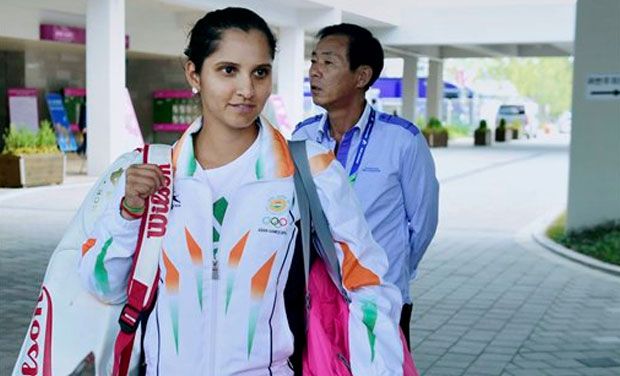
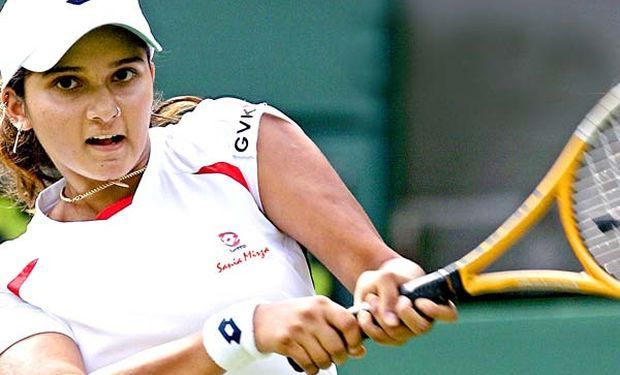
Sania Mirza has lauded Indian tennis team’s performance at the 17th Asian Games, given that the country did not come with the best unit possible for the event. Photo: PTI/ File
Incheon:
Indian tennis ace Sania Mirza feels the five medals that the team has managed to grab at the ongoing Asian Games is a pretty good performance given that the country did not come with the best unit possible for the event.
“It has been a pretty good week. We (she and Prarthana Thombare) got a medal (bronze) in women’s doubleswhich is huge because it’s something that we never did. I had to be the leader. It’s a young team we came here with, didn’t come with the best team possible, especially with the guys. Five medals (including today’s) is pretty good,” she said ahead of the mixed doubles semifinals with Saket Myneni at the Yeorumul Tennis Centre.
Hyderabad and Dubai-based Sania spoke to reporters as the matches for the day had been put off due to continuous rains at Incheon since Sunday night. The 27-year-old Indian tennis star, who was initially inclined towards skipping the Games to gain doubles points on the WTA tour before changing her mind, said the reason was to provide the country with its best shot at picking up more medals in these Games, her fourth on the trot.
Before the current Games she had won a gold (in mixed doubles in 2006 in Doha), three silver medals (women’s singles and team in 2006 and in mixed doubles in 2010 at Guangzhou) and two bronze medals (women’s singles and doubles in Guangzhou). Besides, she also won silver (singles) and bronze (doubles) in the 2010 Commonwealth Games in Delhi.
“The minute I made the decision to come here, I knew it was the right decision. For me the most important thing was to give India the best chance of winning as many medals as possible. I did what I could and I got two in the two events I played (women’s doubles and mixed doubles where she and Myneni will fight for the gold). “I am happy that there was my contribution. Personally it’s my fourth Asian Games in a row and I have got medals in every single Asian Games I have been to. For me to get eight medals in the last four editions is pretty good,” she remarked.
Sania said she has played her part as a mentor to her women teammates here who are of the same age as her younger sister and is hoping they win medals on their own in the next Games which are scheduled at Jakarta in 2018.
“I have a good rapport with these girls and I am always there to help if they ask. They are all of my sister’s age, like babies for me. They are 7-8 years younger than me. I am sharing a room with one of them.”
“Most definitely these are the best youngsters we have had in a while. My doubles partner (Prarthana) has some potential and is still pretty young. We need to build on this. I hope this gives them a lot of confidence that they can achieve certain things,” Sania said.
“I have held this flag for a long time. It will be great to pass it on to someone else. Hopefully by the next Asian Games, they will be ready to win a medal by themselves,” she added.
Sania, who was the world no 23 at her peak in singles, pointed out quite a few factors like lack of guidance and proper coaching as reasons for the other Indian women being unable to break into even the top 200 In singles.
“There are a few reasons. I definitely think planning is one of them, lack of knowledge and lack of maybe even coaching abilities at certain levels. I think a lot of coaches in India haven’t seen what it takes to really make it because they have not produced anyone nor have they been at that level. “I am not saying you need to be a great tennis player to be a coach, but you need to have watched at the highest level to be a good coach. The best they might have watched is the WTA event a few years ago.”
She also said that most of the women players are content to play at the USD 25,000 level which was simply not enough to go places in the world. “Tennis is very competitive these days. Physically as well they struggle a bit, there are a bunch of reasons. I have been trying to help them with scheduling, trying to tell them which tournament to take part in.”
“First of all they need to come out of the USD 25000 tournaments try and believe they can do better at the bigger tournaments. That’s one of the main things. That’s where they have to perform,” Sania said.
“You are not going to play these for the rest of your life. If you do so you will remain in the 300 rankings for the rest of your career. That’s what they have been doing, go for the easier options. It’s not because they want to but because of lack of guidance at certain levels. About her own career and her immediate plans she said she was leaving Tuesday morning to play in the September 27-October 5 China Open with Cara Black, and would probably play Tuesday afternoon.
“It’s been rough last couple of weeks. Since the US open I have not had any time really. I came back after New York and had literally three days at home. I was not even over jetlag when I left for Tokyo and then came here. It’s a good problem to have, it has been busy. After that I go to Singapore (for the WTA season-ending finals),” she said.
Sania said her season so far, especially the second half, has been pretty good and she wanted to finish it on a high. “It’s been a great year and especially the second half of the season has been unbelievable. Hopefully we (she and Black) can finish on a high, can win here (with Thombare) and hopefully go to Singapore which has been the highlight of my career. I want to do well there,” she said.
Touching a new high, India’s tennis ace Sania Mirza on Monday became World No.6 in doubles, her career-best ranking, as the new chart was released following the conclusion of the French Open. Courtesy a quarterfinals appearance at the Roland Garros, Sania earned 430 ranking points along with partner Cara Black to jump eight places in the ranking charts.
Sania and Cara had lost to eventual champions Shuai Peng and Su-Wei Hsieh. “When I started the season this year in January, one of my goals was to better my career-best world ranking. I am happy to have achieved this today,” Sania said from Birmingham, where she is gearing up for the grass court season, leading to the Wimbledon championships.
Sania’s father and coach Imran Mirza said, “Sania has played very consistently this season and has been rewarded. I believe she has the potential to go further.” India’s No.1 singles player Ankita Raina also achieved her career-best rank, 262, with a jump of 28 places. Ankita had ended runner-up at a $25,000 event in Indonesia to earn 30 points. In the ATP rankings, Somdev Devvarman dropped out of top-100 as he lot 23 places to be 119 in the singles chart. He had made a first round exit at the French Open.
In the doubles Leander Paes continued to be the highest ranked player at number 13.
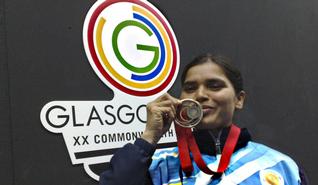
Sakina Khatum talks about her weightlifting career and her route to success at the Commonwealth Games
Such a long journey Sakina Khatum courted success after many trials including being struck by polio / The Hindu
Sakina Khatum hit the headlines with a bronze-winning effort at the Glasgow Commonwealth Games, last month. But the 25-year-old promises to do even better at the Incheon Asian Games, come October.
An irony, or call it fate, as polio struck Sakina, one of the four siblings when she was just a year and half old, and since then, it has been a story of determination and fighting all odds.
Four operations below the knee on the right leg helped her to walk, rather than crawl on fours. A doctor advised Sakina to take up swimming to strengthen the leg, and thus began her tryst with sports.
“I was national champion a year after taking up swimming, and for the next four years, ruled the pool in my category. I did not get any recognition or an international call up,” says the girl, who comes from a poor family. “My father is ailing. My brother does not stay with my family.”
She adds, “I came to Bangalore for the selection camp, ahead of the 2010 Commonwealth Games.
After three months away from home, I was not picked despite impressing coach Dabas, who referred me to ace para power-lifter Farman Basha. And the rest is history.” Farman, himself restricted to a wheelchair says, “She was lifting only 25 to 26 kgs. To turn her into an international star was a challenge, but with coach Dabas insisting, I agreed. I had no money to spare but asked her to train under me. I found her a small accommodation near K.R. Puram.. Four years down and she has won two international medals (both bronze) for her country,” says Farman.
The journey has not been easy.
“One Mr. Majumdar, from Kolkata used to send Rs. 5000 initially and then increased it to Rs. 10,000 per month for her basic expenses (though that has now stopped after her Commonwealth Games success). He supported her financially, till last month. He even procured her tickets to the Hungary Open, early this year where she won her first international medal. We don’t spend our money (on international tours) and save up to buy supplements – a must for every lifter. When I am short of money, we fall back on local produce,” adds Farman.
“I asked Sakina to move into my place to save up on rent and travel time for training. We train for about four-five days a week,” says the gritty lifter.
For more successes, it is important that the state government and the numerous corporates that endorses sports step forward and make it easy for them to travel and perform at the highest level. Is anyone listening?
source: http://www.thehindu.com / The Hindu / Home> Features> MetroPlus / by Avinash Nair / September 29th, 2014
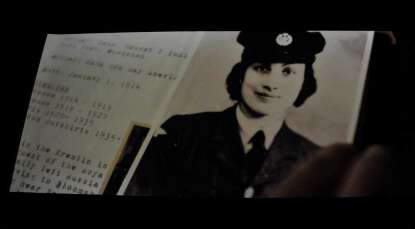
Bruce.Lipsky@jacksonville.com // Noor Inayat Khan is pictured during the film. She was recruited as an operative to help the Allies.
The quiet, unwavering heroism of a young Indian Muslim woman who sacrificed her life to fight against Nazi domination during World War II offers lessons of faith, courage and inspiration as relevant now as it was back then, say those who heard her story Sunday.
Bruce.Lipsky@jacksonville.com / Noor Inayat Khan is pictured during the film. The University of North Florida Distinguished Voices Lecture Series presented “Enemy of the Reich: The Noor Inayat Khan Story” Sunday, September 28, 2014, in Jacksonville, Florida, on campus in the Robinson Theater. (Florida Times-Union/Bruce Lipsky)
“It really makes you think. What would I do in a situation like that? … I hope I would have had her courage,” said K.C. Emerson of Jacksonville, who decided at the last minute Sunday afternoon to attend the screening of “Enemy of the Reich: The Noor Inayat Khan Story” followed by a panel discussion at the University of North Florida’s Andrew A. Robinson Jr. Theater.
The film is the true story of Khan, who sacrificed her life to fight against Nazi domination during World War II. The daughter of an American mother and Indian Muslim father, Khan grew up in a home that nurtured interfaith dialogue and cooperation at a Sufi center of learning in Paris.
In early 1943, she was recruited as a covert operative into Winston Churchill’s Special Operations Executive. By then Khan had trained as a wireless operator in Britain’s Women’s Auxiliary Air Force. As a covert agent, Khan was instrumental to the French Underground’s direct attack on Nazi units in preparation for the Allies’ D-Day invasions.
In August 1943, Khan was the last surviving clandestine radio operator in Paris and signaled London for additional weapons and explosives for the French underground. Khan ultimately was captured and executed at Dachau, the Nazi concentration camp in Germany.
On Sunday, Emerson was among Northeast Florida residents as well as UNF students nearly filling the theater for the screening and panel discussion, part of the 2014 Distinguished Voices Lecture Series. The program co-hosted by UNF and Better Together at UNF, a student organization composed of religiously diverse students with a mission of mobilizing their peers to voice their values, engage with others, and act together to make the world a better place.
“It’s an exploration into meaning and purpose of life, and what values might be worth risking it,” Tarah Trueblood, director of UNF Interfaith Center, said of the program.
Such dialogue, she said, is especially crucial now, given the conflict in the Middle East and fear generated by ISIS and other terrorist groups.
“Peace happens one relationship at a time. And getting to know your neighbor can be that one big step you take today,” said Trueblood, adding sometimes that can take a lot of courage to reach out to our neighbors if they are different from us.
“We want our politicians to make peace or somebody else to make peace. But making peace takes us going over to our neighbors and getting to know them,” Trueblood said.
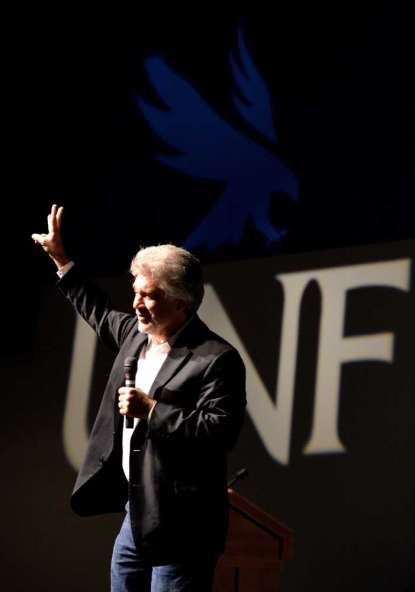
Bruce.Lipsky@jacksonville.com / Alex Kronemer, executive producer of the film about Noor Inayat Khan, speaks before the screening of his film.
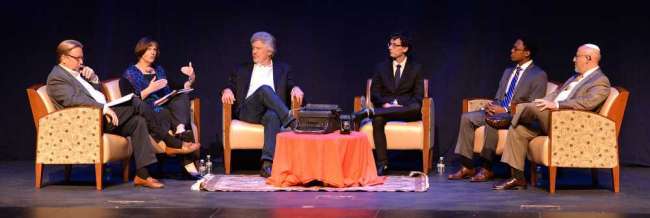
The panelists included Alex Kronemer, one of the film’s producers, UNF Interfaith students, Cheryl Tupper of the OneJax Institute at UNF and vice president of the Arthur Vining Davis Foundation and Rabbi Jonathan Lubliner of the Jacksonville Jewish Center. UNF President John Delaney facilitated the discussion.
Kronemer is co-founder and executive producer for Unity Productions Foundation. A Muslim, he has delivered talks on religious diversity and Islam for the U.S. departments of Justice and State, FBI and other organizations.
Refusing an order to return to England, Khan stayed in Paris and continued radioing information to the Allies after all her comrades were captured by the Nazis.
“In her case, she just had the determination. She had come with these people, bonded with these people and they had all been captured, but she didn’t want their sacrifice to be meaningless. In retrospect, it was a giant decision to make because it led to her ultimately being killed. But at the time, it was a small decision of heroism,” Kronemer said. “That’s really where I think heroes are made. … Today, what are the small decisions of heroism that we’re making?”
Parvez Ahmed, a faculty mentor and UNF professor, encouraged the audience to continue the conversation sparked Sunday through the program.
“I want us to draw upon the inspiration that Noor gave us through our life and our sacrifices. It would be nice if we could all go beyond the lip service that we often give such inspiration and do something that is actually long-lasting and sustainable,” Ahmed said.
To that end, Ahmed said the UNF Interfaith Center is instituting a service award to be presented annually to one or more deserving students. In the form of a scholarship, it will be the Noor Inayat Khan Interfaith Service Award, he said.
Khan was posthumously awarded the George Cross, the highest civilian medal for bravery and sacrifice in Great Britain. The French awarded her the Croix de Guerre with Gold Star. A plaque bearing her name hangs at Dachau, and a memorial statue of her was erected in London’s Gordon Square in 2012.
source: http://www.members.jacksonville.com / The Florida Times-Union / Home> News / by Teresa Stepzinski: (904) 359-4075 / Sunday – September 28th, 2014
City chess player K.V.K. Karthik receiving FIDE Master title from IPCA president Pilimon Zbigniew at Serbia. Also seen is Karthik’s coach Shaik Khasim. Photo: By Arrangement / The Hindu
The Andhra Pradesh Chess Association will felicitate Karthik during the State Open tournament which will be held at Chennupati Ramakotaiah Stadium on September 27
A gold medal at Commonwealth chess championship at Glasgow (Scotland) and a bronze at the World championship at Apatin – Banja Junakovic, Serbia. Twenty-seven-year-old K. Venkata Krishna Karthik is on cloud nine as 2014 is proving to be lucky to him.
The youngster, who is down with a peculiar orthopaedic disorder and poor vision, these two titles in the international tournaments in the physically challenged category has made him realise that his dream of becoming a Grandmaster is not far away.
“We need to thank all those people who stood by Karthik by offering their support both financially and emotionally. Associations like Andhra Cricket Association, Sri Chaitanya Educational Institutes, ARKS Group based at United Kingdom and parents of several players pitched in to give a new dimension to Karthik’s life,” said coach Sk. Khasim of Global Chess Academy.
Karthik not only won FIDE Master title but also earned his first International Master (IM) norm. The chess fraternity went into raptures as Karthik set a fine example to the able-bodied players that what was required to success was hard work and dedication.
“Had Karthik won the eighth round he would have won the title,” felt D. Srihari, secretary of Krishna District Chess Association. Dronacharya Koneru Ashok, Grandmaster Lalith Babu, senior coach and administrator V. R. Bobba and others congratulated the tenacity of Karthik despite his failing health.
Karthik won the hearts of many in the 14 International Physically Challenged World Chess Championship for he played against six talented and higher-rated Russians. A total of 36 players, including International Masters and FIDE Masters from 15 countries, participated in this tournament in which Karthik is seeded the 19th player.
The Andhra Pradesh Chess Association will felicitate Karthik during the State Open tournament which will be held at Chennupati Ramakotaiah Stadium on September 27.
source: http://www.thehindu.com / The Hindu / Home> News> Cities> Vijayawada / by J.R.Sridharan / Vijayawada – September 25th, 2014
After Wajid Ali Shah, the last Nawab of Lucknow lost his empire, his mother Janab-i’Aliyyah went all the way to England to meet the Queen and seek justice, but she failed in her mission as she got no audience.
History lovers in Lucknow will now have access to new insights into the life and times of the last Nawab of Oudh along with rare pictures and never-heard before information. Regarded by the East India Company as a debauched ruler who spent his time with ‘fiddlers, eunuchs and women’ instead of looking after the kingdom, Wajid Ali Shah has become the centrepiece of yet another historical book.
Written by British historian Rosie Llewellyn Jones, ‘The Last King in India’ talks, besides his mother’s failed overseas mission, about Begum Hazrat Mahal’s revolt in 1857.
Though most artifacts of historical importance were lost forever after the downfall, with painstaking efforts, they have re-surfaced to narrate the story of an era in which the Nawab created exquisite poetry, theatrical pieces, music and dance. In the well researched book, he comes across as a compassionate person towards his subjects. The magnificent Qaiserbagh built by him came to be known as one of the most elaborate palace complexes ever created.
Given how little was known about the last Nawab of Awadh, the historian and author researched about Wajid Ali Shah from the original documents in Indian and British archives and through meetings with his descendants.
Several paintings and photographs have also been found. In one of the photographs Wajid Ali Shah is seen sitting with one of his 350 wives and a child on a couch. Although, almost every palace and structure along the banks of Hooghly river was either destroyed or auctioned by the British after his death in 1887, in order to eliminate any chances of a rebellion, his pictures still hang on the wall in Matiya Burj.
It is said that he had actually created a miniature Lucknow in Matiya Burj and transported its multi-faceted culture there.
At the release of her latest book, Jones said “I have always been a fan of Wajid Ali Shah. He was misunderstood by the British as he never wanted bloodshed in his kingdom and continued not to bow against them, much to their dismay. His love for poetry, art and dance is admirable and he was one of the greatest patrons of the cultural landscape.”
source: http://www.timesofindia.indiatimes.com / The Times of India / Home> City> Lucknow / by Shefali Mehrotra, TNN / September 28th, 2014
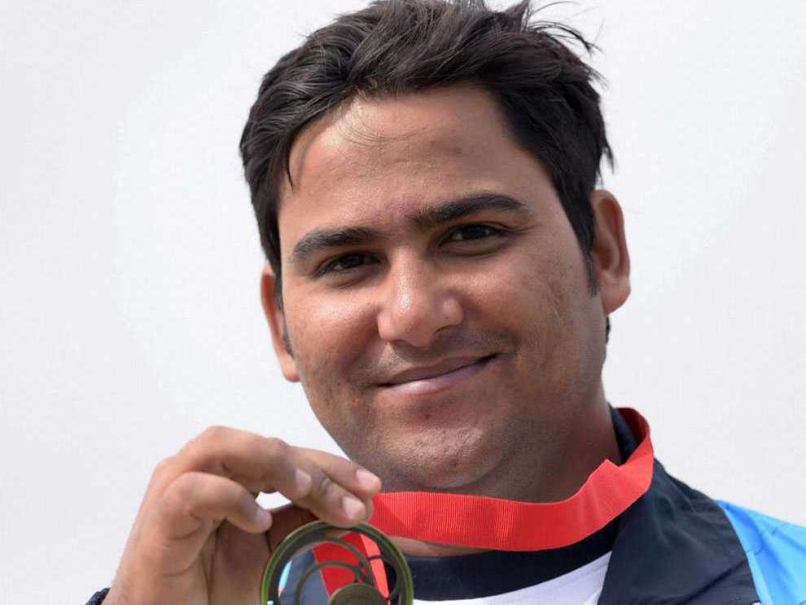
Mohammed Asab beat Nathan Xuereb of Malta to give India their ninth medal in shooting.
India’s Asab Mohd displays his Men’s Double Trap bronze medal. / PTI
Glasgow:
Indian shooter Mohammed Asab won the bronze medal in the men’s double trap beating 17-year-old Nathan Xuereb of Malta in the bronze medal match of the 2014 Commonwealth Games at the Barry Buddon Shooting Centre here on Sunday.
The 26-year-old Asab shot 26 while Xuereb managed 24. Another Indian in the fray, Ankur Mittal missed out on a medal finishing fifth in the semi-final.
Shreyasi Singh grabbed the first medal of the day by winning the silver medal in the women’s double trap event. The Delhi girl shot 92 in the final round to win the silver, the fifth for the Indians from the shooting competition at the Barry Buddon Shooting Centre.
India’s medal count from shooting now stood at nine — three gold, five silver and a bronze.
Abhinav Bindra, Rahi Sarnobat and Apurvi Chandila have won the gold medals. The silver medal winners, besides Shreyasi, are Malaika Goel, Prakash Nanjappa, Ayonika Paul and Anisa Sayyed.
source: http://www.sports.ndtv.com / NDTV Sports / NDTV Sports> News / by Indo-Asian News Service / Sunday – July 27th, 2014