Hindus, Muslims, Sikhs feature on Royal Mail stamp marking King’s coronation
A stamp depicting Sikhs, Hindus, Muslims and their places of worship feature on one of the four stamps issued by the Royal Mail to mark the coronation of King Charles III on May 6.
London:
A stamp depicting Sikhs, Hindus, Muslims and their places of worship feature on one of the four stamps issued by the Royal Mail to mark the coronation of King Charles III on May 6.
Captioned “Diversity and Community”, the stamp reflects a multi-faith community and the cultural diversity of contemporary British society, a news release stated.
The stamp features figures representing the Jewish, Islamic, Christian, Sikh, Hindu and Buddhist religions and is representative of all faiths and none.
“The background shows aspects of both rural and urban Britain and includes some of the many different places of worship that are found around the United Kingdom,” the release noted.
Presented in a miniature sheet, the stamps illustrate the Coronation ceremony and the traditional street party, as well as some of the causes His Majesty has dedicated his years of public service to.
This includes cultural diversity and community, the global ties of the Commonwealth, which he now leads, and sustainability and biodiversity.
This is only the third time in history that Royal Mail has issued stamps to mark a Coronation. The previous two occasions were for King George VI in 1937 and Queen Elizabeth II in 1953.
“Royal Mail is proud to issue this set of commemorative stamps which celebrate the Coronation, and some of the causes which His Majesty has championed throughout his many years of public service,” Simon Thompson, Chief Executive of Royal Mail, said. “This is only the third time we have issued Coronation stamps and I am delighted that they mark the start of a new reign and a new chapter in our history,” Thompson added.
The stamps were designed by Atelier Works and feature newly commissioned wood engravings by British artist Andrew Davidson.
Royal Mail will also be applying a special postmark to stamped mail to mark the event. The postmark will run from April 28 until May 10.
source: http://www.mangalorean.com / Mangalorean / Home> Agency News / by IANS / May 01st, 2023
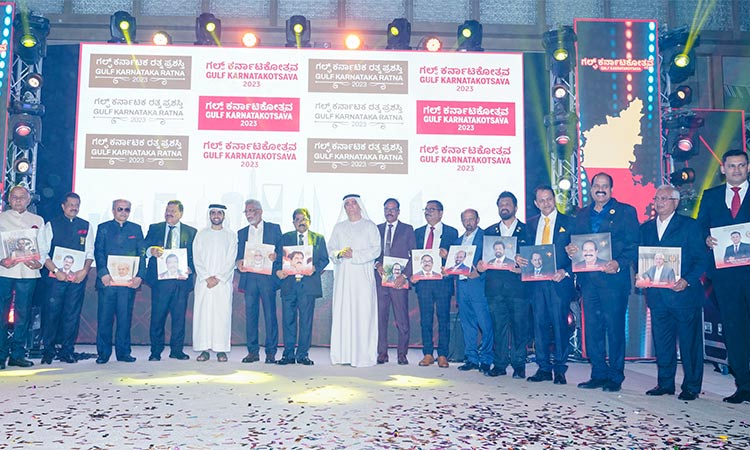
The distinguished honorees pose for a group photo during the mega event in Dubai.
The Gulf Karnatakotsava, an event dedicated to honouring the outstanding contributions and work of Karnataka-origin business icons in the Gulf region, concluded on a grand note.
The mega event marked a significant milestone as it paid tribute to a total of 21 exemplary ‘Most Influential Business individuals’.
These distinguished honorees, recognised as ‘Gulf Karnataka Ratna,’ received their recognition from the esteemed Chief Guest, Sheikh Mohammed Maktoum Juma Al Maktoum, a Member of the Royal Family of Dubai and the Chairman of MBM Group. The heart of this momentous event was a coffee table book launch, capturing their achievements and dedication to both the Gulf nations and their home state of Karnataka.
The Gulf Karnatakotsava was a resounding success, drawing more than 1000 attendees from all walks of life and capturing the essence of Karnataka’s rich culture, heritage, and business prowess. The event served as a platform to acknowledge and celebrate the remarkable success stories of these individuals who have made a significant impact on the economic and social fabric of both the Gulf countries and Karnataka.
The highlight of the event was the felicitation of the 21 distinguished individuals who were honoured as ‘Gulf Karnataka Ratna Awards.’ These business icons, representing the most influential and powerful leaders from a wide array of industries, who have achieved tremendous success but have also contributed significantly to the welfare of their communities and the betterment of Karnataka.
The list of notable icons featured in the coffee table book and ‘Gulf Karnataka Ratna 2023’ awardees included Dr. Thumbay Moideen, emerging as the number one contributor in Medical Education and Healthcare sector of UAE. Notably he’s the only businessman from Karnataka who holds the distinction of being world’s only businessman from Karnataka to own a private medical University outside of India, the leader in healthcare and medical education in UAE.
Other awardees included: Hidayatullah Abbas, Founder & Chairman, Hidayath Group; Mohammed Meeran, Chairman of EMCO International and Electric Way; James Mendonca, Founder & Chairman, Reliable Group of Companies; Nissar Ahmed, Chairman, Nash Engineering; Ramchandra Hegde, Managing Director, Spraytek Coatings; Joseph Mathias, Managing Director, Merit Freight Systems; Vasudeva Bhat Puthige, Owner, Venus Group of Restaurants; Mohammed Naveed Magundi, Intignis Naveed Company; Mansoor Ahmed, Chairman, Saara Group; M. Syed Khalil, Founder Chairman, K&K Enterprises; Michael D’Souza, Managing Director, Ivory Grand Real Estate; Ibrahim Gadiyar, Managing Director – Gadiyar Group of Companies and Director Projects – Pantheon Development Group; Dr. B.K Yousuf, Executive Chairman, Air Chateau International; Dr. Sathish P Chandra, CEO, Global Tech Park; Zafrullah Khan Mandya Chairman and Founder, ZGC Global / Zain Group of Hotels; Devid Frank Fernandes, Chancellor General MEA, Peace Ambassador & Chief of Mission (UAE) ICDRHRP IGO, Martin Aranha, Managing Director, Globelink West Star Shipping, John Sunil, Group Chief Executive Officer, Burjeel Holdings, Mohammed Ashif, Co-president and CEO, Expertise contracting and Ravi Shetty, Managing Director, Advanced Technical Services. Their stories of perseverance, innovation, and commitment to excellence served as an inspiration to all attendees.
The Gulf Karnatakotsava was not just about awards and accolades; it was a true celebration of Karnataka’s vibrant culture and artistic heritage. The event featured a captivating blend of cultural performances, musical concerts, and comedy acts that left the audience enthralled. Traditional dances such as Pili Vesha were showcased, transporting the audience to the heart of Karnataka.
Hidayathullah Abbas, Founder and Chairman, Hidayath Group told Gulf Today that he is honoured to have been recognised at this Gulfkarnatakotsava platform, alongside so many accomplished individuals who share a connection with Karnataka and have made remarkable contributions in the Gulf.
“The Gulf Karnataka Ratna Awards event celebrates our shared heritage and showcases the incredible achievements that have taken shape from this cultural bridge.”
“The launch of the coffee table book emphasizes the stories, journeys, and legacies of Karnataka’s business icons in the Gulf. It serves as a testament to the entrepreneurial spirit of our community and the lasting impact we’ve made across industries and borders. I hope that these stories inspire future generations to continue the legacy of excellence and compassion that our community represents.” Abbas added.
The musical segment of the event witnessed renowned artists and musicians such as, Santosh Venky, Guru Kiran and noted playback singer Chaitra HG, was a testament to the harmonious coexistence of cultures and the bond between Karnataka and the Gulf countries.
Comedy, often regarded as the universal language of laughter, also played a pivotal role in the event. Comedian Kannada actors Prakash Thuminad and Deepak Rai Panaje had the audience in splits, providing moments of pure joy and amusement amidst the grandeur of the evening.
The Gulf Karnatakotsava was a celebration of success and a testament to the strong ties between Karnataka and the Gulf countries. It highlighted the importance of recognizing and honoring the contributions of individuals who have bridged the gap between these two regions, fostering cultural exchange, economic growth, and mutual understanding. As the curtains closed on the Gulf Karnatakotsava, it left behind a legacy of inspiration and pride. The ‘Gulf Karnataka Ratna’ awardees serve as an encouragement for aspiring entrepreneurs and a reminder that Karnataka’s heritage and success stories continue to shine on the global stage.
source: http://www.gulftoday.ae / Gulf Today / Home> Business / by Inayat-Ur-Rahman, Business Editor / September 11th, 2023
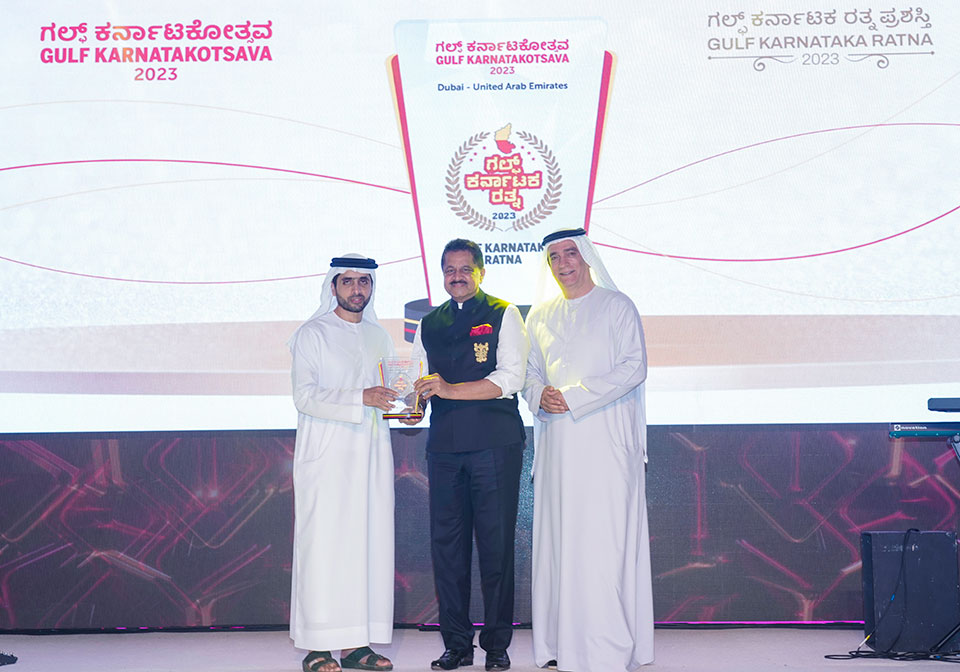
In a testament to extraordinary achievements and contributions, Dr. Thumbay Moideen was bestowed with the ‘Gulf Karnataka Ratna’ Award, emphasizing his leadership in healthcare delivery and medical education. Notably, Dr. Moideen holds the distinction of being the only Indian in the world to own and operate the biggest private medical university outside India. This recognition reflects his dedication to enhancing healthcare and nurturing the future of medical professionals. Alongside him, 20 other distinguished businessmen were also honored for their remarkable contributions at the festivities of the Gulf Karnatakotsava- the United Arab Emirates’ most prominent platform for celebrating business excellence and recognizing the remarkable contributions of Karnataka’s businessmen in the Gulf region.
The award was presented by the esteemed Chief Guest, His Highness Sheikh Mohammed Maktoum Juma Al Maktoum, a Member of the Royal Family of Dubai and the Chairman of MBM Group to Dr. Thumbay Moideen.
In 1997, Dr. Thumbay Moideen founded the Thumbay Group in 1997, which has grown from a private medical college to a prominent conglomerate in medical education, healthcare delivery research, diagnostics, pharmacies, and hospitality sectors. With over 110 locations across seven emirates, the group partners with over 70 institutions.
Speaking about receiving the award, Dr. Thumbay Moideen, founder president, Thumbay Group stated, “I am grateful to God Almighty, the support of the Rulers and the government, and my own sincere team. This recognition will inspire me to do more in driving positive change.”
Beyond business excellence, Dr. Moideen has been an ardent advocate for the importance of healthcare accessibility and quality education globally. His philanthropic efforts have reached communities in need, providing medical services and educational opportunities to those who would otherwise lack access.
The Gulf Karnataka Ratna Award is a testament to Dr. Thumbay Moideen’s commitment to improving the well-being of people and his dedication to nurturing the future leaders of the medical field.
source: http://www.english.varthabharati.in / Vartha Bharati / Home> Gulf / by Vartha Bharati / September 11th, 2023
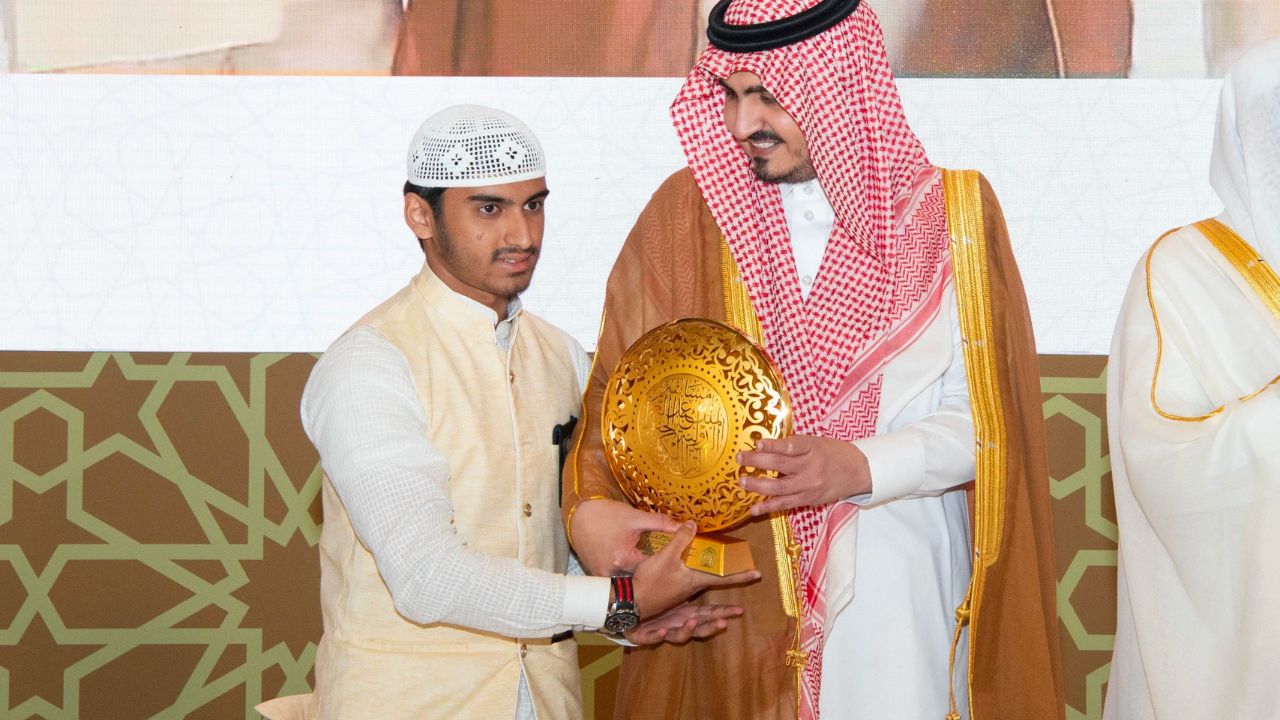
Ibrahim Shahbandari, hailing from Bhatkal, Karnataka, achieved an outstanding second place in the fifth category of the 43rd King Abdulaziz International Competition for Memorization, Recitation, and Interpretation of the Holy Qur’an.
The event, held at the Grand Mosque in Makkah, Saudi Arabia, featured 166 contestants representing 117 countries across all five categories, with a total prize pool of SAR4,000,000.
In the first category, Ayoub bin Abdulaziz Al-Wahibi from the Kingdom of Saudi Arabia secured first place and received a prize of SAR500,000. Saad bin Saadi Sleim from Algeria came in second place, earning SAR450,000, while Abu Al-Hasan Hassan Najm from Chad achieved the third position, receiving a prize of SAR400,000.
In the second category, Ammar bin Salem Al-Shahri from the Kingdom of Saudi Arabia claimed the first position and was awarded a prize of SAR300,000. Mohammed bin Adnan Al-Omari from Bahrain secured second place, receiving a prize of SAR275,000. The third position went to Abdulaziz bin Malik Atli from Syria, who received a prize of SAR250,000.
In the third category, the winners include Mohammed bin Ibrahim Mohammed from Somalia, who clinched first place and received a prize of SAR200,000. Second place went to Shuaib bin Mohammed Hassan from Sweden, who was awarded SAR190,000 while Faisal Ahmed from Bangladesh secured the third position, earning SAR180,000 Saudi Riyals, and Mohammed Mufid Al-Azza from Indonesia claimed the fourth spot and received SAR170,000. Siraj Al-Din Muammar Kandi from Libya rounded off the top five, receiving a prize of SAR160,000.
Regarding the fourth category, the winners are as follows: Mohammed Ghai from Senegal secured the top position, earning a prize of SAR150,000. Hatem Abdulhamid Falah from Libya claimed the second spot, receiving an award of SAR140,000, and Yassin Abdulrahman from Uganda achieved the third position, with a prize of SAR130,000. Mashfiqur Rahman from Bangladesh attained the fourth position and was granted SAR120,000 while rounding off the top five, Abdulkader Yousef Mohammed from Somalia received a prize of SAR110,000.
As for the fifth category, Elias Abdou from the country of Larionion secured the first position, earning a prize of SAR65,000 while the second place went to Ibrahim Shahbandari from India who was awarded SAR60,000. Marwan bin Shalal from the Netherlands achieved the third position, receiving SAR55,000, and Mustafa Sinnanovic from Bosnia and Herzegovina attained the fourth position and received SAR50,000. Lastly, Hassib Amrullah from North Macedonia took fifth place, earning a prize of SAR45,000.
Before earning recognition at the 43rd King Abdulaziz International Competition of Holy Quran, Ibrahim Shahbandri showcased his remarkable talents on a global stage in July 2016. At just eight years old, Ibrahim was awarded the prestigious title of “Preacher of the Nation” in an Arabic religious sermon contest held in the United Arab Emirates (UAE).
Ibrahim’s astonishing oratory skills astounded both the predominantly Arabic-speaking audience and judges as he outshone more than 70 contestants to clinch this coveted title. The contest was an integral part of the 13th annual Ramadan Forum, hosted by Dubai’s Department of Tourism and Commerce Marketing (DTCM), under the patronage of Sheikh Ahmed bin Mohammed bin Rashid Al Maktoum, chairman of the Mohammed Bin Rashid Al Maktoum Foundation.
source:http://www.thecognate.com / The Cognate / Home> News / by The Cognate News Desk / September 07th, 2023
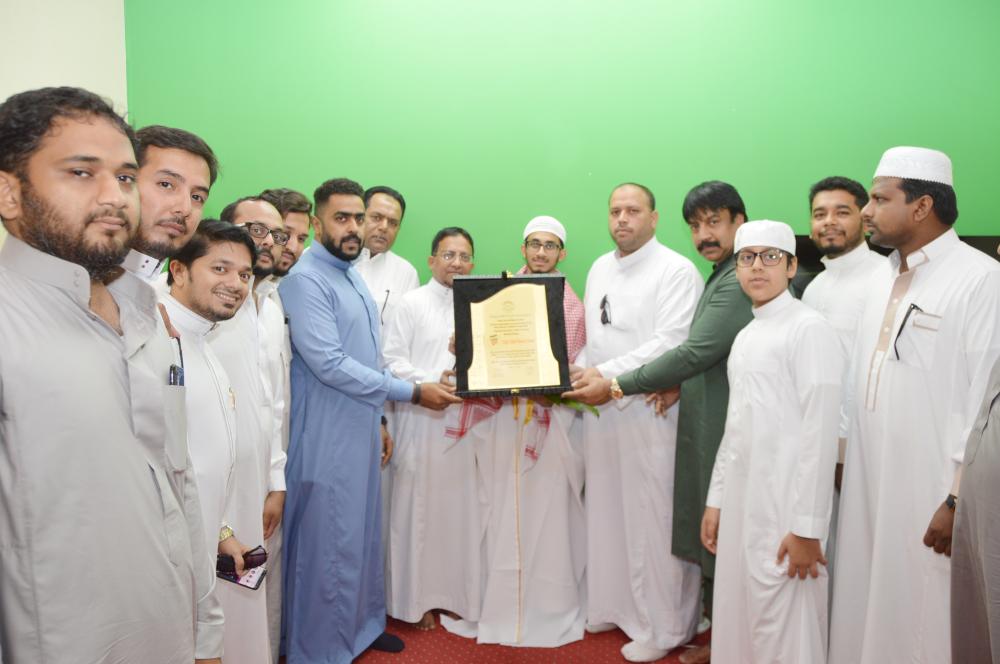
Global NRI Official presenting a memento to Hafiz Abdullah Abdul Mateen Usmani, presented by Azmat Ali Emran and Syed Abdul Hadi / SG Photo by Abdul Rahman M Baig
Jeddah:
Hafiz Abdullah Abdul Mateen Usmani, winner of the annual Qur’an memorization contest organized by Jamiat Khairokum Li Tahfizul Qur’an Kareem (Khairokum Qur’an Memorization Society) for Makkah region, was recently felicitated by the Global NRIs Youth Club here.
Abdullah Usmani won the first prize from among 1,000 participants out of which 13 candidates were bracketed in the category of those securing between 95 and 99 marks. In the ensuing round involving the 13 finalists of the competition, he was declared the winner.
Abdullah Usmani was presented a car by Jeddah Governor Prince Mishaal Bin Majed.
Jamia Al Khairiya Li Tahfiz-ul-Qur’an Kareem is a semi government institution and center established for the students to memorize and recite the Holy Qur’an. It holds the competition every year to encourage students and other participants.
Hafiz Abdullah Usmani is an Indian and belongs to the city of Hyderabad in Telangana state.
Syed Abdul Hadi, vice president of Global NRIs Youth Club, presented a Mishla’h (an adornment cloak wore by men) to Hafiz Abdullah Usmani as a token of appreciation. It was followed by a memento presented by Azmat Ali Emran, president of the club. Bouquets were presented to the contest winner by Fysal Ali, Farhan Baig and Syed Khaja Viqaruddin.
Speaking to Saudi Gazette, Hafiz Abdullah Usmani said: “It took me four years to memorize the Holy Qur’an. I was 11 years old when I started the memorization.”
He is also the alumnus of IISJ from the batch of 2017. Initially he was admitted to Muaz Bin Jabal School where he memorized about one/sixth of the Qur’an. Later he got enrolled in Dar Ul Furqan School from where he completed his memorization of the Holy Qur’an while learning Tajweed. He completed the memorization of the Qur’an four years back. It was last year when the Masjid Al-Aziziyah officials advised him to appear for the Qur’an memorization contest.
Hafiz Abdullah Usmani took the opportunity and appeared from Masjid Al-Aziziyah under the supervision of Sheikh Hamza Rayyan, imam and khateeb of the mosque.
Abdullah Usmani continued with his worldly pursuits along with his Qur’an memorization and took an open school examination from 6th to 8th standard from IISJ. He became a regular student of IISJ from 9th standard after completing his Qur’an memorization.
Initially, he started memorizing of Holy Qur’an on the instructions of his mother. Later after getting admitted in Muaz Bin Jabal School he gained interest in memorizing and was very much motivated by seeing his peers doing so.
While memorizing the Qur’an, he got a chance to meet Sheikh Ayman Rushdi Suwaid, and learned Tajweed from him. He is known to be the Sheikh Ul Tajweed in Jeddah. In his early days of memorizing Qur’an, he used to listen to the Qirat of Sheikh Abdurrehman Al-Sudais and learned the ayats (verses) of the Qur’an that made him memorize the Qur’an faster.
Talking about his future plans, Abdullah Usmani said he would like to learn more Arabic, Islamic history and Qur’an. He said he was interested in pursuing advance accounting courses and build his career. He also has plans to lead Taraweeh prayers during Ramadan in any of the mosques of Jeddah.
Listening to the recitation of Sheikh Meshary Alafasy, Sheikh Mohammed Ayub and Sheikh Al-Sudais helped him learn the correct pronunciation and also helped him in the memorization process.
Speaking to Saudi Gazette, the award winner’s father, Abdul Mateen Usmani, said: “I would first thank and express my gratitude to Almighty Allah for the honor bestowed on my son.”
In this context, he said, efforts of Jamia Tahfiz-ul-Quran was exceptional. “This prize is more than a hundred billion dollar for me. I have not even dreamt that my son Abdullah will be winning the first prize.”
He said all his children initially received their early education having British curriculum. “Me and my wife decided that we will invest money on good education for our children. All my children were enrolled in Al-Waha International School for their primary education. It was my wife’s plan that we will encourage Abdullah to be a Hafiz. So after completing 5th standard, we removed Abdullah from the school and admitted him in the institute for Qur’an memorization. I was a little reluctant but my wife played a major role in making my son Hafiz.
“I advise all unmarried as well as married people not to waste or kill their time by watching movies and TV serials and spoil their future but instead focus on their education both for the deen (religion) and duniya (world). Even the Prophet (peace be upon him) said that one should give priority to the Seerah of anbiya (prophets).”
He said his wife started attending religious classes with other women in our neighborhood soon after she landed in Jeddah. She sacrificed her sleeping hours during daytime to attend these classes.
“It’s the parents responsibility to mold their children as they want. One can lay the right foundation from the word go,” he said.
Speaking to Saudi Gazette, Azmat Ali Emran, president of Global NRIs Youth Club said: “It’s an honor for our club to be the first to felicitate Hafiz Abdullah Abdul Mateen Usmani.”
Syed Abdul Hadi, vice president, said: “Abdullah made the Indians and specially the people of Hyderabad very proud by winning this award. I would like to thank Allah the Almighty and also congratulate his parents on behalf of Global NRIs Youth Club.”
source: http://www.saudigazette.com.sa / Saudi Gazette / Home / by Abdul Rahiman M Baig, Saudi Gazette / Headline edited / September 18th, 2018
The 1860s and 70s were a difficult time for the old and noble families of Delhi. The changes ushered in after the rising of 1857 had precipitated the decline of the city that had begun with the invasion of Nadir Shah over a century ago. The grandeur of the old Mughal capital was gone and with it disappeared the wealth and commerce. This was the era of Mirza Asadullah Khan Ghalib and his poetry of decrepitude and nostalgic longing. Old merchant families were particularly badly hit.
The Ellahies were just such an old family of Delhi merchants. By the 1870s it was being run by Hajee Karam Ellahie. The writing was however, on the wall and the family realized that opportunities in Delhi were dwindling. Karam’s much younger brother, Bukhsh, an ambitious young man therefore decided that he would not sit around waiting for the decline to be complete. Rather he would take on the challenges of the new era head on.
If Delhi was in decline, the new capital of the British, Calcutta, had been growing rapidly over the same period. By the second half of the nineteenth century it was a city bursting with opportunities, ideas and wealth. Young Bukhsh decided the best way to approach the new age was to move to Calcutta. In 1878 he joined an old Muslim firm in Calcutta as a young apprentice hoping to pick up enough skills to survive in the new order.
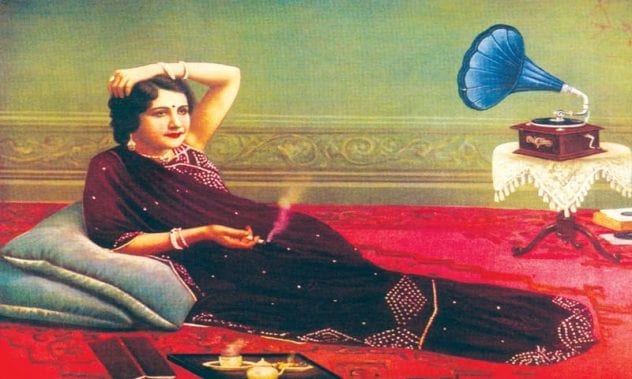
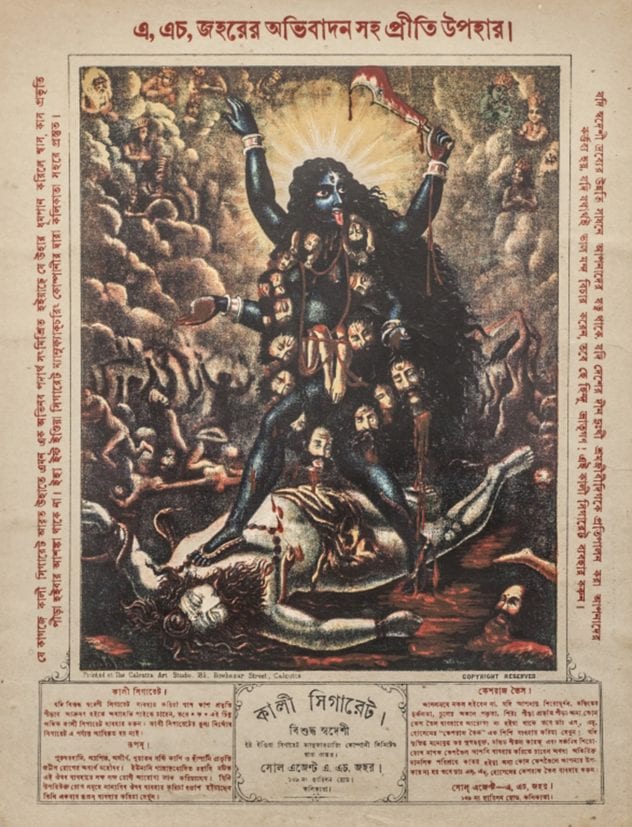
Gauhar Jaan in a Cigarette Advertisement
During his time in the city, Ellahie also keenly observed his fellow denizens closely. Amongst the new fashions that caught his eye was the habit of smoking cigarettes. The British army had picked up the habit during the Crimean War in the mid-1850s from their Turkish rivals. Unbeknownst to Ellahie precisely around the 1880s, when he was apprenticing in Calcutta, a new cigarette-rolling machine was making it faster and cheaper to produce cigarettes commercially.
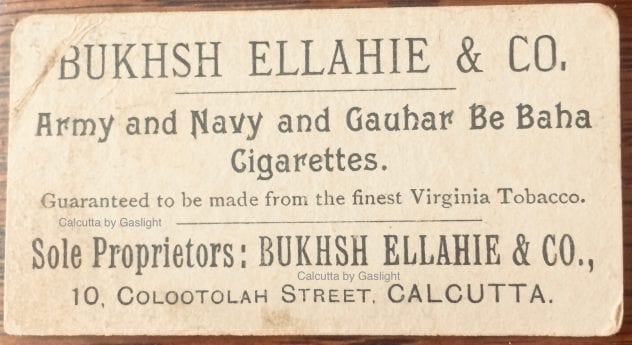
A shrewd businessman, Bukhsh soon asked his older brother to lend him some capital to start a business importing tobacco to make cigarettes. In 1885, with his brother’s loan, Bukhsh set up Bukhsh Ellahie & Co. Apart from new production techniques he also adopted new advertising techniques to popularize the new trend in the city. Cashing in on the growing celebrity of the Hindustani classical singer, Gauhar Jaan, Bukhsh Ellahie launched a brand of local cigarettes called the ‘Gauhar be Baha’. he also distributed free cigarettes to the army as a precocious new promotional tool.
The brand and the business were an enormous success. Before the century ended, Bukhsh was one of the richest men in the city. So complete was Bukhsh Ellahie’s domination of the local market that when foreign firms such as Wills and ATC first came to India, they had to enter into partnerships with Ellahie and depend upon the latter’s distribution networks.
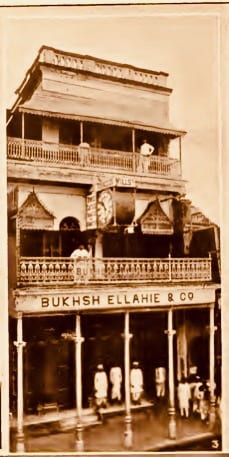
Bukhsh Ellahie & Co Offices
Until 1901 the firm of Bukhsh Ellahie therefore remained the sole agents for the major foreign tobacco companies. It was only in 1901 that E.J. Parrish, the manager of ATC’s Indian operations eliminated Ellahie’s sole agency and instead set up its own distribution depot at 95, Clive Street, Calcutta, with its own devoted staff. While the partnership flourished however, Ellahie innovated once more and advertised the partnership using yet another then still fairly new commodity, i.e. matchboxes.
Matchbox label issued by Bukhsh Ellahie & Co. advertising their partnership with British American Tobacco.
Bukhsh Ellahie & Co. were, as they themselves would later advertise, unquestionably the “Pioneer of the Tobacco Trade in India”. Yet, their mercantile portfolio were not limited to tobacco, or indeed matches. Ellahie was a general merchant and dealt in a wide variety of goods. He was also an official supplier for the Indian Army, thereby acquiring a large and lucrative captive market. Above all, they were one of the first local firms to recognize the importance of foreign trade and worked hard to develop international trading partnerships.
In time, Hajee Bukhsh Ellahie became members of both the Bengal and Punjab Chambers of Commerce and was honored by the British government, first with the title of Khan Bahadur and later, with the Companion of the Indian Empire (C.I.E.). He also became a well-known philanthropist and built or sustained several charitable institutions in his adopted city, Calcutta. On Chitpur Road he built a Musafirkhana or a Traveler’s Lodge. He also founded an orphanage and an association for the burial of indigent Muslims.
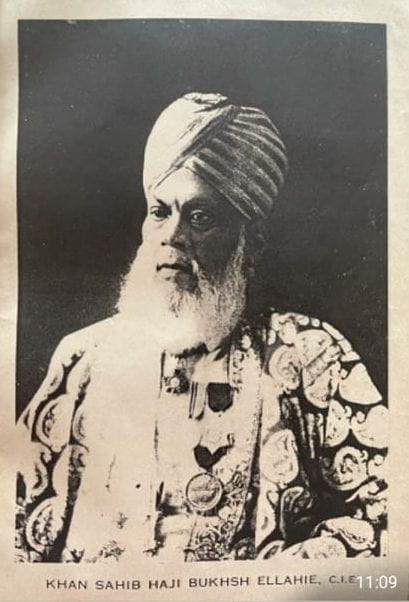
Khan Bahadur Haji Bukhsh Ellahie
Notwithstanding recent awareness of the unhealthfulness of smoking, Calcuttans continue to smoke in large numbers today. A recent survey found the city is the highest consumer of cigarettes in all of India. Few of these modern smokers however, have ever heard of Bukhsh Ellahie. His once legendary fame and wealth have, alas, disappeared from public memory like the smoke from his Gauhar cigarettes.
Ace entrepreneur Haji Bukhsh Ellahie launched India’s first brand of local cigarettes which became a huge success.
Making History: (Left) Promotion board; (Right Portrait of Haji Bukhsh Ellahie Photo: Bukhsh Ellahie Archive
In 1906, Jellicoe and Page, representing British American Tobacco, were unsuccessful in finding an agent in Mumbai to sell their W.D & H.O Wills cigarette brands. In Calcutta, they had no choice other than to tie up with Indian entrepreneur Haji Bukhsh Ellahie. He had made a fortune with his indigenous cigarette brand named after Gauhar Jaan, an upcoming Hindustani music singer who would go on to become the first to be recorded for the gramophone.
Bukhsh Ellahie had moved to Calcutta from Delhi in 1878 in the hope of making his fortune in the then capital of India. His brother, Karam Ellahie, stayed back to mind the family business. Enrolling himself as an intern with a business house, Bukhsh Ellahie soon learnt the tricks of the trade and was all set to take off on his own.
In the Crimean War (1853-1856), French and English officers acquired the habit of cigarette smoking from their Turkish allies. This addiction soon spread all over Europe. There was a great demand from the armies of the Western world for cigarettes. Bukhsh Ellahie saw the potential and realised it would replace pipes and the Indian hookah. When he came across a new and fast model of a cigarette-rolling machine, an innovative business idea germinated.
In 1887, he registered a company under the style of Bukhsh Ellahie & Co., Calcutta. Borrowing capital from his brother to import tobacco, he launched India’s first cigarette branded ‘Gauhar de Baha’, named after the legendary Gauhar Jaan. Bukhsh Ellahie did not just have the vision for business but also an uncanny knack for marketing. What he created then are now standard principles in marketing and promotion. He named his product after a popular singer to cash in on her popularity. He launched a campaign in which the visual showed her relaxing on a couch, listening to the gramophone almost in supine listlessness, holding a cigarette with smoke gently curling from it. The outrageous visual broke all traditions and advertising stereotypes. The campaign grabbed the attention of the audience. Bukhsh Ellahie then launched her face on matchboxes. These were printed in Austria. This was another first in India’s marketing scene.
To promote the product, he also sent free boxes of cigarettes to the Indian Army thereby building a demand which could be best termed as creating ‘brand addiction’. The shift to cigarettes was rapid, as Bukhsh Ellahie had envisioned, and he became one of the richest men in Calcutta by the 1900s. The trend of sending free cigarettes continued for two decades as letters sent to the Army prove. Joined by his son, Abdur Raheem, Bukhsh Ellahie grew the business and soon their portfolio included various types of goods and they took up imports, partnering with several international firms. When Jellicoe and Page came to India, they appointed Bukhsh Ellahie & Co as the first agent of Wills. This was, in a way, the birth of ITC, the multi-business conglomerate of today.
The father and son also contributed to the Army War Fund and towards building hospitals and relief work for natural disasters. Abdur Raheem held several positions including that of Commissioner of Calcutta Corporation from 1913-1923. They also built a traveller’s lodge, founded an orphanage and formed an association for the burial of indigent Muslims. Bukhsh Ellahie was bestowed the title of Khan Bahadur and later, the Companion of the Indian Empire (CIE) was awarded to Abdur Raheem.
The business is tracked till the 1930s and it is assumed that organised cigarette manufacture, including competition from new cigarette companies such as Vazir Sultan Tobacco Company and imports by others dented it. Abdur Raheem had no sons but his daughters were married off into eminent families in Delhi. The next generation took up legal practice. Bukhsh Ellahie’s great grandson was the managing director of Kalinga Airways and his sons went into trade and started their now flourishing tea and export business that spans continents.
(Views expressed are personal)
Rajiv Soni is a brand engineer and mentor
source: http://www.outlookindia.com / Outlook / Home> Profile / by Rajiv Soni / September 03rd, 2023
Nida Anjum Chelat, a 21-year-old rider from Kerala’s Malappuram, became the first Indian to complete the gruelling Equestrian World Endurance Championship for juniors and young riders in Castelsagrat, France on Saturday.
Nida, riding atop Epsilonn Salou, accomplished four laps totaling 120 kilometers within a span of seven hours and 29 minutes.
The goal of the championship is to cover the track without any harm coming to the horse.
Nida demonstrated remarkable skill by successfully finishing all four stages, securing the 23rd position in the initial stage (28.6 kilometers), 26th in the second stage (29.2 kilometers), 24th in the third stage (33.8 kilometers), and an impressive 21st place in the final stage (28.6 kilometers). Throughout the competition, Nida maintained a commendable average speed of 16.7 kilometers per hour.
In this championship, 70 competitors representing 25 different countries participated, with 33 of them unable to finish the race.
The UAE claimed both the individual gold and silver medals, while Bahrain and France emerged as the victorious teams in their respective categories.
“To qualify for the World Endurance Championship, a rider and their horse must complete a 120km distance at least twice within a two-year period. Nida has surpassed this requirement by completing the 120 km distance four times with two different combinations,” said a statement on Sunday.
“Nida has achieved the three-star rider status, becoming the first Indian woman to do so by successfully completing the 120km distance ride more than once,” the statement added.
“I am proud to be the first Indian to have achieved the feat and would try to bring more laurels for the country,” said Nida.
Nida whose parents hail from Kerala’s northern Malappuram district and reside in Dubai, gained entry into World Championships by winning the Gold Sword at the Abu Dhabi Endurance Championship. She is being coached by renowned horse trainer and rider Ali Al Muhairi.
source: http://www.maktoobmedia.com / Maktoob / Home> India> Latest> South India> Sports / by Maktoob Staff / September 04th, 2023
‘Nine women in the Darjeeling Express kitchen made for a powerful visual’, the Kolkata-born British chef and restaurateur tells My Kolkata.
Simone Ashley and Asma Khan at the Darjeeling Express kitchen. (Right) the thali the actress was served @asmakhanlondon/Instagram
Nine women in the Darjeeling Express kitchen made for a powerful visual when actress Simone Ashley visited the London restaurant, owned by Asma Khan, on August 31.
Ashley, known for her portrayal of Kate Sharma in Netflix’s women-centric hit series Bridgerton, expressed her desire to connect with the all-female kitchen team.
Asma Khan, Kolkata-born British chef and restaurateur, shared her experience with My Kolkata from London, saying, “Simone met the girls with so much affection. They were thrilled to meet her. She’s very sweet, very humble. She also left a generous tip. Recognising and appreciating the women who nourish us holds significance for those of Southeast Asian heritage. Regardless of one’s origins, it’s an integral part of our culture.”
Asma’s mission is to embrace diversity in the hospitality industry
Asma has gained recognition for her unwavering commitment to empowering immigrant women, who form the heart of her kitchen brigade at Darjeeling Express. She articulated her mission to embrace diversity in the hospitality industry in a recent piece for British Vogue , where she wrote: “I have made it my mission to hire individuals from all walks of life, and of varying ages and abilities.”
Simone, who is of Tamil descent, arrived at the restaurant with the film crew of her latest project, including the producer and director. Asma said, “My connection with Simone came through our mutual friend, Charithra Chandran, who plays her half-sister in Bridgerton. We had discussed the possibility of Simone visiting the restaurant before. However, this time, the reservation was arranged by Christine, the wife of David Gelb, the director of Chef’s Table and a personal friend. She inquired about the availability and made the booking.”
‘Bridgerton’ star Simone Ashley is of Tamil descent @simoneashley/Instagram
“She had our thali at Darjeeling Express and was particularly thrilled about the puri (luchi), because we prepare them fresh for the thali. She watched our girls making it, and I’ve heard she’s a very good cook herself,” added Asma, who was a guest judge on a recent season of Padma Lakshmi’s Top Chef. In fact, the episode helped “demystify the thali” and is one of the reasons why the Sunday thali at the London restaurant is “doing so well” , according to Asma.
In recent times, Darjeeling Express has welcomed several notable personalities, including Malala Yousafzai , whom Asma describes as someone “who embodies the invincible spirit of women from South Asia”, Michael Buble , Spotify’s CEO Daniel Ek, and Paul Rudd as well as Schitt’s Creek creator Dan Levy, among others.
source: http://www.telegraphindia.com / The Telegraph Online / Home> Food> Star Chefs / by Karo Christine Kumar / September 02nd, 2023
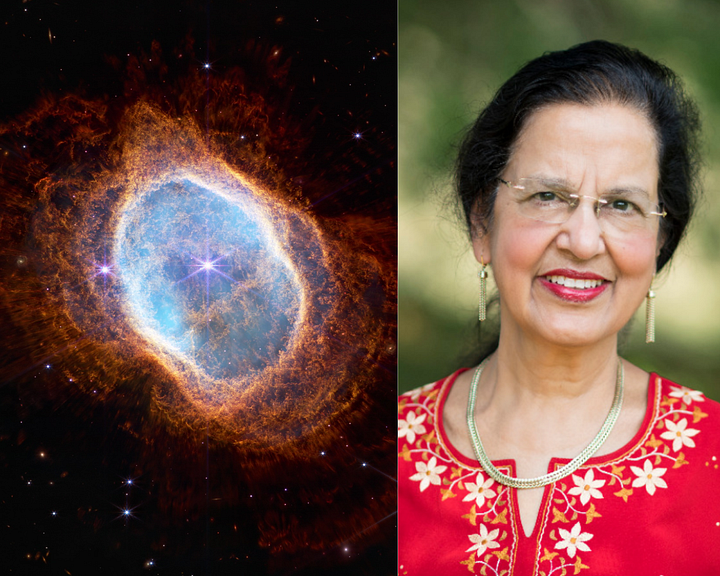
Dr. Hashima Hasan tells AMT about her dream of working for NASA and her extraordinary role in launching the largest, most expensive space telescope in history.
A young girl stands in awe with her family in their yard, as their heads tilt back to watch the Russian Sputnik satellite pass through the clear morning sky in Hazratganj, India, in 1957.
“I still remember watching it and saying, ‘Wow, I’d like to do that,’” said Dr. Hashima Hasan. “That was an inspirational moment.”
Over half a century later, Dr. Hashima is now one of NASA’s leading scientists and has helped develop the device that is currently enthralling the world, by relaying the first quality images of billions of years of the universe.
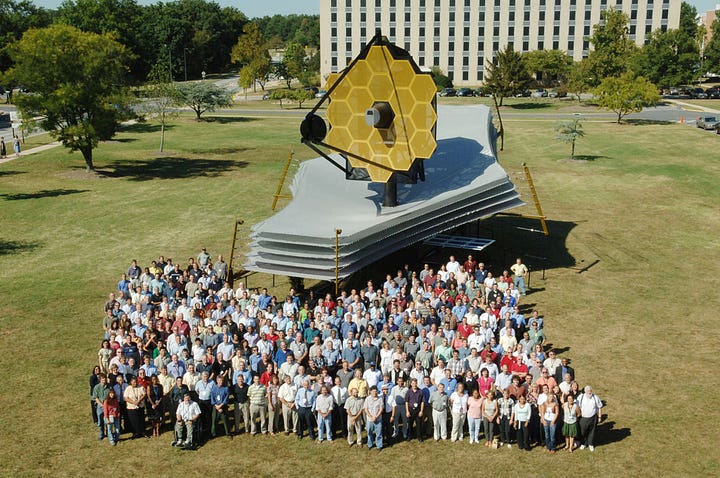
The James Webb Space Telescope is being used to focus on the first light in the assembly of galaxies in the early universe, the birth of stars and protoplanetary systems, as well as planets.
James Webb Space Telescope
“I am personally delighted to see the hard work of the thousands of talented individuals across the nation, Europe and Canada rewarded by the success of the mission as evidenced by the flawless launch, commissioning and the stunning images,” says Hasan. “My colleagues and I are eagerly awaiting the scientific discoveries which are yet to come.”
From the images captured, which were released at a live event by NASA on July 12, scientists will be able to make discoveries about the life cycle of stars, galaxies, and planets and use that information to understand the ever-expanding universe. Hasan was part of the committee that identified candidate objects to be imaged to demonstrate that the powerful new instruments were ready for science.
“Although I didn’t know which images we would use for the demonstration, I was overwhelmed by the depth and details of the images,” said Hasan.
Hubble Space Telescope
Hasan is an expert when it comes to optics, which are used to control the telescope instruments and keep the mission on track. She was actually hired by NASA in 1985 to write simulation optics for the Webb’s predecessor, the Hubble Space Telescope, and played a critical role in fixing the flawed mirror that resulted in it relaying blurry images.
“I was appointed as the Telescope Scientist at the Space Telescope Science Institute and my job was not only to analyze the error but to keep the telescope ‘in the best focus’ while we were trying to figure out how to fix it,” said Hasan.
A few years later in 1989, Hasan was put on the project, at the time called the next-generation space telescope. This project was renamed in 2002 to what is now known as the James Webb Space Telescope, after the former NASA chief who headed the space agency from 1961 to 1968. In her role as the Deputy Program Scientist for the $10 billion telescope, Hasan and her team are responsible for ensuring the instrument stays on mission.
The Webb telescope will play a huge role in advancing understanding of the origins of the universe. The telescope took 30 days to travel almost a million miles away from Earth and will remain to capture infrared light from stars that formed 15 billion years ago.
Carina Nebula
“Until now, we have not been able to see the first stars and the first galaxies forming, so this is the key knowledge that we are planning to get from this telescope,” said Hasan. “We can even look closer to Earth in our own galaxy and we can see stars being born within our own galaxy. We can also see our planets more clearly and get more information on them. We can also see how the elements which form life.”
The James Webb telescope had a number of false starts through its decades of development due to a myriad of issues. Its first planned launch in 2007 was delayed by over a decade but its 2018 launch was canceled due to technical difficulties. As the Covid-19 pandemic hit it was rescheduled two different times. Finally, on Dec. 25, 2021, the telescope successfully launched from Kourou in French Guiana.
As the Webb joins the Hubble telescope it is expected they will work together in capturing images of celestial objects. However, the Webb surpasses its predecessor in its technological abilities. The Hubble telescope does not have the capability to capture infrared light in the same way and the Webb will orbit the sun rather than the Earth as the Hubble does.
Hasan says scientists have already lined up a menu of observations with Webb for the coming year and will soon submit proposals for which celestial mystery they will begin to uncover next.
“What excites me the most is the discovery of the unexpected and unknown,” said Hasan.
source: http://www.medium.com / Medium.com / Home / source: American Muslim Today / by Maya Gayler / July 15th, 2022