Category Archives: World Opinion

With the End of 2019, A Great Scholar Also Departs for Heavenly Abode

Deoband, UTTAR PRADESH / KENYA / Croydon (South London). UNITED KINGDOM :

With 2019 saying goodbye, Maulana Izhar Ahmad Qasmi, an embodiment great scholarship, piety, humility, patience and perseverance, also said adieu to this mortal world.

Maulana Izhar Ahmad Qasmi, 74, was born in Deoband, India, and breathed his last on 30 December, leaving his family and admirers in tears.

MaulanaIzharMPOs31jan2020

He belonged to a very rare breed of ulema who had dedicated themselves to the service of Islam. His funeral prayer and burial was attended by thousands of his admirers from all over UK.

A widely respected and admired person, Maulana Izhar worked tirelessly to propagate the message of Qur’an without indulging in controversial issues.

In 1970 when Indian Muslims living in Kenya approached the great scholar and rector of Darul Uloom Deoband, late Maulana Qari Tayyab, and requested him to send a scholar to Kenya for their religious guidance, his choice fell on Maulana Izhar, a man Allah SWT had blessed with a spiritual attraction, humility, politeness and deep knowledge of Deen. He convinced Maulana Izhar to accept this responsibility.

From 1970 – 1983, Maulana Izhar served as the Imam in Pangani Mosque of Kenya. Following political unrest in the country, like several other Asians, Maulana Izhar had to migrate to Britain with his family.

In Britain he established the first mosque in Croydon, a town in South London, and served as an Imam for 15 years until he was diagnosed with a brain tumour and had to undergo a delicate surgery in the 90s.

As an Imam Maulana Izhar earned admirable love and respect of the local community. His knowledge of Qur’an and deep love to spread its message earned him wide respect all over Britain.

After his surgery, doctors said that his days were numbered and that he would not be able to survive more than a few days. But Allah SWT’s plans and works in strange and mysterious ways. When He chooses someone for the service of His Deen, He does it in ways that are beyond human comprehension. Not only did Maulana Izhar lived for at least 21 years but also completed his seminal translation and interpretation of Qur’an, titled, Izharul Qur’an in ten volumes, and continued his Qur’anic lectures even after suffering from stroke after his brain surgery and becoming partially paralysed. Gradually he became bedridden and spent the last few years in this condition.  Strangely until it was possible for him to sit in a chair he continued his Qur’anic lectures on Iqra TV without letting the viewers feel that his body was paralysed and that he was bedridden.

A comment on my Facebook from Dr Atif Suhail Siddiqui, University of Yale, says it all about Maulana’s resolve. He writes, ‘You did not mention one of the most important qualities of Maulana: He performed 42 Hajjs. After every Hajj he used to travel to Deoband to see his parents. In Deoband, my house is next door to his. So whenever he came to India, I used to visit him. When his [extended] family members noticed his swollen shoulder, they were shocked. I am a witness to it myself. They immediately called for a doctor who advised them to take him to an orthopaedist. His x-ray showed a fracture in his shoulder. It was then that it was found out that during Hajj he got pushed during tawaf and fell down. Due to the stroke one side of his boy had become so insensitive that he did not feel any pain and did not realise that his shoulder had been fractured. He performed all the arkans of Hajj in this condition and even travelled to Deoband. May Allah SWT shower His mercy on him.’

Despite such severe condition Maulana did not like to take anybody’s help. Another Facebook friend, Chicago based alim, social media activist, blogger  and YouTuber, Mufti Yasir Nadeem al-Wajidi, said that he had seen Maulana performing Tawaf and SaI during Umrah without anybody’s assistance or a wheelchair despite the fact that ‘He was virtually dragging himself.’ He added, ‘On one occasion Maulana said that his ailment and his bedridden condition had become a blessing for him because it allowed him to finish one Qur’an every day. Seeing this [and his contentment] one of his Christian doctors had embraced Islam.’

Among Maulana’s survivors is the renowned Alim of Britain, Mualana Qasim Rasheed, who himself is an institutions-maker. Lest this be confused with merely establishing mosques and madarsas, let me make it clear that he is the founder and chairman of one of the major charity organisations, Al-Khair Foundation , that does not only send food and other temporary aid to the displaced people in war-torn and hit by natural-disaster-hit regions of Africa, Middle East, Bangladesh and Pakistan but has also built schools and health clinics for them. He has also established two secondary schools and two TV channels in Britain. However, most important of all these is a full-fledged hospital in Gaza . I have mentioned it only to reflect on the impact of tarbiyah on one’s children.

May Allah SWT bless Maulana Izhar saheb with huge rewards for his services and bless Imam Qasim Saheb and all the survivors with patience and perseverance to tolerate this loss.

source: http://www.milligazette.com / The Milli Gazette / Home> Online News> Community News / by M Ghazali Khan , The Milli Gazette Online / January 04th, 2020

The Underrated Career Of Zaheer Khan Is Deservedly Honoured With Padma Shri

Mumbai, MAHARASHTRA :

Zaheer Khan enjoyed one of the most illustrious careers for Indian pacers. His ability to swing the ball at pace was a sparkling feature in his armoury.

ZaheerKhan01MPOs31jan2020

For someone who was India’s talisman in bowling department for years, his contributions on pitch have always been less appreciated. Whenever Zaheer  stepped out on the pitch to represent India, he wore his heart on the sleeve.

But his significant service to Indian cricket have finally been honoured with Padma Shri, country’s fourth highest civilian honour. It is a rich deserved recognition for the former Indian pacer.

ZaheerKhan02MPOs31jan2020

The left-armer, who has a winners’ medal from the 2011 World Cup  is India’s joint leading wicket-taker in World Cups. With 311 wickets, he’s only behind Kapil Dev for most wickets by an Indian seamer in Tests, while also boasting of 282 wickets in ODIs – the fourth-highest for an Indian.

Zaheer made his debut for India in 2000, and – for the most part of his 13-year career – remained a vital cog in the team in the Test and one-day formats.

ZaheerKhan03MPOs31jan2020

For such illustrious career, it feels though Zaheer wasn’t given enough credit during his playing days. His major contribution to his country came at the biggest stage of it all – World Cup. He was India’s go-to man in critical situations.

His 21 scalps were the joint-most with Shahid Afridi at the 2011 World Cup, and he was key in giving India those breakthroughs at right junctions. He has finally seen his services rewarded in the best way possible – Padma Shri awardee  now, he can be proud of his career.

source: http://www.indiatimes.com / India Times / Home> Sports / by Basit Aijaz / January 26th, 2020

Man who fought for Bhopal Gas Tragedy victims gets Padma Shri

Bhopal, MADHYA PRADESH :

Abdul Jabbar’s family members are very happy about him getting this honour.

Abdul Jabbar, who died on November 14 last year left behind a wife and 3 children

Abdul Jabbar of Bhopal, who fought a long battle for the victims of the Bhopal gas tragedy in 1984, has been awarded the Padma Shri. Abdul Jabbar is receiving this honour posthumously.

Abdul Jabbar’s family members are very happy about him getting this honour.

When India Today reached Abdul Jabbar’s house in the Chandbad area on the outskirts of Bhopal, we found that the condition of his house is very bad.

Abdul Jabbar, who died on November 14 last year left behind a wife and 3 children.

Abdul Jabbar’s wife Saira Banu said, “I am happy that the government is giving this honor to us but I am sad that my husband Abdul Jabbar is not with me in this moment of pride and happiness.”

Wife Saira Banu says that if Abdul Jabbar were alive, the joy of getting Padma Shri would have been doubled.

Jabbar’s wife said, Abdul Jabbar never thought about his own family. He made the gas victims his family. Abdul Jabbar’s wife expressed anguish that when her husband was ill, no one took care of him initially. At the last moment, the government approached the family but it was too late.

“He always kept thinking about the gas victims, and at the last moment he had told me not to let the gas victims fight end here but to take this fight further”, added Jabbar’s wife Saira Banu.

Speaking to India Today, Abdul Shamim, brother of Abdul Jabbar said, “When Abdul Jabbar was ill, no one from the government and gas-affected organisations took care of him. His treatment was also not taken seriously.”

Jabbar’s brother demanded a government job for Jabbar’s wife. ‘Financial condition of Jabbar’s family is very bad and sometimes children eat only once a day’, said Jabbar’s brother Shamim. According to Abdul Shamim, if his sister-in-law gets a job, she will be able to take care of her kids and her children will get a good education too’.

Abdul Jabbar’s eldest son Sahil said that he had learned to serve the poor from his father. Sahil said that ‘his father used to stay at home very rarely, he used to go out in the morning to help the gas victims and sometimes when there was no money in his pocket, he would borrow and help the gas victims. ‘I learned the same from my father’.

source:  http://www.indiatoday.in / India Today / Home> News> India / by Ravish Pal Singh, Bhopal / January 26th, 2020

Abid Hassan Safrani, freedom fighter who gave Jai Hind slogan

Hyderabad, TELANGANA :

Abid Hassan, born in Hyderabad in 1912, hailed from a patriotic family.

 Abid Hasan Safrani/COURTESY INDIANMUSLIMLEGENDS.BLOGSPOT.IN
Abid Hasan Safrani/COURTESY INDIANMUSLIMLEGENDS.BLOGSPOT.IN

Hyderabad :

This is the story of Abid Hassan Safrani who, not many may know, was not just the trusted lieutenant of Netaji Subhash Chandra Bose, but the Hyderabadi who had coined the magical slogan JAI HIND.

I have had the privilege of translating into English the Telugu book on the life of Netaji Bose by the late Ch. Acharya at the behest of the Freedom Fighters Association.

The following are excerpts from the book. Kindly read on:

“JAI HIND ”. No slogan had ever cast a greater spell on the nation than this. It had welded the people of this country of diverse languages, cultures, and faiths during the freedom struggle and filled them with a strong sense of patriotism. It continues to do so even now.

The man who coined this stirring slogan was Major Abid Hassan Safrani of Hyderabad, a close aide of   Netaji Subhash Chandra Bose.

It was adopted as the national slogan at Free India Centre’s first meeting in Berlin in November 1941. Then, it became a popular form of address and greeting.

Safrani was with Bose when he undertook the death-defying undersea journey from Germany to the Far East. Safrani recalled how calm and composed was Bose when enemy ships rained bombs on the submarine. Unmindful, he dictated notes to Safrani on the future course of his action.

Sisir Kumar, the nephew of Bose, gave more details of the adventure in his book, ‘INA in India Today’.

Abid Hassan, born in Hyderabad in 1912, hailed from a patriotic family. After graduating in engineering with distinction, he went to Berlin for higher studies.

Attracted by Bose’s freedom movement, he joined the Indian National Army. Recognising his leadership qualities, Bose gave Safrani ample scope to grow to his full potential.

Safrani could fluently speak several languages like English, German, French, Arabic, Persian, Sanskrit, Hindi, Urdu, Telugu, and Punjabi. This enabled him to build excellent rapport with officers and men of the INA. Major Safrani headed the Gandhi Brigade in the INA. It consisted of men of exceptional courage and valour.

When they eventually surrendered to the British army at Imphal in North East India, top British officers could not help marvel at the bravery of Safrani and his men. He was imprisoned and put in solitary confinement with not even a window to allow light.

He mentioned this in a letter to his mother, Hassans had firm roots in nationalism. Abid’s father, Jaffer Hassan, was dean in Osmania University , and mother, Begum Amir Hassan, a staunch Gandhian. They inculcated patriotic feelings in their sons, Badrul Hassan and Abid Hassan, at a tender age.

All of them were very close to Mahatma Gandhi and used to visit his Sabarmati ashram. Fanatics threatened to kill them and throw their bodies into the Musi. Gandhi would send his secretary, Pyarelal, to railway station whenever the Hassans visited him. Badrul Hassan edited Gandhi’s “Young India” in 1925.

He remained a true Gandhian until his death in 1973. He wore khadi and led a spartan life in a small room.

Abid Hassan Safrani also imbibed these traits.

Begum Safrani was a unique personality who lived a full life(1870-1970). She gave away everything for the freedom of the country, including her paternal property. She was a close friend of Sarojini Naidu and was affectionately called ‘amma Jaan’ by Gandhi, Nehru, Netaji and Abul Kalam Azad.

“Abid Manzil”, their residence in Troop Bazaar, stands as mute testimony to the burning of foreign cloth in 1920 at the behest of Gandhi. In his book, Sisir Kumar Bose gave a graphic account of the escapades of Subhash Chandra Bose and Abid Hassan Safrani such as the submarine journey from Germany to Asia and the INA’s triumphal march through the forests of Imphal.

After the Second World War, Safrani was jailed for six years. Begum Amir Hassan, who did not expect anything in return for the services of the family, was much worried that her son might be sentenced to death in the Red Fort trial. Several INA men were shot dead for participating in the liberation movement. She met Gandhi, Nehru and Sarojini Naidu to plead for her son’s life.

Safrani got a last-minute reprieve after Prime Minister Nehru and Governor-General, Lord Mountbatten, intervened. Nehru had earlier visited a prison in Singapore where INA members were lodged. He spotted a man sitting aloof and asked if he was Safrani from Hyderabad . The man greeted him with “Jai Hind” and nodded ‘yes’.

After his release, an ailing Safrani returned to his “Dhoop Chaon” residence in Banjara Hills, Hyderabad and recuperated under the care of his loving mother and friends like Bankat Chandra, Elizabeth, and C.S. Vasu. He took up radio sales for a living, but with little success. He wrote a civil services examination and qualified for foreign service. He was personally interviewed by Jawaharlal Nehru .

He had served in Indian missions in a number of countries like Egypt, Iraq, Turkey, Senegal, Zambia, Ivory Coast. Safrani was Indian Ambassador to Iraq when Jordan King Hashmath-e-Faizal, was killed in an army coup in 1957. The government drew heavy flak in Parliament for his absence in Baghdad at the crucial movement. Nehru defended Safrani. Safrani loved agriculture and raised a horticultural farm in Golconda . It was his practice to visit Netaji’s hometown, Calcutta, in January every year carrying fruit grown on his farm.

That was his way of remembering his mentor, Netaji Subhash Chandra Bose. He used to recall with moist eyes those memorable years with Bose. He died in 1984 but immortalized himself with the soul-stirring slogan he coined: Jai Hind. It would keep the Hindus, Muslims, Sikhs and others together for centuries and strengthen national integration. He was an ideal Shia and a noble Sufi saint.

Safrani memorial school in Golconda, run by his wife, Suraya, seeks to instill in the minds of young pupils the lofty ideals, values and principles dear to her husband.

Dasu Kesava Rao is a senior journalist who worked for The Hindu, among other newspapers

source: http://www.siasat.com / The Siasat Daily / Home> Featured News / by Safoora / January 26th, 2020

Sania Mirza scripts remarkable comeback to clinch Hobart International title

Hyderabad, TELANGANA :

Indian tennis ace Sania Mirza made a winning return to the professional tennis circuit as she clinched her first tournament after childbirth.

SaniaMirzaMPOs21jan2020

Indian tennis ace Sania Mirza made a winning return to the professional tennis circuit as she clinched her first tournament after childbirth. Partnering Ukranian Nadiia Kichenok, the duo defeated the Chinese pair of S Zhang and S Peng in the women’s doubles finals in the Hobart International 6-4, 6-4 to kick start the year on a triumphant note.

Sania and Kichenok were hardly troubled in the summit clash, as they took the game without breaking into much of a sweat. The Indian now gears up for the Australian Open, where she will team up with Rohan Bopanna in the mixed doubles category. She was expected to play the Grand Slam with American Rajeev Ram, who has, since, pulled out of the tournament.

WTA

@WTA

Straight sets win 🤩

Nadiia Kichenok and @MirzaSania are your @HobartTennis Doubles Champions after defeating Peng/Zhang, 6-4, 6-4!

Embedded video

184 people are talking about this

This would also be the first time that Mirza and Bopanna would be playing mixed doubles together since they teamed up in the Rio Olympics 2016, where they had finished fourth.

Mirza, who had emerged as an inspiration to young girls in India when she forayed into the competitive world of tennis and started returning with impressive results that even saw her clinch the world number 1 ranking in the doubles circuit, had taken a break when she was at the peak of her career to have a child. Her son Izhaan was born to Mirza and Pakistani cricketer Shoaib Malik in 2018, after which the tennis star spent another year getting fit to return to the professional world.

Her fitness regime, her inspiring videos on Instagram, where she is committed to losing weight and not getting bogged down, have been a hit, and with this win, Mirza has also sent out another vocal message to the youth in India. She stands as an icon of strength, one who has not been afraid to take on the naysayers, proving them wrong with results on the field.

source: http://www.thebridge.in / The Bridge / Home> News / by Sarah Waris / January 18th, 2020

Hyderabad to host 1st edition of India international Halal expo

Hyderabad, TELANGANA :

Hyderabad:

IIHE (India International Halal Expo 2020) is staged to take place on the 18, 19, and 20 January 2020 at HITEX, Exhibition Centre in Hyderabad. With an expected 15000 visitors and more than 120 exhibitors, IIHE is set to be the Biggest International Halal Expo in India.

IIHE will be hosted by participants of major Halal Markets of the world (Indonesia, Malaysia, Turkey, , Thailand, U.A.E., Saudi Arabia, UK USA  and many other countries).

IIHE (India International Halal Expo 2020) welcomes all the major Halal Industries as exhibitors. Food & Beverage, Cosmetics, Healthcare, Tourism, Finance, Education, Real Estate & Modest Lifestyle to be a few of the major stakeholders in the Exhibition.

IIHE (India International Halal Expo 2020) intends to network all the major global Halal industries under one roof. We intend to enhance trade within the Halal Market and build an Eco-System which can sustain by itself.

Parallel to the Exhibition, IIHE (India International Halal Expo 2020) would also be having a 3-day International Halal Conference. The Halal Conference is expected to have regional as well as international dignitaries from the Halal industry of trade and commerce Along with Government officials

IIHE is partnered with Government Of Telangana, Federation Of Telangana Chamber Of Commerce & Industry,  “The Malaysia External Trade Development Corporation” (MATRADE-Chennai), “Istanbul Foreigners and Investment Centre” (IYMER), Salaam Gateway-Dubai, Indo-OIC  Islamic Chamber Of Commerce, American Halal Foundation, Halal-Welt (Germany ) , Halal Focus- UK, Collabdin- Singapore, and many more Halal trade organizations which will works as a binding force in trade negotiations for exhibitors to work on joint ventures regionally as well as globally.

As per the Latest research of Dinar Standard, Investments play an important role in driving substantial growth across the economy, there have been major developments. $1.2 billion was invested globally in Halal economy companies, reflecting a growth of 399% on comparable transactions across halal products, Islamic lifestyle & Islamic Finance compared to the prior year.

Muslims spends on food & beverages was valued at $1.4 trillion in 2018 and forecast to reach $2.0 trillion by 2024.

source: http://www.siasat.com / The Siasat Daily / Home> Business / by Mohammed Hussain / January 06th, 2020

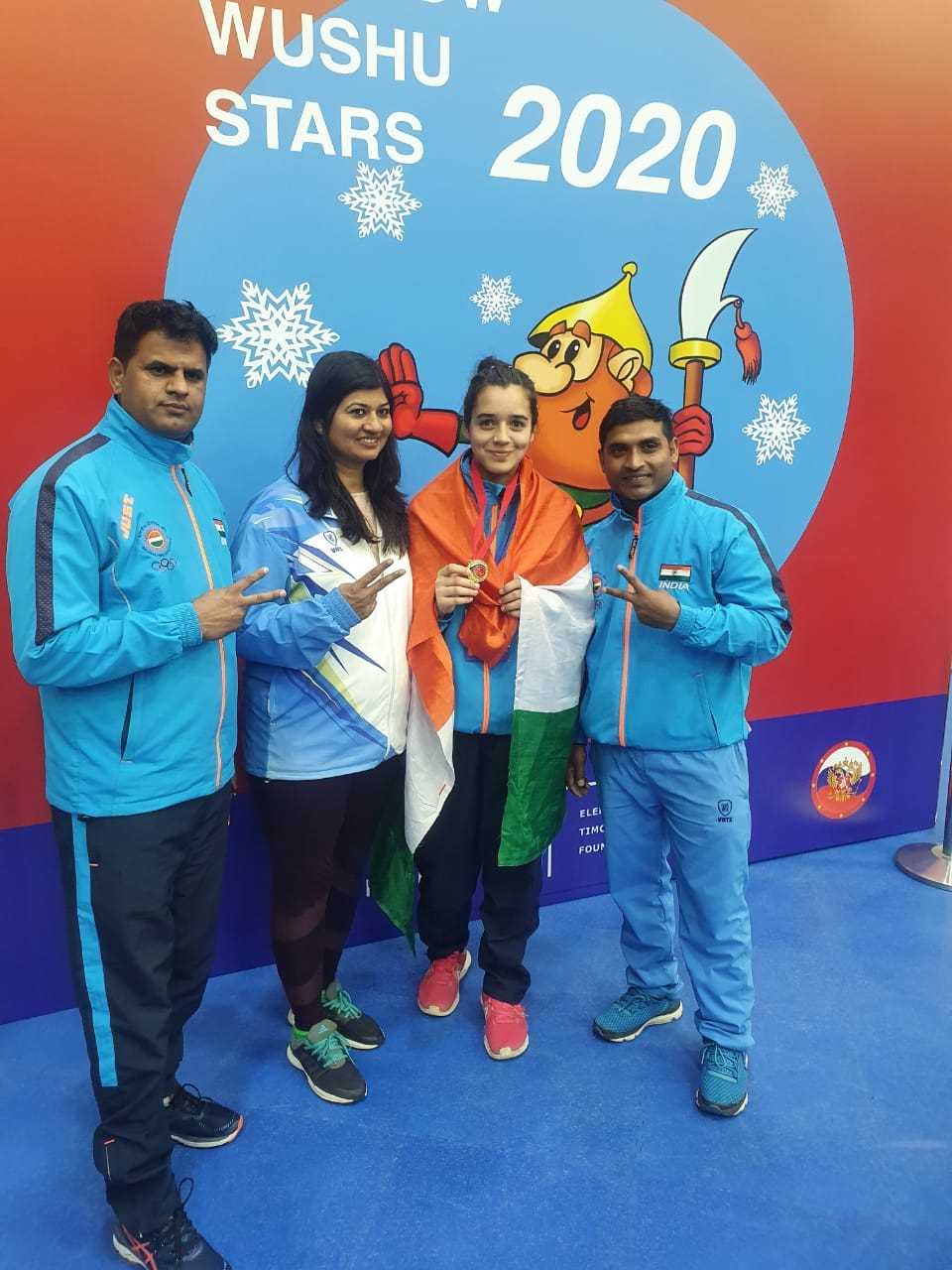
Ronak Reyaz Bags Gold At 5th International Thang-Ta Championships

Magraypora,( Baramulla District), JAMMU & KASHMIR :

Photo: The Tribune
Photo: The Tribune

Some overcome all odds to achieve their goals and dreams, and Ronak Reyaz is the perfect embodiment of this. Even though the situation in Kashmir is still uncertain, Reyaz has not allowed it to deter her from achieving laurels. Reyaz bagged a gold medal at the 5th International Thang-Ta championship held in South Korea recently. With this, she has created a mark in a sport which has been traditionally dominated by men and is serving as an inspiration to many women.

Every Sunday Reyaz and her mother would travel from Baramulla to Srinagar for practice at the Gojwara Club, a portal covering women’s issues stated. And despite not having a practice hub nearby, nothing could break the young sportswoman’s resolve and routine of two years. Reyaz is a 16-year-old from SRM Welkin School in Sopore and belongs to Magraypora, a small village in the Baramulla district.

For Reyaz, her mother Hafeeza, has been a pillar of strength and support. But she worries about arranging funds for her daughter’s trips to various championships. “Her South Korea trip cost us Rs 2,00,000. We had to arrange Rs 75,000 entry fee for South Korea meet in August when everything was shut,” Hafeeza told The Tribune.

Reyaz has still not been approached by any authority for help, despite her consistent performances and bringing accolades to the country. Hence, she feels that sports in rural areas are still a neglected sphere by the government.

source: http://www.femina.in / Femina / Home> Trending> In the News / by Femina / January 02nd, 2020

An incredible Saudi-Indian tale

SAUDI ARABIA :

Eminent Saudis of Indian origin evoke nostalgic memories

SaudiIndianOriginMPOs20dec2019

Jeddah :

Jeddah, the gateway of the Two Holy Mosques, witnessed a historic event during the weekend, with the gathering of eminent Saudis of Indian origin and thus adding a golden page in the annals of history of centuries-old deep rooted Saudi India ties. The interaction titled “Muziris to Makkah”, the first of its kind in the Kingdom, was organized by the Consulate General of India, in association with Goodwill Global Initiative. More than 20 guests were honored on the occasion.

Going down memory lane, they shared with the august audience, including prominent figures from the Indian and Saudi communities, the untold stories of the beginning of migration by their forefathers from the Indian subcontinent to the Arabian Peninsula nearly two centuries ago.

When they spoke in the original slang of the language of their forefathers that they had inherited with showing their keenness to pass on to their younger generation, it was an enthralling experience for the attendees. They interacted with the Indian expatriate community in Jeddah in English, Arabic, Malayalam, Telugu, Urdu and Manipuri languages.

Ahmed Attaullah Farooqui, founder and CEO of Farooqui Group and representative of UN World Human Rights Service Council, recalled that his family’s lineage reaches the second caliph Umar Al-Farooq, and that his forefathers migrated to India during the period of Islamic conquests. “My great grandfather Haji Imdadullah Farooqui emigrated from Jaipur to Makkah 150 years ago and had a role in establishing Madrasa Saulatiya, the first school in the Arabian Peninsula, along with its founder Maulana Muhammad Rahmatullah Kairanavi.

“The school was named after Saulathunnisa Beegam, a rich Haj pilgrim from Kolkata and wife of Bengal nawab, who made the necessary funding for building the school, which was demolished a few years ago for the largest ever Haram expansion.”

In his interaction, Abdullah Mohyadeen Melibary, popular as Kubba, recalled the arduous journey of his father along with many others to escape persecution of British colonial rulers to Makkah and other parts of Arabian Peninsula. “While I was a child, my father died and so I had to work hard to make ends meet. We used to go to school in the morning and do some work in the evening to make a living.”

“After working as teacher and head of a school in Makkah for 34 years, I continued serving Haj pilgrims for more than half a century since childhood,” Kubba said, adding that he learned Malayalam mainly from Haj pilgrims.

Melibary is the finance manager of Madrasa Malaibariya, established in Makkah 92 years ago. At present, the school is running 12 Qur’an memorization centers in Makkah. Adel Bin Hamza Melibari, supervisor of Madrasa Saulathiya and Melibariya, also shared his experiences.

Talal Bakur Melibari, who served as head of schools in Makkah for 36 years, is the supervisor of Nusratul Masakeen Endowment in Makkah since seven years.

“Our ancestors came 120 years ago from the southern Indian state of Kerala and they established three endowments for education, charity and pilgrims’ accommodation. My father Bakur Muhayyaddeen Melibary, along with 10 others, founded Nusratul Masakeen to feed Malaibari Hajis, as well as to handle their transportation in the holy cities besides extending services for the burial of the dead and hospitalize those who fell sick. Keyi Rubat, established by Mayankutty Elaya, first translator of the Qur’an to Malayalam, and Madrasa Malaibariya are other endowments.

Dr. Abdul Raheem Mohammed Moulana, a renowned Islamic scholar, who serves as chief nephrologist in a Makkah hospital, shared his unique experiences as a physician as well as a great scholar. “When we started the dialysis unit in 1978 in Makkah for Hajis free of cost, there was only one dialysis center in India. At that time, we used to provide free dialysis for Hajis. I also started concentrating in learning more about Qur’an.”

A translator of the Holy Qur’an and Qur’an Encyclopedia and Hadith collection from Arabic into Telugu language, Moulana is now working on an Arabic-Telugu dictionary.

Dr. Abdullah Ramizuluddin Ghouth Ali of King Abdulaziz University shared with the audience about the arrival of his great grandfather Barakatullah Khan from the Kingdom of Manipur. He was the chief justice and the second Muslim who performed Haj in 1825. He returned back to India and then Ghouth Ali’s father came to Makkah and settled down there. “Out of 200,000 Muslims of Manipur, four or five families came and settled down in Makkah,” he said.

Musthafa Bakur Melibary narrated the last moments of Sayyid Abdurahman Bafaqi Thangal, a towering Indian Muslim leader and president of Indian Union Muslim League, who died while taking rest at his home in Ajyad close to Haram during the third day of Haj in January 1973.

Those who were honored also included Mohammed Ramizuluddin Ghouth Ali, a retired mechanical engineer, Faisal Al-Saddik, former CEO of Private Aviation, Adil Mohammed Iqbal Sanai, former senior vice president and head of risk management at the National Commercial Bank, Abdulsalam Ramizuluddin Ghouth Ali, head of maintenance department, Savola Co., Abdulgafoor M. Hassan, founder and CEO of Swipe IT Saudi Arabia, Abdul Qadeer Siddiqi, founder and CEO of Modern Gates Company, Ather Anwer Al-Aqqad, CEO of Mantech Systems Company, Abdul Rahman Abdullah Yousuf, chairman of Al Fadul Freight Solutions Company, Jeddah, Mohammed Saied Malibari, managing director of MOSACO, Taqiyuddin Omar Melibary, retired Control Room Operator at Saudi Electricity Company Makkah, Abdul Basit Abdullah Baitan, head of school in Makkah, Mohammed Bakur Melibari, director of SABIC’s Al-Sharq Company Jubail, Saud Bakur Melibari, operation manager at SWCC Shuaibah plant, Jaafar Ali Melibari, students’ dean at Makkah school and supervisor of Madrasa Malaibariya, Hamad Abdurazak Melibary, administrative supervisor of Madrasa Malaibariya, Eng. Adil Mohammed Ali Walanshira, general manager, Savola Foods and Dr. Gadeer Talal Melibari, lecturer at English language center, Umm Al-Qura University.

source: http://www.saudigazette.com / Saudi Gazette / Home> Saudi Arabia / a Saudi Gazette Report / April 17th, 2019

Hamna Mariyam assumes charge as Indian consul of community welfare

Kozhikode, KERALA / Hyderabad, TELANGANA / Jeddah, SAUDI ARABIA :

Hamna Mariyam
Hamna Mariyam

Jeddah :

Hamna Mariyam, a young woman diplomat of 2017 Indian Foreign Service (IFS) batch, joined the Indian Consulate General, Jeddah on Dec. 10 as the new consul of community welfare.

Speaking to Saudi Gazette, Hamna expressed her happiness to get an opportunity to serve the one-million strong Indian community in the Western Region of Saudi Arabia. “I see the community welfare as a major area where I can do a lot in serving the vibrant community in this part of the world,” she said.

Hamna assumed the new position after her stint at the Indian Embassy in Paris where she had completed her French language training before leaving Europe in October this year. Earlier, Indian Consul General Mohammed Noor Rahman Sheikh told Saudi Gazette that that he was very happy to have the first woman IFS officer joining the consulate team at a time when the centuries-old historic economic and socio-cultural ties between India and Saudi Arabia have touched new heights of strategic partnership. Saudi Arabia is India’s 4th largest trade partner with a major source of energy and is the 15th largest market in the world for Indian exports.

“Hamna is a very good combination of Malayali who married to someone from Hyderabad, as the Keralite and Telangana communities are the major communities in this part of the world. Hamna’s appointment would help in the consulate’s outreach programs and interaction with these communities at a time when the consulate is very actively reaching out to all segments of the Indian community,” Sheikh added.

Hamna is married to Abdul Muzammil Khan, an IAS officer of Telangana cadre of the same batch and son of retired IPS officer A.K. Khan, who is presently an advisor to the Telangana government. Muzammil Khan, who is working as assistant collector in Vikarabad, left Jeddah on Saturday after performing Umrah along with Hamna.

Though daughter of a well-known doctor couple from Calicut in Malabar region of Kerala, Hamna chose a career other than medicine, and studied English language and literature from Ramjas College and obtained her master’s degree in the same discipline from Delhi University. While serving as asst. professor at Farook College, Calicut, she bagged the 28th rank in the Civil Services examination.

Renowned pediatrician Dr. T.P. Ashraf, former superintend of Calicut Medical College and former executive director of Kerala government’s Social Security Mission, is Hamna’s father while Dr. P.V. Jowhara, a physiologist at Calicut Medical College, is her mother.

source: http://www.saudigazette.com / Saudi Gazette / Home> Saudi Arabia / by Hassan Cheruppa, Saudi Gazette / December 15th, 2019

Sher Shah Suri – Creator of the Grand Trunk Road

BENGAL / Sasaram, BIHAR :

We must thank Sher Shah Suri, the founder of the Suri Empire, for creating this amazing road connecting the major cities of India

GrandTrunkRoadMPOs13dec2019

New Delhi:

For travellers in India, moving from North to South or East to West, would have been almost impossible if the magnificent Grand Trunk Road did not exist. We must thank Sher Shah Suri, the founder of the Suri Empire for creating this amazing road connecting the major cities of India. Whenever there are discussions about this splendid road, Sher Shah Suri’s name is always mentioned with awe. But the Grand Trunk Road is just one of his major creations. Few know what an extraordinary personality he was and how much we owe him. In his seven-year rule he added a vast number of improvements that we continue to see today.

Born Farid Khan Lodhi in 1486 at Sasaram in modern day Bihar, he was the grandson of an ethnic Afghan, a noble of the Pashtun Sur tribe named Ibrahim Khan Suri. Farid Khan became known as ‘Sher’ when as a young man he saved the King of Bihar, from a tiger that had suddenly leapt upon him. He was later re-named Sher Shah and rose to become the founder of the Suri Empire in the northern part of the Indian subcontinent.

A landowner (Jagirdar) and a representative of the Delhi rulers of that time, he was an adventurer with royal connections and was recruited by Sultan Bahlul Lodi of Delhi during his long confrontation with the Jaunpur Sultanate. He was one of the eight sons of Mian Hassan Khan Suri – a prominent figure in the government in the Narnaul district. His grandfather Ibrahim Khan’s ‘Mazar’, still stands as a monument in Narnaul.

Sher Shah rose from being a private to the status of a commander in the Mughal army under Babur to the level of being the governor of Bihar. In 1538, when Babur’s son Humayun was away at war, Sher Shah took over the state of Bengal and established the Suri dynasty – naming it after the ‘Sur’ tribe to which he belonged. A gifted administrator and strategist during his rule from 1538 to 1545, he introduced a number of important changes, which continue to benefit us till today.

As a brilliant general Sher Shah laid foundations for later Mughal emperors – among them Akbar son of Humayun, was probably the one who benefited the most from this. Among Sher Shah’s more important strategies in his administration, was the setting up of new civic and military rules. Under him, the first ‘Rupiya’ was issued in place of ‘Taka’ – and still continues to remain. Another important improvement was the reorganisation of the postal system of the Indian Subcontinent. To ensure that he would be remembered, Sher Shah renamed the name of Humayun’s city, changing it from ‘Dina-panah’ to ‘Shergarh’ and simultaneously he also revived the historical city ‘Pataliputra’, which had been steadily declining since the 7th century. The feather on his cap is however the Grand Trunk Road, for which he is justly famous.

It is said that Sher Shah and his father were constantly fighting with each other. His father, Hassan Khan Suri, then a jagirdar of Sasaram, had several wives with whom Sher Shah did not get along and so, he decided to run away from home. When his father discovered that Sher Shah had requested Jamal Khan, the governor of Jaunpur to give him shelter, he wrote a letter that stated, “my son being annoyed with me, has gone to you without sufficient cause. I trust in your kindness to appease him, and send him back; but if refusing to listen to you, he will not return, I trust you will keep him with you, for I wish him to be instructed in religious and polite learning.”

But Sher Shah refused and replied in a letter, “If my father wants me back to instruct me in learning, there are in this city many learned men: I will study here.”

Sher Shah started his service under Bahar Khan Lohani, the Mughal Governor of Bihar. Because of his valour, Bahar Khan rewarded him with the title ‘Sher Khan’ After the death of Bahar Khan, he became the regent ruler of the minor Sultan, Jalal Khan. Jalal soon realised that Sher Khan’s power in Bihar would make things difficult and sought the assistance of Ghiyasuddin Mahmud Shah – the independent Sultan of Bengal. Ghiyasuddin sent an army under General Ibrahim Khan but Sher Khan defeated the force at the battle of Surajgarh in 1534 after forming an alliance with local chiefs – and achieved complete control of Bihar.

In 1538, Sher Khan attacked Bengal and defeated Ghiyasuddin Mahmud Shah. But could not capture the kingdom, because of the sudden appearance of Emperor Humayun and his army. On 26 June 1539, Sher Khan faced Humayun in the Battle of Chausa and defeated him. Assuming the title ‘Farid al-din Sher Shah’, he defeated Humayun once again at Kannauj in May 1540 and forced him out of India.

Thereafter Sher Shah turned his attention towards the Rajput Forts. He attacked Malwa and Jodhpur, but was killed during the siege of the Rajput Fort of Kalinjar. Sher Shah had ordered the walls of the fort to be blown up with gunpowder, but he was himself seriously wounded, by the explosion. He died on May 22, 1545 and was buried in Sasaram. His son Jalal Khan succeeded him, taking the title of ‘Islam Shah Suri.’

The founder of the Suri Dynasty lies under the splendid Sher Shah Tomb that is 122 ft high and stands majestically in the middle of an artificial lake in Sasaram – located on the road that he is famous for – India’s magnificent Grand Trunk Road.

(Shona Adhikari is a lifestyle and travel columnist.)

source: http://www.ummid.com / Ummid.com / Home> Life & Style / by Shona Adhikari – IANS / December 11th, 2019