Kochi, KERALA :
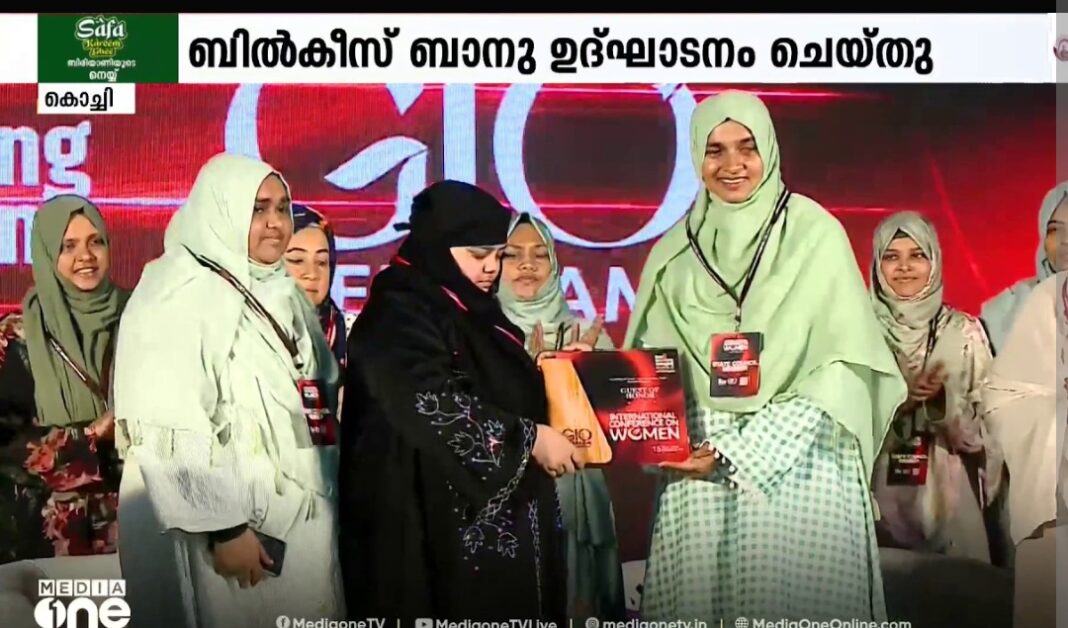
Bilkis Bano, a victim of 2002 Gujarat pogrom, inaugurated the GIO’s international conference at Kochi on November 15, 2026.
An international conference in Kochi challenges conventional perceptions of Muslim womanhood and draws attention to the intellectual aspirations of a younger generation engaging with faith, scholarship and contemporary society.
Kochi :
“My entire life has been a struggle,” said Bilkis Bano, inaugurating the International Conference on Women organised by the Girls Islamic Organisation (GIO) Keralam, an affiliate of Jamaat-e-Islami Hind (JIH), on November 15.
The survivor of the 2002 Gujarat communal violence, whose prolonged legal battle became a landmark in India’s pursuit of justice, expressed the hope that people would continue to live together in love and peace. Her husband, Yakub Rasool, recalled the hardships the family endured and hoped that her struggle would inspire women to raise their voices for their rights.
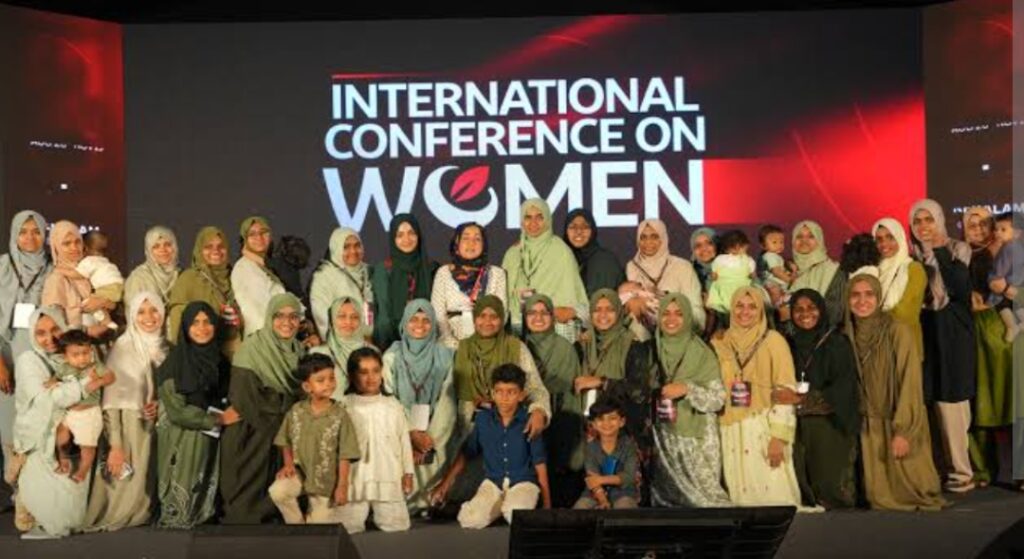
Bilkis’s presence at Kochi’s Rajendra Maidan, named Mujadila Square for the occasion, lent particular significance to a gathering of academics, researchers, architects, designers, journalists and social activists from India and abroad. Conceived, planned and organised by young Muslim women, the conference offered an insight into the intellectual aspirations of a generation whose perspectives receive inadequate attention in contemporary Indian public discourse.
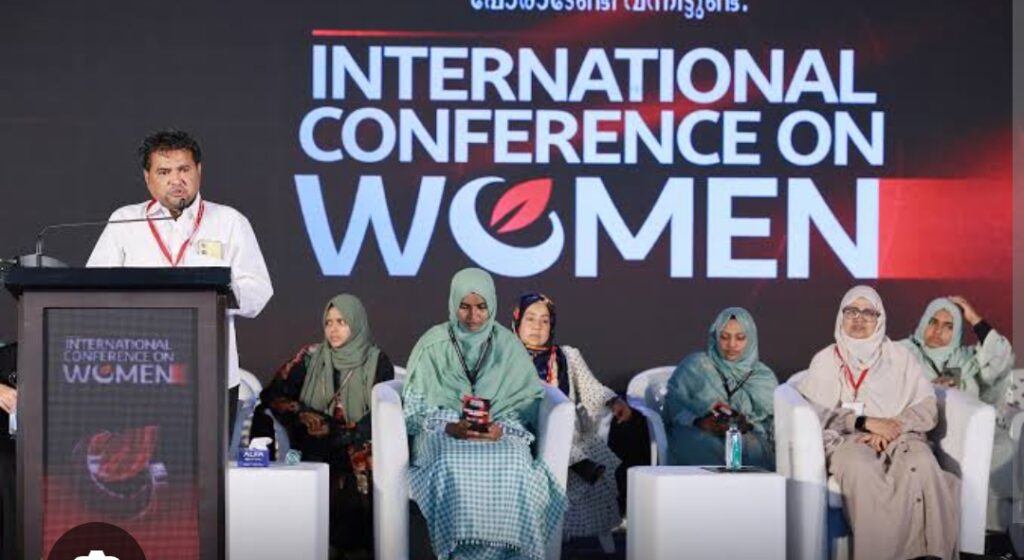
Held under the theme “Being, Becoming, Belonging: Reimagining the Self, Space and Society,” the conference culminated a three-month campaign launched in August. Its programme envisaged 15 sessions across four venues, more than 25 research paper presentations and around 40 invited personalities. A preceding academic conference, themed Trajectories of Muslimah: Across Time, Texts and Tradition, examined women’s engagement with religious, legal, economic and social institutions throughout Islamic history.
Challenging Conventional Perceptions
Indian Muslim women have frequently figured in public debates surrounding the hijab, marriage, divorce, personal law and religious restrictions. The cumulative effect of such representations has often been an image of Muslim women as socially constrained, intellectually dependent and possessing limited influence over decisions affecting their lives. The diversity of their experiences, educational attainments and intellectual pursuits seldom receives comparable attention.
The Kochi conference offered a glimpse into a changing reality. Young Muslim women were engaging with contemporary scholarship, examining inherited social practices, developing international academic connections and exploring institutional reforms. Their ability to formulate questions, commission research and bring together specialists from different disciplines deserves attention irrespective of one’s agreement with their religious or philosophical positions.
V. M. Ibrahim, Editor of the Malayalam daily Madhyamam, believes this was among the conference’s most significant contributions. Speaking to India Tomorrow, he said the gathering drew widespread attention for its organisation and the remarkable participation of women.
“Many observers described it as a conference by women, for women, led entirely by women,” he said, adding that the wider public viewed it as a positive and progressive initiative emerging from the Muslim community.
Ibrahim considered the conference particularly relevant to female students confronting questions concerning Islamic faith, religious practices, culture and traditions. By showcasing the achievements and potential of Muslim women firmly rooted in their convictions, the gathering, he observed, helped strengthen confidence among young women navigating competing interpretations of faith and contemporary life.
His observations point towards a development of wider intellectual significance. A generation of educated Muslim women equipped with research skills, professional competence and familiarity with contemporary academic discourse can engage with prevailing narratives about their community with greater authority. Their conclusions may invite disagreement, but arguments supported by rigorous scholarship and evidence demand serious engagement. They become increasingly difficult to dismiss through familiar stereotypes or ideological assumptions.
A Conversation Across Disciplines
The participation of scholars associated with Coventry University, the University of Cambridge and the University of Leeds gave the conference an international academic dimension. Among the participants were Sariya Cheruvallil, Dalia Saleh, Palestinian writer and journalist Reem Mahmoud Al Haddad and Shaheen K. Moidunny. JIH’s General Secretary Mrs. Rahamathunnisa Abdulrazack, who also serves as JIH women’s wing chief, was also among the prominent participants.
The involvement of Monolita Chatterjee, associated with the Kerala chapter of the Indian Institute of Architects, product designer Tanya Prasad, architect and designer Ganga Dileep, journalist Jisha M. and social science researcher Dr K. Noorjahan broadened the scope of the deliberations considerably.
The inclusion of architecture and design was particularly noteworthy. The planning of cities, educational campuses, workplaces and public facilities has a direct bearing on women’s mobility, safety and participation in social and economic life. These aspects of institutional design frequently escape attention in conventional discussions on women’s empowerment.
Sessions on motherhood, care and domesticity addressed equally pertinent questions. Women’s increasing participation in higher education and professional life has brought changing expectations and responsibilities, often without corresponding changes in workplace arrangements, institutional support systems or the distribution of domestic responsibilities.
Such concerns extend across religious and social boundaries. In a plural society like India, they offer opportunities for Muslim women’s organisations to engage with researchers, professionals and civil society groups working on common problems from diverse intellectual and philosophical perspectives.
How the Media Saw the Conference
The conference received coverage from prominent media outlets, including The Hindu, Madhyamam, MediaOne and several other national and regional media organisations. Bilkis Bano’s participation understandably dominated the initial coverage, with The Hindu highlighting her account of a lifetime of struggle and her message of peaceful coexistence.
Madhyamam and MediaOne gave greater attention to the academic programme, international participation and discussions on women’s rights and collective solidarity. Jamia Millia Islamia student leader Nousheen Farooq also addressed the gathering, urging young women to raise their voices for their rights.
Another moving moment was a video message from Biyyumma, the mother of Zakaria, an undertrial prisoner in the Bengaluru serial blasts case. Her prolonged wait for her son’s return brought into focus the suffering of women whose families endure extended incarceration and legal uncertainty.
While the media coverage reflected the human and social dimensions of the gathering, relatively little attention was devoted to examining the research papers and academic deliberations. The forthcoming publications could enable a more informed assessment of the conference’s scholarly contribution.
An interesting observation made by Ibrahim was that the gathering attracted relatively little of the criticism often voiced by conservative sections of the Muslim clergy and their supporters. Whether this reflects a growing acceptance of women’s intellectual leadership within Muslim society merits further examination.
Examining the Community from Within
The conference also addressed questions concerning the internal life of Muslim society. Advocate Lulu Marjan, a vice-president of GIO Kerala, told India Tomorrow that a central concern shaping the organisation’s discussions was the widening gap between Islamic teachings and their actual practice.
She identified inadequacies in social structures and institutional arrangements that frequently fail to accommodate women’s physiological needs and lived realities. Gaps in the transmission of knowledge concerning women’s contributions during the Prophetic era and throughout Islamic history, she suggested, had also influenced prevailing social attitudes.
Academic sessions on women in Quranic and Hadith traditions examined some of these questions. The writings of Islamic scholar Abdul Halim Abu Shuqqa, who extensively documented women’s participation in religious and social life during the Prophetic era, formed part of the intellectual background to these discussions.
The willingness of young Muslim women to examine inherited assumptions within their own community is an important aspect of this emerging intellectual engagement. It enables them to participate more meaningfully in discussions concerning religious interpretation and social reform, drawing upon their scholarship as well as their lived experiences.
From Research to Public Policy
A potentially consequential initiative emerging from the campaign is a comprehensive field study on various issues concerning women. According to Marjan, its findings will be documented and submitted to government authorities, policymakers, educational institutions, private entities and other relevant stakeholders.
GIO hopes the research will contribute to changes in policymaking and legislation, particularly in Kerala. The organisation has already published a Book of Abstracts containing the abstracts of papers presented at the conference. Academic proceedings, research papers and the field study report are being prepared for publication.
Specific targets have also been identified for interventions intended to make campuses, public spaces and institutions more inclusive. The quality of the research, the practicality of its recommendations and the response of policymakers will provide a more tangible basis for assessing the conference’s longer-term contribution.
The Kerala Experience
The ability of a state-level organisation of young Muslim women to develop international academic connections invites examination of the environment in which such an initiative emerged.
Asked about the organisational culture of Jamaat-e-Islami Hind (JIH) Kerala and its affiliated organisations, Marjan attributed it to a sustained pursuit of knowledge, critical inquiry and intellectual deliberation. Academic connections, she explained, were gradually developed through engagement with scholars whose research corresponded with the organisation’s areas of interest.
Kerala’s educational environment, active public sphere and longstanding culture of social and political debate also provide a relevant context. Conditions elsewhere in India differ considerably, with Muslim women encountering distinct educational, economic, linguistic and institutional challenges. These differences themselves offer fertile ground for research.
Will the Kochi experience encourage GIO chapters in other states to develop comparable intellectual capabilities, undertake independent studies and engage with contemporary scholarship? Replicating a conference would be relatively easy compared with nurturing the intellectual culture that made it possible.
JIH’s decision to establish a separate organisation for female students and young women as early as 1984 is significant in the organisational history of India’s Islamic movements. The subsequent formation of GIO’s National Federation in 2022 further expanded its institutional scope. The Kochi experience now raises a pertinent question: will JIH build upon this legacy by drawing the emerging intellectual and professional capabilities of young Muslim women into its wider policy formulation, organisational thinking, decision-making and leadership? Their expertise could enrich the movement’s entire intellectual and social agenda, including areas traditionally entrusted to men.
For a country where Muslim women’s lives have repeatedly become the subject of public controversy, the emergence of young women capable of articulating their perspectives with academic competence and professional confidence is a development worth watching. Their contribution to contemporary discourse will acquire greater significance as their research enters the public domain, invites critical scrutiny and informs discussions on issues of common concern in India’s plural society.
source: http://www.indiatomorrow.net / India Tomorrow / Home> Education> Human Rights> Society / by Mohammed Talha Siddi Bapa / November 26th, 2026
