Review Of ‘A Brief History Of The Present: Muslims In New India’ By Hilal Ahmed

NEW DELHI :

Hilal Ahmad addresses contemporary issues like the Gyanvapi mosque and the figure of Aurangzeb. He notes that these controversies are not new, but they resurface whenever right-wing politics gains prominence.
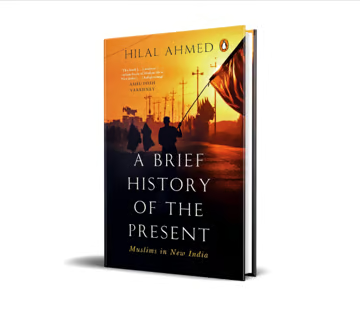
A Brief History Of The Present: Muslims In New India, By Hilal Ahmed Photo: Amazon

Religious polarisation and the rise of majoritarianism in India over the past decade have become a critical concern for scholars in Indian and South Asian studies. The rise of the Hindu right has posed significant challenges to minorities in general and the Muslim minority in particular. Hilal Ahmed, in his book ‘A Brief History of the Present: Muslims in New India’, analyses this Muslim minority question and how it came into being.

The first chapter of this book, titled “Muslimness and Intellectual Politics,” explores the concept of ‘Muslimness’ in two ways: one is explaining Indian Islam as a lived religion while the other is Muslimness as a religious minority in purely statistical terms. The first provides it real-life meaning while the second looks at the Muslim identity in the national or Global question lens. 

Further in the chapter, Ahmad explains the nature and ethics of a researcher, addressing himself as Muslim by religion but as researcher who is bound to follow ethics. He quotes Irena Akbar, saying ‘A Muslim must speak as a Muslim’ and then puts up his view as a Muslim researcher, ‘I do not want to give up my identity as Muslim, yet, at the same time, I do not want to talk only Muslim. I follow intellectual politics which encourages me to have a political stand without compromising with the established procedures and ethics of being an academician’. 

In the second chapter, “What is New in New India?”, Hilal Ahmad explores the historical changes since 2014 and how they have reshaped Muslim politics in India. He argues that the concept of ‘New India’ is a well-formulated ideological framework, with the current regime promoting initiatives like Swachh Bharat, accessible Bharat, and cashless economy (p. 18). However, Ahmad argues its hollowness in the sense regime takes the credit of such grand initiates yet government takes no responsibility for providing employment. For instance, Prime Minister Modi once remarked that selling pakoras is also a form of employment. Ahmad questions whether this is the reality of New India, where unemployment is rampant, and inflation remains high. 

The slogan ‘Sabka Saath, Sabka Vikas’, introduced by Modi in 2014, is scrutinized (p. 20). Ahmad hypothetically argues if it was merely a political move, as actions on the ground suggest otherwise. He highlights how political speeches have often targeted specific communities and promoted fringe elements that commit crimes against minorities, particularly Muslims. Under the guise of cow protection, groups like the BJP-backed Gau Rakshak Dal have been involved in the lynching of Muslims and Dalits. Ahmad questions whether this is truly the vision of New India that began in 2014, signaling the start of a new era. 

In the third chapter, titled “New India and the Muslim Historical”, Hilal Ahmad explores how Muslim history is being reinterpreted in the context of New India. He further explains the Modi’s classification of past that India’s history is often divided into three periods: the first is the era of ‘slavery’, beginning roughly 1000 to 1200 years ago; the second is the period of struggle and liberation; and the third, the present, is described as Amrit Kaal (p. 37).  

Ahmad delves into the evolving dynamics between so-called liberal Hindus and Hinduism, noting a shift in the stance of secular Hindus. Those who once championed pluralism, secularism, and socialism are now silent in the face of rising Hindu communalism. He argues that there is nothing inherently wrong with liberal intellectuals embracing Hinduism as an important identity marker, but he warns that this intellectual shift is dangerous as it subtly excludes Muslims under the guise of opposing an imagined anti-Hindu sentiment. 

For example, Ahmad points to Pavan Kumar Varma, an Indian diplomat and author. Varma once praised the Mughal empire in his book “Ghalib: The Man, The Times”, but in a later work, “The Great Hindu Civilization: Achievement, Neglect, Bias and the Way Forward” (2021), he argues that the arrival of Islam in India disrupted the ‘unadulterated flow’ of the pure Hindu past (p. 41). Ahmad highlights this shift among liberal Hindus, who are becoming more aligned Hindutva, while remaining silent on issues facing minorities. He also notes that this silence is not limited to liberal Hindus but extends to so-called liberal Muslims as well. 

In the fourth chapter, titled “New India and the Muslim Cultural”, Hilal Ahmad addresses contemporary issues like the Gyanvapi mosque and the figure of Aurangzeb (p. 65). He notes that these controversies are not new, but they resurface whenever right-wing politics gains prominence. While these issues may have little direct impact on the daily lives of ordinary citizens, the BJP has made them a central part of its political agenda to garner Hindu votes. 

Ahmad explains how Hindutva groups, such as the RSS and VHP, claim that many historical monuments, like the Gyanvapi mosque, were originally Hindu temples that were demolished by Muslim rulers. These narratives are strategically used to reinforce communal divides and fuel the BJP’s political ambitions. 

In the fifth chapter, titled “New India and Muslim Religion”, Ahmed explores the concepts of religiosity, Muslim self-consciousness, and the rise of Islamophobia or what he terms ‘Muslim politicophobia’. He explains how the growing extremism of Hindutva has fostered a sense of collective identity among Muslims. Ahmed differentiates between Islamophobia, which refers to an intense dislike or fear of Islam or prejudice against Muslims—a notion rooted in Western discourse—and Muslim politicophobia, a more specific phenomenon in India. The fusion of global anti-Islam sentiment with India’s own brand of anti-Muslim communalism has created a new political consensus, which Ahmed refers to as ‘Muslim politicophobia’ (p. 76).

 In the sixth chapter, titled “New India and the Muslim Liberals”, Ahmed explores the question of who qualifies as a liberal Muslim. Many creative individuals—artists, authors, academics, and journalists—who speak out against illiberal tendencies and religious extremism as a moral responsibility are referred to as liberal Muslims. The term has two popular interpretations. One refers to individuals who uphold liberal, egalitarian values while maintaining their cultural and religious identity as Muslims.  

Ahmed raises several key questions regarding liberal Muslims: What is their sociological position, particularly in relation to the highly diverse and heterogeneous Muslim identity? How has the rise of Hindutva challenged their status and legitimacy in public life in recent years? And what qualifications are now required to be considered a “good Muslim” within the Hindutva-dominated discourse? The notion of the ‘liberal Muslim’ is, in fact, a byproduct of India-specific, market-friendly liberalism. Ahmad Argues that it is important to note that this category has always been fluid and open-ended, encompassing progressive Muslims, socialist Muslims, cultural Muslims, and secular Muslims. (p. 94) 

In the seventh chapter, titled “New India and the Muslim Social”, Ahmed delves into the Pasmanda discourse, BJP’s strategies, and Muslim caste dynamics. He points out that the discourse surrounding Pasmanda Muslims is not a recent creation of the BJP’s political strategies. Muslim intellectuals have long discussed how the BJP has attempted to divide Muslims along lines of caste, sect, and differences between Shias and Sunnis. Ahmed highlights how the BJP frames its narrative to gain votes from Dalit Muslims (Pasmanda). 

In the second section of the chapter, Ahmed discusses BJP’s professionalism, noting that the “politics of professionalism” often goes unnoticed in public debates. While Hindutva ideology is frequently overstated as the primary driving force behind BJP’s politics, the party’s electoral strategies and mobilization tactics extend beyond Hindutva rhetoric. This creates the impression that the BJP is strictly pursuing a vision of ‘cultural nationalism’ in overtly Hindu terms, while its political maneuvers are more nuanced and professional. 

In the eighth chapter, titled “New India and the Muslim Political”, the author examines Muslim political attitudes, distinguishing between political participation as interaction and political participation as instrumental action. He maps out the various dimensions of Muslim political behavior in contemporary India. 

In his concluding remarks, Ahmed brings together the key insights of the book, offering a comprehensive understanding of the political status of Muslims in New India. He emphasizes that, despite the BJP’s ongoing efforts, the party still manages to secure only 8-9% of the Muslim vote. Ahmed presents his arguments in a coherent manner that ties together the broader themes of the book, making it a valuable resource for academics, everyday readers, and politicians alike who wish to understand the minorities issues facing New India. 

(Haider Ali did his masters form Jamia Millia Islamia, Mohammad Asif is pursuing his Ph.D. from Jamia Millia Islamia)  

source: http://www.outllookindia.com / Outlook / Home> Books / by Haider Ali & Mohammed Asif / November 09th, 2024

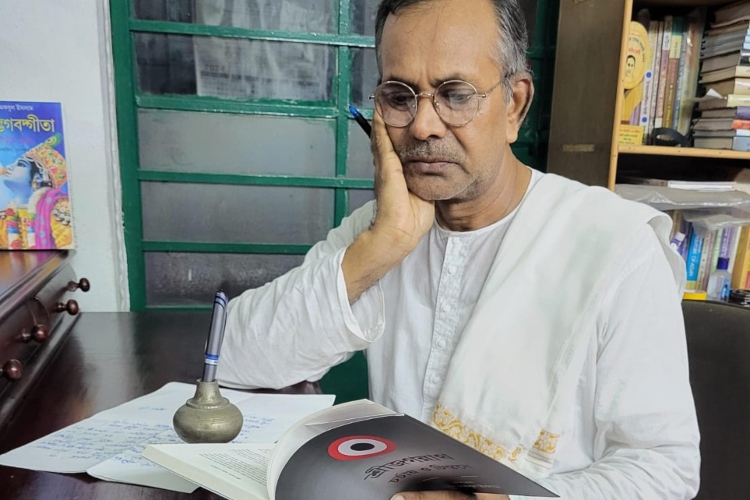
Author of 65 books, Sheikh Maqbool Islam is an authority on Lord Jaganath

Sabsit Village (Bagnan Town, Howrah District) , Kolkata, WEST BENGAL :

Prof Sheikh Maqbool Islam with his latest book on Lord Jaganath

Meeting Professor Sheikh Maqbool Islam is like sitting in the cool shade of a Banyan tree. In my first meeting with this Kolkata academic in his mid-fifties,  my feeling was akin to that of a traveler who finds shade on the banks of a cool river in the middle of his journey on a hot day.

Professor Sheikh Maqbool, Bengali language professor of St. Paul’s College of Kolkata is an expert on Shrimad Bhagwat Gita, the ancient scripture of Hindus as well as the Holy book in Islam the Quran, and of the Christians the Bible.

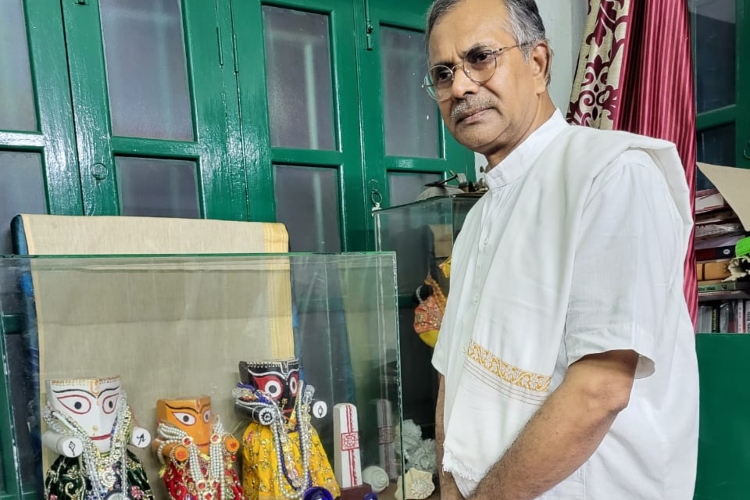
Besides he is an expert on Bhagwan Jagannath of Puri (Odisha), who is the reigning deity of the Eastern States.

Prof Islam feels he is a born Sufi as he is the son of Sheikh Sajad Ali, a Sufi, and his mother Hazra Khatun. However, growing up he never imagined that one day he would write as many as 65 books.

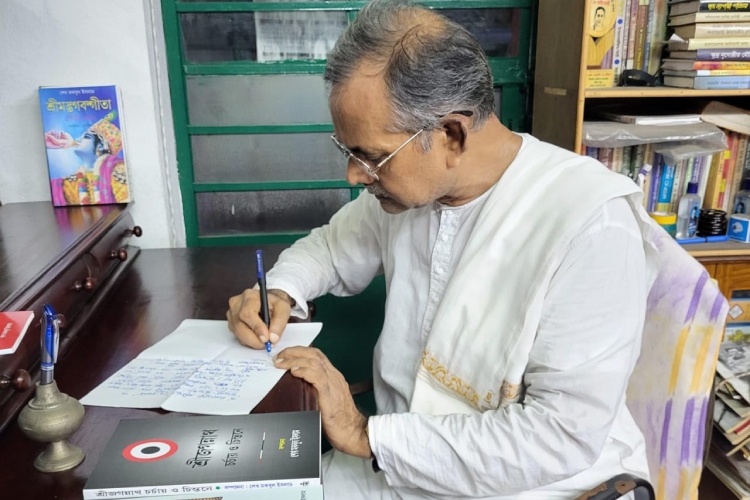
Sheikh Maqbool Islam in his study

Prof Sheikh Maqbool Islam’s mother tongue is Bengali but he knows Hindi, Hindustani, Bengali, Oriya, Assamese, and English languages.

He says, “When I was two and a half years old, I met Sufi saints in my village. My father Sheikh Sajad Ali was himself a Sufi, so Sufi saints and scholars visited our house.”

“In the village, we had many Sufis and a large number of Vaishnav people. So when I was four and a half years old, I gradually started getting influenced by both. At this age, I also came to know about Shri Jagannath Bhagwan of Puri (Odisha).”

He says, “As I grew up, my mind opened up. I started knowing a little bit about all religions and cultures. “It felt as if I was finding the path to freedom from illusion.”

Prof Islam was born in the Sabsit village of Bagnan town of Howrah district, which is two and a half hours from Kolkata.

Prof Sheikh Manzoor Islam with Lord jaganath and other deities in his study

He came to the city (Calcutta) in 1985 holding the hands of his father.“I have been living near Howrah station since 1985. I studied all through in Calcutta.”

The author of 65 book, Prof Sheikh Maqbool Islam says he has Surdas (the 16th-century devotional poet who was blind)), Tulsidas, (Author of the epic Ramcharitramans, the story of Lord Ram in the Awadhi language) and Meerabai (the 16th century Saint who is known for her devotion to Lord Krishna close to in his heart.

Some of his most widely read books include ‘Gita-Quran Comparative Study’, ‘Tattva Chinta of Folk Culture’, and research subject ‘Lok Sangeet Vigyan’ .

He holds a D.Litt in ‘India-Odia Cultural Relations’ from Utkal University of Odisha in the year 2015, then PhD in ‘Comparative Study of Bangla-Odia Folk Literature’.

Professor Sheikh Maqbool Islam has also been a ‘Senior Research Fellow’ at the Asiatic Society of Calcutta. It is the largest center of oriental studies in our country.

Professor Sheikh Maqbool Islam in his study

Since 1997, he has been working as an Associate Professor at Calcutta’s oldest St. Paul’s Cathedral Mission College. He teaches Bengali language and literature in this college, which was established in 1865.

Professor Sheikh Maqbool Islam believes that the fight over religion is meaningless. The main reason for this is the lack of culture.

He says, “It is very important to have a culture to create brotherhood. It needs to be understood properly, otherwise we will keep fighting.”

Prof Sheikh Maqbool Islam, who has traveled to the Philippines, Thailand, Malaysia, Sri Lanka, Bangladesh, and Nepal, has received many awards.

He was awarded Odisha’s highest honour ‘Navakalevara Award’ in the year 2015 for his research work on Lord Jagannath.

Prof Islam was given this award by Puri’s Shankaracharya Swami Nischalananda Saraswati.

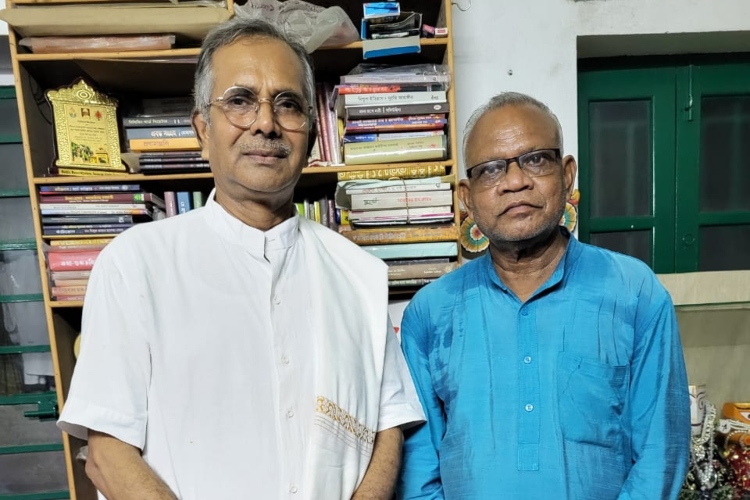
Prof Sheikh Manzoor Islam with the author

He says, “He has a total of 14 books on Jagannath.’ Among these books, ‘Shri Jagannath: Bengali Manas and Lokayat Jeevan’ is the most popular. Professor Sheikh Maqbool Islam has also done research work on Ramakrishna Paramhansa and Sri Chaitanya.

Professor Islam is doing a new research on the spread of Vaishnavism in South Asia and South East Asia

He considers Jagannath, Sri Chaitanya, Tulsidas, and Guru Granth Sahib as his idols, and is currently researching ‘How did Sri Jagannath and our Vaishnavism reach South Asia and South East Asia?’

These countries include the Philippines, Cambodia, Thailand, Indonesia, Malaysia, Sri Lanka, Bangladesh, Nepal, Myanmar, Singapore and Japan. He says, “I have been to some of these countries. Some are still left. I have been engaged in research for a long time.”

Prof Sheikh Maqbool Islam eats vegetarian food. Leaving his library with countless books, I remembered the following lines of Iqbal Sajid:

Suraj Hoon, Zindgi ki ramak choor jauga; Mein Doob bhi gaya tou shafak chod jaonga 

(I am the Sun, I will leave behind the joy of life. Even if I set, I will leave behind the dawn)

source: http://www.awazthevoice.in / Awaz, The Voice / Home> Story / by Jayanarayan Prasad, Kolkata / August 18th, 2024

Kerala Scientist Dr. Safeer CK Wins Prestigious Royal Society Fellowship

Malappuram, KERALA / London, U. K :

London:

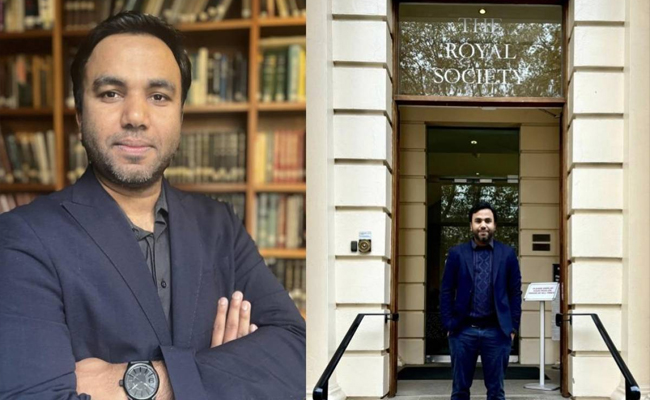
Dr. Safeer CK, a distinguished physicist from Kerala and faculty member at the University of Oxford, has been awarded the esteemed Royal Society University Research Fellowship for 2024. This recognition comes with a significant funding grant of £1.85 million (approximately Rs 19.73 crore).

A pioneer in spintronics, Dr. Safeer’s groundbreaking research in nanomaterials, just one atom thick, aims to revolutionize next-generation electronics, including brain-inspired computing architectures. He leads the Oxford-MIND group at the renowned Clarendon Laboratory in Oxford.

Hailing from Malappuram, Kerala, Dr. Safeer’s academic journey began at Mongam Ummul Qura Higher Secondary School and Morayur V.H.M. Higher Secondary School.

He later pursued Physics at Delhi University’s Hansraj College, followed by postgraduate studies at Joseph Fourier University in France with scholarships from the Indian and French governments. He completed his doctorate in Nanophysics at France’s Spintec Laboratory, part of the French Atomic Centre.

Dr. Safeer’s accolades include the prestigious Marie Curie Individual Fellowship and three international patents in magnetic memory technologies. He has also published 18 research articles, including papers in Nature journals, and teaches Physics and Electronics at Oxford.

The Royal Society Fellowship, one of the highest honors in the scientific community, has previously recognized legends like Isaac Newton, Albert Einstein, Srinivasa Ramanujan, and C.V. Raman.

source: http://www.thehindustangazette.com / The Hindustan Gazette / Home> News> National> Kerala / by Shifa / November 19th, 2024

India’s First International Conference on Indian Muslims’ Contributions to Nation-Building to be Held in Bidar

Bidar, KARNATAKA :

Bidar :

The Shaheen Group of Institutions is set to host a groundbreaking international conference on November 30 and December 1, 2024, in Bidar, Karnataka.

Touted as India’s first event of its kind, the conference aims to spotlight the contributions of Indian Muslims in critical sectors such as education, politics, media, economics, IT, social services, and madrassa education, envisioning their role in shaping a developed India by 2047, the centenary of the nation’s independence.

The conference will serve as a platform for thought leaders, intellectuals, and influencers from India and abroad to network and exchange ideas. Attendees will deliberate on the community’s potential to drive transformative change in various fields, aligning with India’s vision for growth and development.

This pioneering event highlights the Shaheen Group’s commitment to fostering dialogue and collaboration within the Indian Muslim community to contribute effectively to the nation’s progress.

source: http://www.thehindustangazette.com / The Hindustan Gazette / Home> News> Education / by Shifa (image source: shaheengroup.org) / November 27th, 2024

“21st Century awaits Muslims’ constructive role” says author

NEW DELHI :

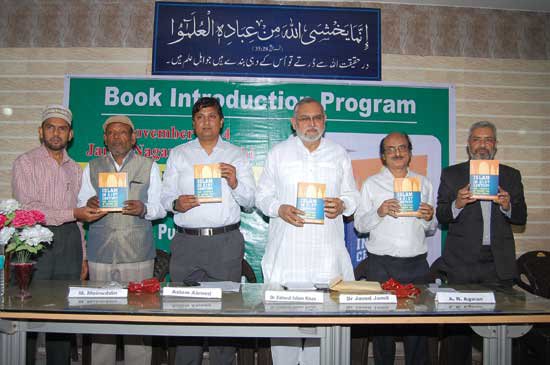
In a book introduction programme held here on 2 November, the author of the book “Islam in 21st Century: The Dynamics of Change and Future-making”, Abdul Rashid Agwan anticipated that Muslims will play their constructive role in the third millennium as effectively as they played it in the past two millennia, especially during the current century.

The author based his optimism on extensive data he collected regarding recent developments in the Muslim World. He underlined that during the past decade or so the average literacy rate of Muslim countries has increased from 40 percent to 72 percent, the number of universities has gone up from 500 to 2137, the graduation enrolment rate and the rate of science research publications have been improving faster there than in other parts of the world. He also mentioned that the average GDP growth in OIC countries was 6 percent during the last decade in spite of  serious turmoil in parts of the Muslim World. He argued that powered by the increasing strength on many fronts and aided by sound vision and proper strategies, Muslims can shape a better future not only for themselves but also for the mankind at large.

Agwan further argued that the western strategies of oil wars and terrorism have not yielded much for the USA-led countries. They have rather caused the USA huge revenue loss, economic recession, failure in diplomacy, loss of credibility, widespread impoverishment of veterans who fought in Afghanistan and Iraq, revival of Russian clout in global affairs, total absence of America from Afghanistan’s mine auction. This was called “a decade from hell” by Time magazine. Agwan further mentioned that the situation has so much gone contrary to the western aspirations that the current century is gradually turning into an Asian Century rather than an American Century as envisaged under a unipolar world.

Journalist and author, Dr Zafarul-Islam Khan said in his presidential remarks that in spite of the positive growth story of many Muslim countries, the gap in terms of quality between the West and the Muslim world is still very wide and this calls for Muslims’ accelerated endeavours on all fronts of human development. He felt a dire need of promoting think-tank activities in the Muslim World and emphasised on innovation and science-research output. Dr Khan was critical regarding lack of freedom in many Muslim countries and wished that the Muslim leadership should rise to the occasion and generate a better environment for development and progress.

While presenting his keynote address on the occasion, well-known author Dr Javed Jamil welcomed the publication of this thought-provoking analysis of the present day standoff between the West and the Muslim World and also for coming out with some wise proposals as a roadmap. Dr Jamil aspired that academics should undertake deeper studies regarding the anti-human policies of the western world and make the global society aware about their pernicious impact on human life at large.

A written note of Dr Mohammad Rafat, professor in physics in Jamia Millia Islamia, was read out during the presentations. He stated that the given book could be included among those few works which have focused on the issue of change and future-making. He expected that Muslims will take proper initiatives and make conscious efforts in this fast-changing world and play their guiding role in future.

Advocate Aslam Ahmed Jamal, the assistant general secretary of All India Educational Movement, appreciated views of the author regarding the nature of change and stated that the book can make a prompting impact on the mind of educated Muslim youths who are serious to contribute some way in shaping human future.

Mohammad Moinuddin, former assistant registrar of Jamia Millia Islamia, briefed  the audience about various academic and social contributions of Abdul Rashid Agwan and appreciated that he wrote the book while bed-ridden for more than two years recovering from a crippling condition called paraplegia, which speaks of his optimism and also of the book that inculcates hope and optimism in its readers towards the realization of a better world not only for Muslims but also for the mankind at large.

The publisher of the book, Gloriords Publications, Shahabuddin Yaqub, wished that Muslims would develop deeper faith on God and deliver their best in future without bothering about the vicissitudes of time. He reminded that the very advent of Islam was from a wretched land sandwiched between two contemporary super-powers, Rome and Persia, which were reluctant to  rule Arabia but became its early causalities within a few decades. Therefore, he said, physical conditions are not that much important for the believers as regards future-making than the depth of their faith and commitment.  

(For more information about the book, visit islamin21stcentury.com)

source: http://www.milligazette.com / The Milli Gazette / Home> National> News / by The Milli Gazette / November 28th, 2014

Waqf power at work

NEW DELHI / INDIA :

New battle-lines are being drawn in Parliament, and out of it, with waqf and its management at the centre of a major political slugfest.

New battle-lines are being drawn in Parliament, and out of it, with waqf and its management at the centre of a major political slugfest.

At this juncture, it is appropriate to recall the achievements of Hakeem Abdul Hameed, the founder of Jamia Hamdard, whose birth centenary was celebrated in December 2008, and the waqf he founded ~ the Hamdard (Waqf) Laboratories ~ is well into its ninth decade. Speaking during Hakeem saheb’s centenary celebrations at Jamia Hamdard, then Vice-President of India Hamid Ansari observed, “in our recent history Hakeem Abdul Hameed is probably the first, and the most successful, to resurrect the waqf concept in innovative ways so that a modern company was registered as a wakf institution whose income was to be used for public good in the areas of education, medical relief and the advancement of knowledge.

It was an important signal in the immediate aftermath of the painful Partition of India to thread together the religious element with socio-economic progress and alleviation of poverty.” The Vice-President added, “Since the 1930s and 1940s, over 25 educational research institutions were established, culminating in the Jamia Hamdard. The range is astounding ~ ranging from primary education to post-doctoral research, from Unani Medicine to Information Technology, from Islamic Studies to Business Management. Besides the university, the colleges and hospitals established for service to society, there are a set of institutions that bear testimony to his scholarly interests.

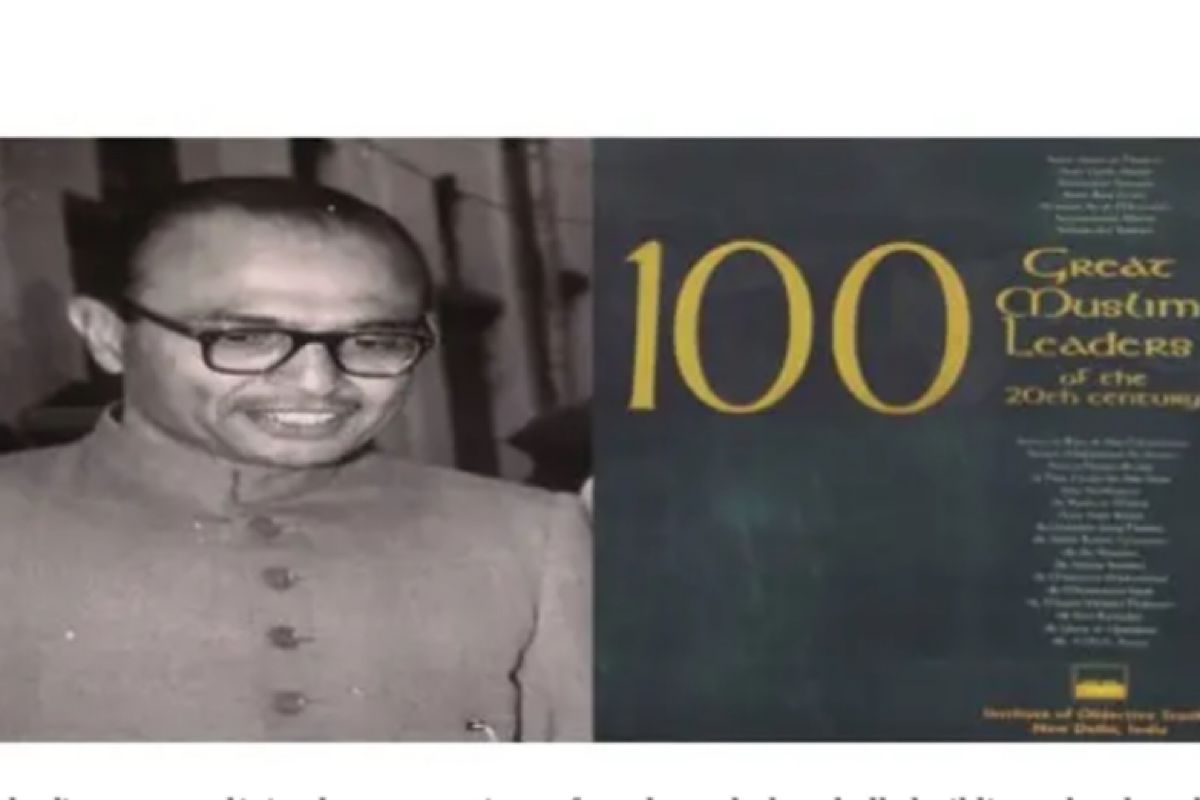
I refer to the Institute of History of Medicine, the Institute of Islamic Studies, the Ghalib Academy and the Institute of Federal Studies. Each of these has rendered significant service to scholarship.” Undoubtedly the list of achievements is long but as Hamid Ansari commented, “these achievements hold a mirror to the potential of what public-minded personalities can achieve through the institution of waqf for the socio-economic, educational and cultural betterment of the community. Future generations would behold Jamia Hamdard and Talimabad and wonder at the capacity, vision and dedication of an individual.” Truly so, for in ‘100 Great Muslim Leaders of the 20th century’, a publication of the New Delhi based Institute of Objective Studies (IOS), Dr Mohd Manzoor Alam provided a larger global context to understanding the achievements of Hakeem Abdul Hameed as an outstanding educationist and social reformer, along with his equally illustrious younger brother Hakeem Mohammad Said.

“In the face of formidable challenges which marked the lives of a selected 100 great Muslim men and women of the 20th century,” wrote Dr Alam in the preface, “their lives, struggles and contributions reflect the response of Muslims to the multiple challenges over the century…the ‘100 Great’ belonged to five continents and they came from different cultural and linguistic backgrounds, they were inspired by the eternal values and principles of Islam and the precepts of their illustrious forebears in the annals of Islamic history.” Through the tumultuous decades of the 20th century, Dr Alam observed that the ‘100 great Muslim leaders’ were unwavering in their “faith in the Holy Quran describing Muslims as ‘good people’, whose mission on earth is to help others live a meaningful life.

Even in the darkest hour the world of Islam was not plaued by a dearth of men and women who had the stature, mettle and competence to rise to the occasion. The two revered Hakim brothers ~ Hakeem Abdul Hameed and Hakeem Mohammad Said ~ who revived the Unani or Greco-Arab system of medicine and created two institutions, the Hamdard in India and its twin in Pakistan, are inspiring examples of leadership. They did not really belong to any one place. This is aggravated by Western colonial redrawing of the Muslim world map: Hakeem Abdul Hameed in India and Hakeem Mohammad Said in Pakistan were, in fact, two sides of a single sub-continental picture of Islamic excellence.”

The lifetime achievements of Hakeem Abdul Hameed were myth-busters: it had been an enduring myth of the 20th century that the Muslim world had been in deep slumber, their state of somnolence stretching back to centuries. Said Dr Manzoor Alam, “the 20th century instead turns out to be a period of extraordinary intellectual, moral and social awakening and struggle across the Muslim world with societies from Malaysia to Morocco trying hard to reform, promote and practice Islam as a living reality that could guide them through difficult times.” The Hamdard story began over a century ago when Abdul Hameed’s father, Hakeem Hafiz Abdul Majeed, established the Hamdard Dawakhana in 1906.

The vision was implicit in the name. Hamdard means ‘the sharing of pain’ and willingness to mitigate it was to be the motto of future generations as well. The vision was also to break the exclusivity of medicinal preparation of each Unani Hakim and make it available to the masses through modern laboratories along scientific lines. A traditional system of medicine was thus modernised with a nationalist inspiration and an indigenous base. “For this reason, Hakeem saheb can rightly be called a Mujaddid (or reformer) of Unani medicine,” said Ansari in the centenary speech.

Writing in ‘Muslim Mirror’, Abdul Rashid Agwan detailed the story. After Independence in 1947, Hamdard University or Jamia Hamdard has been the first institution that was established and managed on the basis of waqf income. In 1948, the manufacturing and selling unit of Hamdard Daw – akhana, Hamdard (Waqf) Laboratories, was converted into an endowment. Its deed dated 28 August 1948 provided for “Qaumi Income” (Public income) and “Khandani Income (Family income). However, the concept of family income was abolished by a declaration of the Settler/ Founder-Wakif Mutawalli in 1985, with retrospective effect from 1 January 1973. From the profits of the company, Hamdard Tibbi College was set up in 1963 in Old Delhi which later shifted to its present 90-acre campus in Tughlaqabad. In order to effectively manage and utilize the income accrued from Hamdard Waqf Laboratories for the promotion of its objective, Hamdard National Foundation was created on 12 May 1964 to disburse company profits to promote interests of society.

All profits of the company were obligated to go to the Foundation. Both Hamdard and the Foundation were registered under Section 12A of the Income Tax Act. Coinciding with the establishment of the Hamdard National Foundation in India, Hamdard Waqf Laboratories Pakistan also formed Hamdard Foundation Pakistan the same year. Its founder, Hakeem Muhammad Said, expressed the mission in these words, “Hamdard … has chosen to serve through activities for the promotion of good health and education ~ the twin pillars of progress.” Through the 1950s and 60s, when educational institutions namely, Indian Institutes of Technology, Indian Institutes of Management, AIIMS and Jawaharlal Nehru University ~ were being established with Government resources and with the focus of providing a new nation the benefit of modern science and education, Hakeem Abdul Hameed was single-handedly building schools, colleges and the university under the Jamia Hamdard banner, relying on internal resources of Hamdard Waqf Laboratories, and focused on rejuvenating the millennia-old Greco-Arab medicine which came to be simplistically known as Unani medicine. In this long process of reviving ancient knowledge, Hakeem saheb’s original contribution was the use of modern scientific methods and technology for the standardisation and manufacture of Unani medicine. “Quite early in life, when he was studying medicine at the Tibbia College, he was deeply impressed by the systematic and methodical approach of Hakeem Ajmal Khan towards the classification and standardisation of Unani medicines,” the IOS publication narrated. The Hakeem brothers travelled across Asia and Europe in the 1950s closely observing modern methods and techniques of drug making. They were convinced of the relevance and necessity of using modern technology for medical experimentation and manufacture of Unani medicines. At Hamdard Laboratories, Hamdard University, Hamdard Nursing Home and Majidia Hospital, these modern methods and technology were put into good use, ensuring the regimen of Unani system of medicine could co-exist with modern science and technology.

“This integrated, holistic approach to diagnosis and therapy is one of the most original and outstanding contributions of Hakeem Abdul Hameed,” the IOS publication stated. Eleven books on Unani medicine: Arab medicine and its relevance to modern medicine; Earth, elements and man: Search for a solid foundation of the theory and practice of medicine; and the magnum opus Qarabadin-e-Hamdard or Hamdard Pharmacopoeia are testimony to Hakeem Abdul Hameed’s medical observations, experiences and researches. In the 1980s, he initiated path breaking research on Ibn Sina’s Al-Qanun fit-Tibb or The Canon of Medicine. The 3-volume study was made available in multiple languages, including English.

Several national and global awards were bestowed on Hakeem Abdul Hameed who lived an austere life on campus till the age of 91, with a Gandhian determination to build the new nation through promotion of medicine, modern education and public charity. Like Sir Syed Ahmed Khan and Hakeem Ajmal Khan, Hakeem Abdul Hameed remains a towering personality whose contribution to modern education and medicine is second to none. It is in the domain of waqf management that Hakeem saheb gave modern India a new path for sustainable, equitable development.

(The writer is a researcher writer on history and heritage issues and a former deputy curator of Pradhanmantri Sangrahalaya)

source: http://www.thestatesman.com / The Statesman / Home> Opinion / by Raju Mansukhani, New Delhi / October 07th, 2024

Jamia’s Mohammad Zahid Ashraf gets Indian Council of Medical Research Award

NEW DELHI :

Jamia Millia Islamia’s Professor Mohammad Zahid Ashraf has been honoured with prestigious Indian Council of Medical Research (ICMR) award for research on oxygen regulation.

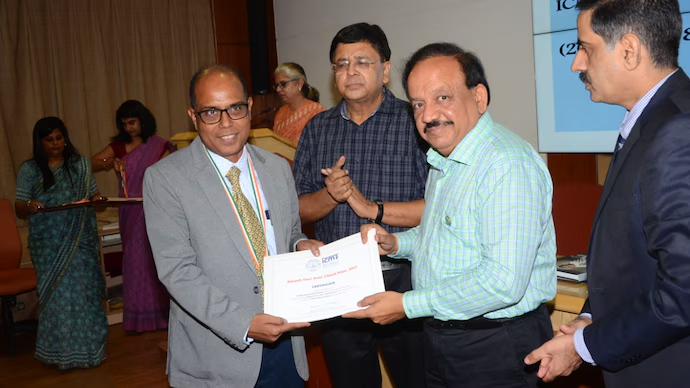
Prof. Mohammad Zahid Ashraf receives Basanti Devi Amir Chand Prize, an award instituted by Indian Council of Medical Research (ICMR).

Mohammad Zahid Ashraf, professor in the Department of Biotechnology, Jamia Millia Islamia(JMI) has been awarded the prestigious Basanti Devi Amir Chand Prize, an award instituted by Indian Council of Medical Research (ICMR). The prize was given by Union Health Minister, Harsh Vardhan yesterday in recognition of Prof. Ashraf’s research excellence.

Basanti Devi Amir Chand Prize is one of the earliest instituted awards of the ICMR in the year 1953 for the significant research contributions in the field of biomedical sciences.

What was Prof Ashraf’s research famous for?

Prof. Ashraf’s lab has been instrumental in understanding the role of low oxygen due to high altitude in the development of cardiovascular disorders including blood clotting.

The significance of research of cellular reactions in response to low oxygen could be analyzed from the fact that this year’s Nobel Prize committee for physiology or medicine recognized the potential of the discovery of how cells sense and adapt to oxygen availability and jointly awarded the three scientists for their landmark discoveries in this field. Oxygen is required for the process of oxidation that produces energy. Therefore, its short supply might result in lung damage, brain dysfunction, heart problems and many more.

” Prof. Ashraf’s research has provided an insight into the role of oxygen-regulated mechanisms behind blood clotting disorders and demonstrated the detrimental effects of low oxygen availability at high altitude.

About Mohammad Zahid Ashraf

Dr Ashraf is Fellow of both National Academy of Sciences and the Indian Academy of Sciences. He is also the recipient of prestigious DBT’s S Ramachandran-National Biosciences Award 2018. He is currently holding the position of Director (Academics) in the university.

Prior to his joining at JMI, he was Head of Genomics Division at Defence Institute of Physiology and Allied Sciences (DIPAS), Defence Research and Development Organization (DRDO), Delhi.

source: http://www.indiatoday.in / India Today / Home> News> Education> Today> News / by India Today Web Desk / October 17th, 2019

How Abbajaan became Pitashri and other stories from Rahi Masoom Raza’s Mumbai years

Gangauli (Ghazipur District), UTTAR PRADESH / Mumbai, MAHARASHTRA :

Edited excerpts from an essay by the translator of the renowned writer and poet’s novel ‘Scene 75’.

The first thing I read when I opened Scene: 75 was the ‘Vasiyat’ (‘Will and Testament’). I was so moved, I kept going back to it until, finally, I took a picture and pasted it on my laptop screen so that I could see it every time I opened my computer. At that time, all I knew about Rahi Masoom Raza was that he was a highly respected poet and novelist, though his success as a writer of Hindi films had somewhat overshadowed his literary accomplishments. But what eventually eclipsed everything – at least in the popular imagination – was that he was the writer of the majestic dialogues for the blockbuster TV series Mahabharat. Over time, as I read more and more about him and his life, I realized that the ‘Vasiyat’ was a true mirror of the kind of man he was: an unsparing critic of fundamentalists and hypocrites of every hue, with deep roots in his hometown in Ghazipur, Uttar Pradesh. All this found reflection in his writing, which also had a strong dose of biting humour that made you laugh out loud and wince at once.

Satire about the stars

Scene: 75 itself is a darkly funny, surreal novel in which Rahi sahib casts an unsparing, satirical look at the Hindi film industry of the 1970s and also writes about Hindu–Muslim relations with his customary blistering honesty. The book begins with Ali Amjad, a struggling scriptwriter from Benares, trapped in a lonely Bombay flat, and ends with him still trapped in that lonely flat. But in the middle is a teeming, intertwined, untidy throng of cynical and manipulative characters and their equally fantastic stories, narrated with a no-holds-barred candour by Rahi sahib. Unscrupulous film producers and ambitious clerks rub shoulders with wealthy lesbians and bigoted middle-class social climbers. There are few lovable characters. When I finished the novel, I realized that the only character I cared for was Ali Amjad (Rahi sahib himself, I think) – nevertheless, all of them held my undivided interest. They made me laugh even as I shook my head in disbelief at their doings.

Rahi sahib wrote several novels between 1966 and 1986, the best-known of which is the first one, Aadha Gaon, a vivid, true-to-life depiction of the Shia community in a village, Gangauli, in the United Provinces at the time of Partition. The lives of Muslims in India and their relationship with Hindus formed the central motif in many of Rahi sahib’s works, including the brilliant Topi Shukla (1968) and Os Ki Boond (1970). Even in Scene: 75, this fraught relationship is thrown into sharp focus. Ali Amjad is hunting for a house and can’t find one because he is a Muslim. He is asked to pretend he’s a Sindhi by a prospective landlord, but Ali Amjad refuses:

“‘I am a Muslim and I also work in films,’ Ali Amjad said. He thought it was necessary for him to say this. He was not a religious man. He didn’t believe in Allah. He didn’t do namaz. He didn’t fast during Ramzan. He was an uncompromising critic of organizations like the Muslim League and the Jamate-Islami … But he was not ashamed of the fact that he had been born into a Muslim family. And he did not want to insult himself or his country by hiding his name and identity.”

Dialogue with cinema

Rahi sahib came to Bombay in 1967 to try his luck in Hindi films, and lived and worked there until his death in 1992. He wrote the script and dialogues for over 300 films, including enduring hits such as Mili (1975), Main Tulsi Tere Aangan Ki (1978), Gol Maal (1979), Karz (1980), Lamhe (1991) and many others. But he is best remembered for his dialogues for the 94-episode mega TV series, Mahabharat, in the late 1980s. There’s an interesting story about how Rahi sahib took up this challenging project. According to his close friend and colleague at Aligarh Muslim University (AMU), Kunwarpal Singh, when filmmaker B.R. Chopra requested Rahi sahib to write the dialogues, he declined, saying he didn’t have the time. But B.R. Chopra went ahead and announced Rahi sahib’s name at a press conference anyway. In no time, letters of opposition from self-styled protectors of the Hindu faith arrived: Were all Hindus dead that Chopra had to give this task to a Muslim? Chopra promptly forwarded the letters to Rahi sahib. Ever the champion of India’s syncretic culture, Rahi sahib called Chopra the next day and said, ‘Chopra sahib! I will write the Mahabharat. I am a son of the Ganga. Who knows the civilization and culture of India better than I do?’

He was born in 1927 in Ghazipur in eastern Uttar Pradesh, on the banks of the Ganga, and retained a deep attachment to his childhood home all his life. (Poet and lyricist Javed Akhtar said in an interview that Rahi sahib found a way to introduce his hometown into every conversation, even if it was about the United Nations Security Council.)

After finishing his school education in Ghazipur, Rahi sahib went to Aligarh for higher studies and did a doctorate in Hindustani literature. By the early 1960s, he had got a job as an Urdu lecturer in AMU. Javed Akhtar, in an interview, says, ‘Rahi sahib was a cult figure [on the campus]. He enjoyed a huge fan-following among the students, boys and girls both, owing to his charming and stylish persona. His admirers would walk by his side whenever he roamed [around] in the campus. He would limp a bit, for he had been affected by polio in his childhood, but his elegant sherwani, which he would never button, and the classy kurta, would make it clear that he was no ordinary man. He was a star.’

Moving to Mumbai

If things were going so swimmingly in Aligarh, why did he uproot himself and shift to Bombay? According to Kunwarpal Singh, this decision was triggered by his wedding to Nayyar Jahan in 1965. She had been previously married, but Rahi sahib fell in love with her and, despite opposition, went ahead and made her his wife. A fullblown scandal erupted and Rahi sahib lost his job at AMU (though Kunwarpal Singh says that the scandal merely gave his rivals and foes an excuse: they had always been opposed to his attempts to introduce Hindi courses in the Urdu department and vice versa).

Aadha Gaon had been published by then. It had brought him renown but was of no help in securing a livelihood. Nadeem Khan, Rahi sahib’s son, says that it was filmmaker Ramesh Chandra, an Aligarh acquaintance of Rahi sahib’s (also the older brother of actor Bharat Bhushan), who invited him to come to Bombay and try his luck in the film industry.

And that’s what he did. Initially, there was no work. He tided over that difficult period with the help of his writer friends like Kamleshwar (who was editing the magazine Sarika then) and Dharamvir Bharati (who was editing Dharmyug). His writings were published in their magazines; often they paid him in advance. But slowly, he began establishing himself in the film industry. He worked closely with film-makers such as Raj Khosla, B.R. Chopra, Yash Chopra, Hrishikesh Mukherjee and others. He became acquainted with the art of writing dialogues. Kunwarpal Singh recounts how once Rahi sahib had to write the dialogues for a Raj Khosla film. When the latter came to read the script, he kept saying, ‘Kya baat hai! Bahut khoob!’ as he turned the pages. At the same time, he kept cutting the dialogues. In the end, he kept just two or three lines out of every two pages. Rahi sahib learnt his lesson – in cinema, you don’t need verbosity; pages of dialogue can sometimes be communicated through a single close-up on screen. Over time, he became a consummate practitioner, winning two Filmfare Awards for Best Dialogue (for Main Tulsi Tere Aangan Ki and Mili).

Nadeem Khan remembers how he got his third award. Rahi sahib had written the dialogues for Lamhe and was very disappointed when it performed poorly at the boxoffice. He was proud of the work he had done in the film and had hoped for a Filmfare Award. But soon after Lamhe released, he passed away. He was just 65. Not long after that, Nadeem Khan, who was then working as the cinematographer for a Rakesh Roshan film, King Uncle, got a call from Filmfare. Rahi sahib had won the Best Dialogue Award for Lamhe posthumously. Khan remembers going to the function and collecting the award on his behalf. Jeetendra, the actor, was on stage and started crying. Khan says he felt his eyes welling up too. ‘As I came down, there was B.R. Chopra on one side and Yash Chopra on the other. Both kept hugging me,’ he recalls. ‘I went home and put the award in front of Rahi sahib’s photograph.’

The masterful dialogues for Mahabharat and the decision to make Samay (Time) the narrator were what elevated the series to another plane. The production values and acting left much to be desired, but the powerful dialogues by Rahi sahib made the show the astounding success that it was. He coined new words, such as ‘Pitashri’ and ‘Matashri’, which became so popular that people thought this was how characters must have spoken in ancient times. The truth is that Rahi sahib adapted these words from the way family members are addressed in Urdu – ‘Ammijaan’, ‘Abbajaan’ and so on.

Nadeem Khan says that those years of writing the Mahabharat took their toll on Rahi sahib: ‘He aged fifteen years in that time. It was very stressful – he couldn’t afford to take one wrong step,’ he says. ‘After Mahabharat, he was supposed to write another TV show, Om Namah Shivay (he was a great Shiv bhakt). But that was not to be.’

Excerpted with permission from Scene 75, Rahi Masoom Raza, translated by Poonam Saxena, HarperCollins India.

source: http://www.scroll.in / Scroll.in / Home> Book Excerpts / by Poonam Saxena / December 30th, 2017

A ‘Ph.D. Wedding’ Celebration for the Study of Malabar Muslim Women

Malappuram, KERALA :

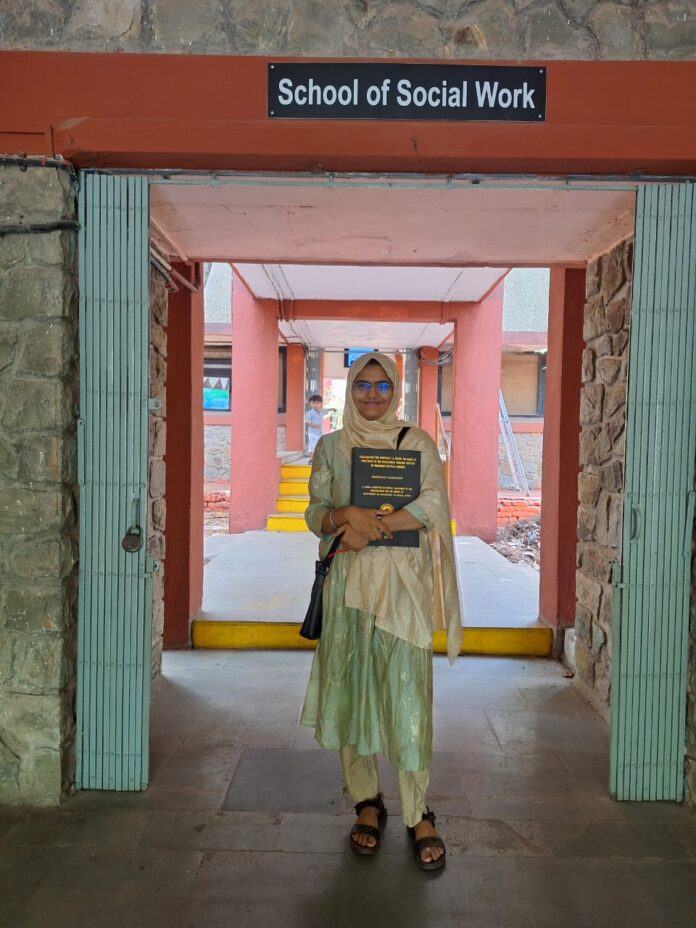
Dr Noorjahan in TISS Mumbai

Kozhikode: 

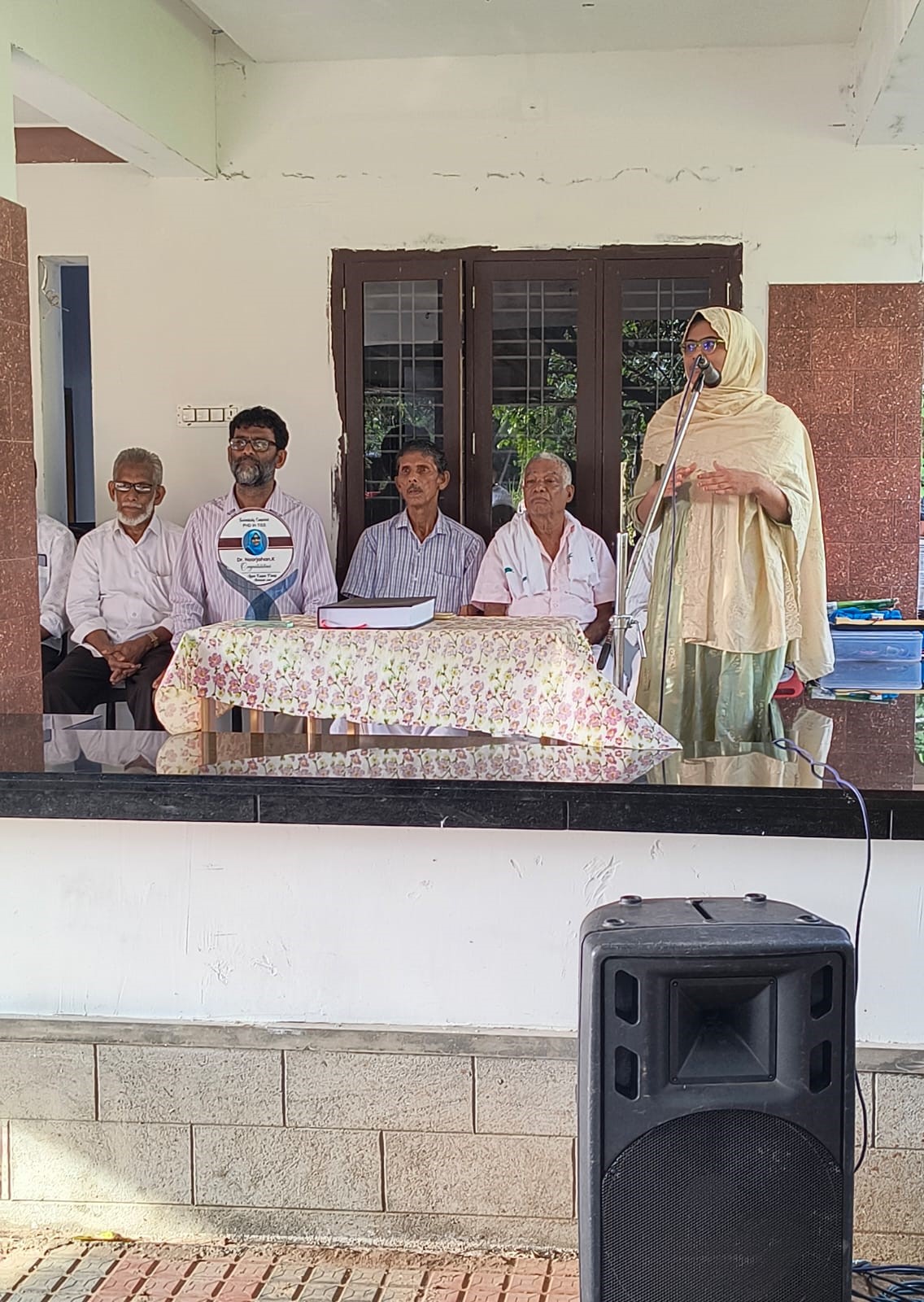
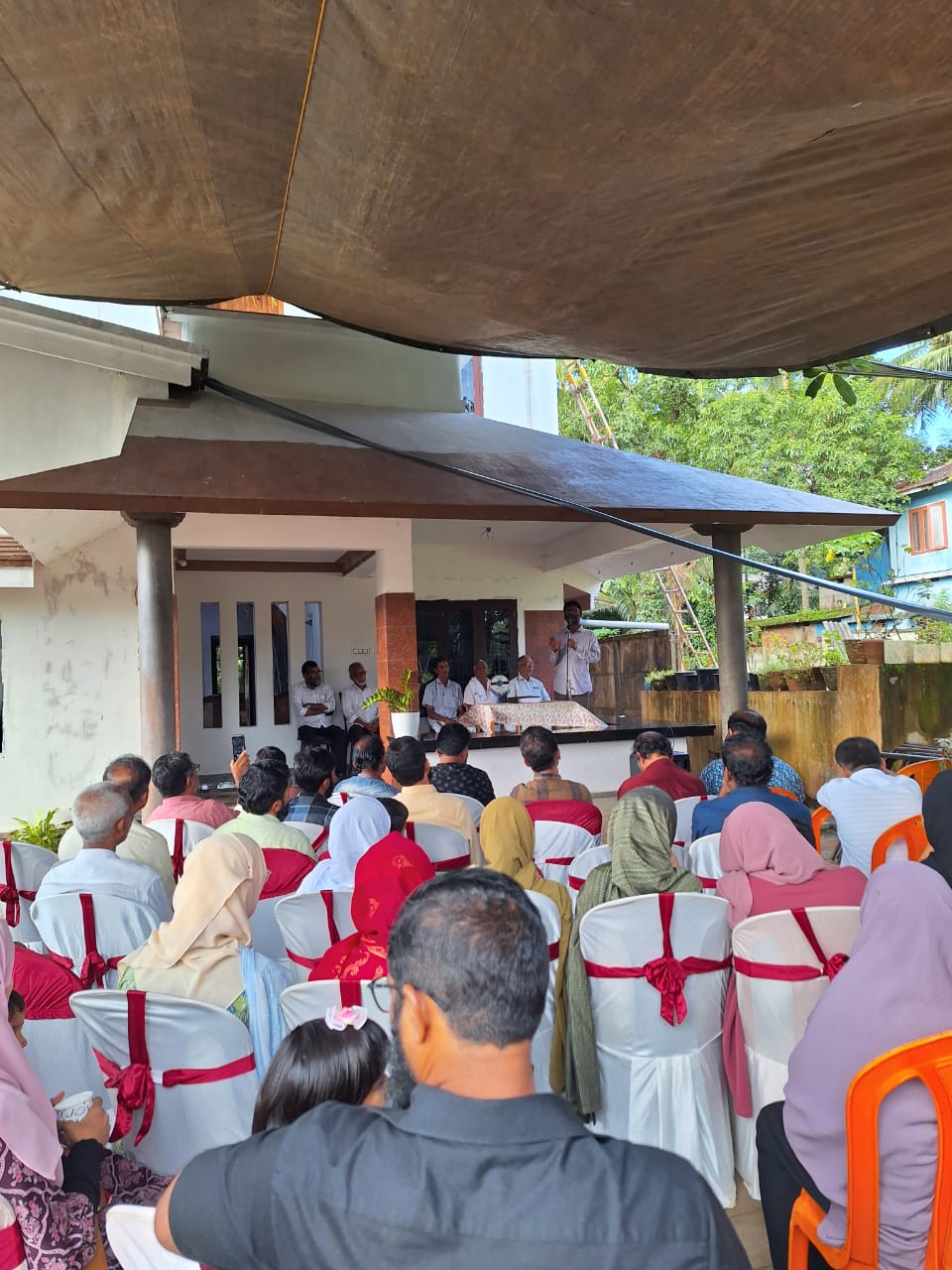
How do we celebrate our achievements, especially when it is an academic milestone? For many, it is posting a proud announcement on social media, celebrating with family and friends and sharing the moments with the world. But for Noorjahan, a 37-year-old woman from Malappuram, the celebration of her doctorate was a unique affair — one that blended tradition, personal triumph and community spirit in a way rarely seen. Instead of a quiet reflection or a typical party, she hosted what she called a ‘Ph.D. wedding’, erecting a grand pandal (a traditional tent used for large gatherings) outside her home and inviting close family, friends and those who had supported her journey.

She wanted to highlight the significance of the occasion in a way that went beyond the usual. “Why not celebrate an academic achievement like we celebrate a wedding, the arrival of a child or a baby’s first haircut?” she asked, reflecting on the importance of her journey.

Noorjahan invited not just her friends, but also those who had been part of her research or who had supported her along the way. “We always focus on the results, but we do not often talk about the process that leads to them,” she told TwoCircles.net. Her aim was to open a conversation about that very process —the often-overlooked work behind the doctorate.

Despite her active presence on social media, she chose not to post about the event herself. Instead, the world learned about her unconventional celebration through the posts of her friends and well-wishers. It was one of these posts that led to the term “Ph.D. wedding”, coined by writer and social critic Emmar Kinalur, who attended the event. In his Facebook post, Kinalur recalled the loud applause that followed when Noorjahan spoke about her journey, particularly from the women and girls in the audience.

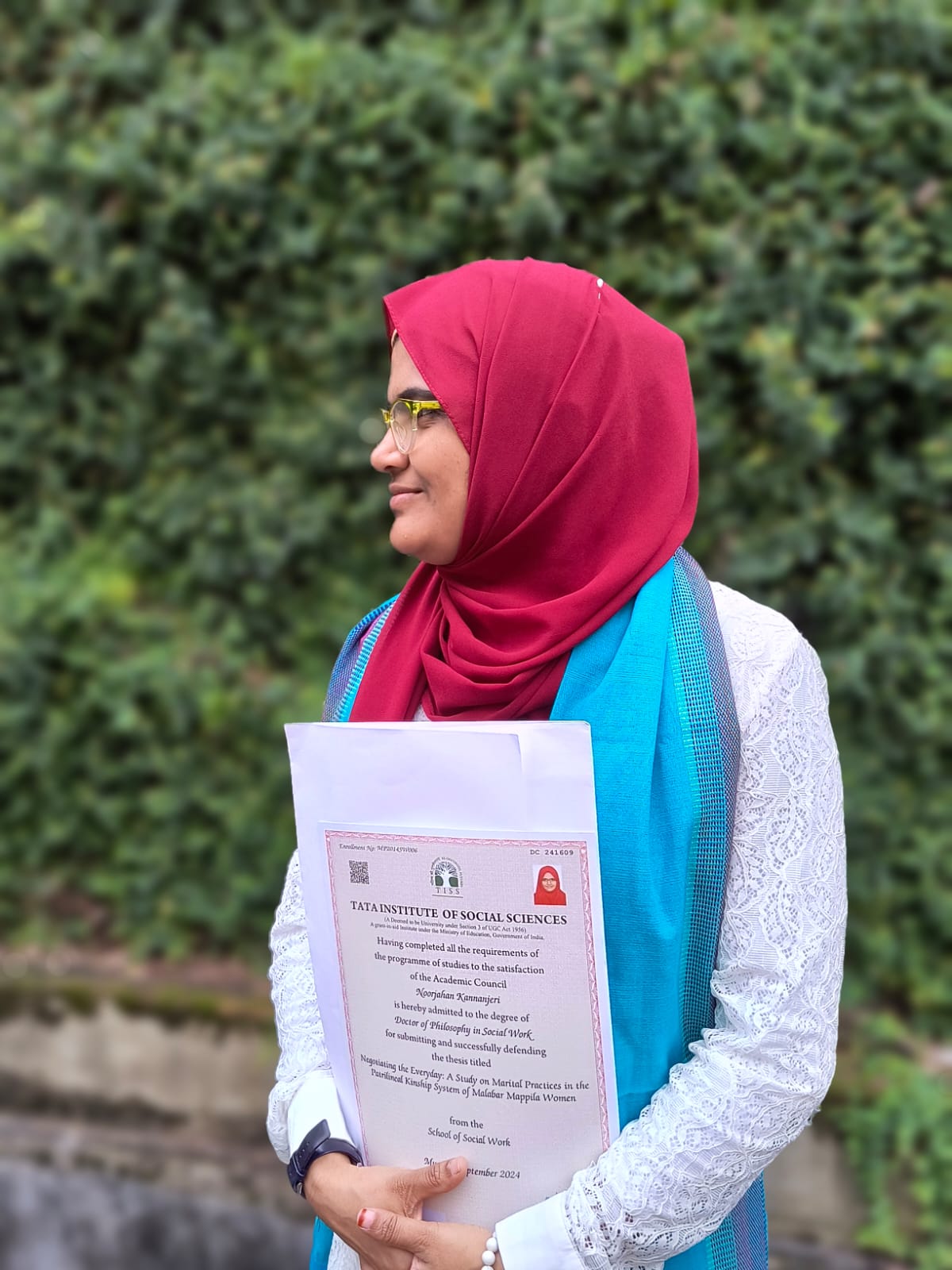
Dr Noorjahan with her PhD thesis

The Everyday Lives of Malabar’s Muslim Women

For Noorjahan, the uniqueness of her celebration mirrored the unconventional nature of her research. Her thesis, titled Negotiating the Everyday: A Study on Marital Practices in the Patrilineal Kinship System of Malabar Mappila Women, delves deep into the lives of Muslim women in the Malabar region of Kerala. What inspired her to choose this topic? For Noorjahan, the subject was deeply personal and autobiographical.

When she began her Ph.D. journey in 2014, the societal discourse was dominated by debates over reducing the marriageable age of Muslim girls to 16. This reminded her of the negotiations she herself had to make to pursue higher education. “I had to convince people at every stage of my life — why I was doing a Ph.D.; why I was going to Mumbai; and whether it would delay having children,” Noorjahan explained.

The decision to pursue her research at the Tata Institute of Social Sciences (TISS) in Mumbai was also a negotiation, as the institution offered an off-campus option for those with an M.Phil. She was one of many women balancing education, work and family, all while negotiating the pressures of everyday life.

Noorjahan’s research journey was not an easy one. It took her a decade to complete, during which she juggled the demands of raising two children, teaching in colleges, working as a psychiatric social worker, co-authoring a book on a prominent Kerala journalist and contributing to social media and magazines. “This process has elevated my perspectives beyond skill development and knowledge growth,” she wrote on her Facebook wall. “Looking through that lens, this was also an evolutionary process; and I am proud of it.”

Guardianship and Widowhood

When asked about the most significant findings from her research, Noorjahan pointed to two key aspects: guardianship and widowhood. These issues, though long present in society, took on new meanings in the context of her work. She explored the concept of wali (guardian) in Islamic law, a role typically filled by a father or brother, but in the absence of a male guardian, a qazi or judge assumes this position during the wedding ceremony. However, Noorjahan highlighted how, in practice, this system often lacks real responsibility, and the role of the guardian is reduced to a ceremonial one.

Dr Noorjahan speaking at the ‘PhD wedding’ function held at her home

Equally important in her research was the issue of widowhood. Noorjahan pointed out that the traditional practices surrounding widowhood in the Malabar region have been influenced by Brahminical patriarchal systems, despite Islamic principles that allow widows the freedom to decide their future once the iddah (waiting) period is over. Instead of offering this autonomy, society often seeks to rehabilitate widows within the same patrilineal framework, framing their inclusion as a virtuous act of charity. “While we call it charity or virtuous deeds, it is women who suffer under this framework,” she argued.

The Support of Women in Her Life

Throughout her academic journey, Noorjahan found steadfast support in the women around her, particularly her mother, Saleemath V – a retired teacher from their hometown in Areekode. Saleemath was a constant presence, travelling with her daughter to Mumbai, caring for the children when Noorjahan was busy and offering her moral and emotional support. “My mother was also learning and changing in her own way, just as I was evolving through my education,” Noorjahan said, underscoring the importance of familial support for women pursuing careers or higher education after marriage and children.

Saleemath herself reflected on her daughter’s resilience, saying it was Noorjahan’s determination and steadfastness that had enabled her to complete her Ph.D. despite the many challenges, including the demands of family life. “Many women give up halfway, but Noorjahan did not,” she proudly noted.

The ‘PhD wedding’ function at the home of Dr Noorjahan

Empowering Women

Now, Dr. Noorjahan works as the head of the Department for the Child and Women Resilience Project at Thanal – an NGO in Kozhikode run by the Daya Charitable Trust. The project aims to improve the lives of widowed, deserted, divorced or separated women and their children in the Wayanad and Kannur districts of Kerala.

Noorjahan’s work continues to reflect her dedication to empowering women and advocating for their rights, a theme that runs through both her academic research and her professional life.

Through her unique “Ph.D. wedding” and her groundbreaking research, Dr. Noorjahan has not only celebrated her own academic achievement but also sparked a wider conversation about the roles of women – especially in the context of the Malabar Muslim community. Her work, her resilience and her commitment to her community continue to inspire those around her — especially the women whose lives she seeks to improve.

source: http://www.twocircles.net / TwoCircles.net / Home> India News / by Najiya O, TwoCircles.net / November 17th, 2024

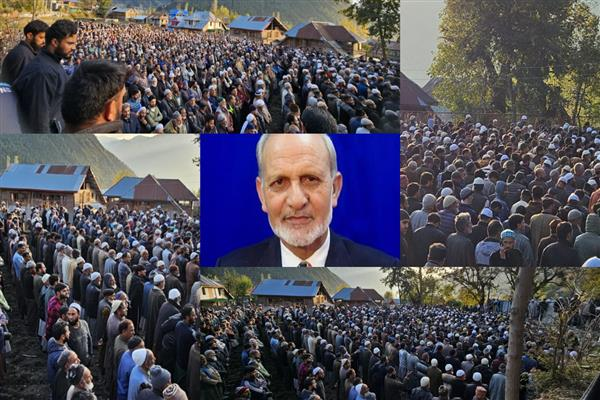
Professor Abdul Wahid Qureshi Passes Away at 80

Karnah (Kupwara District), JAMMU & KASHMIR :

Thousands Attend Last Rites in Karnah; Ministers Sakeena Itoo, Javed Ahmad Dar, CUK, and KU Mourn Demise; Institutions Across J&K Express Grief

Thousands Attend Last Rites in Karnah; Ministers Sakeena Itoo, Javed Ahmad Dar, CUK, and KU Mourn Demise; Institutions Across J&K Express Grief

Karnah (KNS):

Professor Abdul Wahid Qureshi, a prominent scholar and former Vice-Chancellor of Kashmir University, passed away on Sunday at SKIMS Soura Srinagar.

According to KNS Correspondent Karnah, Professor Qureshi, originally from Karnah area of Kupwara, had a distinguished career in academics and administration. After completing his early education at Higher Secondary School Kandi Karnah, he pursued higher studies at SP College Srinagar and later earned his master’s and Ph.D. in Economics from Aligarh Muslim University.

In 1996, at the age of 26, he began his academic career as an Assistant Professor in the Department of Economics at Kashmir University. He later served as Vice-Chancellor of the university from 2004 to 2007, followed by a tenure as the founding Vice-Chancellor of the Central University of Kashmir from 2009 to 2012.

Professor Qureshi was known for his contributions to education and the community. He was a strong advocate for educational opportunities in his home region of Karnah and supported students through guidance and financial assistance.

He is survived by his wife and three sons, who are professionally established as a doctor, an engineer, and a college professor.

Thousands of people gathered at his Lal Bazar residence in Srinagar to pay their respects before his body was transported to his ancestral home in Karnah. He was laid to rest at his ancestral graveyard in Kandi on November 17, 2023, with a large number of mourners in attendance.

Professor Qureshi’s death is being widely mourned in the region, with many recognizing his significant contributions to education and society.

Meanwhile, Central University of Kashmir (CUKashmir) faculty members, administrative staff, research scholars and students, led by Vice-Chancellor, Prof. A Ravinder Nath, deeply condoled the demise of its founding Vice-Chancellor, Prof. Abdul Wahid Qureshi.

Prof. Abdul Wahid Qureshi was also the former Vice-Chancellor of the University of Kashmir, and an eminent Economist.


In his condolence message, Vice-Chancellor, Prof. A Ravinder Nath, said, the demise of a founding figure is a moment of profound reflection and mourning, especially when that person has contributed significantly towards the establishment and growth of the varsity.

“Prof. Qureshi was a visionary leader who laid the foundation of CUKashmir and was instrumental in the creation and growth of the institution. His unwavering dedication, passion for education, and commitment to academic excellence were the cornerstones upon which this university was built,” Prof. A Ravinder Nath said, adding that Prof. Qureshi, played a pivotal role in the academic growth of the varsity and guided the faculty members for achieving academic excellence in their respective fields. Prof.

A Ravinder Nath further said, “We will continue to honour his memory through our work, our commitment to education, and our dedication to shaping the future Prof. Qureshi so passionately envisioned.”

In his message, Dean Academic Affairs, Prof. Shahid Rasool, said, the passing away of the founding Vice-Chancellor marks not only a loss of an individual but a pivotal moment in the history of the institution itself. “Prof. Wahid Qureshi, contributed through his expertise, academic and administrative standing for the overall progress and holistic development of the university since its inception,” Prof. Shahid Rasool said.

“Prof. Qureshi’s leadership extended beyond the classroom, as he endeared himself to all with his humility, wisdom, and generosity.” “For me it is a personal loss as I have had the opportunity of working under his affectionate leadership  for over two decades and a memorable association of over three decades.”

In his message, Registrar, Prof. M Afzal Zargar, said, “Prof. Qureshi’s vision for a forward-thinking, inclusive, and student-centered university continues to guide the institution today.” He said the entire CUKashmir mourns this great loss, and stands united in our commitment to uphold the vision and principles of Prof. Abdul Wahid Qureshi.

The CUKashmir faculty and staff expressed solidarity with the bereaved family and prayed for peace to the departed soul. “Our thoughts and prayers are with the bereaved family during this difficult time,” the CUKashmir employees said.

The CU Kashmir has organised Condolence meetings at all the Campuses on Monday at 3:30pm.

With profound grief and a heavy heart, the University of Kashmir is mourning the sad demise of former Vice Chancellor (VC), University of Kashmir (KU), Prof Abdul Wahid Qureshi.

Prof Qureshi passed away Sunday due to cardiac arrest at a hospital in Srinagar.
A distinguished academic and senior professor, Prof Qureshi served as KU Vice Chancellor from 2004 to 2008.


In a heartfelt message, KU Vice Chancellor, Prof Nilofer Khan, expressed her deep sorrow and offered her condolences.

“Prof Abdul Wahid Qureshi’s passing is an irreplaceable loss for the academic community. His leadership and visionary contributions have left a lasting impression on the University of Kashmir,” she said, adding that Prof Qureshi’s work will be remembered by generations.

“His legacy of dedication and compassion will continue to inspire us. May Almighty Allah grant him the highest place in Jannah,” Prof Khan said in a statement issued here.

KU Registrar, Prof Naseer Iqbal, on behalf of the KU administration, extended his heartfelt sympathies to the bereaved family.

“Prof Qureshi’s profound impact on higher education in Jammu and Kashmir, his commitment to student welfare and his tireless efforts for academic advancement will remain forever in our hearts,” he said, reiterating that the region has lost a mentor and revered academician.

The university community, including faculty, students, scholars and staff, joined in collective mourning for Prof Qureshi praying for eternal peace to his soul.

 Teachers and students remembered him as an inspiring figure whose contributions strengthened the foundation of the institution and enriched the lives of countless individuals.

Scholars reflected on his mentorship and expressed gratitude for his dedication to education and learning. “In this moment of grief, the University of Kashmir stands in solidarity with Prof Qureshi’s family. May Almighty Allah grant him the highest place in Jannah and bestow patience and forbearance upon his family to bear this irreparable loss,” a spokesperson said in the statement.

To pay homage to the departed soul, KU scheduled a condolence meeting on 18th November (today) at 11 am in the main campus, added the statement.

 Also, Minister for Education, Social Welfare, Health & Medical Education, Sakeena Masood has condoled the sad demise of former Vice Chancellor of Kashmir University (KU) and Central University of Kashmir (CUK), Prof. Abdul Wahid Qureshi. In her condolence message, Sakeena Masood described the late Prof. Qureshi as distinguished academic leader and visionary, who dedicated his life to advancing education and fostering excellence.

She added that during his tenure as Vice Chancellor of Kashmir University, he played a pivotal role in the transformation and growth of University, bringing  significant improvements in curriculum, infrastructure and faculty development. She underlined that through his acumen and vision for future, Prof. Qureshi started the entrance based exams for admissions in KU, adding that he also has been the pioneer of starting several new courses in the Varsity.

The Minister also remembered the role of Prof. Qureshi in hand holding the students of far-off areas and downtrodden communities and nurturing them to excel in education. She also said that Prof. Qureshi, as  first Vice Chancellor, played a vital role in establishment of Central University of Kashmir.  She added that during the infancy years of the University, Prof. Qureshi played critical role in starting various courses in different programs at the Varsity.

She further highlighted that Prof. Qureshi, because of his integrity and honesty, has served as the Chairman of J&K Bank selection committee for a considerable time. The Minister, while playing glowing tributes to former Vice Chancellor, said that Prof. Qureshi’s legacy will continue to inspire future generations and his absence will be deeply felt in the academic community. She also extended her deepest sympathies with bereaved family and prayed for highest place in Jannah for the departed soul.

Minister of Agriculture Production, Rural Development Department and Panchayati Raj, Javed Ahmad Dar, has expressed profound grief and sorrow over the demise of former Vice Chancellor of Kashmir University (KU) and Central University of Kashmir (CUK), Professor Abdul Wahid Qureshi.

The Minister described late Wahid Qureshi as a visionary academic leader who not only excelled in his field but also motivated others to strive for excellence.

Paying glowing tributes, the Minister said that Professor Wahid Qureshi was a person of par excellence, who dedicated his life towards taking education to new heights. He said that the deceased played a pivotal role in establishing both University of Kashmir and CUK as great campuses for learning and academic leadership.

Javed Dar extended sympathies to the bereaved family and prayed for eternal peace to the departed soul. He acknowledged that Prof. Qureshi’s teachings will continue to inspire students and professionals to improve educational scenario in Jammu and Kashmir. He said that late Prof. Wahid Qureshi was a beacon of knowledge and inspiration for academic world.

source: http://www.knskashmir.com / Kashmir News Service / Home> Education / by KNS Desk Srinagar / November 17th, 2024