‘Spirit of sacrifice is fuelled by patriotism’

Madikeri, KARNATAKA :

Madikeri:

The spirit of sacrificing one’s life for the cause of the nation is fuelled by a high degree of patriotism, Chief Executive Officer of Kodagu Zilla Panchayat Mirza Akbarulla said here on Wednesday.

He was addressing police personnel at the police parade grounds here on the occasion of Police Commemoration Day.

It was everybody’s bounden duty to remember the supreme sacrifice of police personnel in defence of people and property, Mr. Akbarulla said. Police personnel who had laid down their lives fighting for peace in the country should be remembered always, he said and quoted examples of those who sacrificed their lives during the November 26, 2008 terrorist attacks in Mumbai.

Deputy Commissioner K.H. Ashwatha Narayana Gowda, who led others in paying rich tribute to police personnel who had died in the line of duty, said society should remember with gratitude the sacrifice of the police personnel.

Superintendent of Police, Manjunath Annigeri, who welcomed earlier, read out the names of 833 police personnel who had laid down their lives in the line of duty across the nation in the last one year. Three rounds of volleys were fired in the air to pay respects to the police personnel.

Those who laid wreaths at the police memorial included president of the zilla panchayat V.M. Vijaya; Mr. Gowda; Additional Deputy Commissioner K.M. Chandre Gowda; Mr. Akbarulla; Mr. Annigeri; Air Marshal K.C. Cariappa (Retired); Col. Uthaiah (Retd.); Home Guards Commandant, Kodagu, Maj. O.S. Chingappa; Madikeri CMC Commissioner Srikanth Rao; Deputy Superintendent of Police, Madikeri, J.D. Prakash; Somwarpet DYSP M. Narayana; Virajpet DYSP Annappa Naik; Madikeri tahsildar Devaraju; president of Retired Police Officers Association M.A. Appaiah, and journalists K. Thimmappa and Anu Cariappa.

source: http://www.thehindu.com / The Hindu / Home> National> Karnataka / October 22nd, 2009

Umrao Jaan gets a tomb in Varanasi

Faizabad / Varanasi , UTTAR PRADESH :

Rekha as Umrao Jaan
Rekha as Umrao Jaan

Lucknow:

Umrao Jaan, the courtesan and poetess immortalised by Rekha in a 1981 classic, has got an address 80 years after her death.

A local club of sportspersons and social activists who had found Umrao Jaan’s nondescript grave in Varanasi in 2004 have built a tomb and decorated it for public viewing.

The tomb at the Fatman graveyard in Sigra was thrown open for public viewing on Tuesday (December 26, believed to be her death anniversary) and over 2,000 people have paid tribute to her since then.

Although there is no authentic research available on her, the general belief is that Umrao Jaan, on whose turbulent life at least a dozen films have been made in India and Pakistan and who inspired Mirza Hadi Ruswa’s novel Umrao Jaan Ada, left Awadh at the turn of the 19th century and lived in many places since, slipping into oblivion.

Shakil Ahmad, the president of the Derbyshire Club, a group of sportspersons and While trying to gather more information about her, “I was working on the grave of (shehnai exponent) Ustad Bismillah Khan one-and-a-half years ago when someone told me Umrao Jaan’s resting place was near his.”Some local people and I discussed and decided to renovate her grave. . The grave has been kept open at the centre in keeping with Islamic tradition, which says a grave shouldn’t be completely covered

None of the films made on Umrao Jaan, including the 2006 movie in which Aishwarya Rai Bachchan played the courtesan, mentions that she spent her final years in Varanasi.

source:  http://www.telegraphindia.com / The Telegraph, Calcutta, India / Home> India / by  Piyush Shrivastava / December 28th, 2017

The abiding fame of Faizabad

Faizabad, UTTTAR  PRADESH :

EPITOMISING SYNCRETIC CULTURE Begum Akhtar

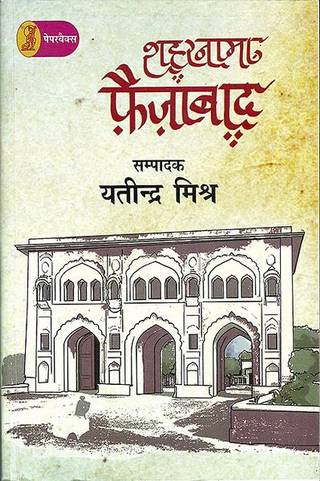
“Shaharnama Faizabad” offers detailed information about the social and cultural life of the historic town

Although Faizabad had acquired prominence during the reign of the early Nawabs of Awadh, it lost some of its lustre when, soon after taking over the reins of the kingdom in 1775, Nawab Asif-ud-Daula shifted the capital from Faizabad to Lucknow.

Yet, it continued to enjoy a lot of influence until the last Nawab Wajid Ali Shah was deposed and banished to Matia Burz near Calcutta (now Kolkata). It was so because of its famed Begums who wielded considerable political and financial clout. However, in the last century, a Begum of a different kind brought the town national recognition when, at the end of every gramophone recording, she would proudly announce: “Mera naam Akhtari Bai Faizabad”. For most of her performing career, Begum Akhtar was known as Akhtari Bai Faizabadi and she truly represented the refined composite culture of Faizabad that abuts the Hindu holy town of Ayodhya.

Last year, Vani Prakashan had brought out an excellent book on Lucknow that offered scholarly research along with useful touristic information. Titled ‘The Other Lucknow: An Ethnographic Portrait of a City of Undying Memories and Nostalgia’, it was edited by Nadeem Hasnain and was based on a research project sponsored and funded by the Ayodhya Shodh Sansthan (Ayodhya Research Institute), an autonomous organisation of the Uttar Pradesh government’s Department of Culture.

FaizabadBookMPOs13jan2018

It’s a matter of rejoicing that this year, Vani Prakashan has published a companion volume on Faizabad with the help of the same Ayodhya Shodh Sansthan. The fact that this volume is in Hindi and it offers very detailed information about the historic town, its social and cultural life, and places of religious and cultural significance would warm the cockles of everybody’s heart. Hindi writer Yatindra Mishra, who recently won the President’s Golden Lotus award for his biography of Lata Mangeshkar, has edited this 640-page tome titled “Shaharnama Faizabad” (A Chronicle of Faizabad). A scion of the erstwhile ruling family of Ayodhya, Mishra’s love for Faizabad is evident in the care and fastidiousness with which he has performed this daunting task with the help of many experts including historians Salim Kidwai, Madhu Trivedi and Yogesh Pravin, Islamic culture scholar Mirza Shahab Shah and Kosala Museum’s Deshraj Upadhyaya, to name only a few. Mishra has not only edited the book but has also contributed a large number of detailed comments on the Faizabad region’s history and culture, making use of painstakingly done research into archival material and other sources.

The book is divided into five sections and opens with the history of Faizabad and the way its architecture and culture took shape under the Nawabs. After Nawab Saadat Khan ‘Burhan-ul-Mulk’ was awarded the Suba of Awadh by the Mughal Emperor, he built a temporary fort called Qila Mubarak near Lakshman Ghat in Ayodhya. After some time, he built a cantonment at a distance of five kms from Qila Mubarak and it was known as Bangla. During the reign of Nawab Mansur Ali Khan ‘Safdarjung’, Bangla acquired the name of Faizabad. This section also tells us a very interesting fact about the royal emblem of the Nawabs as it depicted fish (considered to be auspicious) along with the bow and arrow of Ram, the presiding deity of the adjoining Ayodhya. Detailed information about the arts, architecture, music, jewellery and ornaments, and prominent Nawabs and Begums and their Hindu and Muslim courtiers has been provided in this opening section.

The second section is one of the most interesting and valuable parts of this book as it deals with the events and heroes of the great revolt of 1857, often described as the First War of Indian independence.

Ripple effect

As is well known, the deposition of Nawab Wajid Ali Shah had also played an important role in spreading anger and anguish among the sepoys who hailed from the Awadh region in considerably large numbers. Mangal Pandey belonged to village Dugvan-Rahimpur of Tehsil Sadar in Faizabad district. We also come to know about Maulavi Ahmad Ullah Shah alias Danka Shah who, as early as in February 1857, had started condemning foreign rule in his public speeches. He was imprisoned and sentenced to death. Faizabad remained independent till January 6, 1858 and was defeated by the Nepalese army that attacked its forces and subdued them.

While the third section gives detailed descriptions of important religious places belonging to all the religions present in the region, the fourth section offers invaluable historical information about the writers, poets, courtesans, high-brow as well as folk musicians, folk art, village fairs as well as local festivals, bazaars and traditional haats, instruments and their makers, journalists, newspapers, magazines and printing presses of the region. It’s a fairly long list and offers a glimpse into the cultural richness of Faizabad.

The fifth and final section deals with prominent social workers, sportspersons, educational institutions and public libraries, thus completing a full circle. It’s not possible to discuss such a voluminous book in any detail here. Suffice it to say that those who are interested in knowing the history and culture of Awadh cannot afford to ignore this work.

source: http://www.thehindu.com / The Hindu / Home> Books / by Kuldeep Kumar / June 16th, 2017

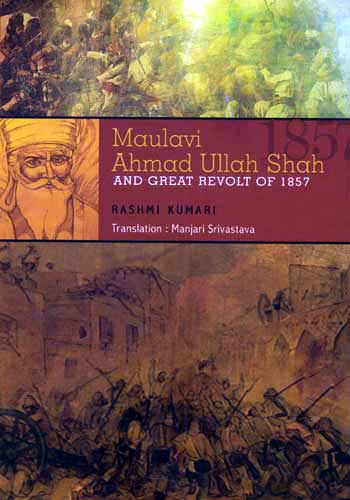
Maulavi Ahmad Ullah Shah and great revolt of 1857

Arcot, MADRAS (now TAMIL NADU ) /  Faizabad, UTTAR PRADESH :

BookAhmedalluhMPOsJAN13mpos2018

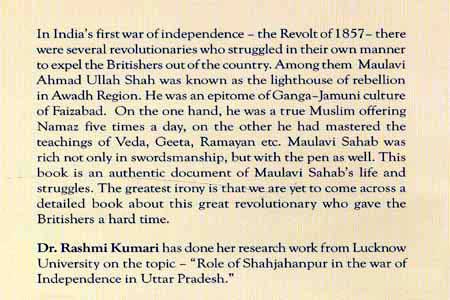
BookAhmedalluh02MPOsJAN13mpos2018

source: http://www.nbtindia.gov.in / National Book Trust, India / Home> Books> National Biography

200th Christmas for Faizabad church

Arcot, MADRAS (now TAMIL NADU ) /  Faizabad, UTTAR PRADESH :

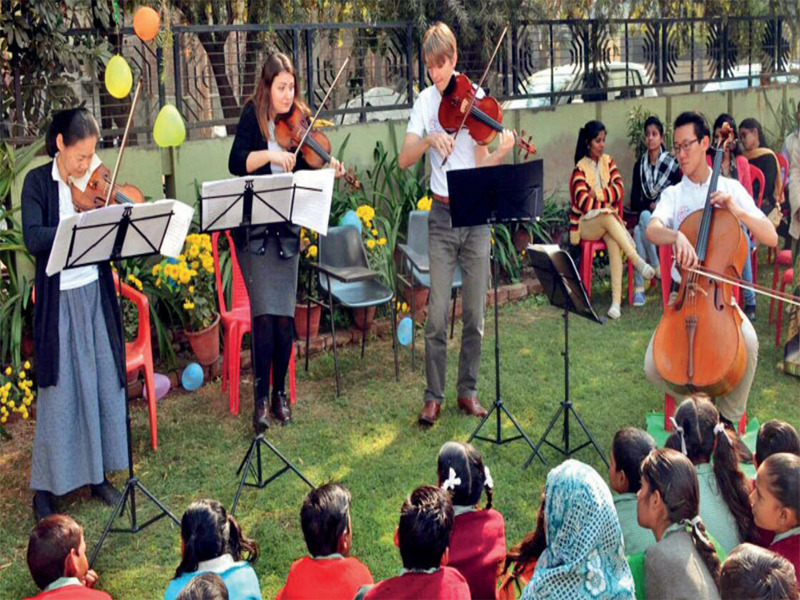
A German music band celebrates Christmas with children

Faizabad

Built 200 years ago, Wesleyan Chapel, a fine specimen of British Architecture, for the British soldiers posted in Faizabad Cantonment, Church of North India is all decked up to celebrate Christmas.

Wesleyan Chapel, built in 1816, merged with Diocese of Lucknow in 1970 and then came to be known as Church of North India.

Talking to TOI, Rev Kaushalendra Solomon, pastor of the church said that special prayer service would be held at midnight on Christmas and then in the morning. Different religious activities will continue in the church till December 31and a special watch night service would be held on New Year eve.

The church committee led by secretary Chitij Charles has ensured special decoration with flowers and lighting as the Church has completed 200 years. Rev Solomon said that they get special cakes baked for Christmas celebrations at a local bakery.

“Ghulam Mohammad, a local scholar, said that Maulvi Ahmad Ullah Shah, who was leading the 1857 mutiny against Britishers from Faizabad, had instructed his soldiers not to damage the Wesleyan Chapel because it was a place of worship.”

source: http://www.timesofindia.indiatimes.com / The Times of India / Home> Neww> City News> Lucknow News / by Arshad Afzal Khan / TNN / December 25th, 2017

Allahabad University scientists find ‘fisetin’ slows down brain aging

Allahabad, UTTAR PRADESH :

The results of the AU study conclude that fisetin can protect the brain from damage induced by aging. (HT)

A team of scientists at the Allahabad University has established that a natural compound called fisetin, found in strawberry, apple, onion and cucumber, can restore brain functions which deteriorate during aging.

A team of scientists at the Allahabad University has established that a natural compound called fisetin, found in strawberry, apple, onion and cucumber, can restore brain functions which deteriorate during aging.

The findings of the team, led by Prof SI Rizvi from the department of biochemistry at AU, have been published in the latest issue of American research journal Life Sciences.

Scientists acknowledge that oxidative stress is a major factor responsible for age-related changes in living organisms. Oxidative stress is the condition when the damage, due to the toxic form of oxygen molecules, exceeds the capacity of the body to repair such damage.

“It is a paradox that oxygen, which is essential for life, becomes the cause of aging,” said Prof Rizvi.

“In human body, most of the oxygen is consumed by the brain. Therefore, it is the brain that becomes more vulnerable to oxidative stress. With increase in age, brain cells degenerate leading to diseases and loss of brain function,” he said.

Through experiments, the research team analysed a host of biomarkers of aging, including pro-oxidants, antioxidants, mitochondrial function, expression of genes, and apoptosis cell death.

The results of the AU study conclude that fisetin can protect the brain from damage induced by aging.

“The study was carried out on rats of different ages and also on those which were chemically induced to age faster,” said Prof Rizvi.

Fisetin was given to rats of old age and the effect was compared with the younger ones. Fisetin-treated old rats were protected from brain damage.

Among all anti-aging strategies being explored, caloric restriction is the most promising which, in common terms, can be defined as less food intake.

Caloric restriction has been effectively tested in small organisms like fruit fly and earthworms. The strategy becomes difficult to implement in humans where several ethical issues are involved.

Scientists have stumbled upon a class of compounds which mimic the effect of caloric restriction. With the use of these compounds, known as caloric restriction mimetics, the body feels like it is food restricted without the need of eating less.

According to Prof Rizvi, fisetin works as a caloric restriction mimetic in showing its anti-aging effect on rats. “Scientists are hopeful that compounds exhibiting caloric restriction mimetic effects will prove to be good anti-aging drugs,” he said.
Several experimental drugs are being tested in Prof Rizvi’s lab for possible anti-aging effects. “Although an increase in human lifespan may not be possible, it may increase the health span,” Prof Rizvi added.

source: http://www.hindustantimes.com / Hindustan Times / Home> Cities> Lucknow / by K. Sandeep Kumar , Hindustan Times, Allahabad / January 08th, 2018

Laurels for the bravehearted prince

Surat, GUJARAT  /  London, UNITED KINGDOM  / Mumbai, MAHARASHTRA  :

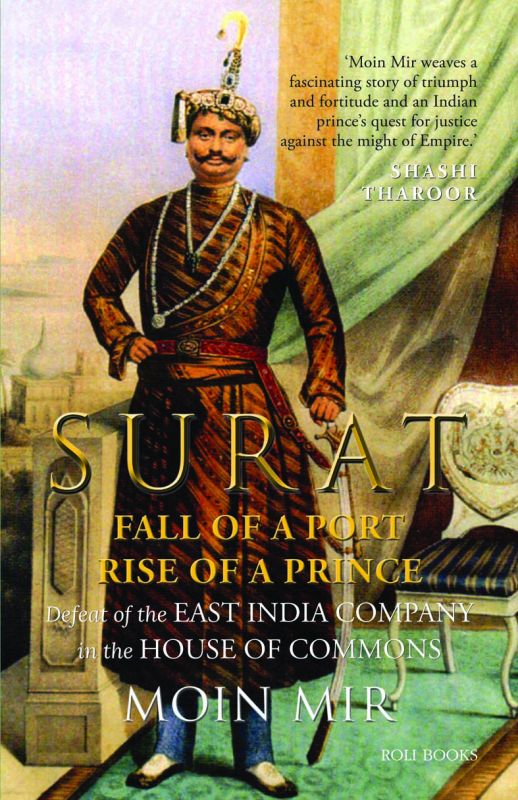
The book “Surat” by Moin Mir begins with a truth that will send a chill down anyone’s spine.

Moin Mir
Moin Mir

Breaking all the shackles and bending, actually, even defying all the ‘rules’, the prince of Surat, Meer Jafar Ali Khan fought a battle all by himself. And win he did!

The book “Surat” by Moin Mir begins with a truth that will send a chill down anyone’s spine. “It is about how the East India Company took control of the great port city, Surat. They violated a treaty with the Nawab of Surat which stated that his family would be secure from generation to generation by stopping the family’s income, usurping the palaces, estates, jewellery and all that was part of the private estates of the Nawab, leaving the infant granddaughters of the last Nawab on the brink of destitution. In a counter attack Meer Jafar Ali Khan, father of the two infant girls stood to defy an empire and expose the corrupt practices of the Company in Victorian England. Spearheading a legal offensive that would shatter the Company’s reputation, Khan’s campaign for justice generated great heat and debate in British Parliament. Fighting against all odds this prince won it all back for his daughters and found true love” says Mir.

SURAT FALL OF A PORT, RISE OF A PRINCE by Moin Mir, Roli Books, pp. 250, Rs 495

“Two things that inspired me to write this, one that the lead character was a fathr on a quest to fight for justice in 1844 by planting himself there and defying an empire on its own soil.

The second reason to write this book was the city of Surat which was an important port. I wanted people to know that how this thriving maritime port was brought down by the English East India Company,” he adds.

Wanting to release the book on Meer Jafar Ali Khan’s 200th birth anniversary, Mir thought that 2017, was the right time to release it. The message he wants to give is that it is a story of a man who believed in his cause.  “It’s a story of a city, an individual, a father and an Indian man in London in 1844. That is rare. And not just being an Indian in London but fighting the empire on their home turf. What are the chances of you winning? Zero! As the empire was at the peak of its power,” he signs off.

source: http://www.asianage.com / The Asian Age / Home> Books / by Kavi Bhandari / January 03rd, 2018

Pataudi: The Afghan connection

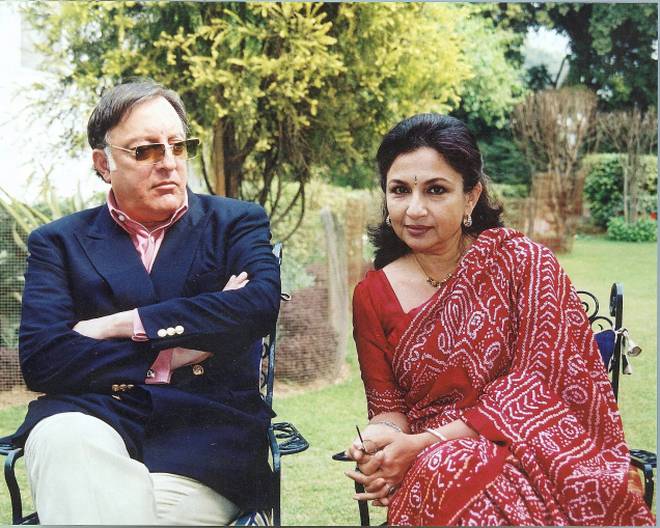
The Pataudis.... Photo: R.V. Moorthy
The Pataudis…. Photo: R.V. Moorthy

They embody the dream of gracious living and togetherness. And you realise why when you meet them, says Kausalya Santhanam, about her tete-a-tete with Sharmila Tagore and Mansur Ali Khan Pataudi.

Cricket, cinema and royalty — can there be a more potent mixture? Three decades after he headed the Indian cricket team with such distinction and his begum won the hearts of cinegoers, the spell cast by the couple continues. The Pataudis — Mansur Ali Khan and Sharmila Tagore — embody the Indian dream of gracious living and togetherness. You realise why when you meet them at their spacious bungalow in Delhi.

Though his clipped replies on the telephone make you apprehensive about the interview, he is quite forthcoming when you begin to talk to him. “I know what it is like to be at the other side for I was a reporter for the Ananda Bazaar Patrika many years ago,” he says. He listens to the questions with patience and courtesy. To be a Nawab is to be heir to a lifestyle marked by refinement in speech and behaviour.

How does it feel to be so respected three decades after leaving the game and how much has the royal aura contributed to this, you ask.

“If there is respect, it is because of a mixture of many things,” he replies. “It is also because I married into a recognised family (Sharmila is a grand niece of Rabindranath Tagore) with cultural interests and a literary background. There is a lot of curiosity (about us).

“I was not the only one in cricket from a similar background,” he says. “There were others like me — Hanumant Singh, Inderjit Singh, Fatesingh Gaekwad (who was President of the Board of Cricket Control), the Maharaja of Udaipur, the Patiala family… there were a lot of us around. The disadvantage was not because of the background but because I did not understand the undercurrents; I had not studied in India but abroad. It helped too for I did not get involved in the local politics. Regarding the royal aura, you are right in the sense we didn’t indulge in nepotism or favouritism. We played it pretty straight — not promoting someone because he was from a particular background. I played most of my cricket from the South. I still meet Chandrasekhar, Prasanna and Ramnarayan.”

What are his links now with Pataudi, the princely State in Haryana?

“Links are with the people,  not with the soil, After Independence, there was a large transfer of property. Quite a few people from Pataudi migrated to Pakistan. Many of my family members too went away, like my uncle, a former army general in Pakistan, who has written a book about the family and its history.”

Does he visit often and how much regard is there now in Pataudi for the former royal family?

“I’m a fairly private person. I don’t make an issue of going there. But for certain occasions, I do go. A large number of people came to my mother’s funeral to pay their respects. So the connection is still there, the bond is strong. I’m not into politics in Pataudi. I do some social work and am involved in running an eye hospital.”

What are his earliest memories?

“The background for me is cricket or sport. The earliest memories are of playing cricket on the lawns of our home and at the Roshanara Club at the age of nine.”

As for the story that he was upset when his father, the renowned cricketer, Ifthikar Ali Khan, stepped in and took a catch, he says, “Oh, that! I was young and father thought I would drop it.” He adds with feeling, “His was a very good presence.”

“My first coach was Sir Frank Worrell,” says the Nawab who became the youngest captain in the world at the age of 21 and acquired the appellation “Tiger” for his superb fielding skills. “My Master at Winchester College (in England where I did my school) also coached me. Winchester was an important turning point. My son Saif also went there, but perhaps,” he adds reflectively, “it is better to go abroad to study when you are a little older.”

Does he regret not playing one-day cricket as he would have been eminently suited for it?

“Yes. But I’m happy I played for my country. Nobody thought that one-day cricket would become so popular. When we played, there was not much money in the game but we enjoyed our game very much. And no, I don’t watch all the matches whether the World Cup or others. I was a commentator for AIR and Doordarshan. The main activity however had to be cricket or commentary — we had to be totally committed to the game.”

Is he disappointed his son Saif did not become a cricketer but an actor?

“Not at all, there was no compulsion for him to be one. I’m very happy that he is happy.”

Did not the commercials on television and the advertisements in print contribute to keeping the Pataudis in the public eye, projecting them in a regal way?

“If I came across well, it was because of the directors of the commercials,” he states simply.

Having been educated in England, did he not want to settle there?

“I feel very comfortable living here. My forefathers came here from Afghanistan during the time of the Lodis and established themselves after Aurangazeb died. Pataudi was set up as a principality by the English.

How difficult is to maintain the property?

“I have no palace. Palaces are like elephants around your neck. They are very difficult to maintain. Part of the Bhopal Palace has been given to a University. My cousins live in the other portions. My father sold the house in Delhi and built the palace at Pataudi for my mother when they got married in 1938. My mother was recognised as the Begum in 1968. Her elder sister migrated to Pakistan and her son, my cousin, was the manager of the Pakistan cricket team in this World Cup.”

With paternal ancestors at Pataudi and the maternal inheritance of Bhopal, life must have been interesting for him as a child…

“It was. Bhopal was a State with a great deal of protocol. There were bodyguards. When we had to meet our grandfather, we had to wear our best clothes and we were then lined up before him. He would ask: `How’s school? Which class are you in?’ We would answer, bow and come away. Pataudi was different — there were no bodyguards and life was more informal.”

Is not the present trend in the country — of religious fanaticism — disturbing?

“Extremely. But it is inevitable, a post-colonial syndrome which the country has to go through. Moderate voices won’t be heard for a lot of propaganda has been unleashed. It reflects poor thinking and vision, as there are more important things to think of — building houses and providing drinking water. There is so much of unemployment and frustration.”

What does he have to say about his foray into politics?

“I was in politics in 1992, when Rajiv (Gandhi) said `we would like you to come into it’. If he was alive, I might have still been in politics though I find it claustrophobic as it robs you of privacy.”

And how does he spend time now?

“Talking to reporters,” he deadpans.

* * *

“WHAT’S in a name?” asks Sharmila Tagore, acclaimed actress and the Begum of Pataudi, when you talk to her. “To elderly family members and friends, I am the Begum. I’m Rinku to my friends and Mrs. Khan to others. I’m better known as Sharmila Tagore. That’s what I am, what I have made of myself. I come from a middle-class literary background and I don’t have an identity crisis.”

“Belonging to a royal family is not an advantage any more in India,” adds the Begum.

“Titles are no longer respected. The tendency is to minimise their worth whereas titled people are respected in England.

“The reaction here comes from a very uninformed source and is a response to the reading of novels, which depict the royals as debauched and autocratic. The books do not highlight how the former rulers maintained law and order. Bhopal did not lose a single life in riots during Partition. The rulers provided good administration. They still have a place in the hearts of the people and are invited to grace marriages and other functions. Jealousy prompts some people to look down on them. But they can’t help but be impressed by royalty.”

Has she had to give up anything — freedom for instance — by marrying the Nawab?

“I haven’t given up anything. He is very liberal in his views. I’ve gained a lot of experience and gained another culture, cuisine, and way of dressing. I’ve benefited a lot.”

As an outstanding example of a successful Hindu-Muslim marriage, would it not be a good idea for them to make efforts to promote communal harmony?

“Pluralism is the strength of our country. History has shown us that we can co-exist peacefully. India absorbed other cultures but now we are becoming xenophobic. We are reacting 500 years after the Moghuls came. But if Tiger and I make attempts to promote harmony, I do not know how far we will succeed. People will say that I am not a Muslim and that Tiger is a Hindu fanatic.”

How do her two daughters, Saba and Soha, and son regard their lineage?

“Saif is very much into family history and all three children are conscious of their ancestry but in a nice way.”

Cricket lofted it

FIVE HUNDRED years ago, Mansur Ali Khan’s ancestors came from Afghanistan, equipped with superb skills in horsemanship, and looking for greener pastures. Salamat Khan, his forefather arrived in India in 1480 A.D. with his clan during the time of Bahlul, an Afghan of the Lodi tribe, says Tiger’s uncle in his book on the history of the family. Bahlul was governor of the Punjab and later ruled Delhi. A mass migration of Afghans to India took place during his time. Salamat Khan’s family was chosen to quell the Mevati tribe.

Bahlul’s grandson, Ibrahim Lodi, did not trust the Afghan nobles. This led to their rebellion and Babur of Kabul was invited to India resulting in the Battle of Panipat. Ibrahim Lodhi was killed and Mughal rule was established.

Salamat Khan did not actively participate in the Battle of Panipat. His great-grandson, Muhammed Pir, rose to power in Akbar’s court.

In the 18th Century, Alaf Khan of the family assisted the Mughal ruler in his battle against the Maharaja of Jaipur. He was rewarded with Kalam Mahal (which later came to be known as Pataudi House near Delhi Gate) to serve as the family residence.

The princely State of Pataudi was established in 1804 by the British when Faiz Talab Khan (who was made the first Nawab) aided them in their battle against the Marathas. In 1857, the Nawab of Jhajjhar, the Nawab of Pataudi’s cousin, joined anti-British forces and was hanged by the British. The territory was cut in half and Pataudi became a minor State. Cricket placed it on the international map with two generations of players excelling in the game.

Tiger’s mother Sajida Sultan belonged to the well-known House of Bhopal. She became the Nawab Begum of Bhopal after the death of her father, Nawab Hamidullah Khan. Flag Staff House, the residential building of the Bhopal rulers is located within the Ahmedabad palace complex which Hamidullah Khan built in the old Bhopal area. Former Prime Minister Jawaharlal Nehru and President Rajendra Prasad were State guests here.

This article was published in ‘The Hindu Sunday Magazine’ on August 3, 2003

source: http://www.thehindu.com / The Hindu / Home> Sport> Cricket / by Kausalya Santhanam / September 26th, 2011
A Hindustani tradition, right in the heart of Madras

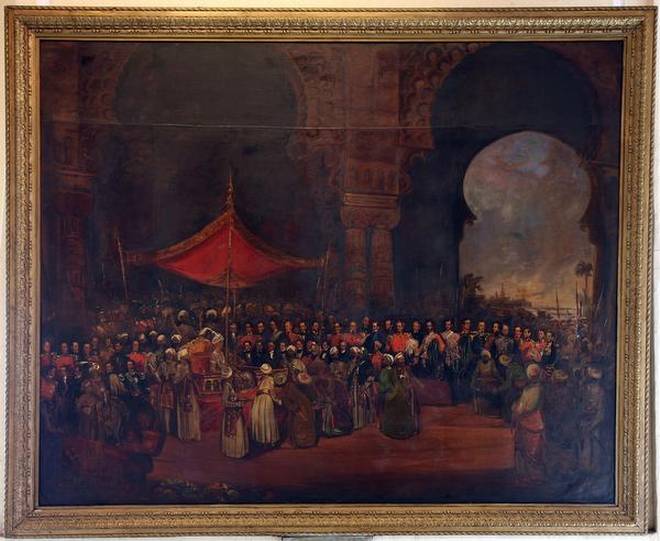
Painting with the installation of Nawab Ghouse Khan

The Kanchenwada was a thriving hub of music and dance; illustrious artistes were among the performers

It wasn’t just another royal wedding, when Nawab Ghulam Ghouse Khan, the last Nawab of Carnatic, took Jahangir Baksh as his second wife. Unlike his first wife, who hailed from a Hyderabadi noble family and chosen by the elders, Jahangir Baksh with whom the Nawab had madly fallen in love, was a dancing girl, a courtesan otherwise known as the Tawaif or Kanchen. On November 24, 1848, he married the dancing girl Jahangir Baksh and awarded her the title Azamunnisa Begum.

The tawaifs were female entertainers who excelled in the arts of poetry, music, dancing, singing, and were considered to be well-versed in etiquette or what was known as ‘Aadaab.’ Highly respected for their politeness and refinement, their entertainment was a fine balance of classical song and dance and romantic enticement.

Though the tawaifs were no strangers to the Tamil country, in Madras they were mostly known as ‘Kanchen.’

“The elite among the tawaifs in the Mughal court were usually referred to as Kanchen” says Saba Dewan, an independent documentary film maker, who had made a film on the tawaifs of Varanasi and is currently writing a book on the same theme. In the 1760s when Nawab Muhammad Ali Walajah moved his durbar from Arcot to Madras, it was only natural that the court musicians and dancers, well-versed in Hindustani, followed him to the city.

According to Sawanihat-I-Mumtaz, which chronicles the history of the Nawabs of Carnatic, “Latifa, Tanu and Sajni, known as Sona, were the dancing girls” and “Aminud Din Khan and Ram Singh Bayragi” were the musicians often invited by Nawab Umdat ul Umra to perform at the palace of his senior sister, Sultan Unnisa Begum.

Umdat ul Umra, who also wrote poetry under the pen name Mumtaz, occasionally asked the musicians to set his verses to Hindustani tunes and even chose the dancing girl to sing and dance the verse. An occasion like his father Walajah’s birthday was celebrated with Sona singing and dancing the verses of Umdat ul Umrah set to tune by Aminuddin Khan and Ram Singh.

Kanchenwada

Over a period of time, Madras became home to a number of Kanchen looking for patronage and a locality sprang up in the heart of Madras, right next to Amir Mahal at Royapettah.

Mir Bakshi Ali Street, Mohammed Hussain Street and Jani Jahan Khan Road, where interestingly the Anglo Indians also lived, became the centre of a thriving Hindustani music and dance tradition in Madras. Perhaps due to the predominant number of dancing girls and musicians at Madras, who originated from Hubli Dharwad, the two streets and the road came to be known as Kanchenwada, as wada in Marathi means a locality or a traditional complex with several mansions for different members of a family or a community.

A century after Nawab Ghulam Ghouse Khan passed away the tradition was still alive in Madras. Old timers recall that as the night wore on, the ‘Kanchenwada’ came alive to the rhythms of the tabla, harmonium, dholak, sitar and sarangi, competing with the ghungroo of the dancing girls, who sang sensuous thumris from Urdu ghazals and popular Hindi film song.

For the elite North Indian in Madras, it was at the Kanchenwada, at the mehfil, that some of the finest ghazals of Mirza Ghalib, Kaifi Azmi, Faiz Ahmed Faiz, Shahir Ludhianvi, Shakeel Badauni (UP) and many other poets could be heard. One could also listen to the likes of Ustad Bismillah Khan, ‘who at the invitation of Nayab Jan Bai played Shehnai at her house’ says Saleem, who learnt the Sitar from Ustad Ahmad Hussain. Just like their patrons, among the Kanchen there were both Hindus and Muslims.

Kamala Bai, Gulzar Bai, Radha Bai, Haseena, Mumtaz, Nazeeraa Banu, Nayab Jan Bai and Baby Bai were some of the names that the old timers remember with fondness. The Kanchen were held in such high esteem that ‘the rich used to send their children to the tawaifs to learn etiquette,’ says Rauf, a senior photographer, who spent his childhood in the Kanchenwada.

Cinema and the Kanchen

“The kanchen also sang popular songs from Hindi films such as ‘Pakeezah,’ ‘Kohinoor,’ ‘Taj Mahal,’ ‘Mughal-e-Azam’ and ‘Umrao Jaan’,” says Laiq Ahmed, who himself wrote poems for the Kanchen. Though the arrival of cinema meant new entertainment avenues for the masses, and possibly declining patronage, many Kanchen took to the medium. “Nasreen Banu had danced in Gemini studio’s Hindi film ‘Paigham’,” says Ilavenil, a Tamil writer who also happened to be her neighbour on Jani Jahan Khan Road. Baby Bai, the most popular of the Madrasi Kanchen of the 1950s made a guest appearance in ‘Gharana’ as a nurse, says Laiq Ahmed. She also made a film, which of course bombed, recollected Abdur Razaaq, who met Baby first as a patron and ended up marrying her in 1960.

Like the dancing girls, the Hindustani musicians too found place in the Tamil film industry. Ustad Ahmad Hussain Khan from ‘Achpal Gharana’ in Pune, moved to Madras at the young age of 14. He subsequently became the Choudhry (caretaker) of the Kanchenwada at Royapettah. “He played Sitar for Tamil film Music composers, mostly for K.V. Mahadevan,” says Saleem, his disciple. “The close-up shot of the fingers playing the sitar in the famous song, ‘Sonnathu Neethaana’ of Nenjil Oru Aalayam are not Devika’s but that of the Ustad Ahmad Hussain” reveals Makbhool Hussain, who used to accompany the Ustad for recording to various studios in Madras. Incidentally, the Ustad also taught music at Bharatiya Vidya Bhavan. The Hindustani musicians found patronage in some of the city’s prominent hotels, while the Kanchen were invited to perform at weddings.

Most of the Kanchen had rich patrons. “Every Kanchen who lived on Jani Jahan Khan Road used to entertain at least five customers. There was a plate kept in front of the musicians. The dancer used to drop the money collected from the evening into the plate. After the performance it was split between the musicians and the dancers,’ says Makbhool Hussain, who played the tabla for many of them. There were occasions when a happy patron would shower more than just money. Ilavenil, the Tamil journalist, remembers the instance of a patron throwing a house document at Nazeera Banu (obviously he had registered it in her name), a Kanchen who had migrated post- Partition from a riot torn Delhi to the relative safety of Madras.

Though the Kanchen were entertainers and inhabited a world that bordered on the ‘sinful,’ they were also religious. Rauf, a senior photographer who lived in Mir Bakshi Ali Street observes, “They would not perform during the month of Ramzan or during Muharram. They also celebrated all festivals including Diwali,” he says.

Horse Racing

“Interestingly, the tawaifs from other cities, including Benares, Lucknow, Bombay, Nagpur, Hyderabad, Hubli and Khanpur, descended on the city when horse racing was on,’ says Makbhool Hussain. They probably followed their wealthy clientele, rented houses and camped in the city till the races were over.

However, cinema and the changing social mores were having an impact on the Kanchenwada and trouble was brewing. The anti-Nautch movement that brought a traumatic end to the Devadasi system, was having its impact on the tawaifs too. Cases were filed to stop their practice and Kamala Bai, a Kanchen, engaged M.A. Ghatala, a High Court lawyer, to fight the case. Around 1958, the Madras High court ruled in the Kanchens’ favour. “The kanchen celebrated the win with a big party for my father, at a house near the Music Academy and the Tamil film actor and great comedian Chandrababu was one among the guests,” recollects Javed Ghatala.

However, the times were changing. What the judiciary rightfully refused to stop was brought to an end by a marriage. Abdur Razaq married Baby in 1960 and moved with her to the upcoming T. Nagar in 1962. With Baby Bai, the star performer moving out to lead a family life, the Kanchenwada lost its lustre and many other Kanchen followed in Baby’s footsteps, seeking a future for themselves in the institution of marriage. By the 1970s, a little more than a 250-year old tradition in Madras came to an end, leaving almost no trace of its splendorous past. As Nazeer Akbarabadi, the people’s poet of 18th century laments:

Kya tamashe inqelab-e-charkh ke kahiye Nazeer

Dum mein wo raunaq thi aur ek dum mein yeh be-raunaqi

(What to say of the lustre of revolving time, O Nazeer. In an instant there was such splendour and in another, this dullness)

(Second part: The Thanjavur Quartet connect)

source: http://www.thehindu.com / The Hindu / Home> Society> History & Culture / by Kombai S. Anwar / January 04th, 2018

How a short film on Bhopal pays a poignant tribute to an age when women ruled the state

Bhopal , MADHYA PRADESH :

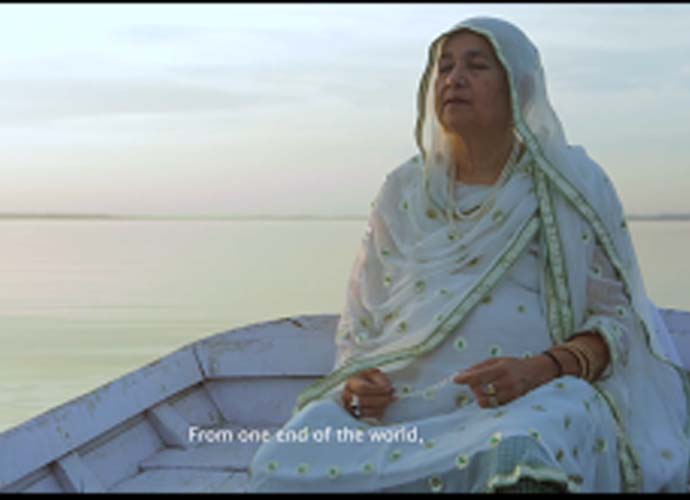
Begamon ka Bhopal is a lyrical ode to a forgotten time.

An 18-year-old widow who declared her infant daughter queen; a wife who survived an assassination attempt and held her husband captive; a princess who abdicated the throne in favour of her mother; a ruler who served as the only woman chancellor of Aligarh Muslim University.

The erstwhile royalty of Bhopal has borne some of the bravest, most dynamic rulers in the 19th and 20th century India. These nawabs were popular, fair, reformist, and fierce; they were also women.

While several women have enjoyed power as regent mothers and influential wives throughout history, Bhopal and its royalty are unique. Between 1819 and 1926, the kingdom saw four women rule it – women who were Nawab Begums, not just Begums, who ruled through inheritance, not proxy.

A still from Begamon ka Bhopal.

The movie

Much has been written about these women and their reign, including by the Nawab Begums themselves, documenting both the personal and the political events of their times.

The footprints they left behind have become part of Bhopal’s everyday life, informing and forming its consciousness and character. It is the exploration of this connect that has resulted in Begamon ka Bhopal, a short film, which is both an ode to the universal feeling of nostalgia, and a document of how an interaction with history can turn deeply existential and personal.

The movie has been directed by Rachita Gorowala, a 30-year-old alumna of Xavier Institute of Communications, Mumbai, and FTII, Pune, and will be available to viewers in January on filmsdivision.org.

Gorowala says she made the movie as her own experiment with truth: “A fascination with Pathan woman rulers who ruled Bhopal for over 100 years started me on Begamon ka Bhopal. A journey that may have begun on the lines of fascination with history became existential, introspective and deeper as an experiment with cinema.”

The movie speaks of a Bhopal long past, and seeks to conjure it up through a writer rooted in the city, a grandson who has preserved reels of films shot by his grandfather between 1929 and 1975, two royal descendants, a royal attendant.

The overarching emotion running through the movie is huzoon, a Persian word for powerful nostalgia, a longing for something lost but not gone. The characters speak of their own past lives, or their engagements and attempts to understand the past life of their city.

The emotion and the sense of old Bhopal is created through both audio and visual evocations – the magnificence and now the absence that marks palaces (Moti Mahal, Shaukat Mahal), the Taj-ul Masjid that is a solid link to the past and the present of the city. Music has been used powerfully – songs written and sung by Firoza Khan, one of the former royals who features in the movie – play like both a dirge and an ode.

“As a student of cinema, I learnt that a film is a medium of time and not of telling stories. Stories are meant to be heard and read. It is through juxtaposition of images and sounds that one creates an emotional journey,” says Gorowala.

Begamon Ka Bhopal is her first short film in the genre of poetic-realism, “a lyrical, musical, introspective journey”. “The movie is an ode to the times that once existed in Bhopal, through an everyday nostalgia that is lived by a writer, a film keeper and royal descendants. Each in their own way hold onto time and thus become it,” she says.

The movie has a lot of frames that show only parts, fragments – walking feet, hands busy with embroidery, dry rustling leaves – which seem to reflect the fragments in which we understand and engage with the past, the parts we hold on to, some passages, some stories that call out to us especially, and through which we try to understand the whole, through which we seek to anchor ourselves in the ocean of time.

The character Salahuddin, writer Manzoor Etheshaam, Nawabiyat descendants Firoza Khan and Meeno Ali, the royal attendant Zohra Phupo, all have important roles, the three women are symbols of the past and have survived into the present, the two men belong to the present and are trying to hold onto their connect with the past.

There is a powerful scene of Firoza fingering dolls as she talks of her own moulding into a member of a royal family post her marriage in 1961; she talks as she dresses up, her begum-ness coming alive with each addition of earrings, kangan, kaajal.

The Begums

For her movie, Gorowala had rich material to draw on. Bhopal’s famous Begums had a lot of variety among them in terms of personality and traits – the first, Qudsia, defied her court’s nobles and conventions to declare her infant daughter King in 1819.

Saif Ali Khan Pataudi has the blood of these begums in his veins. Photo: India Today

Qudsia ruled as proxy for her daughter for 18 years, defending her kingdom against the battering armies of the mighty Marathas – Scindias, Holkars, Gaekwads – and her daughter’s inheritance against internal opposition.

However, some nobles managed to convince the British that a woman ruler was un-Islamic. Thus began a period of daughters inheriting the kingdom and their husbands ruling it. Qudsia’s daughter, Sikander, was married to her cousin Jahangeer. Jahangeer proved unpopular. He even tried to kill his pregnant wife, but she escaped, took refuge in another fort, and subsequently managed to imprison him inside the fort.

Jahangeer died at 26, and once again, his six-year-old daughter Shahjahan was declared king, with power to pass on to her husband when she would get married.

However, Qudsia argued and harangued the British till this clause was removed. Thus, Sikander, and then Shahjahan, both ruled Bhopal as kings who inherited the kingdom. After Shahjahan’s death in 1901, her daughter Sultan Jahan ascended the throne.

While Qudsia was brought up illiterate and in purdah, she rose to the occasion when the need befell her. Sikander was raised to be king. Shahjahan was the most feminine and the least austere of the four, and wrote several books. Sultan Jahan went back to observing purdah, and was the first chancellor of Aligarh Muslim University.

After Sultan Jahan, the throne went to a man, her son Mohammad Hamidullah Khan. However, after Hamidullah died in1960 and his eldest daughter Abida Sultan migrated to Pakistan, his younger daughter, Sajida Sultan, came to power. Sajida’s husband was Iftikhar Ali Khan Pataudi, the grandfather of Saif Ali Khan.

Incidentally, Abida Sultan’s son Shaharyar M Khan, Pakistan’s former foreign secretary, authored the book, The Begums of Bhopal, on his path-breaking ancestors.

source: http://www.dailyo.com / Daily O  / Home> Art & Culture / by Yashee   @ yasheesingh / December 24th, 2017