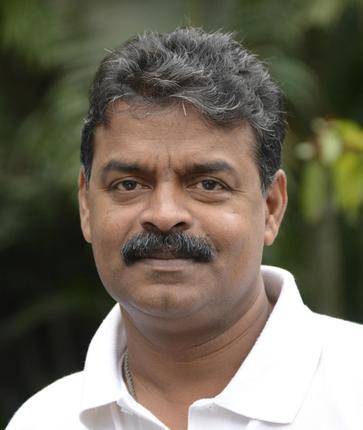
SMOOTH SAILING: It was all smiles for teenager Vishnu Saravanan who showcased his talent enroute to claiming the honours in Laser Radial class. / Photo: G. Ramakrishna
Not yet 19, Vishnu Saravanan was outstanding in the Laser Radial section of the Hyderabad Sailing Week.
The tall yachtsman, representing Trishna Sailing Club (TSC), Bengaluru, claimed half of the dozen-race series to clinch the crown in a 58-member fleet, by far the largest in the annual championship, at the Hussain Sagar on Friday.
Behind him in the overall standings was Sharif Khan of the Army Yachting Node (AYN), who got the gun no less than four times.
The sun returned to duty, albeit briefly, when the penultimate race commenced but did the vanishing trick well before it was completed. Completing the three inner loops served as a survival test for the fittest, the three runs providing brief respite from as many upwind legs.
If this was not gruelling enough, the competitors needed to get around two gybe marks, the vicinity of which is often the graveyard of capsized craft, the manoeuvre involved is definitely not for the poorly-trained.
The skill to skid ahead of the opposition was seen in seasoned hand Sharif Khan.
Not in the top five at the first windward mark, he was fourth when the orange inflatable was circled for the second time. By the last loop, he had cruised to the fore. When the top five set out on the reach, the seventh leg of the trapezoid track, Sharif was in complete command.
There was no trace of the back and knee problems he was battling as his stern skimmed the slimy lake’s surface. After all, this reservoir was the nursery where he’d learned the ropes. By the time he’d reached the second mark, he’d separated himself from the rest of the pack, A. Srinu, placed second then, a good 20 boat lengths behind.
Series winner Saravanan advanced by the third mark but was still about 10 boat lengths behind when Sharif heard the welcoming toot of the hooter. The AYN sailor was equally authoritative in the earlier race, where he brooked no competition either.
A stinging comment by former India captain Dhanraj Pillay and a sustained effort by friends in the hockey fraternity as well as the media has raised a ray of hope for the ailing Mohammad Shahid.
The hockey legend is battling liver and kidney-related issues at a private hospital in Gurgaon, with no assistance coming from any quarter until the Union Sports Ministry stepped in on Friday.
According to Sports Ministry sources, Shahid will be provided the best medical help. “The quantum of the financial assistance will depend on the report provided by the hospital,” said the source.
Railways to fund expenses
The Indian Railways, for whom Shahid played in National competitions, said it would take care of his medical expenses. “The formalities and paperwork are complete. Shahid’s full treatment will be taken care of by the Indian Railways,” said a senior source in the RSPB.
Earlier, Dhanraj had pleaded with the Prime Minister to intervene. “I appeal to our honourable Prime Minister, Sports Minister, all sports associations and everyone else to please take note of Shahid bhai’scondition and provide all help possible. We are also trying to mobilise all support from our end,” he said.
“He is a legend, an icon, and someone who made India proud internationally. Indian hockey was known all over the world because of players like him,” said Dhanraj.
source: http://www.thehindu.com / The Hindu / Home> Sport> Hockey / by Vijay Lokpally / New Delhi – July 02nd, 2016
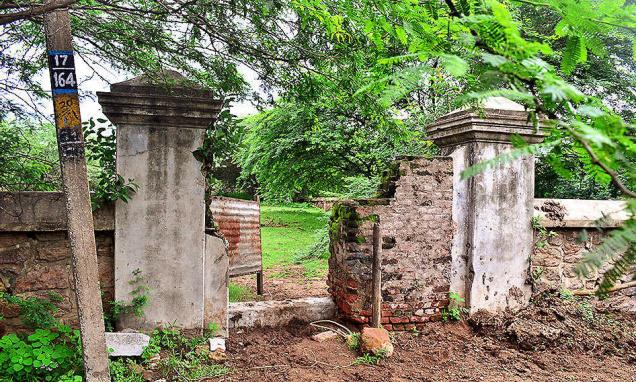
The two-storey mansion where the Hyderabadi noblewoman once stayed is now in ruins.—Photo: T. Appala Naidu
Mansion where noblewoman Khair-Un-Nissa stayed is now a cattle shed
In April 1807, Hyderabadi noblewoman Khair-Un-Nissa was given shelter in a two-storey mansion with a mesmerizing view of palms, fishing canoes and breakers of the Coromandal coast, according to ‘White Mughals; Love and Betrayal in 18th Century India’ by William Dalrymple.
Now, the view of the mansion, which was then residence of East India’s agent in Masulipatam, Alexander, resembles a small jungle, with a cattle shed within the stonewall in the Bandarkota area in Machilipatnam.
Khair-Un-Nissa, most excellent of the women had stayed in the mansion with her mother Sharaf-Un-Nissa for nearly two years during her exile. After Mir Alam, Hyderabad Nizam, died in January 1809, Khair-Un-Nissa and her mother appeared to have returned to Hyderabad.
Outlawed after love affair
Colonel James Achilles Kirkpatrick, the British Resident in Hyderabad (1797-1805), fell in love with Khair-Un-Nissa, and married her in January 1801. Citing disgrace to her family, Khair-Un-Nissa was ordered by Mir Alam that she would not be allowed back to Hyderabad on her way back from Calcutta, where she spent some months, mourning the death of her husband Kirkpatrick. He was 41.
Widowed at 19, Khair-Un-Nissa had to live outside the Nizam’s dominions and thus she had to stay in Masulipatam as suggested by her husband’s assistant, Henry Russel. Nestled between the Dutch fort and an armoury, the mansion has been erased from the memory of the people of Masula and become home for cattle.
The Machilipatnam Municipality’s survey records show that the nearly two-acre site of the mansion is now under the control of private people. “We do not know any history attached to the land. The entire site has been distributed among the 12 members of our family, Vemoori family,” Vemoori Badri toldThe Hindu . Mr. Badri’s family uses this historical site as shelter for their cattle.
“Until 1979, the two-storey British building was in good shape with rooms with spiralling space. It has disappeared on the site over the years. Possession and transfer of right over the site by locals remains a puzzle for me,” local historian and then Masula Revenue Inspector Mohammed Silar told The Hindu . Most of the protection wall and entrance gates to the British site were collapsed. A thatched cattle shed raised on the pillars of the old construction welcomes the visitors.
source: http://www.thehindu.com / The Hindu / Home> National> Andhra Pradesh / T. Appala Naidu / Machilipatnam – July 02nd, 2016
Two swimming coaches – Pradeep Kumar and Nihar Ahmed – on what keeps the states swimmers going
Bengaluru , KARNATAKA :
Karnataka’s swimmers’ success in the recently held Sub-Junior National Aquatic Championship at Bengaluru shouldn’t come as a surprise. Karnataka swimmers have been dominating the National events decade after decade now. Prior to the 2016 sub-junior and junior National meets in Bengaluru, Karnataka won the National Championship in the junior section for a record 24 years and it’s senior team has been a champion for 23 years! In 2015, Karnataka created the historic hat-trick by making a clean sweep of National titles in Sub-Junior, Junior and Senior ranks. The state has produced several Olympian swimmers such as, Nisha Millet, Shikha Tandon, H.S. Hakimuddin and Rehan Poncha . In terms of infrastructure, Karnataka ranks high on the National list and its no surprise that swimmers from other states make a bee-line here for for training.
What makes Karnataka a powerhouse in swimming? The credit goes to two award-winning coaches — S. Pradeep Kumar and Nihar Ameen. Between the two, they have trained hundreds of National and international swimmers who won laurels to the State and the country. The two veteran coaches speak to MetroPlus on the rise of Karnataka in aquatics and what made their swimmers tick.
Pradeep Kumar
Pradeep Kumar, who has been a National coach, says, “I will put that down to our club system. We have several swimming clubs, which have dedicated coaches and good training system in place.” “We also have 1,000 registered competitive swimmers and that’s where the talent keeps coming from. We also have a State Association (KSA) which is committed to support young talent’’ adds Pradeep.
But Pradeep feels that other states, especially Maharashtra, is catching up and there is a dip in the standard of Karnataka swimmers. “Of late, other state swimmers come and train here. This is a disadvantage for us. At my club, Basavangudi Aquatic Centre (BAC), I stopped taking outside swimmers five years ago,” opines the coach.
Pradeep also points out that the short span of swimmers’ career also is a setback. “Most junior swimmers get into professional courses after high school on sports quota. Once they do that, they stop competing and it affects our prospects. Instead of sports quota, it would be better if the State Government directs the Education Department to give grace marks for excellence in swimming,” he observes. Another challenge for the State swimmers is to find jobs. “There is a lack of career opportunity in the State for the swimmers and they often are lured away by other States and public sector units like railways,” says Pradeep.
Pradeep has a healthy rivalry with Nihar Ameen at State meets where their teams clash for the overall title. Nihar, who is the first swimming coach in the country to be honoured with the Dronacharya Award for excellence in coaching in 2015, holds strong views on the state of sport.
Nihar Ameen
Nihar cites three major reasons for Karnataka’s dominance in swimming – “First, we have the best State swimming association in the country and under the president, Neelkant Rao Jagdale, KSA has grown from strength to strength putting in place a well-developed system to promote the sport. Secondly, thanks to conducive system, we have several clubs in this Bengaluru, Mysore and Mangalore, which have good training programmes. Thirdly, we have the best infrastructure and of late many pools have been privatised and are professionally managed now.” He also adds, “The sport is picking up in Dakshin Kannada, especially in Puttur.”
Nihar, however, admits that despite its supremacy, there has been a marked decline in the quality of performances. “There are fewer National records and the attrition rate among swimmers is on the rise. The scene was not the same 20 years ago. The present generation has other options and distractions and I don’t find the same level of commitment that we had in the past.”
Nihar disagrees with the view that training of swimmers from other states in Karnataka poses a challenge for the local talent. He, in fact, trains the Olympians, Virdhwal Khade of Maharashtra and Sandeep Sejwal of Delhi at his pool in Dolphin Swim Centre in Mathikere and adds, “I would say training with outside talent helps local swimmers to raise their standards.”
For Pradeep and Nihar, who have presided Karnataka’s rule in the pool for the past two decades, the lack of a strong second line of coaches is worrisome. But, there are signs that a new crop of top coaches will soon emerge. Former National champion Nisha Millet is on the job, by turning to be a full time coach. But, Karnataka needs more to keep the State flag flying in the pool!
source: http://www.thehindu.com / The Hindu / Home> Features> Metroplus / by Kalyan Ashok / Bengaluru – July 02nd, 2016
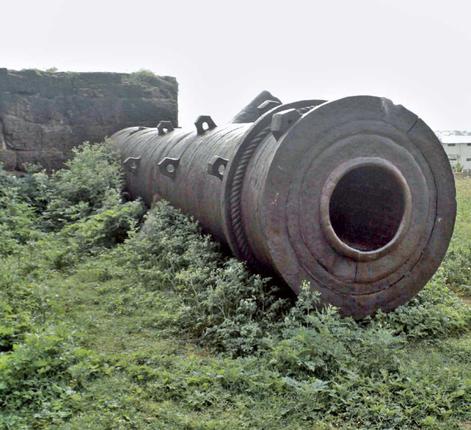
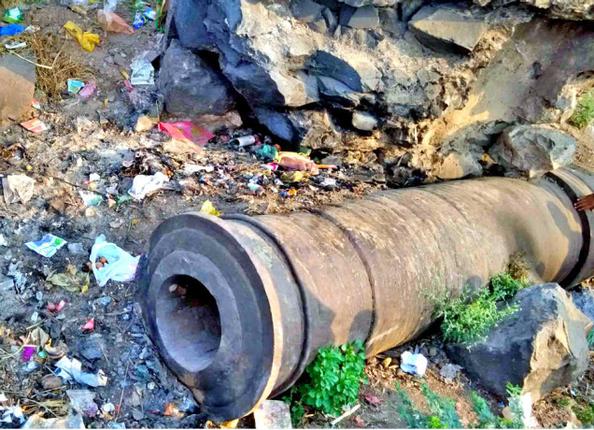
The Mustafabad cannon at Allapur Gate and Landa Qasab cannon, in Vijayapura, are facing neglect.
Some of the massive and marvellous cannons belonging to the Adil Shahi era here are decaying because of lack of efforts to preserve them.
While only a few giant cannons have been preserved at Nakkar Khana, the main pavilion of the Gol Gumbaz, at Malik-e-Maidan, some others are left there in the open.
The cannons at Mustafabad near Allapur Gate, a few hundred metres from the Gol Gumbaz, are in the worst shape.
The cannon was earlier placed on the fort wall. Over a period of time, the wall collapsed owing to lack of maintenance and the giant cannon fell on the ground.
The authorities have not made any efforts to locate it to a better place where it could be preserved. They are now getting gradually buried under a heap of garbage and human waste.
Similar is the condition of the Landa Qasab cannon near Kirti Nagar and Ali Burj.
While a signboard has been placed by the Archaeological Survey of India near the Landa Qasab cannon, the one at Mustafabad does not have one.
According to historians, these cannons played a significant role in protecting the boundaries of the Adil Shahi empire from enemies.
They were strategically placed on towers where security men could keep a watch on the entry of enemies.
source: http://www.thehindu.com / The Hindu / Home> National> Karnataka / Firoz Rozindar / Vijayapura – June 30th, 2016
Qawwal Naseer Taj talks about the power of qawwali, its spiritual approach and why connoisseurs enjoy it
For 30-plus years, Naseer Taj has been enthralling music aficionados with his qawwalis in Hyderabad. “Music is a way of devotion and life,” he smiles as he gets ready for a qawwali rendition at Goethe Zentrum. As part of the World Music Day celebrations, he along with his team including his son gave a soulful performance at the German centre. The packed crowd of 100 members sat mesmerised as his robust voice croonedSabka Malik ek hai. It was followed by the all-time favourite Damadam mast kalandar. The six accompanying artistes added to the lively effect and turned the cool Sunday evening into a memorable onefor the audience.
A few hours before the performance, Naseer is in a buoyant mood. He recalls his early days as an auto driver before his passion created a path for him. “I was passionate about qawwalis. There was something magical about the chorus voice and claps,” he recalls. While his family was concerned about the youngster listening to qawwalis in his spare time, Naseer was unperturbed. “I would drive auto in the mornings and attend qawwali programmes in the night. The family would search for me and I would be listening to a qawwali at a concert,” he laughs and adds, “I was busy pursuing my passion that I never knew when it became my profession.”
The energetic powerhouse pieces of qawwali were traditionally sung at the shrines of saints; they would take many on the path of spirituality. Qawwalis depicted in movies and reality shows seem different from the traditional form, and Naseer says the highpoint of qawwalis is its underlying spiritual approach. “Qawwalis draws their essence from classical music but it is a unique genre. Here music and text blend together and the lyrics are important. While one sings softly in a ghazal, qawwals like to sing loudly. This has a deep effect on the audience’s memory.”
Speaking about qawwali’s roots, he says, “Qawwalis have a unique place in Hindustan and music lovers hold it on a high pedestal. People of all sects enjoy the performances,” he states, giving examples of ,Sabka maalik ek hai. He sums up the essence by saying: “Badan ka rang kuch bhi sahi, sabka lahoo ka rang ek hai. Qawwali is part of our culture and we should be proud of our legacy,” he says.
Naseer has given numerous performances across India and abroad. “One cannot put into words the feeling of singing qawwali,” he says and explains, “The music, rhythmic claps and the loud voice of the qawwal creates a positive energy. The qawwals experience ecstasy and the divine presence. Those moments are magical when the audience also experiences joy.”
He recently sang for the Independence Day celebrations at Golconda Fort and affirms the genre has seen changes according to the changing tastes. He feels connoisseurs enjoy a qawwali with clean words. “There were some songs with cheap lyrics but when there are meaningful words, qawwalis create a connect. Log ache cheez ko sunte hain, chillar cheez ko nahin”
Naseer looks back at his life with satisfaction. “My qawaalis have given my soul joy and peace. I have got my daughters married. I live in a rented accommodation. My only dream is to see my son shape up as a good qawwal. When he sings, people will remember me,” he signs off.
source: http://www.thehindu.com / The Hindu / Home> Features> Friday Review > Music / by Neeraja Murthy / Hyderabad – June 30th, 2016
Newly elected MLC Rizwan Arshad, who arrived in city to day was given a rousing welcome by Congress activists at the Toll Gate in front Columbia Asia Hospital.
He was later taken to City Congress office on Sayyaji Rao where he was felicitaed.
City Congress Committee President T.S. Ravishankar, District Congress Comittee President B.J. Vijaykumar and others were present.
source: http://www.starofmysore.com / Star of Mysore / Home> General News / July 02nd, 2016
He had been ailing for some time and was taken to a local hospital where his condition did not show any signs of improvement.
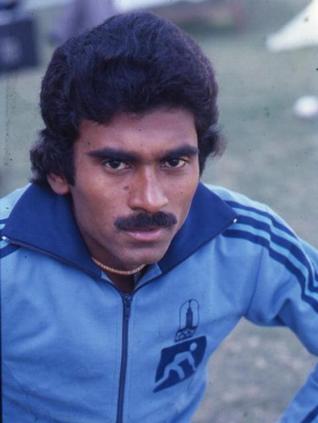
Mohammad Shahid, hockey star of yesteryear, was admitted to a private hospital in Gurgaon on Wednesday for liver treatment which was not available in Varanasi, his home town.
Shahid had been ailing for some time and was taken to a local hospital where his condition did not show any signs of improvement.
According to sources close to the hockey player, he was treated for dengue and jaundice but Shahid complained of restlessness and was promptly advised dedicated treatment of a higher quality in Delhi and was flown in on Wednesday.
With swelling in his legs and acute stomach pain, Shahid, who would once leave opposition defenders chasing his shadow, was not even able to walk on his own. He reportedly presented a pitiable sight and his physical state left many of his admirers in tears.
Known for his exceptional dribbling skills, Shahid had been hurt by the hockey world shutting him out from all schemes. He was hardly involved by his employer — Railways — for any coaching assignment related with the game and that had left the hockey great disillusioned.
True to his nature, Shahid refrained from blaming anyone for his condition and preferred spending his life in solitude. Hockey, needless to say, stayed close to his heart always.
Shahid’s former teammate Zafar Iqbal promised all help. “I am saddened to know about his condition. I will visit him (on Thursday) and offer all possible support from the hockey fraternity,” said Zafar.
source: http://www.thehindu.com / The Hindu / Home> Sport> Hockey / Vijay Lokapally / New Delhi – June 30th, 2016
It is said that Shah never asked his followers to shun their own religion and this is the reason why he had a great number of Hindu followers.
What is common among Dewa Shareef in Uttar Pradesh, Ramdevra in Rajasthan and Powa Mecca in Assam?
These are some of the lesser-known shrines revered and frequented by people of all faiths and since ages have been portals of peace, tolerance and harmony.
The Dewa Shareef shrine of Haji Waris Ali Shah in Barabanki, hardly an hour’s drive from Lucknow, draws the faithful from across many strands of religion.
“The air around the place is liberal and the word intolerance an abomination. Why else would people leave their religious preferences behind and with baskets full of flowers, sweets and colourful shiny chaddars in their hands and wish in their hearts, make a beeline for the shrine of the Sufi saint,” says an article ‘The Sufi of Dewa’ in the latest issue of Equator Line magazine titled ‘Liminality of Faith’
It is said that Shah never asked his followers to shun their own religion and this is the reason why he had a great number of Hindu followers.
The very first foundation of the shrine was laid by Kanhaiya Lal and many more Hindus came forward after that.
Both Hindu and Muslim devotees contributed equally to the monument that it is today.
The Ramdevra shrine, about 12 km from Pokhran, is holy to both Hindus and Muslims.
“Ramdevra, the final resting place of Baba Ramdev, or Ramsha Pir as he is called by Muslims, is probably the only temple in the country with an intriguing assortment of devotees,” says another article ‘A Syncretic Oasis in Pokhran’
“One of the most puzzling features of the temple is the number of mazars inside. There are tiny gravestones representing the graves of children and large ones signifying the graves of adults… These are graves of people who had been close to Baba Ramdev. Among these graves, in the sanctum sanctorum, is the samadhi of the saint himself.”
Powa Mecca in Hajo near Assam’s main city Guwahati is the seat of Sufi saint Peer Ghiyasuddin Auliya.
“Earth was brought from Mecca to lay the foundation of the masjid. The locals believe that a pilgrim to this shrine earns a quarter of the blessings bestowed on someone performing Haj at Mecca. The place — Powa (quarter) Mecca — has derived its name from this belief. It is indeed significant that Hindus, Muslims and Buddhists all find this place holy and come here for pilgrimage,” writes noted Bangladeshi author Selina Hossain in ‘Faith Synthesis’
“More so, they say that the mythical bird Garuda, the carrier of Lord Vishnu, flew off the hill. After flying some distance, it stretched its wings and hovered over the place; it is now called Pakhimela market. A saint named Ourjo also sat in prayer there. The place is said to have been inhabited by the asuras. The most devious among them was Hayasur; his face resembled that of a horse.
“The saint had prayed to Vishnu that the asura be slain so he could pray in peace. Vishnu rode Garuda to defeat the asura in Hajo. This form of Vishnu is now called Haigrib. In a gesture of gratitude, Ourjo established the Haigrib temple here, bonding the two religions forever in an uninterrupted harmony,” she writes.
“Faith, unspoiled by outside interventions, has an openness that its seekers find reassuring,” says the magazine’s editor-in-chief Bhaskar Roy.
The issue also profiles Ajmer and Nizamuddin dargahs, Banke Bihari temple and Bavar Swamy’s empty shrine at Sabarimala among other shrines.
source: http://www.thehindu.com / The Hindu / Home> National / PTI / New Delhi – June 28th, 2016
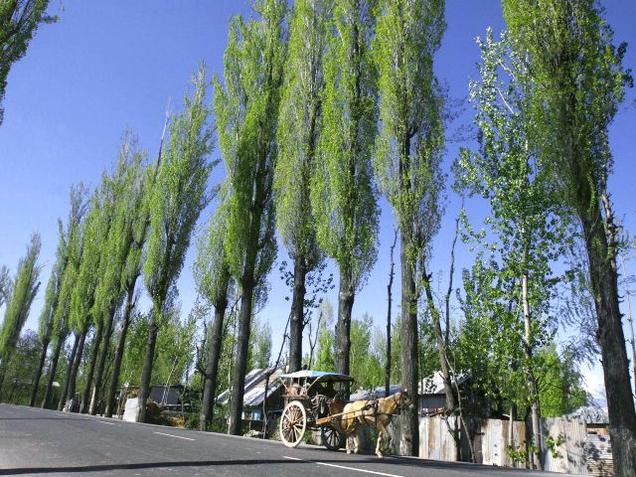
A horse-drawn cart goes past poplars on a highway at Narbal, 15 km north of Srinagar.
Srinagar :
Mathematician Fozia Qazi has undertaken a campaign to protect the trees that are in danger of being axed in large numbers in the valley.
With around 16 million poplar trees facing the axe in Kashmir Valley following a High Court order, noted mathematician Fozia S. Qazi has started a campaign to “dispel the myths” that led to the systematic felling of the trees synonymous with the Valley landscape for decades.
In 2014, the Jammu and Kashmir High Court first banned the sale, purchase and plantation of female Russian poplars (Populus deltoides) following a public outcry and medical warnings that their cotton shedding laden with pollen, during late spring was the main cause of allergies in Srinagar.
Chopped down
Thereafter, lakhs of poplar trees were cut down across the Valley. A compliance report submitted to the court by the Deputy Commissioners of Kulgam and Pulwama district in June this year claimed that it targeted felling of six lakh poplars.
Dr. Qazi, Associate Professor of Actuarial Mathematics at Islamic University of Science and Technology, believes that the High Court’s decision to fell poplars is not only an “exceptional exercise but also a misinformed decision.”
Dr. Qazi, who is filing a petition before the court against the felling, has organised a meet of experts to collate scientific data on the subject and create mass awareness.
Backing Dr. Qazi’s contention that poplars are not the main cause of allergy in Kashmir during April and May, Dr. Dr. Naveed Nazir Shah, Consultant and Assistant Professor at the Department of Chest Medicine of the Government Medical College, Srinagar, said: “Poplar-induced allergy stands at number six as a cause of allergy. While dust remains the main cause, it is followed by lawn grass, deodar, kikaarand chinar pollen.
“Also, the size of its cotton is big enough to enter human body. There is no connection to prove that the poplar was the main cause of the allergies.”
Instead of felling the trees, Dr. Sajad Gangoo, an expert from Sher-i-Kashmir Institute of Agricultural Sciences, argues that pruning these trees during autumn would cut down cotton circulation by 80 per cent in spring.
Key to rural economy
Dr. Qazi, a doctorate from the Syracuse University in the U.S., argues that poplar trees are central to rural economy here.
“The tree grows faster [than the local species]. It’s a source of livelihood for many because fruit boxes are made of it,” she pointed out and said that while “it consumes water, purifies it more than any other tree and could be helpful for water bodies too.”
Poplars live up to 40 years and mature in just three years. They attain height up to 20-30 feet.
“Given its height, poplars stand distinctly in the landscape of Kashmir and dot most highways, forming a mesmerising canopy and fast becoming a tourist attraction too,” Ms. Qazi said.
source: http://www.thehindu.com / The Hindu / Home> National> Other States / Peerzada Ashiq / Srinagar – June 24th, 2016