Reaching out in faith

Tiruchi, TAMIL NADU :
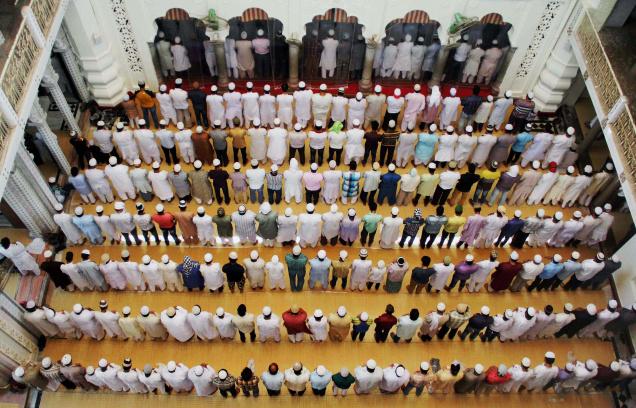
'Taraweeh' prayers are exclusive to the month of Ramadan. Photo: PTI
‘Taraweeh’ prayers are exclusive to the month of Ramadan. Photo: PTI

Qualified reciters of the Quran from North India are in great demand in to lead the Taraweeh prayers in South Indian mosques during Ramadan

Of all the months in the lunar Islamic calendar, Ramadan stands out for its focus on spirituality. Through dawn-to-dusk periods of voluntary abstinence and prayer, the Muslim is expected to feel closer to God.

Ramadan is also believed to be the month when the Quran began to be revealed. So the recitation of verses from the holy book in Arabic assumes greater importance during this month. It is a common practice for observant Muslims to try and finish at least one complete reading of the Quran at home. This is also carried out by imams (prayer leaders) who conduct the late-night Taraweeh prayers in mosques during the month.

With the emphasis on the most sonorous rendition of the Quran, management committees and clerics attached to mosques and other places of congregational prayers in Ramadan take an extra effort to find Aalims (scholars) who have memorised the 6,666 verses of the holy book and are skilled in reciting it in a semi-musical style. A person who has perfected memorising the book is known as Hafez, and one who has mastered the art of recitation, as Qari.

In South India, Islamic institutions often invite qualified reciters of the Quran from the North specifically to conduct the Taraweeh prayers during Ramadan.

North Indians are considered to be better in Arabic pronunciation because of the semantic and phonetic affinity that their regional languages – Hindi, Urdu and Hindustani – have with the language of the Quran.

In Tamil Nadu, cities like Chennai, Tiruchi, Madurai and Salem have been hosting imams from Uttar Pradesh, Bhopal and Bihar to lead Taraweeh prayers for several decades.

“The imam’s talent is important in holding the congregation’s interest,” says Mohamed Meeran Misbahi, Secretary, Tamil Nadu Jama’at-ul-Ulema Sabai, a state grouping of Islamic scholars. The Tenkasi native has been officiating as imam at the Kader Mosque in Tiruchi’s Gandhi Market area for the past 20 years. “Many worshippers visit mosques just to sample the different styles of sermons and Quran recitation during Ramadan, so the clerics have to make an extra effort to keep the people engaged,” he adds.

On average, depending on his professional expertise, a prayer leader can earn from Rs. 8,000 to 15,000 per month. During Ramadan, the income is boosted by donations from the congregation.

Historic link

The erstwhile princely kingdom of Rampur (now a part of Uttar Pradesh) has been maintaining a link with Tiruchi that started in 1952, when Saudi Arabian national of Indian origin, Moulana Qari Hafez Mohamed Ismail Sahib Mujaddidi Madani, was invited to conduct Taraweeh prayers at the Mohammadi Jama Masjid in Tiruchi by the then-Nawab of Arcot.

“My father led the Taraweeh prayers from 1952 to 1974. He died during a prayer service in 1974, and was buried in Tiruchi,” says his son Qari Moulvi Rashid Mujaddidi. The cleric, an Indian citizen, had conducted Taraweeh prayers at the Chowk Mosque from 1960 to 2006. Though he has cut down his engagements due to his advancing years and health problems, the cleric still visits the city during Ramadan, and this year, is officiating as a Taraweeh imam at a private mosque in Singarathope.

His son Salman, who is also an imam, reached Tiruchi a day before the month’s commencement (by the sighting of the crescent moon) was announced, in early June.

“I don’t speak much Tamil, but I have got only love and affection from the people of Tiruchi,” says Moulvi Rashid, who has also worked as an Arabic lecturer in Rampur. “I always tell people to come and visit Tiruchi and learn how different communities can live in harmony. ”

South-side sojourn

For Moulana Hafez Abdul Rab Qassimi, a suggestion by his friend brought him from his village Mansoorpur, Uttar Pradesh to the Bangali Street Mosque in Woraiyur in 1972. “I was a young man when I started leading the Taraweeh prayers here; now I am almost 68. I will continue to come as long as I am physically able to,” says Moulana Abdul Rab, who makes a three-day rail journey via Moradabad, Delhi and Chennai to reach Tiruchi every Ramadan.

Accommodation for the visiting imams is usually provided within the mosque premises. Congregants provide the food for breaking the fast (iftar) and pre-dawn meal (suhour).

It is Moulana Zia-ur-Rahman’s first year as the Taraweeh imam at the Tennur mosque. A graduate of Qurannic studies from Hyderabad, the 27-year-old will return to his native Leela Baran village in Bihar shortly before Eid-al-Fitr, the festival that denotes the end of Ramadan. “The atmosphere in Tiruchi is very peaceful and conducive to prayer,” says the imam.

Quest for authenticity

Despite the continuing patronage of North Indian imams, many South Indian institutions have come up in the interim to create a new talent pool of young Muslim clerics with a comparable expertise in Quran recitation.

“International qirat (recitation) competitions and a wider exposure to different styles have led to more Muslims opting to study this discipline more seriously,” says Moulana Hafiz Mufti Ruhul Haq, principal, Jamia Anvar-ul-Uloom Arabic College, Khaja Nagar.

The college offers Arabic-medium courses in Quran recitation, Islamic jurisprudence and the study of the Traditions (Hadith) of Prophet Muhammad.

“Besides mosque duties, we also train our students in computer skills in English, Arabic and Tamil, so that they can have a wider range of employment opportunities,” says Moulana Ruhul Haq. Taraweeh

The emphasis on certification has increased the number of younger clerics, with institutions attracting students not just from the South, but also the North.

Like any profession, individual talent is ultimately the deciding factor in religious orders too.

***

Fact file

In Arabic, Taraweeh is the plural of tarweeha, which means to rest. In the context of Ramadan prayers, it means to take rest between every four rak’at (units) of praying. Services need to have more than two periods of rest in order to qualify as Taraweeh.

Taraweeh prayer units across the Muslim world range from 8 rak’ats to 20 rak’ats.

Taraweeh is exclusive to the month of Ramadan. However, unlike the compulsory (fardh) five prayers of the day, participating in Taraweeh daily is not obligatory. In fact, Ramadan-specific prayers are meant to be conducted only after the compulsory night prayer (Isha).

source: http://www.thehindu.com / The Hindu / Home> Features> Metroplus / by Nahla Nainar / Tiruchi – June 24th, 2016


The game is on

Mumbai, MAHARASHTRA / Bengaluru, KARNATAKA :

In a league of his own: Mustafa Ghouse (right)

Former Indian tennis player Mustafa Ghouse talks about how private leagues are benefitting our sports

Mustafa Ghouse was born into a family of tennis player and took to the sport as a child. He participated in the ATP Tours and picked up a clutch of medals, including a bronze at the Asian games in Doha in 2006. Post retirement in 2008, he is currently the CEO of JSW Sport, and the chief operating officer of Bengaluru FC, two time winners of the I-League. He also manages the Sports Excellence programme that mentors 40 athletes across Olympic sporting events.

In the city for the recently concluded TedX Bangalore event, Mustafa says, “My background in sports helps me manage the team better. I am happy to have been part of a team that was built from scratch and has gone on to win two titles in three years. We want to keep up our performance. The one factor, that has helped this team, has been the passion for the sport and winning that our players have. Every player is very hardworking and willing to go the extra mile to achieve more success.”

Mustafa feels that the mushrooming of private leagues in sports such as kabaddi, tennis, badminton and football has the potential to become a game changer for Indian sport. “These leagues ensure that players become very popular, get sponsors and are able to compete at higher levels. Audiences are flocking to see sports other than cricket and it is very heart-warming. The BCCI must be given credit for showing us the way ahead.”

Is tennis still his favourite sport? “Yes, I have played all sports, from football to cricket, badminton, tennis and squash. I have enjoyed playing all sports, though tennis holds a special place in my heart.” He is circumspect about India churning out an individual grand slam winner soon. “It will require a lot of systemic changes and will require a lot more effort and support. We do have talented youngsters, but it is important to get a working system in place for achieving success in the long term.”

source: http://www.thehindu.com / The Hindi / Home> Features> Metroplus / Nikhil Varma / Bengaluru – June 06th, 2016

JITS professor to participate in WCE-2016

Karimnagar, TELANGANA :

V. Malsoru, associate professor in Department of Computer Science and Engineering at Jyothishmathi Institute of Technology and Science (JITS) would be participating in an international conference on data mining and knowledge engineering as part of the 24th World Congress on Engineering (WCE)-2016, at Imperial College in London from June 29 to July 1.

He is at present pursuing his Ph.D. research at Jawaharlal Nehru Technological University (JNTU), Hyderabad, under the supervision of A.R. Naseer, principal and professor of Computer Science & Engineering, JITS Karimnagar, affiliated to JNTU Hyderabad.

His research paper titled “Domain-specific performance evaluation of sequential pattern mining approaches” has been selected to be presented at the WCE, according to a note here on Saturday.

source: http://www.thehindu.com / The Hindu / Home> National> Telangana / by Special Correspondent  / Karimnagar – June 26th, 2016

IT employees to have a body to press for their demands

Bengaluru, KARNATAKA :

ITemployeesMPOs27jun2016

The AIITEA will hold its first meeting on June 30 on the ITC Infotech campus

Amid the opportunities and growth prospects, the problems faced by employees of the information technology sector are among the least addressed. The struggles within these workplaces often get sidelined or swept under the carpet by the ‘terms and conditions’ of the company. Consequently, employees often have little say in such matters.

Now these unhealthy workplace practices have forced IT employees to join hands to make a forum where they can address their issues.

The All India Information Technology Employee Association (AIITEA), a registered body meant to take up and resolve problems faced by people in the IT sector, is going to have its first meeting on June 30, on the ITC Infotech campus to announce in the open its arrival in the IT city.

Syed Muqeem, head of AIITEA and one of the founder members of the association, said: “There is a general perception that unions and associations are for blue-collar people, but there are many instances where the IT employees, the so-called white-collar staff, face workplace-related problems, but there is no group to support them.”

“Most associations that have been formed earlier either play in the hands of the big multinational companies or have failed to take up the issues faced by the employees in the sector, and take it to a logical conclusion. This void that the industry has created over a period is what we are trying to fill up. Our main aim is to ensure equal employee representation in resolving employee grievances,” said Muqeem.

Bengaluru, deemed India’s IT capital, is home to 35 per cent of the 8 million IT employees and in the last financial year, it clocked around 1 lakh crore in software exports. But beneath this glitter is a dark cloud looming and that is the ever-deteriorating state of the IT employees.

A global study done by the National Institute of Mental Health and Neurosciences (NIMHANS) says 50 per cent of employees in India Inc are under stress and around 30 per cent software engineers in the city show signs of psychiatric disorder. One in every 20 employees has contemplated suicide.

The fast pace at which the IT industry is progressing has its own side-effects and employees are at the receiving end. Muqeem said that till date “we have helped resolve around 15 cases where the employee was being harassed by the employer, but on an average we receive 15-20 complaints per week, but the fear of losing one’s job, coupled with the feeling that engaging with an association might hamper future growth prospects is what is keeping many from coming out in the open”.

source: http://www.bangaloremirror.com / Bangalore Mirror / Home> Bangalore> Others / Bangalore Mirror Bureau / June 27th, 2016

Resul Pookutty becomes first Asian to win Golden Reel Award

 KERALA  / Mumbai , MAHARASHTRA  :
Resul Pookutty has made the country proud by becoming the first Asian to win the award for best sound for documentary “India’s Daughter” at the coveted Motion Picture Sound Editors’ 63rd annual Golden Reel Awards.

Resul Pookutty has made the country proud by becoming the first Asian to win the award for best sound for documentary “India’s Daughter” at the coveted Motion Picture Sound Editors’ 63rd annual Golden Reel Awards.

Oscar-winning sound designer Resul Pookutty has made the country proud by becoming the first Asian to win the award for best sound for documentary “India’s Daughter” at the coveted Motion Picture Sound Editors’ 63rd annual Golden Reel Awards.

Pookutty, 44, who attended the awards ceremony here, took to Twitter to share his excitement about winning the honour for British documentary maker Leslee Udwin-directed “India’s Daughter”, made on the Delhi gangrape incident of December 2012, which is banned in India.

“I am honoured with the Golden Reel Award for ‘India’s Daughter’. This is an incredible recognition for me as well as for all those worked in the banned film apart from all those who protested against the brutal killing of Nirbhaya,” Pookutty told PTI from Los Angeles this afternoon.

The Oscar-winning sound engineer said he is the first Asian to win the coveted award at the 63rd Golden Reel Award from the Motion Picture Sound Editors’ (MPSE) of US for best sound.

The government had banned the film from public screening/ airing in the country.

Dedicating the award to the 23-year-old paramedic student who was brutally gangraped on December, 16 2012 following which she died, Pookutty said the film “India’s Daughter” is the true spirit of the youth of the nation.

He said the film recognises the entire spirit of the youth who protested against the inhuman treatment being meted out to girls and women.

“I dedicate this award to Nirbhaya’s soul… And her indomitable spirit,” Pookutty said.

The competing films/ television documentaries in the list included “Beware Baltimore”, “Chef’s Table”, “Deadliest Catch”, and “The Undrafted” “Mad Max: Fury Road”, “The Martian”, “Star Wars: The Force Awakens” and “The Revenant” among others.

Pookutty said a double nomination was rarity in the industry and the beauty is that both these are Indian works.

Late last month, in a rare achievement, Pookutty had won two nominations for two films, both banned in the country, from the prestigious American Motion Picture Sound Editors’ (MPSE) Golden Reel Awards.

The 44-year-old artist of “Slumdog Millionaire” fame has won nominations for his sound engineering work in “Unfreedom”, a US production, and “India’s Daughter”.

He noted that all his international recognitions came for the work he has done in India, but expressed anguish over the ban imposed on both the films in the country.

“I don’t understand why a progressive society like ours should react the way we do now. I am pained at the suppression of artistic freedom,” he had said earlier, adding these two works are analysis of extreme violence, which any progressive society should welcome.

“By banning such films we are nullifying the will of the people,” Pookutty said.

The MPSE recognises excellence in an array of sound editing achievement, from sound effects and foley to dialogue and ADR to music and score integration.

The MPSE is the final industry group to announce nominees this year and remains the only group to do so after annual Academy Award nominations.

“India’s Daughter” was directed, written and produced by British director Leslee Udwin. Though the documentary was banned in India, it was globally beamed on March 4 last year.

“Unfreedom”, which espouses homosexuality, is the debut film of Florida, US-based director Raj Amit Kumar. The film, starring Adil Hussain and Victor Banerjee, is also banned in the country by the Censor Board.

The thriller chronicles a lesbian love story set in New York and New Delhi and is said to be inspired by Faiz Ahmad Faiz’s poem – “Ye Dagh Dagh Ujala”. The film is expected to hit North American halls on May 29.

Pookutty is a film sound designer, sound editor and mixer, and lives in Mumbai with his family. He is a graduate of the Film and Television Institute of India, Pune.

He, along with Richard Pryke and Ian Tapp, had won the Academy Awards for best sound mixing for the Britsh production “Slumdog Millionaire”.

source: http://www.indianexpress.com / The Indian Express / Home> Entetainment> Music / PTI, Mumbai / February 28th, 2016

Anas qualifies for Rio Olympics men’s 400m race

KERALA  :

AnasMPOs27jun2016

New Delhi  :

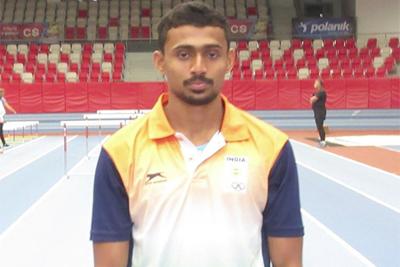
Indian quartermiler Mohammad Anas  qualified for the Rio Olympics by shattering the men’s  400m national record  on the second day of  Polish Athletics Championship  at Bydgoszcz.

21-year-old Anas clocked 45.40secs, the exact Rio qualification timing, to book the Olympics ticket last night and become the 21st Indian track and field athlete to qualify for the upcoming Games.

The Kerala athlete shattered his own national record of 45.44secs which he set on Friday on the first day of the same competition at this Polish city.

Rajiv Arokia, whose national record of 45.47secs Anas broke on Friday, finished second with a timing of 45.60secs.

Anas had won a silver in the Federation Cup of National Athletics Championships  in April with a timing of 45.74secs.

source: http://www.timesofindia.indiatimes.com / The Times of India / News Home> Sports> More Sports / PTI / June 26th, 2016

Resul Pookutty gets another honour

KERALA / Mumbai , MAHARASHTRA  :

ResulPookuttyMPOs27jun2016

It looks like Resul Pookutty is on an award-winning spree. The Academy Award-winning Slumdog Millionaire sound designer was recently honoured with yet another award.The Rocheston Accreditation Institute has honoured the sound designer with Rocheston’s Distinguished Engineer award, for his contribution to the field of sound and music in cinema.

Academy Award-winning musician AR Rahman, took to his micro-blogging page to congratulate Resul. He posted, “Congrats Resul for getting the most distinguished engineer award from Rocheston”. Rahman and Resul share a cordial working relationship.

source: http://www.timesofindia.indiatimes.com / The Times of India / News Home> Entertainment> Tamil / TNN / June 26th, 2016

Now, ‘footie’ is ‘her’ green valley

JAMMU & KASHMIR  :

Kashmir :

Here is an inspirational story that needs to be told and a young woman whose path breaking effort needs to be applauded.
 Nadiya Nighat
Nadiya Nighat
 On a late peak summer afternoon in 2007, Nadiya Nighat walked into the sprawling lawns of Srinagar’s Amar Singh College along with half a dozen boys from Ram Bagh, the locality within a stone’s throw, where they all lived. The boys were carrying a football with them and soon Muhammad Abdullah Dar, a local coach, began to teach them, and about 40 others — all boys — learnt how to roll and tackle the ball on the ground.

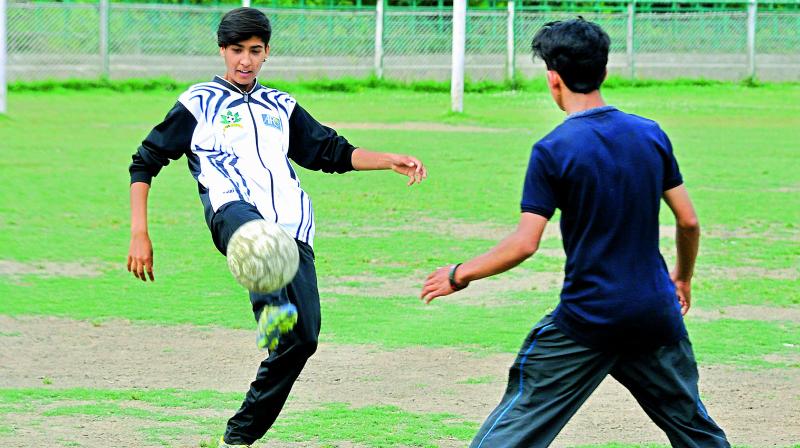
“I just kept watching their pursuit for a while and then requested the coach if even I could join them. He agreed and in about half an hour, I came to know what the game is all about,” Nadiya recalls. “Until then I knew football only as another ball game. Later, I learnt you can work wonders with it. I found it to be a very interesting game and have not moved away from it since then,” Nadiya says who has since, stepped into Dar’s shoes and is incidentally Kashmir Valley’s first female football coach and referee now.

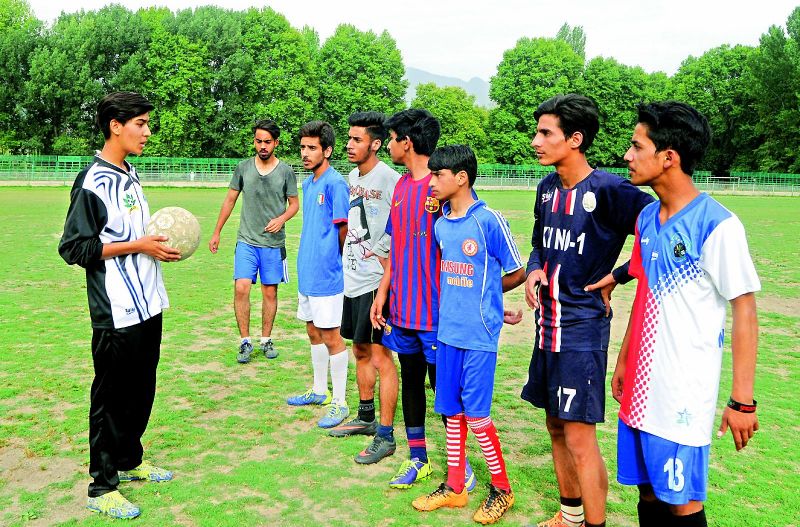
Also, she is the youngest among all the game coaches of the Valley, who just at the age of 19, is training about 30 under-19 players of her own club and a team at the government-run Women’s College at Srinagar’s Maulana Azad Road. She also engages 29 young boys and girls in the 6-12 age group  in soccer coaching drills and games at the ‘Grassroots Centre,’ which is being run by Jammu and Kashmir Football Association (JKFA) in the Himalayan state’s summer capital.
“In fact, I teach them and at the same time,  I learn as well. It has been a wonderful experience,” she adds.


(above) Nadiya Nighat training under-19 players at the government-run Women’s College at Srinagar’s Maulana Azad Road

She passed her 12th Class examination as a regular student of a J&K government-run school (Channapora) a couple of months ago and is now trying to get admission in a physical training institution outside Jammu and Kashmir to pursue a career in sports, with  football being “her life”.

“I would like to go outside J&K. A few have suggested Punjab. But then I learnt that Haryana has better options to offer when it comes to football,” says the girl from a middle class background. If she gets enough girls to join her in the Valley, then she might dedicate her time and skills to build a powerful home- team instead. Unfolding her future plans, she reveals, “If that happens, I might seek admission in the Women’s College here and while pursuing my studies, I will train and form our own girls’ football team.”

So far, she has been able to find 18 girls, most of them are of her age and are willing to join her team. But, in most cases, it is their personal longing for the game, which is not backed by their families. “Unfortunately, only a few are being supported by their families. The rest are willing to play but their parents are discouraging them,” she laments.

Nadiya herself had to face resentment from her mother as it was considered a taboo for women to get into a professional employment, leave alone sports. “My mom cautioned me that people will start spreading unpleasant rumours about me joining (a sport), which may ruin my life. But, my papa put his foot down and said that, “If she is interested in making a career in football, nothing should stop her.”

Luckily, I now find a hardened supporter in my mom as well and I do hear encouraging words from neighbours, relatives and friends, who would earlier raise their eyebrows,” Nadiya spoke to the correspondent after holding a tough 60-minute-long soccer training session with half-a-dozen boys at Srinagar’s Polo Grounds sports facility run by the JKFA.

Sameer Gulzar, a trainee, says, he is being trained by Nadiya from the past five months. “I, like the others, have learnt a lot about the game. She is a good coach who trains us with utmost care and tenderness. She never loses her temper. If one of us makes a mistake, she graciously tells him where he went wrong and how he can rectify it,” said the 17-year-old aspirant.

Like Sameer, others in the group were astonished when they first came across a female coach and when they were told that she would be training them. “Now, it is normal. We come here, do our drills and return home happy, with a resolve to return here for the next session. She is really good and there is no problem in communicating with her,” he adds.

Not only in football, but across almost all sports in Jammu and Kashmir and the entire country, the dearth of women coaches is felt by all aspiring sports women. “This is one of the main reasons why women are not coming forward to play and make a career in football and other games in Kashmir. The JKFA has been very helpful to me. It has given me access to use its facilities, including grounds and tools to train both males and females, but the girls are reluctant as they don’t find these secure enough. For instance – Bakshi Stadium, it is a sheltered place but the round-the-clock presence of security forces within the premises dissuades girls from relocating there to train or play the game,” she said.

As far as polo grounds is concerned, parents are not ready to allow their children to play while being watched by men, “If the government comes forward, releases funds and provides the required facilities, including secure locations for girls to play, we would soon be able to put forth a women’s football team of international standards,” Nadiya says, hoping that, “What is important is changing a person’s thinking about women pursuing a career in sports. Culture badalna chahiyen.

There are many there (who like me) who are inspired by Cristiano Ronaldo and Lionel Andrés ‘Leo’ Messi or want to follow the footsteps of Lotta Schelin and Kim Little. But, before they actually give it a try, the Kashmiri society has to change and it must welcome women who are interested in male-dominated career options,” she concludes.

source: http://www.deccanchronicle.com / Deccan Chronicle / Home> Sunday Chronicle, Headliners / by Yusuf Jameel / June 26th, 2016

Mehbooba Mufti wins Anantnag bypoll

JAMMU & KASHMIR :

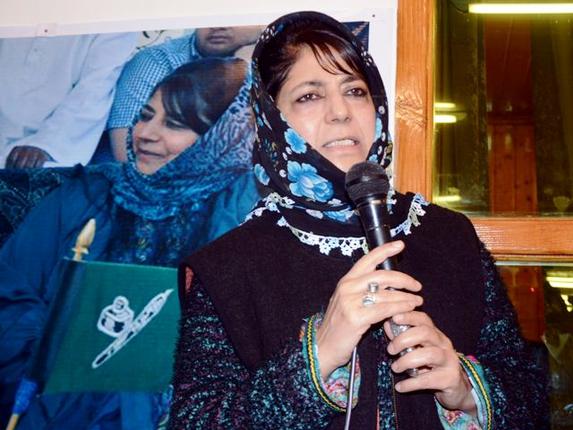
Jammu and Kashmir Chief Minister Mehbooba Mufti.

In the 2014 polls, Mr. Sayeed defeated Congress candidate Mr. Shah by 6,000 votes and the margin has doubled this year.

Chief Minister Mehbooba Mufti on Saturday won the Anantnag Assembly seat by 12,085 votes, driving home a point that her popularity remains unaffected by the Peoples Democratic Party’s decision to join hands with the BJP in Jammu and Kashmir.

Of 28,500 polled votes, the PDP candidate Ms. Mufti has secured 17,701 votes, followed by Congress’ Hilal Shah with 5,616. National Conference (NC) Iftikhar Misger stood a distant third with 2,811 votes.

The PDP’s winning margin has considerably gone up in Anantnag despite the NC and the Congress pegging its campaign on the anti-BJP wave and cornering Ms. Mufti over her alliance partner.

In the 2014 polls, Mr. Sayeed defeated Congress candidate Mr. Shah by 6,000 votes and the margin has doubled this year with 12,000 lead by Ms. Mufti.

Earlier in the day, the counting was stopped immediately after the first round results were announced because of the Congress’ protests.

“An Electronic Voting Machine (EVM) was not properly sealed and should not be counted at all,” alleged Mr. Shah, as he and his supporters left the counting hall in protest.

However, after 15 minutes the counting was restarted.

The NC also alleged EVM tampering. “A lot of EVMs in Anantnag (were) without mandatory seals/locks. Electoral staff says since teachers were incharge, their inexperience is the reason!” alleged NC spokesman Junaid Azim Mattu, who later congratulated Ms. Mufti on her victory.

However, district magistrate Syed Abid Rasheed Shah refuted the allegations of tampering of EVMs.

The Anantnag seat, which fell vacant after sitting chief minister Mufti Muhammad Sayeed died on January 7, went to polls on June 22. Around 28,500 voters participated in the election out of 80,000 registered voters, with poll percentage pegged at 34 per cent, down by five per cent compared to the 2014 Assembly polls amidst separatists’ boycott call.

Considered bastion of the PDP, it’s Ms. Mufti’s fourth win to the State Assembly from south Kashmir since 1996, when she started her political career as Congress candidate and contested from Bijbehara constituency.

She was also elected to the Lok Sabha from Anantnag Parliament seat in 2014 general elections but returned to the State politics in April this year to take over as the State’s chief minister after her father’s demise.

source: http://www.thehindu.com / The Hindu / Home> National> Other States / Peerzada Ashiq / Srinagar – June 25th, 2016

Athala Kotti, a vanishing tribe

Udupi, KARNATAKA / Anantapur, ANDHRA PRADESH :

Udupi:

Around 3am during the month of Ramzan, a group of people from Andhra Pradesh carrying drums and sticks shout in Urdu: “Those who are asleep, wake up, declare your loyalty to God and get up to eat the dawn meal”.

This is like an alarm for Muslims in Udupi to have their ‘Sehari’ and start the fast. These people, called ‘Athala Kotti'(fakir), have been following the tradition for the last four decades. They will do this for 30 days and on Eid-ul-Fitr, Muslims offer them money, food and clothes. The offering is considered as their monthly earning.

These folks are not invited to one place and keep changing places every year. A few of them prefer to visit the coastal district every year.

However, the importance of ‘Athala Kotti’ is decreasing year by year as people are now more depending on alarm clocks and mobile phones to wake up. Earlier, there was no such facilities and these people used to go to each Muslim family and wake them up. Keeping the ancient tradition, some Muslims still prefer to wake up by listening to their voice.

Nazeerulla Shah Khalifa Raphayi from Anantapur district, a member of the group, said, “I have been coming to Udupi for years. We use drums made from animal skin. We sing songs and hold the lamp while moving from one house to another. We start the journey at 2.30am every day and continue till 4am. After the duty, we choose a Muslim house, and in that house we have our Iftar (evening food). The Muslims in the coastal district are used to our visit.”

“We never demand anything from people. This is considered as a service to God. During the month, some of us go to dargas across the country and dedicate their service there,” he said.

Munavvar Alifa, a member of the group, said: “Earlier, there were only few houses here; now, the number of houses has increased, so responsibility is more as we have limited time to wake them up. Even Hindu families give us offerings here.”

According to tradition, the first fakir in Islam was Bilal bin Rabah, who lived between the sixth and seventh centuries, used to wake up believers with his clear voice. Since then, the role passed down from generation to generation, until it became formalized at the beginning of the ninth century.

A person was appointed to carry out the role in every neighbourhood during the month of Ramzan.

source: http://www.timesofindia.indiatimes.com / The Times of India / News Home> City> Mangalore / TNN / June 24th, 2016