Women Icons – Before Sanjukta Parashar, there was another gritty female cop from Assam

The media may not remember Yamin Hazarika, but for many she is still an Assamese icon.

Yamin01MPOs09apr2016

Guwahati, ASSAM :

Since last week, there has been a flurry of news items in social and mainstream media about Sanjukta Parashar, the superintendent of police in Assam’s Sonitpur district. They gave instances of her bravado, heaped richly-deserved praises on her, and many of them described her as the “first female IPS officer from Assam”.

Sadly for me, the articles were a reminder that popular history, both in Assam and the rest of India, has forgotten all about Yamin Hazarika. That petite lady wore a heavy mantle at a time when women were still defining their roles in India. She was selected in 1979 for the state police services DANIPS (Delhi Andaman Nicobar Islands Police Services) and made it to Indira Gandhi’s security team. While it’s unclear whether she was later promoted to the Indian Police Services, most people in Assam saw Hazarika as no less than an IPS officer and a trailblazer in every way.

To those growing up in Guwahati in the ’90s, Hazarika was one of the few modern female Assamese icons. I met her only twice in my school years but she left a lasting impression on my young mind. She belonged to the Assamese Muslim community, from which few women icons had emerged until then. That impression stayed with me. So last week, when the news reports on Parashar began appearing, I decided to learn more about Hazarika. Who was she truly? To find out, I met her 80-year-old mother and her younger brother Yusuf Hazarika at their home in Guwahati.

Breaking barriers

Yamin Hazarika was born in the late 1950s in Lakhtokia, Guwahati, to Shameem Hazarika and Mohammed Serajul Hazarika. She was the second of five siblings.

Lakhtokia is one of the oldest pockets in Guwahati city that was designed by the British and houses some of the most elite and accomplished Assamese Muslims. Former Indian President Fakhruddin Ali Ahmed too was from Lakhtokia, and as my conversation with Hazarika’s brother revealed, their family is related to the late president.
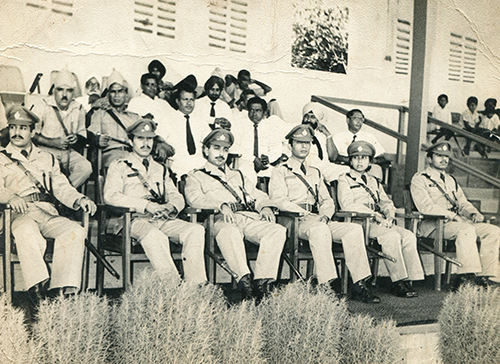
Yamin02MPOs09apr2016

Her grandfather Ikram Rasul was the superintendent of excise in colonial times and was posted in Sylhet. Due to his involvement in the freedom movement, the family said, he was sacked from the job. Hazarika’s mother Shameem was one of the first female car drivers in Guwahati.

Hazarika started her schooling at St Mary’s Convent in Guwahati and passed her senior Cambridge examinations from Pine Mount Convent in Shillong. After that, she left for Delhi to read history at IP College. “She was a bright and studious girl who was always into her books and was completely no-nonsense,” recalled her brother.

After graduation, Hazarika pursued law in Guwahati and appeared for the UPSC examinations twice – first in 1977-78 and then in 1978-79 – clearing both times. She finished her police training at the Maharaj Ranjit Singh Punjab Police Academy in Phillaur, Punjab, where she met her future husband, Rajeev Sagar, who was an IPS officer from the Haryana cadre.

Yamin03MPOs09apr2016

“The results were delayed by over a year when she appeared the first time,” said Yusuf. “Those came out in 1979. By then she had already cracked her second attempt and qualified for the DANIPS [Delhi Andaman Nicobar Islands Police Services] and was part of Indira Gandhi’s security team.”

Does DANIPS qualify as part of the IPS system? One serving IPS officer said a DANIPS official is on par with an IPS officer since DANIPS is a feeder cadre for the IPS. “Yamin was indeed the first Assamese woman to be an IPS officer,” the serving officer insisted, though Scroll could not independently verify this claim. A query to the Ministry of Home Affairs revealed that DANIPS officials get promoted to IPS after certain years’ service. Either way, Hazarika went on to serve in important positions.

Hazarika was posted as  assistant commissioner of police in Chanakyapuri, Delhi, and after some time she was promoted to the position of deputy commissioner of police (crimes against women cell) in the capital. In 1998, she was sent to Bosnia as part of the UN peacekeeping force for three months. It was there that she was diagnosed with leukaemia and she had to return to India. Hazarika received treatment at the Tata Memorial Centre in Mumbai and at Delhi’s All India Institute of Medical Sciences, but she succumbed to cancer on July 25, 1999. She was only 43.

Strong but mild-mannered

The few articles on the web on Hazarika describe how she oversaw stringent measures to cut down sexual harassment of women on the capital’s streets. Yet, despite her strong cop persona, Yamin was mild-mannered. “Innu was a very simple and soft spoken lady,” said her brother. “She would hardly raise her voice or be rude.”

Her daughter Huma Hazarika Sharma added: “She was a strong person. Though she was a strict disciplinarian, she was also a fun-loving person. Everyone in the police force who interacted with her still has incredible things to say.”

An officer at the Hauz Khas police station in Delhi, where Hazarika was posted, spoke at length of the time when he served under her. “She was a very tough lady and even today I will salute her,” he said. “I learned so much from her. I cried a lot the day she died.”

Yamin Hazarika may have faded from the media’s memory, but she is still the first female Assamese icon for many. That includes me.

Shaheen Ahmed is a research scholar at the Jawaharlal Nehru University, Delhi, and a former journalist.

source: http://www.scroll.in / Scroll.in / Home> Women Icons / by Shaheen Ahmed / June 17th, 2015
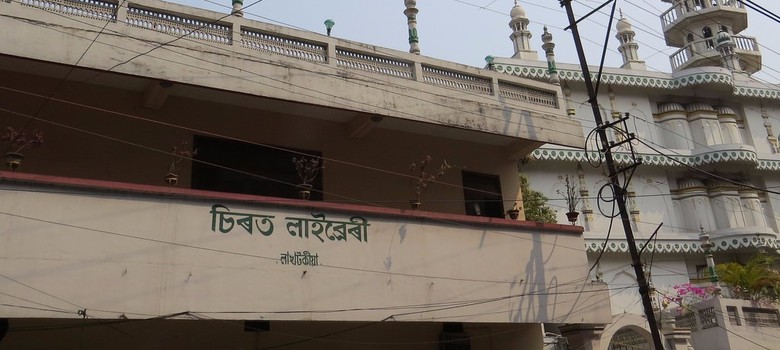
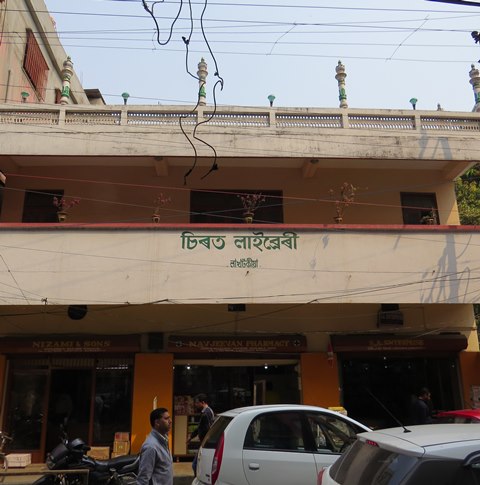
Forgotten histories: A library in a Guwahati mosque shares the fate of an old Assamese community

Guwahati,  ASSAM  : 

Sirat Library finds few mentions in recorded history and it is even fading from the personal histories of the Khilonjia Muslims who live around it.

Image credit: Shaheen Ahmed

Every time Assam heads into an election, the political discourse in the state invariably veers towards the issue of indigeniety. Who is an original inhabitant (and who is not) becomes a central question, with all the political parties nudging the electorate’s collective memory to recall real and imagined injustices.

With elections having kicked off in Assam again, my thoughts returned to something else, to my childhood when I would accompany my parents to a concrete structure in Guwahati’s Lakhtokia area. The structure was architecturally nondescript, but the images and the experiences of it still coalesced to form fragments of my memory. Known locally as Sirat Library – although the Assamese pronunciation Sirot often rendered the name incomprehensible – it was located within the precincts of a mosque called Lakhtokia Masjid No. 1.

I vaguely recall public meetings being held in the small library. And till the early 2000s, it moonlighted as a voting booth. For a child, it was an unusual sight to see so many people of different religions line up to cast their votes and even more unusual to see them do so in a library inside a mosque.

The structure still stands today. But the only sight that greets a visitor is of a small room bereft of books or readers. Its holdings are restricted to a small glass cupboard and a few Islamic texts in it.

Legacy of the past

The history of the library is really important to the Khilonjia Muslims or ethnic Assamese Muslims living in Guwahati. Khilonjia Muslims have been in Assam since before the Ahom invasion in the 13th century and they have always been known to relate to their ethnic, rather than their religious, identity.

Shehabuddin Talish, the official scribe of Mir Jumlah, the Nawab of Bengal who invaded Assam in 1662, described their encounter with the Muslims in Assam: “The Muslims whom we met in Assam are Assamese in their habits, and Muhammadans but in name.”

The famous colonial historian Sir Edward Gait, in his monumental work A History of Assam published in 1905, extensively employed Talish’s descriptions to map out a definitive chart of Assam’s history. Nevertheless, historical narratives of Khilonjia Muslims remain sketchy. The same fate is shared by the library in Lakhtokia.

There are no written records of when or who constructed the library. It is, however, believed that the structure is among of the oldest libraries in Guwahati, and the mosque it is a part of is among the three oldest mosques constructed in the colonial period.

The mosque finds a mention in an article in 1885 in the journal Assam Bandhu, which was edited by the Assamese intellectual Gunabhiram Barua. The land for the mosque was donated by Col. Jalnur Ali Ahmed, the father of the fifth President of India, Fakhruddin Ali Ahmed. Col. Ahmed was a distinguished Assamese of his time: he was the second Assamese associated with the Imperial Medical Services and the first Assamese to receive an M.D. degree from London.

Personal histories

Writer-lawyer Akdas Ali Mir, one of the inhabitants of the locality, points to a letter written in 1915 by AHW Benting, the then Commissioner of Assam, which is probably one of the earliest and only clues to tracing the history of the library. “Benting had issued directions in an Order Letter to shift the Makhtab (primary Islamic school) established by the British from the mosque to the present location, where the Junior Madrassa High School is in Guwahati.”

Mir continued: “We can surmise that Sirat Library is the spot where the Makhtab was and then got converted into a library.” This may be true as Sirat is an Arabic word meaning a “way of life”.

As with all public libraries in the state, Sirat Library too was awarded a monthly grant from the government for its upkeep. But the actual running was done by the area’s Assamese Muslims, with people taking turns as librarians. Renowned Assamese filmmaker Altaf Majid remembers his childhood days spent in the library reading in the quiet. “My uncle used to be the librarian for many years. Every Friday afternoon he would take me to the iconic Lawyers’ Book Stall in nearby Pan Bazaar to buy books. In fact I read the Mahabharata in Bengali in Sirat Library in the 1960s.”

Majid continued: “This library was also a repository of well-known pulp fiction of the period. They were in English, Assamese and Bengali. In fact, I also read my first English novel in this library as well as the famous Bengali Mohan Detective Series and the Assamese adventure series Pa-Phu.”

Credit: Shaheen Ahmed

Mukimuddin Ahmed, another resident, talks of the days in the late 1950s when he would act as the librarian in the evenings. “I was paid Rs 5 every month as the librarian and I worked for a year. Every afternoon after school I would go to the residences to collect the newspapers for the library. In the evenings after the readers had finished reading them I would then return them to the respective households.”

Assamese Muslim women had a strong role to play in the library’s upkeep. In the late 1960s, the only Assamese Muslim women’s social organisation, Anjumaan-E-Khawaateenein Islam, contributed Rs 10,000 to construct the new building for the library from the earlier Assam-type house construction. Noted Assamese woman writer Alimun Nessa Piyar donated furniture to the library in 1960.

As Helena Barranha and Susana S. Martins poignantly observed , “Memory has become both an intellectual challenge and a commodity for easy consumption.” This is true for contemporary India in general, and Sirat Library epitomises the trend. The erasure of the library from popular memory testifies to the erasure of cultural traditions that were once so integral to the Assamese society.

source: http://www.scroll.in / Scroll.in / Home> Memory Lane / by Shaheen Ahmed / April 05th, 2016

HIDDEN HISTORIES – In Aziz Ul Mulk’s Garden

Madras (now Chennai),  TAMIL NADU :

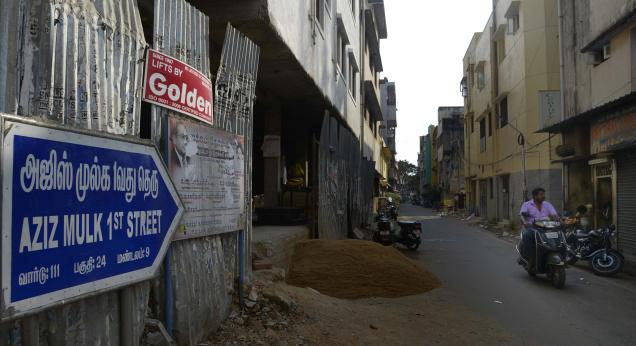
A view of Aziz Mulk Street off Model School Road. / Photo: V. Ganesan

Just beyond the Gemini flyover, Model School Road, Anna Salai and Graeme’s Road enclose a perfect rabbit’s warren of streets. There are nine of them, and they all take their name from Aziz Ul Mulk, a Muslim nobleman who once owned the entire area.

This was known as Aziz Baugh till the early 20th Century and was most likely more of a garden than the residence of the owner. When Sir William Thomas Denison, Governor of Madras, was leaving the city in 1866, he, his wife and daughter were invited for a farewell hosted by the Muslims at the ‘Gardens of Azeez Ool Moolk Bahadoor, Graemes Road, at 7 1/2 pm, on Saturday, the 24th of March’.

‘An evening entertainment in the gardens of a man bearing such a name!’ enthused Denison in his diary. He expected something out of the Arabian Nights and was not disappointed. The first family alighted in front of a wide, open verandah that was brilliantly lit, the brightness being enhanced by ‘suspended globular mirrors’. The hosts, all clad in white but sporting red turbans and sashes, stood on either side of the steps and ushered the guests to sofas at the rear of the verandah. A formal address was presented.

Dinner was in a shamiana to the side of this pavilion and ‘old Azeez Ool Moolk’ led Lady Denison to it, while the Governor was escorted by Nazim Jung, his son ‘who is an active intriguing man, a sort of politician in his way, and the presiding genius of the present entertainment’. Dinner was served in European style and described as a ‘tedious affair’ in which the English found much to their amazement that the hosts ate nothing but a ‘biscuit and some fruit’. Thereafter, the group moved to another shamiana where a nautch was presented.

‘Eight dancing girls, all dressed alike, stood in the centre of the apartment, each holding one of a cluster of eight ropes, which were suspended from the ceiling; and then with a slow and graceful movement passed to and fro, in and out, in such a manner as, by this movement only, to twist the eight ropes into a regular plait through their whole length, and then to untwist them, the whole being done by the dance only, without the application of the hands’. We would recognise this today as pinnal kolattam.

All this gaiety hid the fact that Aziz Ul Mulk was heavily indebted, mortgaging much of his valuables with the bank of Girdar Das Vallaba Das. Like the aristocrat in Satyajit Ray’s Jalsaghar, he was clearly spending his money on entertainment he could ill afford. Aziz Ul Mulk’s death is not recorded, but by 1868, the intriguing son — Sumsaum Ud Dowlah Bahadur aka Nazim Jung — was dead. The family finances must have declined thereafter, for, by 1902, we find the area recognised as a slum. Certainly, there is no trace of the garden where a Governor once dined.

source:  http://www.thehindu.com / The Hindu / Home> Features> MetroPlus> Hidden Histories / by Sriram V / Chennai – April 08th, 2016

If you love a biriyani…

Chennai, TAMIL NADU :

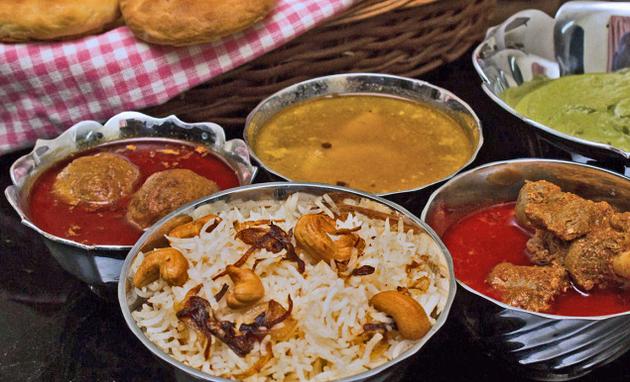
All things Mughlai Biriyani, kebabs and more / Photos:Special Arrangement

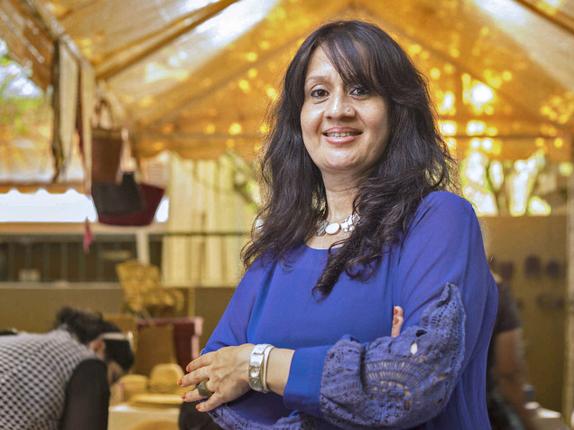
Tasneem Ayub Khan will tell you how to make it, writes K. JESHI

Fourteen ingredients. “That’s all you need to make Dhakni biriyani,” says Tasneem Ayub. “One has to know the right proportion of ingredients, the order in which they have to be added, the time and, most importantly, the confidence. Anyone who loves cooking can easily learn,” she says.

A home chef and home baker, Tasneem runs Ammee’s Kitchen in Chennai. She conducts workshops on how to make biriyani.

“Everyone loves biriyani and so they are eager to make the yummy mughlai biriyani. It is not as difficult as it is made out to be. Keep it simple is what I tell them,” explains Tasneem.

BiriyaniMPos08apr2016

Tasneem draws her inspiration from her mom. “She was a fabulous cook. She worked full-time, as the principal of Ethiraj College, yet she ensured that she made tasty food before she stepped out for work. I have learnt all my recipes from her.”

While Tasneem’s father’s ancestors come from Pakistan, her mother is from Kozhikode in North Kerala, a foodie’s paradise. “I love my mom’s meen moily, a Kerala special; the fish curry, appam and stew. I haven’t changed a thing from my mom’s recipes. ”

Tasneem says it’s a misconception that Mughlai dishes are high on spices. “The Mughals didn’t use spices. It was all about rich, creamy bases made from cashew or almond paste, inspired by Persian and Turkish style of cooking. They never use lime in any of the preparations. I follow the same style.”

She calls herself a traditionalist.

“I stick to the original recipes. Cooking gives me the utmost joy. Even when I am unwell, I crawl to the kitchen and cook. I try out Italian, and Mediterranean cuisines, but there is nothing to beat the versatility of Indian cuisine. I tell people at my classes to try and buy organic ingredients. And, don’t buy anything readymade, even curd or yoghurt. Make them at home. I make my own ginger-garlic paste,” she says.

Tasneem is currently working on a book, a compilation of recipes collected from friends and family members.

“I want to give it a personal touch with the recipes in their own handwriting,” she says.

And, what is her favourite food? “Dal chawal. I love to have it with the pickles I make at home as well!”

To know more about her recipes visit: www.facebook.com/ Ammees

Kitchen Or mail her at ammeeskitchen @gmail.com

source: http://www.thehindu.com / The Hindu / Home> Cities> Coimbatore / Coimbatore – April 06th, 2016

India recalls Hazrat Mahal’s role in freedom struggle

Uttar Pradesh (India) / Kathmandu (Nepal) :

Kathmandu : (PTI) 

India today said Begum Hazrat Mahal, who had rebelled against British colonial rule in the country in 1857-58, will always be remembered for her contribution in India’s freedom struggle and described her as a “source of inspiration”.

Recalling Begum’s contributions towards the freedom movement of India, India’s Ambassador to Nepal Ranjit Rae laid a wreath on her tomb to commemorate her 137th death anniversary here.

“We must remember her with great honour as she has been a source of inspiration for us all,” Rae said.

Begum of Awadh and the first wife of Nawab Wajid Ali Shah, who was one of the heroes of freedom struggle of 1857, died on April 7, 1879 during her refuge in Nepal.

Noting that Mahal was one of the freedom fighters of the first freedom movement of India, Rae said she had always been remembered for her contributions in India’s freedom struggle.

He also offered to provide necessary assistance to protect and preserve one and a half century old Hazrat Mahal tomb located in the heart of Kathmandu.

“Hazrat Mahal has been a symbol of age old tie between Nepal and India,” Rae said.

Begum fiercely fought the British East India Company during the Indian Mutiny of 1857-58, with the help of her commander Raja Jailal Singh. When her forces regained power of Lucknow for a brief stint, her son Brijis Qadra was declared ruler of Awadh.

When the forces under the command of the British re-captured Lucknow and most of Awadh, she was forced to retreat. She then took refuge in Kathmandu along with 10-year-old Qadr and some other loyal supporters.

Begum’s rebellion was ignited by the demolition of temples and mosques by the East India Company to make way for roads.

source: http://www.ptinews.com / Press Trust of India (PTI) / Home> International / by Shrish B Pradhan / Kathmandu – PTI,  April 07th, 2016

India recalls Begum Hazrat Mahal’s contribution to freedom struggle

Uttar Pradesh (India) / Kathmandu (Nepal) :

BegumHazratMPOs08apr2016

Begum Hazrat Mahal was one of the freedom fighters of the first freedom movement of India, Rae said she had always been remembered for her contributions in India’s freedom struggle.

Kathmandu :

India today said Begum Hazrat Mahal, who had rebelled against British colonial rule in the country in 1857-58, will always be remembered for her contribution in India’s freedom struggle and described her as a “source of inspiration”. Recalling Begum’s contributions towards the freedom movement of India, India’s Ambassador to Nepal Ranjit Rae laid a wreath on her tomb to commemorate her 137th death anniversary here.

“We must remember her with great honour as she has been a source of inspiration for us all,” Rae said. Begum of Awadh and the first wife of Nawab Wajid Ali Shah, who was one of the heroes of freedom struggle of 1857, died on April 7, 1879 during her refuge in Nepal. Noting that Mahal was one of the freedom fighters of the first freedom movement of India, Rae said she had always been remembered for her contributions in India’s freedom struggle. 

He also offered to provide necessary assistance to protect and preserve one and a half century old Hazrat Mahal tomb located in the heart of Kathmandu. “Hazrat Mahal has been a symbol of age old tie between Nepal and India,” Rae said. Begum fiercely fought the British East India Company during the Indian Mutiny of 1857-58, with the help of her commander Raja Jailal Singh.

When her forces regained power of Lucknow for a brief stint, her son Brijis Qadra was declared ruler of Awadh. When the forces under the command of the British re-captured Lucknow and most of Awadh, she was forced to retreat. She then took refuge in Kathmandu along with 10-year-old Qadr and some other loyal supporters. Begum’s rebellion was ignited by the demolition of temples and mosques by the East India Company to make way for roads.

source: http://www.india.com / India.com / Home> News> World / by Wires English / April 07th, 2016

Kanpur’s woman qazi tells Fadnavis to study ‘secular’ Indian Constitution

Kanpur, UTTAR PRADESH :

Kanpur  :

(ANI): Heena Zaheer, a woman Qazi, on Sunday criticised Maharashtra Chief Minister Devendra Fadnavis for his ‘Bharat Mata ki Jai’ statement and said people in such higher positions need to study the Constitution of India.

“It is not at all good. The people holding such higher positions in the government need to study the Constitution of India. They should understand that ‘do’s and don’ts’ are set according to the Constitution,” Zaheer told ANI.

“If it was written in the Constitution that we should chant ‘Bharat Mata ki Jai’ slogan, we would do that. But that is not the case. Our Constitution is very secular and there is no such policy,” she added.

Joining the ongoing debate on nationalism, which is being linked to chanting of certain slogans in recent times, Fadnavis said that every Indian will have to chant ‘Bharat Mata ki Jai’, adding that those who can’t say this shouldn’t live in the country.

The Jamat-e-Islami Hind (JIH) yesterday came out to back the fatwa issued by leading Islamic seminary Darul Uloom in Deoband against chanting of “Bharat Mata ki jai”. The JIH said that the attempts being made to use the slogan as a symbol of patriotism are wrong.

Darul Uloom Deoband on Friday issued a fatwa against chanting of ‘Bharat Mata Ki Jai’, saying that the slogan goes against the tenets of Islam.

“Bharat Mata, according to some Hindu sects, is a goddess and they worship her. For Muslims participating in worshiping a goddess would be un-Islamic, the fatwa said.

AIMIM leader Asaduddin Owaisi had stirred a hornet’s nest by rejecting RSS chief Mohan Bhagwat’s suggestion that the young generation be taught patriotic slogans like ‘Bharat Mata ki Jai’ stating that he won’t chant the slogan “even if a knife is put to his throat”. (ANI)

source: http://www.timesofindia.indiatimes.com / The Times of India / News Home> City> Kanpur / ANI / April 03rd, 2016

History Revisted : How knowledge travelled from East to West (and back again) in the early modern world

The flow of scholarly work between the Mughals and Europe involved translation, re-translation, re-interpretation and development.

Mughals&EuropeMPOs01apr072016

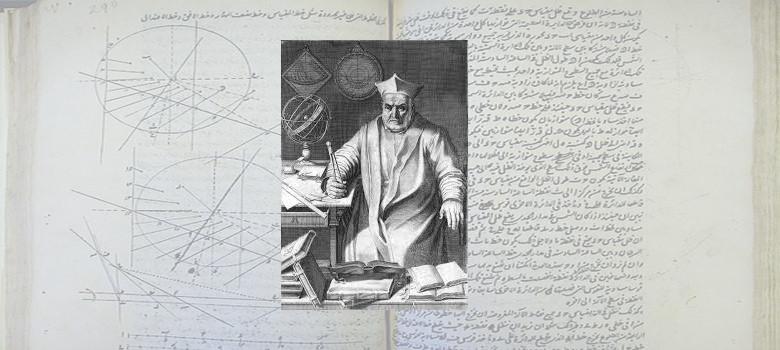
Christoph Clavius was born in Bamberg in either 1538 or 1537 (an amusing discrepancy for a scientist whose fame derives from his work on calendar reform) and was initiated into the Jesuit order by Saint Ignatius Loyola in Rome in 1555, and passed away in 1612, an eminent scholar.

Many of Clavius’ works were influenced by Latin translations of Arabic scientific works, including those of Ibn Rushd (in particular his commentary on Aristotle), the astronomers Abū Ma‘shar, al-Biṭrūjī and al-Farghānī, as well as the mathematician Thābit b. Qurra, among many other scientists writing in Arabic and Persian whose works Clavius cites.

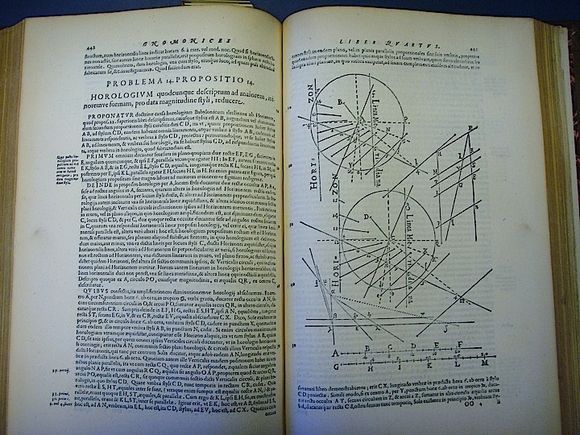
Book 4 of Christoph Clavius, Gnomonices Libri Octo, published in Rome in 1581 (533.k.2, pp. 442-43).

Clavius is an excellent example of the many Jesuit scientists of his age who continued to teach Ptolemaic astronomy (i.e. a geocentric vision of the solar system, indeed the universe, in which the planets and stars orbited the earth in concentric circles), despite the rise of – and often despite their own familiarity with and endorsement of – Copernican astronomy.

Christoph Clavius’ Gnomonices Libri Octo, on the art of gnomonics (timekeeping through the use of a sundial), was published in 1581

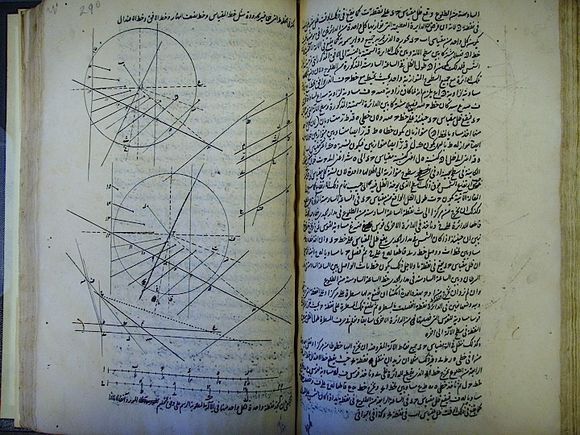
Mu‘tamid Khān's Arabic translation of the identical passage (IO Islamic 1308, ff. 289v-290).
Mu‘tamid Khān’s Arabic translation of the identical passage (IO Islamic 1308, ff. 289v-290).

Arabic version

This work also exists in a fascinating Arabic translation emanating from the Mughal empire that was purchased by Richard Johnson (1753-1807), a well-known collector of manuscripts and miniature paintings who worked for the East India Company.

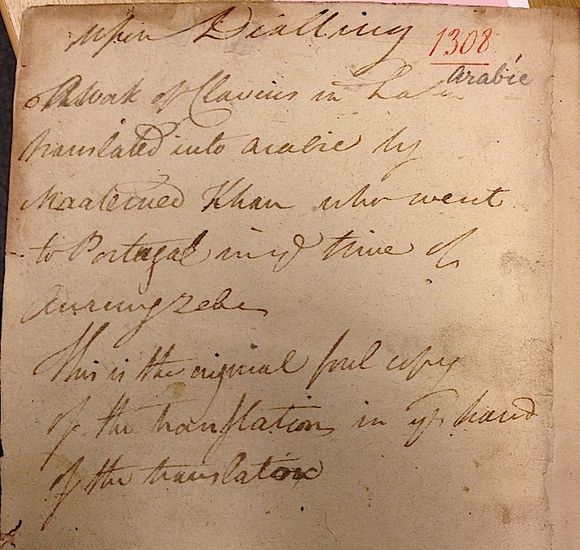
Johnson made an annotation on the flyleaf of the manuscript that the translator of Clavius’ work was sent to Portugal by Aurangzeb – presumably to study or in some diplomatic capacity.

The full note reads, “Upon Dialling. Work of Clavius in Latin translated into Arabic by Maatemed Khan who went to Portugal in the time of Aurungzebe. This is the original foul copy of the translation in the hand of the translator (i.e., the ‘foul copy’ being the first draft, in contrast to the ‘fair copy’).”

Richard Johnson's explanatory note (IO Islamic 1308).
Richard Johnson’s explanatory note (IO Islamic 1308).

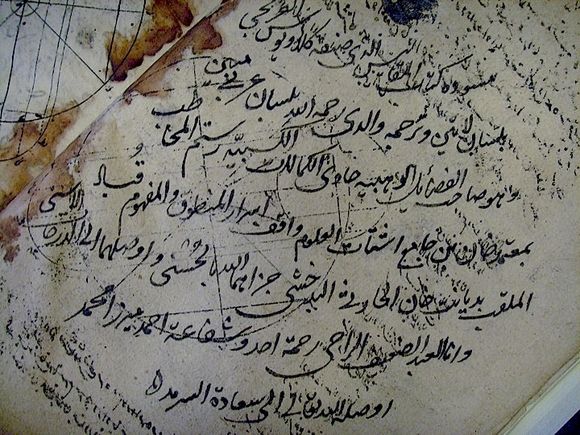
A further note, in Arabic, added by the translator’s son, reads: “Draft of the Book of Measures [Kitāb al-Maqāyīs] which was composed by Clavius the Frank [Kalāwīūs al-Firinjī] in the Latin language, and my father, God have mercy on him, translated it into the [clear – mubīn?] Arabic language, possessor of virtuous talents including the perfection of acquired knowledge,

Rustam called Mu‘tamad Khān, the son of Qubād, gatherer of proofs of knowledge, perceiving the secrets of the spoken and the tacit, given the name Diyānat Khān al-Ḥārithī al-Badakhshī, may God be fair with both of them and elevate them.

Signed: I, who am a feeble slave begging for the mercy of the One and the intercession of the Prophet, Mīrzā Muḥammad, may God cause him to attain eternal happiness”.

Note by Muʻtamad Khān's son (IO Islamic 1308, f.1v).
Note by Muʻtamad Khān’s son (IO Islamic 1308, f.1v).
 Complex process

This translation offers some fascinating possibilities.

The first is the demonstration of how knowledge circulated in the early modern world.

Clavius’ work, which responded to and was inspired by Arabic mathematicians and scientists in Latin translation, here a generation after its publication is translated back into Arabic to be read, presumably by elites at the court of Aurangzeb, where the work’s translator and his son were courtiers.

This translation demonstrates the complexity of knowledge flows – that they were synchronic as well as diachronic, and also involved a process not just of translation, but of re-translation, re-interpretation and development as they travelled.

Furthermore, the inscriptions taken in tandem, one in English made by an East India official, the other in Arabic by a Mughal courtier, open the possibility that already in Aurangzeb’s reign, Mughal elites travelled to Europe perhaps to study.

In the case of Mu‘tamid Khan, the translator of this text, he mastered the technical idiom of geometry and mathematics in Latin, and then translated it into an equally complex scholarly language, Arabic. Not an uncommon intellectual feat at the Mughal court, this process of scientific translation remains to be studied in depth.

It is also possible that the presence of the Jesuits at Goa had an influence on the production of this translation, but firm evidence remains to be found.

 This article first appeared on the British Library’s Asian and African Studies blog.

source: http://www.scroll.in / Scroll.in / Home> History Revisited / by Nur Sobers-Khan / March 30th, 2016

Mehbooba Mufti Sworn In As First Woman Chief Minister Of Jammu And Kashmir

Srinagar, JAMMU & KASHMIR :

Srinagar :  

Mehbooba Mufti  of the Peoples Democratic Party or PDP took oath this morning as the first woman Chief Minister of the country’s only Muslim majority state, Jammu and Kashmir, at the head of a coalition government that includes the BJP.

The 56-year-old succeeds her father Mufti Mohammad Saeed who died in January this year. 23 ministers are taking oath along with Ms Mufti , including members of the BJP, whose Nirmal Singh will be Deputy chief minister.

In an indication of the struggles that lie ahead for Ms Mufti, senior PDP leader and lawmaker Tariq Karra boycotted the oath ceremony.

“I had a meeting Mehboobaji till late last night. I wanted three ministers who have played a dubious role and are responsible for the failure of Mufti Mohammad Saeed to be dropped,” Mr Karra told NDTV.

Mr Karra wanted Ms Mufti to exclude key PDP leaders Altaf Bukhari, Naeem Akhtar and Haseeb Drabu from her council of ministers. He alleges that they plotted to form government in alliance with the BJP without Ms Mufti as she refused to take oath for three months after her father’s death.

Ms Mufti dropped Mr Bukhari, but not the others. She has instead replaced two lawmakers who were junior ministers in Mufti Saeed’s team.

Mr Karra is no lightweight. In 2014, he defeated former union minister Farooq Abdullah of the National Conference in the general elections.

Ms Mufti has been criticised for delaying government formation as she wanted the BJP-led Centre to agree to several demands. But  the BJP stood its ground saying it would agree to no pre-conditions for an alliance .

Last week, after a long stalemate, Ms Mufti’s meeting Prime Minister Narendra Modi cleared the way for a PDP-BJP government to take oath. But her struggle to manage a difficult coalition remains.

Former J&K chief minister and Ms Mufti’s main rival Omar Abdullah has prophesied that Mehbooba will face “more alliance contradictions” in the partnership with the BJP, an ideological opposite.

State elections in December 2014 gave no party a majority in the 70 member J&K assembly. The PDP, with 28 seats and the BJP with 25 had formed government after weeks of hard negotiations last year.

source: http://www.ndtv.com / NDTV / Home> All India / by Surabhi Malik / April 04th, 2016

Video Link : http://www.youtube.com