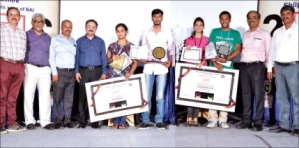
SJCE Wins ‘YUKTI’ Quiz Contest

ATMECE emerges runners-up

YuktiQuizMPOs15mar2016

Mysuru :

Builders’ Association of India (BAI), Mysuru, had organised an Inter-College quiz competition ‘YUKTI 2016, The Battle Of Brains…’ for the Civil Engineering and CTM students of various Engineering colleges of Mysuru, Mandya and Chamarajanagar districts.

The quiz was conducted by Shilpi, students’ wing of BAI, Mysuru, on Mar. 6 at MBCT premises, Mysuru. Five finalists were selected after the first round of written test among 18 teams.

There was a technical talk for the students on ‘Smart Cities – Spain Model’ by M.P. Manjunath Prasad, COO of Brigade Group, Benagaluru, on the same occasion. The technical talk also included short film on Building Technologies which ended with an interactive session.

After the Techtalk, the Quiz YUKTI 2016 continued for the finalists — NIE, MIT, SJCE (Civil), SJCE (CTM) and ATMECE.

An excellent Audio Visual final round was conducted by the Quiz Master S. Prakash, who is the Past Chairman of BAI, Mysuru and MD of Pramur Constructions.

Mohammad Zaidur Rehman and Bindushree of SJCE (Civil) emerged winners of YUKTI 2016. S. Supreeth and K.P. Meghana of ATMECE were declared Runners-Up.

A cash prize, mementoes and certificates, along with a trophy for the College, were given to both the teams. All the finalists were also given certificates.

BAI Mysuru Chairman M.S.Ramprasad, Hon. Sec. JVR Naidhruva, Shilpi Co-ordinators A.S Yoganarasimha and Ganapathy and others were present on the occasion.

source: http://www.starofmysore.com / Star of  Mysore / Home> General News / March 15th, 2016

Urdu Academy picks 4 names for Gaurav awards

After pondering over it for long, Gujarat Urdu Sahitya Academy has announced Gaurav awards to poets and authors of Urdu language.

After pondering over it for long, Gujarat Urdu Sahitya Academy has announced Gaurav awards to poets and authors of Urdu language. Names of four persons have been announced and they have been conveyed individually about the academy’s decision. The awards are likely to be given in April.

According to sources, Urdu poet Shakil Azmi, academic and Congress leader Nisar Ansari, Palanpur-based poet Musafir Palanpuri and Surat-based poet and former Surat Municipal councillor Vaseem Malik have been nominated for academy award for different years.

The announcement has been received in literary circles with applause, but there are many who are not amused because some senior writers have been “sidelined” by the academy.

One such person is Qayyum Kanwal Fatehpuri, a former member of the Academy in its early years. He has authored four poetry collections, besides having edited the Academy’s journal Sabarnama. He was also a close associate of former Congress MP Ehsan Jafri. “The academy has overlooked senior writers like me for some unknown reason for a long time now,” said Fatehpuri whose first collection Sang-o-Gul was published in the early 1980s.

To him, it is hard to establish the credentials of some people who have been named for awards. “Something is seriously lacking in the functioning of the academy and something should be done if the credibility of its awards has to be saved,” said Fatehpuri, who had published an Urdu monthly magazine for some time.

Bhagyesh Jha, chairman of the Academy, said there was no favouritism or grudge at work in selection of persons selected for the awards. “Before announcing the names, we duly consult experts of the subject who suggest panels of names of likely winners, then these names are sent to the executive committee of the academy, which sends the names to the culture minister for final approval,” Jha said.

He said the names were worked out by a senior academic M G Bombaywala, who had been associated with the affairs of the academy for many years. “The names were discussed with him before the announcement,” Jha said. He said he had no information about several writers or their background. “The academy is ready to discuss issues and suggestions threadbare with persons in the know of things,” he said. He added that the criteria was that the candidate should have made contribution to Urdu literature.

Bombaywala said, “I have been suggesting names even before Jha became president. No one objected when other names were suggested and they got awards till 2010. There are better names than Qayyum Kanwal even at present, but still they have been left out for some reason. Let Kanwal go to the academy and present his case if he feels injustice has been done to him. Awards are not given by one’s age or to maulvis, but on literary merit.”

source: http://www.indianexpress.com /  The Indian Express / Home> Cities> Ahmedabad / by Tanvir A. Siddiqui / Ahmedabad / March 14th, 2016

Voonik.com looks beyond the brand

The online fashion marketplace is here to provide a fillip to unbranded fashion

Sujayath Ali, founder of Voonik.com

Voonik.com, (both website and app) was founded with an idea to be a fashion marketplace for women looking for their everyday wear. As it’s labelled as the country’s first personalised shopping app, you’re curious about what it means in this context? “Voonik takes the skin tone, body type and preferences into consideration to see if the fit suits you. We’ve developed a 10000-rule algorithm in coordination with our stylists to assist users,” the founder Sujayath Ali states.

Finalising the criteria was a tough ask, but they’d readied them from a generalised questionnaire of over 150 questions in discussion with stylists that women consider as they shop.

Screenshot of the website

For now, its users are shown a series of celebrities with whom they can compare their body, tone and other preferences. Isn’t that objectification of sorts? “As it was a new idea, we needed a way out to familiarise our user-base. It’ll have an adequate replacement in the coming days,” elaborates Ali.

Voonik respects the fact that not everyone needs to be a fashionista for buying clothes online. “There are so many shopping sites that promote branded fashion but we’re here to show how potent unbranded fashion can also be. We didn’t want to sophisticate things and are clear of catering to the masses,” Ali elaborates. He justifies this saying, most women are focussed on the place and quality where a fabric comes from, than the brand altogether. It looks like their focused strategy has indeed paid off with nearly 6 million app installations in its 18-month run.

Beyond user needs, Voonik’s uniqueness shows up in their ‘Become a seller’ section. They have a one-of-a-kind image recognition platform that’ll help the management assess the quality of the fabric once sellers upload the images of the stock. That has helped them build a vast collection of 15-lakh clothing, the most for an online fashion outlet to date, globally.

They have interesting plans lined up for the times to come. Having just acquired a menswear shopping portal Getsty, they’re on the path to integrate men’s collection to their platform, which users can access through another exclusive app. There are two other acquisitions they remain tightlipped about, but with persistence, we get hints. “There’ll be a premium luxury section that’ll be launched too,” Sujayath manages to say.

source: http://www.thehindu.com / The Hindu / Home> Features> MetroPlus / by Srivathsan Nadadhur /Hyderabad – March 07th, 2016

On a mission to prevent suicides

SanaMPOs12mar2016

by S.N. Venkatnag Sobers

Majority of women in our country spend their lives within the four walls unaware about the outer world. For them, their family is their world. Though women put all efforts to cater to the need of their loved ones, yet there are incidents of them being harassed for dowry or other reasons. Only, few have braved the dare consequences to stand tall in the society and emerge as the role models for fellow women.

Here is a woman from Hyderabad who has been travelling across the country creating awareness against committing suicide and also motivating the youth fight depression.

Meet Sana Iqbal, a native of Hyderabad, who has been travelling across the country creating awareness against taking the extreme step. A mother of the seven-month-old son Mohammed Saqib Ali, Sana has taken up the initiative to prevent youth from ending their lives for trivial reasons. “It is important to address the youth and children in certain issues as they get very emotional and sensitive with matters closely related to them. It is very important for parents to spend quality time with their kids and talk to them as they feel depressed on not being given concentration they rightly deserve. When it comes to youth, they fall for the person who listens to them and sometimes get into relationships without knowing if the person is an ideal partners and later regret when the relationship turns sour. And that is when they get depressed and think of taking the extreme step,” says Sana.

Having covered 17,500 kms since November, 2015, on her Royal Enfield, Sana has covered 49 cities in North and Central part of the country. She has been visiting various colleges and giving special lectures on how to come out of depression and not to take the decision to ending lives. Talking about her decision to take up this initiative, Sana tells that she was also a victim of depression for 5 years and had spent many sleepless nights.

Having gone through the trauma, Sana, one fine day decided to break the shackles to come out depression by going on a bike ride and that is when she decided to go on a solo tour throughout the country on her motorbike creating awareness. Sana was in Mysuru recently where she addressed students at a few colleges before heading to Ooty. She expects to complete her solo tour during first week of June this year.

Being a lone woman travelling across the country, Sana has been received well by the people at places she has visited. For her, it has been a memorable journey so far as many people have come for her help at the times when her motorbike broke down. “There have been instances when my vehicle broke down in middle of the road and people came to my help without any expectation after they learnt about my mission. In fact many offered me free hospitality at her houses which motivated me to carry the message that India is a safe country for women,” adds Sana.

One look at her jacket and you will get to see the badges of various bikers clubs. But, one badge that Sana adores is the one presented to her by Civil Defence of Patiala in Punjab which has the National Emblem presented to her in recognition for her initiative. There was a time during the tour when Sana had to cut short her tour while in Delhi as her father-in-law fell seriously ill and she had to return to Hyderabad. Without giving a second thought she came back to Hyderabad but sadly her father-in-law passed away. She later continued with her tour. Sana, who has been away from her kid over the past few months is determined to reach her goal and motivate the youth. Hats off Sana!

source: http://www.starofmysore.com / Star of Mysore / Home> Feature Articles / March 12th, 2016

A journey to Road to Wimbledon Masters

Guntur, ANDHRA PRADESH /  Hyderabad, TELANGANA  :

Sk. Mubhashira Anjum (right), who has been selected to play at the Road to Wimbledon Masters. Tennis coach Sk. Ahmmad and Mushrath Anjum (left) are also seen.— PHOTO: T. VIJAYA KUMAR

For this tennis prodigy, the journey from the clay courts in the small town of Guntur to Road to Wimbledon Masters, a tennis tourney for Under-14 organised by All England Lawn Tennis and Croquet Club, is a long one. She will take part in the Masters beginning on April 2 at Kolkata.

Ranked No 4 in Under-14 category and 14 in U-16 category, Mubhashira has been among the 16 top junior tennis players in India to be selected for the tourney, out of which two boys and girls would be invited to compete in the UK HSBC National Finals on the grass courts at Wimbledon in August every year.

Mubhashira would soon travel to Vietnam to take part in International Tennis Federation Asian 14 Championship which will begin on March 13.

Mubhashira had her first lessons on the clay courts at B.R Stadium under tennis coach Sk. Ahmmad during the summer camp in 2010. She later mastered the game in the tennis courts at NTR Municipal Stadium under coach G. Siva Prasad, North Club (Vijay Vardhan) and CTC (Venkat Rao).

“She was the pick of the boys and girls and her powerful ground strokes and an ability to cover the court stood out. For a girl of her age, she had an amazing fitness level,’’ Mr. Ahammad said.

Her father Sk. Baji is a small time trader but the family had moved to Hyderabad to enable Mubhashira to take coaching at Sania Mirza Tennis Academy.

source: http://www.thehindu.com / The Hindu / Home> National> Andhra Pradesh / by Staff Reporter / Guntur – March 08th, 2016

Around the country in a solar car

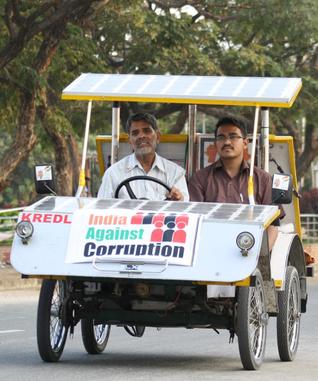
COIMBATORE, 16/02/2012: Syed Sajjad Ahmed (left), a businessman dealing with electrical accessories in Bangalore, with his relative on a solar car in Coimbatore on February 16, 2012 as part of his tour of South India for 1,000 km to generate awareness among the people on pollution and corruption. Photo: M. Periasamy / The Hindu

Syed Sajjan Ahmed travels 3,000 km in self-built four-wheeler.

Bengaluru , KARNATAKA :

Sixty-three-year-old Syed Sajjan Ahmed arrived in Bangalore in a self-developed solar electric-powered car to cover 3,000 km from Bangalore to Delhi to participate in the first India International Science Festival (IISF).

It took Syed 30 days to cover the arduous journey, which included crossing the Vindhyas. Born in Kolar, 70 km from Bangalore, the standard XII dropout began his career as a fruit vendor and went on to set up a shop for electronics repair.

His work included assembly of electronic goods, starting off with transistors, tape recorders and television sets and antennae. Later, he moved on to computers, before attempting to realise his childhood dream to do something for society.

“I had to leave school when I was 15 to start earning for my family. But the fire to create something that would be of use to humanity kept burning within me,” he says.

The break came in 2002. “I told myself that I am 50 now, and I must do something before I become too old and infirm.”

Ahmed started by modifying a two-wheeler to run on electric power, and then a three-wheeler, and later a four-wheeler.

He bagged the Karnataka government’s award for environment protection, instituted in honour of former president A.P.J. Abdul Kalam, in 2006, for his innovation. Ahmed says that the modified car is equipped with a set of five solar panels, each with a capacity of 100 watts.

The power generated by the panels propels the machine through a bank of six batteries, each with a capacity of 12 volts and 100 amps. He takes pride that his small car withstood the test of the 3,000-km trek. “There were times when we thought we would not be able to take the steep climbs on the ghat roads. But, it crossed all the hurdles without much trouble,” he adds.

Ahmed says he has travelled 1.1 lakh km in his four-wheeler across the country so far. He is accompanied by a cousin, Salim Pasha, who travels in a regular car alongside. Both started their journey to Delhi from Raj Bhavan in Bangalore on November 1.

Ahmed, who says his vehicle costs around one lakh rupees at present, would further be driving from Delhi to Dr. Kalam’s hometown of Rameshwaram. “I wanted to make this journey an adventure; I have driven this vehicle for 10 years and hope to keep it going,” he says. He will then return to Bangalore via Kanyakumari.

“Dr. A.P.J. Abdul Kalam is my inspiration. Through my journey, I want to inspire and educate the public, especially students, about Dr Kalam’s Vision 2020 for uplifting the country,” he adds.

source: http://www.thehindu.com / The Hindu / Home> Features> MetroPlus / IANS / December 08th, 2015

A different formula on TV

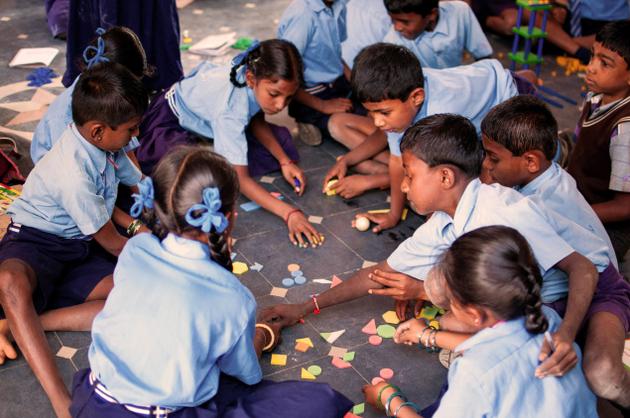
Children working with the Maths kit. Photo: Special arrangement

A clever television contest for Most Innovative Maths Teacher finds schools vying for honours, and viewers asking for reruns. 

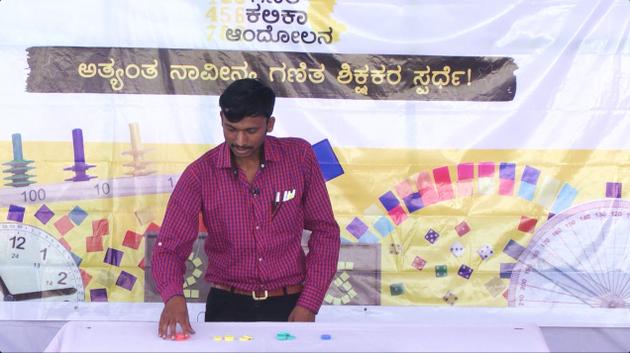
February 14. It was a special day for many students in the north Karnataka taluk of Kushtagi, Koppal district. They were all set to watch their teachers vie for the title of ‘Most Innovative Maths Teacher in Kushtagi’, at the first-ever mathematical reality TV show for teachers of government schools.

Doing the Math: Iranna Patil Photo: Special arrangement

Of the six finalists, at the Ganitha Kalika Andolan contest, Iranna Patil of Government Higher Primary School, Thopalakatti, walked away with the title for his demonstration of the concept of data collection and analysis, and how it could be taught creatively to students of classes IV and V.

Teachers Hafisa Begum of Lower Primary School, Mankalkeri, and Geeta Basarakoda of Lower Primary School, Sherifnagar, took the second and third places, respectively. They were chosen for making maths an enjoyable learning experience.

Ganitha Kalika Andolan (GKA) was started by Akshara Foundation in partnership with the Karnataka government and Sarva Shiksha Abhiyan to improve numeracy skills and facilitate classroom teaching of mathematics in the six districts of the Hyderabad-Karnataka region. Since June 2015, the Bengaluru-based not-for-profit movement has trained over 7,500 teachers in mathematics teaching, especially using teaching learning material such as the Akshara Math Kit, which contained play money, dice, weighing scales, beads and geometric shapes.

But how effective was the programme? Were teachers enthused about it? In 2014-15, the organisation had included popular film dialogues and even a maths jingle composed by Grammy award-winner Ricky Tej to make teaching and learning fun. Would television also help? This led to the GKA contest. The Nanjundappa Committee report for the Redressal of Regional Imbalances states that Akshara Foundation chose Kushtagi, one of the 39 taluks in the report’s ‘most backward’ taluks list. The organisation had trained over 300 teachers in the taluk even before GKA. A peppy teaser was aired on television, and soon teachers started sending in their entries in the form of short videos.

Of the over 230 entries from the 220 schools in Kushtagi, 20 were shortlisted for an exciting buzzer round. During the finals on stage, excitement was high. The teachers had to use elements from the maths kit to demonstrate their lesson. “I knew the answer to one of the judge’s questions, but I fumbled while facing the camera,” says Savitha Maleda. A teacher at the GHPS in Ryavanaki, she always enjoyed using song and dance to teach, but since the maths contest was announced, she has been trying out other creative ways as well. She now wants to do a post-graduation so that she can teach high school students as well.

For Iranna Patil, the contest was a big fillip. “It spread awareness about creative methods of teaching. Earlier, the maths kits were not being used much. Now, all my teacher friends want to use them. We have a Whatsapp group of science teachers, who share news about teaching methods,” says this young man.

Kanchan Bannerjee, managing trustee at Akshara Foundation, says, “We hope the contestants can inspire the larger teaching community as also the students and their parents to see maths as a fun subject.”

As partners involved in releasing the Annual Status of Education Report (ASER), Akshara Foundation is convinced that mathematics needs a leg-up in our schools. Before approaching the Karnataka government with the idea of GKA, the organisation had run the module for nearly four years in schools in Hoskote. They made sure the comprehensive teaching methodology envisaged in the GKA programme was compliant with the guidelines prescribed by the National Curriculum Framework 2005 and that it supported the textbooks and workbooks designed by the Karnataka Department of State Educational Research and Training. They made their manuals and video modules for teachers available under Creative Commons, making it possible for people to freely use them.

“The GKA model runs for two years, and with just a few adaptations it can be replicated anywhere. We hope that our government will extend this to other districts too,” says Ashok Kamath, chairman of Akshara Foundation.

That the TV channel had several viewers asking for a re-telecast shows what a masterstroke it was to use television for maths.

Mala Kumar writes for children and edits books for Pratham Books. She was one of the judges at the GKA contest.

source: http://www.thehindu.com / The Hindu / Home> Features> Magazine / by Mala Kumar / March 05th, 2016

Youth Gives Up Job in West Asia, Takes to Organic Farming

Tirunelveli, TAMIL NADU :

N Sheik Abdullah at work in his organic farm at Kalakudi village near Manur in Tirunelveli | EXPRESS

Tirunelveil  :

At a time when agricultural lands are turning into commercial housing plots, a youth has been silently transforming dry land into organic farming plots near Manur in the district.

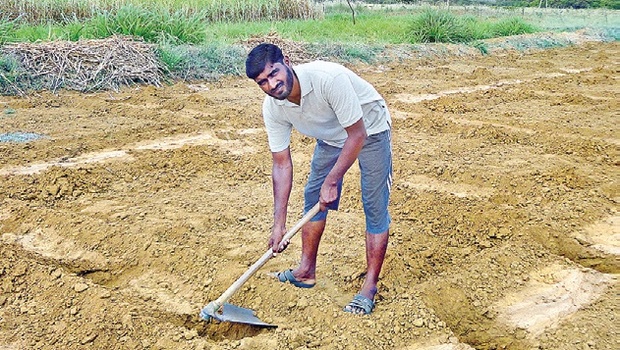
Giving up his high salary job after working around nine years in West Asia, diploma holder N Sheik Abdullah (34) is busy now turning his integrated organic farm at Kalakudi village near Manur into a farm that grows watermelon, drum sticks and marigold.

“After completing a diploma in mechanical engineering, I worked in production arena in Erode and Coimbatore for around five years. Later, I took up the job of  a design engineer in the West Asia. With the support of my family members, I later purchased dry lands at Kalakudi village,” Abdullah said.

He returned from West Asia in March last year to launch into agricultural activities.

Hailing from Pettai in Tirunelveli city, he travels about 25 km to reach his farmland from his house daily.Step by step, he is turning the dry soil into one that is suitable for organic agriculture farming.

Abdullah said he has  plans to keep local breeds of cows, goats and chicken in the organic farm.

He has also planted local tree species of banyan, neem, pipul, fig, Poovarasu among others.

Abdullah, who considers organic farm expert Nammalvar as his role model, has undergone training at his organic farm ‘Vanagam’ in Karur district. He has cultivated paddy in the farm and plans expand it to more areas in his plot.

His idea is to produce healthy milk, egg and organic agriculture produces, which has no pesticides and chemicals.

Satisfied with the milk yield of local breeds of cattle,  the 34-year-old is also chalking out measures to save them.

source: http://www.newindianexpress.com / The New Indian Express / Home> States> Tamil Nadu / by M. Abdul Rabi / March 03rd, 2016

Lexington Town Meeting members selected

Lexington, MA ,  U.S.A :
By Jordan Frias
jfrias@wickedlocal.com

Rizvi, originally from Lucknow, India, missed the February deadline for nomination papers, but learned about the write-in candidate process.

LEXINGTON

Syed Ali Rizvi stood outside of Bowman Elementary School March 2 to gain support for his write-in campaign to become a Town Meeting member for Precinct 2.

Rizvi, originally from Lucknow, India, missed the February deadline for nomination papers, but learned about the write-in candidate process.

“Someone mentioned to me that you can be a write-in candidate. I didn’t know that,” he said. “The best investment I can make to the town is serving it.”

Rizvi was elected with 33 votes, according to unofficial results from the town clerk’s office, as was Jason Bressner, who received 14 write-in votes. Five other candidates in Precinct 2, who were on the ballot, each received two votes.

Precinct 2 was one of two that didn’t have enough people running for Town Meeting. Three write-in candidates were elected to Town Meeting this year.

Rizvi has been involved in school functions since he moved to Lexington 10 years ago.

“We have benefited tremendously from the town and all of what it offers,” he said. “Bowman parents have known me for many years.”

Rizvi had a lawn sign created for parents driving by or to Bowman Elementary School to see, which he held up on Election Day for people like Peter Kovner who might not have known about him.

Kovner only voted for the five Town Meeting candidates on the ballot because he knew of no write-in candidates. Rizvi had held up his sign in the morning and Kovner voted that evening.

“If somebody had let me know that they were running I would have put them down. If they had a sign, they would have my vote, not that they would need it,” Kovner said.

Kovner said low voter turnout was concerning, but he wasn’t at all bothered with the fact that these races weren’t contested. The March 3 election had a 16 percent turnout, according to the town clerk’s office.

“If there were more contentious issues in town people would run. I don’t think people are being smug, I think they’re pretty happy with what’s been happening,” he said.

Long-term membership

One of the longest-serving members, Dan Fenn II, has been in Town Meeting for 52 years. Having experience working in Washington, D.C., Fenn calls Town Meeting “a microcosm of the democratic process.”

“You see the same kind of personalities, the same kind of human behaviors in Congress in Washington,” he said. “It’s important to participate in public affairs of the community in which you live.”

source: http://www.lexington.wickedlocal.com /  Home> News Now> Article / by Jordan Frias / Lexington, March 06th, 2015

Tansen lives! Ghulam Mustafa Khan

Hailing from the senia tradition of Tansen, Ustaad Ghulam Mustafa Khan is that gem that Hindi filmdom can still boast off. Rubina P. Banerjee salutes the maestro whose journey started at the age of 8 and continues even today at 82!

Coke Studio recently witnessed the magic meandering of the golden voice of Ghulam Mustafa Khan Sa’ab as he sang Rahman’s composition ‘Aao balma…’. The studio rebounded with the sonorous depths of Khan Sa’ab’s voice while Prasanna, on the Carnatic guitar, kept pace with his vocal dexterity. At 82, the Padmabhushan awardee is keeping in tune with the times while keeping alive the tradition of the Rampur Sahaswan Gharana.

What can one ask an Ustaad, who started singing at 8 and is still going strong at 82! All my questions seemed banal when it came to his art but one has to start somewhere so we started at the very beginning with his first concert…

“My journey into music had started with the music inherent in my family. At the time, every city had a Victoria Garden and it was the custom that on Janmashtami, the first public performance of those interested in music be performed as a debut. Ali Maqsood Sa’ab, who was the Chairman of the Municipality, organised the Janmashtami function every year and asked me to perform. I was only 8 then and it was the January of 1950 but my performance was much appreciated and people lauded me for my courage to perform at this tender age in front of such a well-informed audience!”

If he performed so well at 8, at what age did he start learning music?

My question brings a smile to his lips…

“I started learning to sing before I had even started talking! My father used to hold me on his chest and teach me sa re ga… even as I was starting to lisp my first words. After a point, I began saying sa re ga… before any other word. My mother was the daughter of the great Inayat Hussain Khan and music was the legacy of my family. Our seniya traditions go back to the times of Tansen and my great great grandfather Ustaad Qutubuddin Khan Sa’ab was the court musician of the Nawab of Oudh, Wajid Ali Shah. My father, Ustaad Waaris Hussain Khan was my first guru. Both my parents wanted me to be a singer.

I started so young that I could remember the tune but not the words! After my father I was trained by Ustaad Fida Hussain Khan who was the court singer at the Baroda royal durbar. And then I learnt with none other than the great Nissar Hussain Khan Sa’ab himself. I never had to find a guru outside my family as there were so many eminent musicians in my family itself.”

Does he look back on his childhood with laughter?

“I have only one complaint with my childhood – that my parents never allowed me to play. Studies and riyaaz; that’s all I did! My father had told all the elders in my family that if I stepped out they should discipline me and make sure I was back inside. Even my mother, who loved me immensely, would complain to my father and ensure I got a sound beating when I played truant. So I have no idea what it is to play and never learnt any sport. I only play with my tanpura.”

When did he realise that he could also sing well?

“You know you are good if the people who are in this field praise you, as they minutely observe and know your strengths and weaknesses. I was indeed very lucky as my brother, Hafeez Ahmed Khan became a producer for All India Radio and I came over to Mumbai. He had organised a programme with all the great performers of the time and I had the privilege of singing with Ustaad Bade Ghulam Ali Khan Sa’ab for four hours at a stretch!

“At the end of the performance, Ustaadji asked me how I managed this deep sonorous voice when my frame was so thin! – and he blessed me. It was a wonderful moment for me.”

The path of music which he embarked on now saw him perform for Dr. Rajendra Prasad (former President of India) in 1952. He was named Junior Tansen in the Haridas Sangeet Sabha in 1969 and awarded the Ustaad Haafiz Ali Khan and Ustaad Chand Khan awards. He performed in India and abroad in the presence of the Queen and Lady Diana and was awarded the Padmashri in 1991, the Sangeet Natak Academy Award (2003) and the Padmabhushan in 2006.

How did he then find his way into the Hindi film world?

“The first film I sang for was in Marathi, ‘Chand Pretticha’. I was here from 1957 and started singing playback for Marathi and Gujarati films but if you ask me if I know the languages, I don’t. At a function, a lady came up to me and said, ‘Khan Sa’ab, aap ga rahi thi, main sun raha tha,’ Yeh mujhe ek aurat keh rahi thi!” His laughter fills the room.

Getting back to films, he says he started with Mrinal Sen’s ‘Bhuvan Shome’ and sang ‘Sajanaa kahe nahi aaye…’  for ‘Badnaam Basti’ under the same music director, Pandit Vijay Raghav Rao. It was Muzaffar Ali’s ‘Umrao Jaan’ that saw him sing the immortal ‘Jhoola kinne dala…’ and ‘Pratham dhar dhyan…’ under Khayyam’s music direction. The ambience of the kotha and the plight of the little Umrao as she is sold into the life of a courtesan, are made all the more poignant by the soulful rendition of the song by Khan Sa’ab.

His connection to Hindi filmdom doesn’t end there. From the late ’50s, he has been a guru to Asha Bhosle, Manna Dey, Geeta Dutt and today, Hariharan, Shaan and Sonu Nigam are among his students. “They have all given me a lot of love and respect and brought me fame as a teacher,” says the Ustaad. On their part, his shagirds acknowledge that their singing skills have been greatly enhanced by their guru.

The most satisfying part of his life is perhaps knowing that he has done his best to keep alive the tradition of the Rampur Sahaswan Gharana; a gharana known for vocal dexterity. His four sons Ghulam Murtaza, Ghulam Qadir, Ghulam Rabbani and Ghulam Hasan Khan are singers as well and have been trained by him.

Today they are professional singers in their own right and have sung for the renowned Rahman in films like ‘Fiza’, ‘Meenakshi’ and ‘Saathiya’. Rahman himself is a student of Khan Sa’ab’s and says he has a lot to learn from his guru. The mellifluous Ustaad Rashid Khan is his nephew as well as his shagird.

However, it is his grandsons who make him proud. Little Faiz and Shoaib have received taalim from the great Ustaad that is their grandfather. Watching Rahman’s song ‘Soz o salaam…’, I see Khan Sa’ab’s eyes light up as Faiz sings the verse flawlessly. His eyes wander wistfully as if seeing in his grandson, his own 8-year-old avatar, performing at his first concert in Victoria Gardens!

source: http://www.freepressjournal.in / The Free Press Journal / Home> Entertainmen / by FPJ Bureau / February 16th, 2014