Sunni Yuvajana Sangha state president, K P Hussain Saadi on chairing a mass wedding ceremony said, “The SYS is holding weddings of poor girls and constructing houses for the poor.” The mass wedding ceremony was held under the aegis of Sunni Yuvajana Sangha, KC Road unit at Kotekar private auditorium on Sunday March 27.
“Besides providing social service, the organization intends to strengthen religious knowledge among the youth. These days the world faces financial problems and it has become impossible for parents to conduct weddings of their daughters. Mosques and Jamaat committees are finding it difficult to run Madrasas under them. Hence SYS with the help of donors has successfully conducted weddings of poor girls,” he added.
Hidayatnagara Al Hidaya Jumma Masjid, Khatib Assayyad, C T M Aleem Porkoya Thanjal, conducted dua. Mani Darul Irshad Education Center president Zainul Ulama Abdul Hameed Musilyar led the weddings. District Wakf president S M R Rashid, S J M Talapady zonal president Ibrahim Madani Talapady, Abdul Hakim Madani Uchila, K C Road Masjid Madarris, Munir Sakhafi, SYS weddings committee president, U B Mohammed Haji, Taluk panchayat member, Siddiq Talapady, Dr Abdul Khader Haji, Talapady, SMA Talapady president, Bava Haji Panjala, SSF Talapady unit president, Abdul Hakim and others were present.
In the study camp, on the unity of the organization held after the programme, Hamza Madani Mithur presented the subject. At the mass weddings, Khatijathul Kubra-Nasrulla and Umaira Banu-Sayyad Abdulla were wedded. SYS, K C Road unit president N S Ummar Master delivered the keynote address. Chief secretary Usman Palla proposed the vote of thanks.
“Though we had plans of holding five marriages last December, we could only conduct three as there were no couples to be wedded. Jewellery and clothes for two couples were set aside and weddings of two more couples were held today,” said N S Ummar Master.
source: http://www.daijiworld.com / DaijiWorld.com / Home> Karnataka / by Daijiworld Media Network – Mangaluru(DV) / March 28th, 2016
Abdul Aziz was elected as the president of Saw Mill Owner’s Association in the Saw Mill Owner’s meet, held at a private hotel here on Friday March 25.
Honorary president, Haji Abdul Y Kunhi, secretary Mohammed Haji, vice president- Faizal, secretary Vishwanath Nayak, joint secretary, Mukthar, treasurer Govindha Bhai Patel, legal advisor Bhaskar were also elected during the meet.
From Sullia, Harish Kamath, Puttur-Haji Kunhi Mohammed, Mangalore-North-Nasir, Mangalore South- Abdul, Mangalore-Dinesh, Bantwal-Rithesh Baliga, Belthangady, Vaikunta Baliga were elected as the office bearers on the occasion.
The newly elected president Abdul Aziz gave a brief note on the need of the association in contemporary scenario and problem faced by the Saw Mill Owners in the society.
Abdul Nasir compered the programme.
source: http://www.daijiworld.com / DaijiWorld.com / Home> Karnataka / by Daijiworld Media Network – Mangaluru(DV) / March 25th, 2016
The Pro-Am event of the Kolkata Classic 2016 was won by local professional Rafick Ali Mollah’s team.
The Pro-Am was played in the Texas Scramble format where the team’s best ball was chosen on every shot including the putting green.
Rafick led his team to victory with a score of 57.1 points. Rafick’s team comprised amateurs Atul Bhalla, Venky Rao and Jaydeep Chitlangia.
Feroz Ali Mollah’s team helped his team finish second with a score of 57.2 points. Feroz’s team comprised amateurs G S Baweja, Hiranmoy Chatterjee and Hirak Dasgupta.
The prize for the longest drive on hole no. 15 was won by Gaurav Ghosh whose drive landed at a distance of 293 yards, while the prize for the closest to the pin on hole no. 2 was won by G S Kohli whose shot landed 12 feet from the hole.
source: http://www.telegraphindia.com / The Telegraph, Calcutta,India / Front Page> Sports> Story / by The Telegraph Bureau / Sunday – March 27th, 2016
The Surabi Trust presented its Seva Achiever Award on Friday to recognise social workers.
Chairman of the state linguistic minorities federation CMK Reddy gave away awards to MohammedRafi ofAnbagam, aschoolfor special children and Iyappan of Sri Arunodayam, a home for the homeless and handicapped.
The award ceremony saw a musical performance by Vadya Sangeetha Sangamam. TN
source: http: //www.newindianexpress.com / The New Indian Express / News Home> City> Chennai / TNN / March 28th, 2016
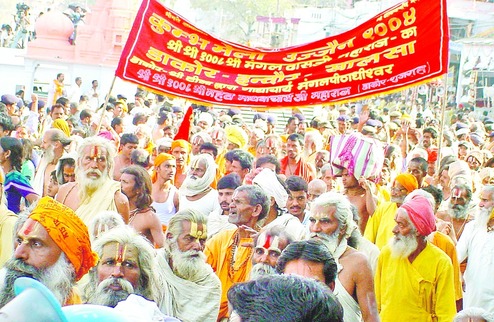
The Ujjain Simhastha in 2004. Picture by Raj Patidar
Ujjain, MADHYA PRADESH :
Bhopal :
When Ujjain city qazi Khaleel-ur-Rahman returned home from juma prayers yesterday afternoon, he was surprised to see a posse of visitors, mostly Hindu seers heading various akharas (monasteries).
Led by the Akhil Bharatiya Akhara Parishad head, Acharya Narendra Giri, the visitors asked Qazi Khaleel to lead the peshwai (procession) that marks the beginning of the month-long Simhastha, starting April 22 this year.
The Ujjain Simhastha is one of the four legs of the Kumbh Mela, each occurring by rotation every 12 years, the other three being the Kumbhs at Haridwar, Allahabad (Prayag) and Nashik.
The qazi – an arbiter for Muslims’ personal matters – said he was “overwhelmed” by the offer. He said he greatly valued the gesture at a time some people were following divisive agendas.
“This is the first time we have formally invited the shahr (city) qazi. The objective is to create goodwill and communal harmony,” Acharya Giri told The Telegraph.
He said that he and the other akhara heads had thought of personally visiting and inviting Qazi Khaleel to “send out a strong signal of communal harmony from the Simhastha”.
For the first time, the transgender community too has been given its own place at the Simhastha – amid resistance from the Akhil Bharatiya Akhara Parishad, the apex body ofakharas.
The Ujjain administration has earmarked five acres of land where around one lakh transgender people would be put up during the Simhastha.
Transgender people from 22 states have formed the Kinnar Akhara for this purpose, said its convener, Rishi Ajay Das.
Traditionally, various akharas take out the peshwai about a fortnight before the Simhastha begins formally with a shahi snan (royal bath). The heads of dozens of akharas join the procession, sitting on silver thrones on elephants, while armed sadhus (ascetics) ride horses and camels.
They are followed by other hermits, monks, priests and devotees on foot while thousands line both sides of the streets. The procession ends at Ram Ghat on the banks of the river Kshipra, which turns holy during Simhastha.
The Shivraj Singh Chouhan government and the various akhara heads have agreed to hold three shahi snans during the Simhastha, on April 22, May 9 and May 21.
More than five crore pilgrims are expected to gather and take a dip in the river. The occasion is called Simhastha because of a rare, 12-yearly configuration of planets with the Sun entering the Aries sign and Jupiter in Leo (Simha).
State minister Bhupinder Singh said that Chouhan had invited Prime Minister Narendra Modi to address a spiritual gathering during the Simhastha.
source: http://www.telegraphindia.com / The Telegraph, Calcutta, India / Front Page> Nation> Story / by Rasheed Kidwai / Sunday – March 27th, 2016
M. Sayeed Alam’s “Sir Iqbal” will be staged in the Capital this Sunday
The most sung poet and perhaps the most sung song in India “Saare Jahan Se Accha” written by Allama Muhammad Iqbal is all set to ignite the imagination of theatre lovers in Delhi. Playwright and directors, M. Sayeed Alam and Danish Iqbal’s spring time production ‘Sir Iqbal’ is a biographical work on the life, times and scholarship of Allama Iqbal who continues to be misunderstood in India but is celebrated in Pakistan as the man who came up with the idea of a separate nation for Muslims.
“Iqbal’s love for India which clearly comes through in the poem ‘Saare Jahan Se Accha’ and yet his choice of living in Islamic Pakistan over a secular India is in itself a study in contrast, a paradox that has pushed him far away from public memory in India. Iqbal died in 1938 much before the idea of Pakistan even took shape. Doctored history, misapprehensions about Allama being a fanatical Muslim who chose to live in a Muslim dominated undivided India needs to be closely looked into. My play is an effort to demystify Iqbal and clear some perceptions about the great poet, philosopher and politician and above all a humanist who has given India its most enduring patriotic poem yet remains forgotten in the country,” said Alam in the midst of rehearsals for the play which opens to public on March 20 at Sri Ram Centre.
“From what I have read about Iqbal’s political philosophy, he never demanded a separate home for Muslims outside India. Iqbal’s formulations somehow suited the supporters of Pakistan and they hailed him as the ideological father of the country – something that many Indians came to detest and therefore Iqbal remains forgotten whereas his poem as a song is sung everyday in schools all over the country. Our play brings out this dichotomy,” said Alam.
“Sir Iqbal” had first premiered in Kolkata in November last year to much critical acclaim. The one and half hour play with a 15-member cast will see Alam himself essay the role of Iqbal. The play is centred around the poet and philosopher’s life. In the play, Iqbal’s story is narrated by his trusted servant Ali Baksh who enjoyed Iqbal’s confidence and had witnessed many events in his life. Set in British India in the backdrop of the first half of the 20th Century, ‘Sir Iqbal’ will mirror the socio-political churnings during Allama’s times till his death in 1938 in undivided India. The play will perhaps set some records straight and clear many perceptions about Iqbal, who for many Indians still remains an enigma.
source: http://www.thehindu.com / The Hindu / Home> Features> MetroPlus / by Anasuya Basu / March 18th, 2016
Geetakshi Arora, a PG student of the South Asia Institute at the School of Oriental and African Studies, University of London, won the £1,000 prize.
An Indian student is the winner of the first Noor Inayat Khan Prize for 2016, the London-based Noor Inayat Khan Memorial Trust announced on Saturday.
Geetakshi Arora, a post-graduate student of the South Asia Institute at the School of Oriental and African Studies (SOAS), University of London, won the prize — which consists of £1,000 and a certificate — for her dissertation on “Goddess Myths in Graphic Novels: Reimagining Indian Feminity”.
The Trust awards the annual prize to a post-graduate student from SOAS, University of London, working in the area of gender studies and South Asian history.
Ms. Arora said that she was “humbled” by the award. “Noor has always inspired me to stand up for the values of peace, education and respect for all individuals irrespective of race, gender and religion. I will always try to live up to her legacy,” she told The Hindu.
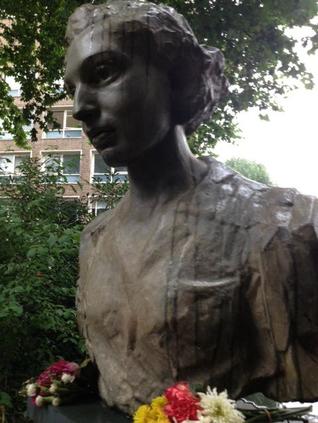
Noor’s bust in Gordon Square, London. / The Hindu
Of Indian descent, Noor Inayat was a secret agent in the Second World War, who was sent to Nazi-occupied Paris in 1943 from where she worked as a wireless operative sending intelligence reports to the Allies. Though betrayed to the Gestapo, tortured and ultimately killed at the Dachau concentration camp, she defied her captors to the very end.
“We hope the annual award keeps the memory of Noor Inayat Khan alive in the student community. We felt that SOAS was the natural choice to locate this prize given its long tradition of promoting South Asian culture and history” said Shrabani Basu, founder and chair of the Noor Inayat Khan Memorial Trust, and author of the biography of Noor Inayat, The Spy Princess.
A campaign by the Noor Trust resulted in the unveiling by Princess Anne in 2012 of a bust of Noor Inayat in Gordon Square, a tranquil lung space close to a cluster of institutions including SOAS.
source: http://www.thehindu.com / The Hindu / Home> International / by Parvathi Menon / London – March 19th, 2016
Prime Minister being welcomed by AIUMB founder-president Syed Mohammad Ashraf Kichuachwi at the inaugural ceremony of the World Sufi Forum in New Delhi on Thursday. / The Hindu
The Prime Minister quotes from Koran and makes a strong pitch against terrorism.
Prime Minister Narendra Modi said on Thursday that all Indian communities were an integral part of India, making a pitch for pluralism and diversity.
Mr. Modi was addressing delegates of a global Sufi meet here at a time when shrill statements from many within the BJP and the Sangh Parivar have created controversies in the past few months.
Rejecting terrorism, Mr. Modi hailed Islam as a religion of peace, citing the Koran and also paying rich tributes to the eclecticism of the Sufi tradition.
“Welcome to a people with an abiding belief in Vasudhaiva Kutumbakam, the world is one family,” Mr. Modi said. Mr. Modi said leaders like Maulana Abul Kalam Azad chose not to side with the idea of division based on religion after Independence.
“This is the spirit of India. This is the strength of our nation,” he said. “All our people, Hindus, Muslims, Sikhs, Christians, Jains, Buddhists, the micro-minority of Parsis, believers, non-believers, are an integral part of India.”
He sought to draw a parallel between these values and his own policies, saying, “The values of harmony, welfare, compassion and love for human beings are the foundation of a just society. That is the principle behind my creed of Sab Ka Saath, Sab Ka Vikas.”
The Prime Minister made a strong pitch against terrorism, underlining that “terrorism divides and destroys us”. “Indeed, when terrorism and extremism have become the most destructive force of our times, the message of Sufism has global relevance,” he said.
“Sufism is a celebration of diversity and pluralism, expressed in the words of Hazrat Nizamuddin Auliya, that every people has its own path of truth, beliefs and focus of reverence. These words reflect the divine message of the Holy Prophet that there is no compulsion in religion; and also that to every people, we have appointed ways of worship which they observe,” Mr. Modi said amid applause.
In reading Islam as a religion of peace, the Prime Minister may, however, have broken with many Hindutva outfits that, academic studies have argued, have tended to highlight Islam as an “invader” in India.
The PM also saw the basic attributes of Sufism among Indian Muslims: “It is this spirit of Sufism, the love for their country and the pride in their nation that define the Muslims in India.”
“They are shaped by the values of the Islamic heritage of India. It upholds the highest ideals of Islam and has always rejected the forces of terrorism and extremism,” he said.
Underlining that Islam is a religion of peace, Mr. Modi said: “When we think of the 99 names of Allah, none stand for force and violence, and that the first two names denote compassionate and merciful. Allah is Rahman and Raheem.”
While asserting that the fight against terror was not a fight against any religion but one between humanism and inhumanity, he hit out at terror as a threat to religion itself. “Terrorists distort a religion whose cause they profess to support. They kill and destroy more in their own land and among their own people than they do elsewhere. Those who spread terror in the name of religion are anti-religious.”
source: http://www.thehindu.com / The Hindu / Home> National /by Vikas Pathak / New Delhi – March 18th, 2016
THEATRE Playwright Danish Iqbal tells SWATI DAFTUAR about “Dara Shikoh”, a play that takes a look at one of Mughal India’s great lost names.
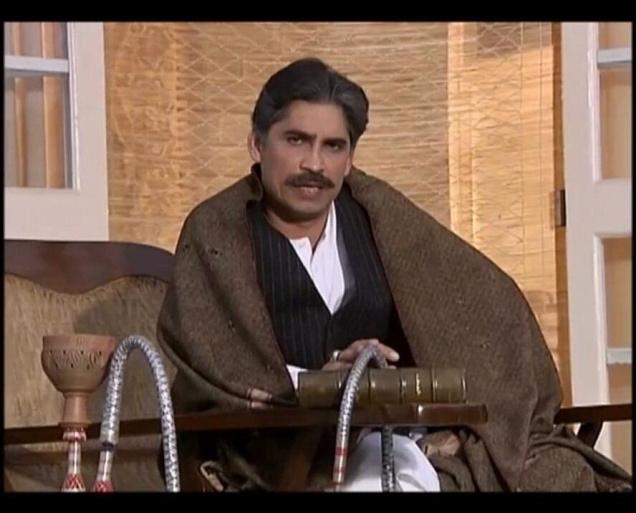
The cerebral MughalA scene from the play; (left) Danish Iqbal
It is 1653, and the siege of Kandahar is raging. Dara Shikoh sits in his tent at night, writing his treatise on comparative religion. His general, a veteran and a contemporary of his great grandfather, enters with the request to discuss battle strategy for the next day. Dara Shikoh explains that for him, the treatise is more important. He doesn’t ask the general to sit down, showing him this respect only later, when the general’s conversation takes an intellectual turn.
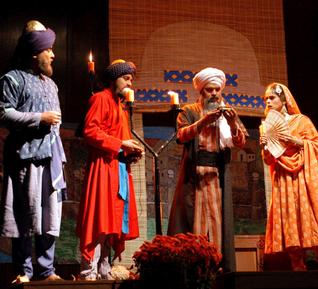
This is a scene from “Dara Shikoh”, the modern classic directed by M.S. Sathyu and written by Danish Iqbal, which encapsulates the play’s portrayal of the young Mughal prince and heir apparent to Shah Jahan. The play, being performed after three years, is once again being directed by the eminent director and stage designer and art director M.S. Sathyu and presented by Impressario Asia. After a recent show in Gurgaon’s Epicentre, it will be performed this Friday at the India Habitat Centre in New Delhi.
The play, Iqbal believes, cannot be considered a revival. “It’s been performed on and off over the years. This time, it’s only got minor changes. It’s a little shorter now, and there are a few new scenes.”
It was ten years ago, in 2004, that Iqbal, who confesses that he only works on commission because he needs to know that the words he pens will be performed, was approached by K.K. Kohli of Impressario Asia, the play’s producer. It could easily have been action oriented, a harsh, blood and gore portrayal of a prince whose life ended brutally and violently, killed in a succession struggle by his own brother. Iqbal and Kohli, though, decided to go a different way. The Dara Shikoh that Iqbal has penned is a prince who respects intellect over privilege. He is an egoistical, liberal, peace loving man who ignored war and translated scriptures.
“Dara was, in my opinion, the greatest person in Mughal history. I think he was greater than Akbar too.” Iqbal, while researching his play, says that he was surprised to see that this giant had been ignored by history. In this play, he has been careful to highlight Dara to the maximum, not allowing Aurangzeb or Sufi Sarmad, Dara Shikoh’s mentor, to take the stage. “I was questioned about this, but I think that in the case of Aurangzeb, the fear of the invisible and unknown would be much greater. Plus I didn’t want Dara overshadowed in any way.”
The playwright also goes on to admit that he owes more than half his knowledge about writing and stage skills to Sathyu. “He’s a grand old man of Indian theatre. He has a terrific sense of aesthetics. He makes sketches of every scene before the performance, to work out how the stage characters, headgear, beards, dresses, everything would look. He’s a very meticulous person. It’s a pleasure working with him. His art work is tremendously beautiful.” Iqbal adds that while he has indeed provided the dialogues, characters and content of the play, they’ve been given shape by Sathyu.
The shape this play has taken seems strangely placed in the past and the present. For Iqbal, the play holds a sort of every day importance. “In the past 10 years the challenges to inclusiveness and coexistence have increased in a big way; people are more fanatic. And terrorism is a bigger threat than before. The play has actually become more relevant.” He terms Dara as the first prince who died for his ideals, and adds that “Dara Shikoh” is today’s play. “It is a metaphor. We discussed if this play, because of how it ends, was becoming too sad and tragic, but it was in his defeat and death that Dara’s principles emerged victorious. This is what we wanted the play to show.”
Iqbal, a student of philosophy, has written a work that plays with many concepts and ideas that affect and influence human existence. Of death, a quote from the play says, “ Maut kya hai, maut hai fakth ek dehleez ”, which loosely translates to mean that death is ultimately the first step to a door between one chamber and the next. That death, ultimately, is nothing.
In a play packed with such layered, ambiguous dialogues, Iqbal confesses that it has become hard to cast the right actors for the roles. “It’s a great challenge. We don’t have very good actors, and especially young actors lack the capacity to understand the nuances of the play, absorb its ideas and translate them into emotions and gestures. This requires intellectuals of a certain calibre, and not all actors can deliver. Often, the average actor only sees the superficial meaning of a dialogue. To overcome this, we have conducted workshops with the actors, to explain the multilayered aspects of play.” Iqbal adds that there are hardly any professional actors hired for this season of the play. “They have their jobs, and (we have) amateur actors who wanted to be part of the production.”
He’s holding a book on Pataudi, and as a closing remark, adds that he’s working on another story that gives him the goose bumps, that of Mansoor Ali Khan Pataudi. “Like Dara Shikoh, his story is also inspiring, and can reach people in manifold ways.”
Director M.S. Sathyu says, “We’ve only made minor changes in the play, and this time there is a new choreographer (Astha Dixit) and they’ve got trained Kathak dancers. The casting is always a problem, because this play requires a lot of Urdu and there are very few actors who can speak good Urdu. They can speak in Hindi and Punjabi but Urdu is a challenge.”
source: http://www.thehindu.com / The Hindu / Home> MetroPlus / by Swati Dastur / January 23rd, 2014