The late bloomer Mufti Mohammad Sayeed (1936–2016) leaves behind a legacy of reconciliation. Make use of it
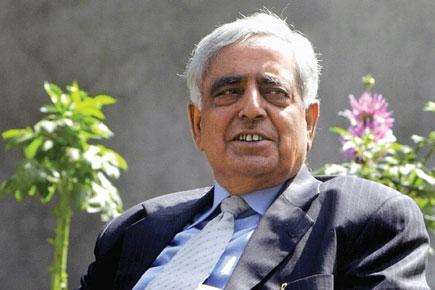
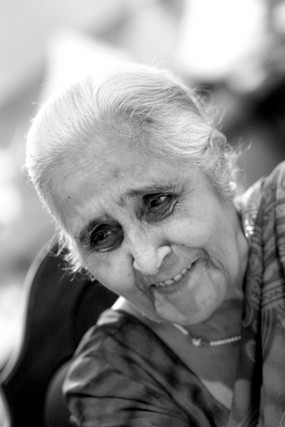
Mufti Mohammad Sayeed (Photo: SAJJAD HUSSAIN/GETTY IMAGES)
Sheikh Mohammad Abdullah, the ‘Lion of Kashmir’, died in September 1982. He was three months short of seventy-seven. He had been ailing, especially since a heart attack in 1977. Sheikh Abdullah’s funeral procession was gigantic. It may have been the single largest ever seen in the Subcontinent. The mass outpouring of grief was a measure of the stature he commanded among his people even in the twilight of his life. He had, after all, been the dominant figure of Jammu & Kashmir’s politics for a full half-century.
A decade later, Abdullah’s grave—near Srinagar’s Hazratbal shrine, on numerous occasions his base and pulpit over that turbulent half-century—was under guard by Indian paramilitary forces to prevent its desecration by armed militants and angry mobs.
The apparent reversal in the Sheikh’s standing among his people was not as astounding as it might seem. The accord he made with Indira Gandhi’s Government in 1975 in return for his personal liberty and political restoration—after 22 years mostly spent in prison—was widely viewed among his popular base and in his own organisation as an abject surrender to and for power. The Abdullah of 1975-1982 was a lion in winter, a far cry from the leader who had long defied and dared New Delhi. In his last years, he even fell out with a lifelong loyalist like Mirza Afzal Beg, the only one of his four cabinet colleagues who had stood with him against the Delhi-sponsored palace putsch of 1953 that deposed him from power (Beg also signed the 1975 capitulation on his behalf). The grand farewell he got from his people on his death was in recognition of his decades of suffering in the cause of ‘self-determination’. The same sentiment, coupled with his party’s grassroots machine, propelled his resounding election victory in 1977 and his son’s equally emphatic win in 1983.
Mufti Mohammad Sayeed, who has died a few days short of eighty, is not comparable to Sheikh Abdullah. For all his faults and flaws, the Sheikh is in a league of his own in Kashmir’s political history—the leader who brought mass political mobilisation to the Valley in the 1940s, emancipated the peasant masses from generations of serfdom through land reforms in the early 1950s, and challenged New Delhi’s machinations and stooges in Kashmir for more than two decades after his removal from power. Abdullah’s political capital was his mass base. The Mufti, for most (over two-thirds) of his nearly six decades in politics, was distinguished by the reputation he gained as a Machiavellian schemer and operator; he had almost no standing among his people and was disliked, distrusted, and perhaps even detested by most of his fellow-Kashmiris.
While I have not seen a single proper obituary of Mufti Mohammad Sayeed in the Indian (or specifically the Kashmiri) media, it has emerged in piecemeal life- sketches that he began his political life in the late 1950s in something called the ‘Democratic National Conference’. This was a dissident faction of a cabal that was installed in office in Srinagar after the 1953 coup, which was formally executed by the barely-adult Karan Singh in his Sadr-e- Riyasat capacity and was followed by the suppression through police and military action of massive protests against it, with dozens killed in firing and thousands arrested.
The cabal, which comprised many though not all of Abdullah’s former comrades (there were important exceptions like Afzal Beg and Maulana Masoodi), falsely appropriated the National Conference name. The real NC was reconstituted as the Jammu & Kashmir Plebiscite Front in 1955 with Beg as its first president and the incarcerated Abdullah as its ‘patron’, and existed under that name until 1975. But the cabal in power developed a schism in 1957 when Bakshi Ghulam Mohammad, Abdullah’s successor as J&K’s Prime Minister, failed to appoint any members of the faction clustered around GM Sadiq to cabinet positions after the first elections to the J&K Legislative Assembly. The ruling pseudo-NC had ‘won’ 69 of the assembly’s 75 seats in these elections; of the Valley’s 43 seats, 35 had been won without any contest (‘elected unopposed’). After the rift, 15 of the 69 legislators joined the rebel group led by Sadiq. The rift was papered over in late 1960 through New Delhi’s intervention and the pseudo- NC entered the 1962 Assembly elections formally re-united.
The young, ambitious Mufti Sayeed entered the Assembly in 1962 from his hometown, Bijbehara. It was not difficult— the official NC ‘won’ 68 of the 74 seats, and 32 of the Valley’s 43 constituencies were won without any contest. It was after these elections that Prime Minister Nehru, worried by adverse international media coverage, famously wrote to Bakshi Ghulam Mohammad mildly rebuking him for not having ‘lost a few seats to bonafide opponents’.
Mufti retained his seat in 1967. It was again a cakewalk. By this time Bakshi was in the doghouse and the ruling party—led since 1964 by Sadiq (who made Mufti a deputy minister in his government)—had metamorphosed in 1965 into the Jammu & Kashmir Pradesh Congress. The Congress won a four-fifths majority— 60 of the 75 seats—in the J&K Assembly in 1967. Of the Valley’s 42 constituencies, 22 saw no contest, and 118 candidates who filed nominations were rejected, 55 because they had not taken the compulsory oath of allegiance to India and the rest with no reason given.
Only a very few undesirables got through this gauntlet. A young Plebiscite Front leader, Ali Mohammed Naik, took the oath of allegiance, managed to get his papers approved, and was elected to the Assembly as an independent from Tral, a southern Valley town fairly close to Bijbehara. Another successful opposition candidate was none other than Bakshi Ghulam Mohammad, disgraced and sulking since his fall from power in late 1963. In 1967, J&K elected Lok Sabha members for the first time. The Congress won five of the six Lok Sabha seats, including two of the Valley’s three. The exception was Srinagar, where Bakshi stood on a platform of Kashmiri pride and won despite attempts by intelligence operatives sent from Delhi to ensure his defeat. When he turned chameleon and ran from Srinagar as a Congress candidate in the 1971 Lok Sabha elections, he lost badly to Shamim Ahmed Shamim, a journalist and Plebiscite Front supporter who contested as an independent.
The people’s interest and allegiance lay elsewhere, outside this ‘democratic process’. On 18 April 1964, Sheikh Abdullah arrived in Srinagar after being released from prison. The Central and J&K governments had decided to free him in a desperate bid to calm down the Valley, which had been in a state of uprising since end-1963, turmoil triggered by the temporary disappearance of Prophet Muhammad’s hair from the Hazratbal shrine but rooted in pent-up rage at the police-state repression and fraudulent governments since 1953. It was reported that Abdullah ‘entered Srinagar and was greeted by a delirious crowd of 250,000 people. Srinagar was a blaze of colour and everyone seemed out on the streets to give him a hero’s welcome… Addressing a gathering of 150,000 people on 20 April, Abdullah said that in 1947 he had challenged Pakistan’s authority to annex Kashmir on grounds of religion, and now he was challenging the Indian contention that the [Kashmir] question had been settled’. Abdullah remained at liberty until May 1965, when he was re-arrested under the Defence of India Rules, a colonial-era regulation used by the British against Indian freedom fighters.
In March 1968, during another, shorter spell out of prison, ‘almost the entire population of Srinagar turned out to greet him’ as he arrived in the city, The Times of India reported. It added that the hundreds of thousands were chanting: “Sher- e-Kashmir zindabad, Our demand plebiscite!” Days later, Abdullah told a 100,000-strong gathering in Anantnag that “repression will never suppress the Kashmiri people’s urge to be free”. In 1968, Abdullah also said: “The fact remains that Indian democracy stops short at Pathankot. Between Pathankot and the Banihal [Pass] you may have some measure of democracy, but beyond Banihal there is none. What we have in Kashmir bears some of the worst characteristics of colonial rule.”
Consistent with the normal pattern of progression of politicians, Mufti Mohammad Sayeed became a cabinet-rank minister in the J&K government after the 1972 state Assembly polls. The Congress had won a three-fourths majority, 57 of the 75 seats, under the leadership of Syed Mir Qasim, who became Chief Minister after Sadiq’s death in 1971. The 1972 election had a back-story. In 1969 the Plebiscite Front had run as independents in panchayat elections and swept the Valley. Then, in December 1970, the Front announced that it would contest both the Lok Sabha polls in March 1971 and the state polls in 1972. Qasim later wrote in his autobiography, My Life and Times (1992), that since its formation in the mid-1950s the Plebiscite Front had ‘reduced [the ruling group] to a non-entity in Kashmir’s politics’ and ‘if the elections were free and fair, the Front’s victory was a foregone conclusion’.
+++
Speaking in Jammu city on 23 December 1970, Prime Minister Indira Gandhi made it clear that she would not tolerate this scenario. Asked by journalists how it could be prevented, she replied cryptically: “Ways will be found.”
On 8 January 1971, ‘externment orders’ were served on senior Front leaders Afzal Beg and GM Shah (the Sheikh’s son-in- law), which required them to leave J&K. During the night of 8-9 January, 350 leading Front activists were arrested across the state under the J&K Preventive Detention Act. On 12 January, the Centre declared the Front illegal under the Unlawful Activities (Prevention) Act. The only reason the Congress did not cross the four-fifths majority mark in 1972 was that five Valley seats were given to the Jama’at-i-Islami in an underhand deal. The fundamentalist pro-Pakistan fringe entered J&K’s legislature through the backdoor.
During the subsequent phase of Indira Gandhi’s wary accommodation of the Abdullahs—on her own terms—Mufti Sayeed emerged as her chief in-state henchman as J&K’s top Congress leader. The Congress-NC rapprochement famously broke down in 1983 and it is more than plausible that Mufti was a key player in the Delhi-sponsored conspiracy that brought down Farooq Abdullah’s democratically elected government in mid-1984. When Farooq’s brother-in-law GM Shah, the Congress-backed replacement, had outlived his usefulness and needed to be disposed of two years later, an episode of rioting targeting Pandits in villages around Bijbehara in March 1986 provided the pretext for his government’s dismissal under Article 356 and Governor Jagmohan took over. Mufti bitterly quit the Congress and joined VP Singh’s bandwagon after Rajiv Gandhi cut his own deal, with its well-known disastrous consequences, with Farooq Abdullah in end-1986.
During the political and human tragedy that engulfed Kashmir through the 1990s, the small town of Bijbehara became one of numerous sites of massacres of civilians. In October 1993, BSF troops fired on a march in the town taken out in solidarity with Jammu & Kashmir Liberation Front (JKLF) militants besieged by the Army in Srinagar’s Hazratbal shrine. Some three dozen people were killed and double that number seriously injured.
The Mufti’s re-emergence at the end of that bloody decade in a brutalised Kashmir in a completely new political avatar alongside his campaigning daughter was nothing short of extraordinary. The platform and rhetoric—dignity, self-respect, rights, and ‘self-rule’—were reminiscent of the Sheikh Abdullah of yore, albeit expressed in a less confrontational, more measured tone. By standing—at last—with his distressed, traumatised people instead of serving the masters in New Delhi, Mufti was able to build a genuine popular following.
The metamorphosis can and does have different explanations, from the romantic to the cynical. Yet one thing is certain. The septuagenarian Sheikh Abdullah was a spent, defeated politician. The septuagenarian Mufti was not. He performed competently as Chief Minister from late 2002 to late 2005, as J&K struggled to move beyond the violence of insurgency and counter-insurgency, until he was compelled to prematurely step down. A decade later, he was able to negotiate, in a spirit of equality, an ‘agenda of alliance’ document with the BJP, which embodies a concrete vision of resolving the Kashmir conflict in its multi-dimensional totality. Because of his past, he retained credibility among Jammu Hindus and Ladakhi Buddhists even while seeking to give voice to the grievances and aspirations of the Valley’s Muslims.
The later political life of Mufti Mohammad Sayeed— 1999- 2015 —has left a genuinely valuable legacy. Jammu & Kashmir, and India, cannot afford to—and must not—lose this legacy.
source: http://www.openthemagazine.com / Open / Home> Open> Voices> Open Essays / by Sumantra Bose / January 15th, 2016
Sumantra Bose is Professor of International and Comparative Politics at the London School of Economics and Political Science. His most recent book, Transforming India (2013), includes an analysis of contemporary Kashmir as one of Indian democracy’s unresolved challenges
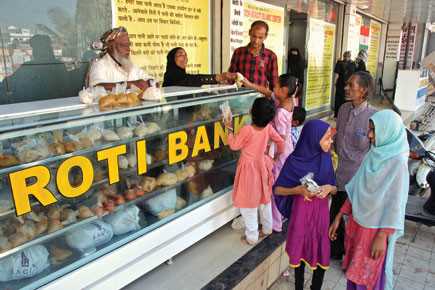
A recently launched Roti Bank that feeds the hungry has become a huge success in Aurangabad.
An unusual food bank in Aurangabad, Maharashtra, which feeds the poor and the hungry with fresh food supplied by its ‘depositors’ has seen its membership double in less than two months of being operational.
This initiative has been launched by 38-year-old Yusuf Mukati, who opened the doors of the bank on 5 December with 250 members. Depositors had to fill out a form with their details and were given a specific code, which is akin to a bank account. The details of the depositor are stored under this number. As the founder of the Haroon Mukati Islamic Centre in Aurangabad, Mukati already had a long list of contacts. So when he bounced the idea of a Roti Bank off them, he found that people were quite keen to contribute. As a rule, this bank only deals in freshly cooked food items.
The Bank is open from 11 am to 11 pm. Each of its members has to deposit two chappatis and either a vegetarian or a non-vegetarian preparation. There is no bar on the number of times this can be done. Once the food comes in, helpers segregate the vegetarian and non-vegetarian food and repack it in plastic bags and containers.
This free food is handed out to all those who come to the Bank’s counters. Leftover food is frozen for reuse the next day. In case there is excess food, Mukati distributes it amongst his staffers.
Mukati grew up in a family of modest means where food was a dear commodity. He says, “Seeing poor and hungry people is a common sight. People feed them, but it is never fresh food. I wanted to create a place where people can get fresh food at no cost. It is not just beggars who go hungry. There are so many among the middle-class who have to forgo meals due to rising costs.”
source: http://www.openthemagazine.com / Open / Home> Open> Shorts / by Haima Deshpande / January 28th, 2016
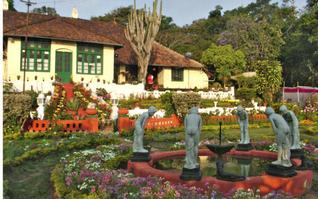
Vibrant:The flower garden at F.M. Khan’s home at Boikeri in Kodagu. The annual flower show will be open for public on Saturday and Sunday.
Madkeri :
The annual flower show being organised at former MP F.M. Khan’s home at the Balayatrie Estate at Boikeri, on the Madikeri-Sunticoppa-Mysore Road, near Madikeri, is sure to become a hit when it opens for the public on Saturday and Sunday.
Mr. Khan played host to the presspersons at his home on Friday as they were taken around the flower arrangements made in front of his home in Boikeri. More than 80 varieties of flowers, all swaying to the gentle breeze and glowing in different hues, are bewitching to watch. Flower-lovers will be surely in for this annual treat, an arrangement being steadfastly followed by Mr. Khan and his family members for many years now.
Name them, the varieties are there. Dahlia, daisy, zerbera, anthurium, lady lock, cactus, marigold, chrysanthemum, bougainvillaea, bonsai, geranium, love in mist, orchids, exora, spider flower, rose, zenia, pinks, and keep counting them, there are more than 80 varieties providing a magnificent sight. It is not an easy task unless one gives personal attention, says Mr. Khan, who was once a firebrand politician and a close confidante of the late Prime Minister Indira Gandhi. However, Mr. Khan says transition from political arena to the kingdom of flowers was not difficult at all.
Mr. Khan had organised flower shows in New Delhi when he was the MP and came under lavish praise from the parliamentarians and flower lovers in the past. Dew drops settled on the flowers on a dewy morning had given a special lustre to the environment. Mr. Khan admits that rearing flowers was a tough task. He rues over the fact that many plants were lost due to unseasonable rains. He has plans to open seed bank in future for the benefit of flower lovers in the district.
Mr. Khan told presspersons that no person in the private sector had opened the flower show for public and he would set his eye on entering the Limca Book of Records in sometime.
A.M. Khan, brother of Mr. Khan, recalled how their father, Yousuf Ali Khan, loved flowers . The show would be open for public from 10 a.m. to 5 p.m. on Saturday and Sunday.
source: http://www.thehindu.com / The Hindu / Home> Karnataka / by Staff Correspondent / Mysore – January 21st, 2012
F. M. Khan is taking a walk in his home garden. Picture right shows Dahlia in full bloom.
Madikeri :
Former Rajya Sabha member F. M. Khan is holding the annual flower show at his home garden for the public in Boikeri, near Madikeri, on Jan. 30 and 31.
The garden at Khan’s Balyatrie Estate, with more than 100 varieties of flowers — most of them rare — is spread over more than half-an-acre in front of his house.
Multi-hued roses, dahlia, chrysanthemum, jasmine are in full bloom to welcome the visitors.
Addressing media persons here yesterday, he said floriculture helps in the economic progress of the country and urged the government to support floriculture.
Stating that there is a huge demand for flowers at the international market, he said floriculturists should grow flowers in a natural atmosphere.
With the vagaries of nature, one needs to give special emphasis on protection of plants, he added.
Flowers like Jasmine, anthurium, marigold, salvia, Gerbera, Zenia, Dahlia, Cosmos, croton, colin, Plectranthus, Impatiens, Daisy, Gardenia, sun flower, Hollyhocks, Clarkia, Cockscomb, Lupine, Verbena, Fuchsia, pinks, spider flower, oster flower, calendula flowers, cupia, Gazania, Sweet pea, Cineraria, stock flower, love in a mist flower, devil in the bush and others are on display.
The flower show will be open to visitors from 10 am to 5 pm today and tomorrow.
source: http://www.starofmysore.com / Star of Mysore / Home> General News / January 28th, 2016
Salman Yusuff Khan, who was in the city as a judge for the MTV Campus Diaries auditions, opens up about his love for dance and Bengaluru
Salman Yusuff Khan who won the dance reality show Dance India Dance Season 1. made his debut as an actor with the movie, ABCD, directed by Remo D’Souza. In an interview with MetroPlus, he talks about what keeps his passion for dance ticking. Excerpts.
You are regarded as one of the best dancers in the country today. How has the journey been?
It has been amazing. I feel blessed to be an artiste. The love for my work and affection showered by the people is what has kept me going. Dance as a profession didn’t have the respect or importance six years ago as it gets today.
There was a period when I was working continuously for three months, without a day’s break. It was hectic, yet I enjoyed it. When you do something you love, it doesn’t feel like work.
How has the transition from dance to cinema been?
Mumbai has treated me well. I started my career here and the support and encouragement that I’ve received has been enormous and has helped me move forward. I had no uncertainty. I knew this is what I had to do. My only struggle was in Bengaluru when I had to complete my engineering. After that, I started exploring different fields, be it dance, movies or television. It hasn’t been effortless, but it hasn’t been difficult either.
What has the response been for the MTV Campus Diaries auditions in Bengaluru?
I loved the crowd. The energy and enthusiasm shown by the youth here is amazing. Though Mumbai has made me the person I am today, Bengaluru will always be special to me. Back in my time, there was quite a lot of stage fear and we weren’t too professional. I’m astounded by the professionalism shown by the youth here. The confidence shown and the effort they put in their work is inspiring.
I want to thank Amazon and MTV Campus Diaries for giving me the opportunity to experience the beautiful variations in all the four cities in which the auditions took place.
It has been difficult to select the best among the participants. I know I’ve broken many hearts but I want them to know this is not the end, but just another phase and it will help them better themselves.
source: http://www.thehindu.com / The Hindu / Home> Features> MetroPlus / by Mythili S. Bhat / Bengaluru – January 30th, 2016
Hajra Mohammed opens her eyes every morning to her one-year-old great-grandson’s videos on her newly acquired iPad. Mohammed, who turned 88 this year, started picking up computer skills recently with her daughter Nighat’s help. She now has a Facebook account in her name where she responds to all recipe requests from friends and relatives all over the world. For a woman of her age who is recovering from an injured back and spending a lot of her time in bed, it is no easy feat.
The Bangalore-based grandma hasn’t allowed age to become a hurdle. She published her first book at 85 and became one of the oldest first-time Indian writers.
“It was my determination and my granddaughter’s persistence that helped me publish the recipes I learnt and practised to perfection over the years,” Mohammed says. Her Dubai-based daughters Tasneem and Nighat Mohammed consider themselves lucky to have grown up on “the world’s best food”. “Mum is a remarkable woman with an amazing zest for learning. She has the courage to motivate herself with her aches and pains and do what she loves,” they say.
Mohammed’s first book, Hajra’s Recipes of Life for Life: Delectable Muslim Cooking, is for those who want a taste of Kutchi Memon cuisine, closely guarded by this Muslim community. A joke that goes about the Kutchi Memons is that even if they are generous enough to share their recipes, they purposely leave out one or two ingredients. Is that why it took Mohammed so long to decide that she could write a book on a cuisine she has mastered?
“I had the idea of a book 15 years before it got published,” she says. It didn’t happen until 2010 because a publisher was hard to find. Some feathers were definitely ruffled on the book’s release. “Several people from my community were shocked that I revealed so many of our secret cooking rituals and masalas,” laughs Mohammed.
But surprisingly, a lot of Kutchi Memons bought her book. Some use it themselves because it is methodically written; others sent it to their children studying abroad because the recipes are easy to follow.
“Our food is not only scrumptious but also healthy. Our biryani, for example, is cooked in minimal oil and spices as opposed to a lot of other Indian biryanis,” says Mohammed.
As a teenager, cooking was not on Mohammed’s mind. When most Indian girls were expected to hone their culinary skills, she enjoyed reading and music. “LPG [liquefied petroleum gas] wasn’t available then and my father didn’t let me cook with firewood.”
Unfortunately for Mohammed, both her parents died when she was still in her teens and she had to move in with her brothers. Her sister-in-law was instrumental in helping her become the expert cook she is today. She got married at 22; when her husband died 10 years later, she was left to bring up three young children all by herself. To eke out a living, she held cooking and baking classes at home and sold handmade dolls to a handicrafts emporium.
Today, she says it is her passion for cooking and learning that has given her the edge.
“The first thing I do is hit a bookshop when I visit a new place, to look at recipe books. An exciting recipe on a TV show finds a way into my diary and is soon tried out in the kitchen,” she says. “Love your cooking – put your heart and soul into it to get the best results.”
She’s excited about publishing her next recipe book, which she plans to call Hajra’s Favourite Recipes.
“This time, I’ll type all the recipes myself,” she says with a smile.
Sukha jhinga (Dry spiced prawns)
Serves 4
Ingredients
500g prawns, sliced and deveined
½ cup oil
Marinade
2 tsp garlic paste
2 tsp cumin powder
3 tsp red chilli powder
8 green chillies, finely chopped
4 tbsp finely chopped coriander leaves
Juice of one lemon
Salt to taste
Seasoning
4 tbsp oil
¼ tsp cumin seeds
10 curry leaves
Method
1 Wash the prawns and dry them with a clean kitchen towel.
2 Combine the marinade ingredients and rub them into the prawns. Refrigerate for two hours.
3 Heat ½ cup of oil in a pan and fry the marinated prawns for about 3-5 minutes, until they lose their translucency, but remain crunchy.
4 Heat the oil for seasoning in another pan. Add the cumin seeds and curry leaves. Once the cumin seeds crackle, remove from heat and pour the seasoning onto the fried prawns. Serve hot.
source: http://www.thenational.ae / The National / Home> UAE> Arts & Life / by Priti Salian / artslife@thenational.ae / December 08th, 2013
Winner of Chakravarti medal and Chancellor’s Bronze medal in 2013 and 2014 respectively, Amitabh Srivastava is now the recipient of Lucknow University’s prestigious Chancellor’s gold medal for the year 2015, awarded for the best student in all the faculties. A law student, Amitabh scored 73.8% in LLb (hons). He is now pursuing LLM from National Law University, Bangalore.
It’s a perfect New Year gift I could have ever thought of. It’s a dream come true,” said Amitabh, who got to know about his medal from the media while he was in his hostel. I got to know it from the reporters, who started calling me,” said he. Amitabh will be given the medal on January 31 when LU will hold its convocation.
Hailing from Faizabad, Amitabh has participated in several moot court competitions. In a national moot court competition, Amitabh won the first runner-up award.
Son of Raj Kumar Srivastava, a court commissioner, Amitabh’s mother Anuradha Srivastava is a government teacher in Faizabad. From cleaning river Gomti to particpating in co-curricular activities like singing, quiz competition, Amitabh has actively participated in social and extra-currcicular activities. Also, he has to his credit a research paper, which is published in a journal of international repute. He has represented his university in various moot courts.
Apoorv Dev has bagged the Chancellor’s Silver Medal which is awarded to the best student among all students in all faculties in post-graduate classes.
Parvish Fatima has bagged the Chancellor’s Silver Medal for being the best woman student in the university.
Apoorv, a national volleyball player is currently in final year LLb. He has participated in rifle shooting competition.
Dr Chakravarti Gold medal has been awarded to Rajat Shukla. The Chakravarti medal is given to the student who is of good behaviour and is found to have been most helpful in the general social life of the university. Rajat, also from faculty of law has also participated in several national and international moot courts. Besides, he has organised legal aid camps, and has worked as volunteers in National Human Rights Commission.
The 10 Chancellor’s Bronze Medal awarded to the best student in different faculties are Shivani Singh and Manvi Tripathi in arts, Shalini Jaiswal and Vibhvantika in science, Arpita Saxena and Shubhagi Dubey in commerce, Pranav Tripathi and Shivangi Tiwari in law, Pramod Kumar and Arti Singh in fine arts.
source: http://www.timesofindia.indiatimes.com / The Times of India / News Home> City> Lucknow / TNN / January 26th, 2016
Power minister Aryadan Mohammed inaugurated the state’s first floating solar plant at Banasura Sagar reservoir in Wayanad on Thursday.
The 10-kilowatt-capacity plant, spread over 1,200 sq ft has been installed on concrete floaters with hollow insides. The platform can carry 45 tonnes and the power generated will be fed to the KSEB grid through cables drawn through the reservoir bed. KSEB officials said that it is the first floating solar plant to be set up inside a reservoir in the country.
The innovative power generation system, set up at a cost of Rs 20 lakh, is the brainchild of two young entrepreneurs from Wayanad – Ajay Thomas and V M Sudhin. The duo’s startup firm Vatsaa Energy Private Ltd has implemented the project with financial aid from KSEB under its Energy Open Innovations Zone.
Inaugurating the plant, Aryadan Mohammed said that KSEB was making a big push in the area of renewable energy. He added that the government has acquired 500 acres of land in Kasaragod to set up a 200 MW solar park. A further 1500 acres will be acquired for the project.
The KSEB also has plans to convert the largest earthen dam in the country to a hub of solar power generation with the launch of construction works for two other solar projects at the site.
The projects include a proposed 500-kW floating solar plant at the reservoir and a 400kW ‘dam- top’ solar power generation project. The former is a scaled-up version of the 10kW concrete floating plant. The Rs 9.25-crore project will be spread over the water surface of the reservoir across 1.25 acres.
The minister will also inaugurate the works of the 400-kW dam-top solar project by installing solar panel canopy over the walkway atop the dam at a cost of Rs 4.6 crore. Another hydel tourism development project is being envisaged near the dam premises.
Ajay Thomas, who had developed the indigenous technology for the floating plant, said the device has around 20% higher efficiency compared to ground-mounted units as the cooling effect of water helps in keeping the temperature of the solar panels low, thus boosting output.
“The low dust environment in the reservoir also aids in enhanced performance of the photo-voltaic panels. Water bodies in the state, including those in large hydroelectric projects, can be used for large-scale solar power generation through floating plants,” he said.
KSEB chief engineer (renewable energy and energy savings), Suku R, said the floating solar plant was designed for dam reservoirs in the state, also taking into consideration the seasonal water level variations, heavy rain and winds.
M V Shreyams Kumar MLA presided over the function. KSEB chairman and managing director M Sivasankar, academician RVG Menon among other spoke.
www.timesofindia.indiatimes.com / The Times of India / News Home> City> Kozhikode / K.P. Rajeev / TNN / January 21st, 2016
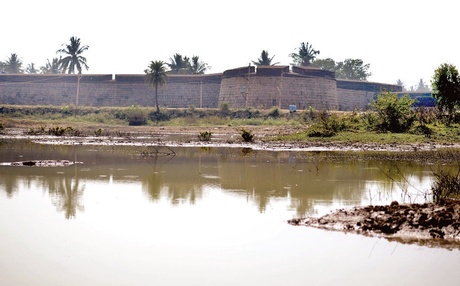
The Devannahalli fort, which stands 35 kms away from Bengaluru, is older than the city itself by 37 years.
The fort has been occupied by different dynasties over time. It was built in 1501 by Kempegowda’s ancestor, Malla Baire Gowda. But in 1747, in a battle led by Nanjarajaiah, the dalwai of Mysore, the clan lost it to the Wadiyar dynasty. Marathas later claimed it and lost it back to the Mysore state, in a siege led by Hyder Ali in 1746.
Arun Prasad, from Discover Bangalore Project, says that though Hyder captured the fort, it was his son Tipu Sultan who was responsible for modelling and building the Pulkad fort.
The town surrounding the fort was meant to be a a centre of learning and arts. “The Devannahalli town was supposed to be a place for learned artisans and intellectuals to inhabit,” says Prasad.
Devannahalli was a town typical of the time, with protected farmlands and fields. A lake, behind the fort and seen from the bastions, was meant to serve the needs of the inhabitants.
Today, the lake is dried up and is a sad sight to notice. Prasad blames it on poor urban planning. Earlier, a highway used to pass through the western part of the town. Now, a road has been built, which passes over the lake. A good portion of the lake was used up for it.
“The lake has always been rain-fed. But the new road cut the lake away from the adjoining canals and channels,” says Prasad. “The rain water could not flow in and the lake dried up. The vast area of 400-500 kms metres has only weeds and little water due to rains. You can also spot some tattered measurement devices, which was a failed attempt to study the level of water in the lake.”
Pics: Pushkar V
Bastions
Built on a higher ground, the bastions were used to keep a watch out for the enemy. The fort is 30 to 35 feet high and bastions, along the fort, are placed at equal distance from each other. “The bastions have well protected chambers, used by soldiers. The gun points are holes in the wall which can still be seen today. They are built from lime and brick. The holes were used to keep guns during the war,” adds Prasad.
Tipu’s Birthplace
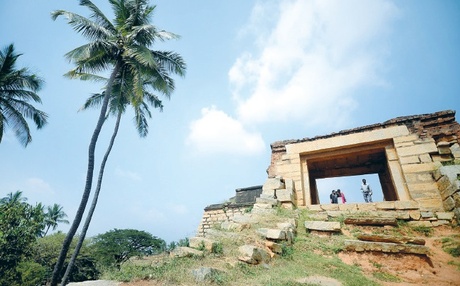
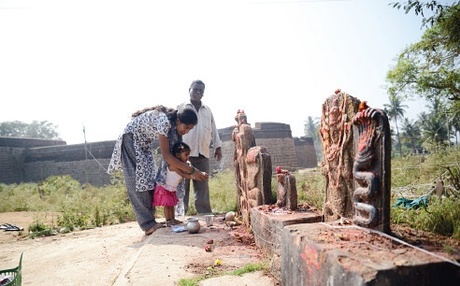
South-west of the fort, there is memorial with a board, which proclaims that Tipu was born here. A six-foot-tall enclosure marks the spot.
When Tipu was born in 1750, his father Hyder Ali was engrossed in a battle. His mother, Fatima Fakhr-Un-Nisa, was secretly ushered into a carriage to give birth at the fort, as it was considered a safe place. However, she ended up giving birth inside the vehicle, right outside the fort. The monument is built over this birth spot.
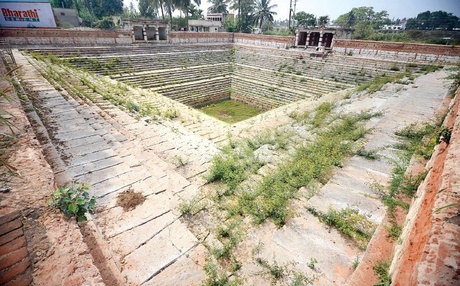
A pond was built under the administration of Purnaiah, the then Dewan of Mysore. It is a beautiful pond with the stones and excavations intact. “The water is used for rituals and festivals,” says Prasad. “People take baths here as well.”
Pics: Pushkar V
Temples
Inside the Devannahalli fort, there is the Venugopalswamy temple. The temple, which was built in the Vijaynagara style, has several depictions from the Ramayana on the walls. “At the entrance, the two horsemen are believed to belong to the Western Ganga dynasty (which ruled 350 and 1000 AD),” said Prasad.
There are sculptures of seamstresses, as you enter, from the same era. The north and south walls have sculptures showing Rishyasringa being brought from a forest to Ayodhya accompanied by dancing girls. There is also a scene of Vishwamitra caught in a an archery battle with Rama. The south wall has ten incarnations of Lord Krishna and Rama’s father performing a sacrifice.
Pics: Pushkar V
The fort gate and the fort walls are crumbling and there are scribblings on the walls. There is no security at the entrance and anyone can walk in. The commercial establishments all around have failed to preserve the authenticity of the past. “An ASI (Archeological Survey of India) office is located at the entrance, which is always closed and does not provide much information,” says Prasad. “The fort area needs to be protected by ASI and does not come under the corporation. The northern gate is crumbling as well.”
How it Began
Refugees on the run from Kancheepuram settled down near the Nandi Hills. Legend has it that Rana Baire Gowda, their leader, was told in a dream that he had to build a settlement in this region. This family goes by the name of Morasu Wokkalu. His son Malla Baire Gowda founded Devanahalli. Kempegowda also belongs to this family.
source: http://www.newindianexpress.com / The New Indian Express / Home> Cities> Bengaluru / by Seema Prasad / January 28th, 2016