Two weeks ago, in a quiz designed by Pavan Jha, we had posed a few questions on veteran actor Dilip Kumar to The Hindu readers. As promised, here are the answers:
01. Which Dilip Kumar-starrer was an adaption of Emily Bronte’s classic novel Wuthering Heights? Certain portions of the film were supposedly directed by him without credits.
Dil Diya Dard Liya (1966). The official director was A.R. Kardar.
02. Which film initially had Jayalalithaa cast opposite Dilip Kumar, only for her to be replaced subsequently by another heroine?
B.R. Chopra’s Dastaan (1972). Jayalalithaa was replaced by Bindu.
03. A big star of the ’60s, known for idolising Dilip Kumar and aping his acting style, made his debut playing the uncredited role of Dilip saab’s friend. Who is the star and which Dilip Kumar film is it?
Rajendra Kumar in Jogan (1950).
04. We see Dilip saab shooting for a film in Hrishikesh Mukherjee’s Guddi. Which film is it?
Phir Kab Milogi (1974), which had Dilip Kumar in a guest appearance.
05. A remarkable moment in his career. What’s so special about the occasion? Name the film and its director.
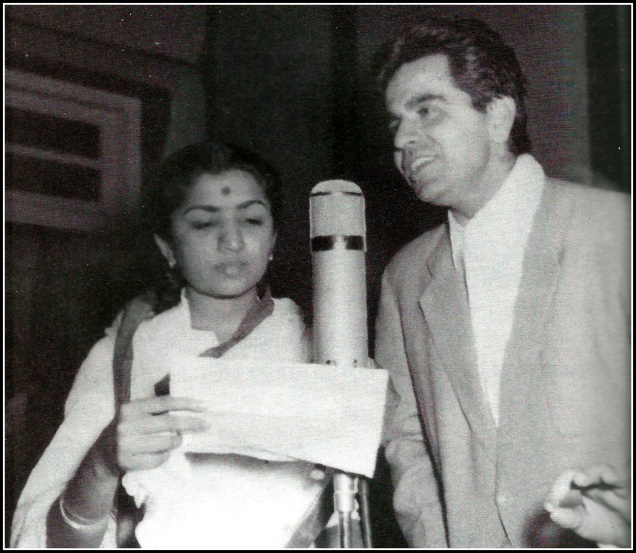
With Lata Mangeshkar at the recording of the song Laagi nahin chhoote ram from Hrishikesh Mukherjee’s Musafir (1957). This was Dilip saab’s only full-fledged attempt at singing in a film
06. In which film produced by Madhubala was Dilip Kumar replaced by Kishore Kumar? All because their personal and professional relationship had taken an ugly turn.
Dhake Ki Malmal (1956).
07. Dilip Kumar and Nutan never worked together in their prime, only later in the ’80s. However, there was one film starring them which was shelved in the ’50s. Identify the film.
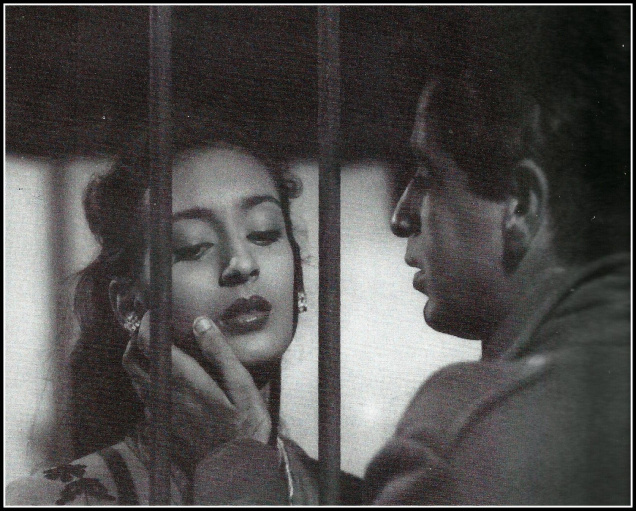
Ramesh Saigal’s Shikwa (1954). In this shelved film, Dilip saab played an undertrial Army officer.
08. Dilip Kumar’s eldest brother Ayub Sarwar started a film starring him in an unusual title role but it never got completed. Which film is it?
Kala Aadmi
And the winner is…
No one! Most people mistook Gopi (1970) to be the film in which Jayalalithaa had been cast opposite Dilip Kumar. No one got all the answers right. The maximum correct responses were six out of eight and they came from: Seshagiri Row Karry (srkarry@yahoo.com), Unnikrishnan Menon (unnikrishnanmenon8@gmail.com), Sowmya Divyanathan (sowmyadivyanathan1980@gmail.com), Kumar Shashi (kushana007@gmail.com), Smitha V. (smithav1986@yahoo.com), Rajeev (rajeevmarcz@rediffmail.com), Sohrab Alam (sohrabalam15@gmail.com), Dhananjay Jha (desiringdj@gmail.com) and Rajeev Malhotra (gm.finance@mriu.edu.in). Congratulations and better luck with our next quiz.
source: http://www.thehindu.com / The Hindu / Home> Opinion> Comment / January 02nd, 2016
Two Chinese have come to the land of Zamorin to find the final resting place of the Chinese explorer who conquered seas through willpower.
The goal of these researchers is to find the grave and the trading points of Zheng He, the explorer who landed in Kozhikode seven times on ships .
They are professor Haiyun Ma, a Chinese descendant who teaches history at Frostburg State University in the US, and Dr Shaojin Chai, a senior researcher at the UAE’s culture ministry .
Zheng He is a hero in China, where students learn about his adventures. They only know that he died in Kozhikode due to sudden illness. Chinese researchers have come to find out if there is anything in Kozhikode that reminds of him .
A Chinese had been buried at Cheenedath mosque in Valiyangadi. Though the team visited the mosque, they could not find anything specific. Haiyun Ma and Shaojin came to Kozhikode with the help of Abbas Panakkal, a fellow at Griffith University, Australia.
english.manoramonline.com
The man who brought Ma Huan
Zheng He, born in 1371, began his travel at the age of 28. He landed in Kozhikode in 1430 with Chinese silk, vessels, jars and fishing nets. He was received by the Zamorin. He returned to China with spices and other goods many times. Over the period, he brought 2,800 Chinese to Kozhikode. One among them was Ma Huan, a historian. It is said that Zheng He even took elephants and horses from here. It is not clear whether Zheng He, a Muslim, was buried on land or at sea .
source: http://www.english.manoramaonline.com / OnManorama / Home> News> Kerala / by Lenin Chandran / Saturday – January 09th, 2015
The top seeds quelled the challenge of German wildcards Angelique Kerber and Andrea Petkovic 7-5, 6-1 in mere 69 minutes.
Hyderabad, TELANGANA :
Sania Mirza and Martina Hingis carried the dominance of 2015 into the new season, winning their sixth consecutive title by lifting the WTA Brisbane trophy, in Brisbane on Saturday.
The top seeds quelled the challenge of German wildcards Angelique Kerber and Andrea Petkovic 7-5, 6-1 in mere 69 minutes.
Sania and Martina, the world number one team, have now stitched a 26-match winning streak together, which has brought them six titles in a row at the US Open, Guangzhou, Wuhan, Beijing, WTA Finals and now here.
It is the longest winning streak since Italians Sara Errani and Roberta Vinci’s 25 in a row in 2012. Sara and Roberta had won five titles in a row.
The top seeds drew the first blood by breaking the rivals in the second game but the joy was short-lived as Kerber and Petkovic reeled off four straight games to take a 4-2 lead in the opening set.
Sania and Martina though were not perturbed, having defused such situations many times in the last few months.
They went about their business calmly and restored the parity with another break.
Soon it was 4-4 and the Indo-Swiss combination held the ninth game, forcing Kerber and Petkovic to serve under pressure and remain alive in the set. The unseeded team though did not crack and stayed solid to make it 5-5.
Kerber and Petkovic again served at 5-6 to stretch it to a tie-breaker but offered two break chances to Sania and Martina and the top seeds obliged on second to nose ahead.
The top seeds controlled the game better in the second set, racing to a 3-0 lead by breaking their rivals in the second game.
It was a cakewalk for them from there, losing only one game before closing the match in their favour.
source: http://www.thehindu.com / The Hindu / Home> Sport> Tennis / PTI / Brisbane – January 09th, 2016
A senior professor and his student occupy a table at Wazir Hotel, off the busy Mohammed Ali Road at crowded Bhendi Bazaar. Over endless cups of tea the professor, a sort of walking encyclopedia on people he met in the past, reminisces about Wazir Hotel’s heyday when it was a favourite haunt of poets, lyricists, musicians, singers and qawwals. Lyricists like Shakil Badayuni, Sahir Ludhianvi and Majrooh Sultanpuri chatted up the music maestro Naushad even as legendary qawwal Aziz Nazan discussed details of his delightful mehfils. And then the professor orders tea yet again but the waiter places two empty cups on the table announcing that the tea is over and the hotel is downing shutters forever. That was in 1986.
This scene from senior Urdu journalist-playwright Saeed Hameed-penned and Mujeeb Khan-directed play ‘Wazir Hotel’ after the long vanished famous eatery is part of Imambada-based Urdu Markaz’s second Bhendi Bazaar Urdu Festival (Jan 8-10). Aimed to revive that fast fading flavor of an era when shairi thrived and culture flourished, the festival celebrates a spirit which today lives in tales and memories.
Many memories will come alive when television actor Neha Sharad reads letters of Safia Akhtar (poet-lyricist Javed Akhtar’s mother) to her husband Jan Nisar Akhtar while ghazal exponent Pooja Gaitonde sings some of Jan Nisar Akhtar’s famous film songs, including the immensely romantic Main tumhi se poochhti hoon mujhe tumse pyaar kyun hai (Black Cat). “This festival dispels many myths and one of them is that Urdu belongs to Muslims alone,” explains Gaitonde.
“The idea is to tell people what Bhendi Bazaar symbolized and can still offer if earnest efforts are made,” says Zubair Azmi, director of Urdu Markaz and the festival. The festival maintains its “secular” character. So, apart from a mushaira featuring non-Muslim poets of Urdu, a discussion titled “Celebrating Urdu” will see non-Muslim intellectuals like Jnanpith Awardee novelist Bhalchandra Nemade and Sudheendra Kulkarni talk about Urdu’s contributions to our celebrated composite culture. “The festival is fast becoming a platform to showcase Bhendi Bazaar’s cultural ethos and promote communal harmony,” says local MLA Amin Patel. While admitting Patel’s “critical facilitation” to host the fest, Azmi agrees with him that the fest needs to be held on a larger scale.
It is not the old-timers alone who will get their antennae recharged through a medley of plays, soirees and singing of Sufi kalams and old Bollywood numbers, but even the young and restless can look forward to fun-filled sessions. “Workshops on drama, fiction, scriptwriting and poetry will engage college students to learning the finer points of these arts,” informs the festival’s reception committee chairman Farid Khan.
source: http://www.timesofindia.indiatimes.com / The Times of India / News Home> City> Mumbai / by Mohammed Wajihuddin / January 03rd, 2016
Javeed Ahmed, a 1984 batch Indian Police Service officer, was appointed DGP after Jagmohan Yadav retired on December 31. (Photo: @ANI_news Twitter handle)
Lucknow, UTTAR PRADESH / Patna, BIHAR :
Javeed Ahmed, a 1984 batch Indian Police Service officer, was on Friday appointed as the director general of police by the Uttar Pradesh government.
Ahmed, who had earlier served as the joint director of the Central Bureau of Investigation during central deputation, was serving as the director general (railways). The post fell vacant after Jagmohan Yadav retired on Thursday.
State principal secretary (home) Debashish Panda said Ahmed will take the charge on Friday.
There was a race among IPS officers for the top post after Yadav’s retirement. The officers played all the cards – caste, religion, loyalty to the ruling party, experience as well as closeness to the family members of the ruling Yadav family – to outdo each other for the coveted post.
No consensus could be reached even after several rounds of meetings. Suspense continued till late on Thursday night as home department officers remained in the office awaiting finalisation of the new DGP.
Sources said since chief minister Akhilesh Yadav was at his native village Safai, it was decided that the name of the new DGP will be announced on Friday.
source: http://www.hindustantimes.com / Hindustan Times / HT Correspondent, Lucknow / January 01st, 2015
Princess Niloufer, the beloved daughter-in-law of the last Nizam of Hyderabad, may have left the city shortly after the Police Action in 1948. But even a good six decades later, she continues to be an enigma that at once intrigues and haunts Hyderabadis. On her centenary year, even as a photo exhibition by Birad Rajaram Yagnik attempts to reveal unknown vignettes of her life, and a documentary film on her is being worked on by historian Arvind Acharya, Hyderabad Times looks back at the dramatic life of the much loved princess of the city of Pearls. Surely, it was nothing short of a movie!
A fairytale set in 19th Century
When Niloufer Farhat Begum Sahiba was born in Istanbul, in January 1916, the Ottoman Empire was already fast crumbling. When she was barely a toddler, the Ottoman surrender was formalised aboard a British warship (October 1918). And by the time she was seven, the 700 year-old empire had officially fallen. In the backdrop of this downfall, the princess had to leave her fairytale life in Istanbul behind, and move to France with her mother in 1924, never to return. aged eight at that time, Niloufer would go on to lead a very ordinary life, learning to read and write French along with Urdu. Her exercise books had her learning about geography of the world. she stuck bits and pieces of the map in separate pages, oblivious to what the future held for her — a future where she would be remembered as the beloved princess of three cities. And yet, hold reign over none.
The romance with Hyderabad
Cut to 1931. In Hyderabad, Mir Osman Ali Khan, the seventh Nizam — also the world’s richest man — was looking for suitable brides for his sons. And that’s how Niloufer, just 15, found herself in Hyderabad. In a grand, royal wedding held in Nice in November 1931, Niloufer married Moazzam Jah, the Nizam’s younger son.
The Nizam had chosen Durru Shehvar (Niloufer’s first cousin) for his elder son — so the shift to a foreign land was less daunting perhaps. Another reason that made Hyderabad feel like home was that the Princess found a father figure in the Nizam. Though known to be officious and keen on protocol otherwise, the Nizam considered Niloufer his daughter. He even let her call him ‘father’. Life in the Hill Fort Palace was grand, Hyderabad was at its cultural peak, and the Princess took on many avatars — fashionista, socialite, philanthropist.
The sartorial queen
Between 1933 and 1948, Niloufer became a fashionista through whom the world got acquainted with Hyderabad. Her sarees, her choice of jewellery, her lifestyle became a talking point. Photographers, especially a crafty portrait photographer, Antony Beauchamp, loved her easy beauty. the international press adored her. Niloufer is credited with adding Parisian grace to the Indian saree. Her sarees were crafted specially for her, by Madhav Das in Mumbai. She loved chiffons and crepes, and wore them often with a broad woven Banaras brocade border. In fact, Mme. Fernande Cecithe, who was originally hired as a midwife for the princess, later created excellent designs to be embroidered on her sarees too. Her wardrobe is still studied by fashion students across the globe and her collection of sarees are now treasured at the New York Institute of Fashion Technology.
The socialite princess with a golden heart
One of the very prominent facets of Niloufer’s social life was the Lady Hydari Club, through which she also initiatied events and dos to raise funds. In 1941, Niloufer decided to organise the staging of a play Ondine (by dramatist Jean Giraudoux) to raise funds for London, which was recuperating from the damages of World War II. She was told by her father-in-law that a princess must not be seen acting in a play. So, her secretary at that time, Fatima Ghani, who would accompany her all the time and therefore even knew the dialogues, took on the princess’ role of a knight-errant Hans von Wittenstein zu Wittenstein.
But it wasn’t until 1949, that Niloufer’s biggest contribution to Hyderabad was going to emerge. When her maid, Rafath Unnisa Begum, died in childbirth, she was so shattered that she decided to ensure that no more such deaths take place. she decided to set up a maternity hospital, which stands today as Niloufer Hospital in Nampally.
The truth behind the glamourous veneer
She was one of the most beautiful women of her time. She was a much loved princess, both at home and overseas. But Niloufer had long learned that the glamour of all this was just that — an eyewash at best. At the heart of it all, there was pain and emptiness. She spent her best years in Hyderabad, craving to experience motherhood — a desire that was never fulfilled.
By this time, Niloufer had already witnessed her first cousin Durru Shehvar give birth to two sons, Prince Mukarram Jah in 1933 and Prince Muffakham Jah in 1939. Her childlessness put much strain on her marriage. In 1948, Moazzam took a second wife, Razia Begum. And by 1951, Niloufer had decided to split from her Hyderabadi commitments.
She moved back to France with her mother. Nice, back then had many members of royalty in exile, allowing Niloufer to still be socially active. As she aged gracefully, her photos from the era show her wearing the string of pearls that her mother had gifted her at birth.
However, irrespective of where she was based, Niloufer never severed her Indian ties. Her friendship with Jawharlal Nehru was one such connection. One of her letters following the assassination of Gandhi read: “Dear Pandit, You have heard and read the cry of so many millions of hearts — you have felt perhaps more than anyone else that great silence that set the void and the loneliness after he (Gandhi) was no more”. The duo continued to stay in touch, Niloufer wrote to Nehru even during the elections and Nehru who was on the road canvasing for the polls, replied, “But I want to tell you that you will always be welcome here whenever you care to come.”
Finding love again
After a good 11 years of being single, Niloufer met Edward Pope and found love once again. In February 1964, she married Pope in the presence of Nawab Ali Yawar Jung who was the Best Man.
Niloufer died in 1989 and was buried in a grave in Bobigny near Paris. The Muslims-only cemetery that is a two-hour drive from Paris not only has her mother resting there, but also all the members of her Seljuk dynasty. Surely, a life as romantic, as magnanimous, and as dramatic as Niloufer’s, deserves to be immortalised.
source: http://www.timesofindia.indiatimes.com / The Times of India / News Home> City> Hyderabad / by Samyuktha K, TNN / January 06th, 2015
Inspiring play by right-out Arbaz Khan, who scored a hat-trick (29th, 50th & 56th) and a goal each by Imran (second minute), Toufeeq (55th) and Usman (69th), helped Lion FC to register facile 6-3 win over Ganesha FC and top Group ‘A’ with 14 points (4 wins & 2 draws) and qualified for the super-league stage in the MDFA ‘B’ Division league for the Govindaraju Memorial Trophy played at the University Grounds here yesterday.
Arbaz Khan continued his fine run in the ‘B’ Division matches and scored his third successive hat-trick in the tournament.
Left-out Amudo scored a brace (4th & 65th), while Yogi (48th) scored the other goal Ganesha FC, who also completed their league engagements with 13 points (4 wins, 1 draw and 1 loss) and finished runner-up in the group.
Asher of Lion FC committed two fouls in the 34th & 55th minutes of the games and received two yellow cards and cannot play the next game for his team.
source: http://www.starofmysore.com / Star of Mysore / Home> Sports News / January 07th, 2015
A well compiled century by left-handed opener V.K. Fahad (104, 4x6s, 6x6s) and useful contributions from Kiran (87), K. Dilip (65) and Syed Zain (61) helped Vidyaranya CC to register a big 216-run win over Jawahars CC in the first round of the KSCA Mysore Zone Sri M. Gopalaswamy Memorial cricket tourney tie played at the Maharaja’s College grounds here on Wednesday.
Batting first, Vidyaranya CC scored 386 for six in 50 overs. In reply, Jawahars CC were restricted to 170 for seven in 50 overs. Faizan (67 n.o.) and Md. Ahmed Sherif (36) were the scorers. Medium-pacer M.G. Naveen took two for 34 for Vidyaranya CC.
Scores
Vidyaranya CC: 386 for 6 in 50 overs (V.K. Fahad 104, Kiran 87, K. Dilip 65, Syed Zain 61, Raghu 2 for 72, Keteshwar 2 for 78) bt Jawahars CC: 170 for 7 in 50 overs (Faizan 67 n.o., Md. Ahmed Sherif 36, M.G. Naveen 2 for 34).
source: http://www.starofmysore.com / Star of Mysore / Home> Sports News / January 07th, 2015
Mangalore University’s A. Dharun broke the men’s 400m hurdles record as he won his second gold at the 76th National inter-university athletics championship at Patiala on Friday. The 19-year-old Tamil Nadu-born Dharun had won the 400m flat on Thursday.
Meanwhile, Bharathiar’s University international Mohammed Salahuddin, son of former international Mohammed Nizamuddin, won the men’s triple jump gold while Mangalore’s K.A. Bharath and Lucknow’s Vijay Laxmi took the men’s and women’s 800m title.
The results: Men: 800m: 1. K.A. Bharath (Mangalore) 1:53.42s, 2. Anand K. Madhu (MGU, Ktm) 1:53.77, 3. Vellayatthevan (Madras) 1:53.83.400m hurdles: 1. A. Dharun (Mangalore) 51.34m NMR, OR 51.51; 2. Jasdeep Singh (Punjabi, Pat.) 52.63, E. Anees Rahman (MGU, Kt3. Mm) 53.58.E.
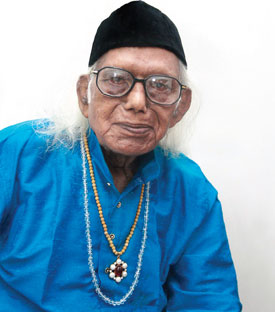
At the age of 104, Ustad Abdul Rashid Khan continues to enthral music lovers across the country with his vocal stamina, virtuosity and lyricism.Vandana Shukla has the honour of meeting the maestro
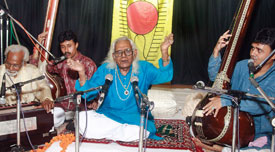
As he is brought to the stage, resplendent in silk kurtaadorned with gold chains, the audience gapes. His age alone makes him a phenomenon worth watching. By the end of his 90-minute recital, they are awestruck—Ustad Abdul Rashid Khan’s gamak taan can make a 25 year-old sulk for want of stamina. But there is no arrogance, only a childlike simplicity when the 104 year-old Ustad removes his black topi and shows us a layer of black hair sprouting from beneath his glorious silver. We wonder about his teeth; after a 100 years, the teeth are said to reappear as well. “The new ones will come only when the old ones fall,” chirps his grandson Bilal Khan, who accompanies him on the tabla.
A direct descendant and proponent of the third son of Miyan Tansen, Surat Sen, Ustad Abdul Rashid Khan sings like autumn leaves surrendered to the winds—in complete abandon. Sitting cross-legged while rendering Puriya Dhanashree, his arms spread like wings, releasing permutations of notes that even connoisseurs find hard to keep track of, floating across labyrinthine octaves. Those who came to the show to satisfy their curiosity about his age now find themselves impelled to stay mesmerised by his artistry. “He enjoys God’s blessings,” says eminent vocalist Pandit Ulhas Kashalkar. “Most vocalists can’t sing beyond the age of 80 years but he still sings with so much power.”
Ustad Abdul Rashid Khan has no concrete answers to offer on his longevity or mastery over music. All he allows us is a glimpse of an amazing mind and soul that live in complete surrender to the Almighty. He is creative like a child, energetic like a young man, and wise like a wizard. Two years ago, while arriving for a concert in Brindavan, he found people greeting each other with ‘Radhe Radhe’. He didn’t have any compositions using the term Radhe, though there were many with references to Krishna. Within 10 minutes of the drive that took him from the hotel to the concert hall, he composed two beautiful bandish.
The amazing vigour that defines Ustad Abdul Rashid Khan’s voice is as remarkable as his mesmerising control over complex notes
He still travels extensively, his concert tours sometimes running for a month at a stretch. We meet him in Chandigarh a day after he has performed at Kamani Auditorium in Delhi; the day before that, he was in Lucknow. In the days ahead, he will go back to Delhi for two consecutive concerts, and then to Varanasi and Allahabad. He attempts an explanation: “When I sing, only God is with me, I do not see anything; I do not do anything; everything is done by Allah!” His faith in the divine was reinforced many years ago. “I was close to
50 when I was given mercury in my food at Khagra in West Bengal,” he recounts. “In those days, when two artists engaged in a duel; one had to lose. The person who lost poisoned me out of envy. I lost my fingers and toes; how my vocal cords were spared was a miracle. I live so that I can sing, and it is His will.”
Ustad refuses to dwell upon what has been lost. “I don’t take any medication. I have only heard of older, and younger, people suffering from diabetes and high blood pressure,” he says with a chuckle. Still, he is a stickler for his routine—he doesn’t eat lunch because it interferes with his namaaz. He compensates with a good breakfast and dinner, which includes chicken, meat and a sweet, preferably rasmalai or gulab jamun.
His appetite for rhythm and rhyme is equally hearty. Gifted with a natural mastery over words—he has penned thousands of verses and compositions under the pen name Rasan Piya—Ford Foundation and ITC Sangeet Research Academy (ITCSRA) have recorded about 2,000 of his compositions for their archives. In the view of Ustad Mashkoor Ali Khan of the Kirana gharana, it is these recordings that enabled the world to learn about Ustad’s talent. “Once people heard him in Kolkata, they realised what a reservoir of knowledge he has,” he says. “It was then that ITCSRA decided to invite him to Kolkata. He has produced many shagird. He is an amazing vocalist; for his age it is no less than a miracle. This apart, he is an extraordinary composer.”
How many of his compositions does the Ustad remember? “Arre baap re!” he chortles. “I don’t remember anything. I just remember Allah.” Hundreds of bandish were, in fact, chewed by a goat, Bilal tells us teasingly and adds, “People plagiarise his compositions; somebody earned thousands of dollars by fusing his Bhairavi composition with French music, and recently I heard a group from Pakistan sing his composition as their own.” With his characteristically naughty smile, Ustad dismisses Bilal and says, “Let them steal; I will compose 10 new ones. Why should I feel sad over such triviality?”
As a child, he was forced by his father to leave kushti (wrestling), his great passion, fearing he might pull a muscle in the neck that might affect his vocal cords. “I had to leave akhada, I could not disobey,” he says. “He was my father and guru. In those days, discipline was foremost and so was obedience. My grandfather Ustad Bade Yusuf Khan was given the stage after 22 years of taleem. We were made to see that each raga had a personality, and you could not disrespect it by hurting its character, by singing it at a wrong time and season.” Those roots continue to nourish him. “Music has been my life and it has given me everything,” he says with candour. “Bismillah Khan, whom I revere, once asked violinist Dr M Rajam, who was heading the music department at Benaras Hindu University, to wait till he arrived. He wanted to hear my concert.” This is something he misses today, the paucity of good listeners who truly appreciated the value of music.
Does he, then, worry that the tradition is being diluted? “No,” he replies firmly. “There are organisations like ITCSRA, Devi Foundation and SPICMACAY [Society for the Promotion of Indian Classical Music and Culture Among Youth] that are doing a lot to save this tradition.” Part of this effort is to embrace change. For instance, girls were not taught music in his gharana—he deprived his own daughters of musical training—and his sons grew up to become contractors. But today, Ustad is proud of his female disciples, who include Rupali Kulkarni, Pampa Banerjee and Shashi Tripathi. “I was nine when Baba started teaching me,” recalls Kulkarni, a station director with Vividh Bharati. “He was as loving as a father while being an exacting teacher. He would get mejalebi, yet lay a lot of emphasis on varjish [exercise], telling me that controlling one’s breath and singing require a lot of stamina. He composed such difficult yet beautiful compositions for me.”
Ustad’s grandson Asad Ali Khan is equally fulsome in his praise—he is the only grandchild that Ustad has trained vocally and lives and travels with him, like Bilal. “In my opinion, there is no teacher in India more knowledgeable than Baba,” he says in a tone that borders on reverence. “He is my Baba; at the same time, he is the best teacher one could have. He never gave me special treatment and treated me like any other disciple. He never loses his temper, yet he makes us do what he wants. He is also fun to be with.”
Ustad too revels in the company of his disciples, particularly when they tour together for concerts. He speaks to them well into the night, not letting them sleep! “Why waste the night sleeping when there is so much to say and sing?” he wonders. When he is not on the road, he teaches music at Kolkata ITCSRA from 11 am to 4 pm. Ustad’s memory remains as active as the maestro himself. He still remembers all his students (past and present), the names of his 15 grandchildren, who all live in Rae Bareilly, and all the dates and places of significance to his life. He is reticent, though, on the subject of his wife—he lost her when his children were young and he appears to have drawn a gentle veil over that chapter. Indeed, setbacks or successes, the Ustad has handled them all with consummate dignity—and faith. As he tells us, “Himmat… sirf himmat se hi safar tay hota hai, aur himmat voh deta hai. (Only courage takes you along, and courage comes with His grace).
Featured in Harmony Magazine
December 2010
source: http://www.harmonyindia.org / Harmony India.org / Home> H People> Diary 100 / Featured in Harmony – Celebrate Age magazine, December 2010