A 110 year-old doctor

Kolkata, WEST BENGAL :

Repository of the ancient wisdom of Unani medicine, 110 year-old Syed Mohammed Sharfuddin Quadri lives a Spartan and frugal life that has worked wonders for him, as Partha Mukherjee discovers

DrSharfuddinMPOs01jan2016

Almost 55 years ago, while I was journeying through a field in a cart, I caught sight of an old towering neem tree, immersed in soundless symphony with a swarm of fireflies. Barely five years old then, I didn’t know that the silhouette of a tree in hushed twilight silence would be a metaphor for a man around whom the sparkle of life never dims, even when ‘night’ tiptoes into his life.

Syed Mohammed Sharfuddin Quadri is famous for treating India’s first president Rajendra Prasad in Gaya in 1942-43 for breathlessness. Fondly known as Hakim saab, he has a photographic memory, sense of humour, never-say-die spirit and, above all, energy that never runs out. On 25 December 2011, he will turn 110. Yet he works for 17 hours at a stretch, preparing concoctions from dry fruits, herbs and roots and advising close to 100 patients (free of cost) every day. At 5 pm, every day through the year, Hakim saab attends to his patients at his Wellesley Square clinic in central Kolkata as well as those in the US. “Abba has patients all over America,” says his 40 year-old son Mohammed Sadique, who assists Quadri in his clinic. “He gives instructions to them over email or through a video conference. Earlier, he used to go to California, Los Angeles and New York, but now he’s restricted because of his gout.”

Sharfuddin Quadri answers all questions, except those about his achievements. Founder of the Unani Medical College and Hospital in Kolkata, Quadri published a magazine titled Hikmat-e-Bangala (Hikmat means Unani medicine) in 1959, which folded up soon for lack of funds. “Success means how much one has been able to help others,” he says, adding that he does honour the Padma Bhushan he was awarded by the President in 2007. He brings out the medal attached to his pocket by a silk ribbon. “I carry it to show my respect to the recognition of Unani treatment. Though I would be happier if I were given a grant so I could at least cover the place with a shed where my patients wait.” Indeed, patients wait for him for hours, sometimes till midnight, even in the rains. “There is no help from the government to collect herbs at a reasonable price,” adds Mohammed Sadique, Quadri’s youngest son (he has six siblings) who assists his father. “Sometime Abba is so frustrated that he thinks of giving up. If medicines aren’t available what is the use of continuing the treatment?”

From a family of hakim in the remote village of Kumrava in Nawada district of Bihar, Quadri trained in Unani treatment from Shafakhana Darsgah Tibbia (Gaya) in 1930. After immersing himself in the freedom movement, he started his practice in Calcutta where his family shifted in 1935-36. “Herbal medicines have a magical effect on our body; besides they have no side-effects,” he says sipping neem juice. If diagnosed, every disease responds to Unani treatment, Quadri claims, adding that with medication one must strictly follow instructions on diet and lifestyle as well. “During the diagnosis, one has to study the dam [blood], balgham [phlegm], safra[yellow bile], and sauda [black bile] of the patient [just like kapha, vata and pitta, the three dosha in Ayurveda], as they are the roots of all diseases,” he explains. “Anyone with any sort of ailment definitely has an abnormality in one of these.”

DrSharfuddinMPOs02jan2016

As for his own frugal diet—neem juice and half a piece of bread—he says, “The less you eat the more you live; the more you eat, the more you court ailments and health hazards. And to lead a healthy life you should have a healthy mind. My father lived to be 122 and never allowed any ignoble thought to cross his mind.”

How does he keep himself so physically fit even at 110? “I never sleep at night; I read books on Unani medicine when others are fast asleep. In the calm of the night, I try to explore things I don’t know about and let them melt into my inner self.” Unani medicine, he says, actually has its roots in Greece following extensive research by Hippocrates (460-377 BC). “It was he who laid the foundation of clinical medicine based on diet and symptoms.” He adds that a number of Greek scholars after Hippocrates—Galen (131-200 AD) followed by Arab physicians Rhazes (850-932 AD) and Avicenna (980-1037 AD)—enriched the system considerably. Rhazes and Avicenna authored Al-Hawi and Al-Qanun respectively, which were later translated into Latin and other European languages and taught in medieval European universities. They are said to have influenced western medical thought.

Unani medicine disappeared from the country of its origin, but found roots in India through Arab traders long before the Mughals. The Khiljis, Tughlaqs and Mughal emperors provided state patronage to Unani scholars and employed many as court physicians. The British imposed strict restrictions on every form of treatment but allopathy. Despite suspension of aid to Unani institutions, the system survived owing to the commitment ofhakim like Ajmal Khan, who served as the president of Indian National Congress in 1921—the Unani physician and scholar founded the Ayurvedic and Unani Medical College in Delhi.

Quadri reads till 4 am, when the city wakes up to fight for the day. “After my daily ablutions, I go to the mosque for namaz which involves many a yogic mudra—I do each of them,” he shares. “I walk back home at 5 am and sleep till 9, after which I go to my clinic. There’s no time to waste till 5 pm, when I go to the clinic, which I believe is the key to my fitness.”

Sharfuddin Quadri thanks his health for having been witness to an eventful century. The Dandi March with Mahatma Gandhi, confinement in Cuttack Jail and a memorable encounter with Maulana Abul Kalam Azad. “In 1943-44, in Ramgarh—then in Hazaribagh and now in Jharkhand—Maulana Azad was addressing the people and suddenly the skies opened up in a heavy downpur making everyone rush for sheds. Azad roared, ‘You are so scared of raindrops, what will happen when the British will rain bombs and bullets on you?’ And then no one moved even an inch.”

Finding his shadow lengthen by the day, Sharfuddin Quadri remembers Rabindranath Tagore through his lines and a brief meeting in 1912: Moron jedin diner seshe asbe tomar duare/sedin tumi kee dhan debe uhare?(When Death will knock at your door at the end of the day/What will you offer him as a gift?) “I wonder what I will be ready with to welcome the inevitable,” he signs off.

Featured in Harmony – Celebrate Age Magazine
July 2011

source: http://www.harmonyindia.org / Harmony India.org /  Home> H People> Diary 100 / Featured in Harmony – Celebrate Age magazine, July 2011

Alleging ‘victimisation’, Dalit IAS officer applies for VRS, converts to Islam

Jaipur, RAJASTHAN :

RSRTC Chairperson Umrao Salodiya at press confrence where announced his decision to convert to Islam and apply for VRS from service, in Jaipur on Thursday. Photo: Rohit Jain Paras / The Hindu

After being denied the promotion that would make him the State’s Chief Secretary, senior IAS officer Umrao Salodia, a 1978 batch IAS officer from the Dalit community, on Thursday, appealed to Chief Minister Vasundhara Raje for Voluntary Retirement. Mr. Salodia, who alleged the Raje government of “victimising him on the basis of caste” also converted to Islam, on Thursday.

In a letter addressed to Ms. Raje, Mr. Salodia wrote: “For the first time after independence of the country, myself, an IAS officer from the SC/ST category would have been appointed today [on Thursday] as Chief Secretary [of Rajasthan] on the basis of seniority.”

In the letter, Mr. Salodia alleged that the current Chief Secretary C.S. Rajan was given a three-month extension, till March next year, to deny him the opportunity of becoming Rajasthan’s Chief Secretary.

“I hereby apply for Voluntary Retirement by giving a three-month notice under the All India Service Rules,” Mr. Salodia stated in the letter, adding that he must be granted the Voluntary Retirement as he did not wish to work under a junior officer.

In another drastic step, Mr. Salodia converted to Islam, on Thursday. While addressing the media he said that he believed in the equality that Islam, unlike Hinduism which discriminates on the basis of caste, offered to all its followers. “After conversion my name is Umrao Khan,” he said.

BJP dismisses claims

Rajasthan Parliamentary Affairs Minister Rajendra Rathore dismissed Mr Salodia’s claims. Addressing the media, on Thursday, Mr Rathore said that Mr Salodia had acted in violation of the law as he spoke against the government. “Mr Salodia’s allegations are baseless. Had the government discriminated on the basis of caste, the Rajasthan Assembly Speaker [Kailash Meghwal] would not be from the SC/ST community.”

“The government will get the matter investigated and will take a disciplinary action against Mr Salodia based on the results of the investigation,” Mr. Rathore said.

Congress condemns BJP govt

Condemning the Bharatiya Janata Party government in Rajasthan for “acts of discrimination against the Dalits”, Rajasthan Pradesh Congress Committee president Sachin Pilot said, “Mr Salodia’s appeal for Voluntary Retirement has put the working of the BJP government [in Rajasthan] under question. Also, it is tragic that the indifference of the BJP government led the senior officer to convert to Islam.”

Mr. Pilot added that Mr Salodia’s reaction is an expression of the increasing acts of discrimination against the Dalits in the State.

Mr Salodia, a 1978 batch IAS officer from Rajasthan cadre, is the Chairman of Rajasthan State Road Transport Corporation (RSRTC).

source:  http://www.thehindu.com / The Hindu / Home> National> Other States / by Kavita Upadhayay / Jaipur – December 31st, 2015

The spinner’s end

djHassanMPOs01jan2016

Bangalore , KARNATAKA :

DJ Hassan has been spinning magic since 2008. A remixer, producer, harmony-arranger and DJ trainer since seven years, Hassan has mastered his music in genres like house and electro Bollywood.

Though he started his journey by learning to spin hip-hop tracks, he is now devoting his time completely to Bollywood. A common name at club gigs and private events, DJ Hassan is known for belting out chartbusters and has his aces up his sleeve from ‘Desi Girl’ to ‘Dabangg’.

He is also a feted DJ internationally, in many places including Doha, Dubai and Sri Lanka.

How did 2015 treat you in the realm of music?
It was a great year for me. I went places and played all across the country. I mainly played at major parties. My biggest event was playing at a private party, where about 3000 people enjoyed the tunes that I spun.

What are you looking forward to in 2016?
All my shows. I plan everything two months in advance so I know that in the end, it will turn out great.

What’s the scenario like for young DJs entering the scene?
The younger lot have to struggle for about four years to survive in the market. Only then, they can establish themselves. Most people think that they can get by in DJing with high-end laptops and expensive mixers but without talent and hard work, they won’t be able to make a name for themselves in the industry.

Comment on the music scene in the City.
There is a lot of space to co-exist. People are extremely open-minded about classical, fusion, Western and Bollywood in Bengaluru.

There are also newer genres coming up by the day as youngsters listen to different kinds of music, travel more and are aware of world music. The crowd is the ‘shuffling’ sorts, who don’t stay in one place and have different influences in music, which is good for musicians and bands to experiment.

Álthough you started with hip-hop tracks and then moved to Bollywood, you are often considered as a Bollywood DJ. What is it that connects you to Bollywood music?
The sheer universality of the genre. It has a certain depth and is a genre that will stay on. At the end of the day, everyone wants to go back home and listen to Bollywood music.

The future of the DJ industry?
The youngsters are spoiling the market by accepting small-budget shows. They also don’t know how to attract the crowd in this industry. They should learn to stay true to themselves and their talent.

Your plans for the New Year?
I’m welcoming 2016 by playing an exclusive set on December 31 at Sutra, Lalit Ashok.

Any New Year resolutions?
I will get to know only in 2016.

source:  http://www.deccanherald.com / Deccan Herald / Home> Supplements> MetroLife / by Anushka Sivakumar, DHNS / December 31st, 2015

117 Muslim meritorious students from across India felicitated, AFMI Bhopal convention concludes

Bhopal,  MADHYA PRADESH :

[Topper meritorious students with their medals, Certificates of Excellence and scholarship cheques posing with MP Chief Minister and other dignitaries]
[Topper meritorious students with their medals, Certificates of Excellence and scholarship cheques posing with MP Chief Minister and other dignitaries]
Bhopal:

Madhya Pradesh Chief Minister Shivraj Singh Chouhan seeing in flesh and blood the rich crop of talent in Muslims on parade when meritorious students from all over India, which had amongst them a 100 per cent achiever in Higher Secondary Board examination, were being felicitated was so much overwhelmed and elated that when addressing the gathering he expressed his delight and pleasure in an unambiguous manner.

Chief Minister Chouhan, who was floored at the spectacle of overflowing talent in Muslim students, spontaneously announced Rs.10,000/- each honorarium for all the 117 meritorious students in the country who were to be feted by AFMI (American Federation of Muslims of Indian Origin).

The occasion was the inaugural function on the opening day of the two-day 24th International Convention on Education and Gala Award Programme of AFMI (American Federation of Muslims of Indian Origin), which concluded here on December 27, 2015 in the central Indian state capital Bhopal, in the walled city at Four Seasons Lawn, Ahmadabad Palace.

The 2-day convention on December 26-27 was held under the aegis of Association of Indian Muslims (AIM) Bhopal. Next year it will be the Silver Jubilee celebrations of AFMI and the 25th International Convention on Education and Gala Award Programme would be held in New Delhi in the last week of December 2016.

100 pc Achiever Saima Rasheed
Amongst the meritorious students was Saima Rasheed, with unique achievement of having garnered 100 per cent marks in Std. XII in Punjab Higher Secondary Board examination 2015. The topper, who aspires to become an IAS officer, was the cynosure of all eyes at the felicitation programme. She gave all credit to her parents and teachers who guided her to achieve this great success. She received a gold medal, Certificate of Excellence and a special cheque of Rs.10,000/ on the occasion to a thunderous applause.

The AFMI had selected 117 talented students for felicitation during the two day convention from 22 states viz. Andhra Pradesh, Uttar Pradesh, Punjab, New Delhi, Gujarat, Odisha, Telangana, Tamil Nadu, West Bengal, Maharashtra, Rajasthan, Chhattisgarh, Jharkhand, Assam, Bihar, Kerala, Karnataka, Jammu-Kashmir, Manipur, Uttarakhand, Haryana and Madhya Pradesh. All the students were honoured with gold, silver and bronze medals along with Certificate of Excellence and scholarships as per their performance in the X and XII Board examinations.

Local MLA Syed Arif Aqeel, Vice Chancellor of Bhoj Open University Dr. Tariq Zafar, former Vice Chancellor of Aligarh Muslim University Padma Shri Dr. Mahmood-ur-Rehman (IAS retd.), convocation’s Chairman Owais Arab, parents of meritorious students and distinguished citizens attended the function. While the Chancellor of Maulana Azad National Urdu University, (MANUU) Zafar Sareshwala, who was to be guest of honour, was conspicuous by his absence on the occasion.

Speaking as chief guest on the first day Chouhan said that education builds human beings. Education is very necessary. The Madhya Pradesh Government has provided necessary assistance and facilities in education sector without any discrimination. Scholarship schemes have been implemented for poor students belonging to minorities, weaker section and general category. The scholarships are being given to 1,60,000 students in the state. Economic assistance worth Rs.15 lakh is also being provided for study in foreign countries. Cycles are given free of cost to students who go outside village to study. The students who are not able to get benefits of these schemes are provided higher education loans on guarantee of state government, he added.

He said girl students securing over 60 per cent marks in examinations are given benefit of “Gaon Ki Beti” scheme. Earlier, only a couple of students used to get selected in prestigious national institutes, this year 1700 students of the state have achieved this distinction through proper guidance and extension of facilities.

Souvenir released
Turning philosophical, Chouhan said that life becomes meaningless without brotherhood. India has given message of love and brotherhood. Everyone is respected and loved in India. He said that “Mazhab NaheeN Sikhata Aapas Mein Bair Rakhna, Hindi HaiN Hum Watan Hai HindostaN Hamara”. Therefore, festivals of all religions are held at Chief Minister’s House with utmost joy, fervour and honour. The Chief Minister released a souvenir “Clarion The Unity” on the occasion.

Dr. Mahmood-ur-Rehman, a retired IAS and former Vice Chancellor of Aligarh Muslim University (1995-2000), who presided over the inaugural function, stressed to provide quality education to Muslim children and youth not just for jobs alone but to mould their character in their formative age so as to become responsible citizens. He expressed concern over the fact that Muslim students are unable to go to good schools due to prevailing poverty in the community and as such are devoid of quality education.

He lamented over the fact that only about 2.5 per cent of Muslims population appear in the IAS and allied services examinations and as such their selection in these prestigious services is also in the same minimal ratio. If percentage of participation in these examinations is high then their selection would also increase and thereby give the community the much needed self confidence and then it can hope to look up and not be looed down upon, he added.

[Saima Rasheed, who accomplished unique achievement of having garnered 100 per cent marks in Std. XII in Punjab Higher Secondary Board examination 2015, being presented gold medal, Certificate of Excellence and a special cheque of Rs. 10,000/- by Madhya Pradesh Chief Minister Shivraj Singh Chouhan at the AFMI Internation Convention in Bhopal.]
[Saima Rasheed, who accomplished unique achievement of having garnered 100 per cent marks in Std. XII in Punjab Higher Secondary Board examination 2015, being presented gold medal, Certificate of Excellence and a special cheque of Rs. 10,000/- by Madhya Pradesh Chief Minister Shivraj Singh Chouhan at the AFMI Internation Convention in Bhopal.]
Dr. AS Nakadar, the founding trustee of AFMI, welcomed the Chief Minister and other distinguished guests present on the occasion. He thanked Owais Arab, president of AIM, who was the chairman of organising committee, and his entire team of dedicated volunteer force and Aziz Bhai of AFMI office in Gujarat.

Dr. Nakadar, who is an alumna of Bhopal-based Gandhi Medical College, informed that the first medals were awarded by AFMI in 1993, with a modest start of 46 students who had demonstrated high academic achievement from five different states. Beginning was then made by rewarding students securing over 90 percent marks. As this practice of awarding meritorious students of Board examinations continued the cut off percentage continued to increase over the years with percentage of marks even as high as 99.9. However, this year it has been has been unique when a Muslim girl from Punjab Board scored cent per cent marks. AFMI will take care of entire education of this girl’s education, he declared.

He pointed out that analysis shows that competition has become so keen that the difference of marks between a gold medallist and a silver medallist is hardly 0.1 per cent (1/10th of 1 per cent) and in some states students receiving 96 per cent don’t even get a bronze medal. Motivation theory recognizes the importance of extrinsic motivation from rewards and recognition for performance. Accordingly, this leads us to believe that an award system encourages students to be more competitive and, therefore, perform better at the exams. Hence, it is reasonable to conclude that AFMI’s medal program has contributed positively to student achievement at the Board Exams, he added.

Turning his attention to the meritorious Muslim students on the occasion Dr. Nakadar said: “We are honoured in celebrating your achievements. You are joy, pride and our future. Don’t think what you are but think what you want to be”.

Be bold and courageous
Dr. Nakadar advised students not to be intimidated but to be bold and courageous in solving the problems in life. When you enter into real life you will realise that real life is not what you learnt in the college. It is tough and merciless. In real life you will face different kinds of multiple problems. Meet these problems with courage, compassion, love and hope.

Continuing, he urged students not be afraid of these problems. Discard fear because it is your worst enemy. There are various kinds of fears you will come across. Fear of what you are; Fear of your beliefs; Fear of failures; Fear of rejection, Fear of not knowing what is next and so on.

To conquer all these fears remember one cardinal principal: Refuse to be afraid and meet these problems and challenges with courage, Dr. Nakadar opined. He said: “Be positive in your approach and towards life if you do that then be rest assured you will conquer peaks after peaks”.

Talking to the assemblage Dr. Nakadar said it is our duty to see India not only survives but gets to the top of the world by adhering to the principles of pluralism, justice and equality. “We know that pluralism is the Achilles Heel of our society’s foundation. And it is this ethos that has led our social, economic and political progress in a democratic setup. We must adhere to this ethos and propagate it. Our fight is an intellectual fight and for this we need to empower ourselves with quality education”, he remarked.

India which is Bharat, he cautioned, is going through a very difficult period and some people in Bharat and the West have questioned the survival of Bharat’s beautiful pluralistic mosaic. “Remember, you are a vital part of Bharat and make sure that the vital part is not weak. If you are weak, then you weaken the whole body of Bharat. It is the duty of all of us to see that Bharat prospers”, Dr. Nakadar concluded.

On the second day of the convention Prof. Akhtar-ul-Wasey, National Commissioner for Linguistic Minorities, New Delhi, who presided over the inaugural function, lauded the efforts of AFMI for nearly two-and-half decades to banish illiteracy from the Muslim Ummah and uplift it educationally so that it is at par with others in all walks of life. He praised the dedication and sincerity of Dr. Nakadar and his entire team leaving no stone unturned to achieve their target.

Prof. Wasey reminded that there is no differentiation between “Deen and Duniya” (Religion & worldly affairs) in Islam as both are entwined together and are complimentary to each other. A perfect balance between spirituality and materialism is the key to success to life here and Hereafter which the Almighty has ordained, he pointed out.

During the two days lectures on Emerging Trends in Academic Fields were delivered. The speakers and their topics were: 1. Ayub Khan (Toronto-Canada), on “Technology and Internet Resources for students”; 2. Dr. Hussain Nagamia (Tampa-Florida-USA), on “Emerging Trends in medical education”; 3. Er. Shafi Lokhandwala, (Livonia-MI-USA), on “Emerging trends in Technological field”; 4. Dr. Khutbuddin, (Indianapolis-Indiana-USA), on “Psychological strategies for youths to achieve goals” and 5. Ali Qureshi (Albuquerqui-NM-USA) on “Progressive way on Model education with limited resources”.

Wing Commander (Rtd.) Dr. Ashraf, Dr. Mohsin U Khan of Zaheer Science Foundation-(New Delhi); Mrs. Darakshan Khan (Chicago-IL-USA); Mrs. Husena Ponawala (NY-NY—USA); Siraj Thakore (Toronto-ON-Canada); Tayeb Poonawala (NY-NY-USA); Afroz Ahmed, Member (Environmental and Rehabilitation) Narmada Control Authority, Shameem Tariq from Mumbai etc. also addressed the gathering with a focus on students to motivate them to unravel their hidden talent and achieve great heights in life.
Prof. (Mrs.) Tahira Abbasi spoke about the aims and objects of Association of Indian Muslims, (AIM), which hosted the function, and its activities over the years.

The two-day programme was compeered jointly by Dr. Afaq Nadeem, Lecturer in CTE of MANUU, and Mrs. Rushda Aejaz with aplomb. (pervezbari@yahoo.co.in)

source:  http://www.ummid.com / Ummid.com / Home> Education & Career / by Pervez Bari, ummid.com / Thursday – December 31st, 2015

Gandhian Hakim Quadri passes away at 114

Kolkata , WEST BENGAL :

He accompanied Mahatma Gandhi on his Dandi March and later spent several days with him in a prison in Cuttack. In 2007, he was conferred with the Padma Bhushan for his fight against the British in the freedom movement.

Late on Monday night, Syed Mohammad Sharfuddin Quadri, who was affectionately referred to as hakim sahab, passed away three days after celebrating his 114th birthday. His family had moved to `Calcutta’ in the mid-1930s.

Quadri, a renowned Unani practitioner, who was instrumental in founding the Unani Medical College and Hospital in Abdul Halim Lane in central Kolkata, was born on December 25, in 1901 when Kolkata was still the capital of the country and Mahatma Gandhi had not returned to India.

“My father was imprisoned with Gandhiji by the British in Cuttack. He would accompany him everywhere during the Civil Disobedi ence Movement,” said son Manzar Sadique in the family’s home in 849 Rippon Street. “In October, abba had travelled to Lucknow where he was the chief guest at a conference of Unani practitioners. Chief minister Ak hilesh Yadav had invited him over to his house,” in forms Sadique.

Hakimji He began his day with Fajar (the morning namaaz) at the break of dawn followed by his visit to his chamber, Swadeshi dawakhana on Haji Mohammed Mohsin Square, where patients would already be waiting for him. He would examine more than 100 patients everyday at free of cost, says son Sadique.

The centurion who specialized in treating infertility would never miss his customary walk after work. “He suffered from arthritis which is why he took special care of his fitness,” said Quadri’s son.

Hakim told his followers that he learned the secret to remain fit from his father who lived till 121.

source:  http://www.timesofindia.indiatimes.com / The Times of India / News Home>  City> Kolkata / by Zeeshan Javed, TNN / December 31st, 2015

Meet Swimming Champ Moin Junnedi, The Boy With Over 100 Broken Bones and a Will of Steel

Image courtesy: Facebook

Belgaum, KARNATAKA  :

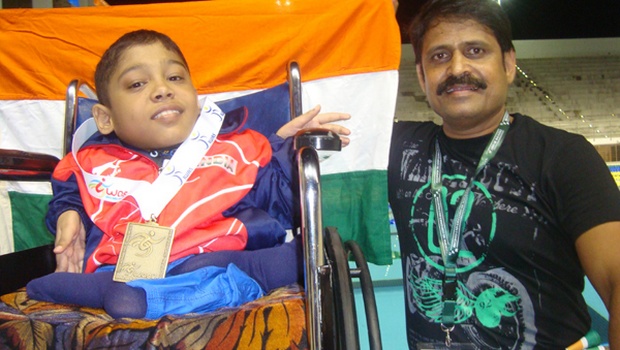
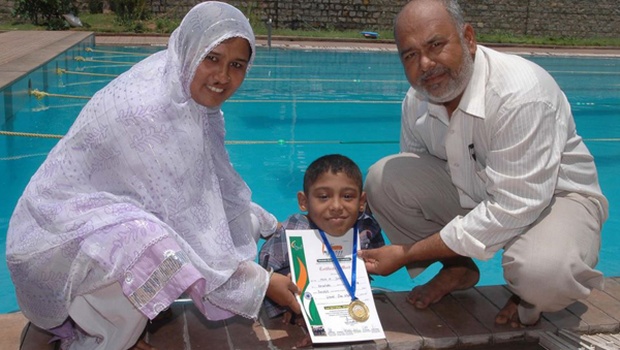
Moin Junnedi, is not your average 18-year-old, he has won seven national gold medals and one international level in para swimming competitions.

Moin suffers from osteogenesis imperfect, a brittle bone disease which makes him prone to fractures. Nevertheless, he has a will of steel that inspires every one of us. The Karnataka government honoured him on World Disability Day.

Moin’s daily struggles include that he cannot eat with his hands as both of them are turned backwards. His legs are weak and fused together. Initially, Kausar, Moin’s mother lost all hope after knowing his incurable disease, but the lost hope was recovered thanks to Umesh Kalaghatag. Umesh is a swimming coach for the disabled.

Image courtesy: Facebook

‘One should learn to never give up, no matter what the situation is. I do not feel I am disabled or have any sort of shortcoming. I love swimming and I want to be the best swimmer in the world,’ says, a visibly enthusiastic Moin.

He trained Moin for the past seven years which made him win a lot of laurels for our country.

Image courtesy: Facebook

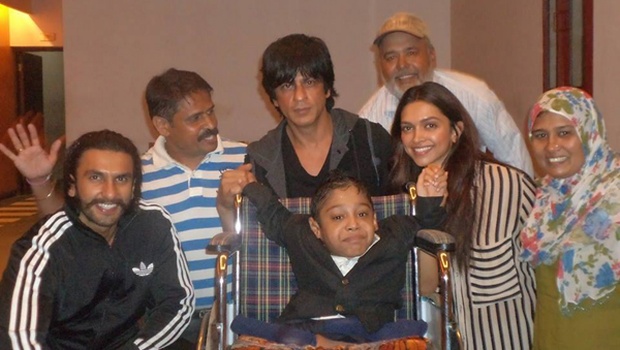
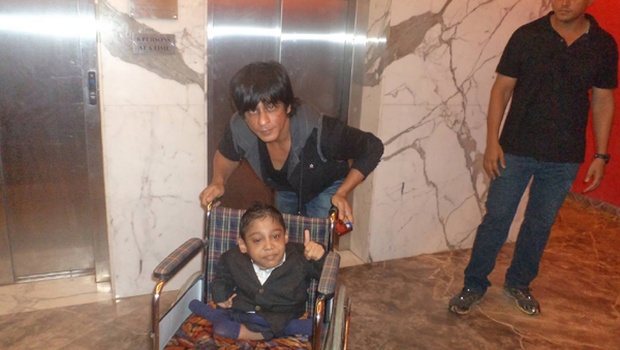
Moin is also a hardcore fan of Shah Rukh Khan and even the Bollywood Baadshah met the boy and spend time with him.

Image courtesy: Facebook

Mushtaque Junnedi his father told Times of India, “We never felt ever that Moin is disabled and never imagine house without him. He is a friend, elder and motivational force to everybody in home. All this happened thanks to his coach Umesh Kalaghatagi.”

source: http://www.newindianexpress.com / The New Indian Express / Home> Nation / by Online Desk / December 30th, 2015

SYNCRETIC TALES – Why Mumbai police detectives are lining up at the tomb of a 14th-century Sufi saint this week

Mumbai, MAHARASHTRA :

Makhdum Ali Mahimi, who is buried in the popular Mahim dargah, is the patron saint of the city police.

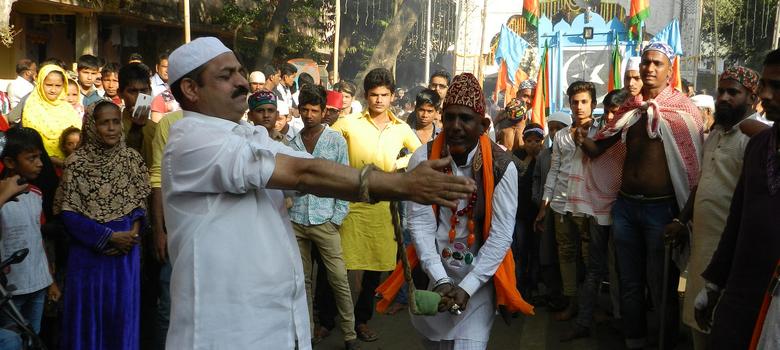
A constable in plain clothes holds his arms out to be whipped.

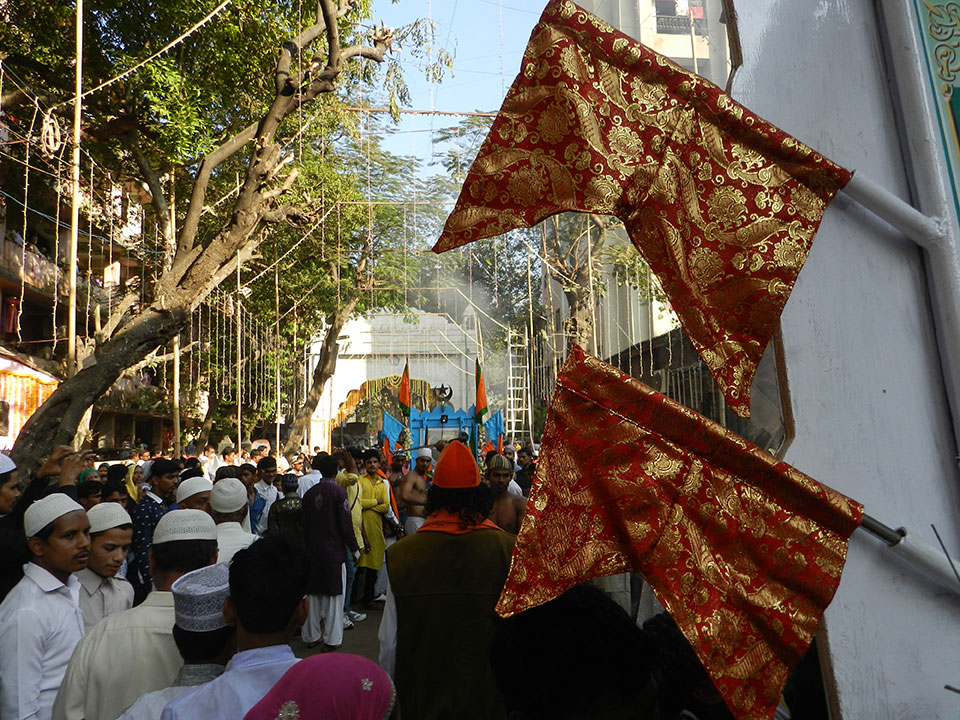
The Mumbai police was out in full force on Friday to mark the first day of the Urs or death anniversary of Makhdum Ali Mahimi, the man to whom the famous Mahim dargah in the central part of the city is dedicated.

Makhdum Ali Mahimi was a 14th-century Sufi scholar remarkable in many ways, but perhaps the most remarkable is that he happens to have been the patron saint of the Mumbai police since its roots as a citizen’s militia in the 17th century.

Once a year on Mahimi’s Urs, thousands from around the city, not least the Mumbai police force, come to pay their respects and seek his blessings. The Mumbai police force has the privilege of laying the first chadar, or decorative tomb covering, of the Urs in Mahimi’s respect.

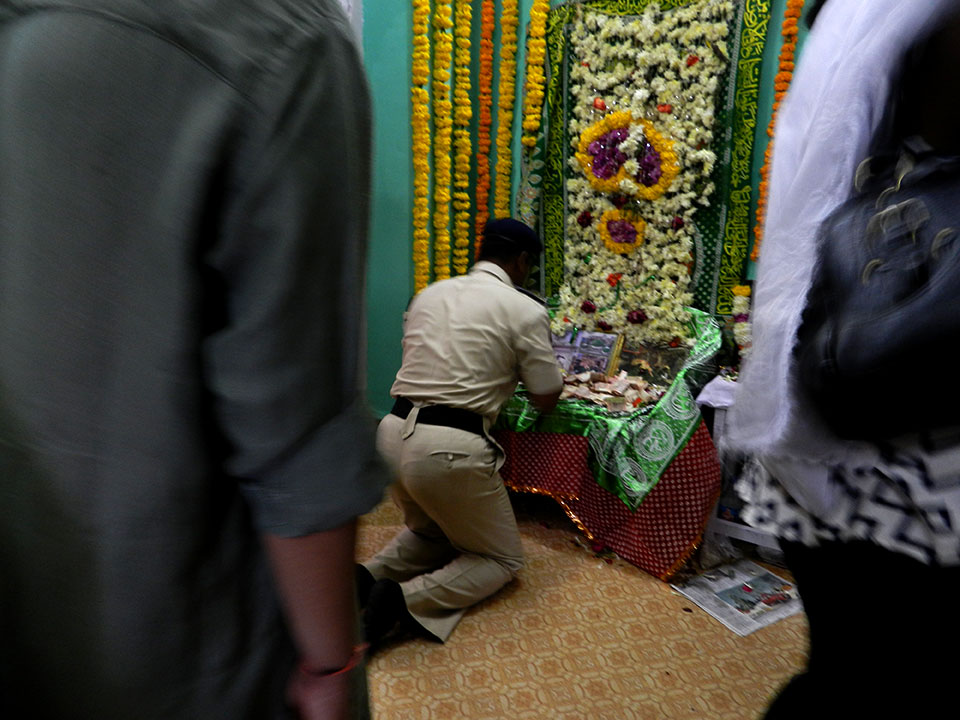
The Mahim police station, about 200 metres away from the dargah, has been built on the site where Mahimi is said to have lived. A green steel cupboard in the Senior Inspector’s room is said to contains the saint’s possessions. During the ten days of the fair held each year to honour Mahimi, the office is thrown open for devotees.

“The full Mumbai police follows Makhdumi Baba,” said Basheer Baba, 55, who is among the dargah officials overseeing the festivities. “Nobody can break that bond. There should be more chances like this of Hindu-Muslim love.”

In the rooom that holds Mahimi's possessions
In the rooom that holds Mahimi’s possessions

An ancient tradition

On hearing that a journalist was in the vicinity, a series of constables in festive plain clothes ushered this reporter in to a small building off the main compound where the retired senior police inspector organising festivities this year, sat with his team of ten constables.

“I was in the papers today,” the inspector said, taking a small, neatly folded rectangle of paper out of his pocket. “See, that’s my name, LB Shaikh.”

Shaikh, as the Times of India said in its three-paragraph note of the procession’s timings, happened to join the police force in 1979 on the very day of Mahimi’s urs. His first posting was at the Mahim police station. This, he said, gave him a special attachment to the holy man.

“He was not a saint – he was our guide,” Shaikh said. “He was a very scholar person, a spiritual and qualified man. Police used to take advice for unsolved cases and he would help us. This is a long tradition of 500 years.”

Makhdum3MPOs30dec2015

Scholar and judge

It is in fact slightly longer than that. Mahimi is thought to have died in 1431, 584 years ago. He was born in 1372 to a family of intellectually inclined Arab immigrants called nawaits. He lived in Mahim his entire life.

Abdus Sattar Dalvi, in a brief history of the Mahim Dargah which is dedicated to Mahimi, writes:

“The figure of Makhdum Ali Mahimi has commanded respect for his unquestioned devotion to his mother, his generosity, his liberal outlook, and his achievements as a Sufi and a scholar.”

As a spiritual and intellectual person, he became a member of an unaffiliated group of Sufis called Uwaysi. He was also renowned for his scholarship, particularly for an early incisive commentary in Arabic on the Quran. Mahimi’s legal excellence, Dalvi notes, was such that Sultan Ahmad Shah of Gujarat made him a qazi for the Muslims of Thana district.

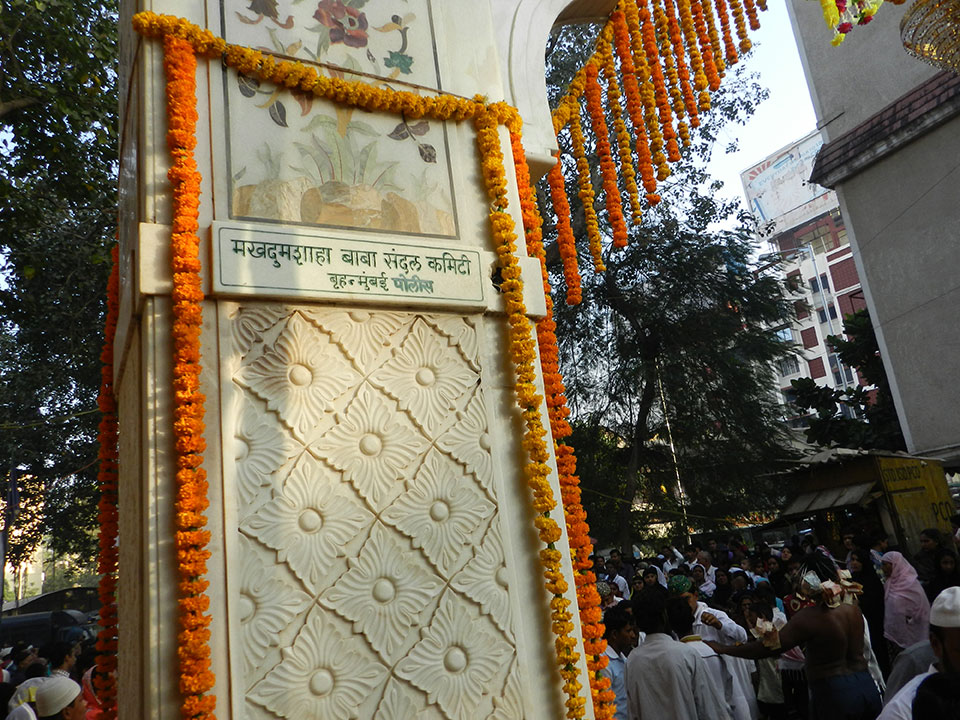
An arch declares the Mumbai police's attachment to Makhdoom Ali Mahimi.
An arch declares the Mumbai police’s attachment to Makhdoom Ali Mahimi.

It was perhaps this appointment that led him to be so closely linked with the Mumbai police. The East India Company formed Bombay’s first militia in 1669, soon after the Portuguese had handed over the group of seven islands to the British in dowry.

The constabulary at that time was drawn largely from conscriptions of land owners, but excluded Brahmins and Banias for a fee. Most of the early recruits were from the Bhandari community of toddy tappers, who were among the original inhabitants of Bombay.

As remained the precedent until Independence, the organising officer of the motley group was a European. It was one of these officers who was said to have worshipped the saint and sought his help for cases.

“A Portuguese sergeant at the time used to worship him and seek his advice a lot,” Shaikh said. “In that way he solved many cases. So at the time of his last illness, he said that after he died, only the police would do Makhdum Shah Baba’s seva.”

Faith runs deep

And so it is today. The Mahim police station was built in 1923 over the site of the saint’s accepted abode. Among the thousands of civilians who lined up on Friday for a chance to seek his blessings, were uniformed members of the police force – traffic police in white, the main force in khaki, and even the red of the police band.

The procession on Friday began, as usual, in the afternoon from the Mahim police station. It ended at the Mahim dargah 200 metres away only at around 11 pm.

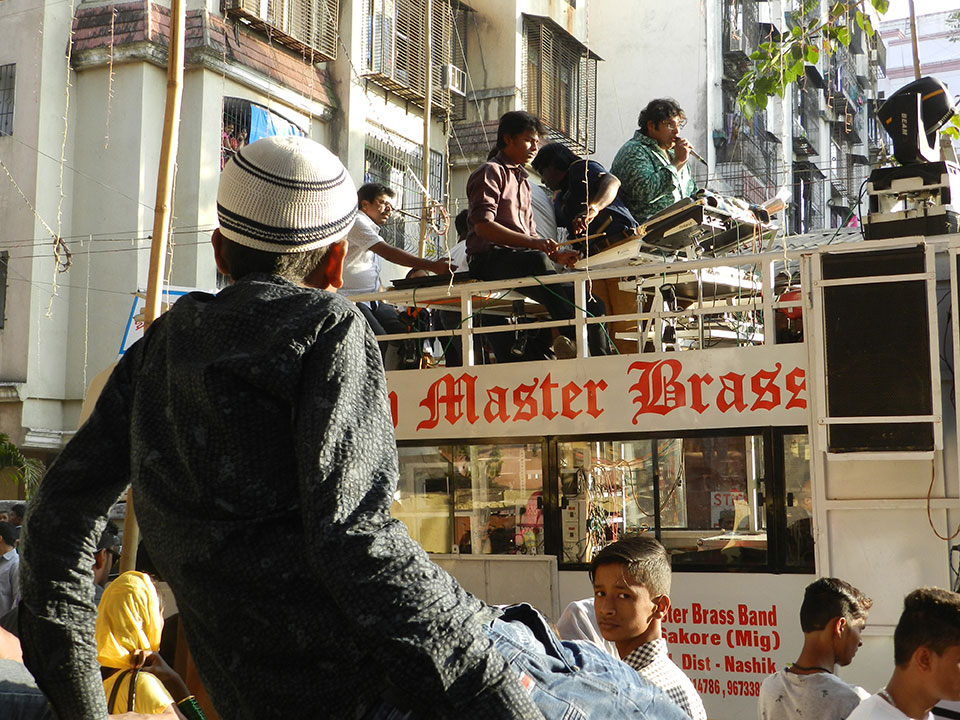
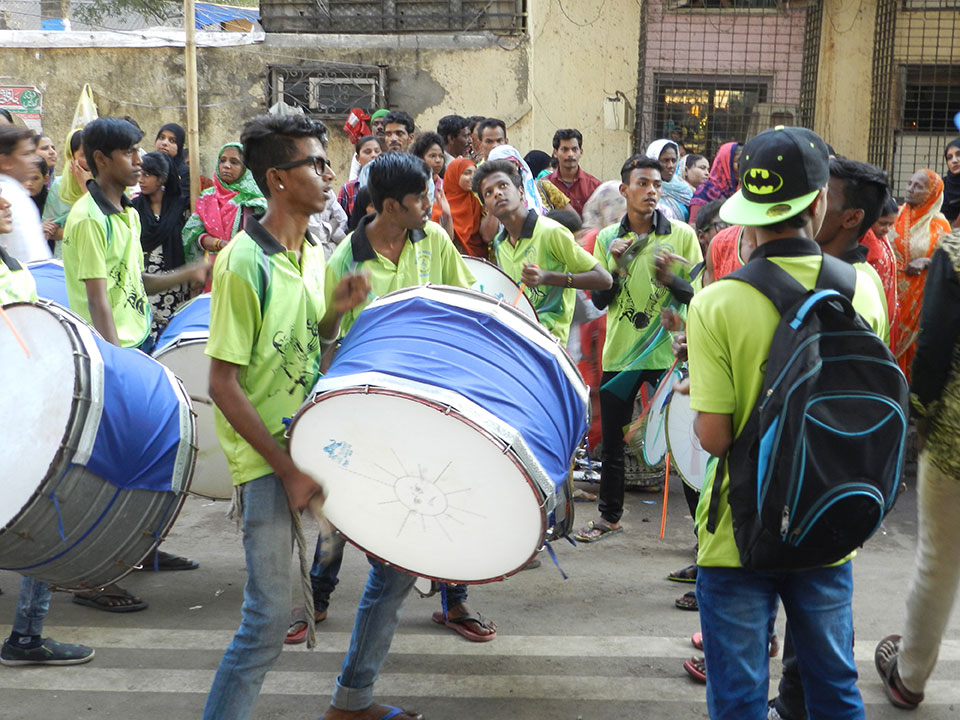
Three vans, all blaring deafening music, marked the procession lines. One, a group called Shaikh Master Brass, had as its star singer a man from Mazgaon whose claim to fame was being one of the qawwali singers in Deewani Mastani from the film Bajirao Mastani.

Makhdum5MPOs30dec2015

A woman dressed in decidedly non-festive clothes and looking as if she were on a mission clutched a decibel meter. When asked which organisation she represented, she wordlessly pointed with an air of doom at its measured 104 decibels and set off once again into the din.

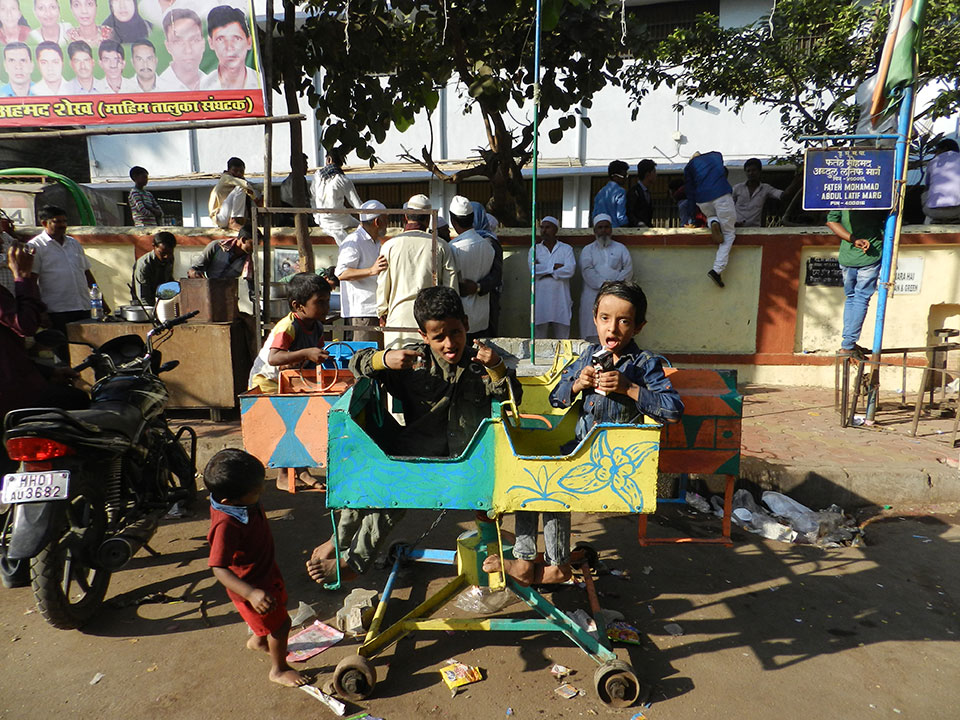
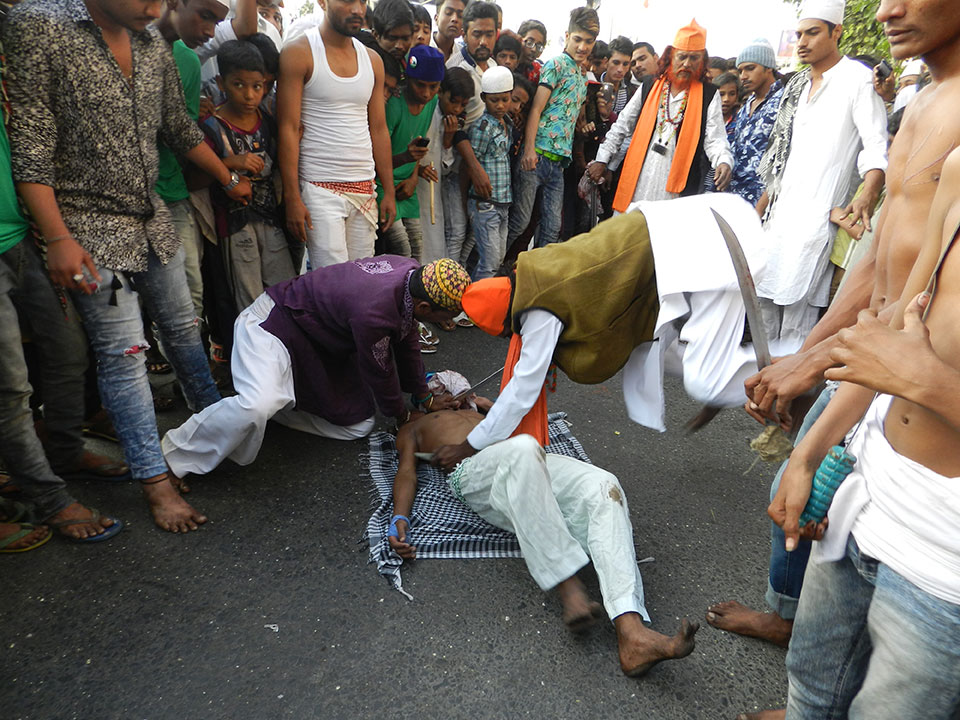
Children and adults alike clambered up to line the boundary walls of residential buildings for a better view as the regular events of an urs proceeded in the centre – devotees swirling incense towards themselves, young men whirling blades to cut their backs, children getting their ears pierced.

Makhdum6MPOs30dec2015


Makhdum7MPOs30dec2015

Sania Qureishi, 8, was a tough customer. When asked what she liked best about the fair, she pursed her lips and said, “I don’t know yet. I will have to wait and see before I can decide.”

A man for Mumbai

Other places in the city also bear Mahimi’s name, notably the colloquially named JJ Flyover that was until a few years ago the longest in Mumbai. In records, it is called the Qutb-e-Kokan Makhdoom Ali Mahimi Flyover.

Nor is he just the saint of the Mumbai police force. Aspiring actor Ramesh Kumar credits his moderate success in films to him.

“I am a Hindu, but I have faith in Baba,” Kumar said. “Hum jaat ko nahi manta, kalakar hai.”

Kumar, or Junior Johny Lever, as he prefers to be known, said that he has been seeing the procession since he was a child growing up in Mahim. Two years ago, he began to perform comedy and anchor small events at the station. He also got a role as extra in two films. This he credits to the intervention of the saint who he began worshipping six years ago.

Said head constable Chandrakant Salve, “See, the way Mount Mary [in Bandra] and Siddhivinayak temple [in Prabhadevi] are both parts of Mumbai, in the same way even Makhdumi Baba is Mumbai’s only. There is no race or religion here – Hindus, Muslims, Christians, they all believe in him. So do I.”

Behind the optics of the grand gesture, though, some problems remain. Muslims form about 1% of the Maharashtra police force, lower than the national average of 4%, according to the National Crime Records Bureau. That’s the kind of structural imbalance offering a chadar to the saint won’t be able to remedy.

Makhdum8MPOs30dec2015

source:  http://www.scroll.in / Scroll.in / Home> Syncretic Tales / by Mridula Chary / Photos by Mridula Chary / December 26th, 2015

Waste picker gives tips to end city’s woes

Bengaluru,  KARNATAKA :

Follow your class 5 moral science lesson on cleanliness, take steps to rein in the garbage mafia and find a solution to sanitary waste -these are not the words of an urban planner but a humble waste picker’s advice to Bengalureans. Mansoor Ahmed, 33, whose hard work fetched him a seat at the Paris climate conference, is back in the city, enlightened and overwhelmed. Still in awe of the French capital, he aims to make Bengaluru the Paris of India.

Mansoor, a waste picker from ward no 198, Jayanagar, collects dry waste from more than 1,000 houses. The passionate worker who spoke about low carbon strategies in the waste sector at the Paris summit has set a threefold agenda for Bengulureans: Keep your surroundings as clean as your house, keep a vigil on the garbage mafia by equipping each ward with cameras and find a way to effectively dispose sanitary waste.

While this is his vision for the city , Mansoor wishes to have a uniform for waste pickers, so that they feel as respectable as any other civic worker. “I have a team of 12 waste collectors and the job we do is exhausting. We show up at people’s doors at 5am and I don’t know how many residents even remember our faces. A uniform will make us feel better about ourselves,” said Mansoor.

The waste picker who doesn’t charge a single paisa for his contribution (he’s not paid by BBMP either) earns a living through his “donate dry waste project”.He collects around 25 tonnes of dry waste in a month and sells it to recycling companies, making enough money for his daily expenses.

“We still don’t have a solution for sanitary waste. We know what to do with dry waste and wet waste but with sanitary waste, we have no option but to burn it.Also, where does all of it go? Even I’m clueless. “I am not educated but still I’m passionate about keeping mine and others’ houses clean. Only if the literate follow what they have been taught in school, their education won’t go waste,” said Mansoor, signing off on a hopeful note.
Needed: A change in attitude

Asked what is the simplest thing he learnt from Paris conference that can be replicated here, Mansoor Ahmed said: “If people’s attitude changes, things will automatically change.When when we go to collect waste, residents are only bothered about the muck getting out of their homes. Whether it lands on the road or in a garbage dump is nobody’s concern. The garbage mafia is our biggest enemy; we should see that after the waste is picked up from a particular ward at 5am, no one uses it as a dumping ground.This can done only if the residents are vigilant and cameras are installed in wards”.

source:  http://www.timesofindia.indiatimes.com / The Times of India / News Home> City> Bangalore / TNN / December 11th, 2015

Testimony to efforts !


MirAlamTankMPOs30dec2015

Hyderabad , TELANGANA :

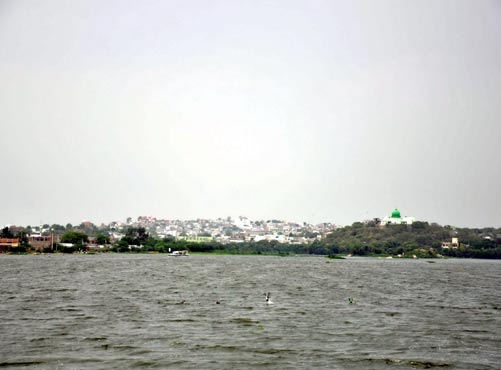
Mir Alam Tank is a fresh water tank in Hyderabad, located in the southern part of Musi River. It had been a primary source for drinking water to the city before the construction of Osman Sagar and Himayat Sagar.

The tank was named after Mir Alam Bahadur, the then Prime Minister of Hyderabad during the reign of Asaf Jah III, the third Nizam of Hyderabad State. Mir Alam Bahadur is believed to have laid the foundation for the tank on July 20, 1804 which was then completed in a period of two years and declared open on June 8, 1806. It was from the share of the treasure he got from Srirangapatnam that he built this tank.

It is indeed a treat to watch this engineering marvel that was built by a French engineering company, which comprised of 21 semicircular arches spread across one mile. It was reportedly planned by General Michel Joachim Marie Raymond, popularly known as Monsieur Raymond, the French Military General to whom Hyderabad’s Raymond Tomb has been dedicated and is the founder of Gunfoundry in Hyderabad.

Mir Alam Tank is a testimony to the efforts of Hyderabad’s erstwhile rulers who have used the topography of Deccan plateau to build vast water bodies. The boating facility is popular with tourists where one gets to enjoy the pleasant breeze and a refreshing experience. The cruise facility is available at an affordable price and the tourism department has introduced modern boats as well. During the peak time of Mir Alam Tank’s utilisation, historians say that the water of the tank was so sweet and pure that people carried them in containers to their home towns.

Nehru Zoological Park lies adjacent to this tank and boats are operated on the lake. It is a perfect tourist spot in Hyderabad. One can choose mechanised boats, steering boats or speed boats. With changing time patterns of the day, the lake acquires different hues. Several migratory birds make the precincts their home during different seasons while the dense vegetation of the Nehru Zoological Park at one side offers a tropical feel.

Compiled by Jaya Vellampalli

(This column features strikingly beautiful, yet lesser-known gems of Hyderabad, which have some intriguing tales related to them.)

source:  http://www.metroindia.com / MetroIndia / Home> LifeStyle> Places / by Jaya Vellampalli / December 27th, 2015

City Waste-Picker heads to Paris for COP 21

Mansoor Ahmed (left) transporting garbage

Bengaluru, KARNATAKA :

by: Preethi Ravi

While the Bruhat Bengaluru Mahanagara Palike (BBMP) plans to introduce stringent measures in the city to ensure proper waste segregation by Bengaluru’s citizens, 33-year-old Mansoor Ahmed, waste-picker from the city, will be in Paris for the 2015 United Nations Climate Change Conference, COP (Conference Of Parties) 21, scheduled to be held from November 30 to December 11.

 
His hard work and vision in spreading awareness about waste management among the citizens has led him to Paris to present a talk to participants from across the world.
During his visit to Paris, he will talk about the importance of waste segregation and how he was able to create awareness and convince 75 per cent of his customers to segregate waste at source.

 
Mansoor speaks three languages: Tamil, Hindi and Kannada. He admits he cannot utter a single sentence in English. “English is not a problem as long as my work talks for me. I’m genuine and there is sincerity in my work which will speak for me. Besides, I will have a translator. As part of my talk, I will be narrating my journey from a seven-year old rag-picker to what I’m today,” he says. He has a team of 12 members at the Jayanagar DWCC who manage an inventory of 10-12 tonnes of dry waste every month.

 
Mansoor’s talk will be translated by Kabir Arora, who coordinates Alliance of Indian Waste-pickers (AIW) – an informal network of organisations, cooperatives, and companies working on waste management with the help of waste-pickers. Hasiru Dala, which is a coalition member the AIW and an organisation of waste-pickers and waste workers, is sponsoring Mansoor’s 10-day trip.

 
“The team from Hasiru Dala asked me if I was interested in going to Paris for a conference. I was elated and immediately said yes. My passport and visa had to be made,” says an excited Mansoor. He flew to Delhi from Bengaluru on Monday and will reach Paris later in the day.

 
Mansoor operates the Dry Waste Collection Centre (DWCC) (recyclables and inorganic waste aggregation and sorting unit) in ward 168 of Jayanagar in. He went door-to-door in the area around the centre to encourage residents to segregate their wastes and drop it at the DWCC.

 
The daily collection of the DWCC is about 120 kg from waste-pickers. The DWCC receives one tonne of waste from apartment collection. Mansoor uses a rotating fund of `3,000 to buy wastes from the apartments.

 
He will be part of a joint delegation of Indian Youth Climate Network (IYCN) and Alliance of Indian Waste-pickers (AIW) for COP 21.

 
The IYCN is a network uniting Indian youth and youth-oriented organisations who are concerned about climate change and environment issues. The network works to generate awareness about and establish consensus on what role India should play in the global debate of climate change and how it should address its domestic issues.

 
Mansoor was just a seven-year-old when he began helping his parents collect waste by sorting it. At that time, he used to manage around 500 kg of waste every month.
He attended a small government school near his home but had to drop out of school in Class 5 when his father passed away.

 
He is the oldest among nine siblings (he has six sisters and two brothers), and the burden of responsibility to take care of them brothers and sisters feel upon his young shoulders.
He joined the informal waste sector with his mother to help supplement the family income.

 
They ran a small scrap shop near their home where all the waste-pickers from their slum would bring their daily collection. They would manage around 500 kg of waste every day.
Working with waste has therefore been the only job that Mansoor has known, but it has provided for him and his family. Thanks to the use of technology and people his people-management skills, Mansoor has been able to scale new heights.

 
He says he is eager to learn the concepts of solid waste management followed in Paris and will find ways to implement it at his centre too.

 
From the conference, he wants the countries to pursue the agenda of recycling (Waste to energy) in their climate action commitments as opposed to incineration of waste — which is currently being proposed as a climate solution by many governments. Incineration is being perceived as a threat to Mansoor’s and many other green entrepreneurs’ livelihood.
For his visit, he was asked to buy a pair of thermal wear as Paris would be freezing at this point of time. “I didn’t know that we could find thermal wear here. I was asked to buy them; but one pair costs `2,000. But it’s going to keep me warm when I land there. I have already purchased my formal wear two months ago. I am too excited about my trip. It all feels surreal,” he says.

 
With his contagious smile he has been easily able to build excellent relationships with his customers to whom he provides waste collection services. The last few days he has been flooded with congratulatory messages from them for this prestigious trip.

 
Today, with the Paris trip materialising, he feels his hard work has paid off although he claims never to have imagined that he would be able to visit a foreign country. “This is my first visit to a foreign country…and in an airplane. I’m feeling ecstatic and proud. Never in my life had I imagined that I would get such an opportunity. This would not be possible if it were not for the people who supported me throughout my life. I really want to thank my well-wishers, friends and relatives,” says Mansoor, who has three children: two boys and a girl.

 
He has enrolled his children in Oxford School in JP Nagar. And his aim now: To give his children a solid education … and the freedom to follow their dreams.

source: http://www.bangaloremirror.com / Bangalore Mirror / Home> Bangalore> Civiv / Bangalore Mirror Bureau / November 30th, 2015