She loves to play with colours and that’s what inspired her to become a make-up artist. It has been over 18 years since Zara Syed, a celebrity make-up artist, entered the industry.
Zara believes that a face is similar to a canvas and a make-up artist gets the chance to showcase his or her skills in the most ideal way. Zara also teaches young girls and corporate women to manage and take care of their hair and skin on a daily basis. She also trains those who want to take it up as a profession.
Recollecting how she got into this profession, she says, “I moved to Bengaluru eight years back and assisted many make-up artists. Since I was doing a hairdressing course then, I decided to start my career with hairstyling solely. I worked on shoots and commercials, and soon enough, I got attracted to this profession. I fell in love with how the face is sculpted and the ways one can change someone’s look just by using various tactics and colours.”
Having worked with many popular faces in the movie industry, both Sandalwood and Bollywood, she says that she has a long list of names she would want to work with in future. “I worked with Sridevi and a couple of Marathi actresses and down South, with Ramya and Sharmila Mandre. Very soon, I will work with Aindrita as well,” she says.
Zara’s forte is giving a natural look to a face. She explains, “I keep my work natural, sharp and defined and avoid choky make-up. I’d rather work on making the person look younger. It should be wearable on a daily basis and not just for the ramp. It defines a woman, makes her look more defined and confident.”
Her look for Christmas is, “Keeping one’s face fresh and natural with a little gloss on the cheeks for the youthful look. Winter makes the skin dry and dehydrated, so my advice is to illuminate the cheekbones and make it look more young and lively rather than leaving it dry and flaky.”
A few things that she keeps in mind when working on someone are, “I focus on the jawline and features that are sharp. Only after this do I decide the base to be applied on someone. I constantly keep in mind that a girl should look beautiful and try my best to achieve that.”
She says that the best thing about her profession is to see the happiness on a girl’s face and especially when it is for a wedding. It is a pleasure to see the bride pleased with what she has done. “It is her day and she should look stunning and at her best.”
As for her future plans, she wants to teach more young girls about the art of applying make-up and encourage them to take it up as a profession. “I strongly believe that a woman can make another woman beautiful since she understands the characteristics and the flaws and can correct it. I would like to help my students financially and make them stand on their feet,” she says.
On a lighter note, she adds, “If not a make-up artist, I would have definitely been a chef since I love to cook and experiment. I love Chinese cuisine and would love to learn more about this it.”
As a piece of advice, she says, “I always advise make-up artists, especially if it is one woman dressing-up another, to focus on the face and forget about themselves. “The face is a canvas and as an artist, you have to give your best and make it look beautiful.”
Make-up for her, “is life. It is like meditation, and I love to play with colours. I completely forget about my worries when I am working with make-up. It is like a stressbuster.”
source: http://www.deccanherald.com / Deccan Herald / Home> Supplements> MetroLife / by Surupasree Sarmmah / DHNS – December 14th, 2015
In school, she would finish all the notebooks her parents bought for her to doodle and design her future clothing collections.
Syma Ahmed
At the age of seven, when the teacher was busy giving important notes that would come for the final examination, Syma Ahmed spent that precious time thinking about what else she could design. By the time she was 12-years-old, she had started designing her outfits that she would show off during festivals like Eid and Bakrid.
She says, “My parents encouraged me from a young age. They would give me the boost that I needed whenever I wanted to design something.” Having completed her Bachelors in Fashion and Apparel from Mount Carmel College, this Bengaluru-born designer is proud to see how much she’s grown in last few years. She was also an intern with Bollywood designer Vikram Phadnis and attended summer school at London School of Fashion. Today, she has carved her own niche with her wedding and Indo-Western collection.
“I think I learnt the most once I started working on my own and branding my own designs. When working under another designer, you need to be on par with their style and execute it accordingly. But here, I have the freedom to experiment and choose what I think looks best, and I’ve also been able to understand the fine line between what people want to wear and my vision in terms of design,” she says.
Syma likes her designs to be elegant and soft, therefore she mostly uses pastel colours. She uses everything around her as an inspiration and decides the colours and patterns accordingly.
Her latest collection is called ‘Wisteria’ and is inspired by a famous garden in Japan. Talking about the collection, she says, “This collection is inspired by the Wisteria Tunnel in The Kawachi Fuji Gardens in Japan. It encompasses 150 Wisteria plants with 20 different spices ranging in colours of white, blue, purple, violet-blue and pink. The clothes also depict these pastel-coloured fairy-tale flowers in their graceful silhouettes, ombre dyeing and intricate embroidery details, making it a complete and rich experience.”
Recalling some of her favourite collections, she says, “The ‘Nur Jahan’ collection that I presented is one of my favourites. It was a lot of fun making because it was something different. All the designs were painted with bright, bold colours, which made it a great collection.” Syma is also proud of her interpretation of the sari. She calls it ‘TMS’ or a two-minute sari, which can be worn as a skirt and wrapped around.
She says, “Wearing a sari is absolutely time consuming. This works well with every body shape. Now people don’t have to go through the hassle of wearing the perfect sari — you can always look perfect with this.”
Apart from designing fashionable clothes, she also makes accessories like clutches and earrings. With an eye for intricate details, she looks up to Zuhair Murad, a Lebanese fashion designer, for his details in embroidery. She also loves the work of Anamika Khanna for her interpretation of the old and the new.
“Designing is something that I’ve always wanted to do and I’m happy that I’ve had so many learning experiences so far. I look forward to experimenting so much more in this industry and bring out the best of designs,” she concludes.
source: http://www.deccanherald.com / Deccan Herald / Home> Supplements> MetroLife / by Anila Kurian / DHNS – December 14th, 2015
Solapur (Maharashtra): In an attempt to highlight the great work that Muslims have done in the field of science, an Assistant Teacher of Urdu High School has written a book called‘Muslim Scienedano ki Scienci Khidmat’.
The 92-page book of Junaid A. Qayyum Shaikh, 37, an Assistant Teacher at Social Urdu High School and Junior College of Science, Solapur, was launched by Prof. Dr. N N Maldar, Vice Chancelor of Solapur University.
Shaikh, who has completed Masters in Science (MSc) and Bachelor of Education (B Ed) wrote this book in Urdu. In order to reach out to more readers, he plans to translate it into other languages. He says he has received several requests for translation of the book into other languages and many are ready to even offer help.
The author used many sources in compiling the present book. Shaikh claims “Book of Knowledge by Al Jazari” an Arabic book in original that was translated by Hill and Donald in English is one of the main source for his work.
He also referred : ‘Invention in the medieval Islamic World’ by Rotlink, ‘Introduction to Historyof Science’ by Sarton and George, ’The Muslim Scientist’ by Muhammad Yasin Owadally, Article on Muslim Scientist by Altaf Hussain Memon Tahari, Muslim Sciencedan by M A Siddiqui & Fayeza Siddique, Musalmano ke Scienci Karname by Muhammad Zakriya Virk and Biography- W Hazmy,Zainurashid Z, Hussain R.
The book presents brief information of Muslim scientists’ contribution in the fields of Mechanical Technology, Transport technology, Gun powder technology, Physics, Chemistry, Botany, Zoology, Optics, etc.
Speaking with TwoCircles.net, Shaikh said, “Today most of us presume that the progress of science and technology is the contribution of Europe and American scientists only. In fact it is our lack of knowledge. The truth is that hundreds of Muslim Scientists have many inventions to their names in the field of science for centuries.”
“I felt that the newer generation is going far from the scientific history of Muslims and therefore thought that they must be reminded of contributions of Muslim Scientists so as to make it guideline and torchbearer for others who are interested in science and technology”, he said while replying to the question of trigger for him to write such book.
“This book is especially written for young Muslims, whose way of thinking is scientific and who are intersected in the research and findings related to science so that they can be motivated”, he added.
source: http://www.twocircles.net / TwoCircles.net / Home / by A. Mirsab / December 13th, 2015
The announcement to honour Bollywood veterans Kumar, Amitabh Bachchan and a few others with the prestigious Padma Vibhushan award was made by the government on the eve of Republic Day on January 25, 2015.
Saira Bano, Dilip Kumar, and Rajnath Singh Image courtesy: ANI Twitter handle
Legendary actor Dilip Kumar was on Sunday presented the Padma Vibhushan by Union Home Minister Rajnath Singh at the thespian’s residence in suburban Bandra.
The 93-year-old legend was presented a medal, a certificate and a shawl by Singh, in the presence of the actor’s wife Saira Bano.
Maharashtra Governor C Vidyasagar Rao, Chief Minister Devendra Fadnavis, were among other dignitaries present at the actor’s home when he received the award.
The announcement to honour Bollywoodveterans Kumar, Amitabh Bachchan and a few others with the prestigious Padma Vibhushan award was made by the government on the eve of Republic Day on January 25, 2015.
However, Kumar, due to ill-health, could not attend the special function held at the Rashtrapati Bhavan in April when other Padma awardees were honoured by President Pranab Mukherjee.
Born as Muhammad Yousuf Khan in Peshawar, Kumar made his debut as an actor in the film Jwar Bhata in 1944 produced by Bombay Talkies.
In a career spanned over six decades, he starred in films of a variety of genres such as the romantic Andaz (1949), the swashbuckling Aan (1952), the dramatic Devdas (1955), the comical Azaad (1955), the historical Mughal-e-Azam (1960) and the social Ganga Jamuna (1961).
Called as the ‘tragedy king of Bollywood’, he also did films like Kranti (1981), Shakti (1982),Karma (1986) and Saudagar (1991) and others. His last film was Qila (1998).
The Government of India honoured him with the Padma Bhushan award in 1991, the Dadasaheb Phalke Award in 1994 and the Padma Vibhushan earlier this year, for his exceptional and distinguished contribution to the Indian cinema.
source: http://www.dnaindia.com / DNA / DNA Analysis> Home> Entertainment / Place: Mumbai, Agency:PTI / Sunday – December 13th, 2015
Amitabh Bachchan has hero-worshipped Dilip Kumar from the time he decided to become an actor. We can see traces of the Tragedy King’s style in the Bachchan’s early performances in Saat Hindustani, Anand and Parwaana. Later in Ramesh Sippy’s historic Shakti, he got an opportunity to share screen space with his idol. In a chat with Firstpost, Bachchan talks about the actor who influenced him the most:
Dilip Saab turns 93. Your thoughts?
I wish him glorious health. I wish him peace of mind. I wish him this days’ celebration, countless years ahead.
You’ve never concealed our admiration for Dilip Kumar. What makes him a role model for you and generations of other actors?
I have admired his performances, for to me they have remained beyond any fault. I have admired his intellect, and the way he has translated that into his work. And I have admired his clarity of speech in whichever language he speaks. Clarity in speech is to me the greatest acumen for an actor. You cannot have clarity of speech without the understanding of its graph and tenor. You cannot be a great actor without the benefit of these two elements in your expression – graph and tenor !
Amitabh Bachchan and Dilip Kumar. Image from IBN Live.
Which of your performances, scenes, have been most directly inspired by Dilip Saab?
None. That would be a sacrilege! I should be inspired by ‘the person’, to inspire me to perform or deliver what is asked of me professionally.
Please tell us about your first meeting with him
Our first shooting scene in Shakti was in a jail sequence, where the police official, but also my Father in film, comes to visit me and tries to convince me that I was taking a wrong path in life and I disagree. It was tough to stand in front of one whom you have admired for ages, and disagree with. But it was a job I had to do.
What were you thoughts when Ramesh Sippy offered you a chance to work with him in Shakti?
It was not Ramesh ji that offered me the chance to work with him; it was Salim-Javed who thought up the idea and the story.
What was the experience like? Did the two of you hit it off instantaneously? How easy/difficult was it fir you to adapt yourself to his method of working?
For me it was a moment of disbelief, until professional exigencies took over. He is a considerate colleague and senior, and never failed in those attributes when we worked together. I would one day share the same screen space with this tremendous talent that would explode in front of me. Never. And it still remains a illusion in my life to have actually been a part of a project which was headed by this thespian. God has been kind, very kind .
You did only one film with him. Any regrets about that?
We seek a moment of Godliness often in our life; it seldom comes, but when it does, you cherish it and remain in gratitude and satisfaction.
Which are your favourite films of Dilip Saab? And why?
All. And why? That would be insolent.
Many of his admirers feel he didn’t do enough work, that he retired too early. Your comments?
Describe ‘enough’. Can you ? No one has the ability to describe it for another. Our individual capacity gives us the liberty to describe it for ourselves. We need to respect that.
If you had the chance to do one of Yusuf Saab’s roles which one would it be?
I would never dare to even think of doing that .
source: http://www.firstpost.com / FirstPost.com / Home> F. Entertainment> Latest News> Bollywood News / by Subhash K Jha / December 11th, 2015
Is there such a thing as the art of giving? Apparently there is. Ask Mark Zuckerberg, who recently pledged 99 percent of his wealth to charity during his lifetime, or Warren Buffett, the guru of philanthropy, or Bill Gates. And closer home, Azim Premji, and maybe a handful of other corporate leaders.
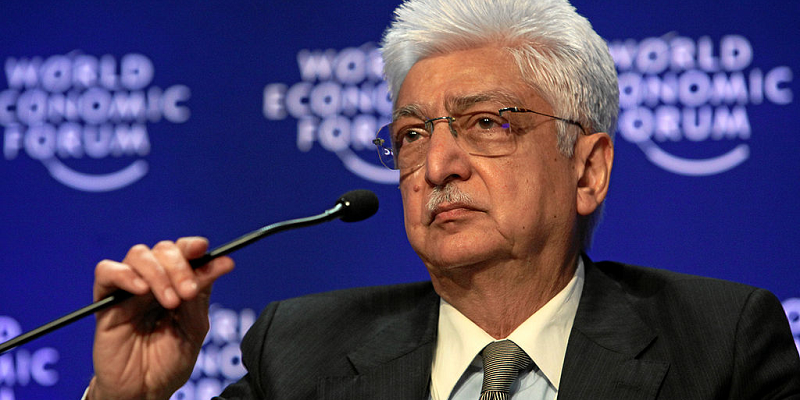
Azim Premji believes charity begins at home.
Philanthropy is suddenly attracting a lot of attention. Though traditionally Indians have always donated to charity in their own little ways, it is usually the big billion dollar charities that get talked about. And who better to demystify philanthropy than Azim Premji who started his philanthropic initiatives systematically in 1999 when he set up the Azim Premji Foundation. He donated 40 percent of his shares of Wipro to not-for-profit philanthropic trust which forms the corpus of Rs 52 thousand crores or $8.5 billion. In the last two years, he has been leading an informal effort with like-minded peers to promote philanthropy.
Premji feels there are two reasons why wealthy Indians don’t give as much as Americans. “One is their families are much larger in terms of wealth sharing. Two, a majority of Indians who are wealthy believe that they must leave their entire money as an inheritance to their children.”
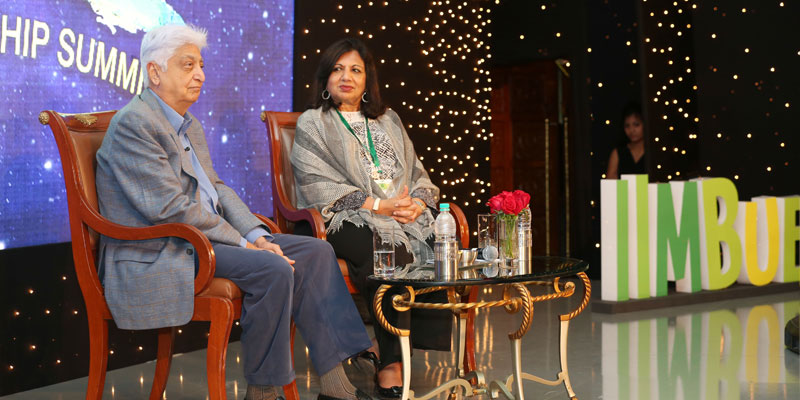
At the first IIM Bangalore Alumni meet, IIMBUE, in Bengaluru on Saturday, Kiran Mazumdar Shaw said if she had to write Premji’s biography, she would call it, ‘Giving it all.’
Here are the excerpts from the engaging fireside chat between Kiran Mazumdar Shaw and Azim Premji.
Azim Premji and Kiran Majumdar Shaw during the fireside chat at IIMBUE.
Kiran Mazumdar Shaw: What is it that influenced you to be so philanthropic? Was it something that was influenced from childhood?
Azim Premji: My greatest influence that encouraged me to go towards philanthropy was my mother. She was a doctor but never practiced medicine. She founded a children’s orthopedic hospital in Bombay (now Mumbai) for polio-stricken children, and children with cerebral palsy. She worked as the chairperson of that hospital from the age of 27 to almost 77. She devoted her whole life to raising money to run this hospital because the hospital depended on government grants which never came on time.
KMS: You have always been someone who has been careful with money. Someone who has avoided staying at five-star hotels and driving expensive cars. In fact, you are known to shun all status symbols. Was there an inflection point in your life that made you take to philanthropy in such a big way?
AP: The reason I give it (money) away is because it is the right thing to do. There is so much poverty, and misappropriation of funds and so many people are majorly disadvantaged.
KMS: There is a great saying that wealth and knowledge must be shared. It is about how we invest in society. How do you send this message to society and ingrain it in people?
AP: My biggest regret is I started too late. It was 14, 15 years back that I started in a small way in education in government schools in villages of India. We’ve really begun to scale in these past four years primarily because we saw such a strong need to uplift the quality of education in government schools. The reality is we started small and we started much later.
In a country like India, sharing your wealth with the unfortunate goes a long way. (Image credit: Getty Images)
KMS: I would like to take you to another part of your philanthropy which is the philanthropic initiative you have started with Bill Gates. And I must say I’m highly impressed by the time you devote to sensitising others in the corporate world about the concept of giving. Why do you think people need to be told and more importantly, why do you think people are so self-consumed and selfish about their wealth?
AP: (a moment’s silence) I think those are very loaded statements (laughter from the audience). You know I don’t think people need to be told. Most people know what their social responsibilities are. The reason I think the wealthy Indians don’t give as much as Americans — in fact, Americans are actually leaders in this – one is their families are much larger in terms of wealth sharing. Two, a majority of Indians who are wealthy believe that they must leave their entire money as an inheritance to their children.That acts as a deterrent. It is more prevalent in certain parts of India than in other parts of India. I think the more generous part of India is South India.
KMS: We are here with the present and future generation of wealth generators. How do you get the message across that they need to give some of their wealth to philanthropy?
AP: I think the present generation of the wealthy and the semi-wealthy demonstrate much more generosity. They either contribute time, effort, or money to philanthropy. So far the older generation is concerned one has to give examples to them. Keep on persuading them and hopefully, we’ll make a breakthrough. Actually, the people you’ve got to convince are the wives (laughter from the audience). Wives are socially more sensible and have more time at their disposal to lead initiatives of philanthropy. The husbands are much too busy making money (loud cheering and laughter from the audience).
Volunteering one’s time and effort to social causes are a good start towards philanthropy. (Image credit: Getty Images)
KMS: I think this is a great testimony to women and wives. You are here at the leadership summit of IIMB…so talking about giving back to alma mater. Is it important to give back to alma mater? Of course, it is a ridiculous question to ask because it is indefensible as an argument. But should one feel guilty about not giving back to the alma mater?
AP: No. I have not given back to my alma mater (loud cheer from the audience). I think the priority of our society far outweighs those of our alma mater. I think it is a matter of individual priority. But most wonderful universities of the world are significantly financed by their alumni.
KMS: But I am sure if your school or college reached out to you for help, you will not say no.
AP: They reach out to me all the time (laughter from audience).
KMS: So why do you say no?
AP: I just want to prioritise my funds to things which are more relevant to our country (applause from the audience).
KMS: I don’t like the applause that you got, Azim (laughter from the audience). Because I do believe that this has to become a part of our giving back to our alma mater. Because I believe that institutions are responsible for making us who we are today (cheer and applause from the audience).
AP: You got a louder applause (laughter from the audience).
KMS: I hope they mean it. Another question I wanted to ask you is when one looks at global business leaders, one associates philanthropy with entrepreneurial wealth whether it is Bill Gates, Elon Musk, Warren Buffet, or Mark Zuckerberg. Yet one sees a lot of other wealth creators in the corporate world like people in banks and hedge funds with huge salaries and stock options, isn’t that wealth creation as well, and shouldn’t they also be philanthropic? Because you don’t hear about that kind of philanthropy being articulated…the salaried class and employees. How do you create that kind of culture?
AP: I don’t know whether they are giving or not giving. I would be hesitant to make a harsh judgment. It just doesn’t get attention or get publicity.
(Image credit: Getty Images)
KMS: I think it is extremely important for media to cover stories of philanthropy from the salaried people.
Talking about philanthropic philosophy, how can businesses institutionalize it? Can we actually introduce a course on philanthropy in business schools?
AP: Oh! yes…and they can make you a professor (laughter from the audience). This kind of a course can generate a spark…
(After the Fireside Chat, Kiran Mazumdar Shaw opened it up to the audience to ask Azim Premji questions. Here are some excerpts.)
To a question on challenges he faced while giving away his money, Premji said, “The biggest challenge we faced is the size of the problem, the scope of the problem, and the depth of the problem. There was a high sense of frustration. However large an organization setup you are there is frustration that you do not have the bandwidth. We do rely on government machinery in what we do, and you have to keep at it, and keep at it.”
Interestingly, to a question on why he is not in politics, Premji replied, “Because it will kill me in a couple of years. I think you need to cultivate a sense of insensitivity to be in politics.”
But the session ended with the most profound thought from him which was an answer to a question on how does one decide when one should start giving.
“We had a meeting of our philanthropic initiative last week, and one of the panel members, whose family has been active in philanthropy, was telling us that as kids whenever they got money as gifts, they were required to give 25 percent of that to charity. And this was inculcated since he was two years old. That’s how you cultivate philanthropy.”
Mumbai Police Commissioner Ahmed Javed has been appointed Ambassador to Saudi Arabia, which has a 2.8 million-strong Indian community.
The Ministry of External Affairs said Javed is expected to take up his assignment shortly.
Ahmed Javed. PTI
The post of Ambassador in Indian Embassy in Riyadh has been lying vacant since April.
Relations between India and Saudi Arabia witnessed some strain after a Saudi diplomat was charged with confinement and rape of two Nepalese women in September. The diplomat later left India.
From trading point of view, Saudi Arabia is a crucial country for India.
The import of crude oil by India forms a major component of bilateral trade with the Gulf nation which is India’s largest supplier of crude oil.
The Indian community in Saudi Arabia is the largest expatriate community in the Kingdom.
IPS officer Julio Ribeiro, who was Mumbai’s police commissioner from 1982 to 1985, also served as Indian Ambassador to Romania.
PTI
source: http://www.firstpost.com / FirstPost.com / Home> F.India> Latest News> India News / December 11th, 2015
Ahmed Javed, Mumbai’s newly-appointed commissioner of police, addressed a press conference after taking charge, in Mumbai.(Arijit Sen/HT photo)
Ahmad Javed, perhaps the only Mumbai cop who wears a bespoke khadi uniform, is known for being a tough, no-nonsense cop who is equally at ease at a police station or a page 3 party. Born in Uttar Pradesh on January 2, 1956, Javed graduated as Bachelor of Arts (Honors) before appearing for the UPSC examinations. On September 15, 1980, he joined the police force as an IPS officer with the Maharashtra cadre.
After serving at various places as superintendent of police and deputy commissioner of police, Javed was appointed commissioner of police, Solapur.
He later returned to Mumbai to serve as additional commissioner of police, central region, before being promoted to joint commissioner of police, law and order. He was responsible for closely monitoring and ensuring the safety of witnesses in the Best Bakery case after its trial was shifted out of Gujarat following a Supreme Court order.
Javed then served as inspector general of police at the State Reserve Police Force, after which he was promoted to additional director general of police and named police commissioner of Navi Mumbai. His next posting was additional director general of police, law and order. Javed is married to Shabnam, with whom he has two children, Amer and Zaara.
source: http://www.hindustantimes.com / Hindustan Times / Home / HT Correspondent, Hindustan Times, Mumbai / September 09th, 2015
S.N. Mohammed Salahuddin (PSGCAS) and P. Madhupriya (Nirmala) hogged the limelight on the opening day of the 34th Bharathiar University inter-collegiate athletic meet at the Nehru Stadium here on Wednesday.
Salahuddin leapt to a new distance of 15.74m in men’s triple jump, while Madhupriya threw the spear to a new high of 41.35m in women’s javelin.
The results:
Men: 100m: 1. A. Kevin Rinalldo (Dr. GRD) 10.7s; 2. D. Karthik (Bharathiar); 3. G. Selladurai (Sri Vasavi); 800m: 1. M. Arun Prabhu (Sree Saraswathy Thygaraja) 1:58.1s; 2. P. Karthikeyan (Sri Krishna); 3. R. Sarath Kumar (PSGCAS); 5000m: 1. N. Senthil Kumar (Sri Krishna) 16:02.7s; 2. A. Mano (Sri Saraswathi Thygaraja); 3. D. Bhoobesh (Sri Krishna); Shot put: 1. S. Saravanan (Sree Saraswathy Thygaraja) 14.22m; 2. S. Mithravarun (PSGCAS); 3. A.S. Sujit (PSGCAS); High jump: 1. R. Gnanasowndaran (Sri Krishna) 1.92m; 2. A. Khassan Khan (Dr. NGP); 3. V. Vijay (Gobi ASC); Triple jump: 1. S.N. Mohammed Salahuddin (PSGCAS) 15.74 (NMR); 2. S. Raj Surya (PSGCAS); 3. P. Kishore).
Women: 100m: 1. C. Sharon Nanda (Dr. NGP) 12.6s; 2. E. Sirpa (Sri Krishna); 3. P.S. Vinodhini (Dr. NGP); 800m: 1. K. Anupriya (Dr. NGP) 2:29.4s; 2. E. Kowsalya (Kongu ASC); 3. K. Saranya (Nirmala);5000m: 1. E. Vasanthamani (Gobi ASC) 20:07.0s; 2. K. Divyalakshmi (PSGCAS); 3. A. Tamilarasi (PSGRK); Triple jump: 1. M.A. Sivanbarasi (PSGRK) 12.06s; 2. U. Sukithra (PSGRK); 3. D. Monisha (Nirmala); Shot put: 1. A. Anjalibai (PSGRK) 10.23m; 2. K. Subashini (Nirmala); 3. R. Indhu (Dr. NGP); Javelin: 1. P. Madhupriya (Nirmala) 41.35m (NMR); 2. M. Valarmathi (Kongu ASC); 3. S. Uma Mageshwari (BU Dept).
source: http://www.thehindu.com / The Hindu / Home> Sports / Coimbatore – December 10th, 2015
Four strikes including a hat-trick by centre-forward Sadat (12th, 17th, 20th & 48th) helped Mysore Muslims FC to register a 5-1 win over Challenge Union FC in the MDFA ‘B’ Division League’s Group ‘A’ match for the Govindaraju Memorial Trophy at the University Grounds yesterday.
The other goal for the winners was scored by Saudh in the 67th minute. The lone goal for the losing team was scored by Bhuvan in the 30th minute. Mysore Muslims have played two games and have won one and drawn one, while Challenge union FC have played two and have lost both their games. Mysore Muslims FC earned three points from this win.
In the match played on Thursday, Youngmen’s FC scored a 3-1 win over South Western Railway (N) FC in their Group ‘B’ tie. A brace by Aditya (60th & 69th) and a goal by Mohith (52nd) helped the winners cause. Mandanna scored the lone goal for the loser in the 5th minute.
source: http://www.starofmysore.com / Star of Mysore / Home> Sports News / Saturday – December 12th, 2015