MEMOIR – Of places called home

East African Asian society was complex and contradictory as any truly multicultural society needs to be, and perhaps as only Indians can make it

Toronto,  CANADA  :

It is amusing to contemplate that if an Indian man, one afternoon in March 1498, had been able to swim, he would have escaped capture by Vasco da Gama off the Mozambique coast, and the world might have been different. The Indian, whose companions had managed to swim away, was called “Davane” by his captors; he was from the Gujarati city of Khambat (Cambay). Davane gave advice to da Gama on local matters and even assisted him in outwitting the local sultan, so that the Portuguese ships eventually anchored safely in Malindi, up north in present-day Kenya. Here he took a pilot, who was possibly a Gujarati, and reached the Malabar coast.

Portuguese sailors plying the Indian Ocean thereafter often wrote about the presence of Indians and Indian ships in Kilwa, Mombasa, and Malindi. Around 1500, Captain Duarte Barbosa observed, “These ships of Cambay are so many and so large, and with so much merchandise, that it is terrible to think of so great an expenditure of cotton stuffs as they bring.” The trading connection between India and East Africa is actually even older, as the carving of a giraffe on a wall of the Konark sun temple indicates.
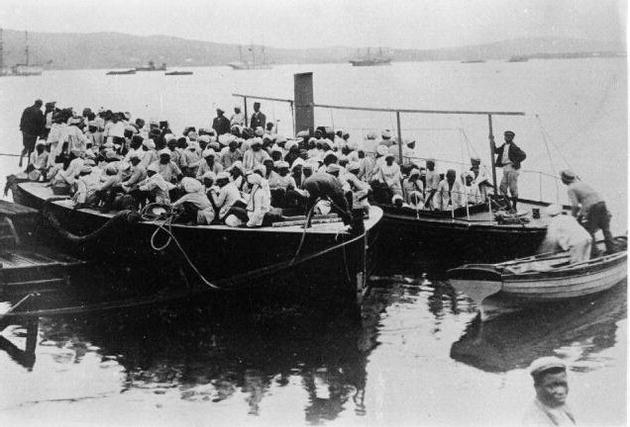
The arrival of Indians in South Africa by boat. / The Hindu Archives

It was in the nineteenth century, however, that Indians began arriving in numbers to trade and settle in Zanzibar, which was by then a major metropolis in the Indian Ocean with international connections, and home to the ruling Omani sultans. The more enterprising men ventured off to the small towns dotting the mainland coast. Most Indians arrived penniless from their drought-prone villages in Kathiawad and Kutch, and remained modest traders, but a few of them went on to become veritable merchant princes with spectacular wealth. Among them were Jairam Sewji, Ladha Damji, and Tharia Topan, to whose firms the sultans farmed out their customs collection and to whom they were often in debt.

Generation of tycoons

With the advent of British and German colonialism in the early twentieth century, Zanzibar’s commercial power and political influence waned, while the interior of East Africa opened up with new infrastructure and increasing trade. As a result, the Indians spread out all over the mainland, which now consisted of the three colonies of Kenya, Uganda, and Tanganyika. (In 1964 Tanganyika and Zanzibar joined to form Tanzania. The Indians went on to be called “Asians”.) The new generation of tycoons included Sewa Haji Paroo, whose caravans went from Bagamoyo (near Dar es Salaam) all the way north to the Kilimanjaro region. His apprentice, Allidina Visram, topped him to become “the uncrowned king of Mombasa,” supplying the dukas (shops) that had sprung up from Mombasa to Uganda, and further in eastern Congo and southern Sudan. In 1890 A.M. Jeevanjee, a Bohra from Karachi, arrived in Mombasa and made his fortune supplying goods (and workers) to the Uganda Railway. Much of early wood-and-iron Nairobi was constructed by his firm; the city’s Jeevanjee Gardens was his donation.

By the mid-twentieth century every small town in East Africa had the characteristic Indian strip of shops, and in even the smallest village you would find an Indian family branch running the solitary Indian shop. The Asian population totalled 366,000, with the highest number, 176,000, in Kenya with its total population of around 9 million. Unlike elsewhere, Indians had settled in East Africa as communities; there were Bhatias and Khojas, Jains, Shahs, Patels, Lohanas, Sikhs, Bohras, Memons, Kumbhads, and others. In the cities, the larger communities like the Khojas had their own primary and secondary schools for girls and boys, hospitals, dispensaries, and community halls. Dar es Salaam, with roughly 100,000 people at the end of the 1950s, had at least five Asian cricket teams. Abject poverty was rare, and even the most straitened household could afford three simple meals a day. For us growing up in East Africa, it was India that was poor and backward, as revealed to us in the newsreels and Indian films of the period.

Complex and multicultural

East African Asian society was complex and contradictory as any truly multicultural society needs to be (and perhaps as only Indians can make it). Asians tended to live close to their own communities; caste discrimination persisted, as did Muslims sectarian differences. Yet by the standards we see today in the world, East Africans were largely tolerant. It was understood that you did your thing. The azaan would go off in the mosques, the Khoja ginans would blare out over loudspeakers from their jamat khanas, a temple procession would block a road, the Diwali fatakdas would explode in the Hindu sections (and elsewhere). There was hardly any inter-communal violence, and nothing to compare remotely with the communal and caste slaughter that seems so routine in India.

Undoubtedly the Asians were racist — looking up to the “Europeans” and down on the Africans, by whom, as middlemen, they were often resented. Intermarriage between communities and races was a taboo that was just beginning to yield as I emerged from my teen years. Because the poorest people were among the Africans, it has been broadly claimed and often in Shylockian language that Asians were their exploiters. Asian liberals like to wallow in self-guilt. I have often retorted that my widowed mother worked from eight in the morning to ten at night, running her small shop, barely making ends meet while raising five children; whom did she exploit? Today many Tanzanian African women run small businesses similar to my mother’s. We often forget the wealthy and sophisticated African peoples who owned land and cattle; and while many Africans had homes in their villages, most Asians in Africa did not. If Asians did not marry Africans, the Africans, with ancient traditions of their own, had their own taboos; to imply that they panted to lay hands on Asian women is itself racist.
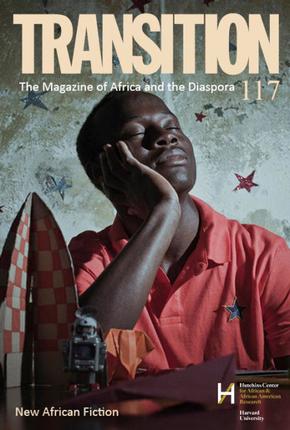
TransitionMPOs27dec2015

At the end of the 1960s

Be that as it may, around East Africa’s independence, in the early 1960s, there was a thriving community of Asians who saw themselves as Africans. In Tanzania most would speak two Indian languages plus Swahili and English. Among the elite there was excited talk of the “new African Asian” identity. There were Asian politicians and budding writers — Wole Soyinka’s Poems of Black Africa (1975) includes, significantly, three young Asian poets from Kenya; Africa’s most influential and exciting literary magazine of the 1960s, Transition, was founded and edited by Rajat Neogy of Kampala; and Amir Jamal, Tanzania’s beloved minister of finance for many years, was elected in African constituencies. At the end of the 1960s, there was no doubt in my generation that Africa was our home and we were in the vanguard.
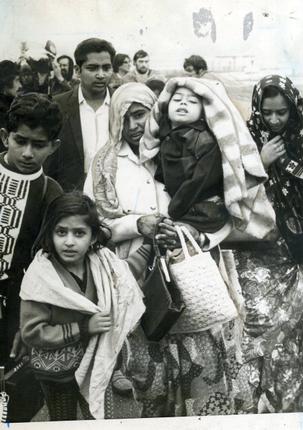
The first set of Ugandan refugees to arrive at Stansted Airport near London after then Ugandan President Idi Amin ordered them on September 18, 1972 to leave the country. / The Hindu Archives

And yet in the 1970s it all fell apart. Kenya’s Asians who had not renounced their British citizenships in time had to leave en masse. In Uganda, Idi Amin had a dream and expelled all the Asians in another “Asian exodus”. In Tanzania, in spite of Nyerere’s enlightened policies, his socialism, combined with the Idi Amin scare, drove out many Asians. What remains of the Asians today is a somewhat insecure and aggrieved population, though most appear dedicated to where they live. Racism of the old sort is gone; intermarriages do happen. At crowded kabab and bhajia restaurants in Dar es Salaam, it is truly pleasing to see Indians and Africans squeezed together at the tables. Indian cuisine has made a big headway especially in Tanzania; country bus stops often have a stand making chapatis; “pilau,” “biriyani” and “sambusa” are Swahili words. What thwarts complete integration is the Asians’ distinct features and cultures, often reinforced by their religious traditions.

A new crop of young Indians has started to arrive. When I see them, they seem foreign and lost. At times I get xenophobic — what are they doing here? do they even speak the language? — when I myself am now Canadian, but also an African Asian.

(M.G. Vassanji is the author of A Place Within: Rediscovering India, and most recently, of And Home Was Kariakoo: A Memoir of East Africa. He lives in Toronto. www.mgvassanji.com)

source:  http://www.thehindu.com / The Hindu / Home> Opinion / by M. G. Vassanji / December 27th, 2015
Tipu’s feared rockets fly into oblivion

The Sangeen Jame Masjid at Taramandalpet in Bengaluru.— Photo: Bhagya Prakash k
Bengaluru, KARNATAKA :
In the congested old market area of the city, where vehicles and pedestrians jostle for space on narrow lanes, lies a tale of Tipu Sultan’s ingenuity that time seems to have forgotten.

It is in this small clearing, now flanked by a sprawling masjid, that thousands of workers had gathered nearly 300 years ago to cut metal, roll gunpowder into barrels and attach sharp metallic pieces to make the once-feared ‘Bangalore Rockets’.

All that remains now of this ingenious machinery that sustained Tipu Sultan through four wars against the British is the name assumed by the few buildings in the area — Taramandalpet , or roughly, the market of the constellation of stars, a name that refers to the pattern of mid-air explosions of these rockets that then rained shrapnel on an unsuspecting enemy.

Residents — primarily shopkeepers and staff of the masjid and madrassa — seem unaware of the place’s rich history that once fuelled Indian rocketry.

“Workers would prepare these rockets that proved very effective against the British. This would then be transported to the armoury at K.R. Market, which still exists,” says Suresh Moona, a historian.

The entire street was a sort of military laboratory, a fact seen in the unearthing of two cannons during the metro construction work between 2012 and 2015.

Much of these signs, however, have disappeared. Activists point out this irony: while the government announced celebrations of the Mysuru King’s birth anniversary — which ended in violent protests — recently, symbols of the Sultan in Bengaluru and even his birthplace near the swanky International Airport on the outskirts continue to fade away.

Syed Shafiullah, vice-president of the Tipu Sultan Publicity Committee, says: “One armoury that we saw is now just piles of thrash and shops. It is a shame that all of it is going. We have been persuading the government to preserve these areas, or at least, to highlight it. It should be a pride that the technology of the British army came from Karnataka,” he says.

source:  http://www.thehindu.com / The Hindu / Home> National / by Staff Reporter / Bengaluru – December 27th, 2015

Bengaluru scientists find drug which could cure malaria with one dose

Bengaluru, KARNATAKA :

The Bengaluru solution - Triaminopyrimidine (TAP) comes with many advantages over existing drugs
The Bengaluru solution – Triaminopyrimidine (TAP) comes with many advantages over existing drugs

Bengaluru :

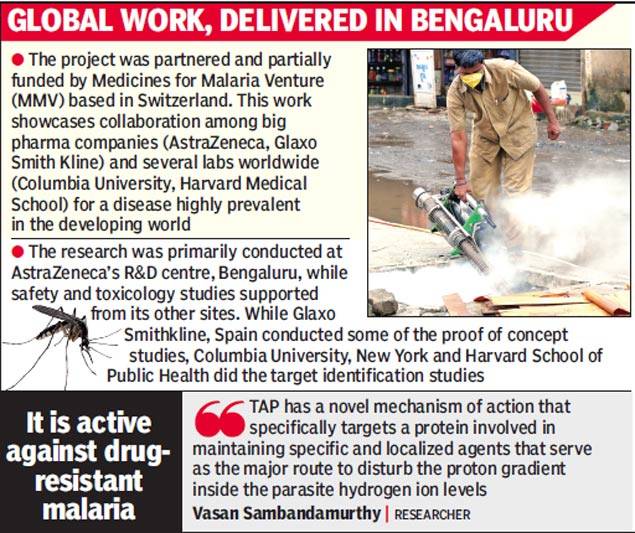
Three scientists from Bengaluru, who led a team of global reserchers looking for an antimalarial drug, have found a fast-killing solution.  After completing some tests, it’ll go in for clinical trials on humans. That this drug has the potential to cure the dreaded disease in one dose makes it more attractive to healthcare providers.

The Bengaluru solution — Triaminopyrimidine (TAP) — comes with many advantages over existing drugs. Vasan Sambandamurthy, one of the senior authors of the research paper, said: “It’s a fast-killing and long-acting antimalarial clinical candidate. TAP acts exclusively on the blood stage of Plasmodium falciparum (the stage responsible for clinical symptoms) in a relevant mouse model. This candidate is equally active against causative agent Plasmodium vivax.”

He added, “The compound has shown good safety margins in guinea pigs and rats. With a predicted half-life of 36 hours in humans, TAP offers potential for a single dose combination.”

The rapid spread of Plasmodium falciparum, the parasite which causes malaria in humans, has left nations battling it with a weakened arsenal and coping with thousands of deaths every year. This parasite has gradually become resistant to available medication.

The World Health Organisation (WHO) estimates that 3.2 billion people in 97 countries, including India, are at risk of being infected with malaria. In 2013, WHO reported an estimated 198 million cases and the disease was responsible for an estimated 5.84 lakh deaths, including 4.53 lakh children less than five years old.

Every person infected with malaria has to deal with millions of parasites and existing drugs have a limited effect in humans. “The half-life, which isn’t more than 2 hours, means it allows parasites to bounce back. Existing drugs are not fast-killing, which means that not only does a human need more doses but each dose is capable of only killing a few parasites,” he said.

GlobalWorkMPOs26dec2015

Besides, a potential side-effect of existing drugs is liver damage. “This doesn’t happen all the time, but the possibility does exist. Also, the parasites have become resistant to these drugs. With TAP, there are now known side-effects and the parasites are unable to develop resistance at the same pace as they do for existing drugs,” he said.

 
TAP was discovered by a team at pharmaceutical company AstraZeneca. “The main research happened in its R&D centre in Bengaluru between 2011 and 2014, which has since been shut down. It took us three years of rigorous work by teams across the globe. Today, we confidently nominate TAPs as a clinical candidate to treat drug-resistant malaria,” Vasan said. Shahul Hameed and Suresh Solapure were the two other team leaders.


Times View
The discovery of a malaria drug, yet again, highlights Bengaluru’s leadership in scientific research. The promise that the new medicine can kill the virus in a single stroke and act for a long time is good news for malaria patients. While the scientists deserve compliments on working towards a remedy free of side-effects, the companies that will eventually massproduce the drug should look at making it affordable to the aam aadmi. For their part, public health administrators must renew their battle to prevent vector-borne diseases, which cause untold suffering.

source: http://www.timesofindia.indiatimes.com / The Times of India / Home> City> Bangalore / by Chetan Kumar, TNN / April 01st, 2015

Col CK Nayudu award for Kirmani

Bengaluru,  KARNATAKA  :

Former stumper chosen for life-time achievement honour

nayuduMPOs

Former India wicketkeeper-batsman Syed Kirmani has become the fourth cricketer from Karnataka to receive BCCI’s prestigious Col CK Nayudu Lifetime Achievement Award.

The Awards Committee, which met on Thursday at Cricket Centre in Mumbai, unanimously nominated Kirmani for the award for the year 2015. The committee consisted of BCCI President Shashank Manohar, Secretary Anurag Thakur and N Ram, former Editor-in-chief of The Hindu Group.

The award — instituted in the name of Col Cottari Kanakaiya Nayudu, the country’s first Test captain — is given to individuals for their unparalleled contribution to Indian cricket, on and off the field.

The award carries a trophy, citation and cheque for Rs 25 lakh.
Kirmani, who made his Test debut in 1976 against New Zealand, kept wickets against India’s famous spin quartet and did the job remarkably well.

Having started his career as an understudy to Farokh Engineer, Kirmani took over the responsibility and added his charm to the role in a decade-long career.

Not only is he arguably India’s best wicketkeeper ever, he was a tenacious batsman that saw him score two Test centuries in the lower order.

Against England in 1981–82, he did not concede a single bye in three consecutive Tests.
A World Cup-winning player in 1983, Kirmani finished with 198 (160 catches and 38 stumpings) dismissals from 88 Tests. He was no mug with the bat either, finishing his career with 2759 runs, which included two hundreds and 12 half-centuries, at an average of just over 27.

Among his memorable innings, the right-hander shared an unbeaten 126 runs partnership with Kapil Dev against Zimbabwe in the 1983 World Cup as the Indian captain went on to script one of the country’s greatest wins at Tunbridge Wells.

Kirmani also provided solid support to Sunil Gavaskar in the unbroken 143-run stand for the ninth wicket as Gavaskar made 236 not out, the then top score by an Indian against West Indies in the sixth Test in Chennai in 1983.

A recipient of Padma Shri award in 1982, Kirmani also served as the chairman of the senior national selection committee.

source:  http://www.deccanherald.com / Deccan Herald / Home> Sports / Friday – December 25th, 2015

Central Meeland Committee celebrates Jashn-e-Meelad Un Nabi in city

MeeladMPOs25dec2015

Mysuru,  KARNATAKA  : 

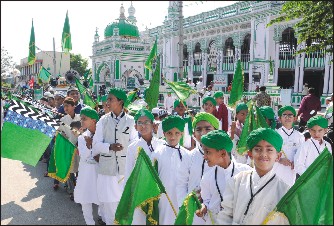
The Central Meelad Committee celebrated Jashn-e-Meelad Un Nabi, the birthday of Prophet Mohamed on Thursday at Meelad Bagh on Ashoka Road here.

Sir Khazi of Mysore Hazrath Moulana Mohamed Usman Shariff presided.

Hazrath Moulana Syed Shahabuddin Nadvi, Mohtamim, Jamia Hazrath Khaki Shah, Hazrath Moulana Mohamed Zaka Ulla Siddiqi, President, All India Milli Council Mysore District Unit, Saleem Pasha, Senior Lecturer, DIET, Chikmagluru, Hazrath Moulana Mufthi Salman Ahmed Rishadi & Nadvi, Vice President, Darul Uloo Siddiqia, Hazrath Moulana Hakim Ziauddin Madni, Ambur, Tamil Nadu, spoke on the life of Prophet Mohamed.

MLA Tanveer Sait, who is also the President of Central Meelad Committee, Ariff A. Mehkri, Chairman, Mysore District Wakf Advisory Committee, former Corporator Shivanna and others were present.Abdul Azeez Chand, Secretary, Darul Uloom Siddiqia. welcomed. S.Moinuddin Pasha proposed vote of thanks.

On the occasion, Tanveer Sait felicitated Social Worker Khaleel ur Rahman for supervising the gardening work and maintainance of Meelad Bagh.

Later, a procession of tableux depicting Kabathulla of Makkah, Gumbad-e-Khizra of Madeena and other famous Masjids was taken out from Meelad Bagh to Dr. Zakir Hussain Circle.

Traffic was diverted for sometime on the procession route. Heavy Police bandobast was provided around Meelad Bagh during the celebrations. The function concluded with Fatheha and Dua by Sir Khazi of Mysore.

source: http://www.starofmysore.com / Star of Mysore / Home> General News /  Friday – December 25th, 2015

Writer Murthy, Ustad Rafique Khan, Devdas Kapikad to be honoured with Sandesha awards

Mangaluru , KARNATAKA :

Writer H.S. Venkatesh Murthy, sitar player Ustad Rafique Khan and comedian Devdas Kapikad are among the eight persons who will be conferred the Sandesha Awards by the Sandesha Foundation for Culture and Education. The awards will be presented on January 16.

Writer H.S. Venkatesh Murthy

Mr. Murthy will be given the award for his contribution to the field of Kannada literature, Mr. Khan for his contribution to the field of music and Mr. Kapikad for his work in Tulu theatre and cinema.

Ustad Rafique Khan
Ustad Rafique Khan

Comedian  Devdas Kapikad
Comedian Devdas Kapikad

Others who have been chosen for the award are writer Gladys Rego (for Konkani literature), Sugantha Sathiaraj (teacher), Alexander Joel Pereira (Konkani Music), Thomas D’Souza (media) and G.S. Jayadeva of Deenabhandu Trust in Chamarajanagar.

Talking to presspersons here on Monday, writer Na. D’Souza, who headed a six-member jury to select the award winners, said the selections were made on the basis of merit and they did not invite applications.

The jury members were writer Sara Aboobacker, playwright Eric Ozario and theatre artiste Richard Louis.

Roy Castelino, president of the Karnataka Konkani Sahitya Academy and trustee of Sandesha Foundation said that Home Minister G. Parameshwara would attend the award ceremony.

Archbishop of Bengaluru Bernard Moras would be present.

source: http://www.thehindu.com / The Hindu / Home> News> Cities> Mangaluru / by Staff Correspondent / Mangaluru – December 15th, 2015

Sandesha Foundation announces annual Sandesha Award to eight including Venkatesha Murthy

Mangaluru , KARNATAKA :

Mangaluru :

Eminent writer H S Venkatesha Murthy is among eight achievers selected by Sandesha Foundation for Culture and Education, Mangaluru to receive the Sandesha Awards 2016.

The foundation for the past 24 years has been honouring personalities who have made significant contribution to Kannada, Konkani and Tulu literature, art and culture and in these years has honoured 223 persons, institutions with the award in 10 different categories.

Announcing the awards here, writer Na D’Souza, president of the Sandesha Awards jury said the jury only went by the merit of the names placed before it and did not receive any applications in this regard. The jury comprised on Na Damodhar Shetty, Sara Abubakkar, Chandrakala Nandavar, Eric Ozario and Richard Louis. The awards that consists of Rs 10,000 cash, citation and memento will be presented at an awards ceremony to be held at Sandesha on January 16, 2016.

While Venkatesha Murthy has been selected for Sandesha literature award, Gladys Rego has been selected for Sandesha Konkani literature award, actor-dramatist Devdas Kapikad for Sandesha Tulu literature award, Sugantha Sathiaraj for Sandesha best teacher award, Ustad Rafique Khan from Sandesha Art award, Alexander Joel Pereira for Sandesha Konkani music award, Thomas D’Souza for Sandesha media award and G S Jayadeva for Sandesha music award.

EOM/December 14, 2015

source: http://www.timesofindia.indiatimes.com / The Times of India / News Home> City> Mangaluru / by Jaideep Shenoy, TNN / December 14th, 2015

The Right Hook

Khidderpore – Kolkata, WEST BENGAL :

A new documentary follows the lives of young Muslim women who are training to be boxers and are taking a shot at a different life.

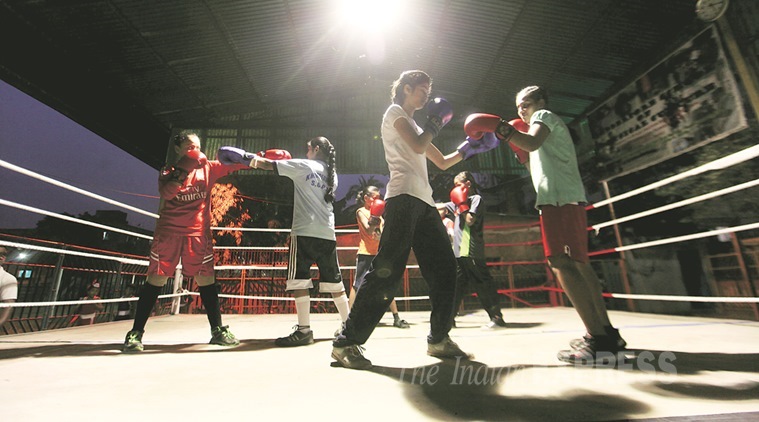
As the strains of the evening azaan dissolve into the air, Mirajuddin Ahmed, a squat man with keen eyes, takes centrestage at the boxing rink inside the Kidderpore School of Physical Culture in central-west Kolkata. It’s not much, just a raised platform lit by an overhead lamp. Ahmed’s students, a group of girls in their teens, wait patiently for his instructions. The evening walkers at the adjacent park peek curiously as the girls bow down to pray before training. The stares don’t seem to bother them. “We are used to it,” says Kashmira Khatoon, 16, who commutes two hours every day from her village, Ghutiari Sharif, in 24 Parganas, south, to attend practice.

Muslim girl boxers of Khidderpore fighting all odds to become professinal boxer. Express photo by Subham Dutta. 17.11.15

Soon, the gloves come on, the girls begin to bounce on their toes and jab their fists into the air. “It takes at least four hours of training, six days a week to be a professional boxer,” says Ahmed. He would know; better known as China da, Ahmed, 49, is a sort of legend in Kidderpore. He has turned out boxers of the calibre of 2002 Commonwealth Games gold medallist Mohammad Ali Qamar. Since 1997, Ahmed has trained over 60 young Muslim women, some of who have found themselves at the centre of Burqa Boxers, a documentary film by Alka Raghuram that is apart of the work-in-progress lab organised by NFDC at the ongoing 46th International Film Festival of India in Goa.

“When I learned about women boxers from Kolkata in 2007, I was intrigued. I wanted to know what their story was. That’s how the film came about,” says Raghuram. The San Francisco-based filmmaker travelled to Kolkata soon after to meet the girls who “dare to dream and fight”. Burqa Boxers tells the story of Razia Shabnam, one of the first Muslim girls to start training as a boxer in the Khidderpore-Ekbalpore area, and how she trains other young women in her neighbourhood.

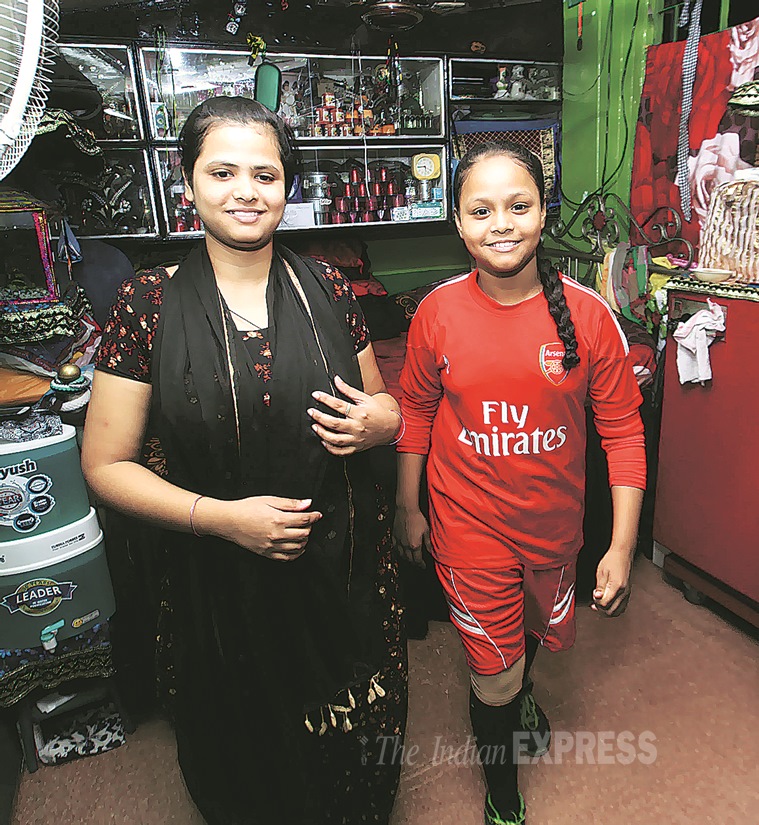
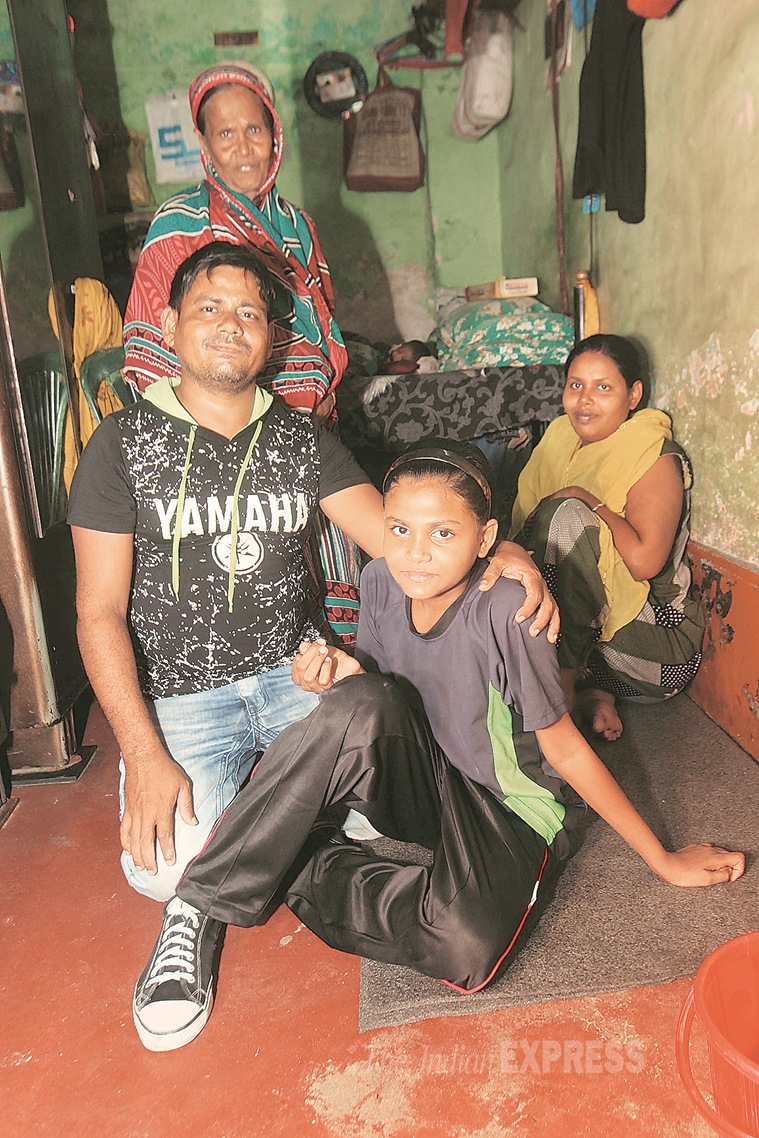
Muslim girl boxer Shaima Ajmeri (11) with her sister Shama Ajmeri (23) at their home at Ekbalpore in Khidderpore area. Express photo by Subham Dutta. 17.11.15

The Khidderpore docks are near the port. Slums huddle next to highrises and unemployment rate here is one of the highest in the city. For the rest of Kolkata, Khidderpore is not much above a Muslim ghetto. In a neighbourhood where women often do not feel at ease in the public eye, boxing means about more than landing the right uppercut. It is also about safety and retaining one’s dignity. “If the girls are able-bodied boxers, they are not teased. But if you happen to be a salwar-kameez clad girl, you are teased if walk alone after sundown,” says Shama Ajmeri, 23, a final year college student at a south Kolkata college, whose sister Shaima, 11, is training in Ahmed’s boxing club. “When I started making the film, I had some preconceived notions. I thought most Muslim families would be unsupportive of their daughters who were learning to box. But I was wrong. These girls most definitely received family support,” says Raghuram.

Mavish Halim, 11, is leading us through the serpentine Mission Dent road that leads to her home. She walks quickly, past the mosque with a mosaic dome, past the granite and chrome building of Ekbalpore nursing home, and the bottle cap factory, past the goat tied to a lamppost. A cavernous gate leads to a foyer; Halim’s family’s one-room apartment is on the fourth floor of a chawl, where she lives with her parents, sister and grandmother. “It’s a bit cramped, but we manage,” she says, shyly.

Dressed in a loose T-shirt and shorts, Halim looks different from her sister, Arshin, 21, who is wearing a pink salwar-suit with a dupatta draped over her head. For the past three years, Arshin has woken her sister at 6 in the morning, made her breakfast and sent her to Ahmed’s classes to train as a boxer. That is the dream of the Halim family — to see their younger daughter as a national-level boxer. “People ask us, why do you send your girl to a boxing class, since we are god-fearing Muslims. My response to them is that Islam doesn’t stop women from being self-reliant,” says Arshin.

Muslim girl boxer Zara Faiyaz (10) with her parents at their home at Ekbalpore in Khidderpore area. Express photo by Subham Dutta. 17.11.15

When Raghuram first met Shabnam, the protagonist of her film, the young boxer was training other girls of Khidderpore to box. Today, Shabnam, 34, is a mother of two and is employed as a trainer at a south Kolkata NGO that works with children from the red light areas. And though she has left the streets of Khidderpore behind, she says that she will never forget her roots. “This was around 1997-98. I was initiated into boxing by my brother, Tabrez, who was training under Mirajuddin Ahmed at the time. I was in college and I didn’t know of any women boxers in the country. I saw Laila Ali (Muhammad Ali’s daughter) on TV and was taken in by the glamour of it all,” says Shabnam. She approached Ahmed and asked to be trained. “Surprisingly, he was quite open to that,” she says. Since that day, there has been no looking back.

Training doesn’t come cheap. Though Ahmad charges only Rs 50 per month from his students, he says the actual cost to train amateur boxers comes to nearly Rs 10,000 a month, which includes a proper diet and training equipment. “We make do with the barest minimum and ask established boxers for hand-me-downs. We also get donations from different organisations,” he says. Most of his boxers can’t even afford gloves. “A basic glove costs Rs 1,500. That’s more than half the monthly income of the families of most of my students,” says Ahmed. One of his star students is Khatoon. “Her father is a vegetable vendor and can’t even afford the daily commuting fare,” says Ahmed.

In spite of all odds, Khatoon, who is representing Bengal at the National Boxing Championship in Guwahati next month, has big dreams. “If I get a railway job, I will be able to help my family,” she says. Khatoon’s brush with boxing began as soon as she hit her teens. “Boys in the locality where we stay would harrass my sister. I felt helpless and wanted to help her. I saw Mary Kom win matches on television and felt that I could do something about this,” says Khatoon. A cousin who lived in Kidderpore suggested Ahmed’s boxing club. But Khatoon had her reservations. “I was scared that it will be too much of a burden on my parents. A boxer’s diet is expensive. But slowly, I realised that they were actually dreaming on my behalf. My father would give me his share of eggs, my mother skips one meal a day so that I can eat properly,” she says.

Most girls in the area are married off early, sometimes in their teens, but the sport is slowly opening up new possibilities. Sufiya Noor, 12, a standard IV student at the Loyala High school has recently informed her parents that she won’t marry till she establishes herself as a boxer. “We will support her. We won’t force her to marry if she decides that she wants to excel in her chosen career path,” says her mother, Shabana Noor, 34.

source: http://www.indianexpress.com / The Indian Express / Home> Entertainment> Entertainment – Others> Eye 2015 / by Premkumar Biswas, Mumbai / November 25th, 2015

‘Dangal’ experience changed my life: Kashmiri actor Zaira Wasim

Srinagar,  KASHMIR  :

“I was like new to the (showbiz) world and felt nervous when I was working with my co-actors on the sets”, Zaira Khan said.

Zaira Wasim, who was unknown a few months ago, has now become a household name in her native Kashmir after landing a role in superstar Aamir Khan’s upcoming movie “Dangal”.

Zaira Wasim, who was unknown a few months ago, has now become a household name in her native Kashmir after landing a role in superstar Aamir Khan’s upcoming movie “Dangal”.

Competing with a thousand girls, Zaira never thought she would ever get a chance to land a role in the film. But luck was on her side, as she bagged the role of wrestler Geeta Phogat and got the chance to share screen space with Aamir. After completing shooting for six months in Mumbai, Zaira is now back in Srinagar.

“I was like new to the (showbiz) world and felt nervous when I was working with my co-actors on the sets”, Zaira told IANS on the phone.

“The experience has been so strong to change my life. Playing Geeta Phogat, the role demanded wrestling skills on my part. I had to go through rigorous physical and mental training,” added the 15-year-old Zaira, who is currently in Class 10.

Phogat is the first woman wrestler from India to have won the gold in the 55 kg freestyle category at the 2010 Commonwealth Games. In “Dangal”, Aamir plays wrestler Mahavir Singh Phogat, who trained his two daughters in the sport.

Zaira’s training included exhaustive morning sessions of running, swimming and wrestling. The training made her learn to overcome anxieties.

“Before ‘Dangal’, I had done two ads. I got a call from Mukesh Chabra (the film’s casting director) to attend an important workshop for a week. I went to Mumbai to attend the workshop. There were a lot of girls who had already done one or more ads or serials and I had to do some scenes in front of them; so, I was like ‘there is no space for me’,” she said.

Like other parents, Zaira too had to convince her parents to support her decision to act in the film, more so being from Kashmir.

“It was my school principal and my aunt who supported my decision. They both convinced my parents and handled the situation very well,” Zaira said.

As the word of her shooting for the film spread, some netizens began trolling and bullying her and also issued self-styled life threats.

“Some nasty comments about me were posted on social media. But Aamir Khan and the rest of the crew helped me. I am still getting comments from unknown persons, but I believe in positivity and have learned how to deal with such comments,” she said.

“To be honest, after getting back to Kashmir and being a girl, it haunts me how people would feel about me now. But I saw appreciation and support from my friends, family and other neighbours and I am really honoured that people are telling me I am representing Kashmir,” she added.

Zaira said that the people in Kashmir should “realise their talent” as they have a “lot of potential and ability”.

Does she have any plans for future in Bollywood?

“I don’t have any goal or any aim which I have to follow; I am going with the flow that life shows me… I want to study, but if another film offer comes my way in future and doesn’t affect my studies I will take it,” Zaira concluded.

source: http://www.indianexpress.com / The Indian Express / Home> Entertainment> Bollywood / by IANS / New Delhi – December 13th, 2015

Meet Riyaz Pasha who decks up Lord Krishna & Radha

Bengaluru, KARNATAKA :

Bengaluru  :

In an obscure bylane abutting the glitzy Commercial Street, Riyaz Pasha is engrossed in some intricate work. He’s giving the finishing touches to an embroidered orange-magenta dress. Ask him who it is for and pat comes a reply. “For Lord Krishna and Radha,” he says before getting back to fine-tuning the chamkis (golden beads) on the skirt.

For 15 years, Pasha, 48, has been the official embroidery designer for Iskcon, Bengaluru. “Everyone has the right to serve god. I enjoy doing this work for the temple,” he told TOI during his first visit to Iskcon on Thursday.

“When we approached him to do the embroidery, he didn’t think twice. And he has no inhibitions talking about our requirements. We have been working in perfect synchronization for 15 years now. We provide the dress material to him and he does the embroidery and other work,” said Bhaktilata Devi Dasi and Chameri Devi Dasi, dress designers at Iskcon.

So far, Riyaz has designed more than 105 dresses for Radha, Krishna, and Balaram. “It takes me two to three days to get one piece ready. Sometimes, it may even stretch to a week,” he said. When asked if his family or community had any reservation to the job, he said: “This is a business for us. All my family members and community leaders understand that and have no problem. No one has opposed what I do. I keep religion out of my work and treat every assignment equally. I will do this work for the Krishna temple all my life”.

Everyday, the attire is changed twice at the temple. “The whole idea of making the deities wear embroidered Kancheevaram sarees is to make them look brighter, even from a distance,” said Bhaktilata.

Not just in Bengaluru but in Vrindavan (Lord Krishna’s birthplace) too, it is a Muslim who designs dresses for the deities. As Vasudev Keshav Dasa, Iskcon vice-president (deities), puts it: “At Iskcon, we do not discriminate based on religion.”

source: http://www.timesofindia.indiatimes.com / The Times of India / News Home> City> Bengaluru / by Seetha Lakshmi, TNN / December 15th, 2015