Located at Hatta in Imphal East District, the Public Hospital and Research Institute Trust provides health care facilities to the poor socio-economic people of the state.
It was established in 2001 by the minority Muslim Community. The majority of the staff members belong to the Muslim community; however there is no discrimination on religious lines. The hospital is well equipped with a laboratory and an operation theatre.
Since its inception, it has treated around 15,000 patients from all over the state.
At present a team of 40 doctors is working in the hospital, of which 20 Doctors are specialized in different fields.
The Hospital not only helps the poor and needy but also is a perfect example of love and unity among different communities.
Category: News & Politics / License : Standard You Tube Licencse
Deputy Commissioner Meer Anees Ahmmed directed the officials to gear up for the upcoming Tula Sankramana event at Talacauvery scheduled to be held on October 17.
Chairing a preparatory meeting on Tuesday, he asked officials to ensure drinking water supply and construct temporary toilets and maintain cleanliness at Talacauvery where thousands of devotees are expected to take part.
The DC also asked officials to make lighting arrangements at the site as the event will be held at midnight and to clear the weed grown on either side of Madikeri-Bhagamandala-Talacauvery, Napoklu-Bhagamandala road and to ensure cleanliness placing waste bins at various locations in Talacauvery.
He directed the revenue officials to conduct revenue and pension adalats and respond to the grievances of the public. “There are complaints about delay in the issuance of income and caste certificates. The issue needs to be rectified at the earliest. The applications received under the old age pension, Sandhya Suraksha yojana, widow pension, Manaswini, Maitri and other schemes should be cleared at the earliest,” he added. Additional DC M Sathish Kumar said there is a need to dispose of the applications filed seeking voter IDs within a short time frame.
source: http://www.deccanherald.com / Deccan Herald / Home> District / DHNS – Madikeri, October 07th, 2015
The Coimbatore Medical College and Hospital has performed 100 cochlear transplant surgeries in the last two years, becoming the first government hospital to reach this number.
Coimbatore :
The Coimbatore Medical College and Hospital (CMCH) has performed 100 cochlear transplant surgeries in the last two years, becoming the first government hospital to reach this number.
All the surgeries had been performed under the chief minister’s comprehensive health insurance scheme, said doctors.
The CMCH is the only other government hospital, besides Madras Medical College, approved to perform cochlear transplants under the Tamil Nadu Health Systems Project.
Doctors said they performed their first cochlear transplant surgery on August 10, 2013 and performed the 100th surgery on October 1 this year.
“All the surgeries were successful and all the children operated have recovered and are doing extremely well,” said professor and head of the ENT department Dr V Aravindhan.
The insurance scheme makes cochlear transplant surgeries free for children between 0 to 6 years of age.
“Cochlear transplants are usually done on stone deaf children or those who are severely hard of hearing,” said ENT professor Dr Ali Sultana.
“But since the implant is something that stimulates an auditory nerve in the brain, and later fills the auditory cortex with sounds and information, children learn to use it and benefit better,” he said. “Thus they can speak on the phone and have face to face like conversations like normal people.”
Earlier cochlear transplants were being done only at private hospitals because of the implant was expensive—Rs 5.1 lakh even for the basic low-end one. Now since the scheme allots Rs 7 lakh for the surgery, government hospitals have now begun performing the surgery.
“This includes pre-surgery screenings tests, the surgery, implants, post-surgery complications and a one-year rehabilitation program for the children,” said Dr Aravindhan.
The CMCH has tied up a private institute called “Hearing Aid Centre” to provide the one-year rehabilitation post-surgery.
“They with a team of audiologists and speech therapists provide audio verbal therapy to children, who will start filling their memory cortex with sounds and noises, and slowly start repeating them as part of speech processing. Within the first three months, they start speaking simple words,” said Dr Sultana. `
While cochlear implant surgeries are being done under the state comprehensive health insurance scheme in private hospitals too, other screening and post-surgery costs start piling up, say patients.
source: http://www.timesofindia.indiatimes.com / The Times of India / News Home> City> Chennai / by Pratiksha Ramkumar, TNN / October 05th, 2015
This is the seventh title that the Sania-Martina combination has won this year. (Getty Images)
Wuhan :
Ace Indian tennis star Sania Mirza continued her superb run with Swiss partner Martina Hingis as the duo clinched its seventh title together by winning the Wuhan Open women’s doubles trophy on Saturday.
The top-seeded pair eased past the Romanian team of Irina-Camelia Begu and Monica Niculescu 6-2, 6-3 in the title clash.
“Title number 7 #SanTina @mhingis #WuhanOpen,” the Indian star tweeted accompanied by a picture of the duo with the trophy.
Sania and Hingis had it relatively easy in the second round, quarterfinals and semi-finals after getting a first round bye in the tournament.
Sania and Hingis dropped serve three times and fought back from a 2-0 deficit in the second set to emerge triumphant in the summit clash today.
With this win, the Indo-Swiss pairing has seven WTA doubles titles together this year — Indian Wells, Miami, Charleston, Wimbledon, the US Open, Guangzhou and Wuhan.
They have won their last three tournaments and their last 13 matches without dropping a single set.
They now head to the China Open in Beijing, where they have been given the top billing.
source: http://www.timesofindia.indiatimes.com / The Times of India / News Home> Sports> Tennis / PTI / October 03rd, 2015
Aishwarya Rai Bachchan dances at the Indian Super League opening ceremony. (AFP Photo)
Chennai :
Aishwarya Rai Bachchan’s breathtaking moves complemented A R Rahman’s soulful music as the country’s who’s who from various fields got together for football to kick off the second season of Indian Super League (ISL) with a brief opening ceremony here on Saturday.
Even as the beautiful Aishwarya sparkled by dancing to her hit numbers such as Dola Re Dola, Dhoom Dhoom, the highlight of the evening was music maestro Rahman performing the national anthem at the Jawaharlal Nehru Stadium here.
The 45-minute programme was attended by, among others, Sachin Tendulkar, Rajinikanth, Mukesh and Nita Ambani, besides the Bachchan family.
The initial part of the programme saw a performance by Bansi Kaul’s troop.
Young Bollywood actor Alia Bhatt gyrated to some of her hits from movies like Student of the Year, besides performing to the ISL theme song ‘Let’s Football’.
The franchises owners of opening day fixture between Atletico de Kolkata and Chennaiyin FC were called on to the stage and introduced by host Arjun Kapoor, following which Aishwarya entered the scene.
Amitabh Bachchan couldn’t stop clapping as her daughter-in-law performed.
“Together with your support we will make ISL a success,” said Nita Ambani, the inspiration behind the initiative and founder chairperson of Football Sports Development.
Heartthrob Rajinikanth hugging cricket legend and Kerala Blasters’ co-owner Tendulkar and cine star Aishwarya were some of the worthy moments of the show.
The noise level reached a crescendo as two of India’s greatest icons — Rajnikanth and Bachchan — took centre stage in front of 15,000-20,000 people and shared a word or two.
Earlier, after a few hundred kids unfurled the team banners of all the eight outfits of the ISL out on the pitch — choreographed wonderfully, it was Alia’s time.
Alia, with a little help from the Master of Ceremony of the evening, Arjun Kapoor, kicked things off with a brief performance, dancing to some of her famous hits, which included ‘Radha’ and ‘Disco Deewane’ before finishing her performance with the song that has been ringing in all ears for the past couple of months ‘C’mon India, Let’s Football’.
Aishwarya, with her husband Abhishek and father-in-law Amitabh watching from the VIP section, came and danced gracefully, with a Tamil number, particularly, cranking up the decibel level.
However, it was an altogether different ball game when Tendulkar and Rajinikanth entered the stage.
Nita Ambani then declared the second season open.
source: http://www.timesofindia.indiatimes.com / The Times of India / News Home> Sports / PTI / October 03rd, 2015
The Indian University athletics team which is set to participate in the World University Games next month will have a lone Tamil Nadu athlete in its ranks.
Twenty-year old SN Mohammed Salahuddin, son of former triple jumper and current national athletics coach KS Nizammuddin, has been picked for the July 3-14 event scheduled to be held in Gwangju, South Korea.
In all 13 Indian athletes (five men, eight women) were selected following trials at the Punjabi University, Patiala on May 27 & 28. The World University Games is an international multi-sport event organized for university athletes by the International University Sports Federation (FISU). The Games has proved to be a springboard for the likes of athletes such as Michael Johnson and Michael Phelps.
A student of Bharathiar University, Coimbatore, triple jumper Salahuddin, won silver at the Federation Cup Senior National Championship in Mangaluru last month and clinched gold at the All India Inter University Athletics Championship earlier this year. A camp for the selected athletes will be held from June 11-26 at Moodbidri, Mangaluru.
M.Sridhar of SBRR Mahajana FGC (centre) was crowned ‘Mr. Mysore University 2015’ in the Best Physique competitions held at the University of Mysore Gymnasium Hall. He is seen receiving the certificate and trophy from Dr.C.Krishna, former Director, Department of Physical Education, UoM (extreme left) and Prof. B. Mahadevappa, Finance Officer, UoM.
Mysuru :
M.Sridhar of SBRR Mahajana FGC, Mysuru, was crowned ‘Mr. Mysore University 2015’ for winning the Best Physique title in the competitions held at the University Gymnasium Hall here yesterday. Sridhar had also won the first place in the 80kg category and in the title round impressed with his performance and won the top honours.
The results:Best Physique: 60kg: 1. M.B.Vikas (SBRR FGC); 2. D.H.Shashikumar (NDRK Hassan); 3. E. Harish (GFGC, Kuvempunagar).
65kg: 1.Syed Muddasir (JSS College, Nanjangud); 2. K. Vinay (Teresian College); 3. N. Prasanna (SBRR Mahajana FGC).
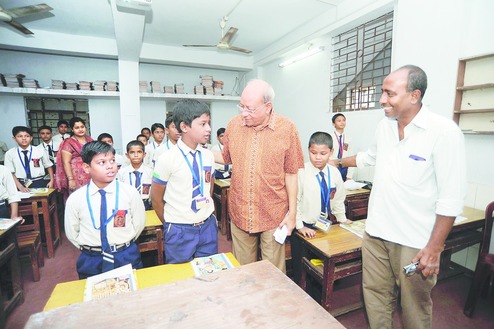
Mamoon Akhtar (right) with Emami co-founder RS Goenka during a visit to his school in Tikiapara. Picture by Sanjoy Chattopadhyaya
Mamoon Akhtar was forced to drop out of school in Class VII because his parents couldn’t afford his tuition fees. Three decades later, the 43-year-old from Howrah is the driving force behind a school in Tikiapara with 3,000 students, most of them children of unlettered parents.
Mamoon’s extraordinary journey from victim to champion of the underprivileged started the day he decided that he wouldn’t be deprived of an education just because his family couldn’t pay for his schooling.
“My father was a labour contractor. Our family fell on bad times when his business collapsed and I had to leave school. But I started giving tuitions and continued studying on my own. I would sit for examinations as a private candidate and this continued till Class XII, beyond which I couldn’t progress because my father died and our financial condition got worse,” Mamoon recalled.
Mamoon is the youngest of six siblings, including four sisters. While one of the Akhtar girls went on to get a bachelor’s degree in arts, he is the only one among the remaining siblings to study beyond Class X.
After his father died, Mamoon took up a librarian’s job in a private school in Tikiapara, supplementing his income by giving private tuitions. Life would have gone on as usual but for what was playing at the back of his mind. Try as he might, Mamoon couldn’t get over how he was forced out of school.
In 2002, Mamoon founded a school in Tikiapara with six students. “I would take in nursery-level kids and prepare them for admission to Urdu, Bengali and Hindi-medium schools the next year,” he recounted.
While the initial expenditure on books and furniture was entirely Mamoon’s, help arrived as the queue of parents wanting to put their children in his school grew longer. Caring Friends, a group of philanthropists, came forward to fund the initiative and the aptly named Samaritan Help Mission School hasn’t looked back since.
Homemaker Tara Khatun’s son and daughter study in the school and she couldn’t be happier for the opportunity. “I pay Rs 80 as the monthly tuition fees for my two children. We couldn’t have paid for an English-medium education if this school didn’t exist,” said Tara, whose husband works at a blacksmith’s shop.
Samaritan Help Mission School is in stark contrast to its surroundings – narrow, dingy lanes lined with shanties inhabited by families for whom life is a struggle every single day. The five-storey school building on a three-cottah plot has Wi-fi enabled classrooms equipped with projectors, among other facilities.
“We use projectors for the benefit of some students with impaired vision. It is easier for them to see on the screen than strain their eyes trying to make out what is on a blackboard,” Mamoon said.
The school currently takes in students from classes I to VIII. Younger students are admitted to the Rebecca Belilious English Institution, located around a kilometre away in an area that used to be a den of crime.
The land on which the second school stands had been a garbage dump for years until Howrah City Police and the Howrah Municipal Corporation got together to create a conducive atmosphere for Mamoon to expand his initiative.
“We helped them (Mamoon and his staff) build a wall, remove encroachments and start a school there. Today, many children from poor families get free education there,” police commissioner D.P. Singh said.
Sources said Singh’s predecessor Ajey Ranade played the key role in transforming the place into a site suitable for a school.
After completing Senior KG at Rebecca Belilious English Institution, most children move to Samaritan Help Mission School, which has been adding a class every year.
“We are affiliated to the West Bengal Board of Secondary Education. When the current batch of Class VIII students is ready for promotion, we will start Class IX,” a teacher said.
Both schools run on corporate funding from companies like Chevrolet, Cognizant, Emami, Edelweiss and Tata Steel. Charity organisations like Kolkata Gives and Caring Friends continue to fund several school activities.
Last Sunday, a team of industrialists and businessmen visited the two schools to see the fruition of Mamoon’s dream. R.S. Goenka, one of the founders of the Emami Group, said: “I come here because the school and the kids here inspire me. I also get to see how people are benefiting from our funding.”
The Emami Group has financed toilets and projectors on the main campus while Rebecca Belilious English Institution has an AstroTurf funded by car manufacturer Chevrolet.
Sport is integral to Mamoon’s vision of a school. Samaritan Help Mission School recently acquired a table tennis board and two of its students, Mohammad Sharik and Sonu Rajbhar, got the opportunity to visit Manchester United Club in Old Trafford earlier this month.
“A big company sponsored the trip. The duo were selected from among kids from underprivileged families who have excelled in football,” a teacher said.
Sharik is in Class IV and Sonu is a student of Class V.
For Mamoon, it’s been a tough but satisfying ride since the days when a group of college girls he had enlisted would go around Tikiapara trying to convince people to send their children to school.
“Many people suggested that I turn my school into a Bengali, Hindi or Urdu-medium institute, but I insisted on an English-medium school. Knowing English is very important in the current scenario,” the 43-year-old said.
Scores of parents are grateful that Mamoon stuck to his plan. Sending their children to any other English-medium school in the area would have been 10 times more expensive.
Mamoon’s three daughters – seven-year-old Atifa Fatema, six-year-old Adifa Fatema and four-year-old Batul Fatema – also study at Samaritan Help Mission School. When wife Shabana readies the three girls for class every morning, he can’t help but wonder what life might have been if he weren’t asked to leave school in Class VII.
What is your message for Mamoon? Tell ttmetro@abpmail.com
source: http://www.telegraphindia.com / The Telegraph, Calcutta,India / Front Page> Calcutta> Story / by Subhajoy Roy / Wednesday – September 30th, 2015
Legendary Bollywood singer Mohammed Rafi’s biography has been released by publishing house Om Books International. Titled ‘Mohammed Rafi: Golden Voice of the Silver Screen’, penned by author Sujata Dev, that includes enriching anecdotes about the singer’s life. The book presents Rafi’s musical journey and what made him an utter delight to work with for every music director.
Author Sujata Dev had to face many challenges as she went about researching the book. “It was the toughest part of the research as those days had no computers and records were hard to find. Many stories and figures came to me from different sources but to authenticate them was not easy,” said Sujata, who has been an avid fan of the legendary singer since her childhood.
In her book, Sujata mentions that Mohammed Rafi, was a music director’s delight. She stated that Rafi sang for directors like Naushad, OP Nayyar and Madan Mohan, amongst many others, who were perfectionist and never failed to satisfy them.
The author adds that tracking his footsteps were extremely difficult as most of his relatives and associates had passed away. “But then I met Pyarelal ji, the renowned music director who had closely worked with Rafi sahab and when I told him about this biography and the challenges I was facing he said – you are the blessed one. You have a great task ahead of you,” stated Sujata.
This statement instilled a lot of confidence in Sujata’s heart and she knew she had a tough task ahead of her but it came with the blessings of Rafi Sahab himself and the good wishes of all his admirers.
The author said she was lucky enough to trace the details of Siddique Chacha, Rafi Sahab’s younger brother, who is hale and hearty even today, and lives in Lahore. She met over a hundred people from the industry before she could complete this book. The DVD accompanying the book has many of these interviews.
Through the book, the author plans to popularize Indian music amongst the younger generation.
By Kirti Arora (ANI)
source: http://www.in.lifestyle.yahoo.com / Yahoo.com / Home> Yahoo India – Lifestyle / by ANI / September 29th, 2015
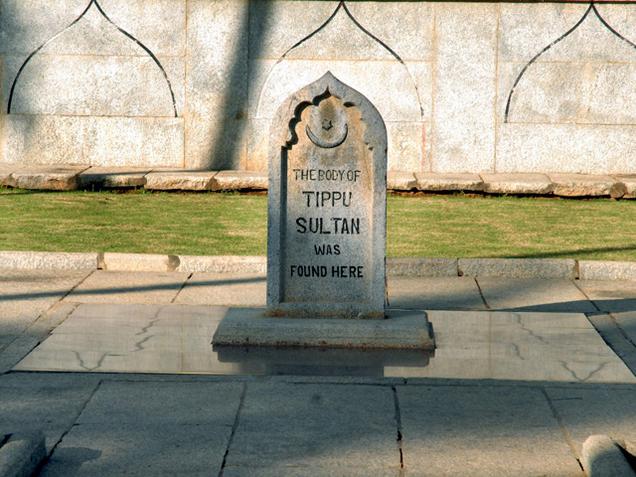
The 216th death anniversary of Tipu Sultan was commemorated on Monday.— Photo: M.A. Sriram / The Hindu
The expansion of sericulture in Mysuru region has been credited to Tipu Sultan
The death of Tipu Sultan on May 4, 1799, brought to close a fascinating chapter in Indian history; but his legacy continues to endure notwithstanding the controversy surrounding him in the present times.
Though it has been 216 years since the death of Tipu Sultan, historians are unanimous in pointing out that his initiatives in the socio-economic fields have continued to endure, though these were fast fading from public memory.
The expansion of sericulture in the Mysuru region has been credited to Tipu Sultan. The Mysore Gazetteer notes that Tipu secured the know-how from Bengal and introduced mulberry cultivation in 21 centres. In what could be described as a step to encourage local industry, he banned the export of cotton to ensure that local weavers were not denied the raw material.
The introduction of sugarcane on a large scale has also been attributed to Tipu Sultan for which he secured the assistance of Chinese experts, according to the Gazetteer, which notes that quality sugar and candy were produced with their assistance.
During the pause between the various wars he fought, Tipu Sultan took some reformatory measures including a ban on alcohol. Cattle being closely linked to agriculture, Tipu Sultan encouraged livestock breeding. Hallikar and Amrit Mahal breeds are believed to be products of this initiative.
Rocket technology
Modern day historians also credit Hyder Ali and Tipu Sultan with an elementary knowledge of missile or rocket technology, which is considered to be the prototype of present-day missiles and rockets. They were put to full use during the wars with the British. Some of these have been preserved at the Royal Artillery Museum in England. The paintings at Dariya Daulat, the summer palace of Tipu Sultan at Srirangapatana, are a clear indicator of the use of these missiles in wars.
A courtyard within the ruins of the Srirangapatana Fort was identified by archaeologists as the possible spot from where the missiles were launched. Scientists from DRDO have also visited the spot on many occasions in a bid to ensure better maintenance. Plans for a ‘missile museum’ are yet to materialise.
The expansion of sericulture in Mysuru region has been credited to Tipu Sultan
source: http://www.thehindu.com / The Hindu / Home> National> Karnataka / by R. Krishna Kumar / Mysuru, May 05th, 2015