Chief minister K Chandrasekhar Rao on Saturday congratulated Hyderabad- based Indian lawn tennis player Sania Mirza for receiving Rajiv Gandhi Khel Ratna award.
The Chief Minister wished her all the best, expressed the hope that in future she would get many more such awards nationally and internationally, an official release from the CMO said.
source: http://www.newindianexpress.com / The New Indian Express / Home> States> Telangana / by Express News Service / August 30th, 2015
(Death Anniversary on May 6, 2006)
In the late 1930s, Naushad Ali came to Bombay to be a success as a musician. But he had to struggle to make it to the top. Initially he faced rebuffs, and had to endure periods of utter deprivation. Naushad even spent nights sleeping on footpaths before he finally secured a job as a pianist in composer Mushtaq Hussain ‘s orchestra. Composer Khemchand Prakash took him on as his assistant and taught him, an act for which he remained extremely grateful throughout his life. Soon, Naushad got his break with the film Prem Nagar (1940), but it was only with Sharda (1942) that he got attention. The film Ratan (1944) took him right to the top, and from then on he could produce blockbuster songs for appropriately smash hit films, most notably films made by either Abdul Rashid Kardar or Mehboob Khan.
Naushad’s style was renowned for his ability to incorporate classical rhythms into his symphonies. He based his music upon the “ragas” that formed a basis in Indian classical music, and thus his music took on complex formations and . His taste for classical music was legendary – in the Mughal musical Baiju Bawra (1952), he used actual classical singers to sing his ghazals. In spite of his classical tendencies, he could also keep up with the times and adapt Western techniques and instruments into his music, as heard in the films Jadoo (1951) and Mere Mehboob (1963). Naushad was also among the first to use the techniques of sound mixing, of separate recording of vocal and music tracks in playback singing, and using background scores to enhance characters’ moods and dialogues through music.
Naushad’s career continued at a steady peak throughout the 1950s and 1960s, with some of his melodies being featured in now-perennial classics like the Mughal period films Baiju Bawra (1952) and Mughal-E-Azam (1960) and the epic Mother India (1957). Unfortunately and to his distaste the times were changing and demanded more fast-paced, peppier tunes, and Naushad had to struggle to keep his music pure and classical. In fact for Saathi (1968), he was persuaded, against his will, to re-record two of his songs to pep up their pace and their appeal. It was due to this uncompromising attitude towards his music that he would only compose less than a hundred films in his lifetime.
Music
“Zalim Zamana Mujhko Tumse” by Naushad, Suraiya & Shyam ()
K. Asif (14 June 1922 – 9 March 1971) was a film director, film producer and screenwriter who was famous for his work on the Hindi epic motion picture, Mughal-e-Azam (1960).
Information On India..This Page Try’s to help You to give Information on “RARE INDIA”
Company Quartermaster Havildar Abdul Hamid, PVC (1 July 1933 – 10 September 1965) was a soldier in the 4th Battalion, The Grenadiers of the Indian Army, The Grenadiers of the Indian Army, who died in the Khem Karan sector during the Indo-Pakistani War of 1965 in the Battle of Asal Uttar, and was the
AAJ TAK “Vande Matram” Remembering An Immortal Hero , Brigadier Mohammad Usman Khunambir (M.V.C.,15 July 1912 — 3 July 1948) Symbol of” India’s “Inclusive Secularism His Mother Was Jamilun Bibi D/o Abdul Kabir Ansari Belongs to Ansari Family of Yusufpur And Father Was Mohammad Faqooq
Indians continued their strong show in the 5th Commonwealth Youth Games by bagging five medals, including two gold, on the second day of competitions here on Tuesday.
Weightlifter Deepak Lather (boys 62kg category) and javelin thrower Mohd Hadish bagged a gold each in their respective events while Jisna Mathew won a silver in girls 400m race. Chandan Bauri (boys 400m) and Velavan Senthilkumar (boys squash singles) won a bronze each to continue India’s medal haul on the second day.
With five medals on Tuesday, India’s count swelled to four gold, two silver and two bronze and occupied the fifth spot in the tally after Australia, South Africa, England and New Zealand at the end of the second day. Indians had won two gold and one silver on the opening day of competitions on Monday.
15-year-old weightlifter Lather gave the gold to India in boys 62kg category as he lifted a total of 258kg with 120kg in snatch and 138kg in clean and jerk. His effort in snatch was a new CYG record.
Indian track and field athletes took part in three finals on the second day of competitions and all of them delivered personal best performances while winning a medal each in their respective events.
Javelin thrower Mohd Hadish, a silver medallist in the inaugural Asian Youth Championships at Doha earlier this year, proved to be a cut above the rest in the field as he set out the spear to a whooping distance of 79.29m in securing the gold.
Although he marginally missed the Games Record of 81.53m set by South African Morne Moolman in the last edition held at Isle of Man in 2011, the Indian thrower dominated the field as the second placed George Davies from England stood a distant 68.23m for the silver medal.
Quarter-milers Jisna Mathew and Chandan Bauri also gave their best efforts in winning a bronze each.
Jisna, an upcoming athlete from the stables of legendary P T Usha and another Doha silver medallist, clocked an impressive 53.14 secs to settle for silver in the girls’ 400m final. She missed the gold in just 5/100th of a second to Jamaican Junelle Bromfield.
source: http://www.thehindu.com / The Hindu / Home> Sport> Other Sports / PTI / APIA – September 08th, 2015
Ahmed Javed on Tuesday was appointed the new Mumbai Police Commissioner .
Ahmed Javed will take over from Rakesh Maria.
Rakesh Maria has been promoted to DG Home Guards.
Rakesh Maria was much in the news these days due to Mumbai Police’s ongoing investigations in the Sheena Bora murder case.
The home department held the changes were made taking into account the law and order factor ahead of the Ganapati festival, dismissing suggestions that that it has some links with the ongoing investigation in the high-profile murder case.
“Maria has been promoted to the director general rank and posted as the DG of Home Guards in Mumbai in place of Ahmed Javed. Javed (who was DG-Home Guards) becomes the new CP of Mumbai,” additional chief secretary (home) K P Bakshi said.
He said that post of Mumbai police commissioner has been upgraded to ‘director general’ rank post.
He said Maria, a 1981-batch IPS officer, had been transferred with “immediate effect” and that Javed, also a 1981-batch IPS officer, will take over as the new CP on Tuesday itself.
“There was no hurry in transferring Maria. It would have been inappropriate to transfer him on September 30, in the middle of the festive season as Ganapati festival, a very important event in Maharashtra would be on at that time. Therefore, we decided to advance the promotion of Maria,” he said.
When asked about the fate of the ongoing Sheena Bora murder case investigation, Bakshi said that all investigations are important and not only this particular case and that the work of the CP is only to supervise the investigation.
“Investigations are conducted by lower-level police officials and supervised by the CP. The new CP is competent. Also, Javed should get enough time to handle the situation in Mumbai,” Bakshi said.
Chief minister Devendra Fadnavis is away in Japan on a visit.
(With inputs from agencies)
source: http://www.timesofindia.indiatimes.com / The Times of India / News Home> City> Mumbai / TNN / September 08th, 2015
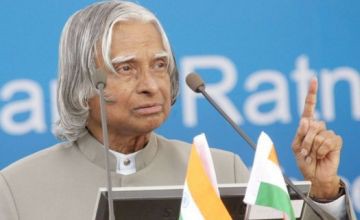
Filmmaker Nila Madhab Panda, who is planning to make a biopic on APJ Abdul Kalam, says he needs good amount of time to direct the movie on the former Indian President.
The I Am Kalam director said he had even discussed the idea of making the film with Kalam.
“When you think of making a film on such a personality, you have to take a hiatus for at least three years. It is not a film which can be made in six-seven months.
“I would love to make a film on him because I have spent ample amount of time with him. But I don’t know when I will start making it. I had few discussions with Kalam sir too about his biopic when he was alive,” Nila said.
When the entire country was mourning the death of the former Indian president, who died in Shillong in July, the filmmaker was happy to see how every channel was showing “I am Kalam” to keep his spirit alive.
“Every channel was showing I Am Kalam after his death.
Though it was not a film on his life, it is a film which will keep his spirit and teachings alive.”
I Am Kalam, a 2011 film, revolved around a poor Rajasthani boy whose life changes forever after he takes a cue from a speech delivered by the former President.
Nila’s latest satirical drama Kaun Kitne Paani Mein hit theatres recently. The film talked about the water scarcity in a village in Odisha.
source: http://www.thestatesman.com / The Statesman / Home> Interview / Press Trust of India, New Delhi / September 07th, 2015
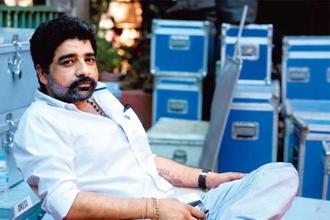
Wasiq Khan, the production designer of ‘Goliyon Ki Rasleela Ram-Leela’, on creating magic and realism
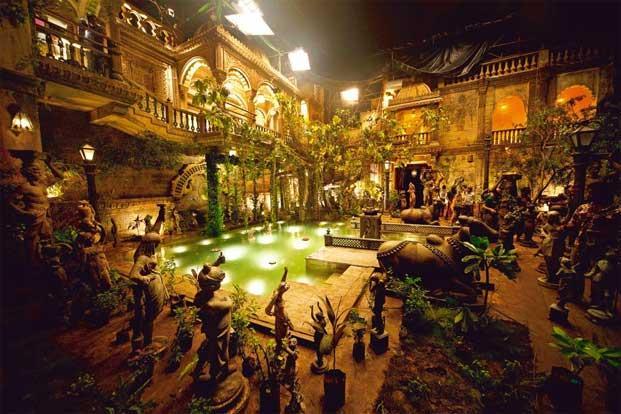
The sets of the film ‘Goliyon Ki Rasleela Ram-Leela’
It was Dhankor’s first scene in the movie, and a debate was raging about the curtains.
Should they be ornate like the apparel and jewellery in which the fearsome matriarch of the Saneda clan in Sanjay Leela Bhansali’s Goliyon Ki Rasleela Ram-Leela is swathed, or should they provide a dash of simplicity?
There were close to 200 samples from which to choose. Production designer Wasiq Khan asked an assistant to put up a roughly textured jute curtain on the wall. Bhansali loved it. The curtain stayed in the scene.
Bhansali’s superbly choreographed treatment of William Shakespeare’s Romeo And Juliet is also his lightest work till date. Here, as in his previous productions, are the epic sets that create a cosmos of impossible beauty, the decorative touches for ordinary objects, the perfectly coiffured men and women. But here is also a grungy underside to the flourishes, playful backdrops, and the co-existence of grandeur and rusticity. Bhansali’s choice of Khan, who has for years created the illusion of reality in modestly budgeted productions, has resulted in a gypsy opera that is more tethered to verisimilitude than previous ventures like Devdas, Black, Saawariya and Guzaarish
Wasiq Khan. Photo: Devendra Parab/Mint
Ram-Leela might be a mild departure for Bhansali but it has set Khan firmly on the road to bigger things. An acolyte of renowned production designer Samir Chanda, Khan has worked closely with film-maker Anurag Khashyap as well as designed such films as Dabangg, Rowdy Rathore andBesharam. He is among the people who create Hindi cinema’s newfound love for lived-in texture, and the go-to man for a level of detailing that seems utterly natural despite being utterly manufactured.
“My school is the Samir Chanda school, which is more realistic and rustic,” Khan says. “In the old days, production designers were called art directors but many of them were glorified carpenters. All rooms had that painting of Arjun and Krishna from the Mahabharat and two sunmica tables. The villain’s den had to have a stuffed tiger. Nobody bothered talking to the art director about costumes.” Greater attention is being paid to costumes, sets and locations than ever before, he says. “Audiences do care for realism, and you can’t take them for granted any more.”
Khan cut his teeth on such Kashyap films as Black Friday, set in the middle-class neighbourhoods and slums of Mumbai, That Girl in Yellow Boots, which unfolds in the city’s grungy parts, and Gangs of Wasseypur, shot at over 300 locations in Uttar Pradesh and Bihar. “I did my first commercial film because there was gadbad (trouble) in my kitchen,” he says. “Even when I did Dabangg, I maintained a sepia tint and a rustic feel. But on a film like Ram-Leela, you can open your mind and imagine things, let the artist inside you wake up even as you try to maintain the realism.”
Bhansali came calling because of Rowdy Rathore, which the filmmaker co-produced. He wanted to keep the Baroque style for which he is known but also wanted to create a parallel universe that would be believable, Khan says.
The merry mix of magic and realism is what makes Ram-Leela so special. Everything is decorated, from tattooed bodies to encrusted guns and bandhini-patterned cellphone covers. There are nods to Baz Luhrmann’s anachronisms and V. Shantaram’s invocation of temple art and architecture. The porn movie parlour run by Ram, the movie’s Romeo, is designer seedy, with neon-lit cut-outs and lurid poster art. In the weapon- storage room, guns peek out of straw baskets and from inside shimmering back-lit glass cases as though they were diamonds. The love story’s Juliet, Leela, exchanges naughty SMSes with Ram in a chamber that has Raja Ravi Varma paintings and diaphanous curtains. Glasswork patches liven up rough-hued walls, not unlike homes in the Kutch region whose craft traditions and folk culture have influenced Ram-Leela’s design and narrative.
“We worked primarily with two colours, black and burgundy, and tried to give a rustic feel in every set,” Khan says. (Bhansali didn’t respond to interview requests.)
The extended and expensive production schedule—over 200 days—was very different from what Khan is used to. He is something of a heartland specialist in his ability to conjure up a “gareeb (poor)” aesthetic, as he says. “Whenever people don’t have budgets but want to make their films look good, they think of me.”
Khan learnt his craft from the man whom he calls Dada. Chanda, who died in 2011, followed in the tradition of celebrated realism specialists Bansi Chandragupta, Satyajit Ray’s long-time collaborator, and Sudhendu Roy, the leading art director for Hindi films from the 1960s to the 1990s. Chanda recommended Khan to Kashyap for Last Train to Mahakali, his contribution to the fictional drama series, Star Bestsellers, that aired on Star TV in 1999. “Dada introduced me to Anurag as his best product, and told him that he should take me away and not send me back,” says Khan.
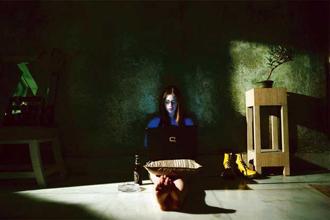
A still from ‘That Girl in Yellow Boots’
He had meagre resources to work with on Last Train to Mahakali, as well as for Kashyap’s unreleased debut feature,Paanch, made in 2003. The resourcefulness born out of need combined with the belief, drilled into him by Chanda, that sets would be convincing only when they looked lived in. “There are sets and then there are sets that indicate that somebody has lived there,” Khan says. “A place must have soul and feeling.”
Khan has been integral to Kashyap’s noir-influenced cinema right from the beginning. “We didn’t have a lot of money for Paanch, but we wanted to make the scenes look rich,” Kashyap says about his debut, in which members of a music band commit murder to fund their dreams. “There is a red room in Paanch that was Wasiq’s brainchild,” Kashyap adds. “I told him about my hostel room, with graffiti on the wall. He said, give me the graffiti and I will figure out how to do it, and he did. His ability to transform something from ordinary to extraordinary and make it look real and never lose character is why we work together.”
However, the two did not collaborate on Dev.D or Kashyap’s forthcoming Bombay Velvet. “We didn’t work on Dev.Dbecause both of us were in different zones, but we missed him a lot,” Kashyap says. “He is tremendous at turning minimal into maximum.”
Khan studied at the faculty of fine arts at the Jamia Millia Islamia university in Delhi. His family was far removed from the tinsel trade, and Khan was expected to follow in his father’s footsteps and become an engineer. He met Chanda while he was a student, on the sets of Ketan Mehta’s Sardar. He got chatting with Chanda, who handed him a business card.
After his graduation in 1996, Khan arrived in Mumbai with Chanda’s business card in his pocket. He dialled the landline number listed on the card, only to discover that the line had been disconnected. He worked his Jamia contacts and got a job at the Kamalistan studio, painting backdrops for art director Ratnakar Phadke. Khan finally met Chanda a few months later, who recruited him as an assistant for Mani Ratnam’s period Tamil film Iruvar. Over the years, Chanda became a surrogate parent for Khan. “He was like my father, we would talk every few days,” Khan says.
He also picked up from Chanda the ability to improvise at short notice. When a shoot for Rahul Dholakia’s political drama Lamhaa in 2010 had to be shifted abruptly from Kashmir to Mumbai because of security concerns, Khan created a set with “truckloads of chinar leaves” that were brought in from the state. “People started calling me from Kashmir and asked me where we had shot the sequence—when you create realism, people do notice.
Chanda’s advice remains a lodestar for the 38-year-old production designer. “I still try and maintain the rules and standards Dada gave me,” he says. “He told me to never stop thinking that the job is done. I don’t do too many films—he used to tell me that money tends to come all of a sudden.” Yet, Khan has been unable to resist the demand for his services. He is now working on the Bhoothnath sequel, a biopic on the political prisoner Sarabjit Singh, a remake of the Tamil film Ramana, and 21 Topon ki Salaami, about P.N. Joshi, a put-upon government employee whose sons try to honour him with a 21-gun salute at his funeral.
Joshi’s chawl abode is a good example of Khan’s adeptness at mimicking reality. Packed into the tiny space are a stainless steel vessel rack, a goddess-themed calendar, a mezzanine storage loft and the ice-cream spoon holder with fake purple flowers that is a common sight in middle-class homes. “You can’t pinpoint it when you watch a movie, but you can feel it,” Khan says about the art of creating the invisible, yet visible, backdrop. “Everything should not be perfect, since life isn’t perfect.”
source: http://www.livemint.com / Live Mint / Home> Leisure / by Nandini Ramnath / Saturday – November 20th, 2013
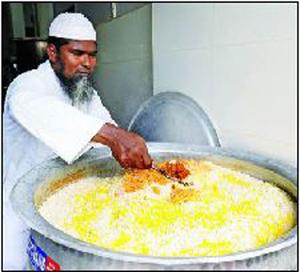
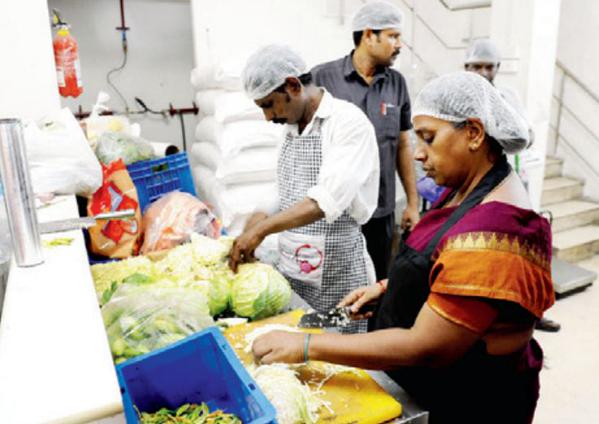
Mohammed Shabbir toils over a huge handi to conjure up his signature dish – kacchi gosht ki biryani. In the kitchen, a few men and women work quietly, cleaning vegetables, and washing vessels. Bhawarchi Shabbir on Whites Road, Royapettah, is not just another restaurant. It is a training centre which aims to help people who have battled or are battling mental illness, find gainful employment and their own space in mainstream society.
An initiative of The Banyan, a mental health NGO, and restaurateur M Mahadevan, Bhawarchi Shabbir was officially launched last Monday. “This is a training centre where about six to eight people will be trained in service – pouring water, cleaning and cutting vegetables in the kitchen, washing vessels and assisting the chef,” says Mahadevan. “At present, we have five women and two men.”
After three months of training, they will be placed in establishments run by Mahadevan, such as The Marina, Copper Chimney and Bombay Brasserie. “Once they become full-time employees they will be paid Rs 9,000 per month, plus accommodation, food on duty, medical and insurance.”
To run Bhawarchi Shabbir, Mahadevan has brought down ustad Mohammed Shabbir from Hyderabad. While customers can drop into the 30-seater place and sample Shabbir’s Dum Ka Murg Biriyani, Shabbir’s Kacchi Gosht Ki Biriyani and vegetable biriyani, along with other Hyderabadi dishes, takeaways is a major market they are targeting. The specialty, of course, are the biriyanis, which customers can order by the kilo.
All the trainees are either residents of The Banyan or former clients who have accessed services from The Banyan. “We select those who are interested in the initiative. The idea is for them to be trained and employed so that more people are inspired to come forward,” says Mrinalini Ravi, assistant director of male shelter programme of The Banyan.
“There are many people living with depression and bipolar disorder who are part of mainstream work; maybe they haven’t disclosed their status for fear of stigma and discrimination. In the case of those who are symptomatic and experience a certain level of chronicity which makes ill health more visible, discrimination seems to be rampant. Sadly maintaining social order is the norm in our society and differences are not easily embraced. Thus one gets judged and alienated if one is different or doesn’t conform,” says Vandana Gopikumar, one of the founders of The Banyan.
This initiative aims to ensure that there is promotion of self-reliance, self-worth and creativity amongst those living with a mental illness as well as positive reinforcement at the society level so that people question their own perceptions and aspire to think inclusively, she adds. “This change in mindset will encourage social mixing and build a more just, friendly and cohesive society,” says Vandana.
There are, of course, challenges. For one, Mahadevan’s staff will be sensitized to work along with the trainees. “His employees know some of the people can be symptomatic, so they have to accept it. They need to incentivize, reward and motivate them,” says Mrinalini.
For Meenakshi*, supervisor, it is a chance to have steady employment. Deserted by her husband and treated for depression, she had to discontinue working as a teacher. “After that I worked in several places,” she says. “But here I hope to get steady work and a regular salary.”
*name changed
source: http://www.timesofindia.indiatimes.com / The Times of India / News Home> City> Chennai / by Priya Menon, TNN / September 06th, 2015