Secret Recipe On a Roll

Mirza Faqib
Mirza Faqib

Unassuming man, humble beginnings and simple food ethics—that’s life for Mirza Faqib, owner of Al-Bake restaurant. Unlike other restaurants, wherein successors inherit business, Faqib has merely joined in as an extra hand. He says, he could never in his lifetime, overtake his parents in any respect—business or otherwise.

His parents, Mirza Ziauddin Beg and Ishrat Ara, who came from Saudi Arabia, left much of their possessions there but for one thing—their penchant for cooking. “When they came to India many years ago, they had few resources, but abundant enthusiasm to make life work here,” says Faqib. It was with that idea that Al-Bake, which literally means all-baked, a restaurant that serves only baked dishes, started. “We have many dishes on our menu, but nothing sells like our shawarmas—vegetarian and non-vegetarian. To be honest, ours is an adaptation of the Lebanese shawarma and we had to improvise because people here wouldn’t have cared for the authentic recipe,” he says.

Having roots in a royal mughal family, father’s inherent interest in food helped Faqib a lot in the process of re-developing the dish. When in Saudi Arabia, he was introduced to many cuisines but the one dish he liked the most was shawarma. “You have to see the queues outside our restaurant. They’re self-explanatory. We knew that people would like what we had to offer but to this extent, we hadn’t fathomed,” says Faqib.

This family is certainly not part of the hoity toity brigade of new-age restaurateurs who prefer to not get their hands dirty. An engineer by profession, Faqib cooks and cleans along with his parents everyday at their restaurant. “Actually, we cannot afford not to. Our recipe is our bread and butter. As clichéd as it may sound, it’s top secret and I cannot even let you in on one single ingredient. We have to preserve this and maintain quality of food that goes off the kitchen counters. We have good chefs, but at the end of the day, being present in the kitchen is what helps,” he says, adding, “Another thing. Working alongside other chefs has many perks, one of them being unlimited gorging on our favourite food. You know which one I’m talking about.”

source: http://www.newindianexpress.com / The New Indian Express / Home> The Sunday Standard / by Ayesha Singh / July 26th, 2015

Weavers in Erode pay homage to Kalam with special window curtain

Erode :

Weavers of Erode paid homage to former president Dr A P J Abdul Kalam by weaving a window curtain with the ‘missile man’s’ face. They plan to hand over their specially made curtain to Kalam’s family soon.

Talking to TOI, designer of Chentex (The Chennimalai Weavers Cooperative Production and Sale society Limited), K Appusamy, said that this is the first time he has designed a curtain for such an occasion. “I have made several curtains stamped with eminent personalities. I am happy to have this opportunity to design a curtain as a tribute to Dr. Kalam.

It’s a jacquard weave he has used to make the curtain. The face is first designed on the computer. After work on the computer was completed, he handed over the jacquard pattern to weavers Baby and her husband Subramanian.

“It took me a day to complete the design work. It took another whole day for the weavers to complete their work. The entire curtain has been made by hand,” he said.

This is the second time Appusamy designed Kalam’s face. On the first occasion, he had made a wall hanging when Dr Kalam became the President of the country. He has also made a wall hanging for Sachin Tendulkar, when he hit a double century in a one-day match for the first time.

He also did some design work for the Semmozhi function held during the DMK regime. When the Thanjavur temple turned 1,000 years old, he created a design of the temple. He got global recognition for his bed spread sprinkled with Tamil vowels.

The members of Chentex plan to present this special window curtain to Kalam’s family in Rameswaram, after all the formalities are completed.

They plan to sell specially made wall hangings through Co-optex outlets across the state.

source: http://www.timesofindia.indiatimes.com / The Times of India / News Home> City> Coimbatore / by V. Senthil Kumaran, TNN / July 30th, 2015

The prolific batsman with a heart of gold

Not only was Najam Hussain a saviour for the teams he represented on the field with his all-round skills, he proved a good Samaritan off it as well.

Even as he was scoring tons of runs and taking wickets on the field, the devout man wouldn’t shy away from lending a helping hand to the needy or distributing alms at a nearby dargah during lunch on match days.

“The holy Quran teaches you to help the needy and that’s what I tried to do. It gave me great joy to go to a nearby dargah and do whatever I could to poor people,” says the 74-year-old with 1,375 runs and 80 wickets from 41 first-class (Ranji Trophy) outings. His former state mates believe Hussain was someone who maximized his talent. “He was no novice with the bat, would chip in with the ball and was an astute fielder as well,” says K R Rajagopal.

Former Hyderabad offie V Ramnarayan vividly recalls Hussain’s match-winning nine-wicket haul for Jolly Rovers in a Buchi Babu game back in the 1960s. “It was a game against Hyderabad and they were cruising. Suddenly, it rained. I left for home and the next day I came to know from the newspapers that Hussain had bowled Jolly Rovers to an emphatic win with his offspin,” recalls Ramnarayan.

Interestingly , Ramnarayan, in his book, describes Hussain’s bowling as `poi’ (false or non-existent in Tamil), but he takes it in his stride. “It’s all in good humour. Having said that, if I wasn’t good enough I wouldn’t have taken a single wicket at the first-class level,” says Hussain.

Belliappa feels Hussain fit the term `team man’ to the T. “He would always put the team above everything else. He would be ready to bat anywhere in the batting order and give his best whenever given the ball. As a captain, I couldn’t have asked for more,” notes P K Belliappa, before adding, “Hussain may have been a great player, but he was a dogooder and that’s what made him such an enduring hu man being.”

Hussain says the strong bonding in the state side is something he will always cherish.”I represented Jolly Rov ers and the state side at a time when they were the strongest. To have been part of a side that had stalwarts such as Rajagopal, Kalyanasundaram, Belliappa was sheer joy ,” notes Hussain, who is currently based in Bengaluru.

(A weekly column on famous sports personalities whose first playing filed was Chennai and its neighbourhood)

source: http://www.timesofindia.indiatimes.com / The Times of India / News Home> City> Chennai / by Prasad R S, TNN / August 29th, 2015

Ambika and Afsana strike it rich

Mysore’s V. Ambika heaved the iron ball to a distance of  11.98 metres to win the gold medal in the under-16 girls’ shot put event in the three-day Shriram Properties National inter-district junior athletics meet (NIDJAM), at the Port Diamond Jubilee Stadium, here on Saturday.

Mumbai’s Poorna Rao Rane (11.94) and Chennai girl S.V. Visruti (11.08) settled for silver and bronze respectively.

In the four other finals held on the inaugural day, Tripura’s Afsana Aktar threw the javelin to a distance of 33.37m to take the top honours in the under-16 girls’ event.

Varanasi’s Versha Verma (32.18) and Cuttack’s Priyanka Toppa (30.95) took the silver and bronze medals respectively.

Mohit of Rewari (16.64m) was away ahead of his rivals in under-14 shot put. Thane’s Abhijit Nair (15.93m) and Panipat’s Sourabh (15.76m) were the other podium finishers.

Ranga Reddy’s Manan Venkatesh, with his impressive second leap (6.11m), bagged the coveted yellow metal. Delhi’s Sumit Rohila and Ernakulam’s Aadhinath took home silver and bronze respectively.

AP Chief Minister N. Chandrababu Naidu gave away the medals to the winners.

In the morning the event was inaugurated by a host of ministers and Athletic Federation of India officials including president Adille Sumariwala and Olympian Anju Bobby George.

The results:

Boys: Under-14 long jump: 1. Manan Venkatesh (RR) 6.11m, 2. Sumit Rohila (Delhi- NW) 6.01, 3. M.V. Aadinath (Ernakulam) 5.97.

Under-16 shot put: 1. Mohit (Rewari) 16.64m, 2, Abhijit Nair (Thane) 15.93, 3. Sourabh (Panipet) 15.76.

Girls: Under-14 long jump: 1. Rabina Khatun (Nadia) 4.80m, 2. Pratiksha Sanas (Aurangabad) 4.58, 3. E. Manisha (Thoothukudi) 4.50.

Under-16 shot put: 1. V. Ambika (Mysuru) 11.98m, 2. Poorna Rao Rane (Mumbai) 11.94, 3. S.V. Visruti (Chennai) 11.08.

Under-16 javelin: 1. Afsana Aktar (Sepahijala) 33.37m, 2. Versha Verma (Varanasi) 32.18, 3. Priyaka Toppa (Cuttack) 30.95.

source: http://www.thehindu.com / The Hindu / Home> Sports> Other Sports / by  J.R.Sridharan / Visakhapatnam – September 06th, 2015

Assam Chief Minister Gogoi votes for Nahid Afrin in Indian Idol Junion Season II

Assam Chief Minister Tarun Gogoi today voted for Nahid Afrin, the young singing sensation from Assam, for the “Indian Idol Junior” Season II.

Tarun Gogoi said the young promising singer from Assam has been regaling the audience and viewers with her mellifluous voice and bringing laurels to the state.

Assam Chief Minister Tarun Gogoi today voted for Nahid Afrin, the young singing sensation from Assam, for the “Indian Idol Junior” Season II.

In a statement here, Gogoi said the young promising singer from Assam has been regaling the audience and viewers with her mellifluous voice and bringing laurels to the state.

The Chief Minister appealed to the people of the state to vote for Nahid, who hails from Sonitpur district, to enable her to win the coveted singing reality show.

Impressed by the singing of the 13-year old Visharad, a Part 2 student of classical music under the Bhatkhande Kala Kendra, the Indian Idol Junior Season 2 judges said she might get offers for playback singing by the end of this season.

Intense campaigning is on in Assam, particularly in her home town Biswanath Chariali, for Nahid’s victory in the singing reality show.

source: http://www.indianexpress.com / The Indian Express / Home> Entertainment> Television / by PTI / Guwahati – August 22nd, 2015

Medal misplaced but glory and glow intact – CYCLING CHAMP’S JOURNEY TO SPECIAL OLYMPICS

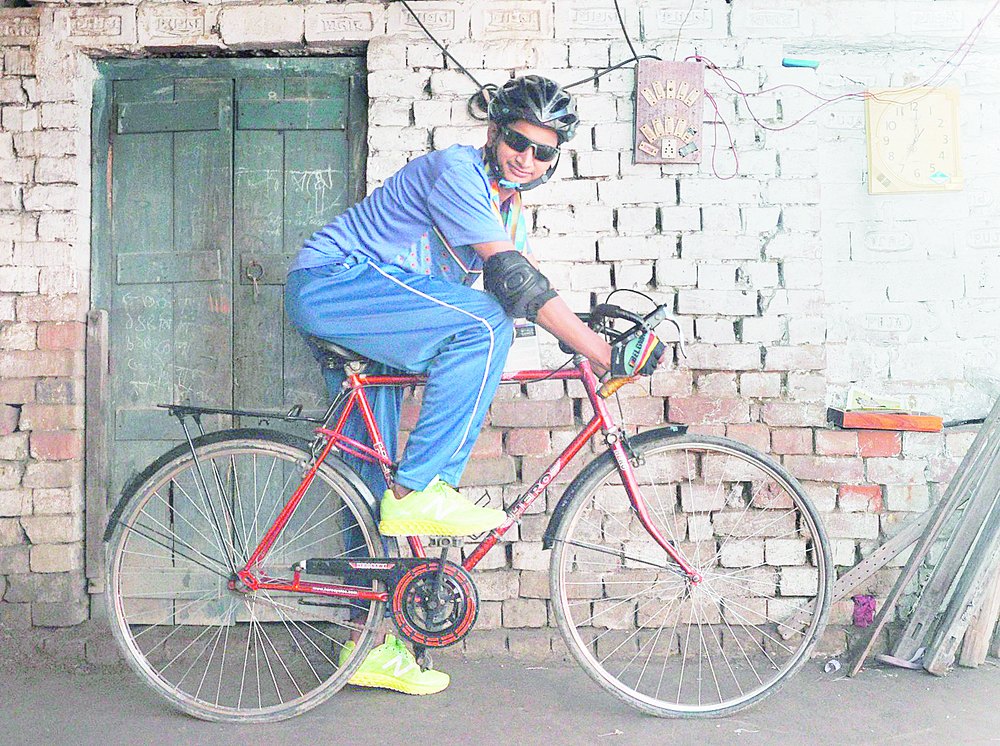
Maksud Alam Mollah outside his home in Dhulagarh, Howrah. Picture by Anup Bhattacharya

Maksud Alam Mollah won three medals in cycling at the Special Olympics in Los Angeles last month but came back with only two. The 22-year-old can’t recall where and how he misplaced the bronze that he had won in the 5km time trial event.

The only cyclist from Bengal in the Indian contingent has a condition called intellectual disability, characterised by a particularly weak memory. “He must have kept the bronze medal somewhere in the hotel or with a friend and forgotten about it,” said mother Kamruneesa.

Maksud has been taught to write down everything so that he doesn’t forget. But if there’s one thing that this young man from Dhulagarh, in Howrah, doesn’t need to be reminded of, it is how to cycle like a champion.

Maksud is convinced he would have won a fourth medal in Los Angeles with the cycle of his choice. “I had difficulty with the cycle that I was first given. It had a flat handlebar. My personal cycle has a curved handlebar. I couldn’t perform well in the first event because of this,” he recalled.

Athletes don’t take their own equipment to the Special Olympics. The Bharat chapter of the Games arranges everything.

“We changed Maksud’s cycle after we learnt that he was having difficulty riding the first one,” said Ashim Pal, the coach who had accompanied the Bengal contingent.

After that first hiccup and a new cycle, Maksud won a medal each in the three other events he competed in, including gold in the 5km road race and silver in the 10km road race.

To his parents, Maksud misplacing his third Special Olympics medal is just another footnote in his journey from Howrah to Los Angeles.

His elder brother Manzoor has the same condition and almost every day brings a new challenge for Kamruneesa and her husband Abu Sattar Mollah. “We had a zari business but couldn’t sustain it after I fell ill. My wife bought a sewing machine and started taking bulk orders for readymade pyjamas. I now run a small shop for candy and chocolates,” said Abu.

Although life is a struggle, the Mollahs are glad that Maksud has found his mission. “I feel proud of my son,” smiled Kamruneesa.

Only three years ago, the prospects weren’t so bright. Maksud had joined the National Institute for the Mentally Handicapped (NIMH) in Bonhooghly in 2012 with diminished cognitive abilities.

“He was studying in a madarsa but had fallen behind in studies. He couldn’t follow his lessons properly. We had to support and encourage him so that his performance improved. His cognition has since improved, which is why he is being able to perform better in sports as well,” said one of Maksud’s teachers at NIMH.

Help has come in other ways too. “The institute would often waive the fees for Maksud’s education. His coach hasn’t taken his fees for several months,” Kamruneesa said.

At NIMH, Maksud has trained under Tamal Chatterjee, the games teacher who also runs a sports centre called KC Memorial at Kamarhati. “I introduced Maksud to various sports. Through trial and error, I realised that cycling was his strongpoint. He went to the National Games organised by Special Olympics Bharat in Bhopal last year, where he was selected for the Special Olympics in Los Angeles,” Chatterjee said.

The selected athletes were required to attend four camps, where they were tested and trained in behaviour and independence, among other things. Maksud needed time to adjust to the fact that he would have to stay without his mother by his side for some time, Chatterjee recalled.

At KC Memorial, Maksud would practise using Chatterjee’s cycle. He got his own cycle after being selected for the Los Angeles trip.

Some residents of the neighbourhood and the panchayat pradhan of Dhulagarh, Rampada Dhonk, pooled in money for Maksud to buy his first cycle. The West Bengal chapter of Special Olympics Bharat sponsored his gear.

“The central government has announced cash awards for the winners. Gold medallists will be given Rs 5 lakh, silver medallists will receive Rs 3 lakh and bronze medal winners will get Rs 1 lakh each,” said Ashoke Chaki, the treasurer of Special Olympics Bharat, West Bengal.

For Maksud, the wheels of success and recognition have just been set in motion.

source: http://www.telegraphindia.com / The Telegraph, Calcutta,India / Front Page> Calcutta> Story / by Dalia Mukherjee / Tuesday – September 01st, 2015

Meet the Hyderabad cop who helps riders with free petrol

Merajuddin Syed has become a local hero over the past few weeks

Image: Facebook/Vijay Vj

Vijay, a resident of Hyderabad, was going home from work on August 26 when his bike ran out of fuel.

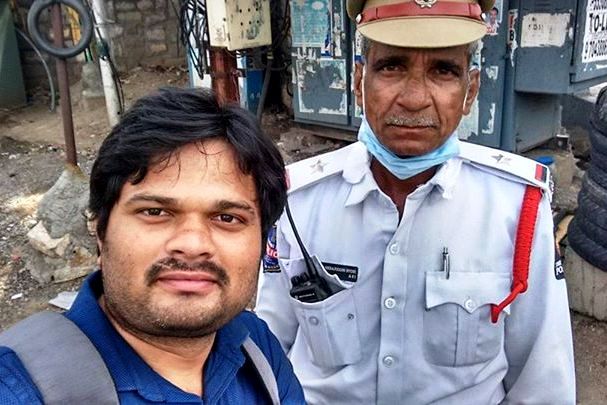
As he was pushing his vehicle, on the lookout for a place to refill, he was stopped by Merajuddin Syed, a traffic policeman who was on duty near the Begumpet area of the city.

“When he came to know that I had run out of petrol, he yelled at a man beside him to get a bottle of petrol from his bike. Meanwhile, he told me that he has got a hike and with the raise in his salary, he wanted to help people. Now, he helps people out who have run out of petrol, gives it to them free of cost. I was so overwhelmed by his kind and helpful nature. Hats off to you,” Vijay wrote in a Facebook post that had earlier gone viral.

Merajuddin Syed has become a local hero over the past few weeks and is always greeted with a smile as vehicles pass by.

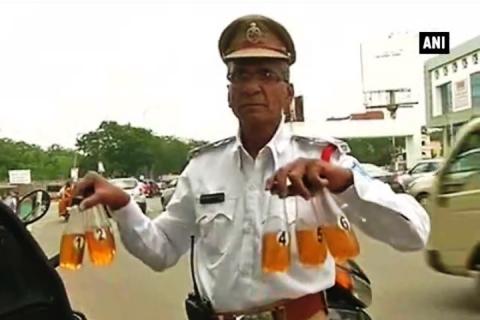
He carries 6 bottles of petrol in his scooty and refuses to take any money for it, even if the vehicle owner insists.

MerajuddinMPOs02sept07

Syed was interviewed by ANI recently where he spoke about his inspiration to do the good deed, and how the idea came up.

He also added that he was content with what he was doing. “I like when they smile after a messy day. I want people to understand that we (police) are not here just to punish offenders or to take a bribe. We can also help them.”

https://www.facebook.com/HYDTP/videos/982309021832170/

source: http://www.thenewsminute.com / The News Minute / Home> Telangana  / by TNM Staff / Saturday – September 05th, 2015

A visit to the hospital in Kerala that’s been repairing pens for almost 80 years now

Pen01MPOs07sept2015

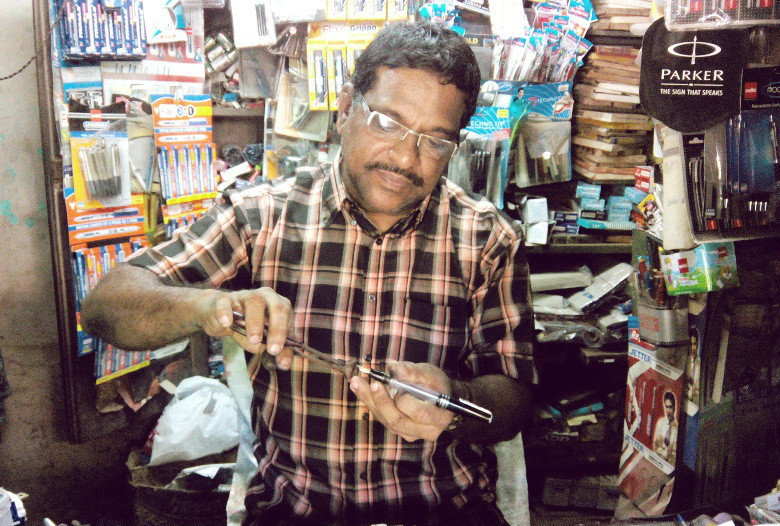
A few metres down the Town Hall Road from the famous Round of Thrissur district of Kerala is a small, single-shuttered, 78-year-old shop where pens of many famous people have been repaired, including those of a former prime minister and president.

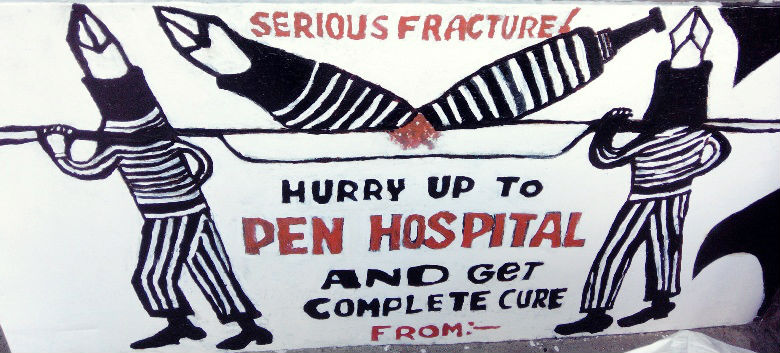
In bold yellow letters against a black background is a rectangular signboard – Honest Pen Hospital. A  painting on a wall adjacent to the shop shows a fractured pen being carried on a stretcher by two fountain pens, below which is written ‘Hurry up to Pen Hospital and get complete cure.’
Pen02MPOs07sept2015

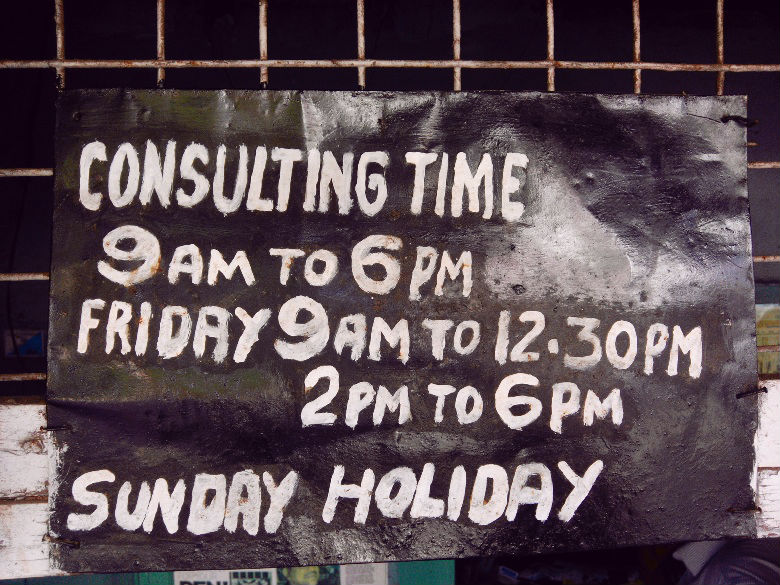
On the entrance hangs a small board with a caption ‘Consulting Time.’ 9 am to 6 pm. Next to it, hangs another board which reads ‘Wait for 10 minutes.’ This is the board which Nazar displays when he is away from the ‘hospital’ to do some household chores.

Fifty-eight-year-old Nazar is the pen doctor and has been repairing pens for the past 36 years, having learned the craft from his father.

Nazar’s father, Kaalathodu Koluthu Parambil Abdulla worked as a fountain pen mechanic in Bengal at a time when they were not popularly used. Swan, Blackbird, Pilot, etc. were the few fountain pens that were then available in India, and they were costly.

“When pens became cheaper and more people started using them, my father came back to Kerala to do the same work here. Thus was born the Honest Pen Hospital in1937,” Nazar recounts. The shop was first located in Thrissur district’s St Thomas College Road and shifted to its current location in 1959.

“My father’s fingers had some sort of magic in them. He knew pens so well that once he got a faulty pen in his hand, even before the owner could say what the problem was, he would diagnose it. He could successfully cure all pen ailments,” Nazar said.

In the last 50 years, the hospital has repaired the pens of many a famous person including former prime minister Indira Gandhi and former president APJ Abdul Kalam, and renowned Malayalm poets Kunjunni Master and Vyloppilli Sreedhara Menon.

Nazar claimed that Indira Gandhis’s secretary had once sent her pen to the shop for repairs when his father was running it. “The pen was special to Mrs Gandhi because it was gifted to her.”
Pen03MPOs07sept2015

After hearing of the death of his father passed away in December 2010, Nazar says that a man turned up at his shop. “The man showed me a fountain pen which my father had repaired. His father, an Ayurvedic doctor, only prescribed medicines using that pen,” Nazar says, adding that the pen was sent to the shop with a faulty nib.

“But the nib was not readily available and it needed a week to be replaced. By the time the son had got the pen repaired and taken it to his father, the father had got another pen for himself.” Nazar says that after his father gifted the pen to him, he got a wooden box made by a carpenter exclusively for keeping the pen safely in his locker. “As years passed the son got many more pens for himself and he forgot his gift. It was when my father passed away that he got reminded of the pen and brought it to me. Even after so many years the pen worked perfectly.”

As Nazar was telling me this story a customer walked in asking for a good fountain pen. Nazar showed him few pieces of the old, famous Doctor brand of pens made in Bombay. These pens are hardly available in ordinary shops as they are out of stock.

Having sold the pen, Nazar told his customer to use the pen regularly, or else to wash the nib section and keep it dry. “It is because of this advice that pen of the Ayurvedic doctor’s son worked perfectly when we tried writing with it after years,” says Nazar.

Nazar has had his own fifteen minutes of fame – he says he has repaired former president Abdul Kalam’s pen when the latter visited the city for an event. After returning to Delhi he learned that the organizers had cut down a tree to make arrangements for his welcome. He asked the organizers to plant a sapling in its place, for which he returned to Ernakulam. “When was placing the sapling in the pit that was dug, his pen fell into it and the pen’s top got stuck. He wanted it repaired and his secretary suggested this hospital to him. I repaired the pen.”

Today, most of Nazar’s customers are judges of the High Court of Kerala, advocates, doctors, or document writers. Typing has eaten away his customers, but for Nazar, other concerns are more important.

“Apart from helping in improving handwriting, fountain pens are more eco-friendly than ball point pens. Also, fountain pens bring sort of a discipline to life. It makes one slow down in this age of pace,” he says.

Even though business is slow as people have switched over to ball-point pens, Nazar sees his work as a service. “It is not all about money. Of course money is a factor but I do it more as a form of service. I know how badly people get affected when the pen they use regularly stops working the way they want it to. Most of the services require minor tweaking of the feed and the nib and I do not charge anything for it,” says Nazar.

But for all his love of pen, the man does not own one. “The only writing I do is when I check a pen after I repair it.”

As a young man, Nazar wanted the Malayali dream – a job in the Gulf. But his schooling was erratic because of a court case that his father had to attend to, leaving his son in charge of the shop. “But for the civil cases in the court I would have been in the Gulf. It is God that wanted me here, and he will have someone else in mind when I am not able to discharge my duties.”

The only thing that Nazar is sure of is that the next doctor in Honest Pen Hospital is not going to be either of his sons who are medical doctors.

(The stories were narrated by Nazar).

source: http://www.thenewsminute.com / The News Minute / Home / by Siddharth Mohan Nair / Sunday – September 06th, 2015

To like and laugh

Comedian Azeem Banatwalla talks about the changing scene of stand-up in the country and his need to constantly reinvent himself

AzeemBanatwalaMPOs06sept2015

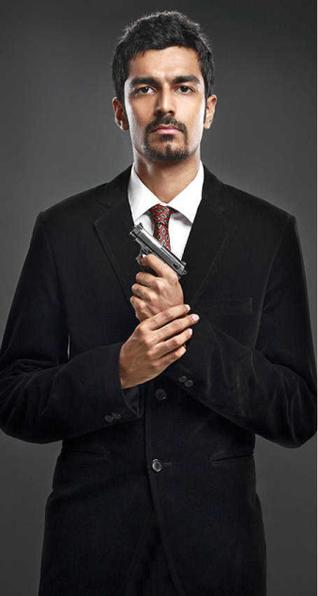
He’s been described as an ‘effortlessly likeable’ comedian, someone whose speciality is ‘merciless humour’. But at Azeem Banatwalla’s recent performance in Chennai, he struggled to find his footing. “It took me a while to get the audience warmed up. As a performer, I take some time to set up my jokes; that could be a reason. However, we settled in soon enough, and things were smooth from there,” he says.

He insists that his brand of humour is different from that of other Indian stand-up artistes. “My acts are all about things that appeal to me. I analyse religion without being offensive, and I absolutely don’t do political humour or over-the-top adult humour. I am more quirky in my approach with these topics; even when I touch upon religion, it is with tact. At the risk of sounding pompous, I’d say I’m into intelligent humour,” he laughs.

With the audience across the country evolving, keeping content fresh is a challenge for stand-up artistes, says Azeem. “The audience in places like Mumbai, Bangalore and Kolkata are good at picking up subtle humour, and they no longer shy away from calling out an artiste, if he or she is off the mark. If your material is stereotypical, you can expect to be booed,” he says, adding, “People are more well-read today. So we don’t just pander to the crowd anymore; we talk about things that we want. And I like this challenge of having to constantly reinvent my humour because, after a point, I get bored telling the same jokes over and over again.”

The 6-footer, who spent the initial part of his career writing for various publications, confesses that his acts were written like staid scripts. “I realised I was delivering the same lines in the same way, over and over again. That is no longer the case. I now just prepare a rough draft of points I want to touch upon during an act, and then go on to improvise my jokes based on how the audience receives them,” he says.

His stories stemming from frequent travels and his observation about life in general usually translate to humour on-stage. “It could be my take on the air hostesses or the crying babies around me,” says Azeem, who himself enjoys watching comedians like Bill Burr, Sundeep Rao and Anuvab Pal.

But the man, who manages to rack up laughs and guffaws throughout his acts, is quite reticent when he’s away from the spotlight. “I think I’m the most confident when I’m on stage. When I’m off it, I’d much rather sit in a corner, finish my drink and go home,” he laughs.

source: http://www.thehindu.com / The Hindu / Home> MetroPlus /  by Ranjani Rajendra / September 05th, 2015