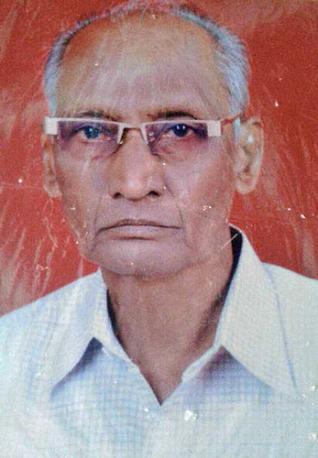
Nissar Ahmed ‘Kaleem’, Urdu poet and Gandhian thinker, died in Bidar early on Wednesday. He was 83. He was the recipient of the Karnataka Urdu Academy award this year.
The retired teacher wrote under the pen name of ‘Kaleem’ and produced thousands of couplets and hundreds of songs. They were compiled in around two dozen books in Urdu and Hindi. He also served as the head of the examination committee for the Hindi Rashtra Bhasha courses for decades.
He wrote poetry on a variety of subjects, but romance remained close to his heart. “That is the one thing that keeps me young,” he would say with a smile.
“There is no way ahead for this country other than Gandhiism,” he would announce during his numerous speeches. He would speak of Gandhian ideas and practices like communal harmony and tolerance, home industries and handicrafts and simple living with a global outlook. He would always quote paragraphs from the Hindi books and letters of Gandhiji.
He was fascinated with the deeply religious outlook of Gandhiji that remained tolerant of other religions. “Gandhiji led by example and showed us that religion and secularism are not contradictory,” he said in a meeting of heads of various religions in Bidar during Ramzan this year. However, the biggest contribution of this Kannada-speaking Urdu writer was that he acted as the bridge between writers and poets of various languages.
He would attend programmes organised by the Kannada Sahitya Parishat and invite Kannada writers to the multi-lingual poetry recitals that he and his friends organised regularly in Bidar. His last rites were conducted in the old city on Wednesday.
source: http://www.thehindu.com / The Hindu / Home> National> Karnataka / by Special Correspondent / Bidar – August 20th, 2015
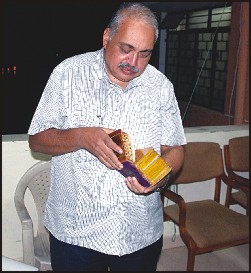
Late last night I had the good fortune of holding in my hands, albeit momentarily, a gold-leaved copy of the Holy Quran from a bygone era that had been seized recently by the Mysuru district Police when attempts were being made by some persons to sell it for a sum of rupees five crores. It all started with a late night phone call from my close friend A.G. Murali, who wanted to know if I had on hand someone who could read Arabic.
When I said that I could do it myself although I could not claim to have a scholarly knowledge of the language, he asked me if I could come down to the office of the DySP of Mysuru rural district. Sensing that I was puzzled by such an unusual request at such an odd time, he explained to me that the Police officers there were examining the recently seized Quran and were keen to know a little more about the book.
Excited by the request, I hurried to the place with my cousin Adil Pasha and my camera, sensing a rare opportunity to see and photograph the rare find. Most often I go looking far and wide for a subject to write about in my column and only once in blue moon a subject comes looking for me and here was one such Godsend!
After meeting the DySP Dr. Vikram Amte, when I eagerly asked him where the book was he smiled and pointed to an almost cubical object placed on the table right before him. Because of its unusual dimensions, I could not immediately recognise it as a book which I expected would be flat and broad as most books are. It was almost as thick as it was broad because its 302 sheets were unusually thick, being gold plated and inter-leaved with butter paper to preserve them. The rich black ink stood out against the golden background, the shine of which seemed to be without the slightest loss over the centuries. Printed on both sides of each sheet, the book has 604 hand-written pages, the text of which is very readable with the naked eye. The title page has the name ‘Al Quran Al Kareem’ like most other Qurans but on the last page is an unusual inscription; ‘Buzargaane Rava’ which the noted historian, Dr. B. Sheik Ali, after examining the book, has interpreted as a dedication of the labour of love by its calligraphers to contemporary saints. He has also said that going by the date AH 1050 on it which translates to 1605AD of the Gregorian calendar the book seems to have been crafted at the time when Emperor Jahangir ascended the throne. This was a time when hand-written calligraphy was at its pinnacle in the Moghul court.
Incidentally, the Islamic lunar year is eleven days shorter than the solar year which we follow and, therefore, an Islamic century is equal to 97 solar years. The present year of the Islamic calendar is 1436 Hijri. A book on calligraphy which I have says that the word which means ‘beautiful writing’ is derived from the Arabic and Persian word ‘Qalam’ which means pen.
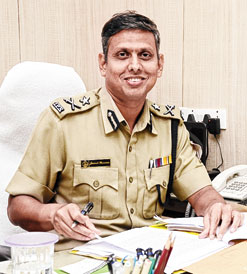
Although calligraphy exists in almost every other language too, it is in the Arabic script that it has almost become an art form. The present artifact which has now passed perhaps from the Moghul court to the custody of the law court will perhaps pass on to the desk of the archaeologists who will verify its authenticity. And, if it confirmed to be a genuine antique really from an era of which it bears the date, it will perhaps go down in history as the biggest catch of our district Police led by our young and dynamic SP Abhinav Khare. The team deployed by him to tactfully nab the persons trying to sell it consisted of Dr. Vikram Amte, Dy.SP, Mysuru Rural Sub-Division; Inspectors D. Ashok, Mysuru South, Siddaiah, K.R. Nagar, Gopala Krishna, DCIB, Sub-Inspectors Gangadhar, Saligrama, Poonacha, DCIB and Police constables Bhaskar, Anand, Ravi, Zahoor and Pachche Gowda.
It appears the BBC channel has been trying to contact our district Police for details of their find. While it is now only the small fry that are in the Police net the actual owner has not yet been traced although evidence points to a source somewhere in the Hyderabad region which is again a prominent seat of royalty and, therefore, a well-known source of royal antiques. If this relic had found its way to the international market, it would perhaps have gone under the hammer for a price that would perhaps have made the whopping sum of five crores it was being peddled here for seem like a mere pittance!
e-mail: kjnmysore@rediffmail.com
source: http://www.starofmysore.com / Star of Mysore / Home> Feature Articles / Friday – August 14th, 2015
Two South Africans of Indian origin have been pitted against current Miss World Roelene Strauss among seven candidates nominated by public vote for the title ‘South African of the Year.’
The two contenders are Imtiaz Sooliman, Chairman of Gift of the Givers Foundation and Salim Abdool Karim, Director of CAPRISA.
Imtiaz Sooliman is the founder and chairman of Gift of the Givers Foundation, a relief organisation which has received international accolades for its immediate relief assistance in 41 countries across the globe hit by war or natural disasters for the past two decades.
Professor Salim Abdool Karim is a South African clinical epidemiologist and the director of the Centre for the AIDS Program of Research in South Africa (CAPRISA).
He also serves as pro-vice-chancellor at the University of KwaZulu-Natal. The two men will come up against Roelene Strauss, Miss SA 2014 and reigning Miss World 2014.
She is the third South African woman to have won the Miss World pageant in its history and is a medical student at the University of the Free State.
The prestigious honour will be finalised early next month.
A second strong woman candidate is the current head of the African Union (AU), Nkosazana Dlamini-Zuma, who is regarded as a trailblazer in her political career in South Africa before becoming the first woman to become chairperson of the AU.
The highly successful Protea Fire campaign to build public confidence in the national cricket side by declaring that that no matter how hot the fire burns, the national flower, Protea, will always survive, through has won Cricket South Africa a nomination in the ‘Campaigns’ category.
Proteas ODI cricket team captain AB de Villiers has been nominated in the ‘Sportsperson of The Year’ category, while former Proteas ‘keeper’ Mark Boucher is nominated in the ‘Conservation’ section for his non-profit company that aims to fight Rhino poaching in South Africa.
Boucher’s career was cut short by a serious eye injury a few years ago. The only other South African Indian in the awards is Shamiel Joosub, CEO and Executive Director of the Vodacom Group in South Africa.
An accountant by profession, Joosub has previously headed up the Spanish operations of mother company Vodafone.
He is nominated in the ‘Business Person of the Year’ category.
(With agency inputs)
source: http://www.english.manoramaonline.com / OnManorama / Home> News> World / by OnManorama Staff / Thursday – August 20th, 2015
Asif Sheikh and Saumya Tandon make for a somewhat unlikely couple in Bhabhiji Ghar Par Hain. While Asif plays the lethargic Vibhuti, Saumya plays his wife Anita, a former beauty queen who is quite the go-getter. In an interview with us, Asif and Saumya discuss their on-screen comic timing and more.
Saumya, Asif, what were your first impressions of each other?
Saumya: Well, Asifji is a seasoned actor — and he’s going to kill me for saying this, but I’ve seen his work since the time I was little! [laughs]. He has done comedy for years and he is good at it. Also, some of my friends who’d worked with him earlier told me he’s a really good person. So when I met him for the first time, I was at ease. I did wonder if, like many established actors, he would be rigid about certain things. But I was happy to find that he is very easy to work with.
Asif: Initially, I had no idea who would play the role of Anita as there were various actors auditioning every day. But finally the day we had our photoshoot, Saumya came up to me and said that she had heard a lot about me from her friends.
She came across as very talkative and we got along really well. Since then, we share a great comfort level with each other.
So, who broke the ice?
Saumya: It happened gradually, there wasn’t this one moment of “breaking the ice”. The comfort level developed gradually.
Asif: I’d say Saumya was the one who ‘broke the ice’…
What do you think works for both of you as an on-screen couple?
Saumya: I think Anita and Vibhuti’s relationship is like a breath of fresh air on Indian TV. It’s not a clichéd relationship that you see in all the soaps, where the wife is the ‘sati Savitri’ and the husband is the typical chauvinist. The chemistry that we depict hasn’t been explored before, and that’s why people find it amusing and refreshing.
Asif: Also, the fact that we appreciate and complement each other’s work builds a very positive environment. We also give suggestions to each other if there is room for improvement and work together on it.
Which scene would you say has been your favourite?
Saumya: I loved the first time Anita makes Vibhuti dress up as ‘Deepu Mastana’, the domestic help, and romances him. I love the scenes where she very sweetly, politely and lovingly entraps Vibhuti in his own game, gets him to do all the work.
Asif: I loved the scenes where Vibhuti becomes Raja Ram!
What do you like most about each other?
Saumya: Asifji is a spontaneous and an intelligent actor. I relate to him.
Asif: She is really calm and composed and always talks to the point.
Okay, any quirk/trait about your co-star that annoys you?
Saumya: Nothing really. Just that he keeps teasing me about me being the bold, brazen bhabhi I portray in the show!
Asif: There is no quirk or trait as such. We are always on the same page and hence there are never any problems between us. We enjoy working together.
Tell us something fans don’t know about your co-star.
Saumya: He gets really jittery doing naughty scenes and keeps joking that his wife and children watch the show, what will they think about him!
Asif: She is a poor eater. Even if she gets sprouts, she counts and gets 20 grains! Also she carries her food in really tiny boxes. The entire cast refers to her tiffin boxes as “matchboxes”.
How do you spend time on sets in between breaks?
Saumya: Oh my room is like a music room, I have a lovely music collection and I listen to music, and I also read. I also finish all my studio work.
Asif: With shooting and rehearsing every day, I like to catch up on my sleep. I also watch some movies on my laptop and read sometimes.
source: http://www.deccanchronicle.com / Deccan Chronicle / Home> Entertainment> TV-Music / Deccan Chronicle / by Natasha Coutinho / June 20th, 2015
Police commissioner Jawed Shamim in his office. (Bhubaneswarananda Halder)
Jawed Shamim, commissioner of police, Bidhannagar, answers 10 questions asked by the residents of Salt Lake through The Telegraph Salt Lake.
When you took over as commissioner, what was your message to your force? And in your stint as commissioner, what have been the three biggest challenges faced by you and your team, and what has been your plan of action to face these challenges?
The message was simple: Together we shall and we will provide an effective police force for the residents of this Commissionerate.
Each and every sphere of policing is equally challenging and maintenance of law and order and prevention of crime are the biggest challenges for any city policing force. However, in the short term, the following three targets were identified.
Revamping the traffic system with special emphasis on traffic engineering and infusion of technology in traffic management. More visibility and better enforcement of traffic rules including removal of the auto and bus stands from various important crossings. It has already been implemented at Karunamoyee crossing and we will implement it in other parts of this Commissionerate.
Rein in illegal activities of the various dance bars and restaurants and immoral activities in various parts of this Commissionerate, especially in Baguiati, New Town & Airport areas.
Devising a mechanism to prevent house burglary and theft in the Salt Lake area through human intelligence patrolling and use of technologies, and involving the community in these efforts.
Does the Commissionerate have adequate manpower and what area does it cover?
Manpower is more than what it was before this Commissionerate was formed. However, it has to be increased further and the same is under the active consideration of the government. Bidhannagar Police Commissionerate has got an area of approximately 150sq km covered by 10 police stations.
The area of Bidhannagar Police Commissionerate has seen changes both in its demographical as well as topographical aspects. It has become the IT hub of Bengal. Many government and corporate houses have made this their home. New townships and recreation centres have sprung up. These have necessitated a more intensive and direct policing system. Policing has become much more professional, inculcating all the values needed to serve the people in these ever-changing times.
Does the police plan to install CCTVs at major crossings? A few block residents’ associations have installed CCTVs, but after a theft last year in one, it was found that the cameras were placed too high to capture faces. What is your advice for such private initiatives?
Yes, this Commissionerate will gradually be covered with CCTV cameras. As of now, we have already installed CCTV connections at 29 places in Salt Lake area, monitored centrally at Bidhannagar control room. There is a proposal for increasing the CCTV surveillance in the Smart City project. Red Light and Stop Line violation camera is being installed at one crossing on VIP Road, which will gradually be increased at other crossings of the Commissionerate.
Many CCTVs have been installed by private units. We have also sent request letters to the business establishments and housing societies to install CCTV cameras. Nowadays, CCTV camera comes at a very reasonable rate and individual houses can also afford to install these. This will go a long way in detection and thereby prevention of crime, especially property crimes. Those who are installing CCTV cameras at their own initiative are requested to contact the local police station so that they can get proper guidance regarding the correct installation points.
What steps would the police take to free the northern side of the Eastern Drainage Canal of squatters? While the other side of the bank is being beautified as the approach to Sector V, shacks have come up in rapid succession on this side over the last year and half.
We are aware about the problems of the squatters and have already taken up the matter with Bidhannagar Municipality.
Salt Lake, as the common saying goes, is like one big old-age home. What steps are the police taking to ensure the safety of elderly residents of the township who stay alone?
We are acutely aware that the services to the elderly residents of Salt Lake is one of the prime responsibilities of Bidhannagar Police Commiss-ionerate and it extends beyond normal policing. To cater to the various requirements, we have associated with the NGO called OFFER in the project Sanj Baati which exclusively looks after the problems of elderly residents of the Salt Lake area. Sanj Baati has its office in the Bidhannagar North P.S. compound. To provide ambulance and other medical facilities is also a prime area that we are working on. All police stations have been asked to get a list of the elderly people staying in their respective jurisdiction and to keep in touch with them as far as possible. Those working on 100 dial are also sensitised to attend the calls of elderly people efficiently and promptly.
Are all crimes related to cyber crime to be reported to the cyber crime police station only? Can we lodge such complaints in the other police stations as well?
This being the IT hub, increasing cyber crime has been a natural corollary. Keeping this in mind, Cyber PS has been set up to cater to the crimes arising out of the cyber world. However, it is not mandatory that cyber crime has to be reported only to the Cyber PS. All police stations are authorised to register cyber cases. If need be, they can take the expert help of Cyber PS.
What can a citizen do if a police station refuses to lodge an FIR and pressures the complainant to turn it into a general diary?
On no account should the citizens under the Bidhannagar Commissi-onerate accept the refusal to lodge an FIR. Clear instructions have been given to police stations for registration of all cognisable cases. In spite of that, if there is any reluctance on the part of the police station to register any case, the matter has to be promptly brought to the notice of the concerned Zonal ACPs / ADCPs / DCPs and my office.
There is now a separate section on your website for registration of landlords, tenants, PGs and domestic helps. How has the response been?
There has been steady response to the online registration on our website. Around 30,000 registrations have already taken place but we will urge citizens of the Salt Lake area to use this facility and register themselves in greater numbers.
One complaint from residents of Sectors 1 and 2 is how thieves escape by crossing the footbridges across Kestopur canal and reaching VIP Road. Do you have plans to guard those at night? Also can the patrol cars do a few rounds in the post-lunch hours when some of the petty thefts take place?
Regular vigil at different footbridges connecting stretches of Salt Lake with Lake Town-VIP connector etc is maintained. Police personnel are posted for night duty at the connecting points of footbridges at Salt Lake side. However, more effective methods of patrolling including foot, bicycle and motorcycle patrol are being introduced within the constraints of the available manpower and resources.
What are your goals for the next few years?
The goals for the near future is to build up a dynamic force…
capable of quick response to tackle a law & order situation.
proficient in prevention and detection of crime.
adept in ensuring smooth traffic management.
involved in various community policing projects.
What would you like to ask the police commissioner?
Write to saltlake@abpmail.com
source: http://www.telegraphindia.com / The Telegraph, Calcutta,India / Front Page> Salt Lake> Story / Friday – August 14th, 2015
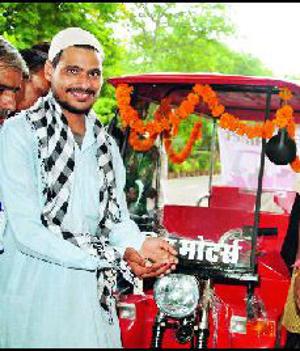
Nagpal along with social activist Sabir Qureshi (who took Aabid to the commissioner of police, Jaipur, Janga Sriniwas Rao to return the money) came to the Jaipur police commissionerate and the keys of e-rickshaw were handed over to Aabid by the commissioner.
Jaipur :
He woke up at 3.45 am to board the flight from Bengaluru to Jaipur. Sixty-six-year old Lal Chand Nagpal arrived here on Monday to salute and reward Aabid Qureshi, the honest rickshaw puller who had returned Rs 1.17 lakh he had found on the road.
After checking into a hotel, Nagpal met with the family of Aabid and in the presence of commissioner of police, Jaipur, Janga Sriniwas Rao, gifted an e-rickshaw to Aabid.
Nagpal, a businessman-turned-social activist, who had won ‘Sindhu Ratan’ award for his work had read Aabid’s story – Rickshaw puller returns Rs 1.17 lakh found on road’ appeared in Times of India on August 6 and contacted the scribe and wished to reward Aabid.
“After reading the news in Bangalore, I was so impressed with Aabid because if you lost a Rs 100 note these days, you can’t expect to get it back. And this man has returned over Rs 1 lakh despite having a very poor financial condition. I met his family and found that they were very humble. It is a good feeling while I gave them an e-rickshaw to raise bar in terms of their daily earning,” Nagpal said while talking to TOI on Monday.
Nagpal along with social activist Sabir Qureshi (who took Aabid to the commissioner of police, Jaipur, Janga Sriniwas Rao to return the money) came to the Jaipur police commissionerate and the keys of e-rickshaw were handed over to Aabid by the commissioner.
“I think this is the best example of a welfare state. A man shows honesty and another man sitting in a city rewards him. These are the real heroes of the society,” said an elated Rao.
Nagpal said, “There were few friends in Bangalore with whom I discussed the idea. They all encouraged me and also asked me to check the credentials of the man. I am satisfied and humbled after seeing the simplicity of Aabid. However, my only concern is that the people of Jaipur should now ensure that the e-rickshaw I have gifted him should only be utilized to earn his bread and butter. They should not misuse it.”
“I thought just money won’t solve the problems of his life. I am giving him a source which can ensure him a proper monthly income,” said an elated Nagpal.
Nagpal further urged the people of Muslim community who had come to welcome Aabid at the commissionerate that they should work as guarantor to ensure that Aabid should not change his path of simplicity and honesty. “Mujhe bada dukh hoga agar meri mehnat ke paise zaya honge (I will feel bad if my hard earned money will be wasted),” he added.
Aabid and his wife Ameena along with their infant daughter Anam were happiest while they were handed over the keys of e-rickshaw. “I had never thought that good act will fetch me so many things. A day after the news stories on me appeared, I had fever and went to see a doctor. The doctor after seeing me said that he had read my story in newspapers and did not charge a penny as fees as a mark of respect. I will now ensure that I should work hard to earn better in my life for my wife and family members.”
Aabid and people of his colony boarded in the e-rickshaw and departed to their destination while celebrating the moment.
source: http://www.timesofindia.indiatimes.com / The Times of India / News Home> City> Japipur / TNN / August 18th, 2015
A bust of Gandhiji installed at the Bhujanga Park, Ajjarkad, in Udupi, where he delivered a speech in 1934.
He addressed a public meeting at Ajjarkad ground
The place where Gandhiji visited and gave a speech during his only visit to Udupi on February 25, 1934, is now a park. There is a bust of Gandhiji in the midst of the park and a radio tower also stands close to it.
Vinith Rao, researcher and in-charge of Gandhian Study Centre at the Mahatma Gandhi Memorial College here, told The Hindu that Gandhiji had come to Udupi as part of his tour for collection of funds for the uplift of the weaker sections of society and also to promote temple entry for people of weaker sections through a consensus. Another object was to collect funds for the relief of persons affected by floods in Bihar.
Gandhiji toured the coastal region in a car. But since there were many rivers and rivulets in between, he and his car were ferried in a barge, then called ‘jungal’ and taken from one bank of the river to another. He was welcomed in Udupi at around 3.30 p.m. by philanthropist Haji Abdulla Saheb.
After inaugurating a ‘Khadi Bhandar’ at Kadabettu here, he went to the Ajjarkad ground to deliver a speech. Nearly 3,000 people attended the event as per a report in the Kannada weekly ‘Rashtra Bandhu’.
In his speech, which was reported in The Hindu on February 28, 1934, and also published in the ‘The Collected Works of Mahatma Gandhi’ (Volume 57), Gandhiji urged the people to create public opinion for opening temples for weaker sections.
But, he emphasised that the opinion can only be formulated by the gentlest of means. Gandhiji also pointed out in his speech that Lord Krishna had turned himself to give “darshan” to saint-composer Sri Kanakadasa at the Sri Krishna Temple here. He also emphasised on the removal of untouchability.
This speech of Gandhiji in Udupi has also been reported in the journal ‘Harijan’ dated March 9, 1934. Gandhiji received a donation of Rs. 1,240 here.
Gandhiji then left for Kundapur the same day and addressed a public meeting there also and spoke against untouchability. He participated in prayer meeting in Kundapur on February 26, 1934, which was a Monday and Gandhiji used to observe silence on that day. “On February 27, 1934, Gandhiji left Kundapur for Karwar in a steamer named ‘Dayavati,” Mr. Rao said.
Since this was the only visit of Gandhiji to Udupi, a plaque should be erected at the Bhujanga Park, where Gandhiji gave a speech. “Besides the plaque, a small museum could be constructed there with some photographs taken during Gandhiji’s visit to Udupi,” Mr. Rao said.
source: http://www.thehindu.com / The Hindu / Home> News> Cities> Mangaluru / by Ganesh Prabhu / Udupi – August 15th, 2015
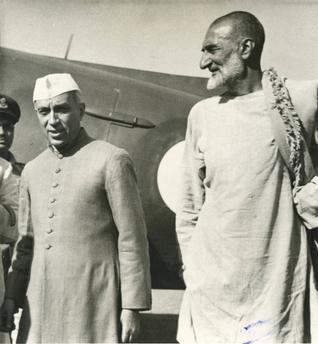
Pandit Jawaharlal Nehru with Khan Abdul Ghaffar Khan at Miranshah during his visit to the North West Frontier in October 1946. Photo: The Hindu Archives
This Independence Day let’s spare a thought for those Muslims who chose to migrate to Gandhi’s India
Taj Mohammad Khan was a young Pathan when India was carved out on communal lines in 1947. He was a Congress activist in Peshawar and was greatly influenced by Mahatama Gandhi and Frontier Gandhi (Khan Abdul Ghaffar Khan). He was a broken man when it became clear that the nation would be divided on communal lines. He was in extreme dilemma whether to stay back in Peshawar, the land of his forefathers, or move to a new place in a new country. And when communal riots broke out post Partition, he decided to leave the homeland for Muslims for secular India. He came to Delhi along with his family and couple of other friends. Today we know him as father of superstar Shah Rukh Khan.
The likes of Taj Mohammad Khan had rejected the two-nation theory with utter disdain. If not thousands, there were many Muslims who shifted to India from newly created Pakistan in 1947 when communal passions were running high.
Many years ago H.C. Shourie, who was the Rehabilitation Commissioner of refugees in Delhi, told this writer that several Muslims families from NWFP region of Pakistan came to India in 1947.They were not ready to live in Jinnah’s Pakistan. That was the region that was not much impacted due to communal violence that engulfed Punjab and Bengal. The local people were close to Gandhiji and Ghaffar Khan. That was the major reason for many Muslims to leave Pakistan and settle in secular India.
Many Hindus, Sikhs and even Muslims migrated to Afghanistan. A former Pakistani diplomat and historian, Nazar Abbas, said that there is a possibility that some Muslims had migrated to India then. “It is a fact that due to Ghaffar Khan, large number of people there were not supporting the idea of Pakistan. As he had a huge support base, I can believe that some of them had shifted to India,” noted Nazar Abbas.
Massive population exchanges occurred between the two newly-formed states in the months immediately following Partition. Once the lines were established, about 14.5 million people crossed the borders. Based on 1951 Census of displaced persons, 7,226,000 Muslims went to Pakistan from India while 7,249,000 Hindus and Sikhs moved to India from Pakistan immediately after Partition. However, the Census failed to identify those Muslims who migrated from Pakistan to India.
Returning to Taj Mohammad Khan and others like him, it goes without saying they would have taken that conscious decision after much thought. Among others, Mohammad Yunus, a close family friend of Nehru-Gandhi family, also came to Delhi with many Muslims. A close relative of Khan Abdul Ghaffar Khan, Mohammad Yunus never returned to his native place. For years together, he was heading Trade Fair Authority of India.
Delhi-based noted theatre activist Dr. Shamshul Islam’s family came from Rawalpindi to Delhi after violence broke out there. His father, grandfather and other close relatives were not ready to live in Pakistan. Islam, who teaches in the Capital’s Satyawati College, says that no member of his family has ever regretted their decision to live in Gandhi’s India.
Shah Rukh Khan has said several times that his father was a Congress activist and was totally opposed to the idea of Partition of the country on the basis of religion. He came to Delhi along with his family members. A lawyer, Taj died of cancer in 1981.
It is rather surprising that the reverse migration, albeit small, but very significant, hardly get any attention from historians. Unlike the general perception that only Hindus and Sikhs migrated to India in the wake of partition of the country in 1947, many Muslims families too decided to shift to India rather than staying in an Islamic country. It is not known whether Hindus or Sikhs too migrated to Pakistan then, but it is a fact that large number of Hindus remained there, especially in Sindh and East Bengal (now Bangladesh).
source: http://www.thehindu.com / The Hindu / Home> Features> MetroPlus / by Vivek Shukla / August 14th, 2015
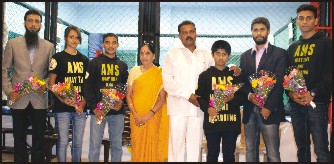
Seen in the picture are (from left) Tanveer Ahmed Syed, R. Rashi, G. Rajesh, Deputy Mayor M. Mahadevamma, former Mayor and Corporator Purushotham, Samarth Vikram, Indian Team Coach M.N. Vikram and Syed Touseef Ahmed.
Mysuru :
Four Muay Thai Kick Boxers from city will be representing the country at the Royal Muay Thai Kick-boxing World Championships, organised by the International Federation of Muay Thai Amateur (IFMA) to be held in Bangkok, Thailand between Aug. 13 and 23.
Vikram is selected as the coach of the Indian National Team for the second time.
The four fighters who have been selected in various categories include: Samarth Vikram, a sixth standard student of JSS Public School, will be fighting in 40-42 kg weight class in 12 to13 years category. R. Rashi, a student of St. Joseph’s College, Mysuru, will be fighting in Senior Female Pin weight category. Syed Touseef Ahmed, a student of SJCE will be fighting in Senior Male Welter Weight category and G. Rajesh, a student of Cauvery College, Mysuru, will be fighting in Senior Male Pin Weight category.
Syed Tanveer Ahmed is deputed for International Referee and Judge course by the National body.
The team along with the coach left for Bangkok today.
source: http://www.starofmysore.com / Star of Mysore / Home> Sports News / Tuesday – August 11th, 2015