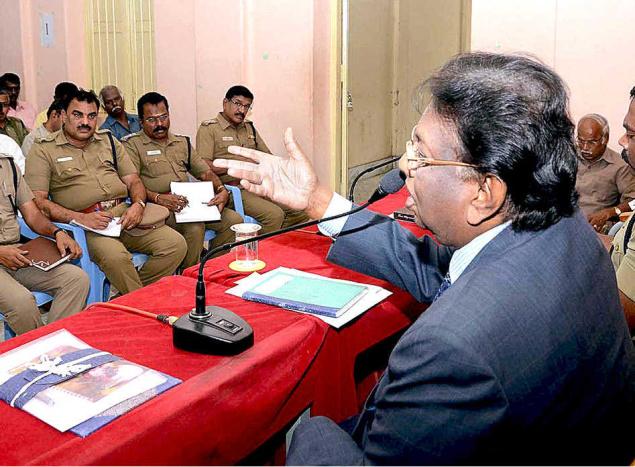
S.F. Akbar, State Information Commissioner, speaking at the training programme for government officials on Right to Information Act in Thanjavur on Friday.— Photo: R.M. Rajarathinam
State Information Commissioner S.F. Akbar inaugurated a training programme for government officials on the Right to Information Act here on Friday.
Superintendent of Police G. Dharmaraj, Dy. SPs, police officers, and officials from various government departments, including Revenue, participated in the training programme that sought to enlighten them on dealing with RTI related issues.
Later, the participants were exposed on the need to reply properly and in time to RTI related queries, dealing with issues arising out of RTI applications and the like.
source: http://www.thehindu.com / The Hindu / Home> News> National> Tamil Nadu / by Special Correspondent / Thanjavur – February 28th, 2015
A mix of young and senior artists from Baroda and Hyderabad share their experiences at a one-of-its kind woodcut camp at DHI Art Space
OF WOOD AND COLOURS Professor Vijay Bagodi Photo: K. Ramesh Babu / The Hindu
As one walks pasts the flowy curtains, a woodcut zone awaits art lovers at DHI Art Space at Dharam Karan Road in Ameerpet. A group of young artists, Gayathri, Jagadeesh and Kiran are casually chatting away. In front of them are a bottle of linseed oil, wooden blocks and colours against a background that blares the number Apologise. One can spot Vijay Bagodi, professor of MS University, Baroda sitting with a wooden block and Hyderabad artists Srikanth Kuruva and Sajid Bin Amar sharing nuances of woodcut techniques. While T. Sudhakar Reddy, (retd) professor of AU University watches the proceedings, artist Rajeshwar Rao is busy poring over on an image on the block at his worktable. But the real sight is to see veteran artist Thota Vaikuntam turn a student to learn the basics of woodcut painting!
OF WOOD AND COLOURS Artist Thota Vaikuntham Photo: K. Ramesh Babu / The Hindu
It is a one-of-its kind week-long woodcut camp at DHI Art Space with a mix of young and senior artists from Baroda and Hyderabad. It is a delectable hub of all things arty and wooden at the camp with the gallery exhibiting artists’ previous works. Besides interactions and observing each other’s style of working, the artists, who are staying on the first floor of the building, also participate in talks and sessions over cups of black coffee and chai. “The unlimited scope of woodcut is at the core of the camp,” informs Bhargavi. “The work is too intricate and the whole process is quite laborious. Most of them do not know about it and artists who know do not practice it. We wanted to bring woodcut and non-woodcut painters under one roof and create a platform for interaction. There are veterans, middle aged and younger artists who share and exchange their ideas and experiences.”
While in Hyderabad Vijay Bagodi was at JNTU, attending a lecture by Tushar Gandhi. The professor says by the end of the session, he knew the theme for his woodcut painting as he shows us a block with Mahatma Gandhi’s image. “Being a small city, Baroda is a great place for artists. One can just call Mani sir (K.G. Subramanyan) or Jairam Patel and they will meet you. The place is buzzing with art,” he smiles as he talks about Baroda.
OF WOOD AND COLOURS Artists Pratap Modi and Rajeshwar Rao Photo: K. Ramesh Babu / The Hindu
There is a sense of palpable excitement as artist Rajeshwar Rao walks around with wooden blocks. “It is a new thing and I am learning how it works,” says Vaikuntam with a smile. “Wood is a totally different media and the colours are different. It is good for artists like me as it is a break from the usual and getting to know about textures. I have seen my friends and great masters at work. I have realised it is a very challenging process,” he adds.
OF WOOD AND COLOURS Artist Karuna Photo: K. Ramesh Babu / The Hindu
As the artists are busy on their worktables, one cannot miss a two-and-half-year old girl running around. Artist Karuna has brought along her little daughter as she participates in the camp. “Wood cut painting is like doing meditation — one goes into a different world of wood and colours. I work on the natural wood and this is compressed wood,” she says while displaying a block. With a laugh she looks at her daughter and adds, “She piles up the dust and makes a rangoli of the chipped out parts.” The camp is also a different experience for artists like Prathap Modi who is used to working on large scale projects. “It is a challenge to work on small wooden blocks and also I like to work alone. This is a new experience as I am trying to mingle with other people,” he says.
Art lovers and budding artists can drop in before February 27 at the Art Space to discover the world of woodcut.
source: http://www.thehindu.com / The Hindu / Home> Features> MetroPlus / by Neerja Murthy / Hyderabad – February 25th, 2015
Callers can now get local information by giving a missed call to the new service, “Free to Dial”, which was launched in the city on Thursday by Deputy Chief Minister Mohd. Mohammed Ali.
He said the service providers had promised to source accurate information on products and services to pass on to people seeking information. S. Sunil Kumar Singh and S.J.Basha, the promoters of the service, said that people need to dial 040–6644 4466 any time.
The call is disconnected immediately and the executives will call back with an enquiry and present the information needed. The service is available round-the-clock.
The service currently offers information in 60 categories and 3,000 sub-categories and it will be further expanded in the next few months. The service will be expanded to Vijayawada, Visakhapatnam and Bangalore in the next six months.
source: http://www.thehindu.com / The Hindu / Home> News> Cities> Hyderabad / by Special Correspondent / Hyderabad – February 27th, 2015
Amirbai’s tale is one of inspiration / Special Arrangement / The Hindu
Amirbai Karnataki is one of the earliest Kannada singer-actress who made it big in Hindi cinema. She went to Bombay when women artistes were labelled ‘fallen’, but with grit and passion Amirbai became a star and sang 380 songs in 150 Kannada and Hindi films
For someone who didn’t belong to the gramophone generation but the golden period of radio, Lata Mangeshkar, Asha Bhonsle, Mukesh, and Rafi ruled our hearts and constituted our imagination of a film song. The same AIR, during a light music programme, had played “Ninnane Neneyuta Ratriya Kalede”. This, was a carbon copy of Lata’s memorable “Saari Saari Raat Teri Yaad Sataye”, but the voice was starkly different. It had a heavy nasal tone, and the flawless rendition had a simplicity to it. The charming song left an indelible mark and I felt I had to recover her voice from pages that were unknown to me. Amirbai Karnataki was an unheard voice for the Seventies: she was long gone, and had faded into the archives of black and white era of early films. She was someone who lived on in personal memories of people who had known and heard her.
Amirbai Karnataki (1912-65), who sang 380 songs in 150 films, was an early singer and actress of Hindi cinema. This singer who sang the unforgettable “Main to pavan chali hoon bole papiha” and “Bairan Nindiya Kyon Nahi Aaye”, was born in Bijapur in Karnataka. During the 1930s Amirbai was a prominent name along with stars like Suraiyya, Shamshad Begum, Noor Jahan and Zohrabai Ambalewali.
When Lata Mangeshkar came on to the scene, many of these singers moved into the background and for the later generations they remained unknown.
Born into a family of artistes, Amirbai’s parents Ameenabi and Husensaab worked for a theatre company and even ran one for many years. Growing up years for Amirbai and her five siblings was filled with music and theatre, what with many of her uncles and aunts being top musicians and actors in theatre. She lost her father early and her uncle, Hatel Saheb took care of all the children.
During those years, Bijapur was part of Mumbai Presidency and the sangeet natak tradition in these parts was flourishing. The famous Balagandharva’s company and several other theatre companies camped at Bijapur; Amirbai and her sister Goharbai, trained as they were in classical music, impressed these companies with their singing and they began to not only sing for several of them, but also act.
As Rahmat Tarikere writes in his biography of Amirbai Karnataki, Amirbai moved from Bijapur to Mumbai, from theatre to films. But the exact date and nature of these movements and transitions are hard to tell. The story of Amirbai is a sum total of several happenings in a historical period as there are few definitive documents to lead us to any accurate picture. Painstakingly put together by the biographer, Tarikere says that when Amirbai reached Mumbai (it was perhaps the year of Alam Ara’s release, 1931), women who worked in films, theatre and music were still seen as “fallen”.
Women artistes were often ridiculed as “free women” and among the several women performers, Amirbai and her sister Goharbai too, tried to free women of this stigma. In fact, families not only disowned such women, but there were instances of women being killed for choosing the arts.
In fact, Rahmat Tarikere says that the kind of fight these women put up with the social circumstances of those days is no less significant than the freedom struggle itself. If women artistes, in the later years, earned fame and reputation, it was because of the sacrifices these women made. Ironically, two very popular films “Basant” and “Kismet” in which Amirbai acted deals with the plight of actresses.
Amirbai became a very reputed singer and actress of her times. She was highly paid, and even built a theatre Amir Talkies in Bijapur. She travelled the length and breadth of North Karnataka giving programmes related to theatre and cinema.
A singer who sang some of the finest love songs, had a very unhappy love life though. Tarikere writes how her husband, a Parsi actor who played villain in those days, Himalayavala, abused her physically and emotionally. She had to suffer several assaults from him and even separation became a painful affair. Unable to recover from the trauma, she went into oblivion for several years, and later Badri Kanchawala, with his love and care brought back peace into her life.
At the age of 55, Amirbai passed away; Karnataka had been unified by then and the rest of Karnataka hardly knew of her. Even the newspapers reported her death four days later. It was only later that people have slowly learnt of Amirbai’s greatness and how Gandhiji was immensely fond of her rendition of “Vaishnava Janato”.
source: http://www.thehindu.com / The Hindu / Home> Features> MetroPlus / by Deepa Ganesh / February 27th, 2015
Examples of children of devadasis qualified with higher education are seen very rare following poor social and financial background of these families. In such conditions, Suvarna Shanta Madar, 36 year old devadasi daughter from Kokatnur village in Athani taluk has achieved doctorate degree fighting all odds came in her way.
After completing B.Com from Karnataka University Dharwad with fifth rank in 2002, Suvarna completed her MA. She did not stop there by deciding to pursue PhD on devadasi system with which she suffered from. Karnataka State Women’s University, Vijayapur awarded her doctorate degree last year for doing PhD in the subject ‘An Economic Study of Rehabilitation Programme of Devadasis in Athani Taluk’.
She did research on five government schemes for the eradication of devadasi system and the welfare of devadasis including the schemes for providing housing, pension, rehabilitation and make them self reliant. Professor S S Peerzade in Economics department in women’s university guided her to pursue PhD.
“Pursuing the education was not a smooth task for me. I used to sell coconut, turmeric, oil, flowers and other things sitting in-front of goddess Renuka Yallamma temple in the village till the school time and after returning from school. It was the business providing us bread and butter. There are lot of hilarious experiences I have experienced in my childhood and adolescence being a daughter of devadasi. Poverty was our biggest enemy. As I had experienced the worries of devadasi system and being a daughter of devadasi I chose this subject”, Suvarna said speaking to the TOI.
In 1993-94 state government conducted the survey of devadasis and after that mother of Suvarna began getting Rs 500 monthly pension. The pension amount gave lot of solace to their day today financial problems for survival. Suvarna has two sisters and one brother. One sister is a police constable while another is a staff nurse on contract bases. Brother is daily wage worker. Suvarna works as a guest lecturer at the local 1 stgrade college.
Shanta Madar, mother of Suvarna is very happy with daughter’s achievement. Speaking to the TOI she said she wanted to look her daughter doing a permanent government job. Suvarna said “I have not married so far to achieve something. My first priority is getting a permanent job which is my mother’s dream too”, she said.
Considering the achievement of Suvarna Madar, district officer on devadasi rehabilitation programme M K Kulkarni has wrote letter to the Women’s Development Corporation fortnight ago to bring a book of Suvarna Madar’s thesis submitted for PhD and print at least 1,000 its copies. He has also appealed to honour both mother and daughter on state level platform on Women’s Day. “It’s not a small achievement for any devadasi daughter and it is encouragement for others too”, Kulkarni said.
source: http://www.timesofindia.indiatimes.com / The Times of India / Home> City> Hubballi / by Ravindra Uppar, TNN / February 13th, 2015
Newly appointed Secretary of Mysore Muslim Football Club Secretary Nisar Ahmed (third from left) is seen being greeted by Club President Nisar Ahmed Sheriff.
Others seen are Abdul Hafeez, Syed Hasham and Nayeemulla.
source: http://www.starofmysore.com / Star of Mysore / Home> Sports News / February 27th, 2015
The week-long annual Urs of Sufi saint, Hazrat Syed JanbazWali (RA) was observed with religious fervour here and thousands of people including women and children braved the chill Friday morning and thronged the shrine of the saint to pay their obeisance.
Thousands of devotees offered Friday prayers at the mosque near the shrine and later caught glimpse of the holy relics of the revered saint.
On the occasion, the shrine was decorated with tiny colourful electric bulbs while as the streets were illuminated properly to avoid hampering of smooth movement of the devotees during evening hours.
Devotees held night-long prayers for peace and prosperity of Muslim brotherhood and communal harmony in the State at the shrine.
The district administration had made enough arrangements of transport, drinking water and power supply for smooth observation of the Urs.
source: http://www.greaterkashmir.com / Greater Kashmir, Srinagar / Home> Kashmir / by Tahir Ibn Manzoor / Khanpora (Baramulla) – January 23rd, 2015
Apart from fire proof and earthquake proof, the Jammu and Kashmir Academy of Art, Cultural and Languages has added flood proof code to its list of precautions for building any new strong room to store rare manuscripts and paintings.
The Academy, whose collection of valuable artifacts was damaged during the last year’s flood, has taken the decision to prevent the occurrence of such a situation in future. The academy is in possession of some of the rarest manuscripts, many of which are the only surviving copies.
“Just a day before the floods, on September 6, we shifted majority of our manuscripts and paintings to the second floor,” said Haroon Rashid, Secretary of the Academy. “That saved our treasure from total annihilation.”
The floods damaged around 40 newly acquired manuscripts and 50 paintings at the Academy’s repository. “To restore these manuscripts and paintings we got a team of four experts from National Museum of India, New Delhi, and National Research Laboratory For Conservation Of Cultural Property, Lucknow,” said Rashid.
The experts worked for over two weeks by employing latest techniques for the preservation of manuscripts. “With their efforts we were able to save our entire flood-affected collection,” said Rashid. “As of now the damage to the cultural treasure of Kashmir remains minimal.”
Rashid said that the Academy was never prepared for floods, although precautions were always taken against other dangers like fire, theft and earthquakes. “Now we have added another safety measure of protection against floods. Whenever our strong room is built it would be flood proof too,” said Rashid. The Academy has currently shifted the strong room to the top floor.
The Academy is in possession of over 400 manuscripts and 500 rare paintings. Their total value runs into hundreds of crores although the officials say that they are priceless. Some of the manuscripts include first Quranic manuscripts handwritten in the subcontinent in 1237 AD by Fateh-ullah Kashmiri, the Holy Quran dating back to 1594 written in an ink prepared by blending gold with saffron, another Quranic manuscript written in gold dating to 1711 AD and a Persian manuscript written in embossed calligraphy with nail of thumb popularly known as Khat-e-Nakhun.
The paintings include those of M F Hussain, GR Santosh, NS Bendre, VS Gaitonde, Tayeb Mehta, J Swaminathan and others. One of Hussain’s paintings with the Academy is worth Rs 5 crores.
source: http://www.greaterkashmir.com / Greater Kashmir, Srinagar / Home> Kashmir / by Haroon Mirani / Srinagar, January 23rd, 2015
Crowds thronged the 12th All-India Urdu Kitab Mela at the Jamia Millia Islamia,being held for the fourth time in Capital. The nine-day book fair,organised by the National Council for Promotion Of Urdu Language (NCPUL),was inaugurated by noted Hindi film lyricist and Rajya Sabha MP Javed Akhtar and actor Shabana Azmi on Saturday.
For centuries,Urdu has been propagating the ideas of secularism even before the word secularism was invented in the West, said Akhtar. It is unfortunate that today in our country,where languages are associated with regions,Urdu is the only language which has been tied to a particular religion.
Those who try to dump Urdu forget that it is very deeply connected to Indian culture,and if we forsake Urdu it will be a great loss to our culture. Beware of throwing the baby with the bathwater, he said.
Referring to the recent rendition of Urdu shers by Prime Minister Manmohan Singh and Leader of Oppostion Sushma Swaraj while debating in Parliament,Shabana Azmi said: Only shayari cannot help a language survive,for the language should be that of communication and for daily usage. We must also take into account the economic aspect of the issue, she said.
The mela,which usually has around 100 stalls of publishers from Hyderabad,Aurangabad,Bhopal,Srinagar and Bangalore,has roped in around 45 stalls this year,mostly from Delhi. Among the prominent stalls are NCUPL,Anjuman Taraqqi-e-Urdu Hind,Jamia Maktaba,and the Ghalib Institute.
The NCUPL stall showcases books on as many as 1,500 subjects. The stall of Anjuman Taraqqi-e-Urdu Hind presents a large section on books from Pakistan,which is an opportunity for Indian authors and readers to get acquainted with recent developments in the Urdu literary circle of Pakistan,according to the stall manager.
Organising such a fair exclusively for Urdu has its own importance,said Professor Shahryar. This will prove wrong the rumours that Urdu is dying. With so many stall exclusively selling Urdu books and young people who are eager to buy them,the future of Urdu is glorious, he said.
Some visitors,however,pointed out the predominance of religious books over those on fiction and poetry. Subhan Ali,a resident of Ghaziabad,said: I was hoping to find some rare books. Barring a few exceptions,the stalls are filled with religious books,which one can easily get elsewhere. It would have been better if the stalls had focussed on poetry and secular literature, he said.
Jnanpith Award-winning Urdu poet Professor Shahryar and Group Editor of the Rashtriya Sahara Roznama Aziz Burney were other eminent personalities at the inauguration.
The reporter is a student of the Express Institute of Media Studies
source: http://www.indianexpress.com / The Indian Express / Home> Cities> Delhi / by Atikh Rashid, New Delhi / March 28th, 2011
Nargistan, a Persian translation of the Ramayana, and Guldasta-E-Haqiqat, a lyrical Urdu translation of the Bhagavad Gita in the form of a ghazal, are two of the dozen-odd century-old books of Hindu scriptures that the Anjuman-E-Islam, Mumbai’s largest Muslim educational institution, has restored and preserved.
The 141-year-old Anjuman-E-Islam, which runs colleges and schools catering to over 1.10 lakh students, came across these manuscripts amid a renovation of its 120-year-old Karimi Library, a treasure trove of over 5,000 books. Officials at the institution said they stumbled upon over 100 Hindu religious texts written in Persian and Urdu. The institute has presently restored and preserved over a dozen such books that were displayed to the public on Saturday. Most of these books were published in the late 1800s.
“The books not only showcase the richness of the Urdu language but also symbolize the syncretic culture of our country and how we had a history of respecting each others faith,” Anjuman-I-Islam President Dr Zahir Kazi said.
Officials said they stumbled upon over 100 Hindu religious texts written in Persian and Urdu.
The institution was recently in the news when a student of one of its colleges joined the Islamic State in Syria. The Persian books restored include a Mahabharata from 1875; Haday-Kul-Marifat, a Persian book written on the Bhakti movement and Bhushan Leela, a book on Lord Ganesha.
Most of these books are by Hindu authors highly proficient in Urdu and Persian, said Anjuman-E-Islam officials. Almost all the books bear Islamic motifs, including the usage of the numerical 786.
The translation of the Ramayana in poetic from by Mirza Bedil, titled Nargistan, interestingly begins with the phrase “in the name of Allah.” There are also Urdu translations of the various adaptations of the Ramayana, including those written by Valmiki and Tulsidas, as well as copies of the Bhagavad Gita. One of the adaptations of the Gita is titled “Guldasta-e-Haqeeqat” and has been written by Munshi Shital Prasda in the form of a ghazal. Kazi, one of the driving forces behind the project that was initiated five years back, says: “Most of the books were in an abject condition when we came across them. We had to undertake an extensive restoration process where we not only treated the pages but also bound them again.”
source: http://www.indianexpress.com / The Indian Express / Home> India> India-Others / by Zeeshan Shaikh, Mumbai / February 03rd, 2015