Beary Sahitya Academy honorary awards for three

Awards to be presented at Chikkamagaluru on January 10

The Karnataka Beary Sahitya Academy will confer its annual honorary awards 2014 on B.M. Ichalangodu, B.A. Shamshuddin Madikeri and Y. Mohammed Beary Edapadavu.

While Prof. Ichlangodu is being honoured for his contributions in Beary language research, Mr. Shamshuddin is being honoured in the field of literature and Mr. Mohammed Beary in the field of education, said academy chairman B.A. Mohammed Haneef.

Mr. Haneef told presspersons here on Monday that the awards would be presented at the Beary Language Conference to be held at Chikkamagaluru on January 10. More than 5,000 Beary-speaking people were expected to attend the event, he said.

The Chikkamagaluru District Beary Federation would be co-hosting the event at the Vokkaligara Sabha Bhavana where the language conference would be held from 10 a.m. and the award presentation would be held from 3 p.m.

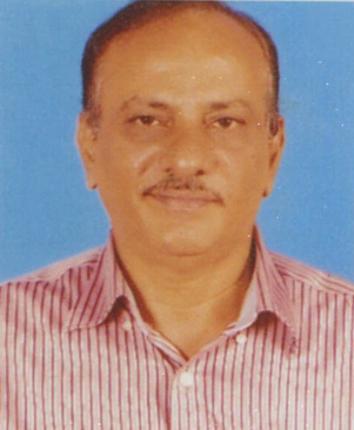
B.M. Ichlangod
B.M. Ichlangod

Prof. Ichlangod worked in various colleges in the undivided Dakshina Kannada and has written many works including translation of Koran, and Muslims of Tulunadu. He has also been active in the consumer rights movement.

B.A. Shamshuddin Madikeri.


Mr. Shamshuddin has worked as a journalist for many publications in Madikeri and has penned many works in Beary language.

Muhammad Byari Yedapadavu.

Mr. Mohammed Beary, after serving the Syndicate Bank for 22 years, established Ideal English Medium School at Edapadavu and has been the president of the Federation of Dakshina Kannada and Udupi district English Medium Schools. He is also the president of the committee of families of victims of Mangaluru air crash.

The awards carry Rs. 10,000 in cash and citation. The Kannada and Culture Department has proposed to the government to increase the cash purse to Rs. 75,000 each, but the academy is not sure when that would come into effect, Mr. Haneef said.

The academy has also identified nine personalities to be felicitated during the language conference for their contributions to various fields.

They are: Mariam Ismail, Ismail Azad, A.M. Sridharan and Umar Farooq (for literature); K. Mohammed (for defence); Moidin Kunhi (for medicine); Azala Ayub and B.H. Noor Mohammed (for social service) and Mohammed Iqbal (for singing), he said.

source: http://www.thehindu.com / The Hindu / Home> News> Cities> Mangaluru / by Anil Kumar Sastry / Mangaluru – December 16th, 2014

Ustad Fayaz Khan to present Hindustani Music Recital on Dec. 15

UstadFayazMPOs20dec2014

Mysuru :

Ustad Fayaz Khan will present a Hindustani classical music recital on Dec. 15 at 6.30 pm at Jaganmohan Palace auditorium at the valedictory of the four-day Parangathotsava – 2014 organised by Vasundhara Performing Arts Centre Trust (VPAC Trust), Mysuru.

Profile: Born in a family of musicians of Kirana Gharana on 17th February at Dharwad, Fayaz Khan’s father Ustad Abdul Quadar Khan was a Staff Artiste in AIR and his grandfather Ustad Sheik Abdulla Khan was a court musician in Mysore Palace and Nawabs of Hyderabad.

Fayaz Khan started his training under the guidance of his father (for sarangi and vocal) and at the same time he learnt tabla under the guidance of Pt. T. Basavaraj Bendigeri and Ustad Mammulal Sangaunkar. At the teen age, he started giving performances with senior artistes. He has participated in several music competitions and has may awards including the National Competition of AIR in 1989 (1st prize) and upgraded from AIR. He has accompanied noted artistes of India like late Dr. Gangu Bai Hangal, Pt. C.R Vayas, Pt M.R. Gautham, Dr. Prabha Athre, Pt. Ajay Pohankar, Pt. Anindo Chaterji, Pt. Suresh Talvalkar, Pt. Yogesh Samsi, Pt. Shubhankar Banerji and Pt. Vijay Ghate, on sarangi.

After his father’s demise he went to Mumbai to continue his further training from Padma Vibhushan Pt. Ramnarayan (for 5 years) after that he moved to Bengaluru and started working for South film industries. He has worked with music directors like A.R. Rahman, Rajan-Nagendra, Vijay Bhaskar, Hamsalekha, M.M. Keeravani, Raman Goukula, V. Manohar and Guru Kiran and sang many title songs of tv serials. He has also composed many Kathak ballets and performed abroad.

The awards include: National Award of All India Radio; Aryabhata Award for TV serial; Best Sarangi Player Awarded from Bangalore Music Academy; Pt. Puttaraj Krupabhushan Samman; Kala Kaumudi (Samskruthi Vidya Peetha, Bengaluru) and Yuva Puraskar from Kaladarpan.

source: http://www.starofmysore.com / Star of Mysore / Home> General News /  Sunday , December 14th, 2014

Bazm-e-Tipu Mushayera

Tipu Sultan Trust has organised the 3rd monthly Mushayera of Bazm-e-Tipu on Dec. 13 at 7.30 pm at Markaz Al Hind #2798, MKDK Road, Savoy Chowk, Mandi Mohalla, Behind Dargahi Masjid under the chairmanship of Zahidulla Khan.

Interested may contact Ph: 0821-2455607 or 2438786 or Mob: 93412-35607.

source: http://www.starofmysore.com / Star of Mysore / Home> In Brief  /  Saturday , December 13th, 2014

City top Cop holds Mass Counselling for reformed criminals, mob

A section of Members of Bureau of Modus Operandi at the Mass Counselling in city this morning.

Mysuru :

In his continued bid to bring listed criminals to the mainstream and aiming to rehabilitate them, now known as Members of Bureau of Modus Operandi (MOB), City Police Commissioner Dr. M.A. Saleem conducted the first-ever mass counselling for nearly 500 members of MOB at CAR grounds here this morning.

Dr. Saleem gave counselling to various categories of members of MOB including those who have been released from prison after serving terms and those accused of crimes ranging from murder, theft, robbery, burglary, dacoity, cheating, criminal breach of trust, circulation of fake currency notes and also minor crimes at all the 16 Police Stations coming under City Police Commissionerate.

There are 4,900 members of MOB in the district including 3,048 from city. Out of them, 500 who attended today’s counselling had been brought from all the Police Stations in city in government vehicles.

Dr. Saleem advised the members saying, “you may have committed crimes in a fit of rage, but you will do well to transform yourselves after serving terms to ensure that the society sees you in a better light.” He also offered to get jobs to transformed members depending upon their educational and technical skills.

Dr. Saleem, further asked the MOB members to change their mindset to gain confidence of the society to look at them as reformed persons and see their family members in a more dignified manner, thus saving their kin from being branded as relatives of criminals.

The Commissioner also collected details on conduct of these members who were divided into nine categories based on the nature of crime committed by them from authorities of all the Police Stations.

DCPs A.N. Rajanna & M.M.Mahadevaiah, ACPs A.K.Suresh, Jai Maruthi and B.T. Kavitha and Inspectors of all the Police Stations coming under the City Police Commissionerate were present during the mass counselling.

source: http://www.starofmysore.com / Star of Mysore / Home> General News /  Saturday , December 13th, 2014

I like Indore-based designer Asif Shah’s work, says model Zulfi Syed

Model Zulfi Syed, who was in Indore recently to participate in a private event, spoke to HT about Bigg Boss, his plans to start a modelling academy and more. Here are excerpts from an interview.

Model and actor Zulfi Syed visited Indore recently to participate in a private event. (Shankar Mourya/HT photo)

You have been a part of reality show Bigg Boss. What do you have to say about the ongoing season of the show?

I find the format a bit different now. Our season was more or less based on an international format. Now there is more contact with the outside world and even the number of wildcard entries have gone up. The audiences have better access to housemates as they can talk to them over phone. This wasn’t possible when Bigg Boss started initially.

We heard you are planning to start a modelling academy. Is that true?
I am starting an academy for people who want to get into modelling. There are hardly any schools to mentor aspiring models in India. I am planning to open such a school. We would be visiting cities like Indore and Bhopal and hold workshops for aspiring models. I have a team of experts which includes models like Rahul Dev, Alisia Raut, Praveen Sirohi, Amrita Patki, Shahwar Ali and Aanchal Kumar to guide them. There will be a makeup artist and a fitness trainer. Shakir Sheikh would be imparting training in choreography. We will train them on how to walk the ramp among other things. We will be doing portfolio shoots and if they have potential, we will handle their work in Mumbai. The institute would be called Smoke and we plan to start the project by February, 2015.

What inspired you to start such an institute?
I have been a part of the modelling industry for several years. I felt the need for such an institute. There are a lot of people who come from small towns to Mumbai and they don’t know where to start if they want to become a model.

Many male models have gone missing from the industry.
There is obviously more work for girls. Designers for women have increased in the recent past. Even a lot of male designers have ventured into creating outfits for women. The industry was always ruled by women and I think it will be this way.

What are your upcoming projects?
I am working on a Bulgarian venture which contains a mix of Indian as well as Bulgarian actors. Portions of the film will be shot in Bulgaria. It’s an action-thriller movie. I can’t talk much about it right now.

Which designer’s outfits do you prefer wearing?
I follow a lot of designers. Of late, a lot of interesting names have crept in the market. I like Asif Shah from Indore for his style of suits. Rohit Bal is really good. I also admire Ravi Bajaj, Suneet Verma and Manish Malhotra.

source: http://www.hindustantimes.com / Hindustan Times / Home> India-News> Indore / by Hussain Malvi, Hindustan Times / Indore – November 29th, 2014

Coconut plucking: women take giant strides

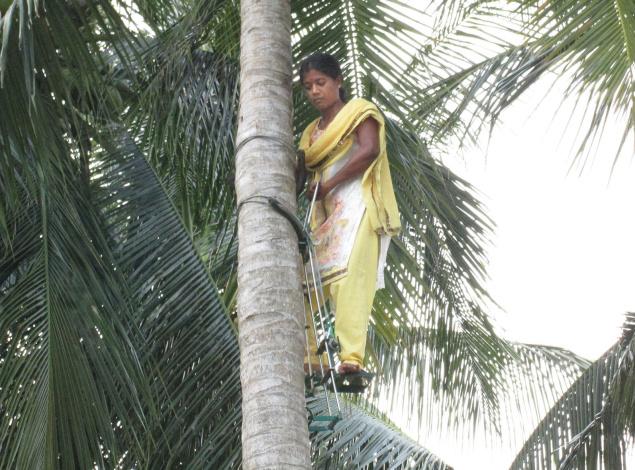
A woman undergoing training in coconut plucking at Parangipettai in Cuddalore district.

Even though Cuddalore district abounds in coconut trees, the price of coconuts is high. The reason trotted out for such market behaviour is the lack of manpower to pluck coconuts or the high wages the workers demand.

It has created a situation in which even the ripe coconuts are left either to rot on the trees or fall. It has become consternation for the coconut growers to find the workforce on time to harvest, not to speak of the plight of the households having a few coconut trees in their garden.

To overcome the problem, the M.S. Swaminatan Research Foundation (MSSRF) has launched the “Friends of Coconut Tree” programme for farmers and the unemployed youth.

R. Elangovan, Project Officer of the MSSRF, told The Hindu that the six-day training programme organised under the aegis of the MSSRF Village Resource Centre at Parangipettai was intended to help the farmers and unemployed youth learn to climb trees to pluck the coconut.

To start with, 20 persons, including four women hailing from Killai, Nochikadu, Manikkollai and Parangipettai, joined the programme conducted recently. It was conducted in coordination with the Coconut Development Board that provided the device for climbing the trees free of cost.

In-house training

It was a sort of an in-house training as the trainees would stay at the Parangipettai centre throughout the training programme. Besides mastering the tree climbing techniques, they were also taught yoga and pranayam.

Mr Elangovan said the Coconut Development Board had made it mandatory that 30 per cent of the trainees ought to be women.

It was a surprise that four women had come forward to enroll their names in the programme.

One of the trainees, Kausalya, 24, told this correspondent that initially she had hesitation in joining the programme as she lacked courage in climbing tall trees.

But, the device provided by the centre made the job simple and easy. She gained confidence gradually.

However, the centre has prescribed a dress code for women — they should either wear salwar kameez or a pair of trousers to avoid risks.

Mr Elangovan said that after completion of the training programme, Parangipettai Town Panchayat Chairman Mohammad Yunus gave away certificates and the climbing device (free of cost) to the participants.

source: http://www.thehindu.com / The Hindu / Home> News> National> Tamil Nadu / by A.V. Raghunathan / Cuddalore – December 18th, 2014

Hyderabad’s Numaish will be here soon

Children enjoying the rides at the 72nd All India Industrial Exhibition, popularly known as Numaish, in Hyderabad. Photo: K. Ramesh Babu / The Hindu

Six hours of entertainment at just Rs.20. Can you beat that? Impossible. One can’t have fun and frolic any cheaper. So tighten your belts for the annual ‘Numaish’. There are some new and amazing things to bedazzle visitors in the 75 edition of the All India Industrial Exhibition beginning here on January 1.

Locating the stalls and your dear ones is now child’s play. The smartphone in your hand will be your guide. Keeping pace with the emerging technology, the Exhibition Society has designed an ‘Exhibition App’ to help visitors navigate the sprawling grounds. It is also thinking of providing Wi-Fi in the 23-acre ‘Numaish maidan’.

The Society will also be celebrating the Platinum Jubilee of the Industrial Exhibition. President Pranab Mukherjee is expected to inaugurate year-long celebrations. Chief Minister K. Chandrasekhar Rao will inaugurate the exhibition on New Year Day, the first in the Telangana State.

The history

The Numaish-e-Masnuaat-e-Mulki had its humble beginning in 1938 when the Economic Committee of the Osmania Graduates Association came up with the idea. The 7 Nizam, Mir Osman Ali Khan, inaugurated the exhibition in 1940 at Public Gardens to mark his birthday celebrations. There were just 50 stalls then. The exhibition was shifted to its present venue in 1946 by the then Prime Minister of Hyderabad State Sir Mirza Ismail. Over the years it has grown both in content and coverage assuming an all India stature.

Given the prevailing security situation, the Exhibition Society is not taking any chances on the security front. For the first time, it has installed 8 CCTV cameras of its own. This will be in addition to the door-frame metal detectors, hand-held metal detectors, dog squad and police security.

source: http://www.thehindu.com / The  Hindu / Home> News> Cities> Hyderabad / by J.S. Ifthekhar / Hyderabad – December 16th, 2014

The teacup and the tabla maestro

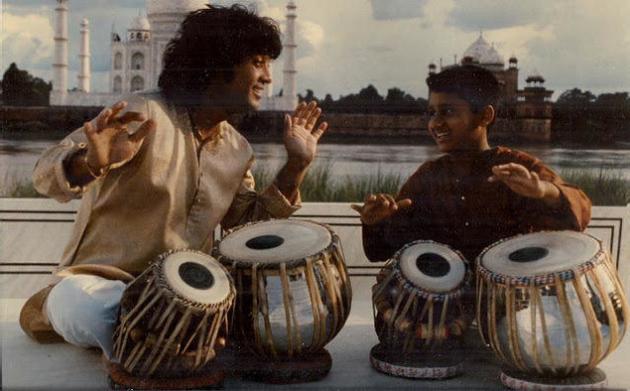
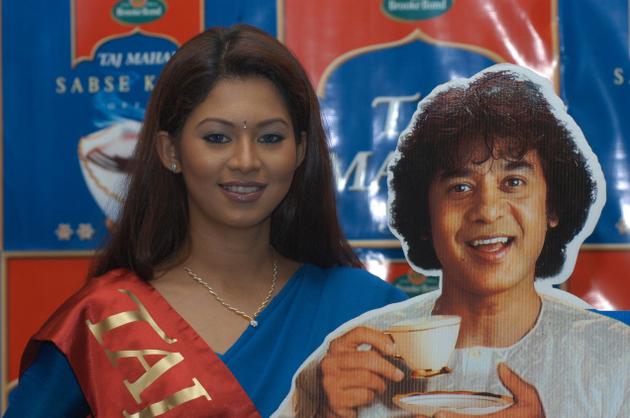
Aditya Kalyanpur (left) with Ustad Zakir Hussain in the commercial / by Special Arrangement

The “Wah Taj” campaign with Ustad Zakir Hussain not only engraved Taj Mahal tea on the popular imagination, it also helped the tabla to make its star space in the popular imagination

You have to admit it was a whacky idea. I mean, taken literally, who would you find to go and sit in front of the Taj Mahal and start practising the tabla? And then continue to sit right there, with India’s most famous monument as a backdrop, and sip a cup of tea served up by an anonymous hand? But it wasn’t just any old tea, it was Brooke Bond’s Taj Mahal, and it wasn’t just any tabla player, it was Ustad Zakir Hussain, one of the earliest ‘stars’ of Indian classical music. So, when the anonymous voice complimented his playing with “Wah Ustad, wah!”, the ustad replied with “Arre huzoor, wah Taj boliye!” And the entire nation was hooked.

Whether everybody began drinking Taj Mahal tea is not the question here, though that may have been important to the tea makers. But if it was consumer connect they were after, they hit a winner. Brand recall? The combination of “Wah Taj!” with the dashing young Hussain’s curly locks flying about his face as his fingers flew across the surface of his tabla — not to mention that charming smile accompanied by the resonance of his playing — ensured brand immortality.

The famous campaign / BL

It’s not surprising that the man commissioned to shoot that ad, Sumantra Ghosal, went on to make an acclaimed documentary on Ustad Zakir Hussain.

The tie-up between the tabla maestro and the tea company went on for a number of years, during which it must have helped that Hussain was not linked to any other product. The ad that added a phrase to the lexicon of modern Indians had a number of sequels. In one of them, an adorable little disciple keeps pace with the maestro and, in place of the disembodied voice, Hussain — hats off to the naturalness of his acting before the camera — praises the little fellow with “Wah, Ustad!” This time it is the cheeky little one’s turn to correct him, “Arre huzoor, wah Taj boliye!”

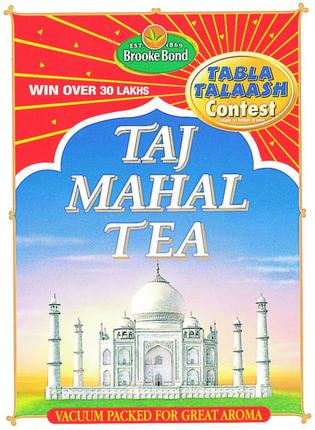
BROOKE BOND, TAJ MAHAL TEA / Special Arrangement

Aditya Kalyanpur is on tour in Goa when we contact him to look back on those early days. “I was around nine when I was invited by the ad company to do a screen test at Famous Studios in Mahalaxmi (Mumbai),” he recalls. It was his guru Ustad Alla Rakha — father of Zakir Hussain — that recommended him to the ad filmmakers, says Kalyanpur. “They were looking for kids to appear along with Zakir Bhai. But they couldn’t find any that played the tabla. So Alla Rakha sahib said why don’t you try this boy, he is playing well. Fortunately, they thought I was good looking and I could play.”

It must be a great thing to know that your guru has recommended you at such a young age as a promising artist. Agreeing that he has had many blessings in life, Kalyanpur says the elder ustad was “like a grandfather and mentor” besides a tabla guru.

While he was “excited and maybe a little intimidated” at the thought of playing with the celebrated Zakir Hussain, Kalyanpur says, “It was the beginning of a new chapter of my career. I learnt how to record, how to face the camera. Fortunately I started when I was very young.”

As for preparations, he says, “Zakir Bhai asked me to play a couple of relas — fast compositions. He picked one up and said let’s play this.” The audio recording was completed in Mumbai in only a couple of takes, but for the video for which they travelled to Agra, a few days were required. “In 1989, things were much different from what they are now,” he adds, referring to the changes in technology.

Kalyanpur agrees that the ad campaign, by emphasising the excellence of an ustad’s playing and juxtaposing it with its claim of a high quality tea, helped ordinary people become familiar with the concept of classical music and the tabla in particular. “Thanks to Zakir Bhai for reaching into people’s lives,” he remarks.

Some old-timers might have cringed at the idea of a serious artist allowing praise for his musicianship to be substituted with a lip-smacking pat on the back for a beverage — no matter how much a part of Indian culture that beverage was considered. If that shocked the purists, the 2001 ad (“Taj Mahal Challenge” of Hindustan Thomson Associates and HLL), really made them shudder. Here the ustad was shown staking a claim that if anyone found a better tea than Taj Mahal, he would quit playing his instrument. But, on the part of the ad makers, the idea was to simultaneously put the tea brand at the top of its category in consumers’ minds, and scotch wild rumours that had recently surfaced that Zakir Hussain was going to give up his performing career. By the time 2002 rolled in, contest winners were getting to meet the ustad and also receive a gold tabla set, for having ‘found’ his instrument, which his detractors — so the ads told us — had stolen since he could not be stopped from playing as no better tea brand had been discovered.

Time has proven that the partnership between the tabla wizard and the tea brand gave both their careers an enviably healthy longevity, and both are still going strong. And the brand’s classical music connection is expanding. Since this summer, sitar exponent Niladri Kumar has been the tea’s brand ambassador.

In recent years — another ad campaign, another beverage — we have been hearing that a lot can happen over a cup of coffee. But there’s no contesting, whirlwinds in a teacup are of an older vintage

source: http://www.thehindu.com / The Hindu / Home> Features> MetroPlus / by Anjana Rajan / December 14th, 2014

Statues of Akbar’s ‘navratnas’ to come up in Fatehpur Sikri fort

Agra:

The nine gems of Akbar’s court will soon adorn Fatehpur Sikri Fort, with Agra Development Authority (ADA) and Uttar Pradesh tourism planning to install their statues in the premises of the monument.

Despite his illiteracy, Mughal ruler Akbar appreciated the presence of artists and intellectuals. His passion for knowledge and interest in learning from great minds meant that men of great intellect received patronage from the emperor. Such men went on to constitute the nine courtiers, also known as ‘navratnas’, of Akbar’s kingdom. The navratnas are Abul Fazl, Abdul Rahim Khan-I-Khana, Birbal, Mulla Do-Piyaza Faizi, Raja Man Singh, Raja Todar Mal, Fakir Aziao-Din and Tansen.

According to ASI, Mughal institutions such as the ‘Ibadat-Khanah’, ‘Din-i-Ilahi’, ‘Tarikh-i-Ilahi’ , Jharokha-Darshan, the doctrine of Sulh-i-Kul and policy of liberal patronage to indigenous arts and literatures, were founded here.

Under the plan, the statues of the nine courtiers would be built at a cost of Rs 10 lakh and will be set up in the interpretation centre coming up in the Fort complex. Fatehpur Sikri was the capital of Mughal Emperor Akbar for 13 years, from 1572 to 1585. The complex of monuments was declared a UNESCO world heritage site in 1986.

Dinesh Kumar, regional tourist officer, said, “We plan to install the statues the way Akbar used to hold court meetings with them. Tourists will also be provided information about them in detail. Although the place for their installation has not been finalized yet, we are trying to get it done in the interpretation centre. A meeting with the divisional commissioner will soon be held to get his permission.”

The interpretation centre will provide a glimpse of history and culture of the Mughal era as well as facilitate tourists’ visit to the Fort. Its construction work is likely to be completed by next month, Kumar added.

Perhaps the most famous of the ‘navratnas’ is Birbal, a Brahmin advisor in the court of Akbar. He is mostly remembered in folk tales that focus on his wit.

In 1586, he led an army to crush an unrest in the north-west Indian subcontinent, which failed tragically when he was killed along with many soldiers in an ambush by the rebel tribe.

Towards the end of Akbar’s reign, local folk tales emerged involving his interactions with Akbar, portraying him as extremely clever and witty. Birbal’s defeat was one of biggest military setbacks during Akbar’s reign and his death is said to have caused the Mughal emperor much grief.

In the folk tales, Birbal is mostly shown as being younger than Akbar, religious and surrounded by envious Muslim courtiers. These tales involve him outsmarting them and sometimes even Akbar, using only his intelligence and cunning, often by giving witty and humorous responses and impressing Akbar.

Mulla Do-Piyaza is a character from a series of folk tales featuring the Mughal emperor Akbar and his witty courtier Birbal. Mulla Do-Piyaza, also portrayed as witty, is Birbal’s rival. Even though these folk tales originated at the end of Akbar’s reign (1556-1605), Mulla Do-Piyaza began to appear later, popularized by writers in the late 19th century. Most scholars consider him to be completely fictional.

The next most heard of navratna was perhaps Tansen, a prominent Hindustani classical music composer, musician and vocalist, known for a large number of compositions. He was also an instrumentalist who popularized and improved the plucked rabab (of Central Asian origin). Akbar gave him the title Mian, an honorific, meaning learned man.

Abul Fazal was the vizier of the Mughal emperor and author of the Akbarnama, the official history of Akbar’s reign in three volumes, (the third volume is known as the Ain-i-Akbari). He was the brother of Faizi, the poet laureate of Akbar.

Abdul Rahim Khan-e-Khana, another ‘navratna’ was a poet known for his Hindi couplets and his books on astrology. The village of Khankhana, which is named after him, is located in the Nawanshahr district of Punjab.

A poet and scholar of late medieval India, Shaikh Abu al-Faiz ibn Mubarak was popularly known by his pen-name, Faizi. In 1588, he became the Malik-ush-Shu’ara (poet laureate) of Akbar’s Court. He was the elder brother of Akbar’s historian Abul Fazl. Akbar recognized the genius in him and appointed him tutor for his sons and gave place to him among his decorative ‘navaratnas’.

Man Singh, the Rajput Raja of Amber, a state later known as Jaipur in Rajputana, was a trusted general of the Mughal emperor Akbar, while Todar Mal rose to become the finance minister in Akbar’s darbar. He was born in Laharpur, Uttar Pradesh in a Hindu family.

Faqir Aziao-Din was a mystic and a chief advisor in emperor Akbar’s court. Akbar regarded his advice on religious matters in high esteem.

source: http://www.timesofindia.indiatimes.com / The Times of India / Home> City> Agra / by Aditya Dev, TNN / December 14th, 2014
MIM expands horizon with cop training

Hyderabad :

In what is known as a “passing out parade” of constables held at the police academy recently, more than 70 graduates were from the stable of the Majlis-e-Ittehadul Muslimeen (MIM). But what is interesting is that of this number, more than half are Hindu, Dalit and Sikhs while only 29 are Muslim candidates.

“As a part of the MIM initiative, we had trained around 200 people over a period of three months for the physical fitness and written tests. Also, of the 10 girls selected, only two are Muslims and the rest are Hindus. It is pertinent to point out that two of the selected youth are Mahesh Yadav and Vijay Kumar from Begum Bazaar. Those selected also belong to the Reddy community and other backward classes. Another two are Sikh recruits,” said Manzoor Ali Khan, in-charge of the constable recruitment training programme.

While the MIM has been vocal about its intentions of forging a Muslim-Dalit political alliance – which has gained momentum with the slogan Jai Bheem, Jai Meem – the move indicates that the party is keen to reach out to members of the majority community as well. The party in addition has proposed initiatives for training youth for employment.

“The top leadership wants an inclusive approach in all things we do. Therefore, we intend to train youth regardless of religion, caste, creed and sex. We are now waiting for the next constable recruitment notification to be issued,” Manzoor said. The number of Hindu recruits trained by the MIM has increased substantially this year, he claimed.

Meanwhile, the Millat Fund, a philanthropic arm of the Siasat Urdu Daily, too has had its share of success in sending candidates from its training rooms. According to the managing editor Zaheeruddin Ali Khan of the daily, around 170 cadets from a batch of around 300 was selected were a part of the parade held last week.

“Since 2003, most of those who have been selected are men and we have tried our best to train women as well. Of the 20 girls who sought training from us this year belong to the majority community. We are encouraging the participation of candidates from all religions,” he said.

source: http://www.timesofindia.indiatimes.com / The Times of India / Home> City> Hyderabad / by Syed Mohammed, TNN / December 13th, 2014