Chennai/Ranipet, TAMIL NADU :
Visually-impaired children from deprived Muslim families gain education and dignity at the institution founded by Mohammad Usman in Chennai and Ranipet
Chennai :
In the busy streets of Chennai and surrounding districts, where poverty often limits opportunity, one institution is rewriting the story for visually impaired Muslim children. Madrasa Imdadiya, a semi-residential trust founded by Mohammad Usman, offers education, skills, and dignity to children who might otherwise have spent their lives begging.
Ashraf Khan, a Tamil teacher in a private college in Chennai, was born blind into a poor family. He recalls his early years at a small madrasa for blind students in Melvisharam, near Ranipet, as life-changing. Today, he earns about ₹50,000 per month. “Education saved my life,” he says.
Usman draws a stark contrast. He has often seen blind children on streets with equally deprived parents. “This is what happens with the poorest Muslims. When parents are blind and poor, the children end up on the streets,” he explains. This inspired him to act.
Founded in 2010, the madrasa now runs centres in Chennai and Ranipet, inspiring similar institutions in Pune, Ahmedabad, Aurangabad, and Kashmir. The Tamil Nadu centre, the largest, covers 5,000 square feet and hosts 50 blind students, including ten girls, with hostel staff managing daily needs.
The madrasa blends religious and formal education, filling gaps left by government institutions. Students study the Qur’an, Hadith, and other religious texts in Braille, alongside school and college instruction via audio tools. Children with other disabilities are also accepted, though Braille education is separate.
Usman stresses self-reliance. “Some parents still take financial help from the trust, but many become self-reliant through their educated children. This is the real success,” he says. Students often pursue higher education, vocational training, or government jobs, with some returning as teachers.
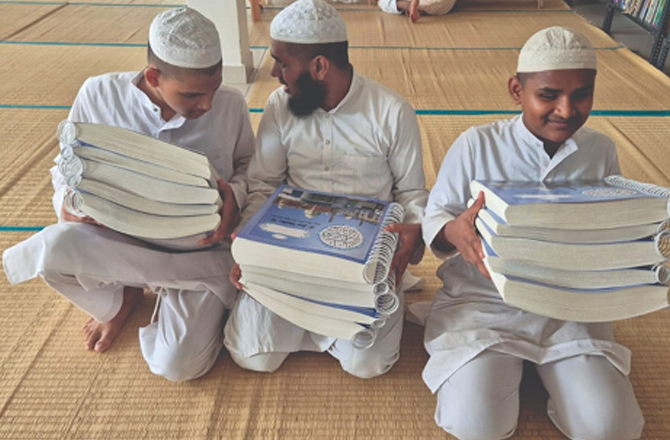
The madrasa also produces copies of Qur’an in Braille, distributed free across India and abroad. Each copy costs about ₹3,500 to print. “All our students become Huffaz and complete Class 12 and degree education,” Usman adds.
Mobina (name changed), a blind and disabled girl who lost her father early, is a shining example. With the madrasa’s support, she now teaches in a government school and earns ₹75,000 per month. “Without this madrasa, I would have remained invisible,” she says.
Challenges remain, especially for girls. Deep social barriers, safety concerns, and marriage prospects keep many girls out of school. Usman says patience is key. “Families do not outright reject education but hesitate. Inclusion is about changing attitudes regarding gender, disability, and value,” he explains.
Disability activists note that blind children in poorer districts often lack access to formal education. Government schools exist only on paper, and families may be unaware of disability certificates, scholarships, or assistive technology. Without early intervention, entire families risk cycles of begging or informal labour.
Madrasa Imdadiya shows how targeted community efforts can break generational poverty and empower blind Muslim children. By providing education, accommodation, and skills, the madrasa transforms lives and reinforces that education is a right, not charity.
“Other communities invest in education, but we do not,” Usman remarks, highlighting a broader challenge within the Muslim community. Yet he takes pride in his students’ successes. With over 500 students across India benefiting from similar madrasas, he dreams of a school for blind children in every district and tuition centre in every village.
“Every story here is regrettable. Happy stories go to cities and private schools; they do not come to my trust’s madrasa,” he admits, underscoring the ongoing need for support for India’s most vulnerable children.
source: http://www.clarionindia.net / Clarion India / Home> Editor’s Pick> India / by Team Clarion / January 10th, 2026
