Tag Archives: Bharat Ratna Maulana Abul Kalam Azad

Historian revisits Maulana Azad: A secular nationalist and nation-builder

Mecca, (Ottoman-SAUDI ARABIA / Kolkata, WEST BENGAL / DELHI :

Abul Kalam Ghulam Muhiyuddin (November 11, 1888-February 22, 1958), better known as Maulana Azad, was a writer-activist-statesman.

Historian S Irfan Habib speaks on Maulana Azad on his birth anniversary at an event organised by the Maulana Azad College alumni association in Calcutta on Tuesday / The Telegraph

Historian S. Irfan Habib, while delivering his Maulana Abul Kalam Azad memorial lecture titled “Revisiting Maulana Azad in Contemporary India” on Tuesday, rued how in today’s India, anytime he posts anything on social media on the freedom fighter, 80 per cent of the comments comprise hateful abuse.

“Full of abuse… 80 per cent of the comments. And from people who have no idea of who he was, what he stood for, and what he did for India,” said Habib, whose lecture on the Maulana on the icon’s 137th birth anniversary was organised by the Maulana Azad College alumni association to mark the college’s centennial.

Abul Kalam Ghulam Muhiyuddin (November 11, 1888-February 22, 1958), better known as Maulana Azad, was a writer-activist-statesman.

One of Mahatma Gandhi’s most trusted lieutenants and the youngest president of the Indian National Congress, he made crucial contributions to the freedom movement. He was also Independent India’s first education minister.

“I will speak about those issues relevant for today’s India. What he did for education, how he defined nationalism — today all those who have no idea of what nationalism is are nationalists — and how he defined Islam…. Islam too is in danger when we see what we believers have done to our own faith,” said Habib, former Maulana Azad Chair at the National University of Educational Planning and Administration, New Delhi.

Maulana Azad’s family moved from Mecca to Calcutta when he was two. He spent several decades of his life in this city, his residence on 5 Ashraf Mistry Lane of Ballygunge now a museum.

November 11 is celebrated as National Education Day to recognise his contribution in establishing the education foundations of India — from the Indian Institutes of Technology, the University Grants Commission, the All India Council for Technical Education, the Council of Scientific and Industrial Research, the Indian Institute of Science, and the Sahitya Akademi, the Sangeet Natak Akademi and the Lalit Kala Akademi, besides the Indian Council for Cultural Relations.

“Patriotism, nationalism and humanism, the difference between them Maulana tried to look at. In this (the belief in the culmination in humanism) he was very close to Gurudev Rabindranath Tagore, and he actually writes about it, that he believes in the idea of nationalism which was pitched by the idea of Tagore’s humanism and universalism,” said Habib.

“True relationship is only one, where the entire earth is one’s native land. This is necessary is today’s India, where we indulge in othering among own citizens, in the name of religion, caste, language, all sorts of issues, all sorts of divisive tools we use to divide Indians, while Maulana says mankind is one family and all humans are brothers, this is the idea of humanity of nationalism which Maulana left behind,” he added.

Habib underscored how the Maulana began as a pan-Islamist, speaking against the subjugation of Muslim nations by imperialist powers — a sentiment expressed strongly in his papers Al-Hilal and Al-Balagh, and it was because of his role as a fiercely upright journalist that the British Raj viewed him as one of the most dangerous persons in India.

Habib stated that after the Maulana was released from exile in Ranchi in 1920, he was torn between reading and writing in seclusion, or public life and the freedom struggle. It was soon after coming out of exile that the Maulana met Gandhi on January 18, 1920, for the first time.

“The meeting seemed to have had a profound impact on both… and they remained inseparable for the rest of his (Gandhi’s) life,” he said.

According to Habib, the Maulana fought on multiple fronts, not only against the British, but also Hindu and Muslim communalists.

“Maulana stressed on indivisible or composite nationalism, where he went back to early Islamic history, when the Prophet (Muhammad) created the first Muslim nation in Medina by aligning with the Yehudis (Jews). He saw no reason why Muslims could not join hands with Hindus and others in nation-forming…. He was appalled with communalists busy with sectarian campaigns when the need was to fight the British as a composite nationalist group,” Habib said.

“Maulana stood for a united India and remained steadfast in this resolve till the end. We are amid polarising politics where religion has become a distinct marker of identity…. The majoritarian nationalism being flaunted today runs contrary to the idea of composite nationalism espoused by Maulana all his life,” he added. “Maulana found the demand for Pakistan absurd as he was conscious of the fact that religion cannot be a binding factor for a nation.”

source: http://www.telegraphindia.com / The Telegraph Online / Home> West Bengal / by Meghdeep Bhattacharyya / November 12h, 2025
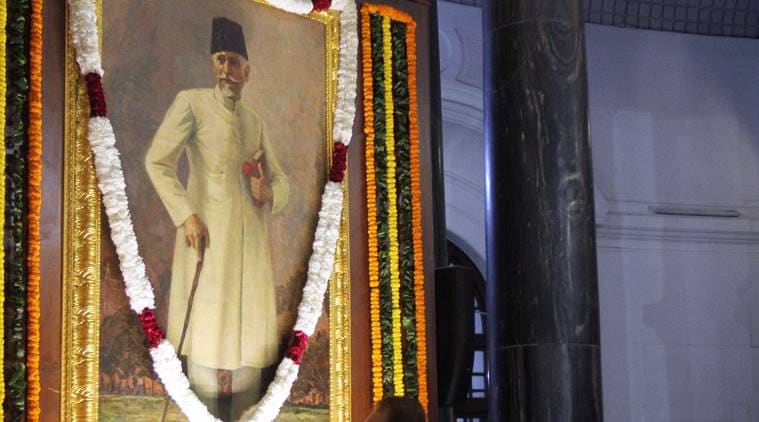
Maulana Azad: The Voice Behind the Dream for a Unified India

NEW DELHI  :

(This story was first published on 10 November 2017. It has been republished from The Quint’s archives to mark Maulana Azad’s death anniversary.)

“I am an essential element, which has gone into building India. I can never surrender this claim.”

These were the famous words uttered by Maulana Abul Kalam Azad, when he stared at the daunting prospect of Partition. On his birth anniversary, we remember his contribution to the country.

source: http://www.youtube.com / The Quint

Azad was among the many Muslim leaders in India who opposed the Partition of Unified India into Pakistan and Hindustan. As the leader of the All India Congress Committee in 1946, he put forth a Cabinet Mission proposal that advocated a federal structure of government, with autonomy for states. Though the proposal did face a great deal of skepticism, the Working Committee passed it, with even Jinnah agreeing to it for ‘the greater good of Indian Muslims’.

This proposal was certainly considered a breakthrough, as Jinnah and Azad had never enjoyed very good relations, predominantly owing to their opposing stances on Partition. Where one batted for Hindu-Muslim unity under a larger India, the other was vehement on the creation of two separate states. But their souring relations never stopped Azad from attempting to convince Jinnah to consider a ‘unified India’.

For instance, when Jinnah’s clamour for Pakistan grew louder, Azad is known to have sent a telegram insisting on the perils of a two-state ideology. Jinnah is said to have insulted Azad in his response, calling him Congress’ ‘show boy President’.

Don’t you feel that the Congress has made you a show boy President to hoodwink non-Congress parties and other countries of the world? You represent neither Muslims nor Hindus.

Having failed at getting Jinnah to reconsider, Azad then unsuccessfully tried to convince the Congress leaders to wait till a solution could be found. But even Patel, who earlier backed Azad’s proposal, was now vehemently pro-partition. Azad in his autobiography later writes that the party agreed to the Partition as “blindness of Congress leaders to facts, and their anger and frustration clouded their vision.”

According to Azad, as he writes in his autobiography, Nehru too contributed to angering the Muslims, by committing two mistakes which ultimately drove Jinnah to lose faith in the proposal and go through with partition.

The first was when Nehru refused to take two Muslim League leaders as Cabinet Ministers in the UP elections of 1937. The second mistake was when after taking over as the President of the Congress in 1946, he indicated that the earlier Cabinet Mission proposal could be changed, which culminated in Jinnah insisting on the formation of Pakistan.

Maulana had not only opposed Partition as an Indian leader, but also as a Muslim. He was, in fact, of the opinion, that the two-state policy will only “create more problems than solve”.

And true to his word, even today the relations between the two countries are strained at best, despite their shared history.

source: http://www.thequint.com / The Quint / Home> News Videos / November 10th, 2017 / and February 22nd, 2020

From naming ‘IIT’ to setting up of UGC: Initiatives by Maulana Abul Kalam Azad

Mecca, SAUDI ARABIA / New Delhi   :

Homeschooled for the early part of his life, Azad is considered to be the father of the Indian Institutes of Technology (IITs). Here is a look at some of the major initiatives taken by him in setting up the Indian education system.

Maulana Abdul Kalam Aazad, HRD Minister of India, JMI, jamai, DU, IIT, National education day, education news

Maulana Abdul Kalam Aazad (File Photo)

Bharat Ratna awardee and India’s first Minister of Human Resource Development (HRD), Maulana Abul Kalam Azad was not only an educationalist but also a journalist. Homeschooled for the early part of his life, Azad is considered to be the father of the Indian Institutes of Technology (IITs) which are still considered among the best Indian educational institutes. Here is a look at some of the major initiatives taken by him in setting up the Indian education system.

Naming IITs – When India was looking to set up higher educational institutes which would impart knowledge in the field of science and technology, a Massachusetts Institute of Technology-like (MIT) model was thought of. The name ‘Indian Institute of Technology’ was adopted by Maulana Abul Kalam Azad before the inauguration of the institutes. The first Indian Institutes of Technology – IIT Kharagpur came into establishment in 1950.

Establishing UGC – A committee headed by S Radhakrishnan under the leadership of Azad as HRD Minister suggested extending the Universities Grant Commission (UGC)’s role to supervise work of all Indian varsities, make recommendations and grant funds. Earlier, UGC looked after three central universities, namely Aligarh, Benaras and Delhi.

DU and IISc – He laid the foundation stone of the Indian Institute of Science (IISc) in 1909, then known as the Tata Institute and granted deemed university status in 1958. Azad also oversaw the setting up of the ‘Central Institute of Education, Delhi’, which later became part of University of Delhi (DU) as the Department of Education. He was also a member of the foundation committee to establish Jamia Millia Islamia at Aligarh in UP.

Minority community – A supporter of education for poor, women and minority communities, Azad had said, “It is a birthright of every individual to receive at least the basic education without which he cannot fully discharge his duties as a citizen.”

To honour his efforts, Ministry of Minority Affairs of the Central Government of India set up the Maulana Azad Education Foundation to promote education among educationally backward sections of the society. The Ministry also provides the Maulana Abul Kalam Azad National Fellowship, an integrated five-year fellowship in the form of financial assistance to students from minority communities to pursue higher studies. The education institutes include Maulana Azad National Institute of Technology, the Maulana Azad College among others.

source: http://www.indianexpress.com / The Indian Express / Home> Education / by Education Desk , New Delhi / November 11th, 2019

National Education Day celebrated at Farooqia College of Pharmacy

Mysuru, KARNATAKA :

FarooqiaCollegeMPOs01dec2017

Mysuru :

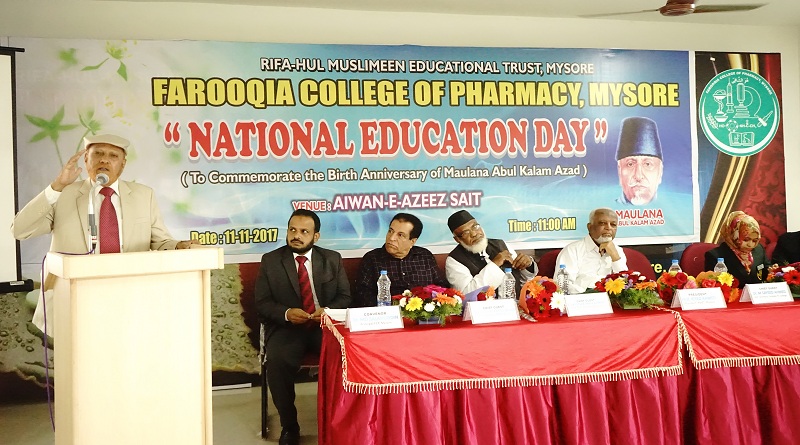
The National Education Day to commemorate the birth anniversary of Bharat Ratna Maulana Abul Kalam Azad was celebrated at Farooqia College of Pharmacy at Tilaknagar here recently.

Speaking on the occasion, Taj Mohammed Khan, secretary of Farooqia Educational Institutions, encouraged the students to follow the footsteps of Maulana who fought for the freedom of India and brought a revolution in education with his reforms as first education minister of post-independent India.

Dr M Sayeed Ahmed, secretary of Farooqia PU College, who was the chief guest, gave a detailed power-point presentation on Maulana’s life.

He said it is Maulana who first opposed the partition and separation of India and Pakistan. Maulana was a firm believer in the co-existence of religions. His dream was that of a unified Independent India where Hindus and Muslims can live peacefully.

Kolar Mustafa said that nowadays the institutions like UGC, AICTE and IITs are still running without modification in their regulations due to the broad based think tank of Maulana Abul Kalam Azad.

President of RMET Prof Riyaz Ahmed in his presidential remarks briefed about the post- independent educational system and highlighted Maulana’s simplicity, who didn’t amass property and wealth for his own family members and relatives even though he was an education minister for 10 long years.

Prizes were given away to Essay Competition winners on “Life of Maulana Abul Kalam Azad after post-independent India.”

Maryam Postdar, a D Pharma student, recited verses from the Quran. Principal Dr MD Salahuddin presented a video documentary on Maulana Abul Kalam Azad’s Life.Sara Ateeq, vice-president, Pharmaceutical Society and others were present.

source: http://www.citytoday.news / City Today / Home> Headlines> Mysore / by CT Bureau / November 30th, 2017