Tag Archives: Danish Khan

Zohran Mamdani’s New York win revives a forgotten history — of Gujarati Muslim cosmopolitanism

GUJARAT / UGANDA / New York, U.S.A :

From Mughal ports to Dutch wars to Bombay’s merchant dynasties, Gujarati Muslims once shaped the Indian Ocean world — long before one of their descendants took New York.

File photo of Zohran Mamdani | Reuters 2025

_______________________________________________

What You Need to Know

Zohran Mamdani’s election highlights a forgotten Indian Muslim cosmopolitanism. Historically, Gujarati Muslim communities dominated Indian Ocean trade, challenging European powers and fostering diverse business relationships. Later, groups like the Khojas adapted through “corporate Islam” (jamaats), becoming powerful economic forces globally. This rich, diverse history is increasingly overshadowed by modern religious nationalism.

*AI-generated summary. Check context in original text.

________________________________________________

Having delivered speeches in Gujarati, Bengali, Arabic, Hindi, Luganda, and Spanish, Mamdani is a reflection of a long-forgotten Indian Muslim cosmopolitanism. The Gujarati Muslim communities he descends from once challenged the Dutch for hegemony in Indonesia; poured money into schools, hospitals, and printing presses from Japan to Arabia; and helped the British Empire consolidate its grip over Africa. To this day, that Indian Muslim history still echoes — in high-end London auction houses as much as in the working-class boroughs of New York.


The election of Zohran Mamdani as Mayor of New York last week has struck a surprising chord in the world’s media — especially considering he is technically the head of just one American city’s administration. But the buzz around this young Indian-origin Muslim, an avowed democratic socialist, is a ripple in a much older ocean.

Gujaratis in the Indian Ocean

This column began with a rather innocuous tweet pointing out that Mamdani’s multilingualism would have made him a fortune in the early modern Southeast Asian spice trade. As of writing, it has racked up over one million views and 54,000 likes — and it’s a pretty accurate reflection of what propelled Gujarati Muslims to international trade superstardom in the first place.

In her paper ‘Gujarat’s Trade with South East Asia (16th and 17th centuries)’, historian Ruby Maloni describes the great port of Khambhat in Gujarat as having “stretched out two arms — one towards Aden, the other towards Malacca.” While Banias were especially prominent in East Africa and the Persian Gulf at the time, Gujarati Muslim merchants dominated the Malacca trade, conveying relatively cheap block-print textiles from manufactories in Ahmedabad deep into Southeast Asia to trade for spices.

The most prominent among these merchants effectively formed ‘dynasties’ closely linked to the Mughal court, among others. But there was also a strong aspect of caste-based collective organisation, paralleling that of Hindu and Jain Gujaratis.

Nowhere was this more evident than in Surat, perhaps the most impressive port on India’s west coast. Its multilingual babble included Gujarati, Arabic, Persian, Urdu, Dutch, English, and Portuguese. Certainly, there were clear distinctions between caste and religious groups, and within their communities Gujarati merchants — Hindu and Muslim alike — could be quite rigid. At the same time, in interpersonal and business relationships, their shared Gujarati heritage encouraged cosmopolitan attitudes.

Historian Jawaid Akhtar offers several examples in his paper ‘The Culture of Mercantile Communities in Mughal Times.’ In Surat, Armenian merchants were in business with Parsis and Muslims; Vaishnavite Bhatias, despite a taboo against crossing the ocean, jointly owned cargo and ships with Muslims. Akhtar cites documentary evidence of Bania men adopting Muslim practices such as offering dowers to their wives. Muslim and Hindu merchants also collectively represented their grievances to Mughal authorities.

On one occasion in 1669, when the Qazi of Surat compelled a Vaishnavite Bania to convert to Islam, nearly 8,000 merchants — apparently of all religions — emigrated to Bharuch in protest against this infringement of their privileges.

Gujarati Muslims quickly identified Europeans as a threat to their trade dominance in Southeast Asia. Maloni notes that Dutch East India Company records mention their difficulties with these merchants, who took them on through price wars and by installing their own candidates as port authorities. It seemed that there was nothing the Dutch could do to prevent Gujarati Muslims from trading. The Sultanate of Johor welcomed ships belonging to the merchant Haji Zahid Beg, who bought tin in flagrant defiance of Dutch embargoes. Other merchants, Maloni writes, hired cargo space on English ships; the spectacularly wealthy merchant Abdul Ghafur of Surat even flew Dutch flags on his own ships. It was only when the Dutch forcibly colonised much of Indonesia that Gujarati Muslims finally lost their grip on Malacca. But by then, new opportunities were already emerging on the horizon.
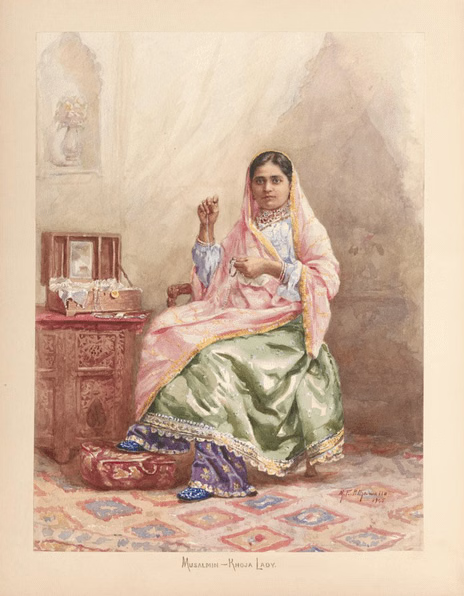
Khoja Lady | From the album presented to the Princess of Wales by the women of Bombay, featuring 13 full-page watercolours of Indian women by artist Manchershaw Fakirjee Pithawalla (1872-1937) | Wikimedia Commons

The rise of ‘Corporate Islam’

As the Mughal juggernaut began to shake and unravel in the 18th century, the old order of great merchant princes and dynasties started to fall apart. Surat, repeatedly raided by the Maratha king Shivaji, faced growing competition from the East India Company’s new port at Bombay.

Three Gujarati Muslim communities — the Bohras, Memons, and Khojas — who had hitherto been relatively small-time traders, found themselves ideally placed to benefit from the changing political landscape. Zohran Mamdani descends from the last of these.

In his seminal book No Birds of Passage: A History of Gujarati Muslim Business Communities, 1800–1975, historian Michael O’Sullivan notes that these three groups had spread “as far east as Ujjain, as far west as Karachi, as far south as Poona, and as far north as Udaipur… They thus inhabited a territory that was, by the reckoning of an Indian lexicographer in the 1840s, larger than Great Britain and Ireland, with their shared mother tongues [Gujarati] serving as the principal language of business in Central and Western India.”

The Bohras, Memons and Khojas had all converted to Islam around the 15th century, but their social and cultural practices varied drastically. Subgroups were affiliated with various Sunni and Shia sects; some were Ismaili and revered the Aga Khans, while others traced descent by region and worshipped Sufi saints.

What these groups shared, though, was the jamaat —an institution that O’Sullivan describes as a form of “corporate Islam”. Essentially, members of each jamaat shared some resources in common — schools, hospitals, that sort of thing. Particularly wealthy members, who often held senior religious positions, also maintained private family trusts and companies.

What the jamaat ensured, O’Sullivan writes, was a mechanism for organisation, exclusivity, and interpretation, allowing these communities to adapt the changing contours of Islamic practice to an era of globalisation. Jamaats could mobilise capital, human resources, and theological flexibility at a rate few other Indian institutions could match.

Collectively, these Gujarati Muslim jamaats emerged as some of the most powerful Indian economic forces of the late 19th and early 20th centuries. Though now outshone in the popular imagination by Parsi and Bania entrepreneurs, Gujarati Muslims similarly negotiated with the Marathas and the British, benefited from the Opium Wars, and switched soon after to manufacturing all sorts of commercial goods, especially in Bombay.

In the 1840s, Gujarati Muslims commissioned pioneering printed texts — in Gujarati — including travelogues and cultural primers for new markets like China. Their growing wealth also funded spectacular mansions, such as those in Sidhpur, now eerily abandoned. It was Gujaratis, perhaps more than any other Indian group, who built the financial infrastructure of the British Raj in East Africa — a migration line from which Zohran Mamdani himself descends.

All of this amounted to a decisive shift in the centre of gravity of Indian Ocean Islam. It was for this reason that the Aga Khan, revered by Ismaili Khojas, moved his seat from Iran to Bombay before Partition.
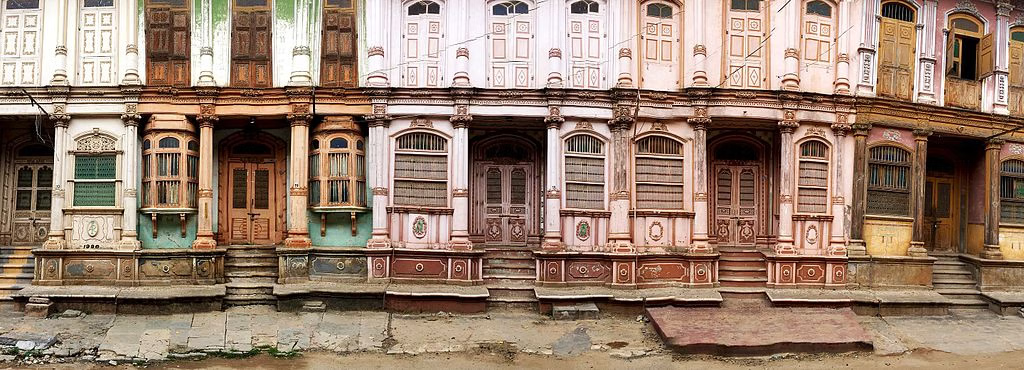
Sidhpur city in Gujarat | Wikimedia Commons

A cosmopolitanism forgotten

The versions of Islam promoted by Gujarati Muslims absorbed the modernist vocabulary of capital accumulation and inheritance, frequently splintering into new jamaats as they expanded into ever-new markets and cultures.

At the same time, as researcher Danish Khan notes, Gujarati Muslims attained positions of leadership and influence in Bombay well before they had even set foot in the United States of America. “The first Muslim baronet in colonial India,” he writes, “was a Khoja and the first Muslim ICS officer was a Sulaimani Bohra. Badruddin Tyabji and Rahimtoola Sayani were the first two Muslim Presidents of Congress party. Sir Adamjee Peerbhoy presided over the first session of the Muslim League in Karachi.”

But with the rise of pan-Islamic and Hindu nationalism in the early 20th century, the scales swung once again, and mercantile, oceanic histories were overridden by grievances inspired by long-dead inland kings.

Where does the history of Gujarati Muslims fit now? Mamdani’s election is ironic on many levels. In Bombay, once the historic home of the community, a BJP politician declared, in response to Mamdani’s victory in New York, that “We won’t allow any Khan to become mayor.”

The fact is that before and since, the history of Gujarati Muslims has, for all intents and purposes, disappeared into the ever–widening gap between radical Hindutva and radical Islam. Every news cycle, it seems, tears India’s many intertwined histories further apart.

Anirudh Kanisetti is a public historian. He is the author of ‘Lords of Earth and Sea: A History of the Chola Empire’ and the award-winning ‘Lords of the Deccan’. He hosts the Echoes of India and Yuddha podcasts. He tweets @AKanisetti and is on Instagram @anirbuddha.

This article is a part of the ‘Thinking Medieval’ series that takes a deep dive into India’s medieval culture, politics, and history.

(Edited by Prashant Dixit)

source: http://www.theprint.in / The Print / Home> Opinion> The Fine Print / by Anirudh Kanisetti / November 13th, 2025

Journey of music: How members of Dilli gharana are keeping up with changing times

NEW DELHI :

Even today, the custodians of the centuries-old Dilli Gharana of music, known for its Khayal gayaki, live and practice their art in the old, romantically named Mausiqi Manzil in the Walled City. But with changing times and commercialisation, they are experimenting with their craft to stay relevant

It will be too much to expect Aalif Iqbal Khan to understand the significance of being the youngest descendant of the Dilli gharana. He is five years old – too young to know the history of the family or the legacy he will have to uphold in the years to come. But the family elders seem to have already decided for him. They enjoy seeing Aalif spend time with his grandfather, Ustad Iqbal Ahmed Khan, 64, the head or khalifa of the clan, in the living room of Mausiqi Manzil, their more-than-200-year-old house in Delhi’s Walled City. They film the child when he exerts his vocal chords while sitting cross-legged on his grandfather’s chest. “Look how beautifully he sings. There is no match to his talent,” says Aalif’s mother, Vusat Iqbal Khan, 32, with pride.

Musical families across the country have seen far-reaching changes over the decades because of the evolving tastes of audiences, the death of royal patronage, the impact of technology and plethora of alternative leisure activities. Having felt the ripple effects of this transformation, the family representing the Dilli Gharana of music (gharana refers to a style of presentation) is trying to remain relevant to the times without compromising on its rich history.

The family is one of the oldest in the country to propagate the city’s Khayal gayaki – a style of singing popularised by 13th century Sufi poet Amir Khusrau. Over time, members of the clan preserved and promoted more than two dozen sub-genres of singing such as sawela, tirvat, dhamar and sawan geet. Some members of the gharana have mastered musical instruments too, such as the tabla, sitar and violin.

“It is hard to find another family which is such a rich a repository of Khusrau’s compositions. They also know the journey of the compositions and the many influences on each composition over the course of centuries,” says Vivek Prajapati, 30, Iqbal’s disciple and a PhD scholar at the faculty of music and fine arts, Delhi University.

According to Hindustani classical singer and writer Vidya Rao, the Dilli gharana strongly suggests that one of the influences on the development of Khayal gayaki could be Sufi tradition and music. “Also, it is perhaps the only Khayal gharana where the ghazal is an integral part of the gharana’s repertoire,” she says.

According to Dr Sunanda Pathak, scholar, performing artiste and author of Origin and Evolution of Raag in Hindustani Classical Music, the Dilli gharana’s style of presentation offers tremendous scope for developing ragas. “The style is taan pradhan or variation in notes is the primary ornamentation tool,” she says.

According to Delhi historian and chronicler RV Smith, “Before Khusrau, there was only bhakti sangeet in India. Khusrau combined the temple music with the music of the Arab peninsula to develop multiple genres of singing, among which, Khayal was the one mostly practiced by the founders of Dilli gharana.”

In the old days, classical artists like Siddheshwari Devi, Malika Pukhraj, musicians and composers like KL Saigal, Roshan Lal Roshan, and Mumtaz Jahan Dehlvi (much before she arrived in Hindi cinema as actor Madhubala), were regulars at Mausiqi Manzil. “In 1938, there was a conference near Jubilee cinema in Chandni Chowk, where she sang. Back then she was just Baby Mumtaz,” says Iqbal.

The narrow lane leading to Mausiqi Manzil has shrunk even further over the decades due to haphazard construction. The bylanes resemble tunnels within a tunnel. The windows of one house open into the bedroom of the facing house. Sunlight is a luxury. Goats are parked along with two wheelers, cycle rickshaws and carts. A web of electricity wires sags above passersby.

Iqbal lives with his wife Zohra, son (Saad, 22) and youngest daughter (Sadiya, 23) on the first floor. Pictures of Khan’s great grandfather Ustad Mamman Khan, grandfather and teacher Ustad Chand Khan and his brother Jahan Khan hang on the wall, silently watching the proceedings in the living room. Iqbal’s books and awards are stacked in a wooden showcase. He takes out a briefcase from a trunk. It contains Chand Khan’s manuscripts in Urdu, Arabic and Persian, and all his medals. An old, dark green pouch contains a few of his belongings, including one of his pens and even a tooth! “Babu miyan had asked me to throw it. But I kept it safely,” says Iqbal, recalling his mentor.

FILMI SONGS
Times are tough. Iqbal’s descendants perform on a freelance basis, take up teaching assignments and perform with him in regional and international concerts.

They are open to trying different formats and styles as long it is in sync with the family’s tradition. Iqbal’s first cousin and student Imran Khan, 38, was in his early 20s when he was approached for a television reality show. “Ab tum filmi gaaney gaaogey?” his mentor said. But Imran says if he got the offer now, he would accept it. “I don’t think playback singing is a bad thing. I sing for bands. In a mehfil, I sing Sufi songs, ghazals, and film songs,” he says. “Hmmm…maybe things would have been different had I participated in that reality show.”

Iqbal faced a similar situation in his youth. “Filmmaker Rajinder Singh Bedi offered me a film. I said I would be comfortable if the composition was similar to what Bade Ghulam Ali Khan sahib sang in Mughal-e-Azam. Otherwise, I was not interested. It didn’t work out,” he says.

More women in Iqbal’s clan have been to college than men. Iqbal, a graduate from Delhi’s Dayal Singh College, and his younger brother, the late Dr Anis Ahmed Khan, a music scholar, were exceptions. “I am all for education. But it cannot replace talent. And then, look at the sheer number of educated unemployed youth,” says Iqbal. After a moment, he adds. “Riyaz consumes lot of time. It does not leave any time for school and college.”

Iqbal’s family is learning to make the art form commercially viable without degenerating the guru-shishya tradition. In 2012, Iqbal’s daughter Vusat quit her job as a communications consultant with the union ministry of information & technology to help her father and add to the family’s body of work. Apart from overseeing the management of two family enterprises – the Amir Khusrau Institute of Music and the Sursagar Society – Vusat conceptualised and performed storytelling for two productions (Rudad-e-Shireen and Ghalib, Umrao Ki Nazar Se). “I realised that my family members were not getting the exposure they deserved. Also, they have a classical music mindset. It is a good thing. But these days, you have to contemporise to become commercially viable. It is the need of the hour,” she says.

The experiments didn’t come about without disagreements. Sometime in 2015, she was designing a performance of Indian classical vocal and instrumental fusion. Her father did not want to compromise on certain elements. His apprehension was that adding instruments might lead to confusion. “He belongs to the era when the world was straightforward and transparent. But we have to look at the commercial aspect as well. It is very difficult to convince abba ji. But eventually we manage,” she says.

Iqbal says he does have a sense of changing times. “In the beginning, our forefathers had the patronage of royal families. Then came the Nawabs. Now, mass media takes us places.”

US AND THEM 
The family members continue to face prejudice in varied degrees in their neighbourhood. Their customs often leave people bewildered. Touching the feet of elders, especially gurus is the norm; there is no fuss about singing Sai bhajans at private gatherings; Iqbal and his students celebrate Holi, Basant Panchmi and Guru Purnima at the institute. They don’t perform during the first 10 days of the month of Muharram because they mourn the martyrdom of Prophet Muhammad’s grandson Imam Hussain – a practice that makes them appear close to Shia Muslims. “Singing and music have no religion,” says the khalifa.

Sitar player Adnan Khan, 25, is Iqbal’s nephew. After learning the sitar from his father, Ustad Saeed Khan, Adnan was at the ITC Sangeet Research Academy, Kolkata, for five years to polish his craft. He remembers the caste slurs hurled at him in the neighbourhood in his early teens. “We were told to ignore remarks such as meerasi, pandit, and we did. But there were occasions when it led to arguments. The situation is very different now. Many of my friends are from non-musical backgrounds,” Adnan says.

FINDING SOUL SISTERS
Miyan Samti, Amir Khusrau’ contemporary and grandson of vocalist Hasan Sawant finds mention in the shijra or family tree of the Dilli gharana. Samti’s descendant Miyan Achpal Khan, the khalifa of the tradition in the early 19th century, was the court musician during the reign of the last Mughal king, Bahadur Shah Zafar. Later, Iqbal’s grandfather Ustad Chand Khan became the khalifa.

Chand Khan didn’t have a son. He raised Iqbal like his son since he was three months old. His formal training began at the age of four with soz khwani or songs of lament. In later years, his day would begin at dawn with warm-up exercises which comprised of squats. Then he would practice sapat (straight) taan on prayer beads “It had 500 beads. We had to finish six strings every morning,” recalls Iqbal.

During his training, he met Krishna Bisht and Bharti Chakravarti, two disciples of Chand Khan, who became Iqbal’s guru behenein (sisters). Bisht, former dean at faculty of music and fine arts, Delhi University, is the senior most living disciple of Chand Khan.

After Chand Khan’s death, Iqbal was declared the khalifa or the representative of the Gharana in February 1981.

Iqbal avoids performing at gatherings where art is considered as entertainment. “We perform for people who know our history,” he says.

Back at Mausiqi Manzil, the new generation is preparing to take on the mantle. Vusat’s youngest sister, Sadiya, a post graduate in political science, may soon become the first woman of the family to sing on stage. “Somehow, women could not get to sing on stage. I doubt if they tried. Sadiya is not a trained singer but she has got a very good voice. Men in the family were particularly surprised when I said she should perform. Battles within the family are more difficult than the ones outside,” says Vusat.

source: http://www.hindustantimes.com / Hindustan Times / Home> Art & Culture / by Danish Raza , Hindustan Times / October 27th, 2018