Bengaluru, KARNATAKA :
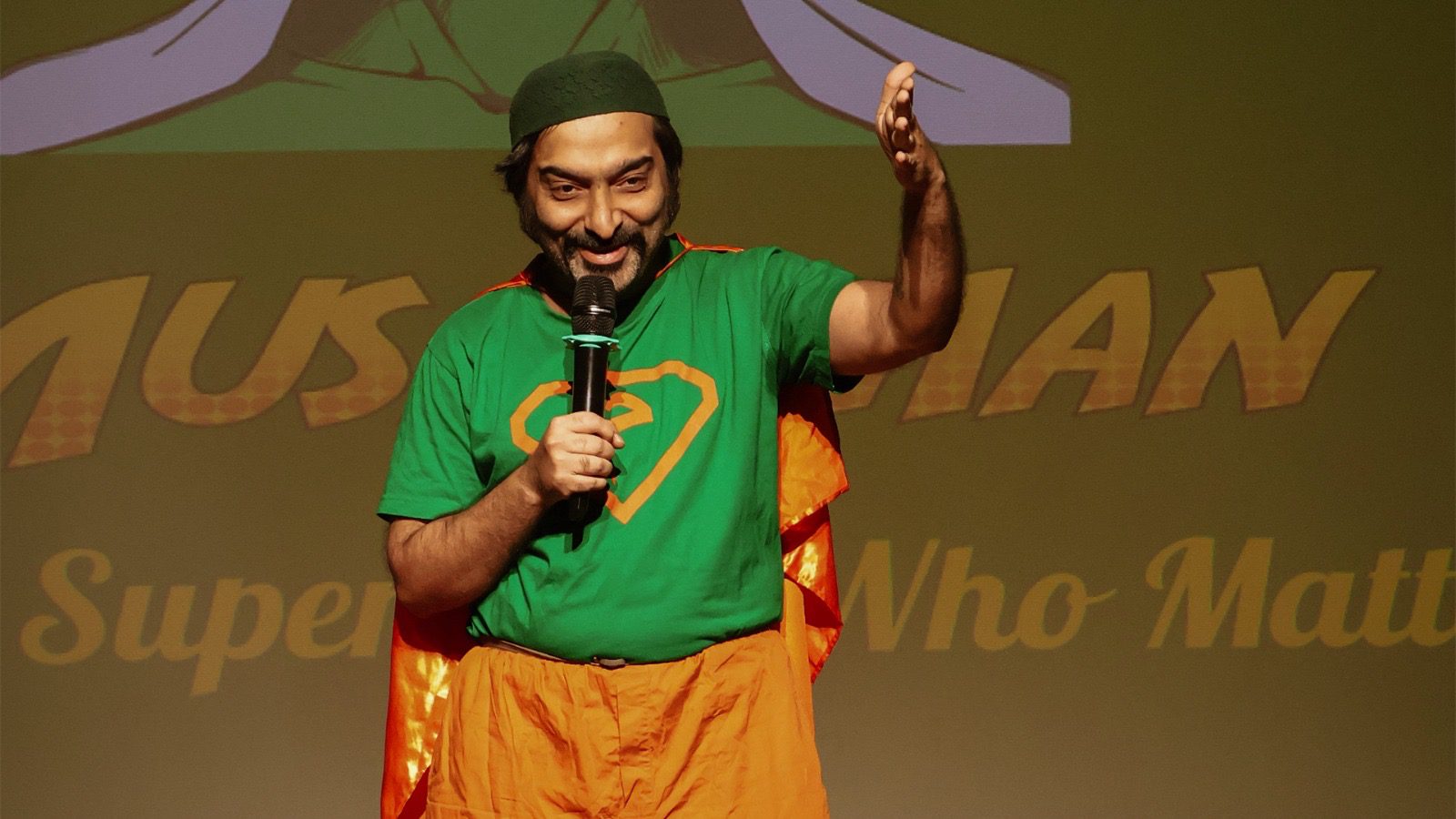
A non-violent Muslim superhero in a violent world: In conversation with Falah Faisal, creator of Musalman
In an increasingly polarised media landscape, Musalman has emerged as a work that blends satire, journalism, and modern mythology. Created by Bangalore-based comic book writer and stand-up comic Falah Faisal, the series has now taken a definitive step into print with the launch of its Graphic Novel in March 2026. Published by Yoda Press, the book carries forward a project that began in 2017 and has since grown into a sharp form of political commentary, using humour and cinematic visual storytelling to question dominant narratives and imagine a way forward.
The Musalman Universe, as described on its official website, is a satirical superhero world built around a non-violent, skullcape-wearing hero navigating a nation marked by Islamophobia and everyday absurdities. At its center is Musalman, a cricketer-turned-superhero who chooses reason and dialogue over violence, reframing what heroism looks like.
The world around him expands through a range of disruptive characters: Starwoman, an astronaut fused with the spirit of David Bowie after a space accident, whose connection to Musalman is rooted in childhood; Musalman X, emerging from Chicago and inspired by Malcolm X, who imagines a global network of Muslim superheroes; Begum Badass, a burqa-clad vigilante shaped by personal loss who turns to martial skill and deception in pursuit of justice; and Falahdeen, also known as Harami No. 1, a stoner anti-hero who discovers a genie in his bong and operates as a chaotic, irreverent counterforce within the narrative. Presiding over this world is Taana Shah, the dictatorial ruler of Antim Pradesh, driven by a prophecy that foretells his downfall at Musalman’s hands, making him not just an antagonist, but a figure shaped by fear, control, and the inevitability of fate.
To understand when Musalman stopped being just an idea and became a necessity, Falah Faisal traces its origins back to September 11, 2017. “At the time, it was sporadic, something I returned to occasionally. That urgency only emerged later, during the CAA protests, when the political climate sharpened my awareness of who was suffering, who was being oppressed, and what was at stake. When the protests gave way to lockdown and people were confined indoors, the need for expression only intensified. It was then that Musalman became essential.”
The way he approaches comics cannot be separated from his filmmaking background. Musalman, in his mind, was always a film first. Like Martin Scorsese suggests about cinema, learning comes from watching and absorbing how stories are constructed. For him, comics operate similarly. Each narrative plays out as moving images in his head, broken down frame by frame, with transitions that often feel distinctly cinematic. The question of whether Musalman is a political act is, for him, inseparable from another: it is also a form of journalism. Having studied and practiced journalism, he now sees the comic as an alternative to mainstream avenues that feel increasingly closed. Drawing from Hunter S. Thompson, he treats it as Gonzo Journalism, documenting reality through fiction, where truth can sometimes emerge more sharply than through facts alone. Humour, then, becomes more than a tool; it becomes survival. In a climate where one can feel constantly targeted, laughter functions as a form of resistance. Refusing to take oppressive forces seriously and laughing in their faces is, for him, a form of rebellion.
If there is one thing he refuses to do, it is censor himself. “The work must be put out exactly as I see it, without dilution or fear,” he says. At the same time, he is conscious of the conversations the comic might provoke, especially among those who disagree with it. “Art, for me, should function as a bridge.” Falah’s influences remain foundational. He puts it,“If the character’s beginnings lay in satire or something closer to irreverent humour, they were shaped early on by influences like South Park. Over time, however, the work evolved into something more pointed, a form of political commentary that reacts to the world in real time. It became a way of interpreting reality and imagining a way forward through it. It remains satire, but also, in his words, a vision for a better world. Alan Moore’s Watchmen and V for Vendetta shaped my understanding of flawed heroes and enduring ideas. Early works borrowed from these influences before evolving into something more personal. Drawing on Grant Morrison’s idea that there is no “us and them,” only “us,” I hope readers begin to question what they have been told, particularly by mass media. The contradictions are already there in everyday life; the work simply brings them into focus.”
But can satire still function when reality itself feels absurd? He acknowledges the difficulty. He observes,“Sometimes the fictionalised versions of real figures behave more sensibly in his comics than their real-world counterparts, such as his character Arnab Cowswamy, drawn from the TV anchor whose on-screen histrionics are legendary. In that sense, the comic becomes a way of restoring coherence to an increasingly chaotic reality.” Humour remains central, not just for commentary, but for connection. It softens difficult truths, makes them easier to engage with, and, at a personal level, “helps stay sane”, he says. Yet he is aware that humour can also be risky. Anything that speaks truth to power, especially in a political context, carries consequences. And still, he insists, that risk is necessary.
The Musalman character itself is designed to challenge expectations. He explains, “Musalman is non-violent, choosing humour and dialogue over confrontation. Even his origin complicates identity, as he is revealed to be a descendant of Ram, embodying both Hindu and Muslim lineages. In doing so, the character questions the idea of fixed identities and counters narratives that frame communities as outsiders.” When it comes to building characters, especially in a genre as saturated as superhero fiction, he sees limitations as well as possibilities. Most powers, he believes, have already been explored over the past century, which is why many of his characters are amalgamations of existing archetypes. “Musalman himself carries shades of Superman, but the real innovation lies elsewhere. The villains are not just individuals but representations of systems and ideas. Drawing from mythology and real life ensures they remain complex rather than caricatured. Figures like Taana Shah embody authoritarian ideologies, while characters like Chairman Maose critique corporate entities such as The Walt Disney Company and Marvel Cinematic Universe. Together, they map a world shaped by both political and corporate power,” he adds.
Is Musalman a person or a symbol? “For me, Musalman is an idea, and ideas are bulletproof. Even if the creator were silenced, the character could endure. I imagine him as a beacon, a lighthouse for those who feel alienated, offering a sense of belonging”, says Falah. For Musalman himself, the greatest fear is not defeat but ineffectiveness, the inability to intervene in real-world crises. Falah explains, “This tension feeds into a larger ambition: the creation of a modern mythology. Influenced by Joseph Campbell and The Hero with a Thousand Faces, I seek to bring together elements from multiple traditions, Hinduism, Islam, Christianity, and Judaism, into a shared narrative. The aim is not to erase differences but to reveal the common ground that already exists between them.” His storytelling process reflects this approach. To him each story is part of a jigsaw puzzle he’s putting together piece by piece, and only he sees the larger picture. Once finished, you’d have to step back to marvel at how it all came together.
Despite its possibilities, he observes that comics are undervalued in India. Yet their strengths, he argues, are unique. As he puts it, “unlike film, comics allow the reader to control time, to linger, revisit, and interpret at their own pace. They also enable expansive storytelling without the constraints of budget.” Even without financial limitations, he would continue working in comics, seeing them as the foundation of visual storytelling.
That visual freedom is realised through his collaboration with his illustrator. The collaboration with his illustrator, Spud, began in November 2019 at a meetup for illustrators and comic writers in Bangalore organised by Sumit Kumar from Bakermax. As introductions went around, he mentioned that he created Musalman, prompting a loud laugh from across the room. Curious, he later sought Spud out and, after seeing his sketchbooks filled with detailed drawings, felt an immediate fit. What followed has been a close collaboration, with Spud’s visual interpretations not only shaping the comic but also pushing the writing to evolve. Over time, the partnership became one of mutual growth.
In the world of Musalman, there’s a character who carries the creator’s name, Falahdeen. For Falah Faisal, Falahdeen operates as a counterpoint to Musalman. If Musalman represents the superego, Falahdeen embodies the id—the space of impulse, desire, and immediate gratification. He draws from his own inner world, shaping the character out of his deepest anxieties and desires, but allowing those instincts to play out more freely. “In the story, he finds a genie and wastes his first two wishes on Everlasting Joints. For the third, he’s given a trial period where he can wish for anything and undo it if he wants. But the genie always gives him the worst possible version of whatever he wishes for. If he becomes a rockstar, his music antagonises the right wing and they come after him. If he legalises weed, it leads to corporate control and manipulation. It’s always the worst version of the desire,” he says, describing the character as one that exists in the tension between impulse and consequence. Over time, however, he adds that he has begun to approach Falahdeen with a certain softness, allowing the character a more compassionate arc.
Audience responses have continually reshaped his understanding of the work. From a nine-year-old who painted a Musalman’s Meem symbol on his T-shirt to meet him, to older readers who have followed the series from the beginning, the range has been unexpected. His work has resonated across generations. This also raises the question of responsibility. “In a deeply polarised world, I hope Musalman can reflect a more inclusive past, one where communities coexisted more fluidly, and offer that vision to younger readers,” he says.
Musalman, for Falah Faisal, remains an ongoing inquiry. When asked about his idea of success, he moves away from conventional metrics. “It is not measured in likes, shares, or sales, but in those rare moments when fiction seems to echo reality, when ideas spill beyond the page and into the world. Success might also take the form of a feature film adaptation or the possibility of influencing real political change. Ultimately, it lies in endurance, in the idea continuing to exist, resonate, and shape the world in small, unexpected ways,” he concludes.
source: http://www.maktoobmedia.com / Maktoob Media / Home> Literature> Bookshelf> Features / by Ashika N / April 09th, 2026