Tag Archives: Freedom Fighter of India

Manzoor Nomani was ‘intrinsically Indian’ in the first place

Lucknow, UTTAR PRADESH :
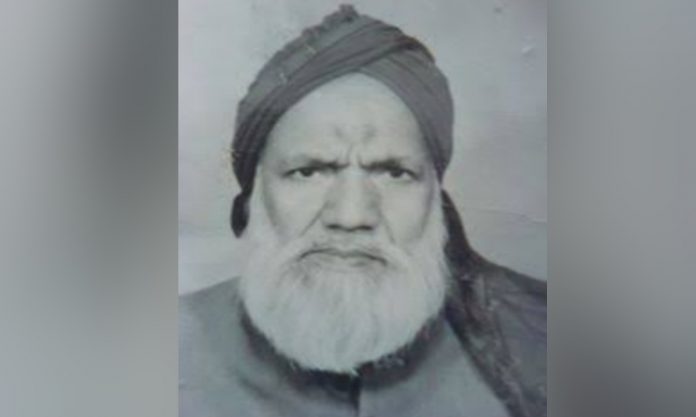
Maulana Manzoor Nomani. Courtesy: Quranwahadith.

Maulana Muhammed Manzoor Nomani (1905-1997), most arguably was one of the five prime most Muslims of the Indian sub-continent in the last century. He was the founding member of Jamaat-e-Islami and later got associated with Tablighi Jamaat and was also the member of founding committee of Muslim World League.

Maulana Khalil-ur-Rehman Sajjad Nomani is his son who gives every credence to his father, as that is what has made him, potentially what he is today; the most potent Muslim voice in the nation.

Sajjad Nomani’s command on Arabic, Quran, Hadith, Urdu, Hindi and English, in the same verve, depth and gravitas, apart from being an eloquent speaker, an indefatigable champion of Muslim cause, a voracious reader and a writer with an unquestionable command on the intricacies of linguistic theory and cultural praxis, are all the qualities he has embodied and imbibed from his late father.

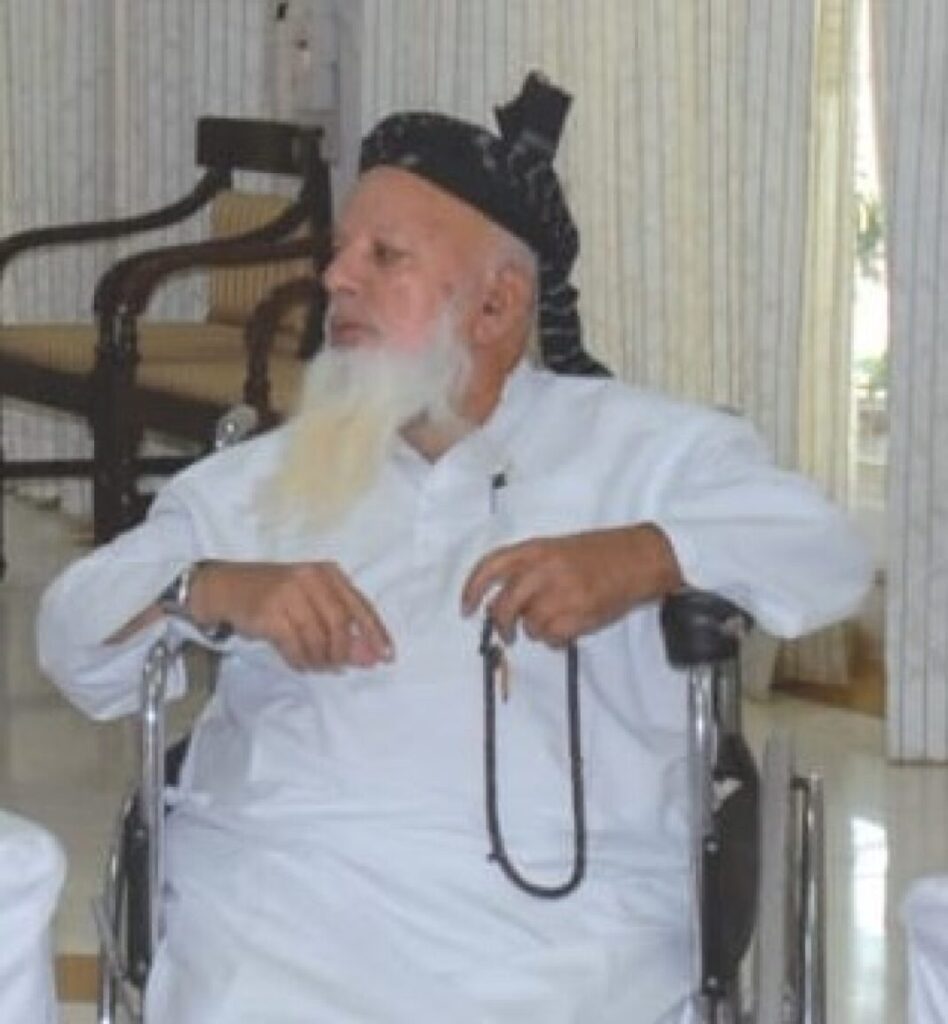
Yours truly also did once saw Manzoor Nomani Sahab, at his Nazeerabad residence, Lucknow, as he sat on his wheel chair engrossed in an Urdu newspaper and also attended to his funeral at Aishbagh, Lucknow in 1997.

It would be worthy to recollect some of the anecdotes Sajjad Sahab shared about his late father, which all are a treasure trove to understand the ‘times’ about seventy-five years back.

He reminisced that Pakistan first Prime Minister Liaquat Ali Khan was very insistent that Manzoor Sahab visit Pakistan and become a part of Pakistan Constituent Assembly to ‘pave for the ingredients’ for Islamic Jurisprudence for the state of Pakistan, and ultimately even officially sought for it, as Manzoor Sahab was one of the most outstanding figures of Islamic Law and Jurisprudence at those times.

When India’s PM Jawahar Lal Nehru came to know of it, he communicated that though he does not want Maulana to volunteer it, yet if Maulana wanted then government of India was to facilitate it. But, there was no question of Manzoor Sahab even entertaining the idea as he was an unwavering Indian by his heart, not out of any chance but primarily for his choice, as Muslims after 1947 were to choose between India or Pakistan and Manzoor Sahab stood for India.
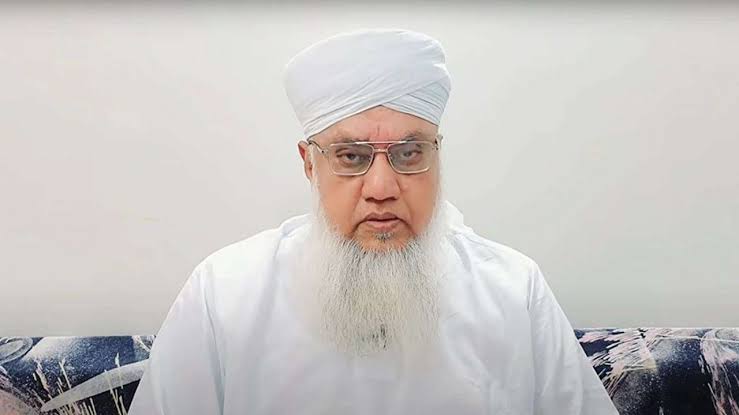
Maulana Khalilur Rahman Sajjad Nomani

Sajjad Sahab would also reflect that it was in 1976, when he was studying in Medina University, and had come to India on his vacations, that Manzoor Sahab kidneys collapsed all of a sudden and he went into coma. That was the time when emergency was in place. He informed that ‘intelligence inputs’ were given to PM Indira Gandhi that unless Maulana Ali Mian Nadwi, Maulana Manzoor Nomani and Qari Siddeeq Baandvi were to be arrested, Muslims were not relent to ‘vasectomy-sterilization’ and Indira Gandhi went to India’s President Fakhrudin Ali Ahmed, for his counsel on it, to which she was answered that all hell will break loose in the country in case of such an eventuality.

In the meantime, Indira Gandhi was also informed about the medical situation of Manzoor Sahab, and a chartered place to carry Maulana to Delhi was sent to Lucknow. The family members could not fathom for it, for they knew, that Maulana was be very angry once after the coma was to subside, the gesture of Indira Gandhi was hence refused, and fortunately by the midnight Maulana regained his senses, but then the next morning Indira Gandhi herself came down to Maulana’s residence. She would insist that Maulana may be flown to Delhi for his medical treatment, but all what Maulana sought from her was that she should implement justice as there was ‘tyranny’ all across the nation. He would address Indira Gandhi as his daughter and that when she played in her father’s courtyard, Maulana was to advice her father JL Nehru on critical issues.

Such has been the sense of belonging of Muslims for Manzoor Sahab , inherited too well by his son, is that while Jamshedpur raged under riots of 1979, Maulana went on to sit in a mosque for 21 days, draw into people and disbursed charity amongst the hapless Muslims, which continued for months. Maulana had an impeccable memory as Sajjad Sahab, relates, that shortly before his death, while he was searching for a Hadith, his ailing father, who was almost comatose, made him look for it on the exact page of Tirmezi- a great compendium of Hadith. Maulana Manzoor Sahab was a living authority and a luminary of Hadith-the sayings of Prophet of Islam.

Manzoor Nomani Sahab surely has left an indelible mark on Muslim civilization not across only in India but throughout the whole Muslim world. The best part however is that, it has all been very well innately translated into a relentless campaign for Muslim rights in India, by his son Sajjad Nomani, an activist always on his heels and one of the most credible voice of Muslims in the nation today. He is right now articulating the cause of Peace and Justice, a desperate call of the nation today. Sajjad Sahab is also the spokesperson of All India Muslim Personal Law Board, the Apex of Muslims in the country.

***

The writer is a former UP State Information Commissioner and writes on political issues.

source: http://www.mulimmirror.com / Muslim Mirror / Home> Muslim Scholars / by Haider Abbas / June 20th, 2022
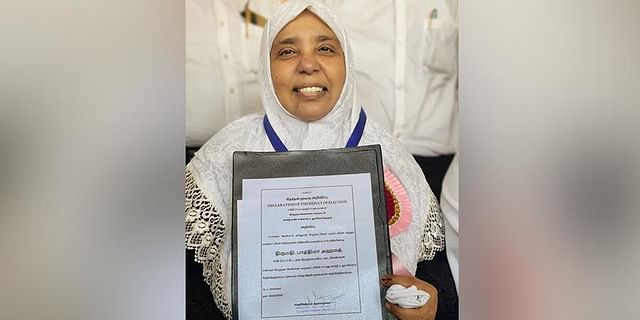
Indian Union Muslim League’s first woman candidate in Chennai Fathima Muzaffer scores a win

Chennai, TAMIL NADU :

Notably, Fathima’s father, Abdul Samad, an ex-Member of Parliament, won from the Harbour area during the 1958 urban local body polls.

AS Fathima Muzaffer led numerous anti-CAA protests in Chennai. (Photo | Special Arrangement)

Chennai :

The woman, who led numerous anti-CAA protests in Chennai, AS Fathima Muzaffer from the Indian Union Muslim League (IUML)-DMK alliance emerged victorious in ward 61 of the Chennai Corporation on Tuesday by a huge margin of votes.

After five and a half decades, IUML’s own symbol (ladder) was used and this is the first time in the history of the party that a woman candidate has contested in Chennai.

Notably, Fathima’s father, Abdul Samad, an ex-Member of Parliament, won from the Harbour area during the 1958 urban local body polls. Fathima bagged 6,347 of 11,443 votes in her ward.

“It is a historic moment for IUML as we contested only from one ward and won. This is a silent answer to the ongoing hijab fiasco. Also, this is my first political campaign. I have been a social activist largely and hope to do the same as a councillor — serve the public,” said Fathima, who is also the national president of IUML’s women’s wing.

With numerous colleges, a prestigious stadium and four slums in her ward, Fathima says she wishes to bridge the gap between the elite and downtrodden.

“I want to implement a lot of youth programmes. Since this ward has good population of youth, it is crucial. Apart from this, social equality and communal harmony will always be at the forefront.”

Fathima’s family has been in politics for three generations.

Her grandfather, Moulana Abdul Hameed Baqavi was a freedom fighter and reportedly the first person to translate the holy Quran into Tamil.

She has also won a lot of awards in the field of social service for her work on women’s empowerment and education, especially in the Muslim community.

source: http://www.newindianexpress.com / The New Indian Express / Home> Cities>Chennai / by KV Navya, Express News Service / February 22nd, 2022

Press Club of India Remembers Maulvi Baqar — India’s ‘First Martyr Journalist’

DELHI :

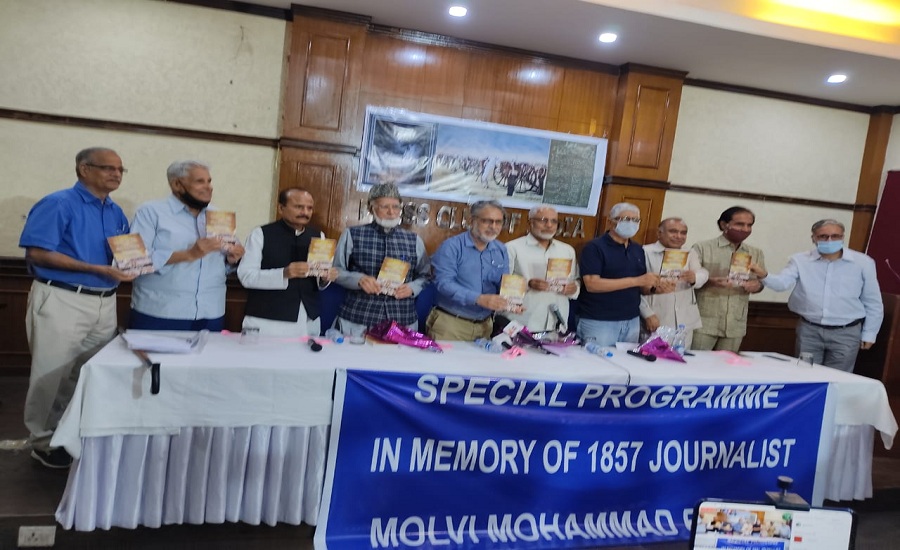
Masoom Muradabadi’s book was launched at the Press Club on Thursday by eminent journalists

The event was organised to launch the Hindi translation of journalist Masoom Muradabadi’s book on Maulvi Baqar.

New Delhi :

The Press Club of India on Thursday held a seminar to commemorate the death anniversary of Maulvi Mohammad Baqar, the first journalist who was executed by the British following the rebellion of 1857.

A Hindi translation of the book titled ‘1857 Ki Kranti Aur Urdu Patrkarita’ (The Revolution of 1957 and Urdu Journalism) authored by journalist Masoom Muradabadi was released at the seminar.

It chronicles the life of Baqar as a journalist and freedom fighter. Moreover, two journalists — Swati Mathur, a reporter with The Times of India, and Shams Tabrez Qasmi, the editor of popular news portal Millat Times — were also felicitated with an award named after Baqar.

A number of veteran journalists and writers spoke on the occasion paying tributes to the ‘first martyr journalist’. They described Baqar as an icon of Hindu-Muslim unity whose ideals are increasingly relevant in the present times.”

“Maulvi Muhammad Baqir was one of the great journalists who preferred martyrdom to collaboration with Britishers.” A U Asif, a senior journalist and member of Press Club’s managing committee, said. “He is the ideal and role model for the new generation of journalists.

Satish Jacob, a BBC veteran, said Baqar was a journalist who sacrificed his life for the sake of the nation. He described him a proponent of Hindu-Muslim unity.

Jacob said he is proud of the fact that he hails from old Delhi which gave birth to a person like Baqar. He said that Baqar had started an Imam Barah in the Kashmere gate area which is still functioning. The Imam Barah was built with the expressed goal of communal harmony, he added.

Noted journalist Meem Afzal, who has been a member of Parliament and India’s ambassador in four countries, lashed out at the current government for communal divide and accused it of obliterating the contributions of people like Baqar. He said that Baqar used his pen to fight for the idea of India.

Maroof Raza, another journalist, appealed for steps to find the original source and preserve the archives of ‘Delhi Urdu Akhbar’, the newspaper Baqar used to publish.

Jai Shanakar Gupta, senior journalist and a member of the Press Council of India, urged the government to get copies of the newspaper that Baqar edited from Britain where they are lying in a museum.

SQR Ilyas, journalist and president of the Welfare Party of India, said that the sacrifice of Baqar should inspire the present-day journalists to speak truth to power. He lauded the Press Club for commemorating Baqar.

Similar sentiments were echoed by Syed Aijaz Aslam, editor of Radiance Viewsweekly.

Mathur and Qasmi expressed their gratitude to the Press Club for felicitating them with the award. “This recognition in the form of an award in Maulvi Baqar’s name is a big thing for me, ” said Mathur.

Qasmi credited his whole team of Millat Times for the work that earned him the award.

source: http://www.clarionindia.net / Clarion / Home> Editor’ Pick / by Zafar Aafaq, Clarion India / September 16th, 2021

Freedom Fighter & Islamic Scholar Mufti Abd-Ur-Razzaq Of Bhopal Passes Away, Laid To Rest With State Honours

Bhopal, MADHYA PRADESH :

Bhopal :

A leading Islamic scholar and freedom fighter Mufti Abd-ur-Razzaq Khan of Bhopal, who was national vice president of Jamiat Ulema-e-Hind (Maulana Arshad Madani faction), breathed his last after a prolonged illness here on May 26. He was about 96 years of age.

Mufti Abd-ur-Razzaq was laid to rest on May 27 afternoon with state Guard of Honours granted by the Madhya Pradesh Government. Since he was a popular figure and had followers cutting across the barriers of religion, cast and creed, the funeral was held amidst tight security apprehending mass turnout in the face of prevailing lockdown and Corona curfew in the city.

He had authored more than 50 books including Sarzamīn-e-Hind: Ambiyā kirām aur Islām; Qur’ān mai kya hai?, Āzādi; Aslāf aur Jamiat Ulama-e-Hind; Islāmi zindagi: paidā’ish se jannat tak; Ahle Qur’ān aur ahle kitāb etc.

Police sealed walled city 

Meanwhile, considering the popularity and his large number of followers, police took precautionary measures to avoid large congregation during his last rites because of corona curfew. The police put up barricades at prominent squares and roads of old city areas and police officers along with district administration also appealed people to avoid gathering because of the Corona curfew. Bhopal entry points from all sides were also sealed to prevent followers and admirers of the cleric from all the districts of the state from entering the city.

Police barricaded the roads in old Bhopal. Only family members and limited people were allowed to attend the funeral. The heavy police force was deployed at all the prime squares and areas including Tarjama Wali Mosque, Iqbal Maidan, Peer Gate, Bhopal Talkies, Nadra bus stand, Alpana Talkies, Sangam Talkies, Moti Masjid, Ret Ghat, Kamla Park and adjoining areas. In addition to barricading all the routes to old Bhopal, the old city area was guarded by additional force of 700 policemen. The routes connecting Bhopal from borders and the roads towards old city areas remained closed.

Equally respected in all circles

Mufti Abd-ur-Razzaq in 1958 had established the Madrasa Islamia Arabia in Bhopal and a mosque popularly known as Tarjama Wali Masjid of Bhopal. He used to teach Islamic preaching in Indian language because of which the mosque gained the name Tarjama (translation) mosque. He was an Indian Muslim scholar, mufti and an activist of Indian freedom struggle, who was equally respected in political, social, civil and all circles. The Governor of Madhya Pradesh, Anandiben Patel, honoured him in January 2021 for his participation in the Indian freedom struggle.

The high point of his life was that he was able to establish a chain of Madrasas/Maktabs all over Madhya Pradesh and Chhattisgarh wherein thousands of students receive Deeni Taleem (Religious education). He was revered by leaders of all religions. He used to organise meetings of leaders of various faiths to establish inter-religious dialogue with objective of creating communal harmony among the people. He was among those religious leaders who ran one of the oldest Gaushala on the outskirt of the city.

Madhya Pradesh Chief Minister Shivraj Singh, MP Congress Committee president & former chief minister Kamal Nath, Rajya Sabha member and Digvijay Singh expressed grief over his demise.

Mufti Abd-ur-Razzaq was born on 13th August 1925. He was schooled in “Masjid Malang Shah”, Jamia Darul Uloom Ilāhiya and Jamia Aḥmadiya in Bhopal. In July 1952, he joined the Darul Uloom Deoband to complete his studies. He studied Sahih Bukhari with Hussain Ahmad Madani; Sahih Muslim with Fakhrul Hasan Moradabadi; Jami’ al-Tirmidhi with Muḥammad Ibrāhim Balyawi; Sunan Abu Dawud with Bashīr Aḥmad; Sunan Nasai and Sunan ibn Majah with Mubārak Hussain; Muwatta Imām Muammad with Meraj-ul-Haq Deobandi; Muwatta Imam Malik with Sayyid Hasan; Shama’il Muhammadiyah with Muhammad Tayyib Qasmi; and Sharah Wiqāyah with Muhammad Salim Qasmi. He completed studying the “Dars-e-Nizami” course in 1377 AH and then specialized in “Ifta” with Mahdi Hasan Shahjahanpuri.

Participated in freedom struggle

Mufti Abd-ur-Razzaq participated in the Indian freedom struggle. In 1947, he was part of a fight that took place in Bhopal’s Qazi camp against the British colonialism. In 1958, he established Madrasa Islamia Arabia, one of the oldest and largest Islamic seminary in Bhopal. He was patron of various Islamic seminaries in Madhya Pradesh. He was also the state-president of the Darul Uloom Deoband’s “Rābta Madāris-e-Islamiya” for Madhya Pradesh. He is credited with the growth and development of Jamiat Ulama-e-Hind in Madhya Pradesh. He served as its national vice-president and the state-president for Madhya Pradesh. In 1958, he was appointed the vice-mufti of Bhopal’s “Dārul Qadha” (Islamic court); and chief-judge in 1968. He served as the Mufti of Bhopal city from 1974 to 1983. He promoted inter-religious harmony by organizing meetings with leaders of various faiths.[10] He was a vivid speaker and instructed Muslims to cope with communal riots with ways befitting the situation.

In 2016, denouncing the Rashtriya Swayamsevak Sangh, Vishva Hindu Parishad and Bajrang Dal activities in Madhya Pradesh, he told Muslims to maintain peace and not to engage in rioting or other things that could damage the peaceful atmosphere in the State. He expressed, “if someone attacks you and you don’t have any other solution but to kill him or to die for saving others from rioters, do not hesitate and go ahead. He also asked the political leaders of Madhya Pradesh to control these right-wing organisations and stop them from attacking and abusing Muslims.

source: http://www.indiatomorrow.net / India Tomorrow / Home> Featured> Religion / by Parvez Bari, India Tomorrow / May 31st, 2021