Those who supported partition sought the then Hyderabad PM’s intervention to stop funds to Darul Uloom in UP
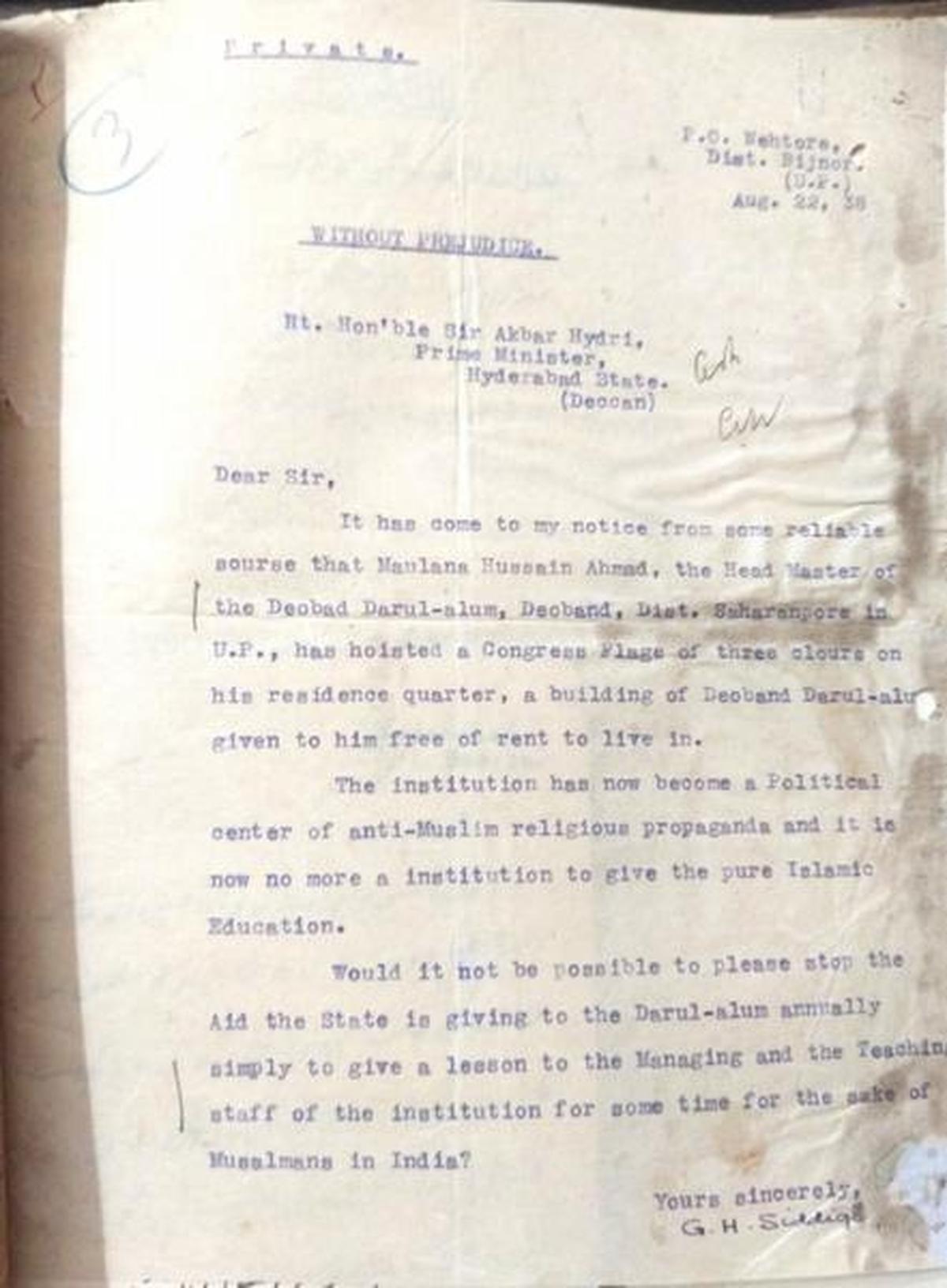
An image of the complaint sent to Sir Akbar Hydari against Maulana Hussain Ahmed Madani; and other connected documents preserved at the Telangana State Archives and Research Institute.
It was the time when Hindus and Muslims joined hands to fight for India’s freedom, and Darul Uloom at Deoband in Uttar Pradesh and scholars of the Islamic seminary played a vital role.
So much so that those who opposed the strong anti-partition stand of celebrated freedom fighter Maulana Hussain Ahmed Madani, who taught hadith (tradition of Prophet Muhammad) at the institution, termed it ‘anti-Muslim’, and even sought a rescinding of a grant to the seminary from the State of Hyderabad.
Documents preserved at the Telangana State Archives and Research Institute reveal that on August 22, 1938, one G.H. Siddiqui from Bijnore had complained to Prime Minister of Hyderabad, Sir Akbar Hydari, saying that Maulana Madani had unfurled a Tricolour atop his allotted quarters. He then proceeded to describe the seminary as an ‘institution which has now become a political centre of anti-Muslim religious propaganda and is now, no more an institution to give pure Islamic education’. He then sought to know whether it would be possible to briefly stop the annual grant to teach a ‘lesson’ to the staff.
Sir Hydari’s handwritten note, polite in tone and tenor, found its way to the Vice Chancellor of the seminary, Maulana Shabbir Ahmed Usmani, another celebrated Islamic scholar, to know whether this was true, even as he requested him to investigate the matter.
In his response, Maulana Usmani said that not only was the incident true, but the small flag that was once atop the quarters was replaced by a much larger one. The maulana, whose political leanings were diametrically opposed to those of Maulana Madani, supported the creation of Pakistan and eventually moved there. He had pointed out that the incident had happened in his absence. While Maulana Madani’s office had responded to inquiries, he himself had not.
The letter shows that there was not much that Maulana Usmani could do. In the letter he writes, “Esteemed sir, you may remember that as I have previously informed you that 10 or 11 years ago, when my predecessors appointed the maulana as principal of the institution, they had accepted all his conditions, that his political activities and leanings would not be restricted.”
Academic and author Shamsul Islam, in his book “Muslims Against the Partition of India”, writes that Maulana Madani, who was fiercely against partition, was famous for saying in 1937, nearly a year before the incident as mentioned in the letter to Sir Hydari, that ‘nations are based on homelands, not religion’.
Speaking to The Hindu , noted cleric and president of Jamiat-e-Ulama Hind (Arshad Madani group) Maulana Arshad Madani, who is the freedom fighter’s son, opined that the staunch opposition to partition was a result of foresight, and conviction in peaceful coexistence of communities.
“He was of the strong opinion that partition would not auger well for Muslims in India and Hindus in Pakistan. He believed that for 1,300 years, both communities lived next to each other without problems. We saw what happened after partition. He was imprisoned for a total of nine years, including in Sabarmati jail, and in Matla,” he said.
source: http://www.thehindu.com / The Hindu / Home> News> Cities> Hyderabad / by Syed Mohammed / August 14th, 2021
The Academy has formed a committee comprising academicians and researchers, and they will be publishing a book on the lives of the freedom-fighters from Karnataka titled ‘Yaaroo Ariyada Veeraru’.
“59 persons from Karnataka, who were part of the 1857 rebellion, were imprisoned in the Cellular Jail in the Andaman and Nicobar Islands. We don’t want their names to be erased from the chronicles of India’s freedom struggle,” says L.N. Mukundraj, president of the Karnataka Sahitya Academy.
Aiming to study the lives of these incarcerated people, the Academy has formed a committee comprising academicians and researchers. Soon, they will be publishing a book on their lives titled ‘Yaaroo Ariyada Veeraru’.
The Cellular Jail in Port Blair in the Andaman and Nicobar Islands was used by the British to exile freedom fighters and political prisoners who had to endure brutal and inhumane conditions.
Committee set up
Mr. Mukundraj explained, “We formed a committee led by writers and historians K.P. Suresh and Vijay Poonacha to study those from Karnataka who died in ‘Kala Pani’, as the punishment was called.” In the State Budget 2026-27, former chief minister Siddaramaiah had announced the publication of such a book.
The committee comprises 15 persons, of which eight will collect documents, and seven will do the fieldwork. The documentation team will search for documents in places that were earlier part of the Bombay Presidency. “Dharwad district is one place where we might find the details of many of these freedom fighters in government archives and libraries. The majority of them hailed from Nargund town in Gadag district.”
South Indians forgotten
Mr. Suresh added that those from southern India rarely figure in the annals of the freedom struggle. “These 59 persons incarcerated in Cellular Jail were mostly from north Karnataka and Uttara Kannada district,” he said, adding that often only big names like Hindutva ideologue V.D. Savarkar are highlighted while talking of those who suffered in Cellular Jail.
Some of these individuals were part of the rebellion of Halagali Bedas in 1857-58, from the village of Halagali near Mudhol. Writer Latha Guthi has published a book on the theme, called Kari Neeru. “This book is a source for us. Our field team and documentation team will head to different places in Karnataka to find such sources. We have decided to put up banners in the villages of these freedom fighters urging people to come forward, and tell us if they know anything, or have documents,” said Mr. Suresh.
Some names…
Among the 59 persons from Karnataka imprisoned in Cellular Jail were Balakrishna from Bidar, Gopal Bhandari from Karwar, Faras Khan from Nargund, Bikaji Ganesh Gokhale from Nargund, Vitu Gawli from Karwar, and Abdulla Moiuddin from Nargund.
source: http://www.thehindu.com / The Hindu / Home> News> India> Karnataka / by Rashmi Patil / June 30th, 2026
Started as a local bi-weekly newspaper, Madinah soon commanded a massive subcontinent-wide circulation. While most newspapers at the time focused on major colonial urban centres such as Lahore, Delhi or Calcutta, Madinah instrumentalised its place of inception—Bijnor—as a political shield.
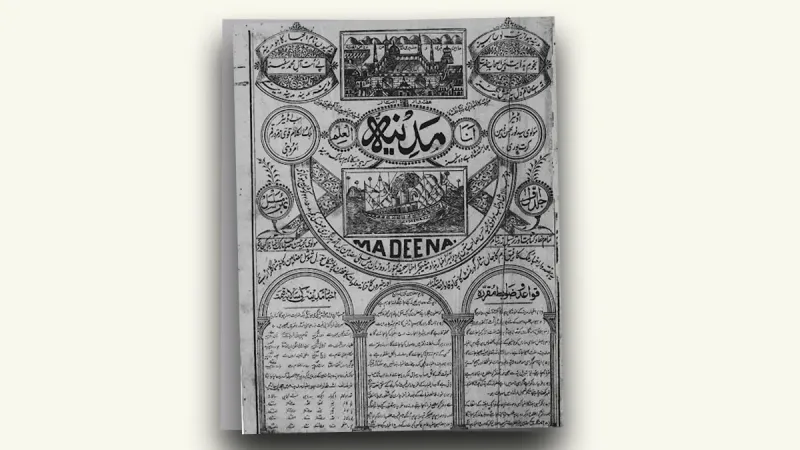
‘Madinah,’ a bi-weekly newspaper founded in 1912 by Mohammad Majeed Hasan, began in his courtyard in the small qasbah of Bijnor in the Northwest United Provinces (present-day Uttar Pradesh). Its inception is later recounted in a dream narrative published in Madinah’s silver jubilee edition in 1939, which describes how Hasan dreamt of “a bright moon shining in the sky, being eclipsed by another moon appearing from behind and drifting away from it, becoming brighter as the dream continued.”
Hasan had been working as a journalist in Lahore while also preparing for a career as a judge. He is said to have had the dream shortly after abandoning his training and returning to Bijnor to continue working for the family newspaper Sahifa, whose modest readership had already begun to dwindle. Hasan later interpreted the dream as a sign that he should start his own newspaper, symbolised by a new shining moon.
Hasan’s first wife, Muhtarma Kaneez Fatimah, whose altruistic nature and firm belief in his venture compelled her to help him start the paper, sold her jewellery to support it. She later proved to be an intelligent and capable assistant in the newspaper’s production, despite being unable to read or write.
It was she who inspired the newspaper to include a separate women’s section named Akhbar-i-Nisvan on one of its last pages. The section frequently appeared during the newspaper’s first three years, from 1912 to 1915, and was intended to serve the interests of Muslim women by including editorials and creative pieces written by both men and women.
Soon, the paper had distinctly identified itself among its audience by creating a space for Muslim women, with a special focus on mothers, to discuss their issues through genres such as poetry and fiction.
The unlikely epicentre: importance of the Qasbah
Started as a local bi-weekly newspaper, Madinah soon commanded a massive subcontinent-wide circulation. While most newspapers at the time focused on major colonial urban centres such as Lahore, Delhi or Calcutta, Madinah instrumentalised its place of inception—Bijnor—as a political shield. In the same year as Madinah’s inception, Maulana Azad, at the age of 23, started the paper Al-Hilal in Calcutta, which was lauded among the Muslim elite and others for its publishing style and genre, soon reaching a pinnacle of readership.
In contrast, Madinah’s unique approach, which embraced the values of the gentry while also appealing to a broad readership beyond the traditional urban elite, distinguished the paper from the incessant urban cynicism that was becoming a prevalent theme throughout the landscape of production. Due to better readership and the greater availability of resources in urban areas, similar endeavours to Madinah redirected themselves to these spaces.
In its founding years, Madinah also addressed British officials, adopting varying strategic and bargaining stances against surveillance and strict government policies through explicit deference to colonial authorities. For instance, Hasan, the proprietor of the newspaper, cited the Ijazat (permission) of the Magistrate and Collector of Bijnor in its inaugural issue. This attentiveness to British intelligence provided the necessary immunity required for the functioning of the newspaper, unlike Azad’s Al-Hilal, which came under heavy scrutiny from the colonial government and had to cease publication by the end of 1914.
Newspapers in urban centres, such as Awadh Akhbar, persisted in their efforts to speak to a broad audience delineated more by language and culture than by religion, while papers such as Madinah reinforced an already rich discursive tradition surrounding religion and identity in the social crevices known as qasbahs (small towns). They also engaged with contested political themes debated by scholars and leaders, including the shaping of early narratives of separatism and communalism among Indian Muslims.
The success of Madinah can be attributed to the spatio-temporal advantages of the qasbah, which can be defined as a place of bureaucratic and market significance where a Muslim minority or majority lived alongside populations from other communities, alongside an influential enclave of intellectual vivacity and economic and political importance for Muslims. Scholar M. Raisur Rahman described qasbahs as “an alternative site for contestation with strong autonomous networks of culture, literature and religion”, while simultaneously defining them as a ‘unique space’ and a ‘microcosm of larger idealized national life’.
These spaces have been significantly important sites in the history of South Asian culture, shaping identities and literary traditions while remaining distinct from the typologies of urban environments, where modernity had already seeped through the sutures of cultural exchanges with the outside world.
Madinah and its role in politics
The political trajectory of Madinah transformed profoundly during the period of World War I, following the Balkan Wars. The paper broadened its purview by juxtaposing the localised ethos and culture of the qasbah with larger international crises, particularly the imminent dismantling of the Ottoman Empire.
Navigating the intricacies of a contested political landscape, Madinah supposedly guarded a global Islamic consciousness through its promotion of the Khilafat Movement and its shared affiliation with Jamiat Ulema-e-Hind. Consequently, its support for the Indian National Congress and its anti-separatist stance against Jinnah became apparent, aligning with Jamiat’s idea of Composite Nationalism, as Madinah continued to anchor itself in the secular, anti-colonial bedrock of Urdu journalism.
According to scholar Gyanendra Pandey, Madinah served as a vital barometer of Muslim public opinion across this shifting timescape. Driven by the ideological synergy of Hindu-Muslim unity during the Non-Cooperation and Khilafat movements, the publication commanded an astounding peak circulation of 12,500 copies by 1922. However, this radical nationalism invited severe repercussions from the colonial state, notably resulting in the paper being banned in Punjab following its courageous and explicit reporting on the 1919 Jallianwala Bagh massacre. Following the ban, the paper was relaunched in August 1919 under a new name—Yasrab (Madinah in Arabic)—as an act of strategic defiance against the colonial government, with a couplet from Iqbal:
Khāk-i Yasrab az do ‘ālam khūshtar ast, Ā’e khunak shahre ke ānjā dilbar ast
(The dust of Madinah is better than both worlds, How wonderful is the city where the beloved is.)
As the landscape of production became increasingly fragmented by communal cynicism and the mass political momentum of the early 1920s waned, the paper witnessed a decline in readership, with circulation dipping to 6,500 in 1927 and further to 6,000 by 1931.
Despite this dwindling circulation, Madinah remained a formidable and persistent critic of communal separatism throughout the 1930s and 1940s. Engaging with the contested political themes of the era, the paper sought to dismantle the early narratives of the All-India Muslim League. Pandey highlights a remarkably bold editorial from the 1930s that dismissed the League as being “neither dead nor alive”, asserting that its existence was confined merely to “the brain and mind of Mr. Jinnah”.
By 1942, the newspaper had effectively transformed into an open town hall, enabling ordinary citizens to debate and largely resist the looming Pakistan movement from within the landscape of the qasbah.
The script and scripture
The prevalent Urdu script, Nastaliq, which had been used throughout South Asia for centuries and was imported from Persia, featured intricate details, ornamentation and a complex structural form forged through the meticulous amalgamation of the Naskh and Ta’liq calligraphic traditions. It became the most recognisable Urdu script and developed strong cultural and ideological ties with the Urdu language. However, due to the rise of globalisation and the growing demand to produce literature for the public, it became increasingly difficult to produce works in the script lithographically on a mass scale. By the end of the 1970s, Nastaliq began to advance with the help of Mirza Jamil Ahmad, who created more than 20,000 combinations to bring the script into the digital world under the name Noori Nastaliq.
By the time the digitisation process began, Madinah was already out of business, shutting down its press with its last issue in 1976. During the seven decades that the paper survived, its editors had no keys to the press and no screens to reflect upon. Instead, the issues of Madinah were produced solely by hand, by calligraphers and artists alike.
The Urdu script Nastaliq had been established as the standard for almost every copy of the holy book Quran in South Asia since the Mughal period. By the time Madinah began using the same script as its standard, it already carried connotations of purity, holiness and divinity within the cultural landscape. Combined with the organic practice of producing it by hand rather than by machine, the paper was considered by its readers to embody a deliberate resistance against illegitimate mechanisation and the rising industrialisation of the subcontinent, curating a new political discourse based on the cultural symbolism of the script.
By using and retaining lithographic practices in an era when other papers were increasingly relying on mechanical typography for efficiency, Nastaliq was perceived as a tactile and handcrafted discipline that preserved the inherent spirit of prose, shielding the paper’s contributions from the mechanical and indifferent processes of Western print capitalism.
The inevitable descent
By the 1940s, Madinah had begun engaging in intense print debates with the supporters and proponents of pro-Muslim League newspapers and writers, arguing in a polemical fashion that religion could not be the sole determinant of a nation’s survival. Despite the paper’s persistent efforts to resist the pro-League and separatist stance, it witnessed the partition of the Indian subcontinent into two parts. The social capital of Madinah was on the verge of collapse, as the paper saw affluent members of the Muslim community, who had constantly contributed to its production and editorials, leave for the other side of the border.
The Language Act of 1951 became a huge blow to the publishing house of Madinah, as Hindi was soon adopted as the state language in Uttar Pradesh, mandating officials and government offices to maintain all data in Hindi and extensively replacing Urdu in institutions under the newly formed Indian government. Although the apparent marginalisation of the paper’s foundational language and the loss of its social capital were significant blows in the paper’s history, they were unable to overshadow its continuing legacy.
Madinah, managing to survive, remained a prominent, albeit ageing, symbol of pre-Partition nationalist Muslim political identity, advocating for the preservation of Urdu heritage amid the growing socio-political shifts in Uttar Pradesh. At the same time, it continued to struggle against declining circulation as newer, faster-printed typographic dailies overtook the market. Its reports on the Indo-Pakistani War of 1971 and the creation of Bangladesh vindicated the paper’s historical assertion that religion alone could not hold a nation together, while it also continued reporting on rising communal tensions in the country.
The prodigious endeavour was about to culminate in the years following the Indo-Pakistani War. Near the end of its operational life, the paper’s traditional lithographic format and qasbah roots struggled to attract younger, urbanised readers. The deteriorating health of Hasan finally caught up with him, leading to his death in 1972. The handling of the newspaper remained in the hands of Hasan’s family until its last editor, Syed Hasan, finally ceased publication, quietly closing the press in 1975.
References
Jones, J. (2023). Megan Eaton Robb: Print and the Urdu Public: Muslims, Newspapers, and Urban Life in Colonial India. New York: Oxford University Press, 2021; pp. xi + 247. Journal of Religious History, 47, 151–153. https://doi.org/10.1111/1467-9809.12917
Abduhu, G. R. (1973). The Educational Ideas of Maulana Abul Kalam Azad. Sterling Publishers.
Rahman, M. Raisur. (2014). “Beyond Centre-Periphery: Qasbahs and Muslim Life in South Asia.” South Asian History and Culture, 5, 163–178. https://doi.org/10.1080/19472498.2014.883762.
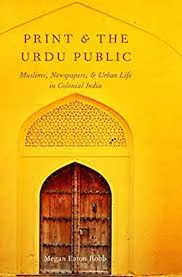
In ‘Print and the Urdu Public’, Megan Eaton Robb writes about the impact and role of popular Urdu newspaper Madinah and how it pushed back against censorship.
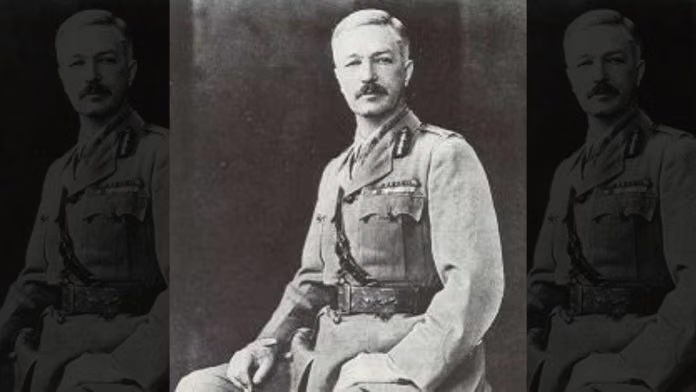
File photo | Gen. Reginald Dyer | Wikimedia Commons
Madīnah’s community of editors, subeditors, and proprietors illustrate the interconnected network of professionals working on newspapers across North India, with a shared commitment to confounding censorship laws. Editors of Madīnah were products of qasbahs and lived in Bijnor or nearby while employed by the publication. At least one assistant editor, Ḥamīd Ḥasan “Fakīr” Bijnorī (1903–1991), was a relative, having married Majīd Ḥasan’s daughter in the 1910s before he became the editor of Madinah Press’s children’s magazine Ghunchah after 1922. Ḥamīd Ḥasan would later be listed as an assistant editor from 1930 to 1935 and even take over as editor for several months when the need arose in 1945. When a new editor took over the work of Madīnah and was not already resident in Bijnor, he would move into the Ḥasan compound, which acted as the administrative office of the paper. Several small apartments attached to the main verandah, so editors could live in comfort with their families, remaining accessible to the newspaper office while maintaining privacy. Maulānā Majīd Ḥasan’s name, along with the name of the current chief editor, always appeared on the paper’s title page. At any given time there could be up to three editors of the paper, with the chief editor being referred to as “mudīr-i mas’ūl.”
Although Majīd Ḥasan’s proprietorship provided continuity for the newspaper, its different editors influenced the paper’s tone and focus. The turnover between editors could be rapid when legal troubles emerged. For instance, in 1924, when the editor Qāẓī Badrul Ḥasan Jalālī (1891–1956) was prosecuted by the British Raj for an article, he resigned his editorship, but he stepped back into his position once the dust of government scrutiny had settled. If Majīd Ḥasan attracted too much scrutiny from government surveillance, he could retreat from view behind the shadow of his prominent editors, continuing to exert the same influence behind the scenes. This allowed his outfit to survive draconian censorship measures while retaining the continuity essential to the newspaper’s success.
When he launched the newspaper in 1912, Majīd Ḥasan had little local influence. The only person of significance attached to the newspaper initially was a prominent journalist of the period, Nūr ul-Ḥasan Zahīn, who wrote for Ṣaḥīfa as well. Colonial censors initially dismissed Madīnah as a “bigoted Muhammadan organ, inclined to make trouble between Hindus and Muhammadans.” Madīnah first earned the ire of colonial administrators by criticizing the headmaster of Bijnor High School for complying with the British Educational Code. This was only the first of many encounters with censorship legislation.
April 1917 marked the beginning of Editor Mazh̤ ar ud-Dīn Shairkoṭī’s tenure, and the newspaper’s shift to publishing more explicitly political, anti-British stances. Shairkoṭī, a novelist as well as a journalist, was born in the Shairkoṭ qasbah of Bijnor in 1888. Initially educated by Maulānā ‘Abdul Qayūm Arshāq and Miyānji Sa‘ad Allah Sahib, he had attended Deoband as a pupil of Maulānā Mahmud ul-Ḥasan Asīr Mālṭā, known as Shaikh ul-Hind. After completing his education at Deoband, Mazh̤ ar ud- Dīn returned to Shairkot, where he worked on the newspaper Dastūr under the management of Ḥakīm Asrār ul-Nabī and on the newspaper Nagīnah.
Maulānā Majīd Ḥasan saw Maz̤har ud-Dīn’s affiliation with the newspaper as the beginning of a new period of commitment to the Muslim community and wrote an illustrious introduction for his new editor. Majīd Ḥasan’s message in his introduction was clear: he had brought in a power player to man the ship of Madīnah, a man who indubitably linked the paper to a network of powerful publications and individuals. The new editor transformed Madīnah into a more explicitly political entity. Maz̤har ud-Dīn associated with prominent political Muslims of the period, including Syed Ḥasan Imām, who presided over the Indian National Congress’s consideration of the Montagu-Chelmsford Reforms in Bombay in 1918. His other associates included Nawab Muḥammad Ismā’il Khān. He was, along with Khalīquzzamān, a key organizer of the UP Muslim League, and a prominent member until 1947; he remained in India after independence.
After the end of World War I in November 1918, discussions of independence and postwar reality in India began in earnest. The state of Islam, and the progress of both national and local branches of organizations such as the Muslim League and Congress, became matters of intense concern. Mohandas Karamchand “Mahātmā” Gāndhī (1869–1948) featured in several articles musing on the way forward for political Muslims. In addition, discussions of the fall out of World War I in Turkey and the caliphate took center stage. Under Mazh̤ ar ud-Dīn’s leadership, the newspaper emphasized the connection between the fate of Indian Muslims and of those in Turkey and other nations with significant ties to Islam.
Mazh̤ ar ud-Dīn presided over Madīnah’s publication of an article critical of the government’s role in the Jallianwallabagh massacre, which led to a dramatic conflict with the British Raj. In April 1919 Madīnah published an article criticizing Lieutenant Governor Sir Michael O’Dwyer’s (1864–1940) endorsement. Putting Madīnah on the Muslim Map of the actions of Colonel Reginald Dyer, who had overseen the disproportionate response at Jallianwallabagh. The article minced no words:
His honour O’Dwyer’s government of Panjab, from the very beginning, kept as the foundation of its policy a despotic course of action [ . . . ] This was his honor O’Dwyer’s last period of government; therefore it was necessary that he make amends for his past course of actions. This was the time when, instead of extinguishing the fire with the water Of gentleness and kindness, he inflamed the hearts of the ahl-i Punjab. Perhaps it could be said that he did not put out the fire with water, but instead doused it with oil. If that were not the case, then why would he at the conclusion of his reign, give orders that were so repellent, so far from resembling affection that they approximated hate?
It was actually illegal at this point in time to question the motives of the colonial government; thus, the final statement of the quotation accusing O’Dwyer of “hate” fell afoul of censorship laws. The government banned Madīnah from circulating in Punjab as a result of this piece. Mazh̤ arud-Dīn and Majīd Ḥasan’s response was defiant: in August 1919 they renamed the newspaper Yasrab, an Arabic synonym of Madīnah, as a bid to evade censorship.64 On the cover of each issue of Yasrab an Iqbal couplet appeared, a knowing wink to its readership base:
The dust of Madinah is better than both worlds. How wonderful is the city where the beloved is.
Khāk-i yas̱rab az do ‘ālam khūshtar ast Ā’e khunak shahre ke ānjā dilbar ast.
The couplet hinted at the paper Yasrab’s true identity, offered praise for the paper’s unpretentious popularity, and emphasized the link between the newspaper and the city Madīnah. Madīnah’s proprietor and editors were men who wore their few educational laurels lightly. More important than formal education was the ability to use that knowledge in the service of Indians generally and Muslims particularly. Unsurprisingly, the attempt at flouting the circulation ban was quickly detected. The paper reverted back to the title Madīnah after a few weeks, and the ban on circulation was lifted eventually.66 Madīnah was a space offering a figurative point of access to the community of Islam, the qaum, and it was a space increasingly under siege of colonial censorship laws.
Madīnah had been only one of many significant voices in the press commenting on the Jallianwallabagh fiasco. As the UP fortnightly report complained, “[The] occurrences in the Punjab [ . . . ] practically absorbed the entire attention of the press.” Along with Madīnah/Yasrab, the British excluded from Punjab al- Khalīl of Bijnor, The Independent of Allahabad (a Nehru paper), Hamdam and Akhuwat of Lucknow (Farangi Mahalli papers), Swadesh of Gorakhpur, and Amrita bazar patrika of Calcutta. The government demanded securities, or large sums of money as surety against future crimes of sedition, from papers in Bengal, Nagpur, Lucknow, and Madras. Madīnah’s inclusion in this censorship was a testament to its growing influence; its subterfuge demonstrated a growing sense of urgency in its mandate to reach readers and an emerging resolve to flout British restrictions.
In the 1920s, Madīnah focused on coverage of the Muslim League and the Indian National Congress, showing a preference for Congress.
It was per- haps Maz̤har ud-Dīn’s affection for the League that motivated him ultimately to resign from Madīnah in 1921. It is also possible that Mazh̤ ar ud-Dīn’s taste for politics pulled him closer to Delhi and toward the League after the political awakening accompanying the Khilafat Movement.
It was common for editors to move around among different qasbah-based newspapers, and after leaving Madīnah, Mazh̤ ar ud-Dīn joined Munshī Safīr Aḥmed’s Naginah-based paper Almān as its first editor; he was instrumental in relocating that paper to Delhi. He later became close to the leadership of the All-India Muslim League, including Muḥammad ‘Alī Jinnāh. In the 1930s he founded a paper entitled Vaḥdat (Unity) in order to assist the propagation of Muslim League ideals. When Maulānā Shabbīr Aḥmed ‘Usmānī, a Deobandi who supported the creation of Pakistan, resigned from the pro-Congress Jam‘īat ‘Ulamā and declared his allegiance to the Muslim League and Jinnah, he did so from Mazh̤ ar ud-Dīn’s office. This demonstrated Madīnah was one node in an important network of political power and publishing prestige in this period and had to make considered choices when it came to balancing shifting political alliances.
This excerpt from Print and the Urdu Public: Muslims, Newspapers, and Urban Life in Colonial India has been published with special permission from Oxford Univerity Press.
source: http://www.theprint.in / The Print / Home> Page Turner> Book Excerpts / by Megan Eaton Robb /May 15th, 2021
Can a stable and just democracy flourish on foundations of wilful amnesia and erasure?
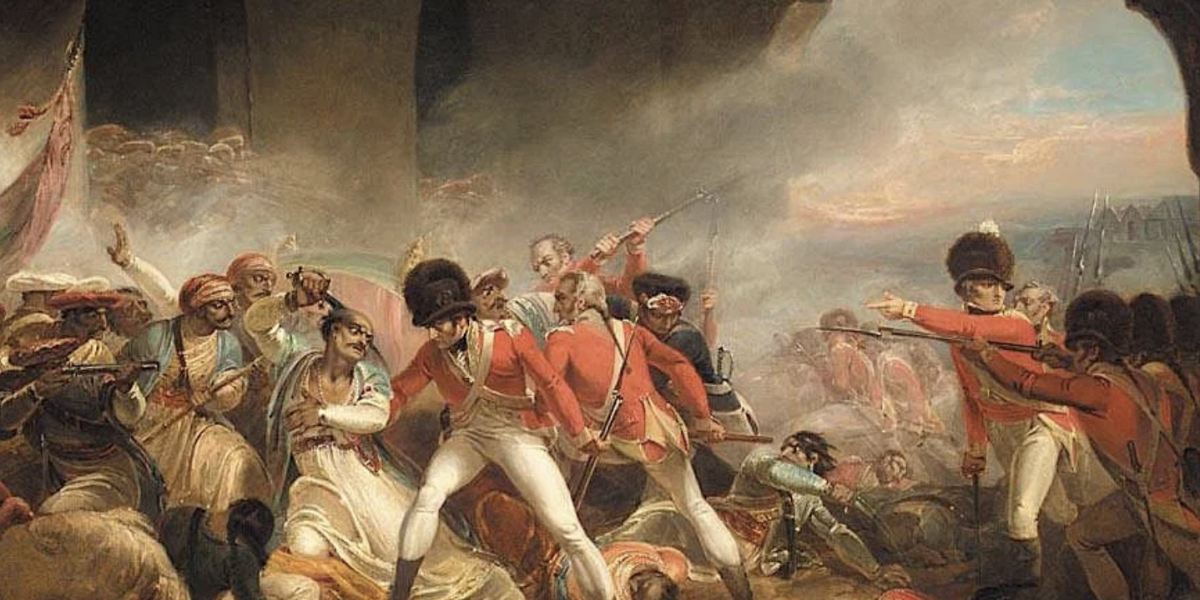
A c. 1800 painting showing the last stand of Tipu Sultan, ruler of Mysore in 1799 at the end of the Anglo-Mysore Wars with the East India Company. Photo: Henry Singleton/Public domain.
Many will ask why a book about Muslims who fought for India’s freedom? There’s no answer to such questions except another question. Had we been better memory keepers as a nation, could we have avoided the peak disinformation and stupidity which normalises reviling ordinary Muslims as outsiders, infiltrator and insurgents?
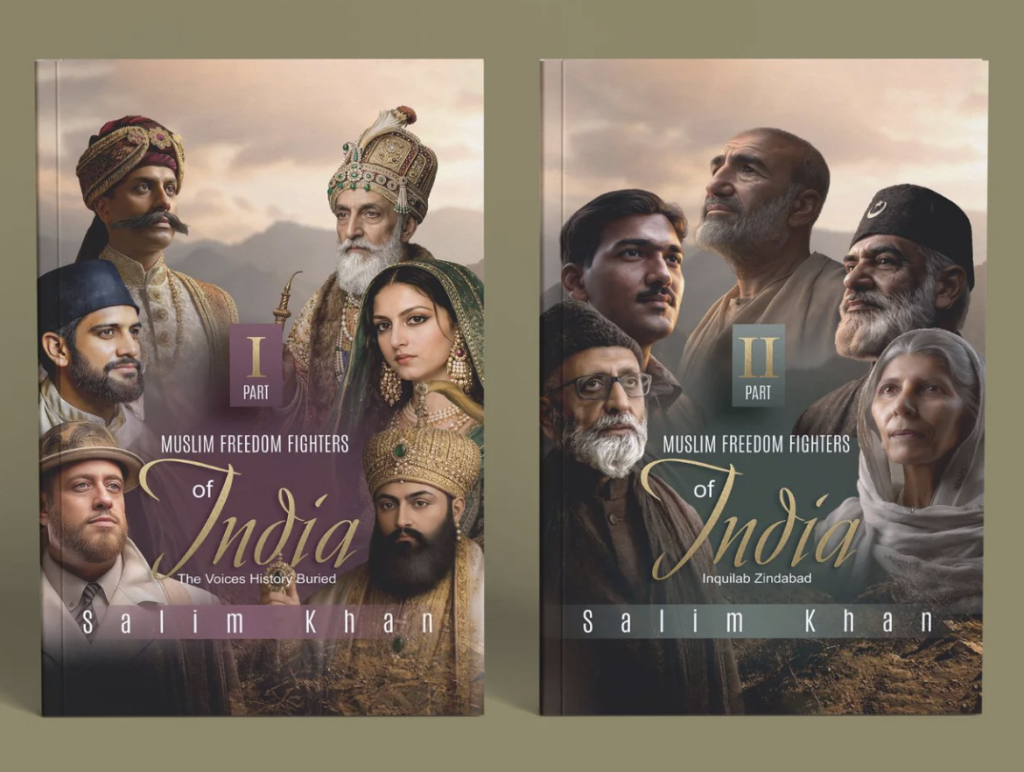
Muslim Freedom Fighters of India is a two-volume biographical compilation by Salim Khan on less-known, mostly forgotten and hardly known Muslim figures. The books aim to clear the fog around Muslim freedom fighters whose names are heard of without them being extensively known and this requires us to understand why this fog exists. Written in an extremely readable and accessible format, these biographical accounts embed the historical figures in the context of their times, responding to unprecedented events with foresight, clarity and conviction that sealed their fate and shaped and the nation’s destiny.
Whether we are reading about Generals of 1857 – Bakht Khan and Khan Bahadur Khan – or the Cambridge-educated Rampur scion Mohammad Ali Juahar of Khilafat moment and his fiery mother Bi Amma, the larger questions seething beneath the stories keep rising to surface. Who does a society and nation choose to remember and celebrate? Whose memories are deemed worthy of preserving? History is always shaped by those who control archives, narratives and memorialisation and hence memory.
Reading about Tipu’s dazzling reign through the three Anglo Mysore wars where he proved superior to British forces, I was reminded of the controversy sparked by the late Girish Karnad’s suggestion of naming the Bengaluru airport after Tipu Sultan. Karnad had said, “It is true that Tipu Sultan was not born in Bengaluru, but he was a son of this soil and a freedom fighter. Had Tipu been a Hindu, he would have achieved the status of Shivaji, and the airport would have been named after him.” I recalled Karnad because his play Dreams of Tipu Sultan echoes the same theme that this two-volume tribute to erased, obscured and deliberately unremembered historical figures echoes: that when politics lays down who should be forgotten, remembering the erased becomes a duty, an affirmation and a political act.
It is important to clarify that this is not a compilation of eulogies but well-researched fact based account of people who had the uncommon clarity to resist colonial domination even before the nationalistic narratives took shape. That they happened to be Muslims is important today because of the distortions that have obscured and erased them. But back then when they fought and resisted, they were simply rallying for the cause of their soil and their watan. From the earliest times they understood that freedom from foreign domination required Hindus and Muslims to put up a united front as in the war of 1857, the Khilafat movement, and the period between 1919 and 1924. Back then too, traitors cut across religious lines – Jagat Seth, Mir Jafar, and Ilahi Baksh.
Muslim Freedom Fighters of India: Part 1 and Part 2’, Salim Khan, Qalam Aur Kaagaz Books.
From Siraj ud Daulah to Tipu to Shahzada Firoz Shah, the book shows how the fog around these personalities is not accidental but meticulously designed – initially by the colonial mind, then picked up by early nationalists and woven into simplistic narratives. The macabre dance of history further stifled Muslim voices. Cataclysmic events like the ‘end’ of the Mughal Dynasty in 1857 and the Partition in 1947 sundered clans, erased family histories, legacies crumbled with no one is around to defend and uphold them. Today, even people who don’t know history have heard of Lakshmi Bai, but many who read history may not have heard about Shahzada Firoz Shah, the Mughal Emperor’s grandson who in August 1857, led a band of armed soldiers to rally the rebels in Rohilkhand and Malwa and who fought alongside Tatia Tope and called for a united Hindu-Muslim front against the Company.
The British understood the dangerous potential of popular memory and subverted any potential for memorialisation of hugely influential figures. No one knows if Shahzada Firoz died in battle or escaped to West Asia. The Maulavi Ahmadulla of Faizabad whose authority and fearlessness scared the British so much that they kept a reward on his head, was likewise interred in an unmarked grave. Knowing that even his memory could become a node to unite the rebels, the British saw to it that no commemoration was permitted or possible. Zafar, the last Mughal was exiled to Rangoon for the same reasons.
In her book, India, 5,000 years of history on the subcontinent, Audrey Truschke, elucidates how Muslim rulers like Nawab Siraj ud Daulah and Tipu Sultan to Zafar felt a responsibility for their subjects no matter what their religion. For example, Siraj ud Daulah actively intervened in times of famines and drought in Bengal. But after the British took over they did nothing to alleviate human suffering, so that 20% of Bengal’s population died in the famine of 1768 and the small-pox epidemic of 1769-70 following it. This had never happened during earlier episodes of failed harvests. Truschke says, British historians initiated the custom of categorising Indian rulers as tyrannical, effete and incompetent, reducing them to their religion and writing in terms of Hindu rulers and Muslim rulers. The British needed to demonise Muslim rulers who were their immediate predecessors in subcontinent so that they might look good by comparison, Truschke notes. It was a part of the colonial propaganda.
Another pattern Salim Khan’s compilation brings out is that from mid-18th century onwards, the first responders and the most committed crusaders resisting colonial domination – the kings, queens, princes, preachers, noblemen – were Muslims. Not only because the British had wrested from them the power they had wielded for centuries (howsoever fragmented or diluted it may have become); but also, because they were looked upon as leaders. In Awadh, for example, the Shia elite took it as their moral-ethical duty (see Chapter 7, volume I: Shia Ullema and Noblemen of Awadh)
Even in the 20th century, Muslim freedom fighters like Hasrat Mohani of the Inquilaab Zindabad fame and Asfaqullah Khan of the Kakori conspiracy who was an icon for Bhagat Singh, remain in the shadows, seen only in a hazy half-light. Were their contributions any less or only less remembered? One of the most important projects post-Independence should have been to restore memory and affirmation to those whom the British put on the wrong side of history, no matter what their religion or caste. But we know this is not what happened.
Since the arrival of the political controversy over Tipu Sultan, we have entered in an era of deliberate distortion of history. The larger question that these accounts refrain from asking but that jumps to any thinking person’s mind is this: can a stable and just democracy flourish on foundations of wilful amnesia and erasure? Should the memory of Muslim freedom fighters be kept only by the Muslims? The heritage and memory of Indian Muslims needs to be reclaimed by them. But equally, these volumes are required reading for the casually miseducated, hopelessly disinformed or simply ignorant Hindus who have been stupefied into denying and distorting their composite history.
Varsha Tiwary is a Delhi-based writer and translator. She has recently published 1990, Aramganj a translation of the best-selling Hindi novel Rambhakt Rangbaz.
More than seven decades after India achieved independence, the role of innumerable martyrs and freedom fighters who gave their blood and offered lives for the motherland, needs to be remembered.
Many of them got harsh punishments, didn’t get proper last rites, remain forgotten and even those whose sacrifices are known, don’t have monuments or memorials built in their memory.
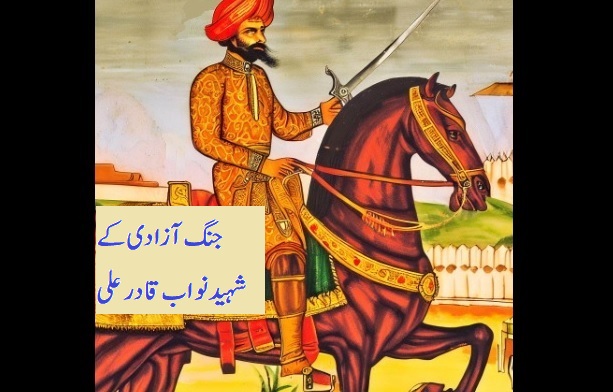
The martyrdom of Nawab Kadar Ali, and his companions, who planned attack on residency and to take on the East India Company forces in Nagpur, also needs to be recalled. They were hanged here for their role in 1857–the first war of independence.
Though there is no monument named after them and no big memorial, they remain heroes in public memory. The fort that had been a base of 118 Infantry Battalion for years, is opened on three days including August 15 and January 26. Thousands of people arrive on these days, and also pay visit to the grave and offer their respects.
The flame for independence was already lit. History books mention that soon after Meerut, the anger was palpable among soldiers and citizens in this region too. On June 13 1857, a large gathering took place near Mission High School. The soldiers too were anxious and ready.
Scared, some of the East India Compnay officials ran towards Kamptee Cantonment, while others went inside the Sitabuldi Fort. It was due to treachery that the attack plans had been leaked and the news reached British officers. More EIC forces were called from other places to control and overpower the rebels.
Rani Baka Bai, wife of late Raghoji II, was supporting the British and issued a warning that anyone abetting or aiding the revolutionaries would be arrested and handed to the East India Company. It’s a long story and how the soldiers and citizens suffered, refused to name the leaders of the movement.
Historical texts say that the signal of a fire balloon was decided. But after the traitors gave information to East India Company officers, Plowden, the commissioner, ordered a regiment to move into the city. The irregular calvary at Tali was dismayed. Major Arrow tried to get information from ring leaders but no one gave names.
Baka Bai summoned all her relations, and dissuaded them with threats. This chilled the spirit of public. However, later when Company officials’ strengthened their hold, the rebels were identified. Arms were collected and after inquiry, Dildar Khan, Inayatullah Khan, Vilayat Khan and Nawab Kadar Ali were tried and executed.
KILLED, HANGED, BURIED IN A COMMON PIT
The Gazetteer briefly mentions that ‘tucked away between the easter walls of the inner fort and the barracks is a large grave known as Nav Gazah Baba…the grave of Nawab Kadar Ali…and his eight associates..who were killed and hanged by the ramparts of the fort due to their role in the war of independence”.
“They were all buried in a common pit, nine yards long. The fort recalls to our mind the memory of the brave soldiers who fought in an attempt to preserve the independence of the mother land”. It was treachery that was responsible for the arrests and the punishment. Those who helped the British, got ‘jagirs’ as rewards.
Ghulam Rasool ‘Ghamgeen’, the poet, wrote these lines in Farsi :
Choo.n Qadar Ali Khan Ameer Kabeer Shud-az-tohmat, ahl-e-balwa aseer
Duaa’e shahaadat ba-raahe Khuda shab w roz mi kard aa.n mahtada … … Khirad guft ee.n misra-e-silk-e-noor Za-daar-e-jafaa shud ba-daar-e-suroor
The last couplet of this long Persian verse, brings out the ‘tarikh’, the year of execution. The complete verse is mentioned in Dr Mohammad Sharfuddin Sahil’s book ‘Tarikh-e-Nagpur’. It shows the impact of the hangings on the people in the region. Nagpur is geographillcally considered to be a part of Central India and is the biggest city in Vidarbha region of Maharashtra.
The fort for a long period remained the base of 118 Infantry Battalion of Territorial Army. Every year, on August 15 and January 26, fort is opened for public so that it can pay respect to the freedom fighters. It’s also opened on May 1 i.e. Maharashtra Day. [Illustration is representive]
source: http://www.newsbits.in / NEWS Bits / Home> Top News / by Shams Ur Rehman Alavi / August 15th, 2021
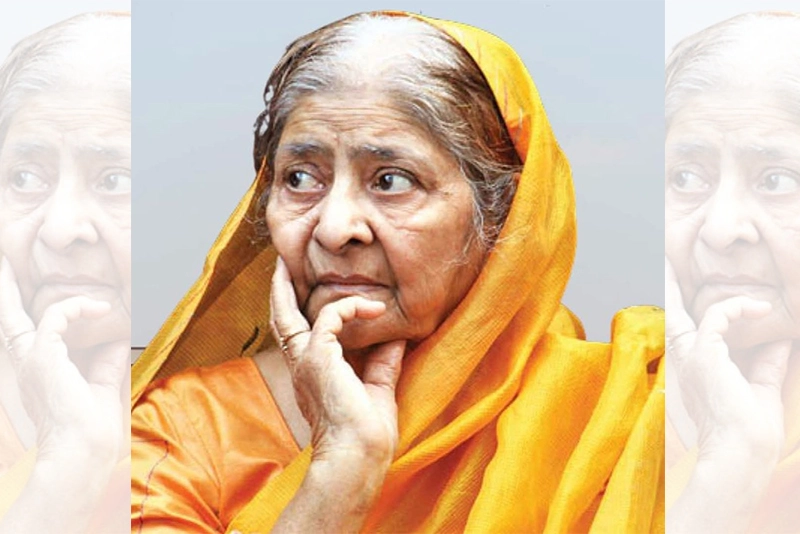
Zakia Jafri, wife of former Congress MP Ehsan Jafri – the Legal Crusader who became a Symbol of Resistance, died at her residence in Ahmedabad Saturday February 01, 2025.
Mumbai:
Zakia Jafri, wife of former Congress MP Ehsan Jafri – the Legal Crusader who became a Symbol of Resistance, died at her residence in Ahmedabad Saturday February 01, 2025.
Zakia Jafri was 86.
Zakia Jafri is survived by sons Tanveer and Zubair, and daughter Nishrin. “Mom passed away at around 11:30 AM”, she told media.
Zakia Jafri’s sad demise was later shared with the world by Rights Activist, Journalist and Author, Teesta Setalvad.
“Zakia Appa a compassionate leader of the Human Rights Community passed away just 30 minutes ago!” Teesta Setalvad wrote on her X account around 01:30 PM Saturday.
“Her visionary presence will be missed by the nation, family. friends & world! Rest in Power and Peace Zakia appa!” Teesta wrote while condoling Zakia Jafri’s death.
Originally from Khandwa district of Madhya Pradesh, Zakia Jafri had shifted to Ahmedabad, Gujarat in 1971. This after living in a refugee camp after her home in Khandwa was burnt during the 1969 communal riots.
Zakia Jafri’s husband Ehsan Jafri was a freedom fighter and Member of Parliament.
Ehsan Jafri and his family had provided shelter to dozens of Muslim families at their Gulbarg Society in Ahmedabad during the 2002 Gujarat riots.
But, the society, considered to be a safe haven because of Jafri family’s stature, too was targeted by the rioters who burnt alive and killed at least 68, including Ehsan Jafri.
Zakia Jafri later fought a long legal battle to seek justice for the 2002 Gujarat riot victims. She had also challenged the SIT clean chit given to Prime Minister Narendra Modi, who was Chief Minister Gujarat, during the riots.
During the long legal battle she was threatened and later cajoled by different means and tactics. She however remained firm.
Zakia Jafri is likely to be laid to rest beside her husband in Ahmedabad.
Condolences pour in
Meanwhile, condolences are pouring in from different circles after the demise of Zakia Jafri.
Kerala Chief Minister, Pinarayi Vijayan, in his condolence message said, “Zakia Jafri, an unwavering voice for the victims of the 2002 Gujarat riots, is no more. The widow of former MP Ehsan Jafri, who was brutally murdered by a Sangh Parivar-led mob, she dedicated her life to the pursuit of justice. Her relentless fight leaves behind a legacy of courage and resilience. Her memory will continue to inspire us in our fight against communalism and divisive forces.”
Congress Spokesperson, Pawan Khera, wrote, “Zakia Jafri died today. Her Hope for justice had died in her life time. She chronicled the history of ‘New India’ through her tears, her sobs, her fight and her defeat.”
Hyderabad MP and AIMIM Chief Asaduddin Owaisi in his condolence message wrote, “Zakia Jafri watched her husband being murdered by a mob in 2002. For nearly two decades, she fought a lonely legal battle against some of India’s most powerful men, never showing fear. She passed away today. May Allah grant her peace and strength to her loved ones.”
Sanjiv Bhatt (IPS) who was posted in Gujarat during the 2002 Godhra Riots condoled Zakia Jafri’s death in these words.
“Zakia Jafri Ji was an unshakable voice of truth against power. For decades, she fought not just for justice, but for truth, dignity and the very soul of our democracy. Her strength in the face of unimaginable loss will forever inspire us. Today, India has lost a true warrior, but her courage will live on! Rest in power, Zakia Ji!!”
Condoling the death of Zakia Jafri, Journalist and TV Anchor Rajdeep Sardesai worte: “Sad news: Zakia Jafri, whose husband and former Cong MP Ehsan Jafri was brutally killed in the 2002 Gujarat riots passed away today. For years, she fought a valiant battle for justice. When even an MP’s wife struggles to be heard, imagine the plight of an ordinary citizen. And yet, she remained steadfast and courageous till the end. Refused to give up.”
Mumtaz Patel, daughter of Congress leader Ahmed Patel, condoled Zakia Jafri’s death in these words.
“Zakia Jafri ji, symbol of resilience and an unwavering voice for justice, is no more. Her fight for truth and accountability in the face of unimaginable tragedy will always be remembered. May she rest in power.”
My heart goes out to the brave lady #ZakiaJafri who fought against these devils and those three judges who betrayed you . But they all will have to pay for their karmas before they depart from this world,this also includes the supreme leader . pic.twitter.com/JQUZTueTuI— Ravinder Kapur. (@RavinderKapur2) February 1, 2025.
“Zakia Jafri, widow of former parliamentarian Ehsan Jafri, who was killed by a Hindutva mob in the 2002 Gujarat genocide, Zakia Jafri Survived in genocide and become the relentless voice of Justice”, Noor Mahvish, a lawyer, wrote on X.
“Zakia Jafri . A life time of a fight for justice 23 years out of the 85 she spent on this earth ,waiting for justice for the killing of her husband along with the people they tried to protect inside Gulberg Society in Gujarat 2002”, a social media user, who identifies her as Realm of Bohemia, wrote.
“Brave and fearless, she fought for Justice till the end”, an activist wrote.
“She left this world fighting for justice and showing the whole world how to never give up”, Razia Pathan, an activist, wrote.
source: http://www.ummid.com / Ummid.com / Home> India / by ummid.com News Network / February 01st, 2025
Badruddin Tyabji, the grandson of freedom fighter and third Congress President by the same name, was entrusted with arrangements for the inaugural Republic Day celebrations in 1950.
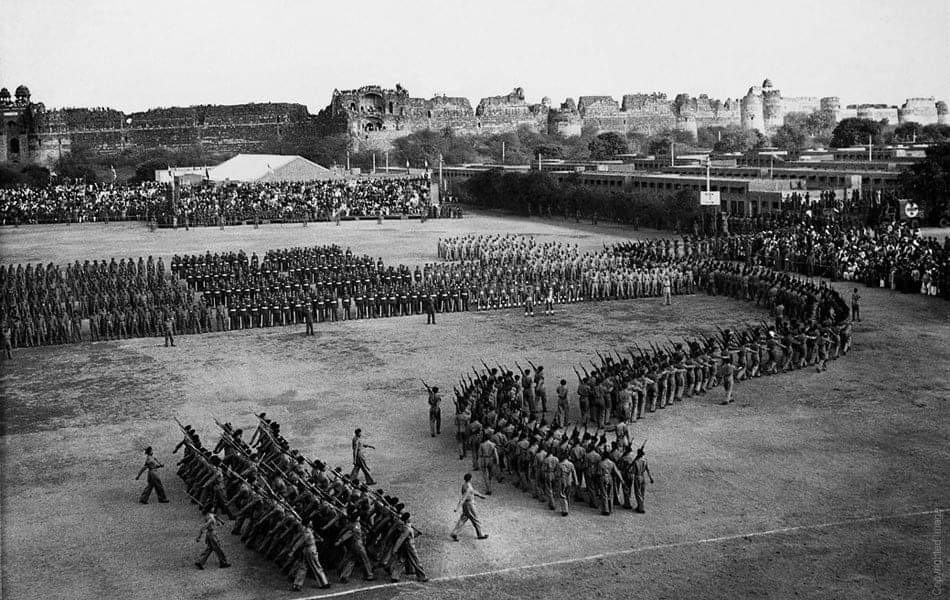
HISTORIC: National Stadium during the first Republic Day Parade. Old Fort is also visible
Every year on January 26, the Tyabji family sit together in their posh West End Colony house (near Vasant Vihar) to watch the Republic Day Parade which holds special significance for them.
Their late patriarch Badruddin Tyabji, a 1936 batch Punjab cadre Indian Civil Service officer, was responsible for looking after the arrangements of January 26, 1950 functions: first at the President House and later at Irwin Stadium (now Major Dhyan Chand National Stadium).
Tyabji’s painter wife Surayya Tyabji made the prototype of the Tri-colour on paper based on which the flag of cloth for Republic Day was made in Connaught Place.
“Just a couple of weeks before the first Republic Day, Prime Minister Pandit Jawaharlal Nehru entrusted me to look after the arrangements of the January 26 functions,” Tyabji told this writer in his south Delhi house in 1994.
He was also member secretary of the Constituent Assembly.
“I was called by Pt. Nehru and he gave me the huge responsibility for the historic day. I used to live at Sujan Singh Park during those days.”
From that day onwards, the tall and gracious Tyabji moved from the President House (now Rashtrapati Bhavan) to Irwin Stadium several times a day to finalise the arrangements as time was running out for the big day.
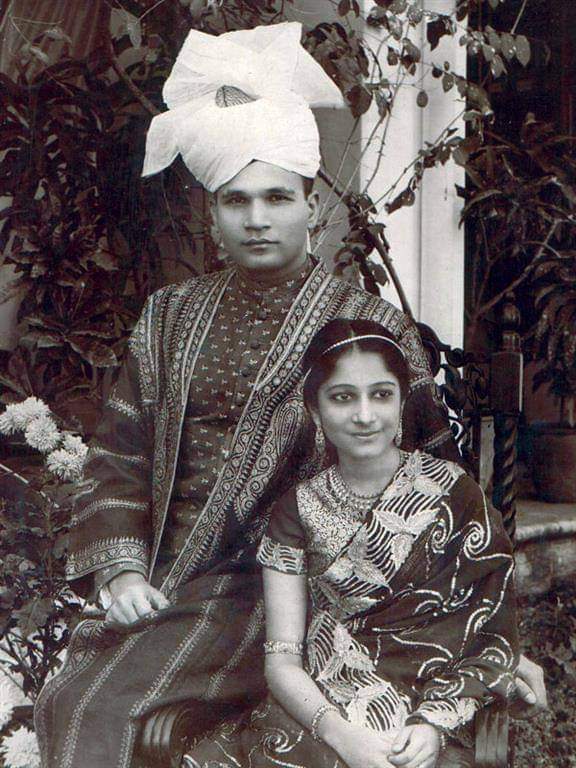
HAPPY FAMILY: The Tyabji clan including Laila Tyabji (centre, front row), who is a social worker, designer, writer and crafts activist
The big day for which Tyabji had worked so hard was also hectic for Rajendra Prasad, the soon-to-be first President of independent India. He marked the momentous occasion with a visit to Raj Ghat to pay homage to Gandhiji. He remained there for around 15 minutes.
But before the would-be President of India could get to the President House, C Rajagopalachari, the Governor General of India, had already reached there. The latter used to live in the double-storeyed bungalow at the then 10, Hastings Road, which was later renamed after him as Rajaji Marg. Edwin Lutyens, the chief architect of New Delhi, also lived in the bungalow, and so did Pranab Kumar Mukherjee, who also lived in that house after demitting his office of President of India.
“Dr Rajendra Prasad was sworn in as the country’s first President at around 9 am by the Governor General of India, C. Rajagopalachari. Rajvanshi Devi, his wife, and other family members were also there. The swearing-in ceremony was attended by over 500 guests, who had assembled inside the Durbar Hall. President Sukarno of Indonesia and several members of the Diplomatic Corps, members of the Constituent Assembly and prominent citizens had graced the occasion. The President was dressed in black achkan, white churidar and a white Gandhi cap. Pandit Nehru and his other Cabinet colleagues were sworn in soon after Rajendra Prasad,” recalled Tyabji, who was named after his grandfather, the third President of Indian National Congress.
Immediately after returning from Raj Ghat, Rajendra Prasad was sworn in. The Chief Justice of India, Sir Hiralal Kania, read the oath of office in Hindi. President Prasad repeated it sentence by sentence.
“The outgoing Governor General, C. Rajagopalachari; our first Prime Minister, Pandit Jawaharlal Nehru, beaming with pride and joy; the Deputy Prime Minister, Sardar Patel; cabinet ministers, judges of the Supreme Court and the Auditor-General of India, were present in the hall to witness the historic moment of India’s history. Pandit Nehru and his other cabinet colleagues were sworn in soon after.”
The national emblem of Ashoka Pillar with three lions was placed in the Durbar Hall for the first time near the throne where the British Viceroys used to sit.
A smiling statue of Lord Buddha was also placed behind the throne for the first time. Rajendra Prasad, the President, who greeted the large gathering smilingly with folded hands, made a short speech in Hindi and English, stating that it was a memorable day in our annals.
“Let us begin by offering our thanks to the Almighty Power who has enabled us to see this day; to the Father of the Nation who showed us and to the world at large his infallible method of Satyagraha, and led us on along it to freedom and to the numberless men and women, whose suffering and sacrifice have rendered the attainment of independence and establishment of this sovereign democratic Republic possible.”
The birth of the Republic was celebrated by the masses in the Capital through Prabhat Pheries (early morning movement of people singing patriotic songs). Outside the Durbar Hall, there were unforgettable scenes of jubilation. Large crowd of men, women and children had assembled in the forecourt of President House.
People raised slogans of Gandhiji-ki-jai and Vande Mataram.
After a dignified ceremony was held at the President House, the scene shifted to Irwin Stadium. The new President travelled to the stadium in a horse-drawn carriage and Delhi’s roads were lined up with enthusiastic crowd standing along the five-mile route with the Tri-colour in their hands. A huge crowd greeted the President’s entourage when it reached the vicinity of Connaught Place. And when the first President of India reached the stadium, he was welcomed with a booming 31-gun salute.
According to Tyabji, “Rajendra Prasad made a brief speech at the stadium. Later, students from various schools of the Capital presented cultural programmes.”
Old timers still recall that there were very few policemen guarding the VIPs inside the stadium. After the programme, the leaders mingled with the people. Nehru was mobbed by his admirers. He spent a good 20 minutes with them.
Tyabji, who could not sleep for several days ahead of the big occasion, was there managing the affairs carefully with his colleagues. Following very cold weather days in Delhi, brilliant sunshine greeted the Capital on January 26, 1950.
It was India’s defining moment, the day India truly freed itself from the shackles of colonialism to become a Republic. A truly sovereign state.
The talk of the first Republic Day cannot be complete without discussing the role of Tyabji’s wife, Surayya, in the making of the first Tri-colour.
According to Tyabji, “Once the Constituent Assembly finalised our Tri-colour with Ashok Dharma Chakra inside the flag, I was asked to furnish the model of Tri-colour on both paper and cloth.”
Without wasting any time, Badruddin Tyabji went straight to his Sujan Singh Park residence and asked his wife Surayya to make the Tri-colour on paper. She did not disappoint her husband. Once she made it on paper, Tyabji carried the design to the now defunct SC Tailors at Regal building of Connaught Place and asked them to make the Tri-colour in cloth. The rest, as they say, is history.
After retirement from government service, Tyabji also served as the Vice-Chancellor of Aligarh Muslim University in the 1960s.
He finally settled in Delhi and passed away in 1999. His wife, Suraiya, had died before him.
During one of our meetings, Tyabji had told me that when he came to Delhi from Hyderabad to appear for ICS examination, he was staying in Daryaganj.
He used to take a tonga to reach Metcalfe House in Civil Lines to appear for his examinations.
“Delhi was a very small city then. Except for old Delhi and villages, there was not much here. New Delhi was coming up,” he had said.
When India was divided on the basis of religion in 1947, he was perhaps one of the only two Muslim ICS officers who opted to stay in India instead of accepting Islamic Pakistan.
OFFICER RANK: Badruddin Tyabji was a 1936-batch ICS officer of Punjab cadre. His wife, Surayya was a painter
Tyabji’s first son, Hindal Ahmad, was an IAS officer. He passed away last year.
Tyabji’s daughter, Laila Tyabji is a noted social worker, designer, writer and crafts activist. She is one of the founders of Dastkar, a Delhi-based non-governmental organisation working for the revival of traditional crafts in India.
Like in the past, the Tyabji family would watch the annual parade this year too. After all, they are the true and proud first family of India’s Republic Day. Yet, they are so self-effacing.
source: http://www.thepatriot.in / The Patriot / Home> Cover Story / by Vivek Shukla / January 26th, 2024
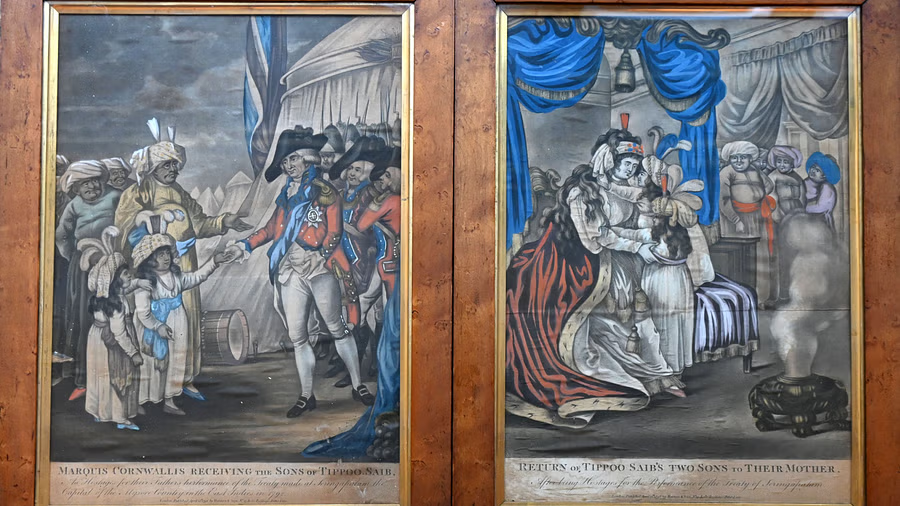
One print depicts Tipu’s two sons being taken hostage by Lord Charles Cornwallis, after the third Anglo-Mysore war in February 1792, and the other is a portrayal of their return to their mother.
The prints were made in 1796 by publisher Haines. / Credit: DH Photo/ B K Janardhan
A city-based art collector, Sunil Baboo, has recently acquired two rare prints of paintings from Tipu Sultan’s era. They capture significant moments in the history of the erstwhile Kingdom of Mysore.
One print depicts Tipu’s two sons being taken hostage by Lord Charles Cornwallis, after the third Anglo-Mysore war in February 1792, and the other is a portrayal of their return to their mother.
History has it that Cornwallis laid out severe conditions Tipu had to adhere to in the Treaty of Seringapatam. He demanded that Tipu hand over his sons to British custody, until the king carried out all the demands he had agreed upon.
“While there are multiple artworks depicting the moment of surrender, it is rare to come across one capturing the sons being returned to Tipu’s wife,” says 65-year-old Baboo, who has been collecting historic books, maps, aquatints and documents since 1982.
The creator of the paintings is unknown, but they were turned into prints in 1796 by publisher Haines. This was even before the defeat and death of Tipu during the fourth Anglo-Mysore war in 1799. “Many of these artists never set foot in India. They created these images based on what was described to them. While there was an artistic bent to them, it was more a way for them to document important events,” Baboo explains. Many of these prints were originally etchings and engravings that were coloured by hand, adds the Gangenahalli resident.
He learnt of the prints a few months ago, and was able to edge out some of the biggest auction houses like Bonhams, UK. “They were planning to auction them in June 2024, but I was able to procure them through my contacts,” he explains. Over the years, Baboo has built a wide network of collectors and auction houses that tip him off on new discoveries. Most of this category of prints are found in family collections of descendants of French and British soldiers of the colonial period.
The prints, once discovered, are restored and framed. Baboo’s 16×14-inch prints came with a lot of archival tape and paper at the back of the frame. “Presumably to reinforce them. They can be kept in this condition for a long time,” he says.
source: http://www.deccanherald.com / Deccan Herald / Home> India> Karnataka> Bengaluru / by Rashmi Rajagopal / January 24th, 2025
It is well-timed and relevant to know that Aligarh Muslim University (AMU) has produced many freedom fighters who fought for independence. While we are celebrating the Azadi Ka Amrit Mahotsav, present-day India is going through difficult and trying times, as hate speeches against Indian Muslims are often heard from every corner of India. It is believed that most of them are not patriotic and are supporters of Pakistan.
During the last eight years we have seen some incidents of mob lynchings of Muslims and Dalits and have also heard unfortunate calls for genocide of Muslims. Knowing about the contribution of AMU towards the national struggle of independence is relevant to dispel the myth that the founder of AMU, Sir Syed Ahmed Khan, advocated that Muslims of India constituted a separate nation, qaum, or that the idea of Pakistan took birth among the intellectual class of Aligarh. Moreover, the study of AMU’s contribution to freedom movement will, it is believed, strengthen Hindu-Muslim Unity.
The Mohammado Anglo-Oriental College (MAO College), Aligarh, established in 1875 (which later became AMU in 1920), produced many freedom fighters, prominent among them are Ali brothers (Maulana Shaukat Ali and Mohammad Ali), Abdul Gaffar Khan (Frontier Gandhi), Maulana Hasarat Mohani, Raja Mahinder Pratap (President of 1st Indian Government established in exile at Kabul), S. M. Tonki, Saifuddin Kichloo Kitchlew (recipient of Lenin Peace Prize), Abdul Majeed Khwaja and Qazi Adeel Abbasi, Saith Yaqoob Hasan, Ali Sardar Jafri, Shafiqe-ur-Rehman Kidwai, Rafi Ahmad Kidwai, Raja Gulam Husain, Shoeb Qureshi, Sheikh Mohammad Abdullah, Dr. Datu (Leader of African National Conference), Abdul Matin Chowdhry (Founder Member of Indian Civil Liberty Union), Mazharul Haque, Syed Ali Zaheer, Syed Hossain, Syed Mir Qasim, Syed Rauf Pasha, Tassauq Ahmad Khan Sherwani, Yaseen Noori Z Ahmad, and Zafar Ali Khan.
In the following pages we provide a brief profile of fifteen prominent freedom fighters who are alumni of AMU (Hakeem Ajmal Khan was not an alumni alumnus of AMU but was associated with it as a member of Trustee).
Khan Abdul Ghaffar (1890-1988)
Khan Abdul Ghaffar is one of the most important Muslim freedom fighters of India and he was also known as “Frontier Gandhi “. He started the famous KhudaiKhidmatgar (“Servants of God”) movement in 1929 and it was a very successful freedom movement. The British were so infuriated by the success of the movement that they began a harsh crackdown on its supporters. The atrocities committed on KhudaiKhidmatgar were one of the most severe repressions that the Indian independence Movement ever witnessed. He also opposed the All-India Muslim League’s demand for the partition of India. When the Congress Party did not consult him on partition, he felt very sad and told the Congress “you have thrown us to the wolves”. After the partition, he remained in Pakistan and started fighting for a separate Baloch province. He was jailed many times from 1948 to 1988 and most of the time was under house arrest. When he died in 1988, tens of thousands of mourners attended his funeral. At the same time heavy fighting was going on between Soviet forces and Afghan Rebel forces but both stopped their fight and paid tribute to the great leader.
Zakir Husain (1897-1969)
Dr. Zakir Husain served as 3rd President of India and he was also the first Muslim President of India. He was one of the founders of Jamia Millia Islamia, Delhi. He was deeply influenced by Gandhi’s doctrine of Non-Violence and believed that India’s struggle for freedom would only be successful when Indian Society is educated with value-based education. He acted as the Vice Chancellor of Jamia Millia Islamia for 22 years (1926-48) and made it one of the finest educational institutes in India. He was awarded The Bharat Ratna, India’s highest National Honour.
Saifuddin Kitchlew (1888-1963)
Dr. Saifuddin Kitchlew completed his studies in Europe and then returned to India to practice Law. He was appointed as Municipal Commissioner of Amritsar when the infamous Rowlatt Act was passed by the British Government. He soon left his law practice and took part in the Non-Cooperation Movement. He was arrested with Mahatma Gandhi and Dr. Satyapal for leading a protest in Punjab and to protest the arrest of the trio, a public meeting gathered at the Jallianwala Bagh where Gen. Reginald Dyer and his troops fired mercilessly upon the unarmed civilian crowd. He was also the founding leader of the Indian Youth Congress. Kitchlew spends nearly fourteen years in jail for his revolutionary activities. He strongly opposed the Muslim League’s demand for Pakistan and partition of India. India Post released a special commemorative stamp featuring him on his 100 Birth Anniversary.
Abdul Majeed Khwaja (1885-1962)
Khwaja Sahab, as Abdul Majeed Khwaja was affectionately known as, served – first as Vice Chancellor and then as Chancellor of the Jamia Millia Islamia for the longest duration in its 100 years. Jamia’s history will remain incomplete without his mention.
He was educated at MAO College, Aligarh, after which he went to Cambridge and was called to the Bar. At Cambridge his contemporaries included Jawaharlal Nehru, Saifuddin Kitchlew, Syed Mahmud and T. A. K. Sherwani, all of whom joined India’s freedom movement.
Khwaja Sahab was a committed Congressman who had joined the party in 1915 and, despite ups and downs, remained with it till his last breath. He also remained associated with Jamiat Ulama-i- Hind almost from the beginning and was in the Khilafat delegation that went to England. He was Junior Law Professor at MAO College, had served as its Trustee and was also Secretary of the MAO Old Boys’ Association.
Khwaja Sahab was a distinguished lawyer, and was quite famous in Patna High Court. But, in response to the call for non-cooperation which included boycotting the British Government supported education, he gave up his legal practice, and got himself involved in the formation and building of Jamia.
Abdul Majeed Kwaja held high offices in the Khilafat Congress and was associated with Jamait- Ulamae-e-Hind from its inception. He was a close associate of Jawaharlal Nehru and a great advocate of Hindu-Muslim unity. He took keen interest in the Khilafat movement and went to England as a member of the Khilafat delegation (1920), led by Dr. MA Ansari.
Hakeem Ajmal Khan (1868-1927)
Ajmal Khan was a prominent leader of India’s freedom struggle and was among the founders of Jamia Millia Islamia. He is also the sole person who has had the honour to be elected the President of the Indian National Congress, the Muslim League and the All-India Khilafat Committee. He was a prominent freedom fighter, respected physician and academician of India. After beginning his practice, Khan was elected as the main physician to the Nawab of Rampur from the time period 1892 to 1902. Here, he was introduced to Sir Sayyid who chose him as the trustee of the MAO College.
His life changed its course from medicine towards politics after he started writing for an Urdu weekly ‘Akmal-ul-Akhbar’ that was launched during 1865-70. Khan was also heading the Muslim team, who met the Viceroy of India in Shimla in the year 1906 to give him a memorandum for creation of AMU.
At a time when many Muslim leaders were arrested, Ajmal Khan approached Mahatma Gandhi for help. As such, Gandhiji united with him and other Muslim leaders like Maulana Azad, Maulana Mohammad Ali and Maulana Shaukat Ali in the famous Khilafat movement. Ajmal Khan resigned from AMU as its trustee when the authorities refused to accept the non-cooperation movement waged by Gandhiji and the Congress against the British government. He was elected the president of the Indian National Congress in 1921.
Hasrat Mohani (1877-1951)
Syed Fazl-ul-Hasan, known by his pen-name Hasrat Mohani, co-founder of Communist Party of India, was an Indian political activist (as he was expelled from MAO College in 1903 due to his political activities), freedom fighter in the Indian independence movement and a noted poet of the Urdu language. He coined the notable slogan “InquilabZindabad” (translation of “Long live the revolution!”) in 1921. Together with Swami Kumaranand, he is regarded as the first person to demand complete independence for India in 1921 at the Ahmedabad Session of Congress. Maghfoor Ahmad Ajazi supported the complete independence motion demanded by Hasrat Mohani. The demand of “complete independence” was however not upheld by Mahatma Gandhi then as he believed that “it could not be incorporated in the Congress creed until the Hindu-Muslim unity is completely achieved which also meant that the idea was premature.
Mohani was opposed to the Nehru Committee Report and left Congress to become President of the Muslim League at Ahmedabad in 1921. As a member of the Constituent Assembly, he refused to sign the draft Constitution to protest partition and India’s membership of the Commonwealth.
While he was a devout Muslim, he didn’t find it odd to be inspired by Krishna, the Hindu deity. Makkah, Mathura and Moscow were Hasrat Mohani’s popular symbols. He did not find any conflict between them. A firm believer in religious integration, he repeatedly performed hajj pilgrim as well as attended the Sri-Krishna celebration fair held annually at Mathura.
Raja Mahendra Pratap (1886-1979)
Raja Mahendra Pratap Singh was an Indian freedom fighter, journalist, writer, revolutionary, President in the Provisional Government of India, which served as the Indian Government in exile during World War I from Kabul in 1915, and social reformist in the Republic of India. He also formed the Executive Board of India in Japan in 1940 during the Second World War. He also took part in the Balkan War in the year 1911 along with his fellow students of MAO college. He is popularly known as “Aryan Peshwa”. Government of U.P. established in 2021, Raja Mahendra Pratap Singh State University, at Aligarh, to cherish his memory and legacy. Prime Minister Narendra Modi laid the foundation stone of the University on 13 September 2021.
Maulana Shaukat Ali (1873-1938)
Shaukat Ali was the elder brother of the renowned political leader Mohammad Ali Jouhar. He helped his younger brother Mohammad Ali to publish the Urdu weekly, Hamdard, and the English weekly Comrade. In 1915 he published an article which said Turks were right to fight the British. These two weekly magazines played a key role in shaping the political policy of Muslim India back then. In 1919, while jailed for publishing what the British charged as seditious materials and organizing protests, he was elected as the last president of the Khilafat conference. He was re-arrested and imprisoned from 1921 to 1923 for his support to Mahatma Gandhi and the Indian National Congress during the Non-Cooperation Movement (1919–1922). His fans accorded him and his brother the title of Maulana. In March 1922, he was in Rajkot jail and was later released in 1923.
While still a supporter of Congress and its non-violent ethos, Ali even surpassed some of his colleagues in also providing support to the revolutionary independence movement. To this end, he supplied guns to Sachindranath Sanyal.
He opposed the 1928 Nehru Report. Instead, he demanded separate electorates for Muslims and finally the Khilafat Committee rejected the Nehru Report. Shaukat Ali attended the first and second Round Table Conferences (India) in London in 1930-31. Ali served as a member of the ‘Central Assembly’ in British India from 1934 to 1938. He travelled all over the Middle East, building support for India’s Muslims and the struggle for independence from British rule in India.
Maulana Muhammad Ali Jauhar (1878-1931)
Maulana Muhammad Ali Jauhar studied in MAO College and in Oxford University. He launched non-cooperation and Khilafat movement with Mahatma Gandhi. His regular writings in leading Indian and foreign newspapers like TheTimes,London,TheManchesterGuardian and TheObserver made him look like a visionary that the Indian Muslims and the general public was waiting for decades. Later, in the year 1911 he launched his well-received magazine TheComrade in Calcutta. But Kolkata didn’t suit him much and he shifted base to Delhi, from where he launched an Urdu daily, Hamdard, in 1913. Muhammad Ali was in the forefront in the war against British Raj. He wholeheartedly supported Mahatma Gandhi’s call for a national civil resistance movement, and inspired hundreds of protests and strikes all over India. He was arrested by British authorities and imprisoned for two years for what was termed as a seditious speech at one such meeting. He was one of the founders of Jamia Millia Islamia and was its first Vice Chancellor.
He was elected the President of INC in 1923. The fearless Maulana, despite his ill-health, went to attend the first Round Table Conference in London in 1930. He told the British Government in a very clear tone that he would not return to India alive unless the country was set free. “I would prefer to die in a foreign country so long as it is a free country, and if you do not give us freedom in India, you will have to give me a grave here”, the Maulana said. The true freedom lover, Muhammad Ali died during the same journey in London on 4 January 1931. He was buried in Jerusalem in the proximity of the Dome of Rock. While speaking bluntly in the Round Table Conference, he said, “I have not come to ask for Dominion Status. I do not believe in the attainment of Dominion Status. The one thing to which I am committed is complete independence. In Madras in 1927, we passed a resolution making that our goal.”
AbdulQaiyumAnsari(1905-1973) was a freedom fighter of India. He was known for his commitment to national integration, secularism and communal harmony. He fought against Jinnah’s two nation theory through the All-India Momin Conference of which he was the President. He vehemently opposed the very idea of Pakistan and spoke out openly to the extent of inviting attack by Muslim League supporters. While speaking in Patna during the Bihar Provincial Momin Conference on 21 April 1940, Abdul Qayyum said: “It is blasphemy to say that Islam is in danger here. It is tragedy to place orders for a Pakistan for the segregation of Islam. It is a defeat of Islam to run away from the battle of life in search of a privilege. It is a fantastic wavering of a fevered mind”.
He was impressed by Mahatma Gandhi, Maulana Azad and Ali Brothers who were the leading lights of the freedom movement. His activism in the freedom movement and social causes can be gauged by the fact that he established a national school for the students who had boycotted government schools in response to the call of the Indian National Congress (INC). For this he was arrested and imprisoned at the young age of 16 since it amounted to participation in Non-Cooperation and Khilafat Movements. Abdul Qaiyum Ansari was also a champion of weaker sections of the society. He was among the top leaders of the Momin Conference and used the forum to make every effort to beat Muslim League and its divisive agenda. Besides, he also stood firmly against divisive politics of other organizations. He worked closely with the INC throughout as a youth leader and even took part in the students’ agitation against the Simon Commission during its visit to Calcutta in 1928. He was also an accomplished journalist, writer and a poet.
Ali Sardar Jafri (1913-2000)
Sardar was a rebel, freedom fighter, pacifist, radical activist, story writer, critic and documentary filmmaker at once. But, above all, he was a poet endowed with exquisite imagination, one of the brightest stars on the firmament of 20th century Urdu poetry. Like all great poets he was a prophet engaged in unravelling the mysteries and ambiguity of human drama. The principal theme of his poetry was compassion, love, perseverance and sensitivity surviving amidst the callous inhumanity of our times. In his unique style, he depicted the exemplary survival of the human spirit in face of all- pervasive adversity and defeatism. In so doing he not only carried forward the traditions of Urdu poetry but enriched its treasure with new symbols and powerful imagery. Indeed, his poetry gradually evolved into a genre of its own kind whose influence is difficult to ignore among the present generation of Urdu poets.
Sardar’s early works reflected a restless yearning for India’s independence from the colonial yoke. Equally intense was his yearning for the freedom and dignity of the proletariat. This was because of the strong impact of the Progressive Writers’ Movement inspired by Marxism and the Bolshevik Revolution in Russia in 1917. As early as 1938, he joined the movement at its conference held in Calcutta and soon became one of its leading advocates. The influence of Marxism on his poetry was thus profound and everlasting.
AMU conferred a doctorate (D. Litt.) on him in 1986, fifty years after he was expelled from the university. He was the fourth person to receive this honour, his predecessors being the notable Dr. Allama Iqbal, Mrs. Sarojini Naidu and Jigar Moradabai. His works have been translated into many Indian and foreign languages.
K.M. Ashraf (1903-1962)
Kunwar Mohammad Ashraf was an eminent historian, scholar of Islamic studies, a communist leader and crusader of Hindu-Muslim unity. During the non-cooperation movement, he left MAO College to join recently created Jamia Millia. Later he rejoined AMU in 1923 to pursue M.A. (History) and LL.B. courses. He received a Ph.D. from SOAS, London University. After teaching at AMU for a year, he gave up his academic career due to his commitment to the national movement. Ashraf came under the influence of Professor Mohammad Habib and joined socialist movement. Inspired by the Russian Revolution, he joined the Congress Socialist Party formed in 1934. During 1933-34, he led the Meo peasant struggle against the Maharaja of Alwar’s oppression and the Government had to intervene to introduce reforms. Dr. Ashraf was a trusted associate of Jawaharlal Nehru and was a member of AICC from 1934-45. He headed the Muslim Mass Contacts Campaign Cell of Congress, 1937-39, formed to wean away the Muslims from the influence of Muslim League and propagate Congress’ nationalist programmes. Ashraf exhorted the Indian Muslims to participate in the freedom movement and staunchly opposed M.A, Jinnah’s idea of Pakistan. He served as the Secretary to Jawaharlal Nehru and Maulana Azad when they were Congress Presidents. In 1948 he edited Naya Daur, the daily newspaper that denounced communalism and was distributed by the CPI. He taught at the University of Delhi and joined the Humboldt University, Berlin as a Guest Professor (Medieval Indian History) in 1960. In 1962 he died and was buried in the ‘Cemetery of Socialists’ at Berlin.
Rafi Ahmad Kidwai (1894-1954)
An Indian independence activist and a socialist to the core, Rafi Ahmed Kidwai’s ceaseless efforts in making the country free from British rule have been nothing but praiseworthy. Although a graduate from MAO College, his skills of keen observation and learning from human nature took him beyond bookish knowledge. During the crisis situations that he had to deal with during his service to the nation, he showed distinct man management skills and an innovative approach to resolve human issues. And with Pandit Jawahar Lal Nehru as his mentor, there was no stopping him further. His efforts in bringing out many reforms and fighting against the unjust with utmost conviction will always be remembered. A committed freedom fighter to the very end!
It was by 1920 that Kidwai’s political career officially began after he had become an active force behind the Khilafat Movement and the Non-Cooperation Movement and was even jailed for the same. In 1922, he moved to Allahabad after being released from jail and served as the private secretary to Motilal Nehru. In 1926, Kidwai was elected to the Central Legislative Assembly of British India and from there on it was his political and social insightfulness that made him the Chief Whip of the Congress Legislative Assembly from 1926 to 1929. He also held the secretary position of the United Provinces Congress Committee and organized a no-rent campaign to protect Ashraf came under the influence of Professor Mohammad Habib and joined socialist movement. The farmers of the Rae Bareli district from the ongoing economic depression. For this, he was even sentenced for six months.
The Government of India Act 1935 made him a minister-in-charge of managing the revenues and jail portfolios in Pandit Govind Ballabh Pant’s cabinet in the United Provinces when congress government was set up. He was second to Pant as home minister in the 1946 government and in the same year, he became the home minister of UP. Post-independence, Kidwai became India’s first minister for communication in Jawahar Lal Nehru’s cabinet. Kidwai, along with Abul Kalam Azad, were the two Muslims in Nehru’s central cabinet. The “own your telephone” service that he launched in 1948 still goes by the name of OYT; under which a new telephone may be obtained. In the same year, he also launched night air mail service as a minister for communications.
Saith Yaqoob Hasan (1875-1940)
Saith Yaqoob Hasan (Maulana Yakub Hasan Saith) was an Indian businessman, freedom- fighter and politician who served as a cabinet minister for Public Works in the Madras presidency, under Rajaji (1937-1939). In 1916, Saith was elected to the Madras Legislative Council by the South Indian Chamber of Commerce. He joined the INC and participated in the Khilafat agitations in 1919 and was imprisoned for six months. He was arrested and imprisoned once again in 1921 for his participation in the Non-Cooperation Movement. On his return from jail in 1923, he resigned from the Congress and founded the Madras Province Muslim League. This move was prompted by Saith’s preference for Dominion Status when the Congress declared independence as its primary goal. As a result, no Muslim leader from the Presidency participated in the Civil Disobedience Movement. Saith stood for the elections and was elected to the Assembly.
Before the 1937 elections, Saith, left the Madras Provincial Muslim League and joined the Indian National Congress. Soon, he became one of the top leaders of the provincial Congress. He condemned Mohammad Iqbal’s two-nation theory and supported a united India. However, he still supported most of the other policies of the Muslim League.
Shoeb Qureshi
Qureshi edited Harijan during the detention of Gandhiji.
(Abdulrahim P. Vijapur is currently Emeritus Professor of Political Science at the University of Science and Technology, Meghalaya. Formerly he was Professor of Political Science at Aligarh Muslim University. He retired in 2020 after serving AMU for 37 years. He can be reached at: Email: arvijapur@gmail.com )
This article was first published in countercurrents.org on 26 August 2022
source: http://www.indoislamic.org / Indo Islamic Heritage Centre / Home> Article / by Abdulrahim P Vijapur / October 23rd, 2023