Ranipur (Madhubani District), UTTAR PRADESH / DELHI :
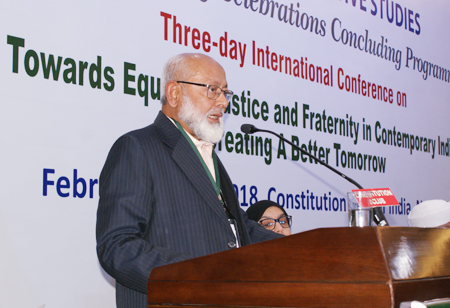
Dr. Mohammad Manzoor Alam, the founder of the Institute of Objective Studies (IOS), stands as one of the most prominent leaders of the Indian Muslim community. Recently, his biography “Dr. Manzoor Alam: Empowering the Marginalized” written by senior multilingual journalist A. U. Asif, was released at the Constitution Club of India in New Delhi. The event was attended by several distinguished personalities from politics, academia, the judiciary, and the media.
The biography reveals many unknown aspects of Dr. Manzoor Alam’s life, his contributions, and his wide national and international connections — from Dr. Manmohan Singh to Ahmed Patel, from cabinet ministers to chief ministers and governors. His close friendships extended to Malaysian Prime Minister Anwar Ibrahim and several prominent personalities across the Gulf Cooperation Council (GCC), including ministers and academicians. Among his international associates were Prof. Omar Hasan Kasule, Secretary General of the International Institute of Islamic Thought (IIIT), USA; Dr. Ahmad Muhammad Ali, the first President of the Islamic Development Bank (IDB); Dr. Ahmed Tutunji, General Secretary of the International Islamic Federation of Student Organizations (IIFSO); and Professor Ismail Raji al-Faruqi, co-founder of IIIT, Dr. Abdullah Al-Maatouq, Chairman of the International Islamic Charity Organization (IICO) Kuwait etc.
The Institute of Objective Studies: A Pioneering Muslim Think Tank
Undoubtedly, the IOS — the first Muslim-run think tank in India — has played an unparalleled role in academic and intellectual engagement. Over the past four decades, it has organized more than 1,230 conferences, seminars, symposia, and workshops on diverse issues affecting Muslims and Indian society at large. It has completed over 410 research projects and produced around 405 publications focusing on socio-economic, educational, and cultural challenges.
Through its data-based research, collection, and presentation, IOS provided valuable insights into the conditions of marginalized communities. The institution succeeded in building a network of more than 500 research scholars, social scientists, academicians, judges, lawyers, and politicians. Its studies and deliberations form a crucial body of work on the socio-economic conditions of Indian Muslims.
However, despite its achievements, the IOS has failed to evolve a sustainable mechanism for implementing the findings of its research. After nearly four decades of existence, the impact of its ideas on the ground remains negligible. The think tank, while rich in intellect and intent, fell short of translating its research into practical policies for the empowerment of marginalized communities. When one examines the ground realities, the absence of tangible transformation makes this collective effort appear more like an academic exercise than a movement for social change.
The Promise and the Reality
The Institute of Objective Studies was established in 1986 with the vision of empowering the 200 million-strong Indian Muslim community — a group that, even today, lags behind many other marginalized sections, including Dalits, on multiple socio-economic parameters. While IOS produced a wealth of research and data, it failed to create models of empowerment or tangible change on the ground.
It would be unfair to assume that Dr. Manzoor Alam’s vision was limited to research and conferences alone. He unsuccessfully attempted to extend his work into education, media, and healthcare. Unfortunately, many of those initiatives remained unrealized.
Dr. Alam had conceived numerous projects, including a dream university and television channels Al-Hind and Falak TV — both designed to serve as platforms for education and social awareness. He presented these projects at several events in India and abroad, yet they never materialized beyond the planning stage. Why these ideas remained confined to files is a question that only Dr. Alam himself can answer.
Dr. Manzoor Alam’s Tryst with Education and Development
In the 1990s, Dr. Alam invited Mohammad Yunus Saleem, then Governor of Bihar, to lay the foundation stone of an educational institution in his native village, Ranipur, in Madhubani district. Decades later, that very school continues to function from a thatched hut.
Similarly, he invited another Governor, Akhlaqur Rahman Kidwai, to lay the foundation of a hospital in the same village. However, there is no trace of that foundation today, and the land has reverted to agriculture. It is said that even a few delegations of Arab dignitaries visited the site to explore funding possibilities for these projects. Yet, despite such visits and promises, Ranipur remains a mirror reflecting the unfulfilled dreams of Dr. Alam’s vision for grassroots empowerment.

Akhlaq Ur Rehman Kidwai, then Governor of Bihar, during his visit to Ranipur — the native village of Dr. Manzoor Alam — for the foundation stone-laying ceremony of a school.
The Unfulfilled Dream of an Islamic University in India
Following the model of the International Islamic University Malaysia (IIUM), the International Islamic University Islamabad, and the International Islamic University Dhaka, it is said that funds were once earmarked for a similar university in India. The responsibility for establishing it reportedly rested with Dr. Manzoor Alam. A 25 acres of land were even purchased in Palwal district, Haryana, under the Taawun Trust which was formed in 1980s for the same purpose. However, the project never moved forward, and its current status remains unknown.
Under the same trust, a clinic in Zakir Nagar, New Delhi, was inaugurated by the then Chief Minister, Sheila Dikshit. But today, little remains of that initiative — its fate is known only to its former manager, Mohammad Alam, son of Dr Manzoor Alam. Likewise, a valuable piece of land (D-16 worth over 10 crores) in Abul Fazal Enclave, earmarked for the Taawun Trust office, was later developed into a five-storey building. The ownership and purpose of this property are known only to Dr. Alam and other trustees.
Other Institutions and Initiatives
Along with the late Qazi Mujahidul Islam Qasmi, Dr. Manzoor Alam co-founded several organizations, including the All India Milli Council, Islamic Fiqh Academy (IFA), Qazi Publications, Universal Peace Foundation (UPF), Featured and News Analysis (FANA), United Mass Media Association (UMMA), Indo-Arab Economic Cooperation Forum, and the Taawun Trust. Except for IOS and IFA, most of these institutions are now nearly defunct.
In earlier years, FANA and UMMA operated from 166 Zakir Bagh but were later shifted to the IFA premises at Zakir Nagar. The present status of the Zakir Bagh flat remains unclear. Similarly, behind the IOS office once stood the premises of the Universal Peace Foundation (UPF), which was closed many years ago.
A Malaysian organization once sponsored Bharat Offset Press, located at 2035 Mumtaz Building, Gali Kasim Jan, Ballimaran, Delhi. The press was set up under Dr. Manzoor Alam’s patronage to provide financial support to widows and orphans. One can only hope it continues to serve that noble purpose today.
Interestingly, most of the important publications of the Institute of Objective Studies are now being published and marketed by Genuine Publications and Media Pvt. Ltd., where Dr. Alam’s younger son, Ibrahim Alam, serves as the Executive Director.
Now, his elder son Mohammad Alam has taken over as the General Secretary of the IOS. It is hoped that the unfulfilled dreams of Dr. Manzoor Alam will be realized and a university will be established on the proposed land in Palwal
The Unasked Questions
A serious question arises: Why has no one from among Dr. Manzoor Alam’s large circle of associates — including intellectuals, professors, writers, and bureaucrats — ever raised concerns or sought accountability? Why has there been such silence around the unrealized projects and abandoned initiatives?
Dr. Alam is a man of extraordinary connections and resources, with access to national and international leaders, institutions, and philanthropists. Yet, despite such privilege and goodwill, he could not establish even a modest school or clinic in his own native village — a village that once saw two governors visit to inaugurate his projects.
Dr. Manzoor Alam’s journey represents a paradox: a leader of vision and intellect who created one of India’s most influential Muslim think tanks, yet whose dreams for practical empowerment of the marginalized remain largely unrealized. His ideas, no doubt, inspired a generation of scholars and activists. But without concrete implementation, the towering edifice of research and conferences risks standing as a monument to missed opportunities.
source: http://www.muslimmirror.com / Muslim Mirror / Home> Exclusive Reports / by Syed Zubair Ahmad / October 30th, 2025