GUJARAT/ UGANDA / New York, U.S.A. :
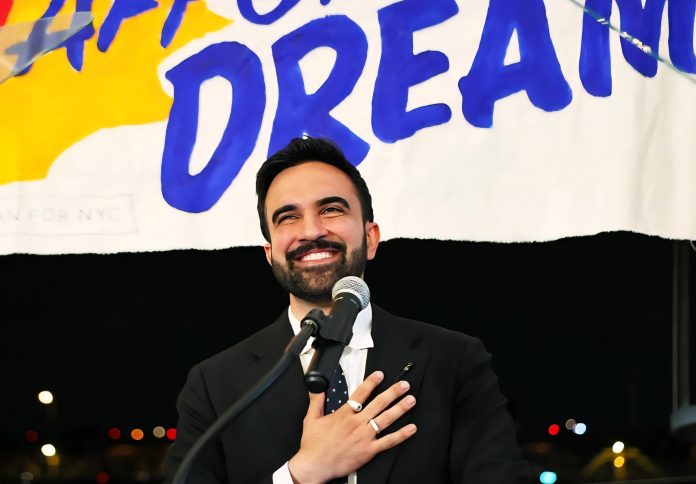
Zohran Mamdani
A Historic Win
“I am a Democratic Socialist, I am a Muslim… I am not apologizing for either.” With these words, Zohran Mamdani declared victory in the New York City mayoral race, a symbolic global capital of commerce and culture. His triumph rekindled hope among conscientious citizens in New York and resonated worldwide, especially amid the rise of populist, authoritarian-leaning leaders who thrive on division and privilege wealthy allies.
Only a year prior, Mamdani was widely seen as an underdog. Yet he defeated Andrew Cuomo, the former governor who ran as an independent and received informal support from prominent national figures, including the sitting president. Mamdani garnered just over 50 percent of the vote, becoming the youngest mayor in a century and the first Muslim and South Asian to hold the office. His campaign also achieved one of the highest voter turnouts in New York City since 1969, signalling renewed civic engagement for a progressive, inclusive agenda.
Political Polarization and Economic Context
While such a victory might appear routine in an established liberal democracy, it must be understood against the backdrop of deep U.S. political polarization since the Trump era. Divisive rhetoric and exclusionary policies fractured communities and workplaces, stifling dreams and limiting opportunity.
During the Trump administration, harsh immigration enforcement via ICE and other agencies fuelled fear in immigrant communities. Arbitrary detentions, wrongful arrests, and forced family separations became emblematic of policies that disregarded due process and human dignity. At the same time, tariffs and trade disputes increased living costs, particularly in metropolitan areas like New York. Rising rents and price hikes strained households across demographics, as economic hardship transcends ethnicity, citizenship, or geography. Some commentators noted that the political climate during Mamdani’s election was marked by tension between the federal administration and certain Democratic-led cities. Debates around federal funding, social welfare programs, and executive rhetoric heightened the stakes of the mayoral race, creating a context in which Mamdani’s message of local accountability and inclusion resonated strongly with voters.
The Socioeconomic Landscape of New York
New York City, with a population of approximately 8.48 million as of 2024, is among the world’s most diverse urban centres. Over 30 percent of residents are foreign-born, representing more than 100 nationalities. Yet the city struggles with high income inequality, reflected in a Gini coefficient of 0.555. Housing shortages, rising rents, and long commutes—averaging 41 minutes—have made the city increasingly unaffordable for lower- and middle-income households, prompting out-migration to suburbs.
Employment levels have recovered post-pandemic, with private-sector jobs growing 2.8 percent in 2024–25, yet the income gap continues to widen. Households in the highest quintile earn more than twenty times those in the lowest quintile. Policies favouring high-income earners during prior administrations exacerbated this structural inequality.
A Campaign Grounded in Inclusion
Mamdani’s success can be attributed to his focus on everyday concerns of New Yorkers: affordability, public transportation, universal childcare, housing, and progressive taxation. He positioned himself against divisive political rhetoric, resonating across New York’s diverse communities and appealing to those marginalized economically or socially helping unite both conservatives and liberals as economic hardship doesn’t see political allegiance.
A defining moment in his campaign was his emphasis on local priorities. During a mayoral debate, while other candidates pledged their first visit abroad to Israel, Mamdani highlighted his responsibility to New Yorkers first, reinforcing his commitment to municipal governance over symbolic foreign policy gestures.
He also navigated sensitive international issues with nuance, affirming support for the safety and rights of Jewish residents while criticizing the humanitarian crisis in the occupied Palestinian territories. His stance on human-rights accountability, including adherence to ICC mechanisms, underscored a principled approach that strengthened his political credibility.
Major New York City billionaires marshalled tens of millions of dollars to thwart Zohran Mamdani’s mayoral campaign, deploying deep-pocketed political machinery in support of his opponents. For instance, former Mayor and billionaire Michael Bloomberg is reported to have donated approximately US$8.3 million to the pro-Andrew Cuomo super-PAC Fix the City. Hedge-fund billionaire Bill Ackman contributed at least US$1 million to the anti-Mamdani PAC Defend NYC, and additional sums to Fix the City.
Concurrently, opposition efforts against Mamdani involved advertisements and mailers that his campaign denounced as blatant Islamophobia. For example, a mailer circulated by the pro-Cuomo super-PAC Fix the City was reported to have altered his appearance, darkening his beard and lightening his skin, a move Mamdani characterized as racially and religiously discriminatory. In addition, opponents sought to question his political allegiances, falsely portraying him as a supporter of Hamas and suggesting that he did not recognize Israel’s right to exist—claims that his campaign firmly rejected as misleading and defamatory.
Engaging Communities on the Ground
Mamdani’s outreach strategy was multifaceted and culturally inclusive. Campaign messaging spanned multiple languages, reaching New Yorkers across diverse linguistic and ethnic backgrounds. Beyond digital platforms, he visited places of worship, including Hindu temples, Jewish synagogues, and Christian churches, reinforcing interfaith solidarity.
He also engaged with ethnic food outlets and small businesses, highlighting immigrant contributions to the city’s cultural and economic life. This ground-level engagement translated into broad support across communities—Muslims, Christians, Jews, and secular groups alike—demonstrating a shared alignment with his vision for an inclusive, socially just New York.
Diasporic Resonance and Global Context
Mamdani’s heritage evokes transnational connections to India and Uganda, reflecting the experiences of diaspora communities navigating multiple cultural and political identities. His election elicited reactions from segments of Indian nationalist (Hindutva) movements, including online circulation of Islamophobic commentary. In contrast to widely celebrated Indian-origin figures such as Rishi Sunak, Kamala Harris, Tulsi Gabbard, and Usha Vance—often cited as symbols of India’s soft power abroad—Mamdani’s identity as a Muslim and his candid critique of the 2002 Gujarat riots have positioned him outside these narratives. He has reflected thoughtfully on the experiences of Muslims in New York, observing that “to be Muslim in New York is to expect indignity,” while emphasizing that such challenges do not define the broader community. His principled approach extends to global issues as well; his measured stance on the Israel–Palestine conflict underscores a commitment to human rights and ethical governance, reinforcing his reputation as a leader guided by conscience and social justice rather than partisan or sectarian considerations.
Zohran Mamdani’s unapologetic assertion of his identity, faith, and commitment to the public good offers a potential model for Indian Muslims and other marginalized communities confronting the rise of militant Hindutva and an increasingly adversarial state. His example demonstrates that principled, assertive engagement—grounded in inclusivity and social justice—can effectively challenge exclusionary and sectarian politics. Secular political parties in India, which in recent years have often sidelined Muslim voices in public life, might draw lessons from Mamdani’s approach: defeating divisive politics requires active, unapologetic advocacy for inclusion and pluralism, rather than silence or timidity. In essence, countering the forces of social and political exclusion demands a combination of ethical clarity, strategic assertiveness, and public visibility.
A Template for Inclusive Politics
Domestically, Mamdani’s rise occurs amid American ideological polarization and Democratic Party struggles to counter authoritarian rhetoric. His unapologetic advocacy for inclusive, pluralistic, and redistributive policies offers a potential model for progressive politics, reinforcing democratic values while countering divisive populism.
Mamdani’s victory, therefore, represents more than a personal or partisan success: it is a reassertion of democratic ideals, a rejection of exclusionary politics, and a renewed belief in a morally grounded, economically just, and inclusive vision that resonates far beyond New York City.
Diasporic Resonance and Global Context
Mamdani’s heritage evokes transnational connections to India and Uganda, reflecting the experiences of diaspora communities navigating multiple cultural and political identities. His election elicited reactions from segments of Indian nationalist (Hindutva) movements, some of whom circulated Islamophobic commentary online.
In contrast to celebrated Indian-origin figures such as Rishi Sunak, Kamala Harris, Tulsi Gabbard, and Usha Vance—often cited as symbols of India’s soft power—Mamdani’s identity as a Muslim and his critique of the 2002 Gujarat riots positioned him outside such narratives. He has reflected on the experiences of Muslims in New York, noting that “to be Muslim in New York is to expect indignity,” while emphasizing that these challenges do not define the broader community. His principled, humanitarian approach extends to global issues, with a measured stance on the Israel–Palestine conflict that underscores his commitment to ethical governance and human rights.
A Model for Marginalized Communities
Mamdani’s unapologetic assertion of his identity, faith, and commitment to the public good offers a potential model for Indian Muslims and other marginalized communities confronting militant Hindutva and adversarial state policies. His example demonstrates that principled, assertive engagement—grounded in inclusivity and social justice—can effectively challenge exclusionary politics. Secular political parties in India, which in recent years have often sidelined Muslim voices, might draw lessons from Mamdani’s approach: defeating divisive politics requires active advocacy for inclusion and pluralism rather than silence or timidity.
A Template for Inclusive Politics
Domestically, Mamdani’s rise occurs amid increasing ideological polarization in the U.S. and ongoing struggles within the Democratic Party to counter authoritarian and exclusionary rhetoric. His unapologetic advocacy for inclusive, pluralistic, and redistributive policies offers a potential model for progressive politics, reinforcing democratic values while challenging divisive populism.
Ultimately, Mamdani’s victory represents more than a personal or partisan success: it is a reaffirmation of democratic ideals, a rejection of exclusionary politics, and a renewed belief in a morally grounded, economically just, and inclusive vision—one that resonates far beyond New York City.
source: http://www.muslimmirror.com / Muslim Mirror / Home> Opinion / by Mushtaque Rahman / November 11th, 2025