Tag Archives: Mohammadan Anglo Oriental College – MAO College

Celebrating a Century of Educational Book House: An Enduring Legacy of Literature and Learning in Aligarh

Meerut / Aligarh, UTTAR PRADESH :

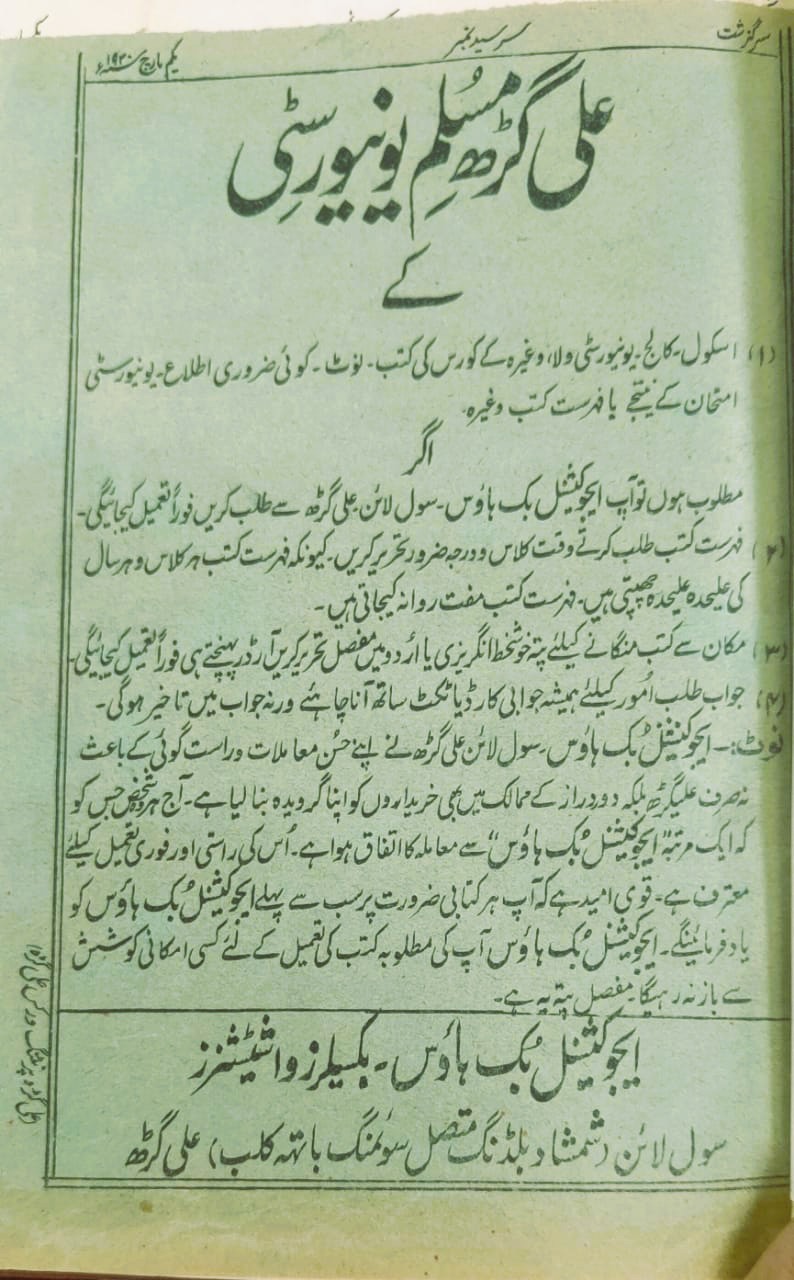
Responding to this need, Abdul Shaheed Khan, an alumnus of MAO College Aligarh from Meerut, opened a small stationery shop in 1925, named this establishment “Educational Book House”, marking the beginning of a new chapter in Aligarh’s literary landscape.

Aligarh Muslim University, renowned as a beacon of knowledge and service to the nation, has nurtured multiple institutions dedicated to education and culture since its inception. Among these, the Educational Book House (EBH) stands out as a distinguished establishment, symbolizing a century of dedication to the dissemination of literature and learning.
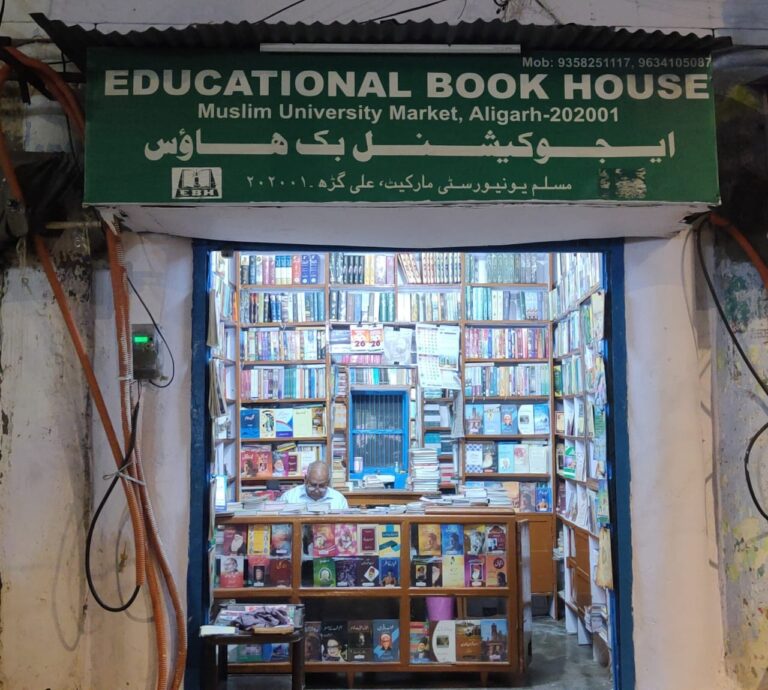
Established in 1925, EBH is more than an ordinary bookstore; it holds a revered position among bibliophiles, scholars, and literary circles both nationally and internationally. Over the past hundred years, EBH has played a pivotal role in spreading the literary and academic works of Aligarh across a broad audience, ensuring its legacy endures today. Its contribution to the development and promotion of Urdu language and literature is of profound importance in the history of book publishing

Historical Roots of Book House at Aligarh:

The story of Book house in Aligarh is intertwined with the visionary efforts of Sir Syed Ahmad Khan (1817-1898) and his pioneering movement to elevate Muslim education in India. As early as 1888, Sir Syed aimed to establish a bookstore in Aligarh to serve the students and teachers of his educational institutions.  He launched a campaign to establish a bookstore in Aligarh and even raised funds for this purpose.  An advertisement in the Aligarh Institute Gazette dated 7th July 1888 announced the opening of a bookshop: “Aik Tijarti Dukan Kitabon aur Stationary yani Saman Nosht wa Khwand Kay Farokht Ke Aligarh Mein” – a commercial shop for books and stationery in Aligarh. (see AIG, 7th July 1888)

This initial venture was called the “College Book Depot” which quickly became a vital hub for literature, academic materials, and stationary. It functioned as a bridge connecting scholars, students, and the wider community, fostering a culture of learning and intellectual curiosity in Aligarh. The original depot thrived under the stewardship of Mir Wilayat Hussain (1862-1949) but faced decline after his retirement in 1920, eventually closing down. (see Aap Beeti ya MAO College Ke Kahani, Mir Wilayat Hussain Ki Zubani, Sir Syed Academy, Aligarh, 2024, p.126).

The Birth of EBH

The establishment of Aligarh Muslim University in 1920 created a renewed demand for a dedicated bookstore that could cater to the needs of students and faculty alike. Responding to this need, Abdul Shaheed Khan (1898-1968), an alumnus of MAO College Aligarh from Meerut, opened a small stationery shop in 1925 near Fuller Road, close to Tasweer Mahal. He named this establishment “Educational Book House”, marking the beginning of a new chapter in Aligarh’s literary landscape. His vision was to provide affordable and accessible academic books and stationery, supporting the educational aspirations of students and teachers.

Abdul Shaheed Khan, Founder EBH

Moving to Shamshad Market:

In 1928, Sahibzada Shamshad Ahmed Khan (1888-1954), son of eminent educationist and vice-chancellor of AMU, Sahibzada Aftab Ahmed Khan (1867-1930), built a bustling commercial complex known as “Shamshad Building” in civil line Aligarh near AMU. This market was designed to serve the needs of the university community and local residents, housing shops for tailoring, groceries, milk, bread, bicycle repairs, and more. A mosque was also constructed within the complex, serving as a spiritual and community center.

Recognizing the importance of proximity and accessibility, Sahibzada Shamshad Ahmed Khan requested Abdul Shaheed Khan to relocate EBH to this new marketplace. The bookstore shifted there in 1929, anchoring itself within a vibrant hub of activity. This move significantly increased EBH’s visibility and accessibility, making it a central point for students and scholars seeking academic and literary materials.

The Aligarh Magazine (1929-30) praised Shamshad Market as a vital institution, emphasizing how it simplified the lives of students by providing essential books and stationery close to their place of study. In an editorial note, editor write:

“The Shamshad building has undoubtedly rendered an invaluable service to the student community of the University, for all the requirements of the students are to be found in the shops contained in the building and they have no more to worry themselves by running down to the city to fetch even the most ordinary things of everyday use. Sahibzada Shamshad Ahmad Khan deserves the thanks of all those whose life has been made easy and pleasant by the erection of this splendid building and we most cordially congratulate him on this.” (see Editorial Notes, Aligarh Magazine, 1929-30, p.11)
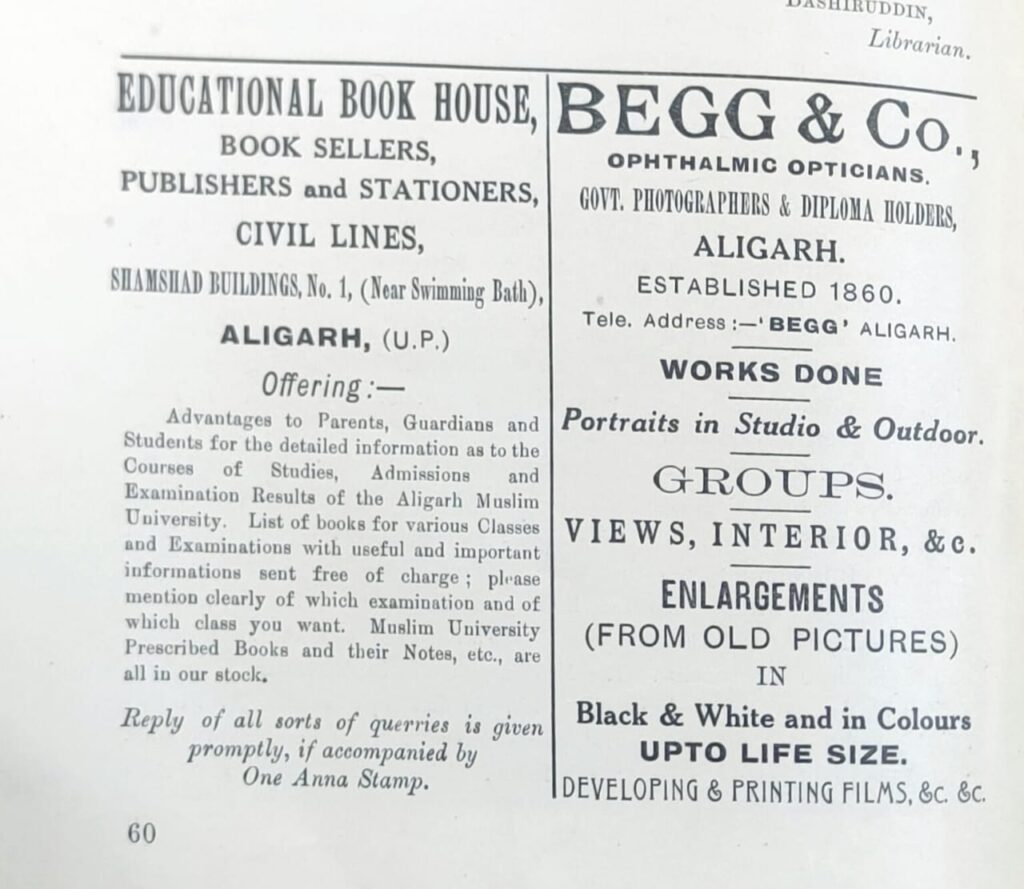
According to renowned historian Prof. Iftikhar Alam Khan, in his authoritative work “Muslim University Ki Kahani, Imarton Ke Zubani 1920 to 1947”, the Shamshad Building was constructed in 1929 at a cost of Rs. 30,000, financed by Sahibzada Shamshad Ahmed Khan’s mother. The building housed 18 shops, including EBH, and was a bustling center of commercial and cultural activity.

EBH’s shop within this complex charged the highest rent—Rs. 31—indicating its prominence and importance in the market. Its strategic location made it an essential resource for students, teachers, and literary enthusiasts, solidifying its reputation as a hub of education and culture. (See “Muslim University Ki Kahani, Imarton Ke Zubani 1920 to 1947”, EBH, Aligarh, 2006, pp. 161-165)

Early Contributions to Literature and Publishing:

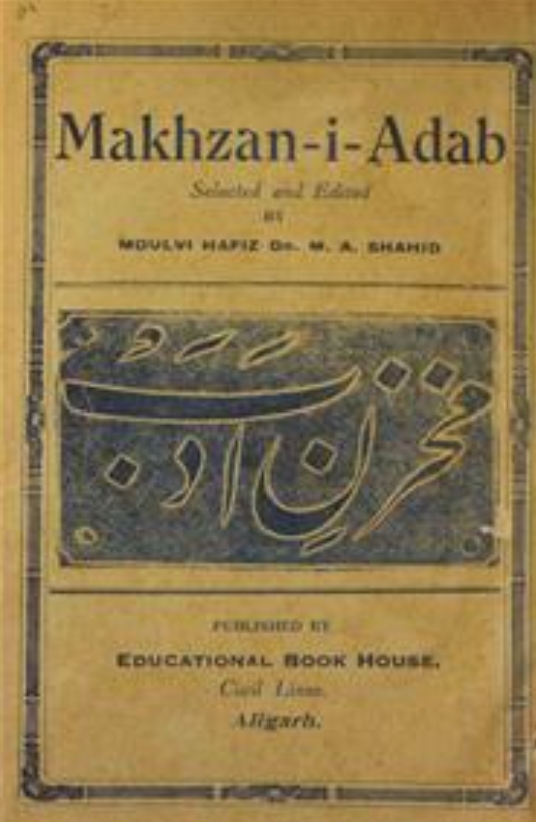
Even before India’s independence, EBH distinguished itself as a publisher committed to a broad spectrum of subjects. Unlike many publishers focused solely on literature or religion, EBH ventured into publishing works on children’s psychology, social sciences, philosophy, history, linguistics, and sciences. Its publications catered to the academic community and the general public, fostering a culture of knowledge dissemination. Notable early publications included: “Kainat Adab” by M. A. Hameed Alig (1935) editor Nazara Meerut,  “Ahsan-ul-Intikhab’’ by Ahsan Marehrawi, “Makhzan Adab” by M. A. Shahid, “Sukhna Nau”“Husn-e-Intikhab’’ by Abdul Jaleel Kidwai,  “Delhi Ka Ek Madar Akhiri Mushaira” by Mirza Farhatullah Beg, “Dastan Rani Ketki Aur Kanwar Uday Bhan Ki” by Syed Inshallah Khan Insha, “Bachhon Ki Tarbiyyah” by Musarrat Zamani, “Al-Aqeedah Al-Hasna” by Molvi Sham and Maulana Abdussalam etc.
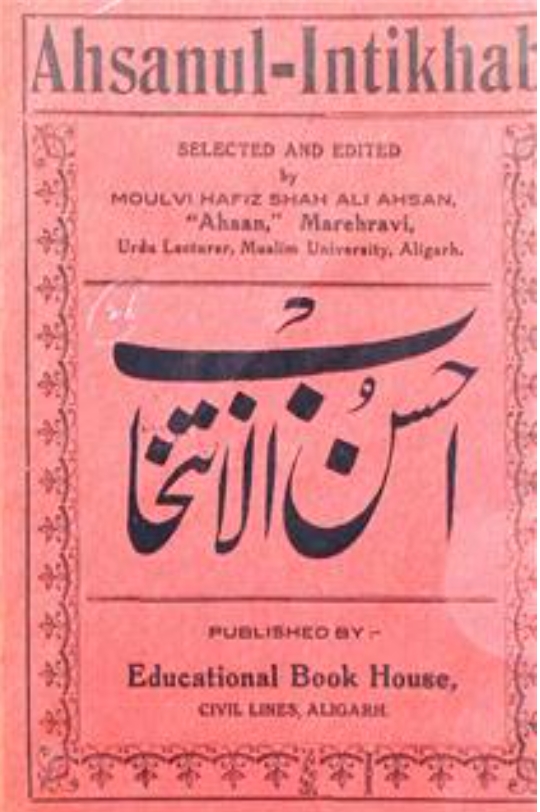
These works reflected EBH’s commitment to educational and literary growth, providing resources that supported scholarly pursuits and cultural development.

Post-Independence Challenges and Resilience:

The partition of India in 1947 was a tumultuous period that resulted in massive migrations and upheavals. Many families left their ancestral homes, but Abdul Shaheed Khan chose to remain in Aligarh. His son Asad Yar Khan says that just after independence many of his father’s relatives and friends asked him, he also migrate to Pakistan, but Professor Rashid Ahmed Siddiqui and Dr. Aale Ahmad Suroor advised him to continue his work from here, thus his father put this idea out of his mind.

His dedication ensured that EBH continued serving the community, moving from Shamshad Market to the Conference Market in 1951 to accommodate expanding operations.

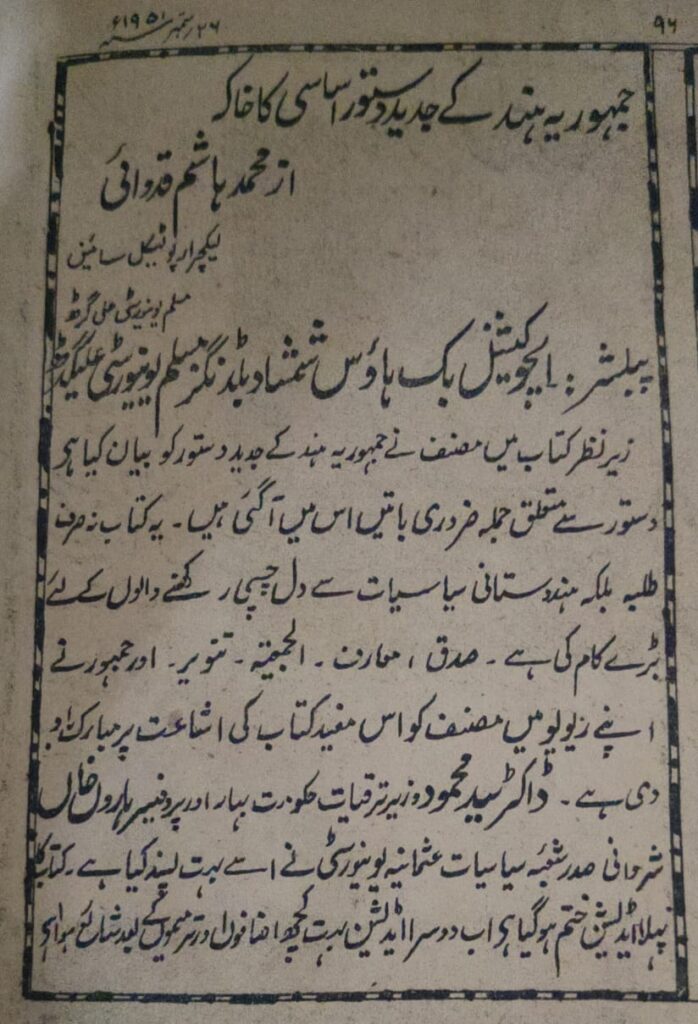
In this period, EBH expanded its publishing activities further. It published influential titles on Indian politics and governance, including Dr. Hashim Kidwai’s “Jhamooriya Hind” (1951), which analyzed India’s political system and constitution. Apart from Jhamooriya Hind, some of his titles are: Mubadiat Ilm Madniat (1951), Duniya Ke Hukoomatain(1961), Mubadi Siyasiyat (1971), Tareekh-e-Afkar siyasi (1982), Usool-e-Tammaddun, Usool-e-Siyasiyat (1988).
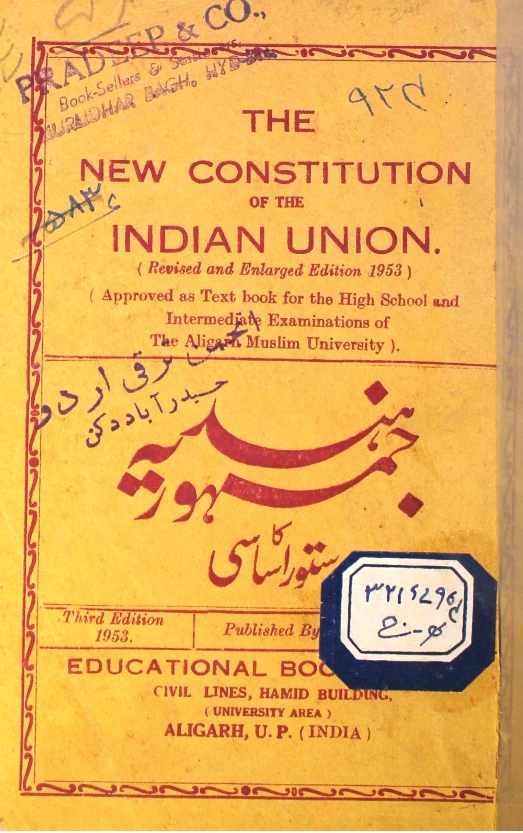
An Advertisements of book highlighted the importance of such works for students, scholars, and policymakers appeared in Weekly Jhamoor Aligarh dated 26th December 1955 states:

“In the book under consideration, the author has described the modern constitution of the Republic of India, all the essential things related to the constitution have been included in it. This book has done a great job not only for students but also for those interested in Indian political science. Sadq, Maarif, Jamiyat, Tanveer and Jamhur in their reviews congratulated the author for publishing this useful book.  Dr. Syed Mahmood, Minister for Development, Government of Bihar, and Professor Haroon Khan Sherwani, Head of the Department of Political Science, Osmania University, have liked it very much.”

Supporting Urdu Education and Literature:

A vital aspect of EBH’s mission was promoting Urdu language and education. The bookstore provided textbooks for institutions such as Jamia Osmania, Hyderabad, Aligarh Muslim University and Jamia Urdu, Aligarh and collaborated with teachers from Aligarh Muslim University to develop curricula that emphasized Urdu literature and linguistics.

This support helped to sustain and foster Urdu’s growth as a language of scholarship and culture across the region.
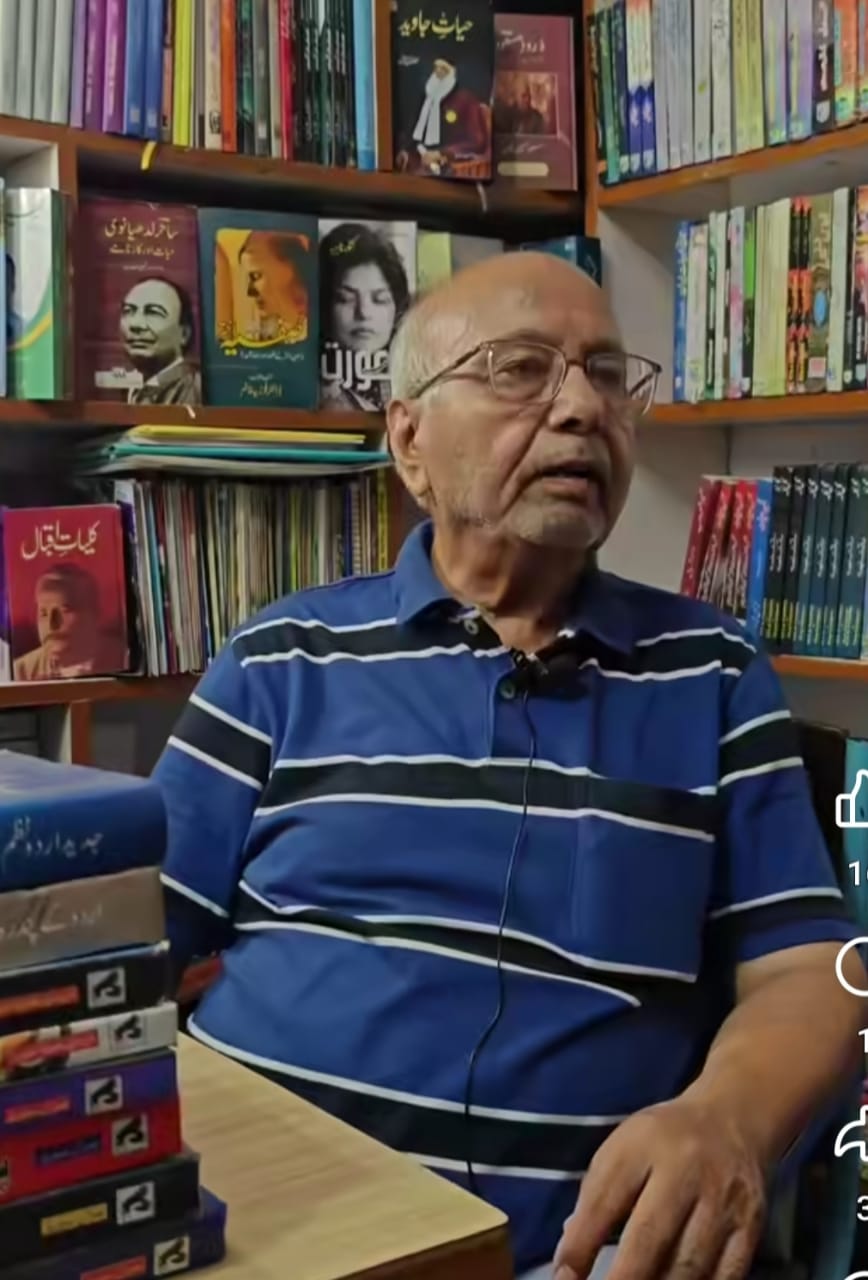
Asad Yar Khan

Following the death of Abdul Shaheed Khan in 1968, his sons, Asad Yar Khan (b. 1941, famously known as Kaptan Sb. as he served the Captain of Horse Riding in AMU several years) and Ahmed Saeed Khan (b.1948, affectionately Bhayya of all known people), inherited the legacy. Under their leadership, EBH grew into one of the most respected Urdu publishing houses in the subcontinent. They enhanced the quality of printing, expanded their catalog to include works of eminent poets, scholars, and political thinkers.
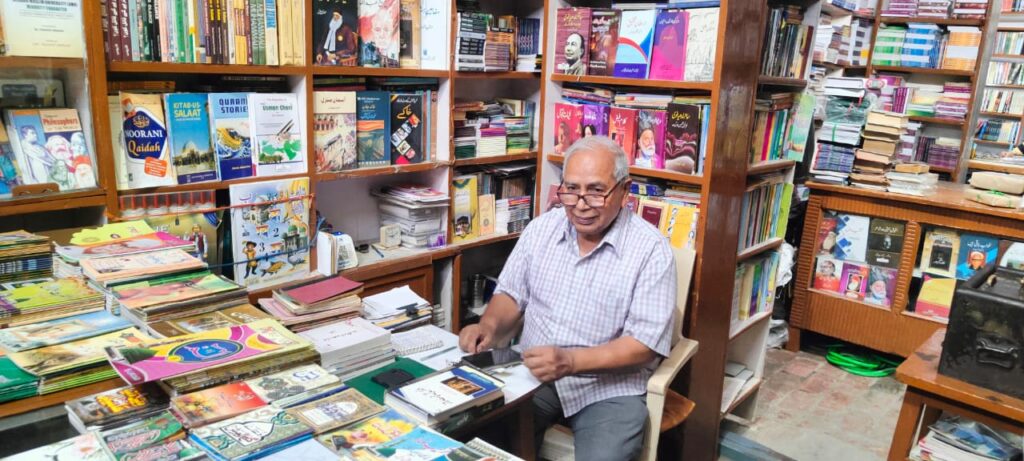
Ahmed Saeed Khan

Works of Prominent literary figures such as Iqbal, Faiz Ahmed Faiz, Khalifa Abdul Hakeem, and Ghulam Sarwar published and promoted through EBH, significantly contributing to the Urdu literary renaissance.

It also published works of  Wazir Agha, Abu Lais Siddiqui, Hassan Askari, Masood Hussain Khan, Akhtar Ansari, Syed Abdullah, Khaliq Ahmed Nizami, Muhammad Hashim Kidwai, Vaqar Azeem,  Majnoon Gorakhpur,  Ateeq Ahmad Siddiqui, Ibadat Barelvi, Raza Ali Abidi, Qurratul ain Haidar, Aal-e-Ahmad Suroor, Khurshid-ul-Islam,  Abdul Qadir Sarwari, Waheed Quraishi, Athar Parvez, Zaheer Ahmad Siddiqui, Khadeeja Mastoor, Ziauddin Alvi, Abdul Mughni, A.A. Hashmi, Rasheed Hasan Khan, Masood Hasan Khan, Masood Hassan Rizvi, Shaharyar,  Manzar Abbass Naqvi,  Mirza Khalil Beg, Abul Kalam Qasmi, Iftikhar Alam Khan, Asghar Abbas, Surraya Hussain, Sagheer Afrahim etc.

The Literary Magazine “Alfaaz”: A Cultural Milestone:

In 1975, Asad Yar Khan launched “Alfaaz”, a literary magazine dedicated to Urdu literature. Edited initially by Abul Kalam QasmiAlfaaz became a vital platform for poetry, literary criticism, and cultural dialogue. It provided a space for emerging writers and established intellectuals to exchange ideas, debate, and showcase their work.    
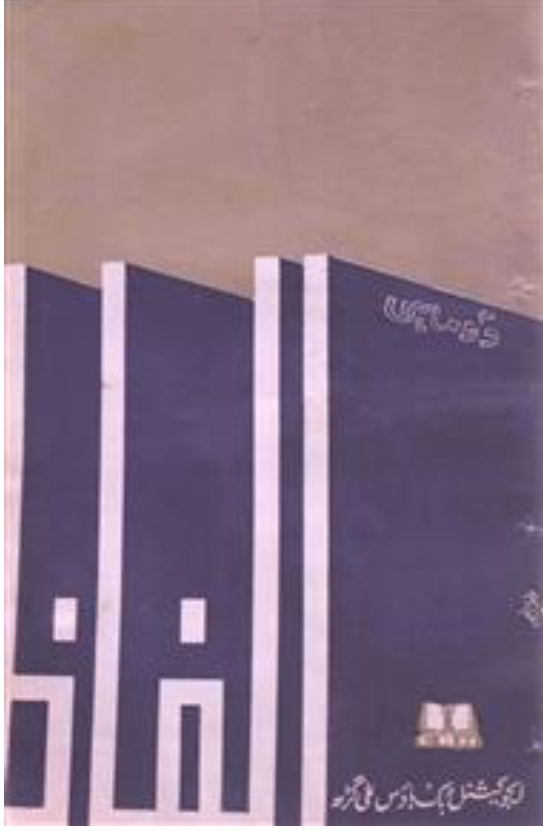
The magazine’s editorial board included notable scholars such as Khurshid-ul-Islam, Khalil-ur-Rehman Azmi, and Naseem Qureshi. Over nearly two decades, Alfaaz played an essential role in nurturing Urdu literature, fostering new talent, and preserving the cultural heritage of Urdu language and thought.

Personal Reflections:

The author’s personal association with EBH began in 1995, when as a seventh-grade student, he first visited the bookstore to buy storybooks and magazines. Over the years, this relationship deepened, leading to interactions with notable scholars, poets, and literary figures, including Professor Hashim Kidwai, Professor Mushir-ul-Hasan, Professor Qazi Abdul Sattar, Manzoor Hashmi, Professor Abul Kalam Qasmi, Qurban Ali (BBC Hindi), Tariq Hasan (Prominent Journalist), Mirza Masood Beg (Prominent Linguists) and many others.

In 2016, EBH published the author’s book on Aligarh’s journalism, “Aligarh Ke Urdu Sahafat”, a testament to their ongoing support for young writers and scholars.

Celebrating a Century of Service:

Today, as EBH celebrates its hundred years of existence, it stands as an integral part of Aligarh’s intellectual and cultural heritage. The dedication and honesty of Late Abdul Shaheed Khan and later his sons have made EBH a symbol of Urdu literature’s resilience and growth. Their efforts to promote Urdu, support education, and foster literary excellence have left an indelible mark on the Urdu circle.

A Legacy for the Future:

It is hoped that EBH continues to serve as a beacon of literary and educational excellence, nurturing new talents, publishing significant works, and promoting the Urdu language. As it celebrates a century of remarkable service, the entire community extends heartfelt congratulations and best wishes for its future endeavours.

The Educational Book House’s journey over the past hundred years stands as a shining example of dedication to knowledge, culture, and language. Its legacy is a reflection of the enduring power of literature to unite, educate, and inspire. May EBH continue to flourish and illuminate the path of learning for many more generations to come.

source: http://www.heritagetimes.in / Heritage Times / Home / by Dr Asad Faisal Farooqui / July 27th, 2025
Aligarh and Women’s Education: A Brief Overview

Aligarh, UTTAR PRADESH :

Women’s education in nineteenth-century India was no easy task. In the case of Muslim women, the task was even more difficult due to their triply marginal identity: as colonial subjects, as women, and as Muslims. Not only did the custom of purdah added to their seclusion from the social and cultural changes, their men hated everything about the western cultural influence (being displaced as rulers by the British). As a result, the middle class (the initiators of reform) was to develop late among the Indian Muslims than their Hindu counterparts. Nevertheless, by the late nineteenth century, a middle-class among the Indian Muslims was fledging. For this, no institution of the nineteenth-century can be given more commendation than Aligarh Muslim University.

Formed in 1920, the Aligarh Muslim University just completed its hundred years as a modern residential university. There has been a perception that the Aligarh Movement, for whatever reasons, neglected the issue of modern education to Muslim women. But there is more to this argument, some things to be explored, some to be re-interpreted.

This article, therefore, attempts to trace the genesis and trajectory of women’s educational reform in Aligarh through the profile of a woman reformer – Waheed Jahan (1886-1939), wife of Shaikh Abdullah (1874-1965), and the co-founder of Aligarh’s first girls’ school. Waheed Jahan was a pioneer of Muslim women’s education at Aligarh in the early twentieth century. Her role in ending the relative isolation of Indian Muslim women, while at the same time preserving the Muslim identity of the community, is worthwhile to recall. Her biography was published in Urdu by her husband in 1954. [1]

The educational reforms among Indian women were mostly started by men. Such men started with writings advocating women’s education. In this regard, among Muslims, Nazir Ahmad (1833-1912) published his novel, Mirat-ul-Arus, in 1869; Altaf Hussain Hali (1837-1914) published Majlis-un-Nissa, in 1874. Soon, magazines and journals followed, like the Tahzib un-Niswan by Sayyid Mumtaz Ali (1860-1935), the Khatoon by Shaikh Abdullah and Waheed Jahan, and the Ismat by Rashid-ul- Khairi (1868-1936). Gail Minault regards these as ’The Big Three.’ [2] Apart from literary activism, others tried more practical measures, like opening schools for Muslim girls.

As the movement intensified, so did the opposition against it. In such an atmosphere, even the talk of women’s education by a woman herself was quite a chivalry.

Yet, unexpectedly, there were women who defied the odds and broke the ground. Rashid-un-Nissa of Patna, became the first Muslim woman to write an Urdu novel, Islah-un-Nissa in 1881 (published in 1894), when writing was a distant dream for Muslim women. Rokeya Sakhawat Husain (1880-1932), a widow herself, pioneered Muslim women’s education in Bengal. Muhammadi Begam (1878-1908) edited one of the leading ladies’ home journals, Tahzib-un-Niswan. One such icon of women’s education at Aligarh was Waheed Jahan.

Waheed was born in 1874 in a landholding family in Delhi. Her father Mirza Ibrahim Beg was of Mughal ancestry, serving as a minor municipal official in Delhi. Her only brother, Bashir Mirza went to the Mohammadan Anglo-Oriental College (MAO Colege), Aligarh, where he befriended Shaikh Abdulla (a Kashmiri convert to Islam, named Thakur Das before conversion).

As was the custom, Waheed received no formal schooling. She learnt Urdu and Persian from her father and arithmetic and elementary English from a visiting English tutoress.

Ismat Chughtai, in her autobiography, Kagazi hai Pairahan, records, how Waheed Jahan, before her marriage, had dreamt of establishing a school for the girls. She would gather the servants’ children and teach them, and soon the rudimentary school became popular among her neighbours. It is noteworthy that, at a time when others (mostly men) were still imagining a school for girls (that too only in their writings), Waheed, in her own limited capacity, was practically making a difference.

In 1902, Waheed married Shaikh Abdullah – a lawyer at Aligarh, and an ardent supporter of women’s education since his school days. Following the marriage to a woman with some education, he began to consider concrete ways to promote Muslim women’s education. The Mohammadan Education Conference (MEC, founded at Aligarh by Sir Syed Ahmad in 1886) had established a Women’s Education Section (WES) in 1896 to start a Normal School for girls and to train female (zenana) teachers. In 1902, Shaikh became the secretary of WES, which by then had merely achieved anything beyond discussions and debates around women’s education.

Luckily, Waheed’s marriage to a reformist like Abdullah helped her materialize her dream. To champion women’s education, they started an Urdu monthly, the Khatoon, in 1904 with Waheed Jahan as editor. Begum Sultan Jahan (1858-1930) of Bhopal, Binnat Nazir-al-Baqir, Suharwardiya Begum, and Binnat Nasiruddin Haider were some important female contributors to the journal.

The paucity of funds made it impossible to start a Normal School. Waheed Jahan advised her husband to start a primary school for the elite (Sharif) girls. In 1904, the Mohammadan Educational Conference passed a resolution to start a girls’ school in Aligarh. Waheed proved to be an efficient manager and fund-raiser for the cause.

Her capacities as a fund-raiser and organizer were displayed in 1905, when she organized a meeting of Muslim women in Aligarh, with participants from far corners of Lahore and Bombay. Judging from the context of the time when purdah among Muslims was so harsh, even the idea of organizing such an event was quite revolutionary.

Aware of women education in Turkey and Egypt and its benefits to society, she tried to convince other women; she said:

When women meet among themselves, there will be more solidarity. . . Now there is a division between educated and uneducated women. Uneducated women, who do not go out, think that respectability is confined to the four walls of their houses. They think that people who live beyond those walls are not respectable and not worthy of meeting. But God has ordained education for both men and women, so that such useless ideas can be dispensed with. . . [3]

The meeting was a success, the exhibition of women’s craft secured good funds; finally, the women passed a resolution favouring a girls’ school in Aligarh. In October 1906, Aligarh Zenana Madrasa (girls’ school) opened its doors, and seventeen students were enrolled. Urdu, arithmetic, needlework, and the Quran formed the curriculum. Leaving her own children in servants’ care, Waheed took the responsibility of supervising the school. Within six months, the number of students increased to fifty-six. Waheed’s efforts secured the school a cumulative grant of Rs. 15,000 and a monthly grant of Rs. 250. By 1909, the school taught 100 students and shifted to a larger building.

The opposition to girls’ school took new forms. One amusing story is recorded in Shaikh Abdullah’s Urdu memoir (1969), Mushahedaat o Taaassuraat. [4] Maintaining purdah, the girls were carried in daulis (curtained carriages) to school, and some street urchins started harassing the school going girls by lifting the curtains of their daulis. The mischief only stopped when Shaikh gave one of the miscreants a good thrashing. In another incident, Shaikh confronted a tehsildar who had accused the school of making the girls insolent.

When the Abdullahs proposed a girls’ boarding school, it invited opposition from elite corners. The European principal of MAO College, W.A.J Archbold; Ziauddun Ahmad (1873-1947); and Viqar-ul-Mulk (1841-1917) opposed vehemently.

The couple, however, succeeded in 1914, witnessing the transformation of the school into a boarding school. The same year saw the culmination of Muslim women’s activism by the foundation of Anjuman-i-Khavatin-i-Islam (AKI) at the same venue. Begum Sultan Jahan (1858-1930) of Bhopal graced the foundational ceremony of the boarding school, felicitating Waheed; she urged other women to follow her example. Fyzee sisters, Abru Begum, Begum Shafi, and Begum Shah Nawaz were the other dignitaries.

The Begum was already active in various social and educational reform projects. She served as the first chancellor of AMU from 1920 until her death in 1930. Having a woman as the first chancellor was indeed a historic feat.

Only nine girls became the residents, most of them from Waheed’s own family. By the end of the year, the enrollment rose up to twenty-five. This was the result of what the historian Gail Minault calls as Abdullahs’ portrayal of girls’ school as an extension of girls’ families and also of their own. To make the school successful, Waheed used to invite the parents of girls to Aligarh, for a few days stay in the hostel, to convince them that the conditions there were safe enough to let their daughters stay, records Sheikh Abdullah, in his Mushahedaat o Taaassuraat. She supervised everything – housekeeping, laundry, shopping, and even tasted each dish cooked for the girls.

It could be said that Waheed Jahan acted as a foster mother to these girls, counselling, nursing, and treating them as a part of her own extended family. They called each other as Apa (sister), Shaikh Abdullah as Papa Mian, and Waheed Jahan as Ala Bi. This created a sense of sisterhood among the girls.

This familial system of ethos still remains unique to the Aligarh Women’s College.

The boarding school project contained other complex problems, such as maintaining proper purdah. Both Shaikh and Waheed agreed that the purdah practiced in the Sharif society was more restrictive than purdah sanctioned by the Shari’a (Islamic Law). But to secure social acceptance for their school, they chose to go with strict purdah, building fortress-like walls to fend off the male gaze, students’ mails were scrutinized, and only close relatives were allowed inside.

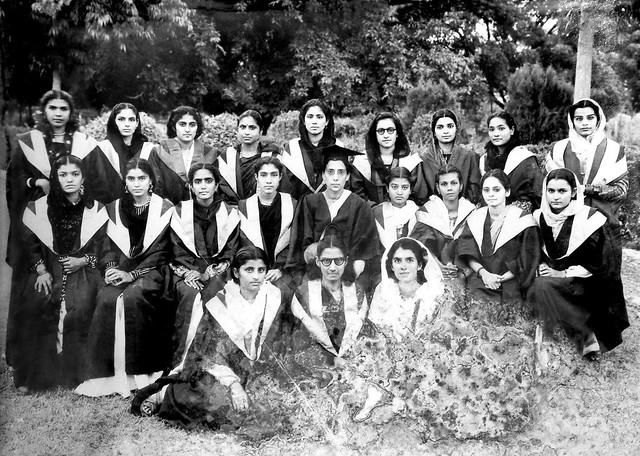
This accommodation of purdah within the gamut of their reformist agenda, to gain social acceptance, was indeed very astute of the Abdullahs. Thus, Waheed Jahan succeeded in preserving both the elite and the “Muslim” identity of herself and her community while simultaneously breaking the relative isolation of Indian Muslim women. The girls’ school became an intermediate college in 1925 and started degree classes in 1937 (with 250 students). Waheed passed away in 1939, only after seeing her school becoming a degree college.

The relation between education and social change is complex, varying from culture to culture and among different classes in the same culture.

True, that Aligarh movement was late to include women’s education in its fold. Even the school founded by the Abdullahs did not fulfil all its expectations – their choosing an exclusively elite (Sharif) clientele limited the impact of their reforms.

But their efforts indeed bore fruits; the educational reforms for Muslim women at Aligarh contributed to many social developments. After the formation of AKI in 1914, the number of meetings and associations (for women-only) increased rapidly in the 1930’s. The growth in the number of educated women created a market for new publications for and by women.

The Aligarh Women’s College produced many women of substance, who made sure to shine above and beyond purdah, some figuratively and others literally. These ladies excelled in various fields, from teaching to medicine to writing.

Rashid Jahan, Waheed Jahan’s daughter, became a successful physician, a radical writer, and a staunch communist. Her short stories in Angare (1932) became the opening salvo of the Urdu Progressive Writers Movement (1936). Rakhshanda Jalil, in her biographical work on Rashid, A Rebel and her Cause: The Life and Work of Rashid Jahan, writes that Angare was a “document of disquiet”; a self-conscious attempt “to shock people out of their inertia, to show how hypocrisy and sexual oppression had so crept in everyday life”. Rashid became an inspiration for a generation of women writers such as Ismat Chughtai, Attia Hosain, Sadia Begum Sohravi, and Razia Sajjad Zaheer, among others.

Like all other reform movements of that time period, the Aligarh movement had its limitations too. For a start, it did prioritize men’s education over women’s, for various reasons (a story that needs to be told elsewhere), but by the early twentieth century, things were changing. The Aligarh movement not only took up the cause of women’s education actively, but it also let women (Like Wahid Jahan) be a part of the process.

Notes

[1] Shaikh Abdullah, Savanih-i- Umri-i- Abdullah Begum, Aligarh, 1954

[2] Gail Minault, Gender, Language, and Learning: Essays in Indo-Muslim Cultural History, Permanent Black Publications, Ranikhet, 2009, p. 87

[3] Khatoon 3, 1 (Jan 1906) “Ladies Conference”, pp 7-8

[4] Shaikh Abdullah, Mushahidat-wa-Ta’asurat, Female Education Association, Aligarh, 1969, pp. 234-6

(Ishrat Mushtaq is PhD Candidate, Centre of Advanced Study in History, Aligarh Muslim University and Sajad Hassan Khan is PhD. Candidate, Centre of Advanced Study in History, Aligarh Muslim University. Article courtesy: Mainstream Weekly.)

Janata Weekly does not necessarily adhere to all of the views conveyed in articles republished by it. Our goal is to share a variety of democratic socialist perspectives that we think our readers will find interesting or useful. —Eds.

source: http://www.janataweekly.org / Janata Weekly / Home / by Ishrat Mushtaq and Saad Hassan Khan / January 24th, 2021