Panniyur (Ramanathapuram District) / Madurai, TAMIL NADU :
He was a servant of the British East India Company and the Nawab of the Arcot before turning against them.
He started his military career as Yusuf Khan, a Muslim convert, and fought in the early wars between the English and the French for the possession of southern India. It was through a conspiracy that the British captured him.
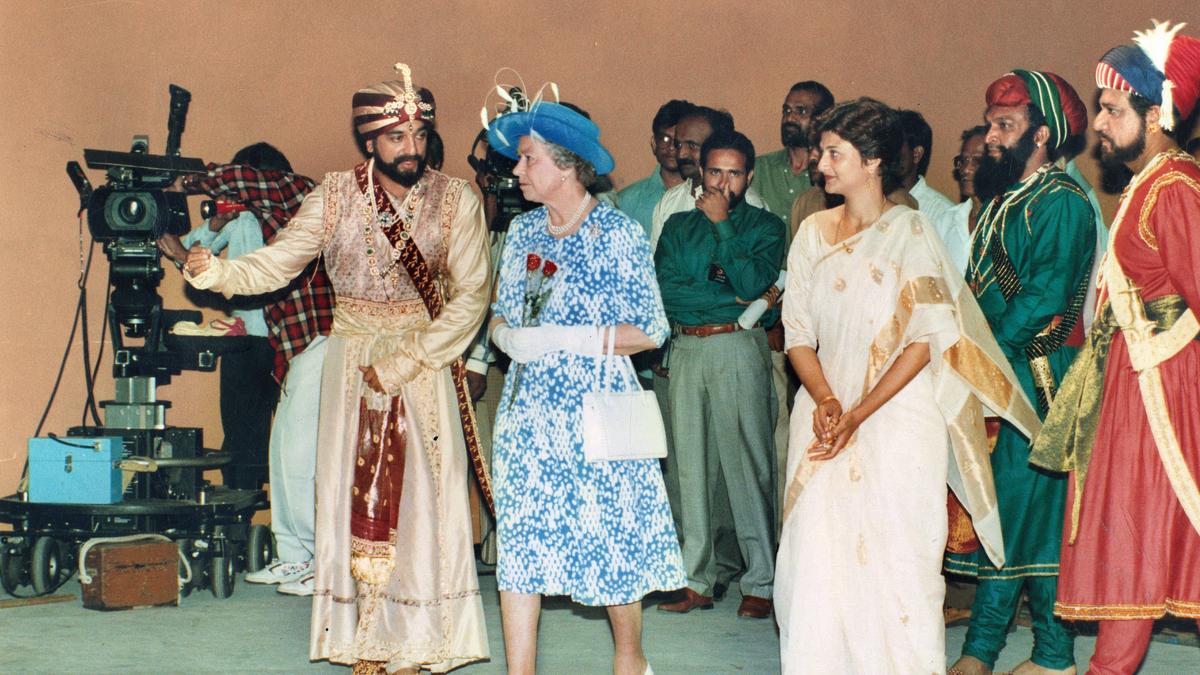
A surprise engagement: Kamal Haasan, director and actor of the film Marudhanayagam, explains a point to Queen Elizabeth on the sets on October 16, 1997. The Queen launched the shooting. | Photo Credit: THE HINDU ARCHIVES
Many were surprised when the visiting Queen Elizabeth launched actor Kamal Haasan’s dream film, Marudhanayagam, in 1997. It was a time when there was a demand for an apology for the Jallianwala Bagh massacre. But Maruthanayagam was a servant of the British East India Company and the Nawab of the Arcot before turning against them. It is a misnomer to call him Maruthanayagam as he built his military career as Yusuf Khan, a Muslim convert.
“Muhamed Yusuf — better known in his time as Yusuf Khan — was by far the ablest of the Indian soldiers who fought in the early wars between the English and the French for the possession of Southern India,” writes S.C. Hill, author of Yusuf Khan: The Rebel Commandant. Hill, an Indian Educational Service officer, was in charge of the records of the Government of India. Published in 1914, the book draws heavily on the Madras Records, the Orme Collection of Manuscripts in the India Office, The French and Dutch Archives, the Tamil poem, The War of the Khan Sahib, and documents at the British Museum.
A man of genius
“Yusuf Khan was, in fact, of the same type as Haidar Ali [Hyder Ali] — one of those men of genius who naturally comes to the front in times of great social and political unrest. Had he been left without outside interference to settle scores with his quarrel with his native suzerain, like Haidar Ali with the Raja of Mysore, there is absolutely no doubt that he would have succeeded in establishing his independence,” writes Hill. Historians depended on the memoirs of Ponnusami Tevan, manager of the Ramnad Zamindari, to trace the background of Maruthanayagam Pillai. The title, Pillai, became part of his name as he was born in the Vellala caste at Paniyur in Ramanathapuram district.
In his youth, he was wild and disobedient to his parents, and ran away to Pondicherry and served under a European for three years and a half. Then, he was dismissed for theft. According to the French account, his ears were cut off as a punishment. Hill, however, dismissed the accusation as groundless, saying it was never mentioned until after the death of Yusuf Khan and then only by those who, if not actually hostile, were certainly biased against him.
After leaving Pondicherry, he joined the army of the King of Thanjavur and subsequently Nawab Muhammed Ali of Arcot. According to another account, he joined another European, Brunton, after his dismissal. Brunton had him instructed in several languages. He entered the services of the British by joining a company of sepoys which he had raised himself in Nellore, under Robert Clive, shortly before the Battle of Kaveripakkam.
According to British officer Major-General Stringer Lawrence, Yusuf Khan was “brave and resolute but cool and sensible in action — in short, he is a born soldier and better of his colour I never saw in the country.”
Freed from trammels
It is not clear why he chose to become a Muslim, and Hill has a theory. Maruthanayagam Pillai wanted to avoid what befell Aryanatha Mudali, the great general of the 16th Century and founder of the Poligar (Palayakar) system in Madurai. J.H. Nelson, the author of The Madura Country Manual, says Aryanatha Mudali, despite being a great warrior and administrator, was dissuaded by his family from becoming the king because he was a Vellala. “For Yusuf Khan then to rise to the position to which he attained, it was necessary for him to be freed from whatever trammels might be imposed upon him by his religion. This was effected by conversion — voluntarily or by force is unknown — to Muhammadanism,” writes Hill. But the Nawab objected to the elevation of Yusuf Khan, though to a Muhammadan, the “lowly birth” was “no hindrance to his success”.
Appointed Governor
Yusuf Khan, however, was appointed a Governor by the British. He ensured peace in the provinces of Madurai and Tirunelveli, which belonged to the Nawab, but had been placed by him under the control of the Madras Council.
“The name of this hero, for such he was, occurs almost as often in the pages of the English historian (Robert Orme) as that of Lawrence of Clive,” Sir John Malcolm writes about Yusuf Khan, who later rebelled against the Nawab and declared his alliance to the French. This led to a war between Yusuf Khan and an alliance of the British and the Nawab, and the seizure of Madurai. The British captured Yusuf Khan through a conspiracy and one of the participants in the conspiracy was Srinivasa Rao, his diwan and chief adviser.
The British officer Marchand, who went with the conspirators, says he was seized in his darbar. But the Dutch account says the capture occurred in a private room. Bishop Caldwell, quoting a native account, says he was arrested at his prayers by Moossoo Marsan and his Hindu diwan Srinivasa Rao “He begged them to kill him there and then rather than deliver him to the Nawab. He was carried under guard to Marchand’s quarters,” says Hill.
On October 15, 1764, the Nawab wrote to Madras that the “Rebel was hung at five o’clock in the evening, which struck terror into the hearts of our enemies”. His body was dismembered. The head was sent to Tiruchi, the limbs were sent to Thanjavur, Palayamkottai, and Travancore. The trunk was buried at Sammatipuram, where the Khan Sahib’s ‘pallivasal’ still stands.
source: http://www.thehindu.com / The Hindu / Home> News> India> Tamil Nadu> In Focus / by B. Kolappan / August 09th, 2024