Raizada Village (Ajnala Tehsil, Amritsar District), PUNJAB :
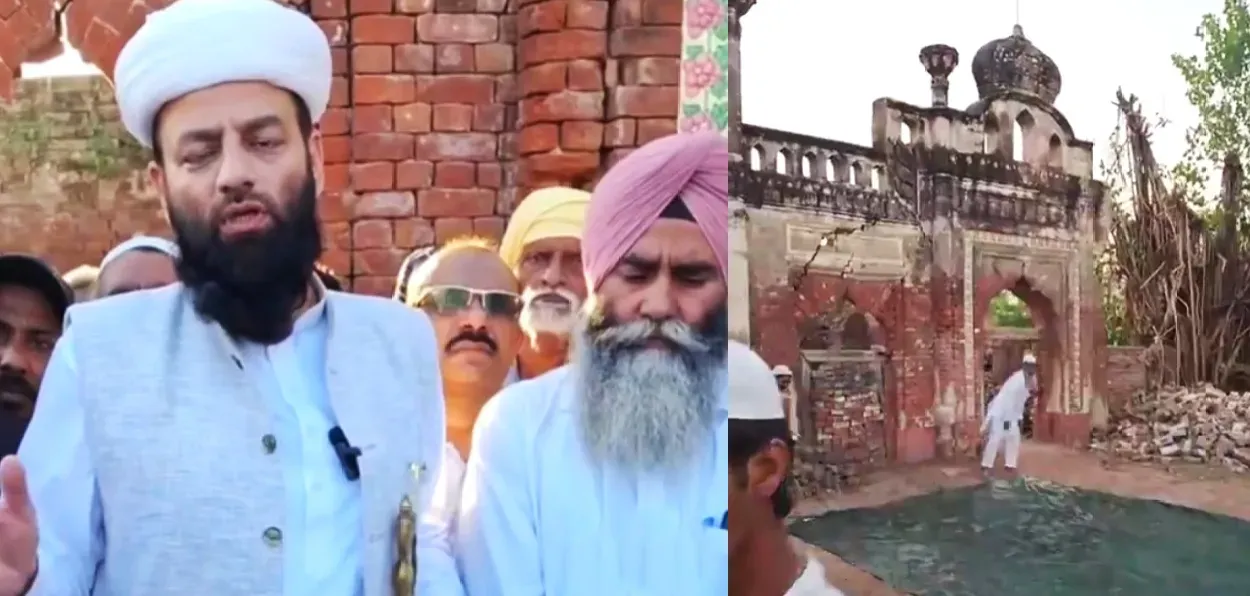
Shahi Imam of Punjab Maulana Usman Rehmani Ludhianvi taking charge of the mosque in village Raizada of Amritsar, Punjab
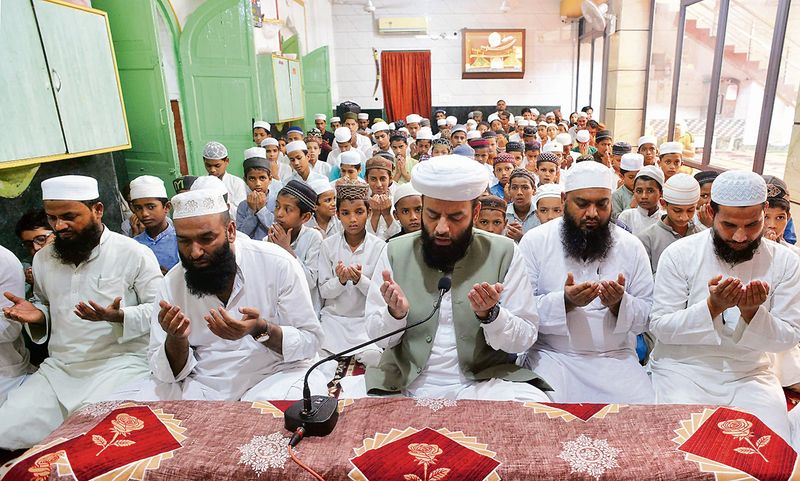
The Sikhs and Hindus of a village in the Amritsar district of Punjab have handed over a mosque which lay in a run-down state since no Muslims lived there after the partition of India in 1947, to the Muslims for restoration.
In a ceremony attended by Shahi Imam of Punjab, Maulana Muhammad Usman Ludhianvi, in the small village of Raizada in Ajnala tehsil of Amritsar, locals formally handed over the mosque to the Muslim community.
The initiative was led by the village sarpanch, Sardar Omkar Singh. Closed since the partition of 1947, the mosque, for the first time on Friday, echoed with the sounds of the Azaan, the call for prayers.
Sikhs, Hindus, Muslims, Christians and Dalits all stood together inside the mosque located on the banks of the River Ravi.
The mosque is in a dilapidated condition, wild grass and vegetation covered it; its walls collapsed. A school running inside it was closed 11 years ago.
Yet the non-Muslims of the village believed the mosque was not just a Muslim heritage, but that of the village. One of them remarked, “In Punjab, we are connected not by religion, but by heart.”
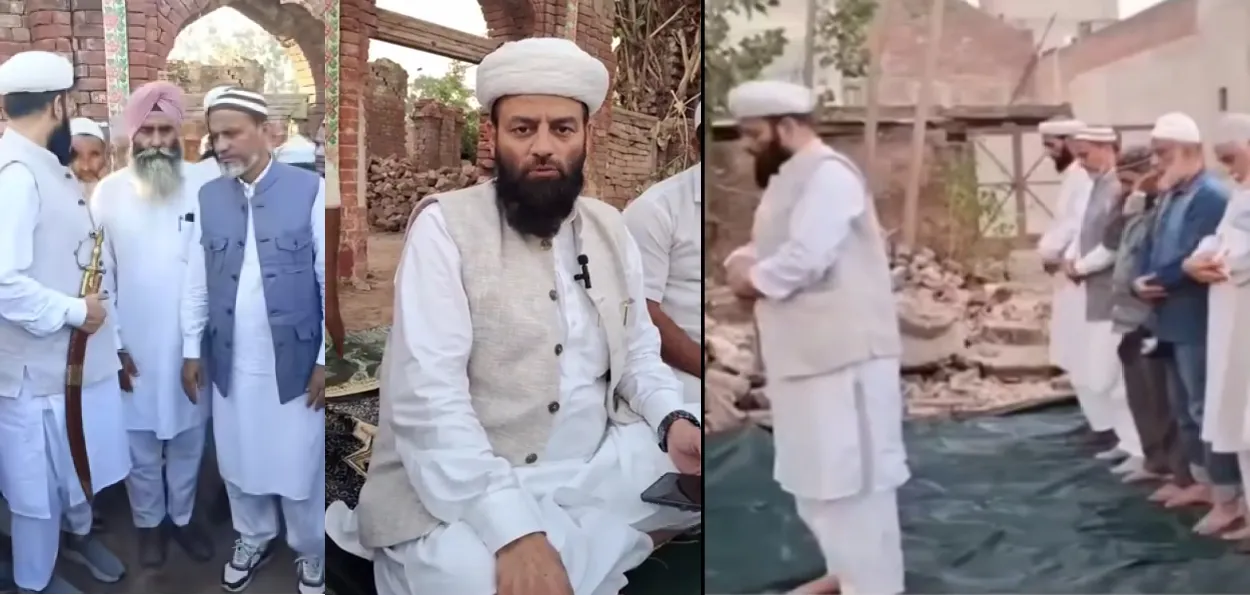
Shahi Imam of Punjab Maulana Muhammad Usman Rahmani Ludhianvi with villagers of Raizada
In his address, Maulana Muhammad Usman Rahmani Ludhianvi narrated the history of harmony in Punjab. He said Guru Nanak Dev, whom Muslims remember as “Baba Nanak”, was carried to a safe place by Muslim brothers Nabi Khan and Ghani Khan in his palanquin during the war.
He also mentioned Diwan Todarmal, a minister in Akbar’s Court, who dedicated his land for the burial of the Guru’s sons.
The Shahi Imam said that this is the real strength of Punjab, Sikhs, Hindus and Muslims have stood together for centuries. The greatest beauty of India is its “unity in individuation”.
He announced that the restoration of the village mosque was being done as a tribute to two Muslim volunteers who sacrificed their lives during relief work in the recent floods.
These youths were Shamshad Bhagwanpuri (Uttarakhand) and Zakaria Mewati (Rajasthan). Both of them distributed ration and medicines in the affected areas for a week, but met with an accident on their return journey. Shahi Imam said that they did not just deliver goods, but also conveyed a message of love and brotherhood. Punjab will never forget their sacrifice.
The mosque will be named ‘Masjid-e-Shamshad Bhagwan Puri’ to honour the sacrifice of the flood relief volunteers in the name of humanity.
He said while the foundation of the mosque will be laid this month, the story of Shamshad’s life and service will be engraved on the wall of the mosque.
The second mosque, “Masjid-e-Zakaria” will be built in Fagan Majra village of Mewati-Patiala district, the land for which was acquired this week. The parents of these two martyrs have been invited to lay the foundation. The Shahi Imam prayed that for love to spread throughout the country.
The incident comes amid a wider humanitarian effort that has been seen during the recent floods. Volunteers from Mewat in Haryana, traditionally allies of Punjab farmers, sent more than 300 truckloads of relief supplies to the states of Punjab, Himachal Pradesh and Jammu and Kashmir. It reflects agricultural ties that predate the separation of Haryana and Punjab in 1966. Organisations like Khalsa Aid have been on the ground since August, rescuing families and providing water and medical aid in affected areas like Gurdaspur and Ferozepur.
The event took place in a backdrop of peaceful harmony. As the sounds of Gurbani recitation echoed from the gurdwara during evening prayers, the call to prayer for Maghrib was soon heard from the mosque, symbolizing the harmonious heartbeat of Punjab. The villagers distributed sweets to celebrate. As the sun was setting over the Ravi River, the Shahi Imam concluded the ceremony with a prayer. He said, “May this love spread throughout the country and every corner be illuminated like a lamp of brotherhood.”
According to media reports, more than 30 such mosques have been restored so far through interfaith cooperation, with most of them led by Sikhs in providing financial support, labour, and land.
According to Shahbaz Ahmed Zahoor, leader of the Idara Mosques, there have been about 200 such incidents across the state in which Sikh families have donated land for mosques and graveyards.
In 2018, in village Moom, Baranala district, while Hindus provided the land, the Sikhs raised funds for the construction of a mosque that shares a wall with their gurdwara.
This created a rare combination of Hindu, Muslim and Sikh places of worship in one place. In 2022, in the Bakhatgarh district, Barnala, farmer Amandeep Singh donated 250 square yards of land for the Noorani Masjid. Other Sikhs and Hindus shouldered a major part of the construction cost of Rs 12 lakh so that 15 Muslim families would not have to travel 5 km to offer prayers.
In January of the same year, former Sarpanch Sukhjinder Singh Noni and his brother Avininder Singh donated 5.5 biswas (worth Rs 7-8 lakh) of valuable roadside land for a new mosque in Umarpura village of Malirkotla district. They were joined by donors like Tejwant Singh (Rs 2 lakh) and Ravinder Singh Grewal (Rs 1 lakh).
In Malla village of Ludhiana district, in 2016, Sikhs and Hindus renovated the old mosque for the only Muslim family in the village and provided financial assistance while locals worked as labour for its construction.
In Nathuwal village of Sangrur district, in 2015, non-Muslims bore more than 65% of the Rs 25 lakh cost for the renovation of the Jama Masjid and the addition of a second floor.
source: http://www.awazthevoice.in / Awaz, The Voice / Home> Story / by Mansooruddin Faridi, New Delhi / October 27th, 2025