Tag Archives: Syed Ghani Khan – Awarded – Krishi Pandit Prashati – Government of Karnataka

The kernel of rice conservation

Kirugavalu Village (Malvadi Taluk, Mandya District), KARNATAKA :

Passionate efforts
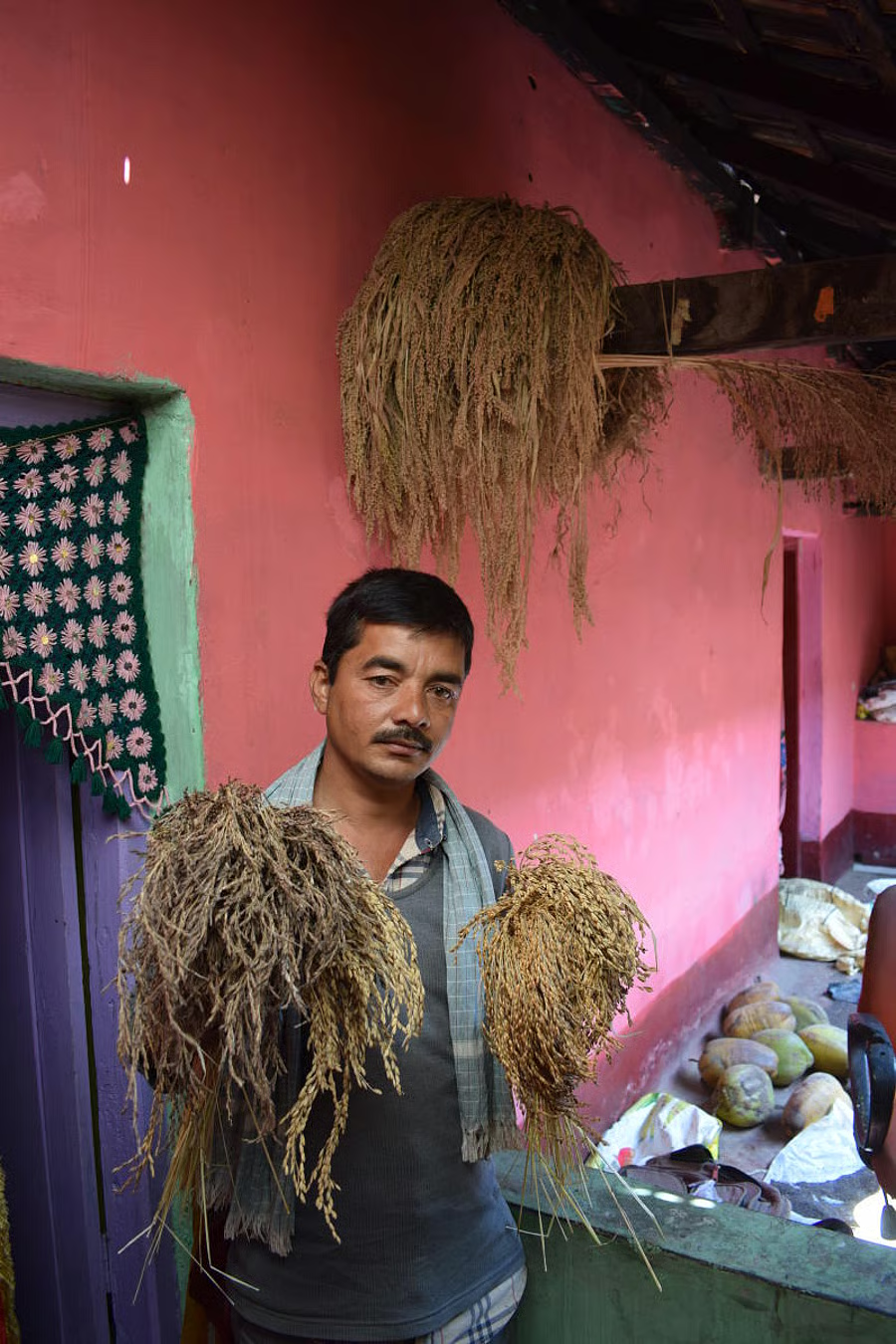
Farmer Syed Ghani Khan has brought back the use of traditional varieties even as farmers are lured into buying unsustainable varieties.

Some farmers have been the victims of forceful marketing and have opted for commercial varieties of rice and other crops promoted by seed firms.

In effect, they have switched from native varieties — which suit the soil and climatic conditions — to the ones that consume more water and fertilisers, and are easy prey for insects and pests. But it does not take farmers long to realise that the yield comes down after a few years, leaving the soil toxic.

Remedy lies in returning to traditional grains. But wooing farmers away from commercially promoted seeds, fertilisers and insecticides is a task.

Syed Ghani Khan, a farmer from Kirugavalu, a village in Mandya district, has been pursuing that task as a lifetime passion.

He has set up a museum in his village home by setting apart two rooms for the purpose.

He has conserved over 700 varieties across 15 and more acres of land. These crops are harvested carefully, and the panicles laden with grain are bunched, marked with names and numbers, and arranged systematically on the walls of the two-room museum.

Some of them are even stored in bottles to be given away to farmers around the village to experiment with the heritage crops they lost in the race to boost harvest with new varieties.

Khan is a graduate from Mysore University with a degree in Archaeology and Museology. After completing his studies in Mysuru, Khan joined his father in tending to his farm.

He was pained at the sight of farmers getting addicted to industrial products and giving up the traditional varieties and practices.

He took up the task of preserving traditional seeds in packets and supplying them to those who were converts to his cause. Yet, he was not satisfied with what he did. He thought he needed more systematic efforts to create awareness about the usefulness of the old varieties and the supply of seeds.

According to Khan, continuous onslaught of publicity for industrial farm products has misled farmers into switching over to newer seeds — be it cereals, lentils, vegetables or fruits. This has led to enmasse shift to high-yielding varieties like MTU-1001, IR-64, Jaya etc.

Khan says traditional varieties hold the key to sustainable farming that is less expensive, does not erode the fertility of the soil. “In our pursuit of bumper harvest, we have damaged the soil and have made paddy an aquatic crop, which it is not,” he laments.

He began collecting varieties like Rajmudi, Ghamgadale, Doddibatta, Parimala Sanna, Basmati, Ratnachudi, Gandhasale, Mysore Mallige, Jeerige Sanna, Burma Black, Rasakdam, Thai Jasmine etc in earnest. Several of these varieties harbour medicinal properties while others emit aroma while being cooked.

According to Khan, varieties such as Doddibatta, Ghamgadale and Biddi Doddi can be grown in farms that receive just one or two spells of shower.

Ratnachudi, HMT, NMS-II are high-yielding traditional varieties while Jeerige Sanna, Rasakdam, Gandha Sale, Parimala Sanna and Mugadh Sugandh turn aromatic while being cooked.

He says most of the seeds of paddy varieties collected by him have a shelf life of 18 months. In contrast to the practice of preserving seeds in freezers, he applied on-field conservation methods where no synthetic chemicals were used.

Propagator

Farmers from all over South India have been approaching him for seeds of the native varieties.

Shiv Prasad, who has a farm in the outskirts of Hyderabad, took seeds of nearly 200 varieties from him. He has since been a promoter of the cause in his region.

Khan maintains a meticulous record of all those who have procured seeds from him. During the last two decades, nearly 10,000 farmers have accessed supplies from him.

Krishna, a farmer from a village in Maddur taluk, is a regular visitor to his farms. Rachanna, from Hosamalangi village in T Narsipura taluk, successfully grows around 25 varieties in his farm. He had visited him a decade ago.

A corner of his museum displays several medals, certificates and awards. He was conferred with Krishi Pandit Prashasti by the Govt of Karnataka (2008). National Genome Seed-saver Recognition Award was conferred on him a year later by Plant Protection Variety Forum. Govt of Karnataka chose him for ‘Biodiversity Award’ in 2010, while Directorate of Rice Research in Hyderabad presented him ‘Rice Innovative Farmer Award’ for the year 2011-12.

Ghani Khan says one should not be surprised to find one variety being replaced by another after every 40 km as India is home to thousands of varieties of rice.

He says several of them carry medicinal properties.

He says while Karigajivili and Ambe Mohur from Karnataka are said to be good for lactating mothers, Navara of Kerala is good for those who have joint pain. While Mappillai Samba from Tamil Nadu improves virility, Mehdi is held to be good for healing of bone fracture. Khaima provides relief for those suffering from piles.

Mangoes, too

Ghani Khan has taken up the conservation of native varieties of mango, too. He has registered himself with the National Bureau for Plant Genetics, New Delhi.

He has trees that have been there in the family farm for the last six to seven generations. These trees yield native varieties like mosambi ka aam (tastes like sweet lime); seb ka aam (tastes like apple); pheeka aam (bland mango) for those with diabetes; kaale malghoba, bada gola; mangamari; manji bi pasand and mittmia pasand.

His family has been supportive of his efforts and to this day help him in maintaining their farms and marketing the produce.

Womenfolk of his family use paddy in making decorative art.

Syed Ghani Khan can be reached on 9901713351 or muhinuha786@gmail.com

source: http://www.deccanherald.com / Deccan Herala / Home> India> Karnataka / by M A Siraj / October 12th, 2019

Conserving Native Varieties of Rice

Kiragavalu village (Malavalli Taluk, Mandya District) , KARNATAKA :

Syed Ghani Khan of Kirgavalu village has been conserving and propagating hundreds of native varieties of rice which are threatened with extinction in the race for high-yielding commercial varieties.

For Syed Ghani Khan of Kirgavalu village in Karnataka, preserving native varieties of rice is a lifetime passion.

This 42-year old has been cultivating virtually hundreds of varieties of rice on his 14-acre farm in the village located 20 kilometres from Mandya in the Cauvery basin. He preserves seeds of nearly a thousand of these varieties in a tiny museum that he has organized at his house in the village.

Walls of his first floor hall display these seeds, held in clusters of panicles neatly pinned on several panels with tags bearing the names of the varieties alongside.

Museum at Home
Son of a farmer and someone who does not fight shy of calling himself a farmer, Ghani Khan holds a degree in Archaeology and Museology from Mysore University.

Pained at the increasing use of chemicals, fertilizers and pesticides and loss of native varieties, Khan took up the task of preserving seeds of these varieties in packets. He would supply the same to local farmers around his village before the arrival of the next monsoon. But he was not satisfied. It needed a little more effort. He conceived the idea of a museum for promoting general awareness together with the supply of seeds. Two halls in the upper floor of his old, tiled house were readied for the purpose. The clustered panicles were arranged on wall panels in a hall, while those in bottles were arranged on shelves in the second one.


Ghani Khan feels that commercialization of farming has led to rejection of traditional varieties of crops, be they cereals, lentils, vegetables or fruits. The farmers were influenced by the publicity to seeds produced by large firms that promised better yield. This has resulted in en masse switching over to hybrid varieties like MTU-1001, IR-64, Jaya etc.

Sustainable
Ghani Khan says conservation of traditional varieties is critical to sustainable agriculture as several of them carry medicinal properties, some give out aroma on cooking, some can withstand drought and yet others can be grown with just one or two showers.

He wanted to conserve these varieties for future generations. So, he began collecting varieties like Ratnachudi, Gandhasalai, Rasakadam, Rajamudi, Ghamgadale, Doddibatta, Doddabyrenellu, Chinna ponni, Mysore Mallige, Zeerge Sanna, Parimalla Sanna, Basumati, Burma Black, Thai Jasmine etc.

Dedicated Zone
He says while agricultural colleges or universities used freezers to preserve seeds, he applied on-field conservation methods which can ensure a life of at least 18 months for the paddy seeds without pesticides. He has dedicated one acre of land in his farm in a demarcated zone where seeds of several varieties are sown in documented segments.

He even wrote to the Chief Minister of Karnataka to initiate measures to preserve and conserve native varieties. But no response has been received from him.

During the last two decades, he has supplied free seeds of native varieties to around ten thousand farmers and received positive responses from them. He keeps a meticulous record of all those who have visited him or sought seeds from him. Shiv Prasad, a farmer from the outskirts of Hyderabad has taken seeds of around 200 varieties from him and forwarded the seeds from the resulting crop to his associates. Krishna from nearby Maddur village has been a constant procurer of seeds from him. Rachanna from Hosamalangi village in T. Narsipur taluk has successfully grown around 25 varieties of rice after having taken from him.

Honours Conferred
A corner of his museum displays several trophies, medals and certificates that were presented to him in recognition of his work for propagation of native varieties. He was conferred Krishi Pandit Prashasti by the Government of Karnataka in 2008. Plant Protection Variety Forum conferred on him National Genome Seed-saver Recognition a year later. Directorate of Rice Research, Hyderabad selected him for Rice Innovative Farmer’s Award for 2011-12. Government of Karnataka chose him for Bio Diversity Award in 2010, while Suvarna TV channel declared him winner of the ‘Man of the Year Award’ in 2017.


According to Ghani Khan, India is home to thousands of varieties of rice and one should not be surprised to find one variety being replaced by another after every forty kilometres. He says several varieties are known for medicinal properties. If Navara of Kerala is good for those who have joint pain, Karigajvilli and Ambe Mohur from Karnataka are said to be good for lactating mothers. Mehdi is held to be good for healing of bone fracture, while Mapillai samba from Tamil Nadu improves virility. Khaima is said to be good for those suffering from piles.


Ghani Khan is a mobile encyclopaedia of knowledge on varieties of rice. He says it is wrong to presume that paddy is an aquatic plant. He refers to several varieties such Doddi Batta, Ghangadale and Biddi Doddi which can be grown in farms that receive just one or two showers. He says Ratnachudi, HMT, NMS-II are high-yielding varieties while Zeerge Sanna, Rasakadam, Gandha Sale, Parimala Sanna and Mugadh Sugandh emit pleasant aroma on cooking.


For the last few years Ghani Khan has taken up conservation of native varieties of mango too and has registered himself with the National Bureau for Plant Genetics, New Delhi. He has trees that have been there with his family farm for the last six to seven generations.

These trees yield native varieties like Mosambi ka Aam (tasting like sweet lime); Seb ka Aam (tastes like apple); Pheeka Aam (for diabetics); Kaale Malghoba, Bada Gola; Mangamari; Manji bi Pasand; Mittmia Pasand. Some of these varieties are procured from him by suppliers attached to Lulu Mall in Dubai.


Syed Ghani Khan can be reached at 99017-13351, email: muhinuha786@gmail.com.

source: http://www.islamicvoice.com / Islamic Voice / Home> Features / by Maqbool Ahmed Siraj / February 15th, 2019