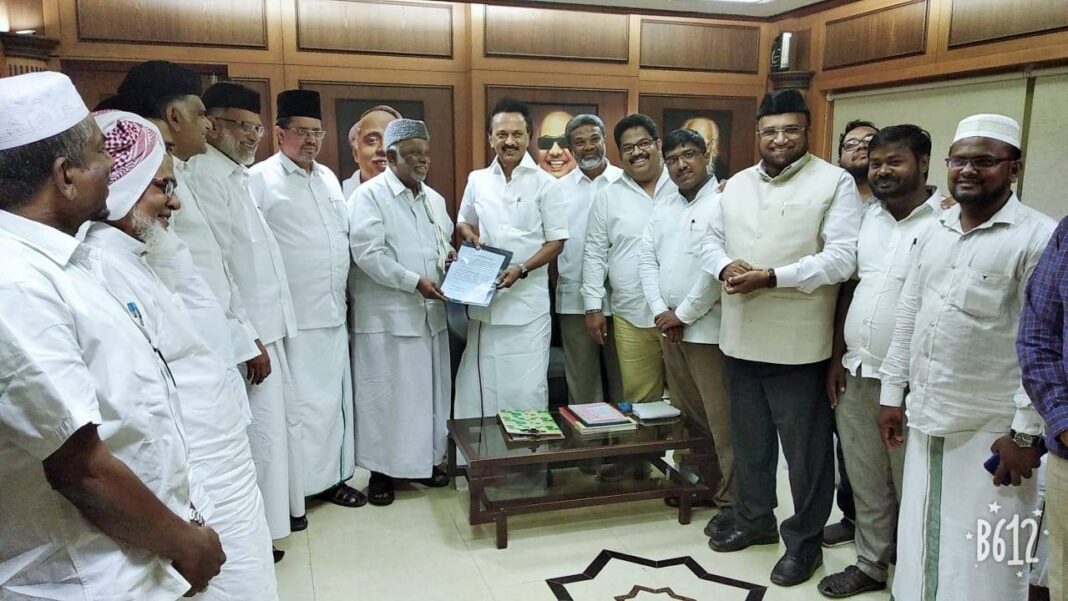
Ahead of the Assembly elections in Tamil Nadu, scheduled for April-May 2026, the Muslim community is emerging as an important player in the poll-bound state, with Chief Minister M.K. Stalin rolling out several welfare initiatives aimed at benefiting them. Stalin has laid emphasis on the ruling Dravida Munnetra Kazhagam’s (DMK) historical ties with Muslims.
Muslims in Tamil Nadu constitute approximately 5.86% of the state’s population. Their number in the state was 42 lakh, as per the 2011 Census, and they primarily belong to the Tamil-speaking Labbai, Marakayar, and Rowther communities. With a history dating back to 7thcentury Arab trade, they are well-integrated, often using Tamil as their native tongue, and exhibit high social, literacy, and economic indicators compared to other regions.
In a powerful message to the ruling Bharatiya Janata Party (BJP) at the Centre, Stalin has claimed that Tamil Nadu is the “only state which is safe for Muslims” and described the DMK as a fortress that protects the minorities in the state. Because of this, incidents like mob lynching could not rear their head in Tamil Nadu, Stalin said at a function at Kumbakonam recently.
The occasion was the State Mahalla Jamaats Conference organised by Indian Union Muslim League (IUML) near Kumbakonam, in which office-bearers of around 8,000 Jamaats from across the state participated. In his address, Stalin launched a scathing attack on the Central Government, accusing it of using central agencies like the CBI, ED, and IT to intimidate political opponents and the public.
The Chief Minister remarked that he did not need to explain the current situation of the country further, implying a climate of pressure from the Centre. His remarks were indicative of the DMK’s strategy to consolidate minority votes by positioning itself as a primary defender against central interference and communal insecurity.
Stalin accused the Opposition All India Anna Dravida Munnetra Kazhagam (AIADMK) of betraying minority communities to appease central authorities in Delhi. He asserted that only the DMK-led Secular Progressive Alliance has the strength to defeat the anti-people AIADMK-BJP alliance in the upcoming Assembly elections.
Stalin announced five welfare schemes for Muslims on the occasion, including the establishment of a third Waqf Tribunal at Coimbatore and the increase of pension for Ulema registered with Tamil Nadu Waqf Board from Rs. 3,000 to Rs. 5,000, and the family pension from Rs. 1,500 to Rs. 2,500.
Stalin also announced that in the first phase of a scheme, 1,000 Ulema will receive the increased subsidy of Rs. 50,000 for buying two-wheelers. The Ulema play a pivotal role as Islamic scholars in Tamil Nadu’s Muslim societies, acting as guardians and interpreters of religious knowledge and law. They are highly respected for their deep understanding of Islamic theology, Sharia law, and the Hadiths, guiding the Muslim community on matters of faith and practice.
The other announcements included creation of burial grounds in City Corporation areas where there is none, and filling of 10 vacant posts of Urdu language teachers at the government high schools and higher secondary schools. Stalin said the efforts of those who were trying to disturb peace had been in vain, and added that they had formed in their own interest, an alliance of those who are servile by threatening with agencies like ED, CBI and IT.
Pointing at AIADMK’s support to the contentious Citizenship Amendment Act (CAA), 2019, the Chief Minister said the Leader of Opposition, Edappadi K. Palaniswami, has been continuing his betrayal of Muslims. “But for AIADMK’s support, the CAA Bill would have been defeated in the Rajya Sabha,” he said. He further pointed out that the DMK government had courageously declared the CAA would not be implemented in Tamil Nadu.
Stalin also referred to the DMK’s vote against the Triple Talaq Bill and Waqf Amendment Bill. “If the BJP alliance comes to power in Tamil Nadu, it will ruin the developed state. Only the DMK alliance has the courage and strength to stop it from coming to power,” he declared.
Pointing out that the DMK cadre have started their door-to-door campaign, he urged the IUML cadre, particularly the youth and women, to campaign for those who will protect and enable their growth. IUML chief K.M. Kader Mohideen, who presided over the meeting, said his party and members of Mahalla Jamaats will ensure the continuance of the Dravida model of governance.
The key aspects of Muslims in Tamil Nadu include their cultural fusion, social harmony, and concentration in towns like Kayalpatnam, Kilakkarai, Adirampattinam, and Melapalayam. Chennai also has a notable Muslim population, comprising about 9.45% of the capital city’s total population.
The Tamil Muslims are known for a unique synthesis of Tamil culture and Islamic faith, with strong traditions in trade and education, particularly in coastal towns. The community is primarily Sunni, with diverse, well-integrated, and long-settled, as well as some Dakani-speaking groups. The presence of ancient mosques like the Kilakaraj Jumma Masjid, built in 7th century, highlights early Islamic contact through maritime trade, while Tamil Nadu is often described as a model for communal coexistence because of its peaceful Muslim community.
source: http://www.indiatomorrow.net / India Tomorrow / Home> Debate / by India Tomorrow Correspondent / February 03rd, 2026
Kilakarai (Ramanathapuram District) / Chennai, TAMIL NADU :
Death of Dr. B.S. Abdur Rahman has not only shocked who knew his mission and lifelong works but also those who have benefited by his devotion and those who took inspirations from him. His untimely death has brought a vacuam in Indian educational scenario and it is almost impossible to be filled up in near future.
Indian Muslim Community has legacy of Sir Syed Ahmad Khan, the founder of the Aligarh Muslim University before it, Dr. B.S. Abdur Rahman has achieved almost that place and has become another inspirational figure.
Dr. B.S. Abdur Rahman was born in kilakarai falling under Ramanathapuram district of Tamilnadu state in 1927. Due to his works and philanthropist bent of mind, Dr. Rahman became a well known personality who devoted himself for the upliftment of the economically weaker sections and minorities through their educational empowerment. He did not lagged behind in providing good facilities of health care to the deprived sections of society.
B.S. Abdur Rahman, Vice Chairman of Emirates Trading Agency LLC and Associated Construction and Investments Co. LLC (ETA-ASCON), the Dubai-based $2 billion industrial behemoth, was a multi-faceted personality, much like the diamonds he dealt with when he began in humble business in Sri Lanka, over half a century ago.
Diamond merchant, industrialist, educationist, philanthropist, shipping magnate, generous contributor and enthusiastic participant in many other business and social activities he is a renaissance man whose outlook was Millennial. Meaning, while his values were classical, his thinking was forward looking.
Kilakarai, on the coast of Ramanathapuram district in Tamil Nadu, where Abdur Rahman (fondly known as Sena Aana) was born, is a town made famous in the region by his illustrious ancestor, Vallal Seethakathi.
The forbears of Abdur Rahman migrated to Kilakarai from Arabia in the 12th century. Kilakarai, which means East Coast in Tamil, was a flourishing port to which mearchants from the east and west came. A densely populated area, predominantly by Muslims, it owned its prosperity to them.
From centuries they traded with Sri Lanka (then known as Ceylon), dealing in pealing in pearls, gemstones and conches. Even today, many of them live in Sri Lanka or do business with the island. Abdur Rahman too began his career in Ceylon. Among the pearl traders of Kilakarai was Buhari Aalim. Abdur Rahman was his son.
Aalim was an expert in valuing precious stones and pearls. He would hold a gem between his right thumb and index finger and, looking at it against the sun, study the quality of the watermark within to judge the worth of the precious stone. He would be unfailingly correct.
Watching his father at work, the young Abdur Rahman was soon able to understand the nuances of the trade. This training and experience helped him to become one of the most successful merchants in the diamond trade in due course. When Abdur Rahman first went to Colombo, he was fifteen years old. He had with him just Indian Rupees 149. He worked as an errand boy for diamond merchants, carrying their diamonds and other gems from sellers to buyers and back. He was at the time staying with some traders from Kilakarai and neighbouring villages. They allowed him to stay with them without any payment, but he had, instead, to fetch tea them from a nearby hotel, clean the rooms and perform other menial tasks.
A lesser person perhaps would have thrown in the towel. But Abdur Rahman was made of sterner stuff. Before long, he used his persuasive skills to obtain gemstones from another merchant and began trading in them. In time he became a successful gem trader. The base that Abdur Rahman built in Ceylon was to help him in all his future activities.
He began visiting Belgium, then as now, a centre of the gem trade, the USA, South America and set up business in Penang, Malaysia, Chennai, Kolkata (then Calcutta), and then in Hong Kong. It was in Hong Kong that his business flourished. Incidentally, Abdur Rahman was the first person from Kilakarai to go to Hong Kong.
In Hong Kong he launched the Precious Trading Company in 1954. Later, his very special brainchild, the Amana Group of Hong Kong, was established. It was under its banner that the multinational company ETA-ASCON came into existence.
He was a firm believer in education and took upon himself the task of educationally empower the poor and the deprived. He established a wide network of educational institutions. In 1967, he founded Seethakathi Trust and in 1979, All India Islamic Foundation to achieve his target of serving the community and nation. He founded twelve educational institutions including an Engineering University, a woman’s college, an Arabic College two boys schools, 3 girls schools, a woman Nursing college, a Teacher Training College, B.Ed College for woman and 2 hospitals beside orphanages in rural and urban areas. His biggest achievement was founding a 60 bed Yousuf Zulaikha hospital at Kilakrai and a 150 bed Crescent hospital at Madurai. He did not lagged behind in providing comfort of life to most deprived orphanages and founded Al Momin orphanages for boys and girls at Ottapidram, Tanjore, Kilakarai and Thiruvithancode of Tamilnadu.
Dr. B.S. Abdur Rahman was farsighted man and knew the importance of administration. He was well aware that to uplift community, it is very necessary that Muslim youths join Indian Administrative Services and so he established Crescent IAS and Carriers Guidance Academy in 1994 beside an Islamic Studies & Cultural Centre at Chennai.
His social works span to wide area. Dr. B.S. Abdur Rahman founded B.S. Abdur Rahman Zakat Fund Foundation in 2007 which provides educational grants for students. Through this foundation, B.S. Abdur Rahmand has maintained magniticence of Zakat which may be called a pillar of Islam and which is an instrument for survival of poor Muslims. He 1017 Self Help Group (SHG) which became beneficial to 17093 deprived and helpless women. He also founded and managed various other trusts like Yousuf Zulaikha (1993) Chennai for education, health care and women empowerment. United Economic Forum in 1994 and Seethakathi NGO in 2002.
He also establish new milestones in business field.
He was founder Chairman of Dubai based ETA – Ascon – Star Group and was treated a renowned Indian entrepreneur in UAE. It may be known that the group has a turn over US$ 5.5 billion and employs 50,000 people. With his visionary zeal and entrepreneurial spirit.
B.S. Abdur Rahman has been the guiding force behind many companies in India, among which the most important is the Buhari Group the Indian Multinational. The prominent companies and establishments under Buhari Group include East Coast Construction Ltd. (ECCI) 50 years in the field of construction, Coal & Oil and many other automobile dealership companies.
In recognition of his services he received many awards also.
The Aligarh Muslim University Students Union conferred him life membership while Sathyabama University awarded Honorary Doctorate in recognition of his contribution to Women Education.
In fact Dr. B.S. Abdur Rahman had became an inspirational force to young generation during his own life time. There are very few people who climb the ladder of success and remember the down trodden sections of the society or do anything meaningful for them.
Whatever Dr. B.S. Abdur Rahman has done for the manginalised and deprived sections of society will be always not only remembered but will also be documented in social and educational history of India. The best tribute to Dr. B.S. Abdur Rahman will be to follow the path shown by him not only in business but other fields also.
-Dr. Jasim Mohammad / Author is Editor of The Aligarh Movement monthly
source: http://www.hastakshep.com / Hastakshep.com / Home> Uncategorized / by Dr Jasim Mohammad / March 29th, 2019
The latest addition at the historic Jamia Masjid, Salem, is the nine-tier tower
The historic Jamia Masjid on the southern banks of River Tirumanithar in the heart of Salem city has got a 135 ft. tall ‘minaret.’ This is said to be one of the tallest minarets to be constructed in a mosque in South India in the recent past.
The minaret is a significant feature of mosques across the world, and is one of the earliest characteristics of Islamic architecture. The ‘muezzin,’ a person who announces the call of prayer, usually delivers the ‘azaan’ from the minarets.
Jamia Masjid in any town or city is considered as the chief mosque. They are known as congregational mosques, as Muslims gather in large numbers to offer prayers on Fridays and during Ramzan, Bakrid and other festivals.
Rich past
Jamia Masjid in Salem city, standing on about 1.5 acres of land, has a rich past. It is one of the oldest mosques in the state and was said to have been built by the Mysore ruler Tipu Sultan (1750 – 1799), popularly known as the Tiger of Mysore, more than two centuries ago. Tipu Sultan, who had visited the Salem region on various occasions, is said to have offered prayers in this mosque. He has also donated inams (properties) for this mosque. The British regime, which understood the importance of this Jamia Masjid, also extended assistance to this mosque and gave ‘inams’.
This Jamia Masjid is built on the lines of the North Indian mosques. The prayer hall of this grand mosque stands on an elevated ground and is decorated with tall, elaborate granite pillars. On Fridays, this masjid gets more worshippers from the town and neighbouring areas of Salem.
According to S.R. Anwar, the Muthawalli of the Jamia Masjid, the minaret has nine small tiers ranging between 10 ft. and 20 ft. The cornice (metal kalasam), atop the minaret was made in Kumbakonam. A silver cone and crescent decorate this metal structure.
Anwar says that this Jamia Masjid plays a stellar role in promoting communal harmony in the entire western belt and has been held in high esteem by everyone.
S. Veerappan, an expert architect from Kamanayakkanpatti, led a team which was in-charge for the construction of this minaret. His name is engraved on the inaugural stone. “It is a great honour that my name is on the tablet stone of the mosque,” says Veerappan. “This highlights the mutual respect and goodwill that the people from different communities have for each other,” he adds.
The new minaret was inaugurated recently by A. Anwar Raajha, MP and Chairman of Tamil Nadu Wakf Board, in the presence of MPs V. Panneer Selvam, P.R. Sundaram and K. Kamaraj.
source: http://www.thehindu.com / The Hindu / Home> Today’s Paper> Features> Friday Review / by Syed Muthahar Saqaf / July 06th, 2018
On his birth centenary, Nagore Hanifa continues to be celebrated and his timeless devotional and political numbers continue to draw in listeners.
The Hanifa fan base continues to grow, as seen by the number of cover versions of his ‘Iraivanidam Kaiyenthungal’ | Photo Credit: Special Arrangement
Of the many singers in South India with a universal appeal, ‘Isai Murasu’ Esmail Mohamed Hanifa stands tall on the pantheon of greats with origins in Tamil Nadu’s Cauvery delta region.
Hanifa, an iconic minstrel of Islamic devotional songs in Tamil had strong links with Nagore, the town in Nagapattinam that hosts the 16th century shrine to Sufi saint Syed Abdul Qadir. It eventually became the prefix to his name too.
Recently, the Tamil Nadu government kickstarted the celebration of Hanifa’s centenary year by naming a street and public children’s park in Nagore after him.
It is a fitting tribute to a man who captured the hearts of fans with his distinctive baritone from the early 1930s.
Even posthumously, the Hanifa fan base continues to grow, as seen by the number of cover versions of his ‘Iraivanidam Kaiyenthungal’ and his other songs that are available online.
Hanifa’s devotional and wedding songs continue to hold sway in Tamil Muslim social functions | Photo Credit: Special Arrangement
The youngest of three children of Mohamed Ismail, a railway worker in Malaysia, and Mariam Biwi of Ramanathapuram, Hanifa began singing mainly to support his family.
The singer spent his early childhood in Ramanathapuram, and later went to work for his paternal uncle Abu Bakr Rowther in Tiruvarur. It was here that Hanifa’s musical talent was noticed. His first professional concert at the age of 13 set him off on a trajectory no one imagined.
“My father’s rousing voice owes much to the Ghousia Bait-us-Sabha at Nagore, for whom he used to sing,” says his son Naushad Ali, based out of Chennai.
“At the time, there was a practice of taking out a pre-wedding procession to introduce the bridegroom to the families in the neighbourhood. A team of young drummers beating ‘thabs’ would head the procession, followed by the groom in a car or on horseback.
My father and his accompanists would be in the middle, with the hosts and guests making up the back of the crowd. He learned early on to beat the competition from the ‘thabs’ boys by singing loudly and in tune, without the help of a microphone. It was a skill that he developed out of necessity,” he adds.
Hanifa was a mainstay at most of the ‘Urs’ festivals held by the Sufi dargahs in the State | Photo Credit: Special Arrangement
Naushad, now in his sixties, was his father’s caregiver in his later years, and also renders vocal concerts in the Nagore Hanifa style.
Hanifa’s devotional and wedding songs continue to hold sway in Tamil Muslim social functions. His devotional songs were often based on ‘nasheed’ (Islamic chants sung a cappella or with instruments) and ‘naat’ (poetry in praise of Prophet Muhammad), referencing the Muslim faith, history, and current events. Quite a few of them were modified to suit Tamil listeners.
‘Hasbi rabbi jallalah’, for instance, has just the first stanza in Arabic; the rest of the song in Tamil adds elements from Ramanathapuram’s history. “It was first recorded in the 1970s for a school function, and I was among the children who sang the chorus,” recalls Naushad.
‘Maalai soodum manamakkale’, ‘Vazhga, vazhga, vaazhgave’ and ‘Deen kula kanne’, were among the songs that he presented at marriage concerts, usually held a day before the nuptials or after the wedding reception.
He was a mainstay at most of the ‘Urs’ festivals held by the Sufi dargahs in the State.
Nagore Hanifa married past the age of 30, and his wife A.R. Roshan Begum looked after the couple’s six children in Nagore while Hanifa built his career.
“We did not get to see our father much while growing up, because he would always be on tour. At the peak of his career, he would have at least 45 engagements in a month. He rarely declined any offer. Those were different times, with no marketing, public relations or copyright. Many songs were set to popular film tunes re-arranged by his small orchestra. I wonder how he managed his career all alone,” wonders Naushad.
Hanifa’s songs were known for their profound lyrics. He was helped in this by poets Abidin and Nagore Saleem, among others.
The self-taught maestro picked up tips on Carnatic music from S.M.A. Qadir at the Nagore dargah.
Naushad was tasked with the job of copying out the lyrics and taking care of his father’s correspondence. “Much of what I know about Tamil literary expression and pronunciation is due to my father. He would rap me on my head if I got the spelling or grammar wrong,” he laughs.
Though he had a prodigious memory for lyrics, Hanifa would always take his notebooks with him on stage. “If he noticed mistakes in the rendition, he would skillfully re-sing the portion in a way that the audience would not notice,” shares Naushad.
Nagore Hanifa performed in all kinds of venues — from five star hotels and modest homes — with the same flair, and never let his celebrity status get in the way. He would also do any number of encores — he had no ego, says his son.
Hanifa occasionally lent his voice to Tamil films — in movies such as Gulebakavali (1955), Paava mannippu (1965) and Chembaruthi (1992) — but consciously kept away from cinema because he was not open to adopting a ubiquitous name such as ‘Kumar’, which was what some composers demanded.
“My father used to say that it is more satisfying to sing four songs as Hanifa than a crore songs as Kumar. Having held the stage in live concerts that ran into hours, he did not appreciate his craft being adapted for light music,” says Naushad.
When Hanifa passed away on April 8, 2015, at the age of 96, a veil fell forever on an era of homespun superstars produced in Tamil Nadu.
Political anthem
In his heyday, Hanifa used to be known as the ‘voice’ of the Dravida Munnetra Kazhagam (DMK), because of his political anthems for the party. His warm friendship with DMK leader and former Chief Minister M. Karunanidhi began in their adolescence and stayed strong through their lifetime. Some of the songs he sang for the party are still used by the DMK to raise the morale of party cadres.
source: http://www.thehindu.com / The Hindu / Home> Entertainment> Music / by Nahla Nainar / February 06th, 2025
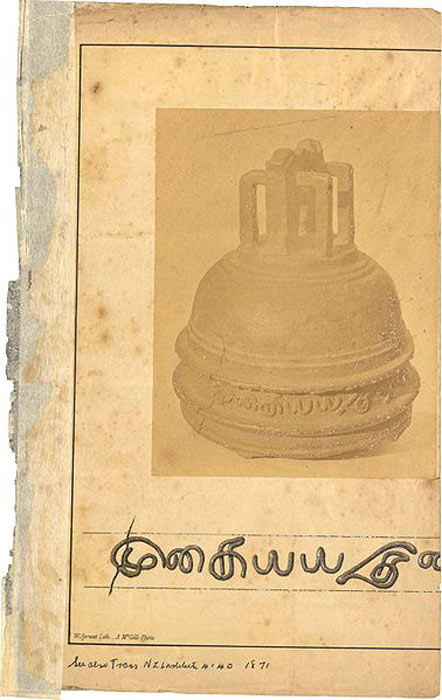
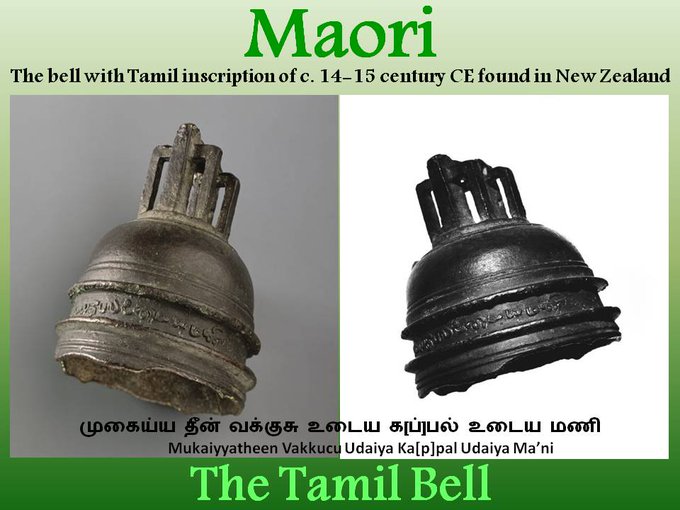
It was 1836 when William Celenso, a Christian missionary from Cornwall in England, first stumbled upon the mysterious Tamil Bell in a remote Maori village in New Zealand. It was being used as a cooking pot by some of the local people, who told the fluent Maori speaker that it had been found under the roots of a large tree, swept up from the ground by a storm many years prior.
Upon inspection, Celenso discovered a series of markings and runes in an unfamiliar language. Realizing the strangeness of the find, he traded it for a cooking pot, and deposited the curiosity in the Otago Museum in Dunedin. It was later bequeathed to the Dominion Museum, which today is the Museum of New Zealand Te Papa Tongarewa in Wellington.
Deciphering the Strange Inscriptions on New Zealand’s Tamil Bell
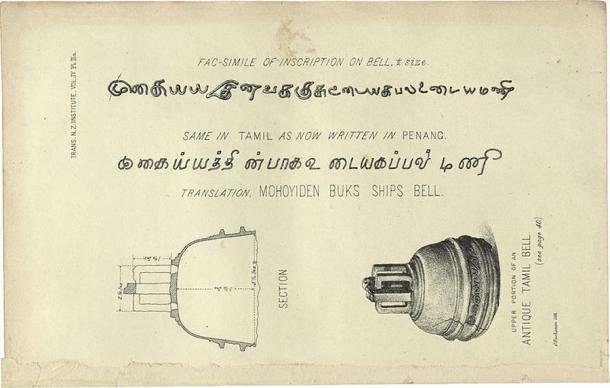
In 1870, ethnographer J. T. Thompson chanced upon the bell, and puzzled by the strange archaic writing, he took photos and sent them all around India in the hope of producing a translation. Just two months later, Thompson had replies from Ceylon, which is modern-day Sri Lanka, and Penang, a settlement on the Malaysian Straits.
The obscure inscriptions had been identified as ancient Tamil, a language that hadn’t been in use for hundreds of years. The primitive words that adorned the curious metal oddity were Mohoyideen Buks , which were translated to mean “Bell of the Ship of Mohaideen Bakhsh.”
This led to several fascinating revelations. It illustrated that the owner was a Muslim Tamil, of high stature and probably from a famous Indian shipping company based in Nagapattam, in the south-east of India. This was because his name was Arabic, and his first name came from the Tamil phrase meaning “owner of ships.”
Later, in 1940, the age of the Tamil Bell was estimated to be 400 to 500 years old, dating back to the period between 1400 to 1500 AD. This was a remarkable surprise, suggesting that outside contact with New Zealand had been made hundreds of years before English captain Thomas Cook landed on the windswept coast of Poverty Bay in 1769. But had it really?
Facsimile of inscription on the Tamil Bell. ( Public domain )
Evidence of a Tamil Colony in New Zealand
Only 7 years later, another perplexing discovery would further mystify the people of New Zealand, leading to a possible explanation for the out-of-place artifact. In 1877, a shipwreck was discovered half-buried in sand between the ports of Raglan and Aotea. It was first assumed to be a modern ship, as the New Zealand coast was renowned for being extremely dangerous and accidents were common. But this was different.
The vessel appeared to be of Asian origin and extremely old. C. G. Hunt noted how the ship was constructed of teak beams that were placed diagonally and secured by wooden screws, strongly suggesting it was built in South East Asia. Inside, a brass plate with Tamil inscriptions and a plank of wood containing the familiar name Mohoyd Buk were found.
Inexplicably both pieces of tantalizing evidence vanished in Auckland, and experts were never able to compare it to the timeworn letters of the Tamil bell. Nevertheless, several early theories were put forward by the historians of the day. Some argued this was proof of an early Tamil colony on New Zealand. Others maintained that the skillful construction and expertise of the Tamil seafarers made it perfectly possible they could have sailed to New Zealand.
On the other hand, the evidence for such arguments remains scarce. As far as historical record is concerned, the eastern-most frontier for Indian sailors was the island of Lombok, next to Bali in current-day Indonesia. Furthermore, the Spice Islands of West New Guinea, where nutmeg, mace, and cloves could be exclusively found, although in use, were never controlled by the Tamils and instead remained in the hands of local magnates of Ternate, Tidore, and Amboyna. Add to this that no other Indian relics have ever been found in New Zealand.
Facsimile of inscription on the Tamil Bell. ( Public domain )
A Lost Portuguese Trading Ship?
Another theory put forward is that the Tamil Bell was originally Portugese, and from a lost ship sent as part of a fleet by the Portuguese emperor to secure the Spice Islands. From the 1490s, the Portugese became a major player in the Indian Ocean trade network, securing Asian goods for a booming demand back in Europe. In 1511 the Portuguese even established a trading colony on the Malacca Straights and in many places on the Indian mainland.
One of these places was Goa, and in 1521 the Portuguese Viceroy sent out a fleet of three caravels captained by Cristovas de Mendonca, to explore the lands beyond the Spice Islands. Only Mendonca’s caravel returned, the other 2 being lost at sea and never seen or heard from ever again.
In 1877, the shipwreck found on the New Zealand coast was identified as being constructed in Goa, precisely where the Portuguese ships had set out from. Tamil was widely spoken in Goa which neatly explained the Tamil writing on the bell.
However, all of this is incredibly unlikely. There is no direct evidence that points to a bell being on the Portuguese caraval. Lastly, the Portuguese had already established an incredibly lucrative trade system, which meant there was no motive for them to explore further as the known world of the Indian Ocean was already providing them sufficiently.
Spanish Castaways or Anthropological Science Fiction
One of the most famous and controversial theories was advanced by Robert Langdon in his book The Lost Caravel , in which he proclaimed that the Tamil Bell was brought to New Zealand by a group of Spanish sailors from the East Indies who became disorientated and eventually settled in New Zealand, hundreds of years before Thomas Cook’s arrival.
He wrote that in 1524 the King of Spain ordered an expedition to the Spice Islands, sending a sortie of six ships. A maelstrom of disasters ensued, with two wrecked on the coasts of Patagonia and the Philippines, one reaching Mexico, another returning to Spain, and the remaining two disappearing. One of the stray caravels, the San Lesmes, which contained the Tamil Bell, was last observed in 1526, voyaging across the Pacific Sea.
After running aground at Amanu, an atoll of French Polynesia, where four cannons were later discovered, the crew repaired their ships and sailed on to the atolls of Ana and Raiatea, where several of them settled down and married the native woman. Later on, in a bid to return to Spain, the weary seamen set out west, discovering New Zealand in the process and deciding to make a home on its verdant shores.
The descendants of the castaways explored further, discovering new lands as far as Easter Island, and introduced new cultures, customs, and languages to the Polynesian people influenced by their Basque origins. Langdon was convinced that the additional discovery of a Spanish helmet dated from the 16th century in Wellington Harbor in the 1880s gave his hypothesis more credibility.
However, like the Tamil and Portuguese ship propositions, Langdon’s argument has been highly criticized for its extravagant interpretation of available evidence. Bengt Danielsson, an academic from French Polynesia, described it as “anthropological science fiction.” Throughout his account, Langdon disregarded all existing archaeological and historical literature of the Pacific which often contradicts and disproves his ideas.
The existence of Caucasian-like individuals with fair-skin, red hair, and blue eyes on many Pacific Islands was deemed proof of his hypothesis. While there is no doubt that these traits existed, even in the earliest contact with Polynesian natives, Langdon argued the Spanish castaways were the only source of these genetics, a fact that is impossible given that there were only reportedly 20 to 50 castaways in the forgotten band. It was equally as unlikely that they had travelled to all of the Polynesian Islands .
Next, Langdon pointed to linguistic anomalies as a sign that Spanish words were absorbed into the local dialects. However, there are no identifiable Spanish words in the languages of Eastern Polynesians. Without a shred of evidence, Langdon explained that this was because the children only learned the language of their mothers, leading to the decline and eventual disappearance of the Spanish, Basque, and Galician languages of the fathers. He even proposed that the lack of sounds in the Polynesian tongue meant that Spanish words could easily have been changed beyond recognition after only a day or two.
On the other hand, in all other cases of European and native intermixture in Polynesia, European languages were adapted into the local speech. A diverse array of English words still remain in Polynesian languages today after being incorporated 200 years ago. For example, on the Pitcairn Islands, where only one Englishman lived with eight native women, his descendants still speak English!
In addition, Langdon believed that the indigenous beliefs of Polynesians were derived from the Christian faith of the Spanish diaspora. He utilized sources from 1874 from Catholic missionary Albert Montiton, who remarked on how Christian the native religion seemed to him. Yet Langdon completely ignored the wide conversion of natives to Christianity that happened from 1817 onwards, which presents a more reasonable explanation.
Finally, Langdon cited the “talking boards” of Easter Island, a series of stone tablets discovered in the 1860s with archaic runes, as a type of script invented by the Spanish castaways. Yet his main source for this point was a native guru called Hapai, a man who claimed that Europeans had inhabited Easter Island, and whose evidence was subsequently found out to be fabricated. In the end, Langdon’s farfetched argument was systematically disproven, and the confusion over the Tamil Bell persisted.
There are many examples of ghost ships found floating at sea without any sailors. ( muratart / Adobe Stock
The Derelict Theory: Did the Tamil Ship Drift to New Zealand?
After years of fantastical hypothesizes, Brett Hilder entered the debate with a theory more rooted in reality. His so-called derelict theory re-invigorated the earlier claim that the bell came from a Tamil ship. Hilder’s theory attacked the assumption prevalent in most theories that the crew who possessed the Tamil bell were alive. In the choppy, capricious oceans, there had been many instances of intact wooden ghost ships being found without any sailors.
The Flying Dutchman was perhaps the most famous example, having been discovered with full sails and without anyone on board. Nearer the Pacific, the wreck of the sailboat Joyita, on a journey from Apia to the Tokelau Islands, was observed to have no remaining personnel when it was detected half-submerged in the sea.
These “derelicts” were usually still floating, even after many years at sea, because of the buoyancy of their hulls. Hilder entertained the idea that the Tamil Bell originated from a Tamil merchant ship that was caught in the eastward sea current between Antarctica and the southern parts of the continents.
During the late 1400s and 1500s, when the bell was dated, Tamil seafarers dominated the trade networks of the vast Indian Ocean. Muslim Tamils were particularly skilled navigators, plying their wares across the sea as far as the eastern coast of Africa. Indeed, modern examples of the power of the great Southern Current, which stretches from New Zealand to the Cape of Good Hope in South Africa, cement his idea.
For instance, in June 1973 it was reported in the Nautical Magazine of Glasgow that an unmanned lifeboat had travelled 7,000 miles from the coastline of East London, South Africa, to the Princess Royal Harbor in Albany, Australia. Thirty jars of barley, sugar, and lifeboat biscuits were found in perfect condition, sealed in two compartments. It is more likely, then, that a similar fate befell a Muslim Tamil ship, and that the preservation of its wooden hull helped bring the Tamil Bell to a wild new frontier of the world.
@tamilancient
Enduring Enigma of the Tamil Bell
Since its discovery in 1836, most theories surrounding the Tamil Bell were highly speculative and lacked the sufficient evidence to be taken seriously. Unlike others, Brett Hilder’s focus on the Great Southern sea current, a real geographical phenomenon, presented a case for the Tamil Bell that finally made sense without the mental leaps and bounds taken by other theorists such as Langdon, whose sole proof that the crew of the San Lesmes reached Amanu and married the native woman was the fact that four rusty old cannons had been found there.
Yet even Hilder’s theory has weaknesses. All of the theories incorporated the 1877 shipwreck as a key piece of evidence that identified if the bell was brought by the Tamils, Portuguese, or Spanish. Yet by 1890 the shipwreck, said to be half-sunken in the sand, had mysteriously disappeared, never to be seen again. Subsequent attempts to re-find the wreck, as late as 1975, were all unsuccessful.
“The problem with all these and other ‘mystery’ items, such as ancient shipwrecks on New Zealand’s wild west coast beaches that are reputed to be uncovered briefly in storms, is that in the absence of hard evidence to explain their existence and context, numerous fanciful interpretations are often placed upon them according to particular agendas,” explained Katherine Howe, summing up the situation perfectly. Thus, the mystery of the Tamil Bell lives on.
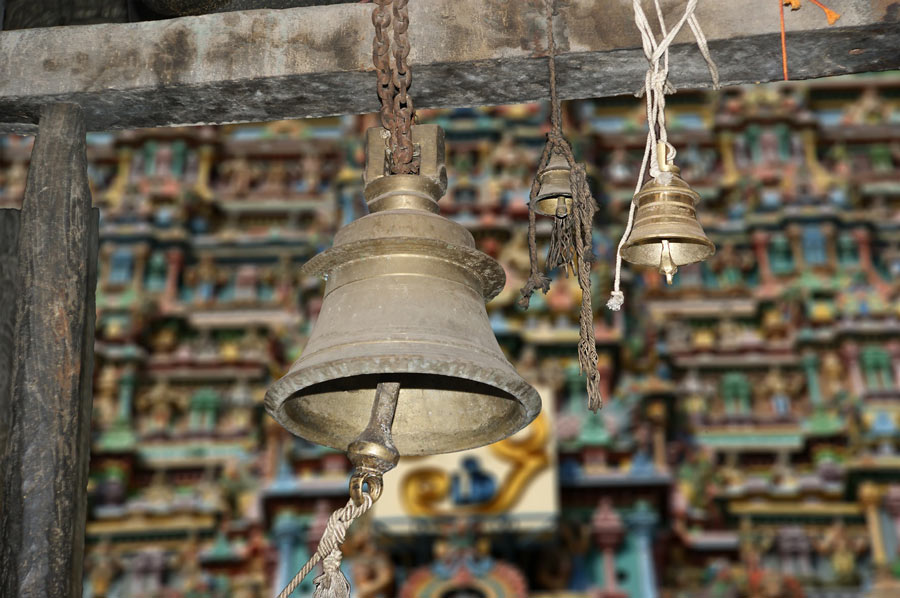
Top image: Representational image of a tamil bell from inside of Meenakshi Hindu temple in Tamil Nadu, South India. Source: Владимир Журавлёв / Adobe Stock
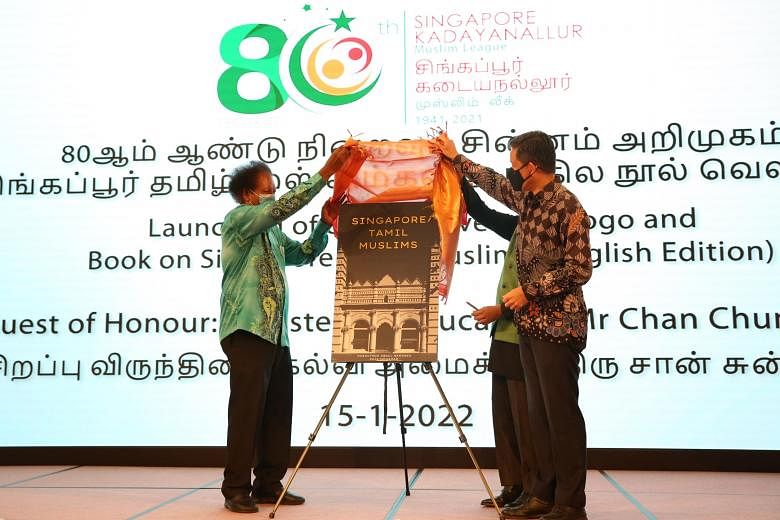
(From left) Co-authors A R Mashuthoo and Raja Mohd with Education Minister Chan Chun Sing at the launch of the English edition of Singapore Tamil Muslims. PHOTO: TAMIL MURASU
Singapore :
The Tamil Muslim community in Singapore has contributed to the Republic’s multiracial and religious harmony, with collective efforts that have strengthened the nation’s social compact, said Education Minister Chan Chun Sing on Saturday (Jan 15).
In 1946, for example, members of the community dedicated a portion of their salaries to help the Singapore Kadayanallur Muslim League (SKML) start the Umar Pulavar Tamil School, the first Tamil-medium secondary school in South-east Asia at the time.
The school played an important role in advancing and shaping Tamil language education here, and many graduates have taken up the baton and become Tamil teachers today, Mr Chan said.
“While the school was closed 40 years ago, its name lives on in today’s Umar Pulavar Tamil Language Centre, which continues the important mission of transmitting Tamil language and culture to the next generation.”
The centre is in Beatty Road.
Mr Chan was speaking at the launch of the English edition of a book titled Singapore Tamil Muslims.
The event was held in conjunction with SKML’s 80th anniversary celebrations in Chui Huay Lim Club in Newton.
The book, which looks to provide a better understanding of the Tamil Muslim community in Singapore, is supported by organisations including the National Heritage Board and Islamic Religious Council of Singapore.
It has forewords by President Halimah Yacob and former senior minister of state Zainul Abidin Rasheed.
The English edition of the book, which was first published in Tamil in 2015, is authored by SKML president Raja Mohamad and deputy president A. R. Mashuthoo.
In his speech, Mr Chan highlighted how the spirit of grit, resilience and service to community has shone brightly among Singapore’s Tamil Muslims.
Many have become successful professionals and leaders of the community, he said.
“But they have all imbibed the spirit of service, and continued to pay it forward to the community and nation.
“Importantly, these collective efforts by your community have also strengthened Singapore’s social compact – where we help the young to have a good start in life, give more to those with less, and enable our people to bounce back from adversity.”
The minister expressed his hope that the book can serve as a reminder, not just for the Tamil Muslim community but also to a broader audience, that Singaporeans must honour and protect what they have, and inspire the next generation to continue paying it forward.
The book can be purchased by contacting SKML, and funds raised will be used for its work to support the disabled community and education needs of children from low-income families.
source:http://www.straitstimes.com / The Straits Times / Home / by Choo Yun Ting / Jan 15th, 2022
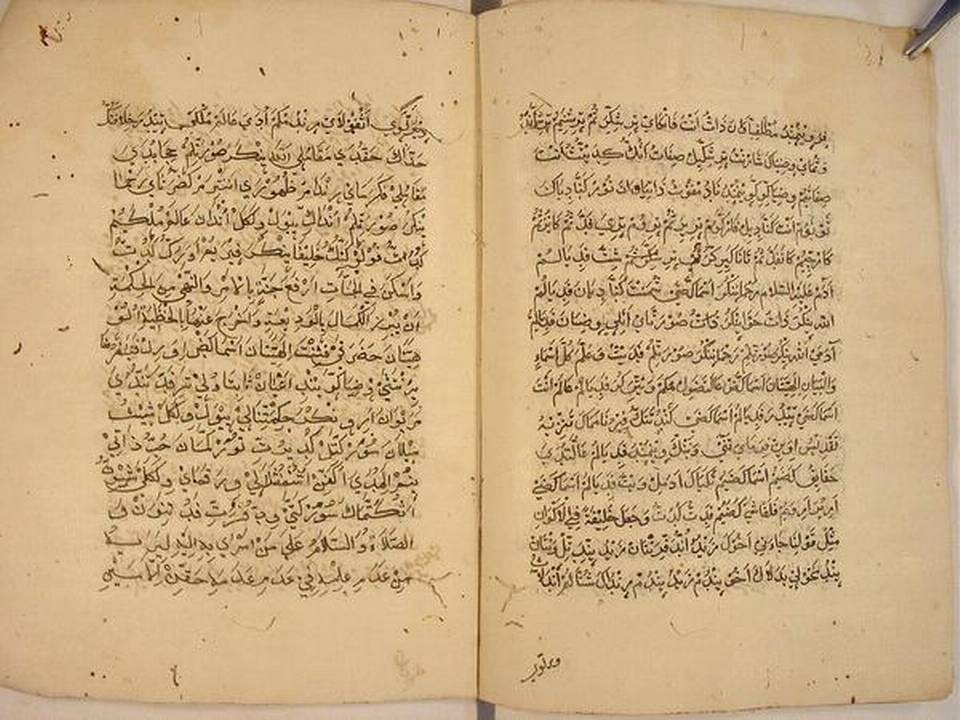
An Arwi manuscript. Photo: Special Arrangement/The Hindu
Tracing the roots of Arabu-Tamil, a link-language that evolved to facilitate communication between Arab settlers and Tamil Muslims
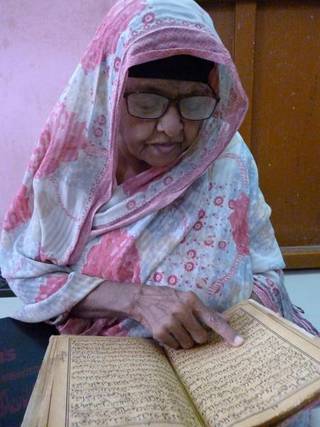
A hush falls over the room when Ammaji Akka starts reading out from the yellowing pages of a textbook called Simt-us-Sibyan (Pearls of Wisdom for the Young). Her voice may quaver, but her fingers glide surely on the modified Arabic alphabet that expresses ideas in Tamil.
The Salem-based septuagenarian is among a dwindling number of people who know Arabu-Tamil (or Lisan al-Arwi), the link-language that texts like Simt-us-Sibyan are written in. A language that evolved to facilitate communication between Arab settlers and the Tamil Muslims in southern India and Sri Lanka, Arwi was in active use from the 8th century up to 19th century.
A former Ustad Bi, or female teacher of Islamic scriptures, Ammaji Akka used to visit Tamil Muslim families at home to tutor adolescent girls and women in how to recite the Holy Quran in Arabic.
Simt-us-Sibyan (written by Maulana Mohamed Yusuf al-Hanafi al-Qadiri) was a learning tool in religious studies; and for many Tamil Muslim children up to the 1970s, used to be a part of Quran recitation classes.
Ammaji Akka, a former Ustad Bi or teacher of Islamic scriptures, reads an Arabu-Tamil booklet at her home in Salem. Photo: Special Arrangement/The Hindu
“I have four Arabu-Tamil books — Noor Nama (an account of Prophet Muhammad’s life), Simt-us-Sibyan, Ya Sayed Maalai (songs in praise of the Prophet) and Penn Buththi Maalai (advice for Muslim women). Though nobody wants to learn Arabu-Tamil anymore, I still read these books out loud after the evening (Maghrib) prayer, because I believe they will bring good fortune to the neighbourhood,” says Ammaji Akka.
Linguistic influence
The impact of Arabs on the Indian subcontinent is most evident in its languages; and Arabu-Tamil is just one of the several hybrid tongues that were once prevalent here.
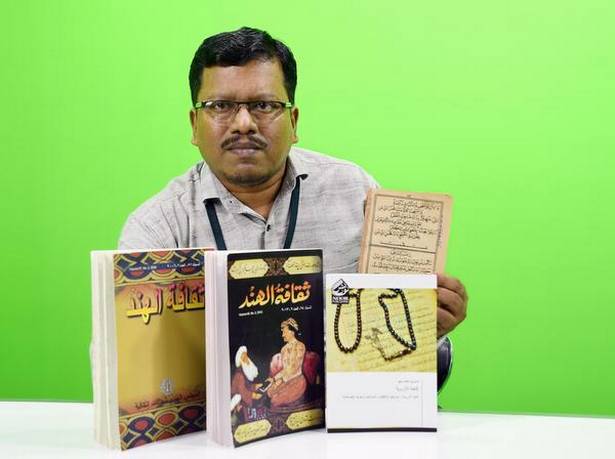
“The vocabulary and certain grammatical features of indigenous languages like Hindi, Punjabi, Bengali and Sindhi have been affected by Arabic,” says KMA Ahamed Zubair, assistant professor, Department of Arabic, New College, Chennai, who has written four books on Arabu-Tamil. “Some of the languages along the western and southern coasts of India even adapted the Arabic script, as evident in Sindhi, Arabu-Tamil, Gujarati, Arabu-Malayalam, Arabu-Telugu and Arabu-Bengali.
“According to catalogues maintained in the Madras Archives Library, there are 3000 Arabu-Tamil books dating from 1890-1915, on a variety of subjects,” says Zubair. While the Arabu-Tamil texts still in use seem to be primarily religious in nature, the language had covered general topics like sports, astronomy, horticulture, medicine, and children’s literature, among others, when it was in common usage. On most social occasions, such as weddings, invitations would be issued in Arabu-Tamil.
“The Bible was translated in Arwi. There are four Arwi dictionaries published in the 1930s. Magazines in the language were printed in Ceylon and Rangoon since the 1870s,” says Zubair.
Dr KMA Ahmed Zubair of New College, Chennai, with books on Arabu-Tamil. Photo: R. Ravindran/The Hindu
Literacy drive
Arabu-Tamil spurred a major literacy drive in the Tamil Muslim community in pre-independence India, with women especially using the language to play vital roles in education, medicine and even politics.
“In those days, Tamil Muslims were invariably taught Arabic, not Tamil,” says J Raja Mohamed, former curator of Pudukottai Government Museum, who has chronicled the use of the language in his book Maritime History of the Coromandel Muslims (A Socio-Historical Study on the Tamil Muslims 1750-1900). “In conservative families, women were educated in Arabu-Tamil rather than Western languages. Many people still have archive files of personal correspondence and bookkeeping ledgers in Arabu-Tamil. Most of the Islamic folkloric traditions such as prayer songs and hymns in praise of the Prophet were recorded in this language.”
Tamil Muslim merchants were the descendants of Arab maritime traders who had settled down in the coastal areas of southern India. The power of this mercantile community declined in the early 20th century due to stiff competition from the British and the reluctance of the Tamil Muslims to adopt new shipping technology and modern education.
After independence, Arabu-Tamil started losing out to the predominance of English in nearly every sphere of life, and has become an heirloom language that only a few can remember. Seminaries in Kayalpattinam and Kilakkarai are among the places where rare Arwi manuscripts can be found. With qualified calligraphers of Arwi no longer available, most printers have stopped publishing Arabu-Tamil books.
_________________________________________
How it works
The Arwi alphabet consists of 40 letters, out of which 28 are from Arabic, and 12 are devised by adding diacritical marks that allow Arabic letters to express sounds particular to Tamil.
Common loan words from Arabic that are still in use in Tamil:
Abattu (danger, from the Arabic root Aafat)
Baaki (remaining, from Arabic root Baaqi)
Jilla (district/zone, from Arabic root Zill’a, one side of a triangle)
Wasool (levying/collection, from the Arabic root Wusool, arrival
_______________________________________
Need for revival
It is ironic that while Arabic is taught at graduate level in several colleges across the State, Arabu-Tamil doesn’t get much attention, except in a few madrassas (religious schools).
“Arwi works should be introduced as Open Educational Resources (OER) content to reach Tamil Muslims and the diaspora living in Malaysia, Singapore, Myanmar and Bangladesh,” says Zubair, who has devised Unicode substitutes for four Arwi characters in a research paper.
There are others who are hoping to revive interest in the language among young people. E Mohamed Ali, a former telecom employee based in Tiruchi, learned Arwi in his childhood through the devotional songs taught by his mother.
He is currently transliterating into Tamil, the Arwi song anthologies Tohfat-ul-Atfal and Minhat-ul-Atfal written by noted Sri Lankan Islamic scholar Syed Mohamed Alimsa for a local magazine, and is also planning to release an audio CD of the same with young singers.
“Arabu-Tamil enriched not just Arabic, but also Tamil, in many ways. Notable poets and writers of the coastal districts have written extensively in this language. Bringing it back would be a rewarding experience for the coming generations,” says Ali.
source: http://www.thehindu.com / The Hindu / Home> Society> History & Culture / by Nahla Nainar / May 24th, 2019
The kallupallis are reminders of the region’s cultural and architectural traditions
Among the many inscriptions at the Vaishnavite shrine of Adhi Jagannatha Swamy at Thirupullani, about 10 km from Ramanathapuram in southern Tamil Nadu, there is one about a grant for a mosque. This particular inscription of the late 13th Century by the Pandya King Thirubuvana Chakravarthy Koneri Mei Kondan, describes the grant made to the Muslim Sonagar, to build a mosque at Pavithramanikka Pattinam. While no one today has a clue as to the exact location of Pavithramanikka Pattinam, the region has many ancient mosques like the rest of Tamil Nadu. What is unique about these mosques is that they were all built of stone, in the Dravidian architectural style with Islamic sensibilities.
Unlike north India, Islam came to the south through maritime spice trade even as it was spreading across Arabia in the 7th Century. The Muslims who were traders enriched the country with precious foreign exchange, and hence were accorded a special place by the Tamil rulers of the day, and often received grants to build mosques, like the one at the Adhi Jagannatha Swamy temple.
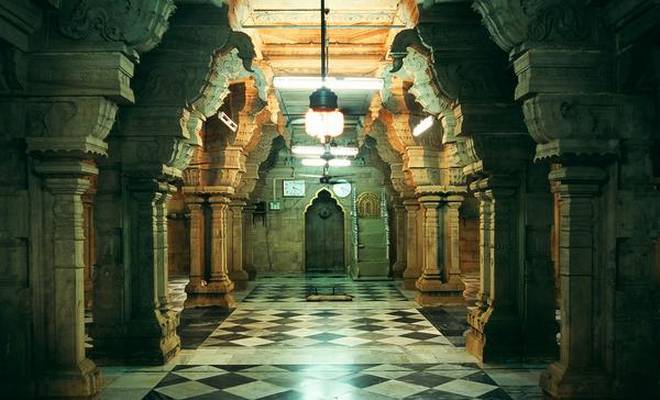
As mosques are called Palli Vaasal in Tamil, and they were built of kal, the Tamil word for stone, they came to be locally known as kallupallis. These kallupalliswere essentially built more like mandapams, better suited to Islamic requirement for the congregation to assemble and stand together in prayer.
Engraving of Tamil calendar for prayer found inside the mosque
With guidelines for the construction of mosques being simple – such as prayer facing Mecca, no idol worship and clean surroundings, the masons who worked on these mosques under the supervision of religious heads restricted themselves to carving floral and geometrical motifs instead of human figures as in a temple. “While the raised ‘Adisthana’ of the Hindu temple was retained, there were no ‘Garbha Grahas’ and no figurines carved on any of the pillars” says Dr.Raja Mohammad, author of Islamic Architecture in Tamil Nadu.
For more than a millennium, hundreds of such mosques built in the Dravidian Islamic architectural style came up across Tamil Nadu, often with the help of grants from the rulers of the day, ranging from the Cheras, the Pandyas, the Venad kings and the Nayaks to the Sethupathis of Ramanathapuram. Across Tamil Nadu, wherever Tamil Muslims lived in large numbers, from Pulicat near Chennai to Kilakarai, Kayalpatnam, Kadayanallur, Kottar, Tiruvithancode, Madurai, etc., one finds these beautiful kallupallis.
Amongst these kallupallis, though not the oldest, the most beautiful mosque is to be found at Kilakarai, near Ramanathapuram. A medieval port town with a predominant Tamil Muslim population, Kilakarai has many mosques built during different eras spanning many centuries. The one built towards the end of 17th Century is the most beautiful of them all. It is believed to have been built by the great merchant and philanthropist Periathambi Marakkayar, also known as Seethakkathi, whom the Dutch records speak of as a great trader having considerable influence with the Sethupathis, the then rulers of Ramanathapuram.
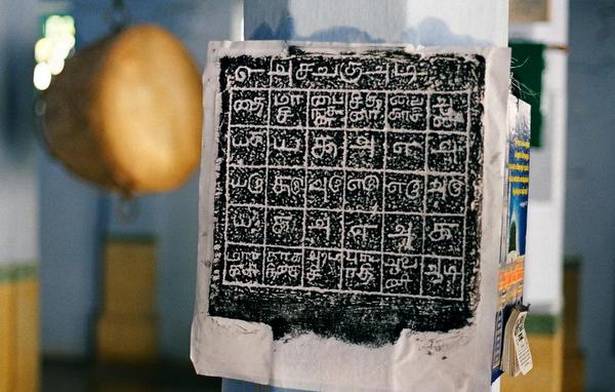
The mosque built in the Dravidian architectural style of the late Vijayanagara period, has elements that are specific to native traditions. Like many other kallupallis, this mosque too has Podhigai, the floral bud detailing on the pillar corbels, which represent positivity and auspiciousness, an essential part of the cultural beliefs of the land. An interesting engraving found in this mosque is the Tamil calendar for prayer.
What is unusual about this calendar is that, timings for prayers in the various Tamil months are marked in Tamil numerals, a rarity, found in just a few other mosques in southern Tamil Nadu.
These mosques, deeply embedded in the Tamil culture, were also places where Tamil flowered. Further down south, at the Kottar mosque in Nagercoil, an early Tamil Islamic literary work, Mikuraasu Malai, was presented to the assembled congregation by Aali Pulavar in the late 16th Century.
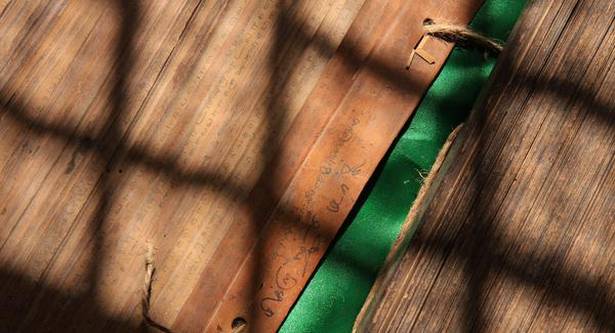
Mikuraasu Malai, a palm leaf work
Mikuraasu is a Tamilised form of Mihraj, and narrates a significant event in the life of Prophet Muhammad (Pbuh), his ascension to the heaven. Even after 400 odd years, the tradition of singing Mikurasu Malai on the eve of Mihraj continues to this day at the Kottar mosque. Other literary works such as Seera Puranam, a Tamil epic on the history of the Prophet, are also recited across mosques in Tamil Nadu.
The Kallupallis in Tamil Nadu stand as proud reminders of not just an architectural tradition but also of cultural traditions, where Islam effortlessly adapted itself to the native customs.
source: http://www.thehindu.com / The Hindu / Home> Society> History & Culture – Anwar’s Trail / by Kombai S. Anwar / November 23rd, 2017