TAMIL NADU :
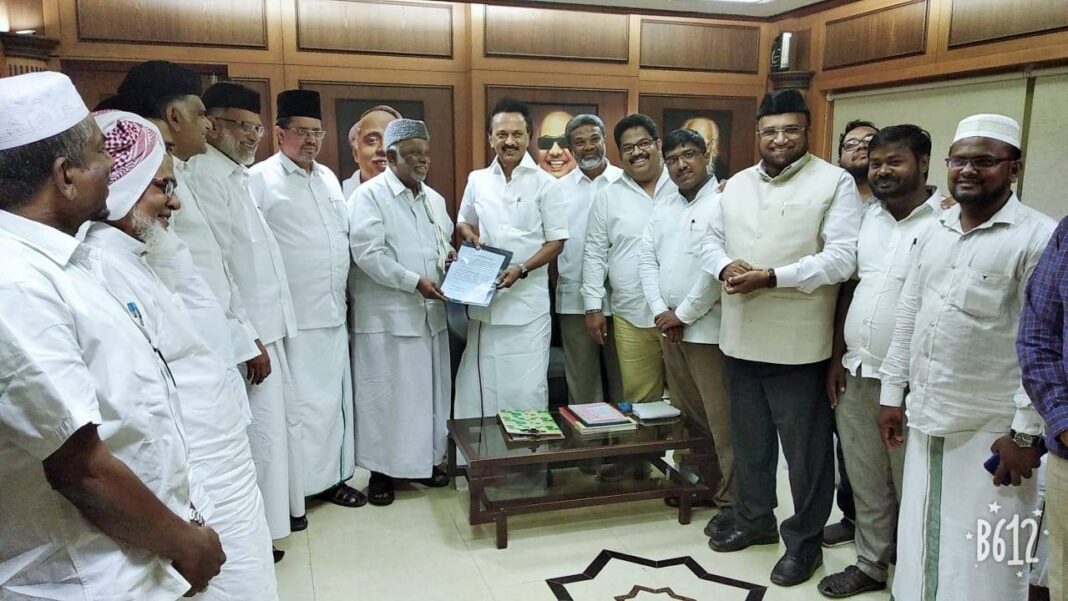
Representational photograph
New Delhi :
Ahead of the Assembly elections in Tamil Nadu, scheduled for April-May 2026, the Muslim community is emerging as an important player in the poll-bound state, with Chief Minister M.K. Stalin rolling out several welfare initiatives aimed at benefiting them. Stalin has laid emphasis on the ruling Dravida Munnetra Kazhagam’s (DMK) historical ties with Muslims.
Muslims in Tamil Nadu constitute approximately 5.86% of the state’s population. Their number in the state was 42 lakh, as per the 2011 Census, and they primarily belong to the Tamil-speaking Labbai, Marakayar, and Rowther communities. With a history dating back to 7th century Arab trade, they are well-integrated, often using Tamil as their native tongue, and exhibit high social, literacy, and economic indicators compared to other regions.
In a powerful message to the ruling Bharatiya Janata Party (BJP) at the Centre, Stalin has claimed that Tamil Nadu is the “only state which is safe for Muslims” and described the DMK as a fortress that protects the minorities in the state. Because of this, incidents like mob lynching could not rear their head in Tamil Nadu, Stalin said at a function at Kumbakonam recently.
The occasion was the State Mahalla Jamaats Conference organised by Indian Union Muslim League (IUML) near Kumbakonam, in which office-bearers of around 8,000 Jamaats from across the state participated. In his address, Stalin launched a scathing attack on the Central Government, accusing it of using central agencies like the CBI, ED, and IT to intimidate political opponents and the public.
The Chief Minister remarked that he did not need to explain the current situation of the country further, implying a climate of pressure from the Centre. His remarks were indicative of the DMK’s strategy to consolidate minority votes by positioning itself as a primary defender against central interference and communal insecurity.
Stalin accused the Opposition All India Anna Dravida Munnetra Kazhagam (AIADMK) of betraying minority communities to appease central authorities in Delhi. He asserted that only the DMK-led Secular Progressive Alliance has the strength to defeat the anti-people AIADMK-BJP alliance in the upcoming Assembly elections.
Stalin announced five welfare schemes for Muslims on the occasion, including the establishment of a third Waqf Tribunal at Coimbatore and the increase of pension for Ulema registered with Tamil Nadu Waqf Board from Rs. 3,000 to Rs. 5,000, and the family pension from Rs. 1,500 to Rs. 2,500.
Stalin also announced that in the first phase of a scheme, 1,000 Ulema will receive the increased subsidy of Rs. 50,000 for buying two-wheelers. The Ulema play a pivotal role as Islamic scholars in Tamil Nadu’s Muslim societies, acting as guardians and interpreters of religious knowledge and law. They are highly respected for their deep understanding of Islamic theology, Sharia law, and the Hadiths, guiding the Muslim community on matters of faith and practice.
The other announcements included creation of burial grounds in City Corporation areas where there is none, and filling of 10 vacant posts of Urdu language teachers at the government high schools and higher secondary schools. Stalin said the efforts of those who were trying to disturb peace had been in vain, and added that they had formed in their own interest, an alliance of those who are servile by threatening with agencies like ED, CBI and IT.
Pointing at AIADMK’s support to the contentious Citizenship Amendment Act (CAA), 2019, the Chief Minister said the Leader of Opposition, Edappadi K. Palaniswami, has been continuing his betrayal of Muslims. “But for AIADMK’s support, the CAA Bill would have been defeated in the Rajya Sabha,” he said. He further pointed out that the DMK government had courageously declared the CAA would not be implemented in Tamil Nadu.
Stalin also referred to the DMK’s vote against the Triple Talaq Bill and Waqf Amendment Bill. “If the BJP alliance comes to power in Tamil Nadu, it will ruin the developed state. Only the DMK alliance has the courage and strength to stop it from coming to power,” he declared.
Pointing out that the DMK cadre have started their door-to-door campaign, he urged the IUML cadre, particularly the youth and women, to campaign for those who will protect and enable their growth. IUML chief K.M. Kader Mohideen, who presided over the meeting, said his party and members of Mahalla Jamaats will ensure the continuance of the Dravida model of governance.
The key aspects of Muslims in Tamil Nadu include their cultural fusion, social harmony, and concentration in towns like Kayalpatnam, Kilakkarai, Adirampattinam, and Melapalayam. Chennai also has a notable Muslim population, comprising about 9.45% of the capital city’s total population.
The Tamil Muslims are known for a unique synthesis of Tamil culture and Islamic faith, with strong traditions in trade and education, particularly in coastal towns. The community is primarily Sunni, with diverse, well-integrated, and long-settled, as well as some Dakani-speaking groups. The presence of ancient mosques like the Kilakaraj Jumma Masjid, built in 7th century, highlights early Islamic contact through maritime trade, while Tamil Nadu is often described as a model for communal coexistence because of its peaceful Muslim community.
source: http://www.indiatomorrow.net / India Tomorrow / Home> Debate / by India Tomorrow Correspondent / February 03rd, 2026
