Indore, MADHYA PRADESH :
There are individuals in smaller cities who have taken upon themselves the task of archiving, preserving, narrating, and circulating historical narratives — all for the love of the place and history. Indore-based Zafar Ansari is one such person who has been painstakingly collecting historical artefacts on Indore since three decades.
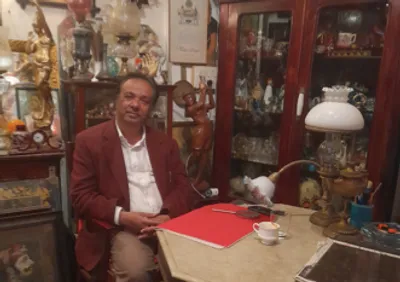
Zafar Ansari in his Museum Office. Photo: C. Yamini Krishna
As I was preparing for my research visit to Indore for a study on the princely state of Indore, all I found online were a few articles from Free Press Journal on the city. It was just a glimpse of how much of the ‘national’ media coverage and public history writing is focussed on the metropolitan cities.
Absence, inaccessibility, decay of archives and historical artefacts are constant challenges faced by history scholars in India. The lack of historical consciousness, poor funding, disinterest, discrimination, and destruction of the archives based on the ideology of the ruling disposition are some of the known reasons why such problems exist. These challenges are acute as one moves beyond the metropolitan cities, into the smaller cities and towns.
History in India, has mostly been studied from the perspective of the nation and to such endeavour small places are often insignificant. Also due to the policy of housing all the state archives in capital cities and the absence of efforts to do neighbourhood or local/regional histories, smaller cities almost feel ‘history less.’
However, inspite of the institutional gap, voices from the smaller cities are not silent. Each time I have ventured into these cities in search of archives, I have always met individuals who have taken upon themselves the task of archiving, preserving, narrating, and circulating historical narratives — all for the love of the place and history.
Indore-based Zafar Ansari is one such person who has been painstakingly collecting historical artefacts on Indore since three decades. “It all started when I received the National Youth Award for my social activities in 1994. The then President Dr Shankar Dayal Sharma said, do something great, and then I decided I will build a museum for Indore,”Ansari says with a sparkle in his eye as he narrated his dream to make a museum for his beloved city Indore.
“This will be one of its kind museum, dedicated to the city, telling the story of the city,” he mentioned. His office in Barwani Plaza in Old Palasia, bustling with artefacts, feels like a portal into another time. As one spends time with these objects, they start speaking through the voice of Ansari.
A miniature maker for industries by profession, Ansari spends more than 60% of his income towards the museum. He never lets any historical object pertaining to Indore pass, without acquiring it, sometimes this means he has had to pay very high price. “It is almost like an addiction,” he says, “It has its flip sides. I have never been able to pay my daughter’s education fee before the last date.”
The history walks, myth-busting artefacts and rare photographs
Ansari is also committed towards sharing his collection. He conducts history walks in the city and curates specific objects from his collection to tell stories of the city. Ansari has recently conducted one such walk for some of the dignitaries who had visited India during the G20 summit. He regularly runs a history column in Dainik Bhaskar where he reintroduces stories of the past to Indore’s citizens.
“I don’t just write about Kings, but also about common people, their lives,” he says, what a historian would call the social history of the place.
Through his consistent effort of writing more than 300 essays on history, Ansari has built a cannon of public history for Indore. Sitting among those objects, he narrated how Indore (state) became a commercial centre due to its close connection with opium trade, “Opium would come from Mansur to Indore and then to Bombay. Many traders and merchants from Rajputana and Gujarat settled here to do opium trade with China. After the ban on opium, the trade was converted to cotton industry.”
Ansari is hopeful that his museum will be a pedagogic intervention. “History is not something to be taught in a classroom, it has to be taught in an archive or a monument or on field using objects and artefacts,” he notes. His work with the artefacts also helps him dispel certain myths and false narratives in circulation.
Ansari’s collection has helped writers like Geraldin Lenain to write books such as The Last Maharaja of Indore by providing access to many rare photographs.
A historian or an antiquarian
After meeting Ansari, I was wondering, if there is a term to describe this love for history, something like a cinephile in case of film.
A historian is often a tag used to describe someone who engages in the work associated with history making, professionally, i.e. as a main vocation. A history buff, focusses more on consumption of history and fails to capture the commitment shown by these keepers of a city’s lore. A collector, is often differentiated from an archivist as someone who is more involved in the process of acquiring artefacts, and is not primarily oriented towards providing access. Someone like Ansari, however, who harbours a hope to build a museum, would fall somewhere in between these two.
Cambridge Dictionary offers a word antiquarian, “a person who studies or collects old and valuable or rare objects.” Antiquarianism historically has often had a negative connotation, as someone in an almost ‘mindless’ pursuit of collecting objects and committed to the minute details of it. Historian, on the other hand, is someone who narrativised the past, with the focus on writing.
Historian Rosemary Sweet notes that history writing could be done for political or polemical purposes while antiquarians prided themselves to be impartial and staying true to the material. Antiquarians are often interested even in objects of everyday life which was not of interest to historians. Interestingly, Sweet points out that the contemporary practice of history, associated with archival study, which relies on the details presented by historical artefacts is very close to antiquarianism.
After searching for these variety of terms, I am still left with no word to capture the affective engagement with history which I experienced in the office of Ansari, where history is not just a vocation or a profession, where there is a lot at stake in telling stories of the past, a significant portion of one’s earnings. This voice of history is not a dispassionate, distant evaluation of the past, but is an expression of belongingness.
Deeply personal work like this has larger social implications, it is about communities taking the ownership of their own history, and inculcating historical consciousness among themselves. Such efforts go a long way in forming the first line of defence against vilification of history and weaponisation of history for political gains, of which we are seeing increasing incidence.
C. Yamini Krishna works on film history, urban history and Deccan history. She is a part of the Khidki collective. She currently teaches at FLAME University.
This work was done as a part of the Foundation Project is implemented by India Foundation for the Arts (IFA) under the Arts Research programme, made possible with support from BNP Paribas India.
source: http://www.m.thewire.in / The Wire / Home> Culture / by C Yamini Krishna / May 16th, 2024