Tag Archives: Zohran Mamadani

Zohran Mamdani’s New York win revives a forgotten history — of Gujarati Muslim cosmopolitanism

GUJARAT / UGANDA / New York, U.S.A :

From Mughal ports to Dutch wars to Bombay’s merchant dynasties, Gujarati Muslims once shaped the Indian Ocean world — long before one of their descendants took New York.
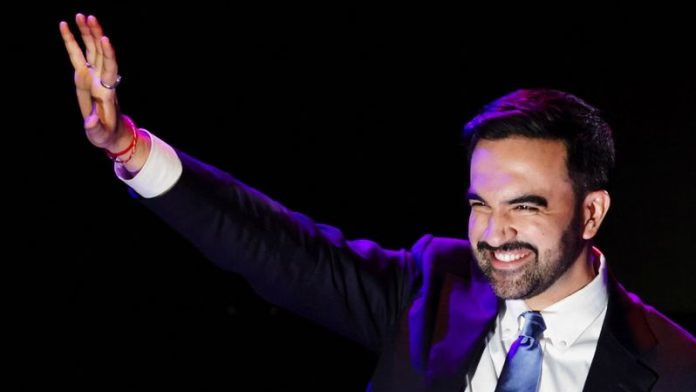
File photo of Zohran Mamdani | Reuters 2025

_______________________________________________

What You Need to Know

Zohran Mamdani’s election highlights a forgotten Indian Muslim cosmopolitanism. Historically, Gujarati Muslim communities dominated Indian Ocean trade, challenging European powers and fostering diverse business relationships. Later, groups like the Khojas adapted through “corporate Islam” (jamaats), becoming powerful economic forces globally. This rich, diverse history is increasingly overshadowed by modern religious nationalism.

*AI-generated summary. Check context in original text.

________________________________________________

Having delivered speeches in Gujarati, Bengali, Arabic, Hindi, Luganda, and Spanish, Mamdani is a reflection of a long-forgotten Indian Muslim cosmopolitanism. The Gujarati Muslim communities he descends from once challenged the Dutch for hegemony in Indonesia; poured money into schools, hospitals, and printing presses from Japan to Arabia; and helped the British Empire consolidate its grip over Africa. To this day, that Indian Muslim history still echoes — in high-end London auction houses as much as in the working-class boroughs of New York.


The election of Zohran Mamdani as Mayor of New York last week has struck a surprising chord in the world’s media — especially considering he is technically the head of just one American city’s administration. But the buzz around this young Indian-origin Muslim, an avowed democratic socialist, is a ripple in a much older ocean.

Gujaratis in the Indian Ocean

This column began with a rather innocuous tweet pointing out that Mamdani’s multilingualism would have made him a fortune in the early modern Southeast Asian spice trade. As of writing, it has racked up over one million views and 54,000 likes — and it’s a pretty accurate reflection of what propelled Gujarati Muslims to international trade superstardom in the first place.

In her paper ‘Gujarat’s Trade with South East Asia (16th and 17th centuries)’, historian Ruby Maloni describes the great port of Khambhat in Gujarat as having “stretched out two arms — one towards Aden, the other towards Malacca.” While Banias were especially prominent in East Africa and the Persian Gulf at the time, Gujarati Muslim merchants dominated the Malacca trade, conveying relatively cheap block-print textiles from manufactories in Ahmedabad deep into Southeast Asia to trade for spices.

The most prominent among these merchants effectively formed ‘dynasties’ closely linked to the Mughal court, among others. But there was also a strong aspect of caste-based collective organisation, paralleling that of Hindu and Jain Gujaratis.

Nowhere was this more evident than in Surat, perhaps the most impressive port on India’s west coast. Its multilingual babble included Gujarati, Arabic, Persian, Urdu, Dutch, English, and Portuguese. Certainly, there were clear distinctions between caste and religious groups, and within their communities Gujarati merchants — Hindu and Muslim alike — could be quite rigid. At the same time, in interpersonal and business relationships, their shared Gujarati heritage encouraged cosmopolitan attitudes.

Historian Jawaid Akhtar offers several examples in his paper ‘The Culture of Mercantile Communities in Mughal Times.’ In Surat, Armenian merchants were in business with Parsis and Muslims; Vaishnavite Bhatias, despite a taboo against crossing the ocean, jointly owned cargo and ships with Muslims. Akhtar cites documentary evidence of Bania men adopting Muslim practices such as offering dowers to their wives. Muslim and Hindu merchants also collectively represented their grievances to Mughal authorities.

On one occasion in 1669, when the Qazi of Surat compelled a Vaishnavite Bania to convert to Islam, nearly 8,000 merchants — apparently of all religions — emigrated to Bharuch in protest against this infringement of their privileges.

Gujarati Muslims quickly identified Europeans as a threat to their trade dominance in Southeast Asia. Maloni notes that Dutch East India Company records mention their difficulties with these merchants, who took them on through price wars and by installing their own candidates as port authorities. It seemed that there was nothing the Dutch could do to prevent Gujarati Muslims from trading. The Sultanate of Johor welcomed ships belonging to the merchant Haji Zahid Beg, who bought tin in flagrant defiance of Dutch embargoes. Other merchants, Maloni writes, hired cargo space on English ships; the spectacularly wealthy merchant Abdul Ghafur of Surat even flew Dutch flags on his own ships. It was only when the Dutch forcibly colonised much of Indonesia that Gujarati Muslims finally lost their grip on Malacca. But by then, new opportunities were already emerging on the horizon.
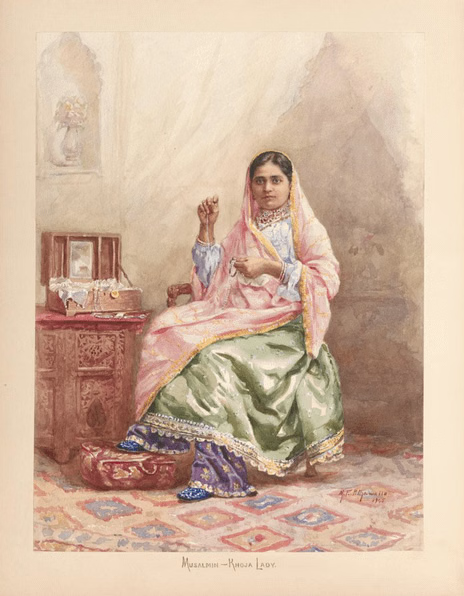
Khoja Lady | From the album presented to the Princess of Wales by the women of Bombay, featuring 13 full-page watercolours of Indian women by artist Manchershaw Fakirjee Pithawalla (1872-1937) | Wikimedia Commons

The rise of ‘Corporate Islam’

As the Mughal juggernaut began to shake and unravel in the 18th century, the old order of great merchant princes and dynasties started to fall apart. Surat, repeatedly raided by the Maratha king Shivaji, faced growing competition from the East India Company’s new port at Bombay.

Three Gujarati Muslim communities — the Bohras, Memons, and Khojas — who had hitherto been relatively small-time traders, found themselves ideally placed to benefit from the changing political landscape. Zohran Mamdani descends from the last of these.

In his seminal book No Birds of Passage: A History of Gujarati Muslim Business Communities, 1800–1975, historian Michael O’Sullivan notes that these three groups had spread “as far east as Ujjain, as far west as Karachi, as far south as Poona, and as far north as Udaipur… They thus inhabited a territory that was, by the reckoning of an Indian lexicographer in the 1840s, larger than Great Britain and Ireland, with their shared mother tongues [Gujarati] serving as the principal language of business in Central and Western India.”

The Bohras, Memons and Khojas had all converted to Islam around the 15th century, but their social and cultural practices varied drastically. Subgroups were affiliated with various Sunni and Shia sects; some were Ismaili and revered the Aga Khans, while others traced descent by region and worshipped Sufi saints.

What these groups shared, though, was the jamaat —an institution that O’Sullivan describes as a form of “corporate Islam”. Essentially, members of each jamaat shared some resources in common — schools, hospitals, that sort of thing. Particularly wealthy members, who often held senior religious positions, also maintained private family trusts and companies.

What the jamaat ensured, O’Sullivan writes, was a mechanism for organisation, exclusivity, and interpretation, allowing these communities to adapt the changing contours of Islamic practice to an era of globalisation. Jamaats could mobilise capital, human resources, and theological flexibility at a rate few other Indian institutions could match.

Collectively, these Gujarati Muslim jamaats emerged as some of the most powerful Indian economic forces of the late 19th and early 20th centuries. Though now outshone in the popular imagination by Parsi and Bania entrepreneurs, Gujarati Muslims similarly negotiated with the Marathas and the British, benefited from the Opium Wars, and switched soon after to manufacturing all sorts of commercial goods, especially in Bombay.

In the 1840s, Gujarati Muslims commissioned pioneering printed texts — in Gujarati — including travelogues and cultural primers for new markets like China. Their growing wealth also funded spectacular mansions, such as those in Sidhpur, now eerily abandoned. It was Gujaratis, perhaps more than any other Indian group, who built the financial infrastructure of the British Raj in East Africa — a migration line from which Zohran Mamdani himself descends.

All of this amounted to a decisive shift in the centre of gravity of Indian Ocean Islam. It was for this reason that the Aga Khan, revered by Ismaili Khojas, moved his seat from Iran to Bombay before Partition.
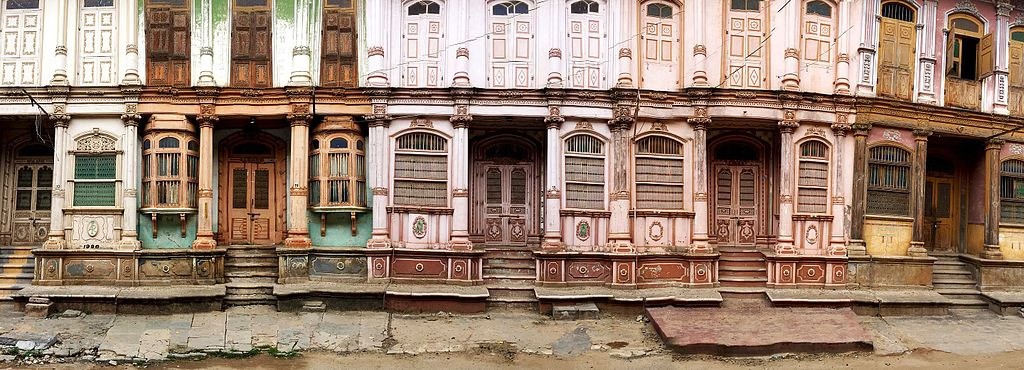
Sidhpur city in Gujarat | Wikimedia Commons

A cosmopolitanism forgotten

The versions of Islam promoted by Gujarati Muslims absorbed the modernist vocabulary of capital accumulation and inheritance, frequently splintering into new jamaats as they expanded into ever-new markets and cultures.

At the same time, as researcher Danish Khan notes, Gujarati Muslims attained positions of leadership and influence in Bombay well before they had even set foot in the United States of America. “The first Muslim baronet in colonial India,” he writes, “was a Khoja and the first Muslim ICS officer was a Sulaimani Bohra. Badruddin Tyabji and Rahimtoola Sayani were the first two Muslim Presidents of Congress party. Sir Adamjee Peerbhoy presided over the first session of the Muslim League in Karachi.”

But with the rise of pan-Islamic and Hindu nationalism in the early 20th century, the scales swung once again, and mercantile, oceanic histories were overridden by grievances inspired by long-dead inland kings.

Where does the history of Gujarati Muslims fit now? Mamdani’s election is ironic on many levels. In Bombay, once the historic home of the community, a BJP politician declared, in response to Mamdani’s victory in New York, that “We won’t allow any Khan to become mayor.”

The fact is that before and since, the history of Gujarati Muslims has, for all intents and purposes, disappeared into the ever–widening gap between radical Hindutva and radical Islam. Every news cycle, it seems, tears India’s many intertwined histories further apart.

Anirudh Kanisetti is a public historian. He is the author of ‘Lords of Earth and Sea: A History of the Chola Empire’ and the award-winning ‘Lords of the Deccan’. He hosts the Echoes of India and Yuddha podcasts. He tweets @AKanisetti and is on Instagram @anirbuddha.

This article is a part of the ‘Thinking Medieval’ series that takes a deep dive into India’s medieval culture, politics, and history.

(Edited by Prashant Dixit)

source: http://www.theprint.in / The Print / Home> Opinion> The Fine Print / by Anirudh Kanisetti / November 13th, 2025
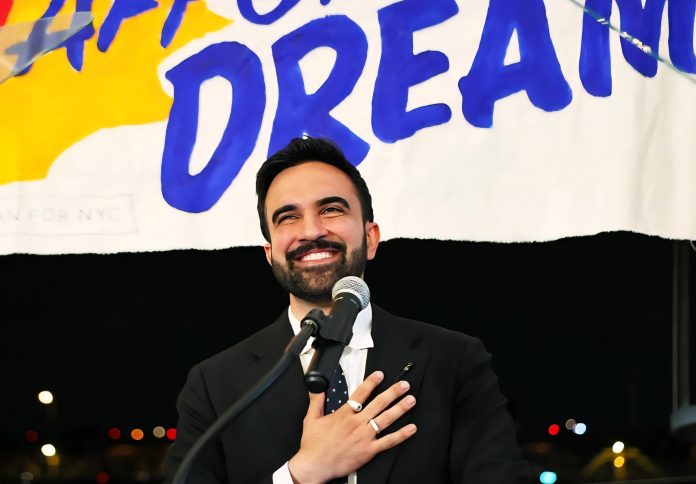
Mamdani’s Hindustani Effect: A Historic Triumph for Inclusion in New York

GUJARAT/ UGANDA / New York, U.S.A. :

Zohran Mamdani

A Historic Win

“I am a Democratic Socialist, I am a Muslim… I am not apologizing for either.” With these words, Zohran Mamdani declared victory in the New York City mayoral race, a symbolic global capital of commerce and culture. His triumph rekindled hope among conscientious citizens in New York and resonated worldwide, especially amid the rise of populist, authoritarian-leaning leaders who thrive on division and privilege wealthy allies.

Only a year prior, Mamdani was widely seen as an underdog. Yet he defeated Andrew Cuomo, the former governor who ran as an independent and received informal support from prominent national figures, including the sitting president. Mamdani garnered just over 50 percent of the vote, becoming the youngest mayor in a century and the first Muslim and South Asian to hold the office. His campaign also achieved one of the highest voter turnouts in New York City since 1969, signalling renewed civic engagement for a progressive, inclusive agenda.

Political Polarization and Economic Context

While such a victory might appear routine in an established liberal democracy, it must be understood against the backdrop of deep U.S. political polarization since the Trump era. Divisive rhetoric and exclusionary policies fractured communities and workplaces, stifling dreams and limiting opportunity.

During the Trump administration, harsh immigration enforcement via ICE and other agencies fuelled fear in immigrant communities. Arbitrary detentions, wrongful arrests, and forced family separations became emblematic of policies that disregarded due process and human dignity. At the same time, tariffs and trade disputes increased living costs, particularly in metropolitan areas like New York. Rising rents and price hikes strained households across demographics, as economic hardship transcends ethnicity, citizenship, or geography. Some commentators noted that the political climate during Mamdani’s election was marked by tension between the federal administration and certain Democratic-led cities. Debates around federal funding, social welfare programs, and executive rhetoric heightened the stakes of the mayoral race, creating a context in which Mamdani’s message of local accountability and inclusion resonated strongly with voters.

The Socioeconomic Landscape of New York

New York City, with a population of approximately 8.48 million as of 2024, is among the world’s most diverse urban centres. Over 30 percent of residents are foreign-born, representing more than 100 nationalities. Yet the city struggles with high income inequality, reflected in a Gini coefficient of 0.555. Housing shortages, rising rents, and long commutes—averaging 41 minutes—have made the city increasingly unaffordable for lower- and middle-income households, prompting out-migration to suburbs.

Employment levels have recovered post-pandemic, with private-sector jobs growing 2.8 percent in 2024–25, yet the income gap continues to widen. Households in the highest quintile earn more than twenty times those in the lowest quintile. Policies favouring high-income earners during prior administrations exacerbated this structural inequality.

A Campaign Grounded in Inclusion

Mamdani’s success can be attributed to his focus on everyday concerns of New Yorkers: affordability, public transportation, universal childcare, housing, and progressive taxation. He positioned himself against divisive political rhetoric, resonating across New York’s diverse communities and appealing to those marginalized economically or socially helping unite both conservatives and liberals as economic hardship doesn’t see political allegiance.

A defining moment in his campaign was his emphasis on local priorities. During a mayoral debate, while other candidates pledged their first visit abroad to Israel, Mamdani highlighted his responsibility to New Yorkers first, reinforcing his commitment to municipal governance over symbolic foreign policy gestures.

He also navigated sensitive international issues with nuance, affirming support for the safety and rights of Jewish residents while criticizing the humanitarian crisis in the occupied Palestinian territories. His stance on human-rights accountability, including adherence to ICC mechanisms, underscored a principled approach that strengthened his political credibility.

Major New York City billionaires marshalled tens of millions of dollars to thwart Zohran Mamdani’s mayoral campaign, deploying deep-pocketed political machinery in support of his opponents. For instance, former Mayor and billionaire Michael Bloomberg is reported to have donated approximately US$8.3 million to the pro-Andrew Cuomo super-PAC Fix the City. Hedge-fund billionaire Bill Ackman contributed at least US$1 million to the anti-Mamdani PAC Defend NYC, and additional sums to Fix the City.

Concurrently, opposition efforts against Mamdani involved advertisements and mailers that his campaign denounced as blatant Islamophobia. For example, a mailer circulated by the pro-Cuomo super-PAC Fix the City was reported to have altered his appearance, darkening his beard and lightening his skin, a move Mamdani characterized as racially and religiously discriminatory. In addition, opponents sought to question his political allegiances, falsely portraying him as a supporter of Hamas and suggesting that he did not recognize Israel’s right to exist—claims that his campaign firmly rejected as misleading and defamatory.

Engaging Communities on the Ground

Mamdani’s outreach strategy was multifaceted and culturally inclusive. Campaign messaging spanned multiple languages, reaching New Yorkers across diverse linguistic and ethnic backgrounds. Beyond digital platforms, he visited places of worship, including Hindu temples, Jewish synagogues, and Christian churches, reinforcing interfaith solidarity.

He also engaged with ethnic food outlets and small businesses, highlighting immigrant contributions to the city’s cultural and economic life. This ground-level engagement translated into broad support across communities—Muslims, Christians, Jews, and secular groups alike—demonstrating a shared alignment with his vision for an inclusive, socially just New York.

Diasporic Resonance and Global Context

Mamdani’s heritage evokes transnational connections to India and Uganda, reflecting the experiences of diaspora communities navigating multiple cultural and political identities. His election elicited reactions from segments of Indian nationalist (Hindutva) movements, including online circulation of Islamophobic commentary. In contrast to widely celebrated Indian-origin figures such as Rishi Sunak, Kamala Harris, Tulsi Gabbard, and Usha Vance—often cited as symbols of India’s soft power abroad—Mamdani’s identity as a Muslim and his candid critique of the 2002 Gujarat riots have positioned him outside these narratives. He has reflected thoughtfully on the experiences of Muslims in New York, observing that “to be Muslim in New York is to expect indignity,” while emphasizing that such challenges do not define the broader community. His principled approach extends to global issues as well; his measured stance on the Israel–Palestine conflict underscores a commitment to human rights and ethical governance, reinforcing his reputation as a leader guided by conscience and social justice rather than partisan or sectarian considerations.

Zohran Mamdani’s unapologetic assertion of his identity, faith, and commitment to the public good offers a potential model for Indian Muslims and other marginalized communities confronting the rise of militant Hindutva and an increasingly adversarial state. His example demonstrates that principled, assertive engagement—grounded in inclusivity and social justice—can effectively challenge exclusionary and sectarian politics. Secular political parties in India, which in recent years have often sidelined Muslim voices in public life, might draw lessons from Mamdani’s approach: defeating divisive politics requires active, unapologetic advocacy for inclusion and pluralism, rather than silence or timidity. In essence, countering the forces of social and political exclusion demands a combination of ethical clarity, strategic assertiveness, and public visibility.

A Template for Inclusive Politics

Domestically, Mamdani’s rise occurs amid American ideological polarization and Democratic Party struggles to counter authoritarian rhetoric. His unapologetic advocacy for inclusive, pluralistic, and redistributive policies offers a potential model for progressive politics, reinforcing democratic values while countering divisive populism.

Mamdani’s victory, therefore, represents more than a personal or partisan success: it is a reassertion of democratic ideals, a rejection of exclusionary politics, and a renewed belief in a morally grounded, economically just, and inclusive vision that resonates far beyond New York City.

Diasporic Resonance and Global Context

Mamdani’s heritage evokes transnational connections to India and Uganda, reflecting the experiences of diaspora communities navigating multiple cultural and political identities. His election elicited reactions from segments of Indian nationalist (Hindutva) movements, some of whom circulated Islamophobic commentary online.

In contrast to celebrated Indian-origin figures such as Rishi Sunak, Kamala Harris, Tulsi Gabbard, and Usha Vance—often cited as symbols of India’s soft power—Mamdani’s identity as a Muslim and his critique of the 2002 Gujarat riots positioned him outside such narratives. He has reflected on the experiences of Muslims in New York, noting that “to be Muslim in New York is to expect indignity,” while emphasizing that these challenges do not define the broader community. His principled, humanitarian approach extends to global issues, with a measured stance on the Israel–Palestine conflict that underscores his commitment to ethical governance and human rights.

A Model for Marginalized Communities

Mamdani’s unapologetic assertion of his identity, faith, and commitment to the public good offers a potential model for Indian Muslims and other marginalized communities confronting militant Hindutva and adversarial state policies. His example demonstrates that principled, assertive engagement—grounded in inclusivity and social justice—can effectively challenge exclusionary politics. Secular political parties in India, which in recent years have often sidelined Muslim voices, might draw lessons from Mamdani’s approach: defeating divisive politics requires active advocacy for inclusion and pluralism rather than silence or timidity.

A Template for Inclusive Politics

Domestically, Mamdani’s rise occurs amid increasing ideological polarization in the U.S. and ongoing struggles within the Democratic Party to counter authoritarian and exclusionary rhetoric. His unapologetic advocacy for inclusive, pluralistic, and redistributive policies offers a potential model for progressive politics, reinforcing democratic values while challenging divisive populism.

Ultimately, Mamdani’s victory represents more than a personal or partisan success: it is a reaffirmation of democratic ideals, a rejection of exclusionary politics, and a renewed belief in a morally grounded, economically just, and inclusive vision—one that resonates far beyond New York City.

source: http://www.muslimmirror.com / Muslim Mirror / Home> Opinion / by Mushtaque Rahman / November 11th, 2025