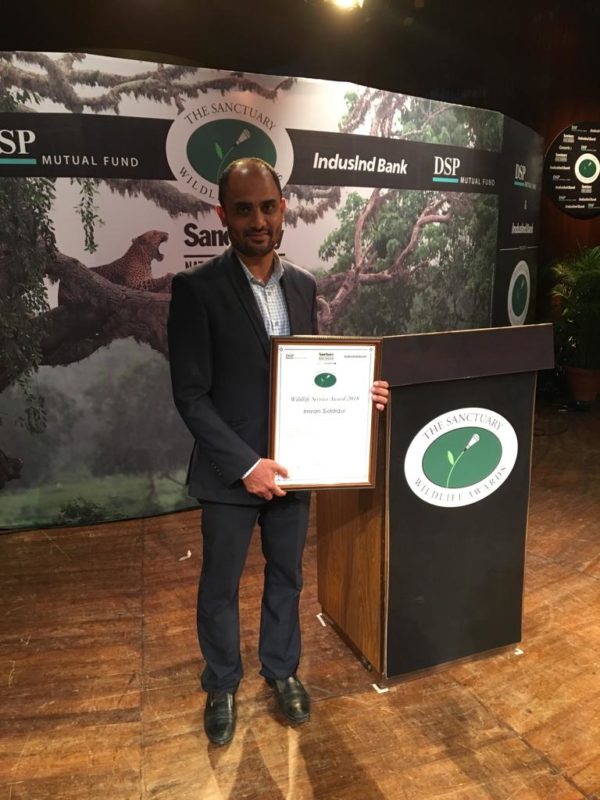
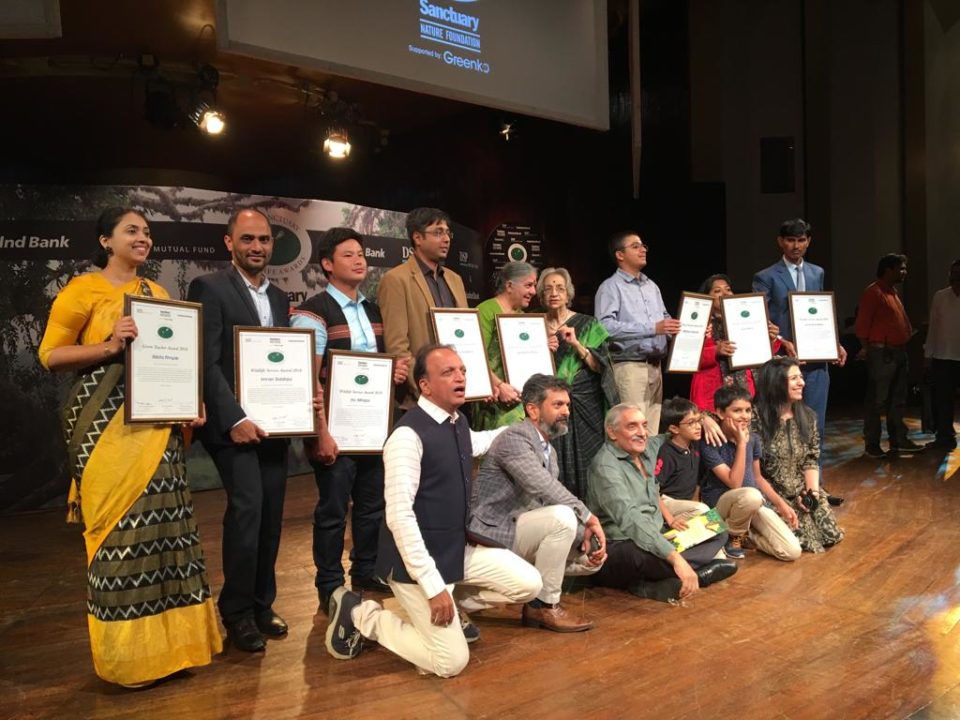
Imran Siddiqui of the Wildlife Conservation Society – India has been honoured with the prestigious Sanctuary Wildlife Service Award 2018.
Imran Siddiqui has come a long way from raising and selling poultry to fund his wildlife obsession.
He is now on the Telangana State Board for Wildlife and works as an external expert for tiger monitoring in Andhra Pradesh and Telangana. He is also the Assistant Director for Conservation Science at WCS-India, and the co-founder of the Hyderabad Tiger Conservation Society (HyTiCoS).
As his life and work reveal, Imran has no respect for man-made boundaries, much like the wildlife he’s so obsessed with. Traversing the rugged landscapes of Kawal, Amrabad and Nagarjunsagar-Srisailam Tiger Reserves and the Gundlabramheswaram Sanctuary, he works in tandem with state forest departments and local communities. His work covers 10,000 sq km of wilderness in Telangana and Andhra Pradesh, with his crew comprising over 35 field staff, 300 volunteers and hundreds of supporters.
Taking a cue from the success of WCS-India in Karnataka and extending it to the neighbouring states of Andhra Pradesh and Telangana, he leads scientific surveys on prey analysis and occupancy surveys on mammals.
He also helps in management planning, engages in snare removal drives, initiates voluntary relocation programmes for forest dwellers, facilitates capacity building workshops for the forest department and influences policy through public interest litigations, high-level committees, community engagement, strong advocacy and creating political will on wildlife.
His efforts have resulted in the speedy disbursal of compensation, besides the initiation of relocation of landless tribals who live within the two tiger reserves of Kawal and Amrabad.
Imran is also largely credited for the declaration of the Kawal Tiger Reserve (where he conducted the fieldwork for his Masters dissertation). For this he had to lobby relentlessly at the political level as well as work tirelessly on the ground to counter misinformation spread by vested interests, and finally win the support of local communities.
A tenacious man on the field and a convincing man in the boardroom, Imran Siddiqui is in no small way responsible for the revival of tigers in this vast but obscure landscape.
The Sanctuary Wildlife Service Award 2018 is a testimony of his untiring efforts to save wildlife and wild places.
source: http://www.india.wcs.org / WCS – Wildlife Conservation Society / Home>News> Current Articles>Archive / by WCS India / December 07th, 2018
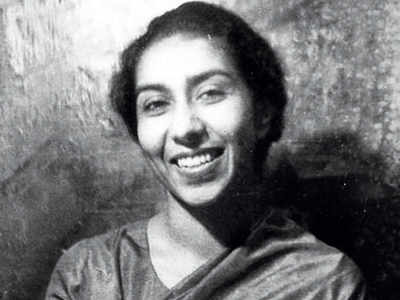
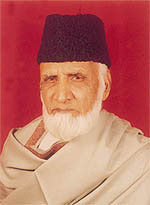
Asiya Siddiqi (1928-2019) (Pic Courtesy: Obaid Siddiqi)
Siddiqi also broke new ground by studying 20,000 HC insolvency records to recreate the lives of an array of 19th-century city inhabitants.
In an age that sometimes overrates quantity and is beguiled by grandiloquence, economic historian Asiya Siddiqi, who passed away on Monday morning, went against the grain.
A chronicler of 19th century India, she wrote just two books. But each was a culmination of decades of painstaking original research, presented in prose that many might describe as being quietly elegant. In between working on the two books, she edited a volume on trade and finance in colonial India.
She broke new ground in both her books by closely reading new or underutilised primary sources. In the second book, Bombay’s People, 1860-1898: Insolvents in the City, published in 2017 by the Oxford University Press, she not only tapped a voluminous new source, namely about 20,000 insolvency records in the high court, but also incorporated the innovative conceptual approach of microhistory to illuminate the past.
She admired the work of one of microhistory’s founding scholars, Italian historian Carlo Ginzburg, especially his book ‘The Cheese and the Worms: The Cosmos of a 16th Century Miller’. Microhistory focuses on small units of research, such as a village, a single event or an individual, instead of large ones such as nations, kingdoms and cities. Siddiqi’s chapter, ‘Ayesha’s World’, the story of an unlettered butcher’s wife, is a gem of this genre.
“She was a first-rate historian, approaching her work with a craftlike precision,” said Mariam Dossal, a friend of hers who is an urban and maritime historian of 18th and 19th -century Mumbai and a former professor at the University of Mumbai, where Siddiqi worked for everal years. “In Bombay’s People, her view was so rich and broad that it covered every kind of person who inhabited the city, from the wealthy Jamshetji Jejeebhoy all the way to Ayesha. One marvelled at her beautiful use of language, through which she recreated the worlds of these inhabitants. For Asiya, everybody deserved a history.”
Her early work on the 19th-century opium and cotton trade based in Mumbai was also influential, in particular her article ‘The Business World of Jamshetji Jejeebhoy’, which appeared in the Indian Economic and Social History Review in 1982. She worked for years on the private papers of the merchant who was a central figure in those two trades to offer a finely-etched view of the entrepreneurial climate of that period, while also shedding light on the ways in which Mumbai supported the growth of the British economy.
A large portion of these papers consisted of letters in which Jejeebhoy had recorded both his business dealings and social life in great detail. Because the papers were disintegrating in the heat and humidity of Mumbai, she got them laminated with help from her uncle Saiyid Nurul Hasan, who was then the union minister of state for education, Dossal recalled.
Asiya Siddiqi’s first book, Agrarian Change in a Northern Indian State: Uttar Pradesh, 1819 to 1833, published in 1973 by Oxford Clarendon Press, grew out of the thesis she did for her DPhil at Oxford University. In what became a classic of South Asian economic history, she analysed the relevant records with characteristic rigor, becoming one of of the earliest to show how colonial trade policies contributed to a severe agricultural depression in the region.
She grew up in Lucknow, and from 1962 worked in and on Mumbai for four decades. She moved in the late 1990s to Bangalore, where her daughter said she passed away peacefully in her sleep. Her husband was the eminent biologist Obaid Siddiqi, who founded the biology department at the Tata Institute of Fundamental Research in Colaba and the National Centre for Biological Sciences in Bangalore. He passed away in 2013.
Asiya Siddiqi balanced her research with bringing up four accomplished children: the eldest Imran, a leading plant biologist based in Hyderabad; Yumna, a professor of English in the US; and fraternal twins, Diba, a visual artist and high school social science teacher in Bangalore, and Kaleem, a computer scientist in Canada.
Siddiqi seemed happiest working by herself in the archives, as an independent researcher, although she had two productive teaching stints: one at Aligarh Muslim University, where she met her husband just after getting a bachelor’s degree at Oxford University, and the other at Mumbai University.
She quit teaching when, at one point she found it difficult to commute from her home in south Mumbai to the university campus in Kalina while also keeping up with her research and and raising four children.
Disclaimer: The views expressed here are the author’s own. The opinions and facts expressed here do not reflect the views of Mirror and Mirror does not assume any responsibility or or liability for the same.
source: http://www.mumbaimirror.indiatimes.com / Mumbai Mirror / Opinion > Columnist / by Sumana Ramanan / October 11th, 2019
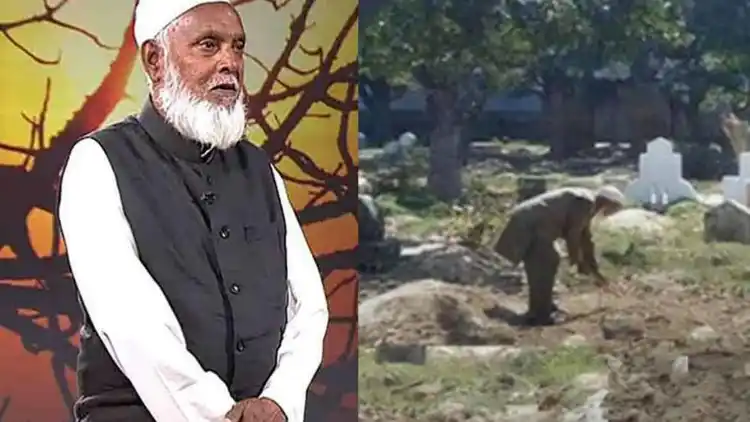
Shareef Chacha who received Padma Shri award from President
A few days ago, when President Ram Nath Kovind presented Padma Awards, the Social Media went abuzz with claims that the Narendra Modi-led Bharatiya Janata Party (BJP) government has transformed an earlier elite award into a people’s award. Awardees like Tulsi Gowda, Mohammad Sharif, Bhuri Bai, and others represent those who had worked at the grass-root level. Earlier the award was mostly given to a select band of people who had access to corridors of power in Lutyen’s Delhi; many deserving Indians were ignored.
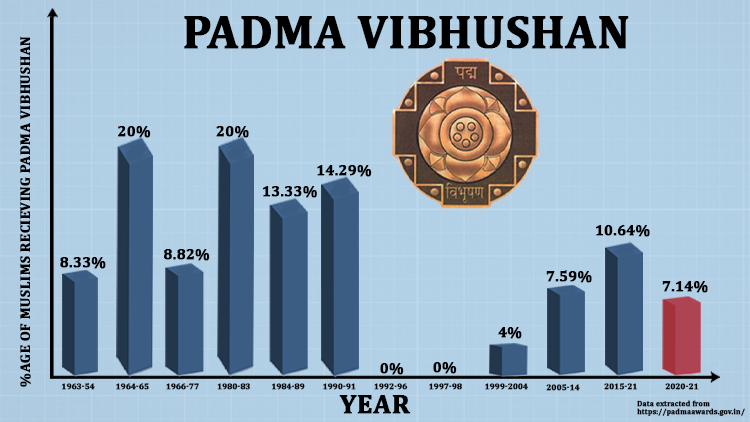
The optics of Padma awards and the chatter around it made me look into the veracity of these claims. As an Indian Muslim, my primary interest was to understand that how Muslims are represented at the Padma Awards over the year and if there was a change in the attitude of the givers of the awards. The first Padma Awards were presented in 1954. So far, 4,827 persons have been conferred the awards. Muslims are under-represented in these awards. With a population share of around 14%, only 7.5% of the awardees were Muslims, including some foreigners. However, the list of awardees for the years 2020 and 2021 that were conferred on recently, Muslims had all the time higher share. The two lists had 24 of the 260 Padma Awardees who are Muslims, 9.23%.
Padma Vibhushan
Coming to Padma Awards, the second-highest civilian honour after Bharat Ratna, that and is awarded for exceptional and distinguished services, I worked with figures of Muslims over the years since 1954. So far 321 people have been bestowed upon Padma Vibhushan. If we look at different regimes, it’s interesting to note that Muslims fared worse during the PV Narasimha Rao-led Congress government and Janata Dal governments of 1997 – 98. During these six years, out of a total of 14 Padma Vibhushan, no Muslim name figured in the list of the prestigious awardees. Interestingly, only 2 Muslims receive the award in 9 years of Jawaharlal Nehru’s premiership. One of them was Zakir Husain, who was later awarded a Bharat Ratna as well. Indira Gandhi oversaw 14 Padma award ceremonies during her two spells as Prime Minister and in this period, 7 Muslims were among a total of 73 honoured. Ten years of Manmohan Singh-led UPA government witnessed 6 Muslims receiving the award, while 5 Muslims received it in seven years of the Narendra Modi-led BJP government. Considering a category of PMs who completed a full term, 13.33% of Padma Vibhushan were awarded to Muslims during the Rajiv Gandhi era followed by Narendra Modi, in whose times 10.64% of the awards went to Muslims.
Padma Bhushan
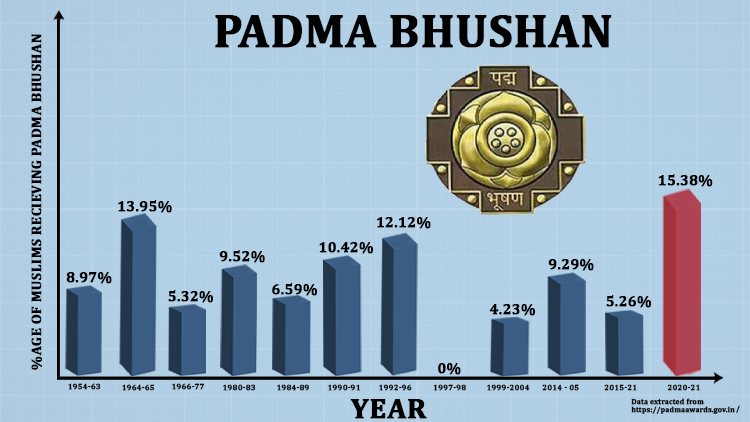
Padma Bhushan is awarded for distinguished service of higher order. To date, 1281, including 95 Muslims, people have received this award. This is at 7.42%, not commiserating with their population. Like Padma Vidhushan, no Muslim was awarded Padma Bhushan in 1997 and 1998. During Nehru’s time (1954-63) 14 Muslims of the total 156 received the award. The Muslim show was very dismal in the first five years of the present regime with one award for the community. However, in the last two editions, we saw 4 Muslims being awarded Padma Bhushan. Of 26 awardees in the two years, 15.38% were Muslims.
Padma Shri
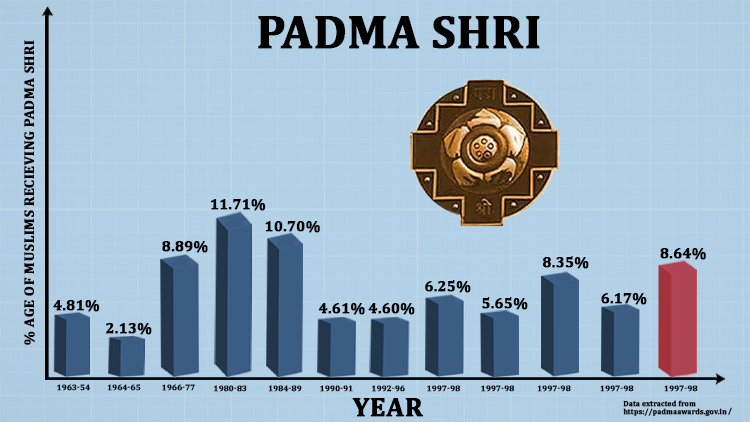
Padma Shri, awarded for distinguished service has since been conferred on 3,225 Persons. In the first 9 editions, only 9 Muslims were among 187 recipients. A period from 1966 to 1983, saw increased representation when 62 (out of 775), awardees were Muslims (9.29%). In the next five years, 23 more Muslims were awarded and it rose to 10.70%. In the 90s, Muslims representation dipped below 5% as fewer Muslims received Padma Shri. In the last two editions, 8.64% of the recipients were Muslims, a very positive surge that creates optimism.
The figures represent only a larger picture. A closer look reveals that a changed nomination policy for Padma Awards is at work. In 2017, the government opened the nominations for the common Indians as against the system of ministers and members of the government forwarding the names and a committee headed by the PM finalising the list of awardees. The government’s social media campaigns encouraged the people to nominate genuinely deserving and unsung heroes. Earlier, the system encouraged the well-connected people with links to the corridors of power to be nominated and get awarded.
In the new policy, people working at the grassroots are being nominated by the common man. As a result, we see people like Ali Manikfan, Abdul Ghafur Khatri, Mohammad Sharif, and Shahabuddin Rathod receiving the Padma awards. Apart from the fact that there is a positive surge in Muslim representation in these awards, the awards have grown to be more inclusive. Muslims from lower castes, backward regions, and non-elite backgrounds are being honoured. Larger participation of communities and people living at the margins, on social media has ensured that people working among them, and from them, are recognized.
(Saquib Salim is a Writer and a Historian)
source: http://www.awazthevoice.in / Awaz, The Voice / Home> Stories / by Saquib Salim / February 2022
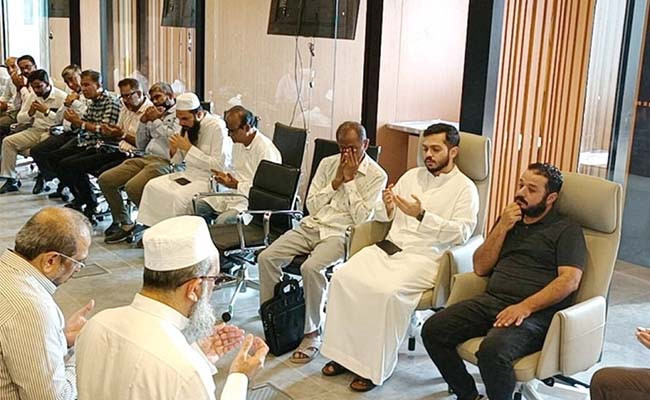
On Thursday, Jan Brothers, a well-known company in the Nawayat community of Bhatkal, inaugurated its new and luxurious head office on the 8th floor of the Gold Souq Metro building. The inauguration took place with prayerful words here in Dubai.
Situated in close proximity to the New Gold Souq, this location not only serves as the head office but also houses the wholesale showroom of Jan Brothers. The move to the Gold Souq Metro building follows the company’s presence in Dera Fakhri Market, Al Raas, and the Gold Souq.
Moulana Irshad Africa officiated the inauguration ceremony with a prayer, blessing the new head office.
The event saw the participation of Jan Haroon Rasheed, the caretaker of the company, Jan Maktoum, CEO of Jan Brothers, along with other company officials such as Jan Fauzan and Jan Abdul Azim. Additionally, Jan Muhammad Nabit, Jan Muhammad Nihal, Jan Muhammad Shaman, and various other staff members of Jan Brothers graced the occasion.
source: http://www.english.varthabharati.in / Vartha Bharati / Home> Gulf / by Vartha Bharati / December 28th, 2024
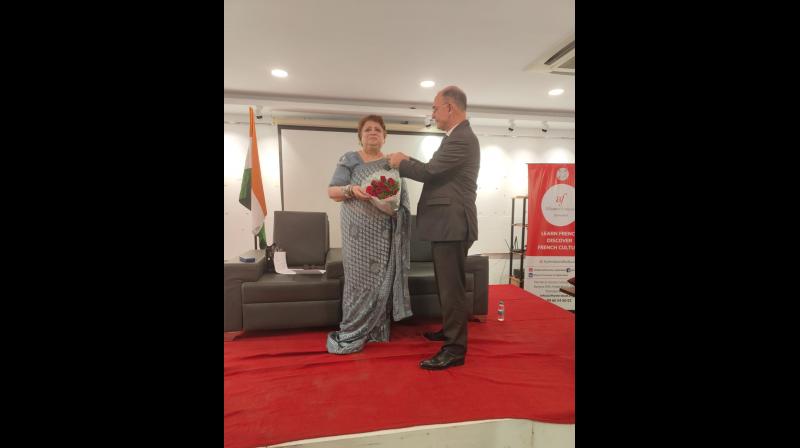
Dr Begum Fatima Shahnaz being conferred the Chevalier dans l’Ordre des Arts et des Lettres (Knight of the Order of Arts and Letters), the second highest French civilian honour by the French ministry of culture for her significant contribution to arts and literature, on Thursday. ( Photo: DC)
Hyderabad:
The multifaceted Dr Begum Fatima Shahnaz was conferred with Chevalier dans l’Ordre des Arts et des Lettres (Knight of the Order of Arts and Letters), the second highest French civilian honour by the French ministry of culture for her significant contribution to arts and literature, on Thursday.
The Jawaharlal Nehru gold medal winner for writing in her teens, Dr. Shahnaz was felicitated at a special investiture ceremony at Alliance Française by Consul General of France, Bangalore, Thierry Berthelot.
The teary-eyed Shahnaz broke into French as she thanked the distinguished guests and shifted to English after a minute or two.
“I didn’t realise I was speaking in French, it comes so naturally to me and I sometimes think in French too,” said the actor, writer, humanitarian, journalist, theatre & art director, professor and journalist.
Talking about the significance of the honour, she said, “France has supported me, and through me, it has supported the Indian people. A Hyderabadi being honoured is an honour to all my people. This places huge responsibility on me, as a citizen of India.”
She also spoke about France and its relationship with Hyderabad and recalled her college years there.
Hailing from royal Indian dynasties, Shahnaz is an actor from the Institut d’Arts Dramatiques Rene Simon in Paris, and is associated with Broadway in New York. She completed her education with a stint at the legendary French school of cuisine, the Cordon Bleu and hopes to bring a new dimension to ‘nouvelle cuisine’ through innovations in Indo-French culinary arts.
Her works include Golconda, Khaki-poems on Pulwama, Saraswati, Shards, Prince of Tears, The New York Poems, Kaleidoscope Eyes, Tiger in the twilight, among several others.
source: http://www.deccanchronicle.com / Deccan Chronicle / Home> Nation / by DC Correspondent / May 19th, 2023
Mohammad Ghalib is the sole remaining practitioner of the centuries-old craft in the city’s historic Mughal-era bazaar.
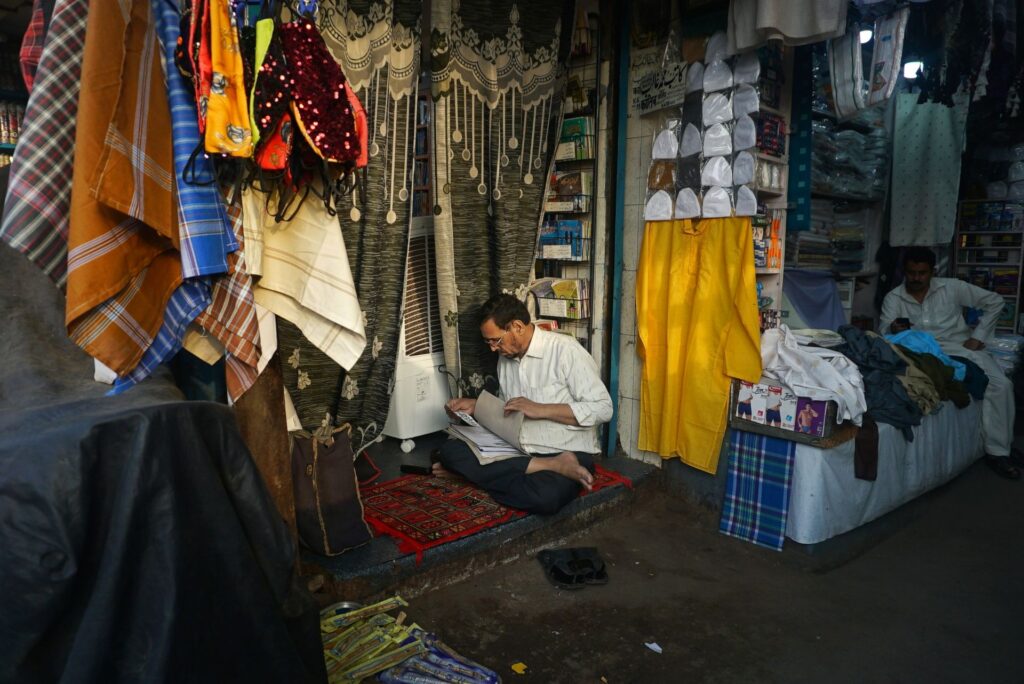
Mohammad Ghalib sits in his small makeshift workspace in the corner of a book shop in Old Delhi’s Urdu Bazaar. (Darash Dawood)
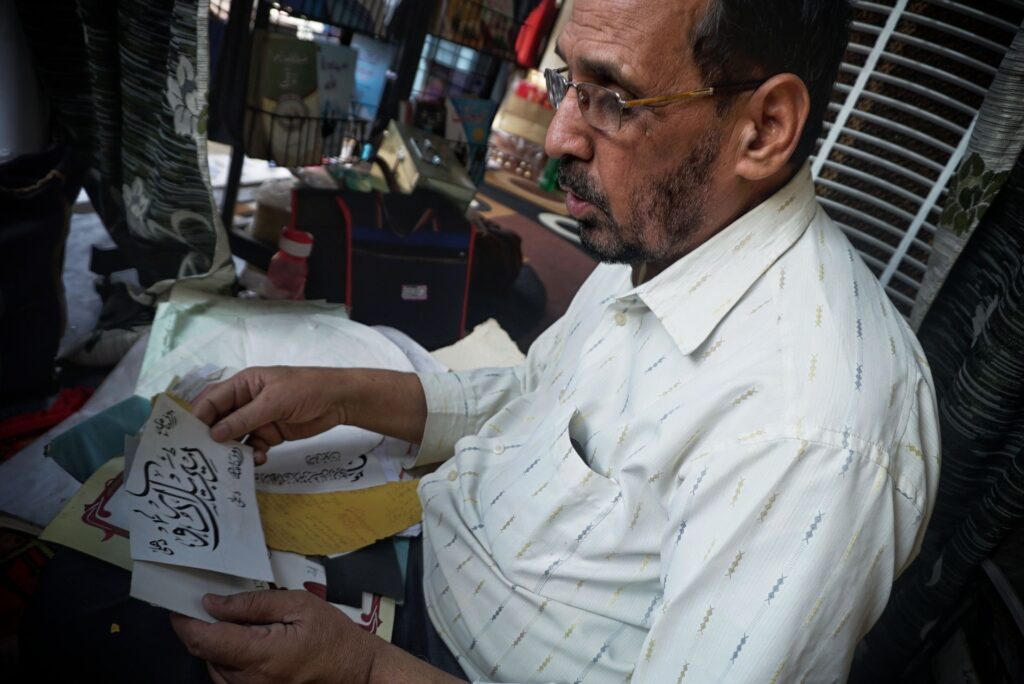
Mohammad Ghalib sits in the corner space of a book shop, barely a couple of square yards large, that was offered to him by a late friend years ago, as he couldn’t afford it on his own. He is the only “katib,” or calligrapher, left in the celebrated Urdu Bazaar of Old Delhi, witnessing his art form dying before his eyes.
On the wall outside the shop hangs a small, barely noticeable, handwritten nameplate in Urdu, Hindu and English, which reads “Katib Mohammad Ghalib,” desperately seeking attention. Amid large flex boards in the busy market, which was once a literary haven for Urdu connoisseurs, the nameplate itself becomes a telling tale of Ghalib’s bygone profession.
After setting everything up inside his shop, Ghalib hangs his small nameplate on the wall to grab the attention of customers. (Darash Dawood)
A couple of decades ago, about a dozen calligraphers would make this printing and books market come alive with their sharp bamboo pens, creating an aura of ornamental penmanship with their dexterity and delicate strokes. Holding their breaths tight, they would peck the nib of their bamboo pens in the ink and create unique styles and typographies for invitation cards, posters and logos.
Today, most of them are now dead, while many of the remaining few have retired from the profession, as it became obsolete due to technological advancement and digitization. Ghalib, however, still sets up his small workstation every day and lives in nostalgia.
“Kitabat,” or calligraphy, is a centuries-old art form in the Indian subcontinent, which attained its peak during the Mughal era. It was used to write the “farmaan” (official decrees) of the royal courts, as well as manuscripts, books, journals, newspapers, postcards and lineages.
“In earlier times, katibs were hired for Munshigiri [a position held by officials to maintain accounts] and were placed in royal courts,” says Ghalib. “It was the most respectable job. I am proud of the fact that even kings used to learn the art of kitabat and nawabs [governors in the Mughal era] used to keep at least one katib in their court for writing books, biographies or about their kingdom.” He adds that, “It is known as ‘shahi fun,’ or the royal profession.”
Ghalib leafs through his archival work, which dates back to the 1990s. (Darash Dawood)
“If any needy person came to the door of a katib and he had nothing to spare, the katib would write a word, any word, and tell the person to take it to Red Fort [the primary residence of Mughal emperors from the 17th century onward]. When he showed it to even a doorman, he would recognize that some katib had sent him and [would] fulfill all his needs,” explains Ghalib. After a breath, with an expression as if giving his final verdict about the buried brilliance, Ghalib adds, “Even Aurangzeb was a katib. And Dara Shikoh. Such was the value of a katib.” (Aurangzeb was the sixth Mughal emperor; Dara Shikoh was his elder brother and heir apparent whom he defeated, eventually arranging his execution for the throne.)
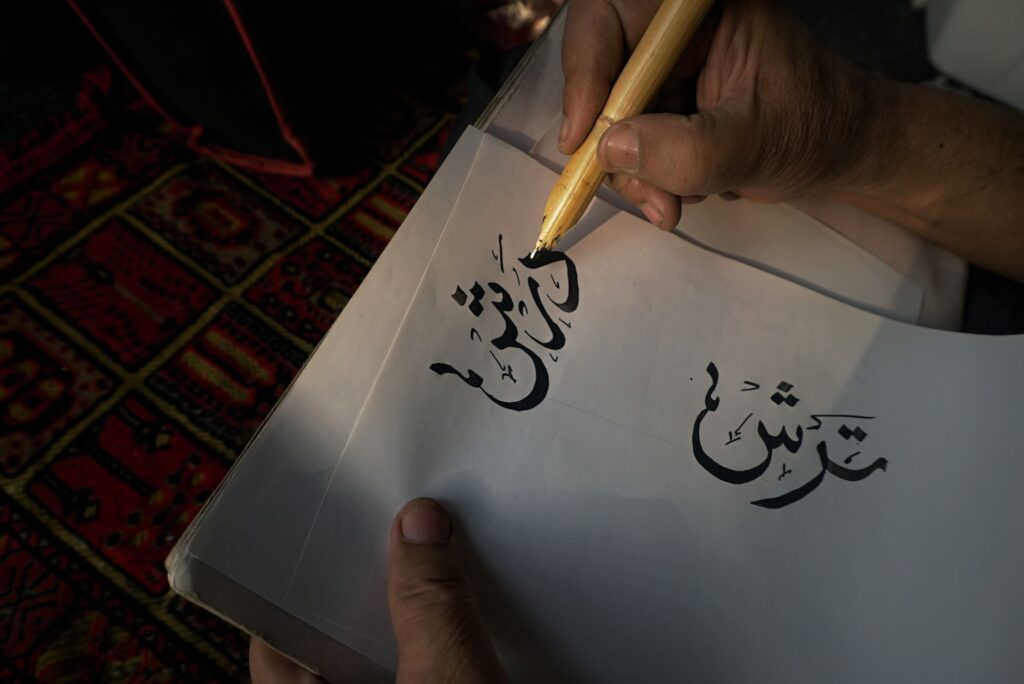
In kitabat, he says, one needs to be very dedicated. “A person gets lost in this work. It demands your full attention. Even a small movement of the hand can cost greatly. You have to hold your breath in order to write precisely. You can’t talk much when you begin writing; distraction is unforgivable.”
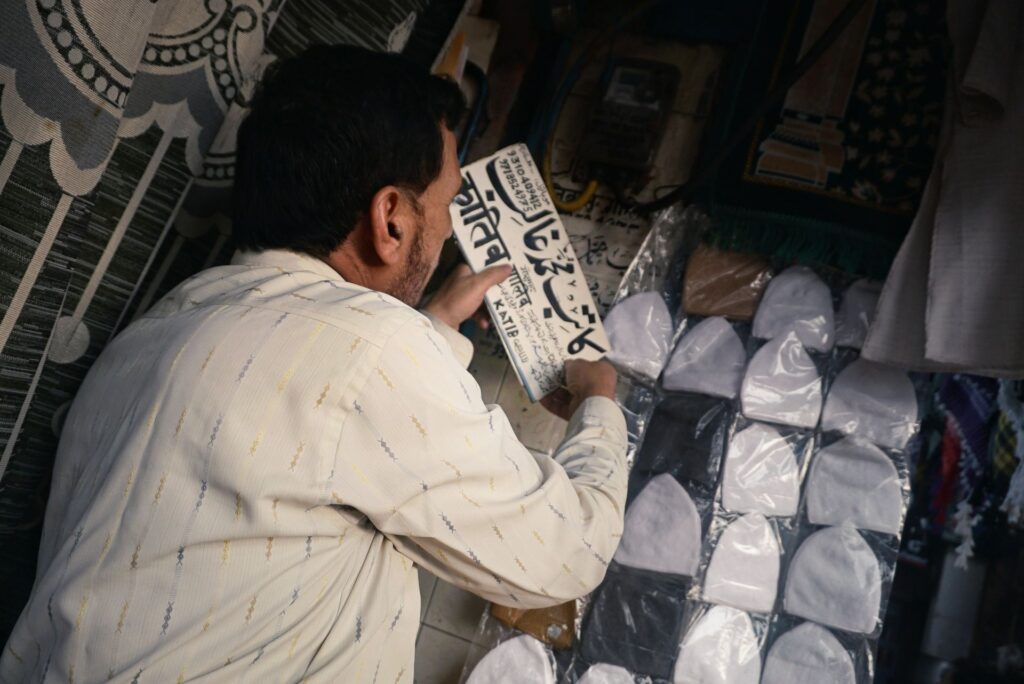
Ghalib demonstrates the art of calligraphy by writing out a name. (Darash Dawood)
The Urdu Bazaar in Old Delhi, where most katibs were stationed, also dates to the Mughal era. The very word Urdu, which means “camp” in Turkish, refers to the army camps in the area. Facing the eastern gate of the Jama Masjid, a large field that lay adjacent to the grand mosque was called Urdu Maidan, or army’s field. The two markets on each side of the grand mosque’s gate were known as Urdu Bazaar. “The army would fetch their essentials from these markets. The supplies of army disposals, including jackets and boots, would be available in this market till [the] late 1970s,” Sohail Hashmi, a Delhi-based writer and historian, tells New Lines.
Toward the end of the Mughal empire, books and printing shops emerged in this market, where one could find the best Urdu books, including translations of the Quran, the Vedas and Ramayana. Poets, writers, readers and publishers would throng the bazaar to discuss the latest Urdu literature while sitting on benches outside the bookstores. Inside their shops, there would be a dedicated corner for the katibs.
The rise of kitabat in the bazaar can also be traced to the lifetime of the famous court poet of Urdu and Persian, Mirza Ghalib, whose mansion in the neighborhood has been designated a heritage site by the Archaeological Survey of India. “Mirza Ghalib would come to this market to get his new work proofread, calligraphed by katibs and compiled as a diwan [collection],” Hashmi says.
The bazaar, along with the city of Delhi, first took a hit during the Rebellion of 1857 — the first major uprising against the British. Mirza Ghalib was heavily dismayed and lamented its destruction: “Urdu bazar ko koyi nahi janta tha to kahan thi Urdu / Bakhuda! Dehli na to shahar tha, na chavni, na qila, na bazaar.” (“When no one knew Urdu Bazaar, then where was Urdu? By God! Delhi was no longer a city, nor cantonment, fort or bazaar.”) The second major blow came during the Partition in 1947, when several Urdu poets and writers migrated to the new state of Pakistan. Over time, the market that had once bustled with book shops, printing presses and katibs became home to eateries serving Mughlai delicacies.
Almost two centuries after the 1857 rebellion, Mohammad Ghalib shares a similar pain. At 60, he is also ailing from many diseases: diabetes, heart disease and hypocalcemia.
He studied kitabat, introductory Arabic and Persian, and qirat (recitation) at Darul Uloom Deoband, the renowned seminary in India, from 1979 to 1983. His calligraphy teacher Munshi Imtiyaz was the son of Munshi Ishtiyaq, one of the most prominent katibs and teachers of Arabic in India in the 20th century. Later, Ghalib migrated to Delhi from the north Indian city of Saharanpur to work as a calligrapher. He has been in the Urdu Bazaar for four decades.
Since then, Ghalib has calligraphed academic books for the National Council of Education Research and Training, a government organization that prepares school curricula. He has also written by hand three volumes of “Tareekh E Arabi Adab” (History of Arabic Literature), authored by Dr. Abdul Haleem Nadvi, known for his contributions to Arabic studies in India. Ghalib has also worked for the National Council for Promotion of Urdu Language. Nowadays, however, he frequently returns home without any work for days and sometimes weeks. “Now all work is done by computers and I am mostly jobless,” he laments.
Once upon a time, calligraphers like Ghalib would be among the busiest professionals in the market, working day in and day out completing their assignments. “There used to be so much work. We would work even on holidays. We would receive assignments to write books on multiple genres, including academic books,” Ghalib says. Professional katibs with expertise in the craft are known as Har Fan Maula, which translates to “jack of all trades,” a tag given to calligraphers who are experts in writing many languages and scripts.
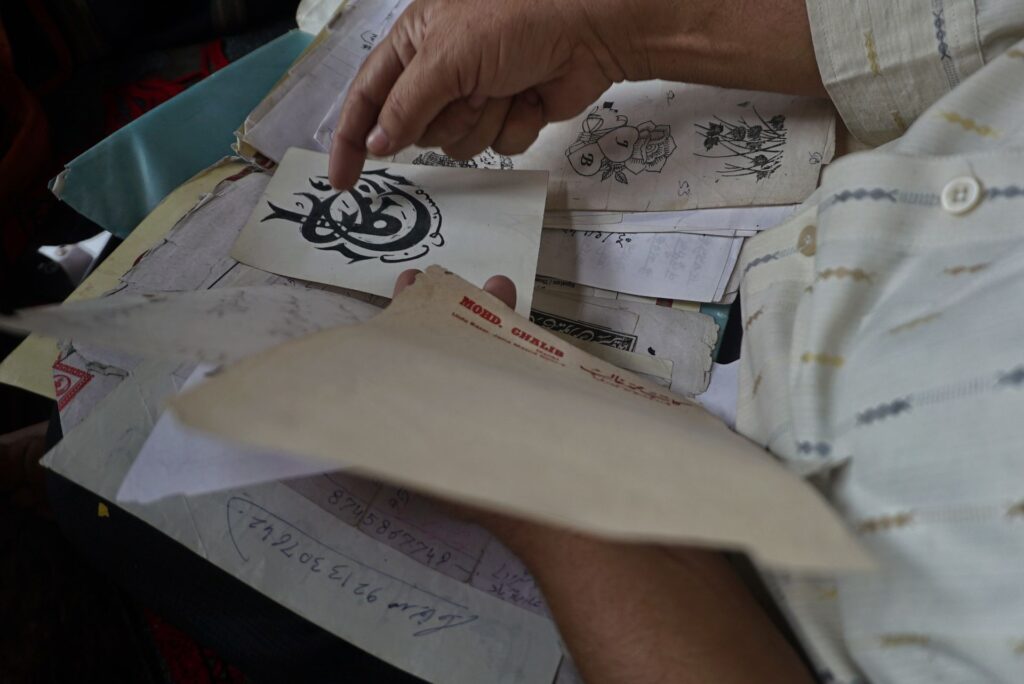
Reminiscing on the days when the calligraphy market was booming, Ghalib recalled the time he made a letterhead of his name. (Darash Dawood)
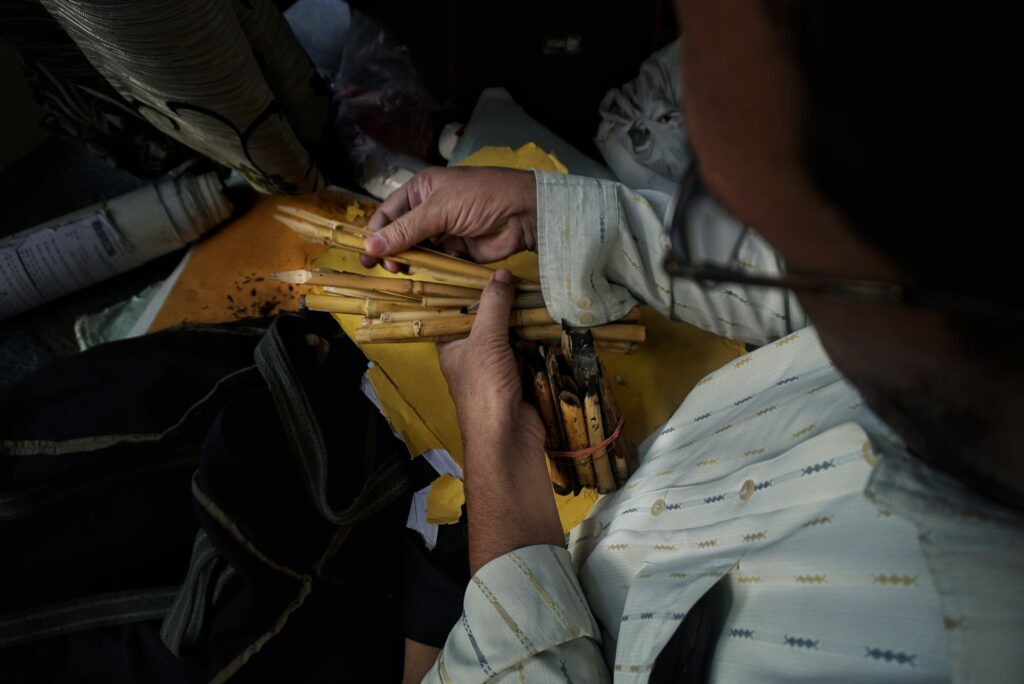
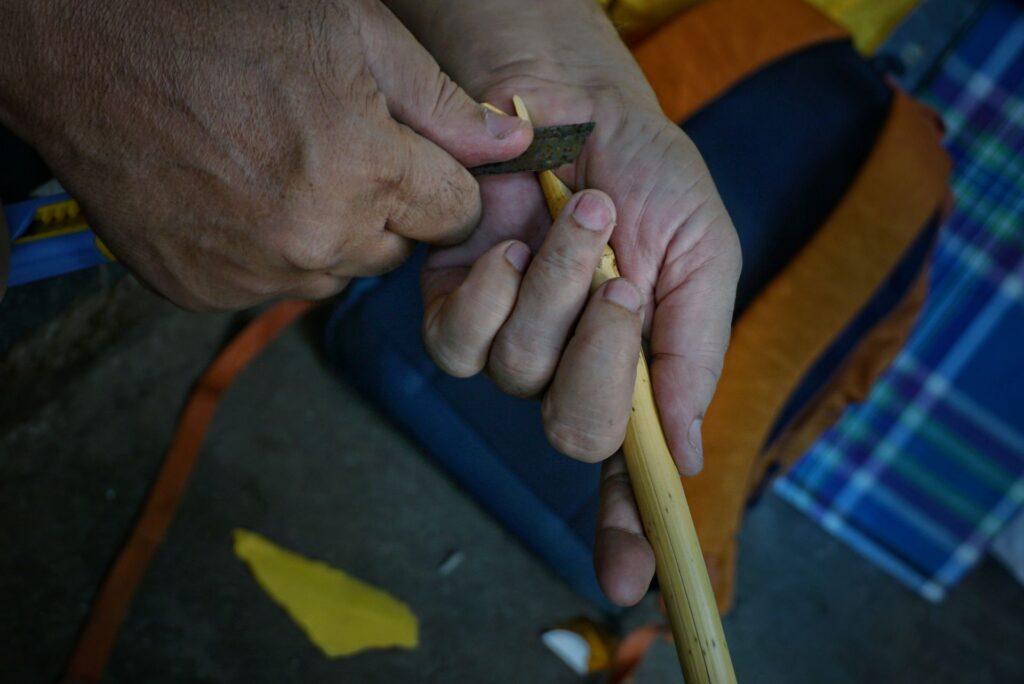
The craft is traditionally practiced with a “qalam,” a pen made from dry bamboo, which is used to write several scripts of Urdu and Arabic calligraphy including Thuluth, Nastaleeq, Kufic, Naksh and Diwani. “Contemporary calligraphy has taken the shape of an aesthetic art with colors and other decorative elements. They write Arabic in different ways, in colorful ways,” he explains. “People now write with brushes while we practice with wood pens. If you ask them to do some fine work or write a newspaper, they won’t be able to do it.”
Ghalib holds a selection of his wooden pens, recalling that the finest he ever used were manufactured in Iran. (Darash Dawood)
For Ghalib, kitabat means everything. Despite the challenges, he speaks of it with a high sense of honor, in euphoria. “It is dearer to me, more than my own life,” he says. “I have earned a lot of things because of this profession. Because of this profession, I met a number of educated people.”
He traces the decline of kitabat to almost two decades ago. “I witnessed the sharp decline when most of the books were typed on computers 15 to 20 years ago,” he says. He acknowledges that technology gets work done quickly. It would take a month for Ghalib to write a book of about 500 pages, which typists could complete within a week.
“I will tell you one thing,” Ghalib continues. “I, too, would have left it [calligraphy] a long time ago. I am not boasting. I am Har Fan Maula — I write in Urdu, Persian, Hindi, Arabic and English. Sometimes, they would call me to the courts to write their papers. Last time, a few people from Medina, Saudi Arabia, sent 15 property papers in Arabic through someone. I do every kind of work. I write posters, receipts, etc.,” Ghalib says. His recent assignments have been limited to receipt writing for Islamic seminaries in Kashmir during Ramadan, designing calligraphic logos and layouts for wedding cards.
Ghalib sharpens his bamboo pens meticulously. (Darash Dawood)
The only institution that still uses this dying craft in India is The Musalman, an Urdu newspaper published, or rather handwritten, in the city of Chennai, capital of Tamil Nadu, a state in south India, 1,400 miles from Ghalib’s workspace. Published since 1927, The Musalman is a daily, four-page paper, currently run by Syed Arifullah, the youngest son of its former editor, Syed Fazlullah.
The craft has also taken a hit due to language politics in South Asia. Prior to India’s Partition, Hindustani, a vernacular of the country’s northern regions, especially Delhi and its surrounding area, bifurcated into Hindi and Urdu. After Partition, Pakistan adopted Urdu as its official language, which further complicated the language politics, yet a 2011 census showed that India still had over 50 million Urdu speakers. Over time, however, the language has come to be taught only in madrassas, which is why Muslims in India have come to be seen as its sole proprietors. Even young Muslims in India don’t engage with the language as much anymore. “People actually don’t read Urdu now … writing in Urdu is a little costly,” Ghalib says.“They print in Urdu, only if someone insists. Otherwise, they say who knows Urdu now?”
Ghalib too has fallen victim to this unfounded language divide of late. “Here [India], even if I upload a video on Facebook, they call me Pakistani. The condition here is such that you can’t even write anything in favor of uplifting the Urdu language. Hindus in India think that Urdu is the language of Muslims. Many people call me ‘Pakistani Khatat’ on my Facebook,” Ghalib laments. (Khatat is another word for katib.)
Four decades later, Ghalib is now dealing with his poor eyesight. His hands shiver while holding the pen. He takes long gasps before making each stroke on the paper. He is too withered to do any intricate work requiring precision. His teeth have fallen out due to disease and medicine. “I can’t eat properly, can’t even hold a cup of tea easily. My work suffers,” he says in a tone of exasperation.
Even on the days when Ghalib returns home without any work, he still holds out hope that “enthusiastic people” will eventually visit his little corner. “Sometimes, when I don’t have work for a week, I do not let this art die at home,” he says. “I return to my shop and then it is like Allah sends work one day that compensates all those days.”
source: http://www.newlinesmag.com / New Lines Magazine / Home> Reportage India / by Ubaid Majeed & Darash Dawood / February 09th, 2023
Calligraphy. Aware of this word? Or heard it somewhere? It is an art, now a rare art almost on the brink of extinction. It is an art of writing a decorative language that begins from right to left for instance, Urdu Arabic, Persian, Pashto, Kashmiri and Sindhi.
The art, ‘kitabat’ as it is commonly known, owes its origin to a period before the Mughal reign in India. At that time, a town called ‘Bayana’ in Rajasthan had an entire mohalla, ‘Katibaan’ (meaning calligraphers who write books only), whose residents’ vocation was calligraphy. The art saw its golden times during the Mughal era.
Emperors Babar, Jahangir, Darashikoh, Alamgir, Aurangzeb and the last Emperor-in-exile Bahadur Shah Zafar were not only experts in calligraphy but they also ordered that it was a must-learn art, an order that was first carried out in their own homes.
It is also said that Aurangzeb brought home the bacon by writing the Quran in calligraphy. Once, when his aging wife requested him to keep a maid for her, as she was unable to do the household chores alone, the emperor was believed to have replied, “How do you expect me to hire a maid for you with such a low income?”
For the people hailing from the upper strata, learning this art or ‘funne khattati’ was considered a proud privilege. They would use the language primarily for writing beautiful, artistic letters to their near and dear ones and also for incorporating this skill in various other forms of art.
Once, Muradabad was also considered a hub for calligraphic works for it had various printing houses for the purpose.
The art was used later to write books of literature and religion by various calligraphers, so also epitaphs and engraved writings on the monuments all over the world. On the three gates of the wonder of the world, the Taj Mahal, Surah Yaseen (a surah, which is considered as the heart of the Quran) is inscribed in splendid calligraphy. Similarly, in all monuments, which are a remarkable example of Mughal architecture, calligraphy in the form of writings on its various facets can be witnessed till today. These calligraphers were invited from different parts of the world. Most of them find their names mentioned at the end of their creation in all these structures.
Earlier, several pens or ‘kalam’ of 7–8 inches with different width, made up of wood and ‘sarkanda’ (cow dung) were used to write artistically. Its ink too was home-made. Kanpur was considered to be the hub for such ink-making, where it was a small scale industry. As the art saw new developments, so did its pens. Now, America and China are the main pen nib makers and Germany has replaced the wood pen with steel one.
The art started witnessing its decline in early 90s, when it was learnt that China and Pakistan had created a software that would replace the art to merely a mechanical work and render many jobless. The threat has come true in many aspects. Sadly enough despite having a glorious history, this legendary art is dying a slow death.
Seventy-nine-year-old Syed Manzoor Uddin is a renowned name in the field, who has to his credit around 600 books written on history, literature, prose, poetry and religion in Urdu, Arabic, Persian, Sindhi, Pashto and Kashmiri and who has countless works done and distributed in Bahrain, Sharjah, Dubai, Pakistan, Iran and Turkey. He says, “In the days of yore, a ‘khushnavees’ (calligrapher) would be awarded even a palace by the kings and queens for their work in the field. Now, those who want some work to be done in calligraphic style, refuse to pay even Rs 25 for such an arduous work.”
Syed Manzoor has written coronation/invitation, (sahra) for the Shah of Iran, rare letters of the world’s who’s who, addresses of ex-prime ministers of India, and poems for the showman Raj Kapoor’s elder daughter on her wedding and several such works. He has now stopped practising this art. He owes the reason to his age and the invasion of computer that has almost destroyed this art. “I have served the artistry for more than five decades. The hopeless times have done a great injustice to this rare writing form. Now, I don’t feel like working,” he reasons.
With the onset of computers, the art has suffered a setback mainly because the computers do not have softwares that could parallel the manual skill. Moreover, the graphic designers mainly do not have a good command of Urdu. Hence, the work they do on the computer is full of grammatical mistakes, Syed Manzoor observes.
Unfortunately, for such an art, there is no recognition in the form of any award. Most awards instituted by one or the other organisations, have now been withdrawn.
Take for example, the Information and Broadcasting Unit of Press Trust of India had a National Award for printers and designers that included calligraphers also. But the practice saw its last year in 1988.
Similarly, Ghalib Institute also had an award for the same and 15 years back this award was also withdrawn.
The Urdu Academy, however, still gives an award in this category that carries a citation and Rs 11,000. This year it is awarding, Mohd Yusuf, a calligrapher of repute though his work does not diversify in other languages as of Syed Manzoor.
An ailing and aged Mohd. Yusuf, who did India proud through many of his works, is now living in penury with his several family members in a small room, enough only for two men in old Delhi. While many calligraphers, for whom it was the only source of earning sometime back, now sit on pavements in the vicinity of Jama Masjid and get just a measly amount for their labour of love.
The art of calligraphy has mainly suffered because of lack of promoters. “Only in last November, the Ministry of Human Resource and Development had organised an Urdu Kitab Mela at Lal Qila ground. It turned out to be a major fiasco for this form of art. Even the rent for the ground, Rs 3,000, could not be recovered in the 11-day fete. Only two persons turned up all these days. And they too thought that a sum of Rs 25 was high for getting their names written in a calligraphic style. Even someone from the famous Rajshri Production bargained for a rare pen, used in the art and managed to buy it for just Rs 3,” recalls Syed Salahuddin, the disciple and son of Syed Manzoor.
Here, slogans were shouted against Mr Hamidullah Bhatt of Qaumi Council, who was blamed for not doing enough publicity for an art though he received a package for it. The condition of dying art was witnessed at the fete by Civil Aviation Minister Shahnawaz, Chief Minister Sheila Dikshit and HRD minister M M Joshi.
Salahuddin asks, “When a doctor can be awarded for operating upon the Prime Minister. There is an award for Hussain’s brush; even for a best citizen. Then why not for a calligrapher? Why not my father and guru, who burnt the midnight oil to prepare 600 books and countless other works for many ministries all over the world. Why can’t he be recognised for his contribution to the art?” Ironically, Salahuddin, who wants to carry forward this artistic legacy, finds no sponsors for it. He also tries hard to get an award for his aged father from the government.
Although a few organisations and individuals are doing some work in the domain, that is not sufficient. For example, Urdu Academy still provides a two-year course on calligraphy that includes computer calligraphy in its second year. While in the first year, the manual expertise in the Urdu language and design is taught so that they do not commit errors that today’s so-called computer calligraphers are committing. But, unfortunately the learners there come only from the aged and financially week backgrounds, who learn the art only to make fast bucks. In fact, the academy pays a scholarship of Rs 150 to teach this art!
“I see several grammatical and other mistakes in Urdu newspapers and names of roads, lanes, bazaars in Urdu are mostly wrong because the language is not known to those who get the work done on computers by inefficient people,” moans Syed Manzoor. However, he is happy about the Urdu software that has come in the market now as he is reminded of what Dr Zakir Husain’s said once, “The language that does not have its type face, dies its own slow death.”
A reputed calligrapher, Anees Siddiqui is known to be compiling a dictionary of calligraphers in India.
The art, however, still needs a helping hand. Will the recognition ever come to the dying art and its artists? Will the proud heritage of India be saved? Only time will tell.
source: http://www.tribuneindia.com / Tribune India / Home> Culture> Artscape / February 22nd, 2002
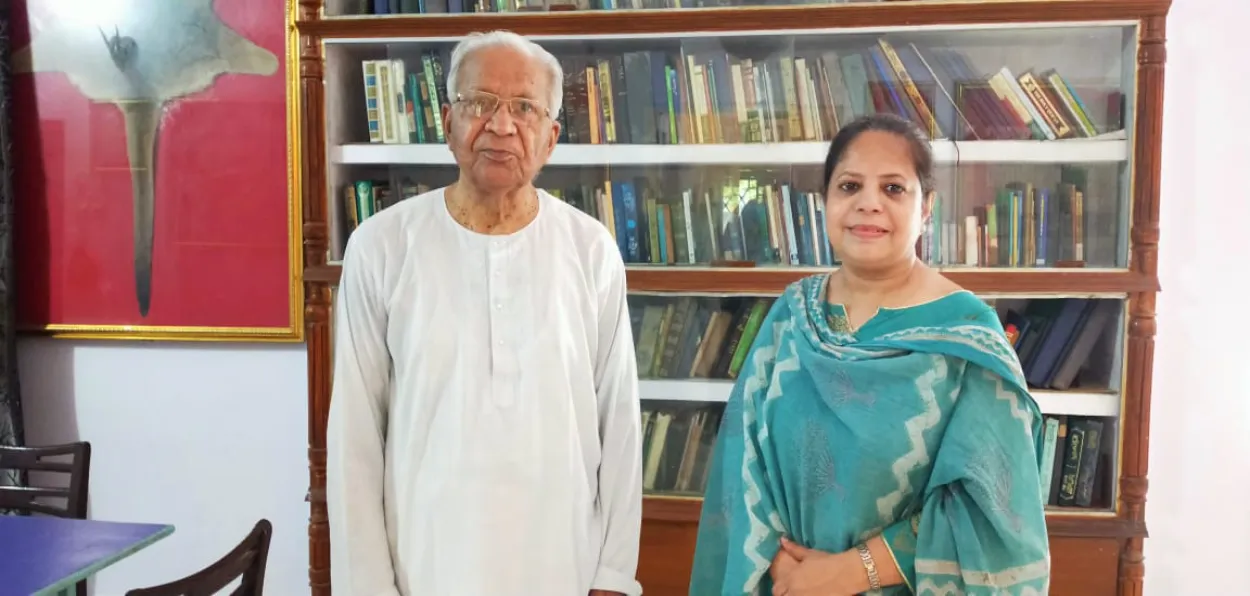
Professor Syed Zillur Rahman, founder,Ibn Sina Academy of Medieval Medicines and Sciences with the author
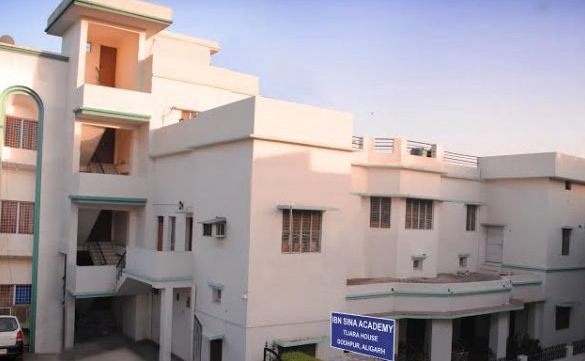
Known for its locks, Aligarh, a city in Uttar Pradesh, has also locked a legacy in its reserve – for generations to benefit from it. It houses a rare academy and museum called Ibn Sina Academy of Medieval Medicines and Sciences.
Located at Tijara House, amid a vibrant market place and residential area, Ibn Sina is hailed as the rarest house of legacies in arts and sciences combined under one roof. Named after the legendary scholar of philosophy and medicine Abu Ali Ibn Sina (980 -1037), this academy was accredited to the Ministry of Ayush in 2004 and promoted to Centre of Excellence in 2008.
The institution was established for encouraging and promoting research and studies in medieval sciences, especially Ibn-Sina’s as well as arts, culture, poetry, and other sciences.
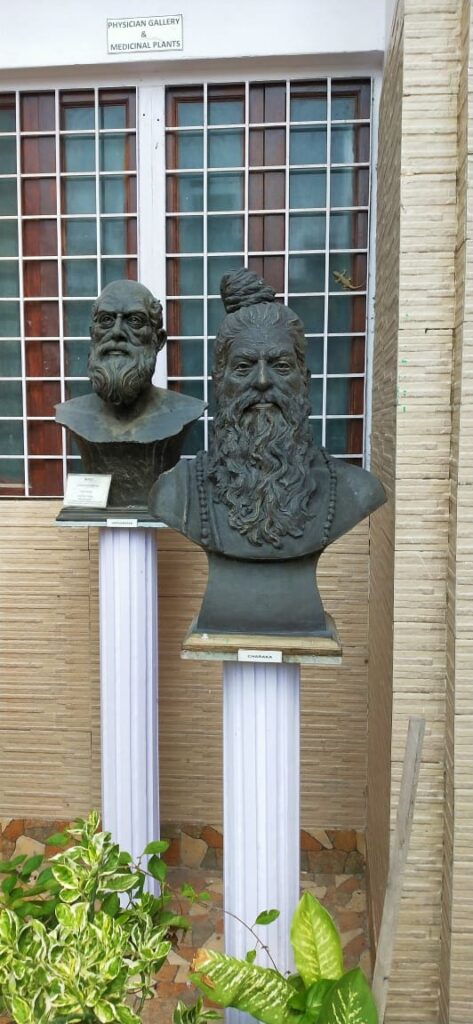
The bust of Ibn Sina with Charak inside the museum
Of Ibn Sina’s four stories, a major attraction is on its second floor which houses the Fazlur Rahman Museum of Orientalism, Art, and Culture.
It has four main galleries; the crockery gallery has a large collection of oriental and British Indian utensils, hammami plates, bowls, tea sets that belong to prominent personalities such as Hakim Ajmal Khan, Nawab Sultan Jahan, Nawab Shahjahan Begum of Bhopal, Nawab Yusuf Ali Khan of Rampur and many others.
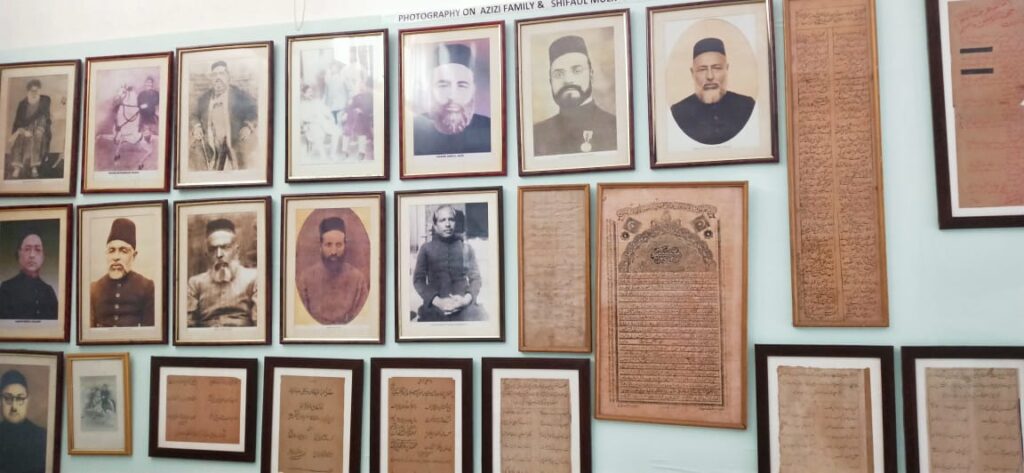
The textile gallery is ornate with attires, garments with gold and silver calicos studded with precious stones, one of which has entire Quranic surah Yaseen embroiled in gold zardozi on it, turbans worn in battles, among many other oriental attires. The picture gallery has prominent personalities of AMU’s pictures, drawings, photography, prints, etc.
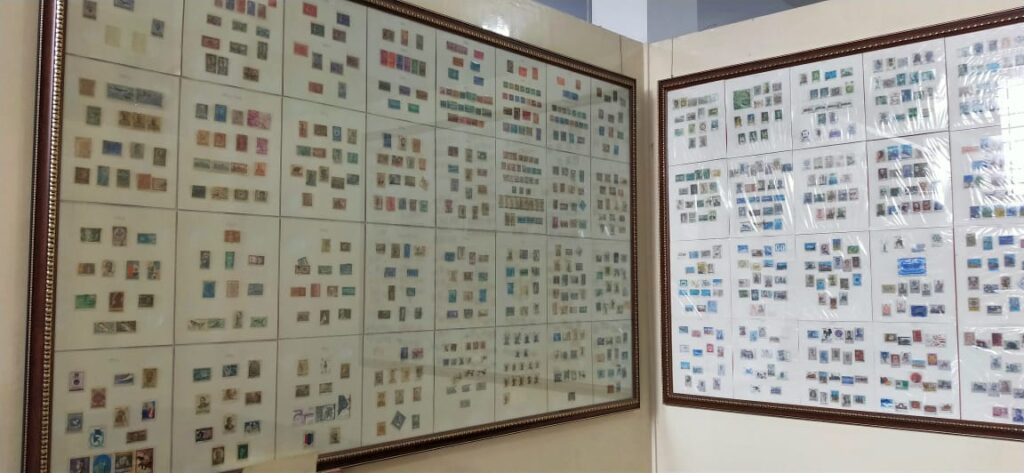
Its miscellaneous gallery has coins, postage stamps, clocks, busts, pens, memes, and relics of prominent personalities.
“We have over 2 Lakh stamps beginning from ever since the stamps started, from all countries and India. People who were pioneers in the world of arts and culture, education, and freedom fighters on whose names, and stamps were released, we have a collection of the same. shares Dr. Aftab who is a convenor at Ibn Sina.
In addition medical manuscripts, medical philately, medical souvenirs memories of physicians especially those of Nobel laureates are well preserved here.
The wall of fame (Pictorial history of some important Muslim families)
The connecting rooms of the galleries welcome you with a sofa of Raja Jai Kishan, a mirror of the times when they were made of iron sheets. The iron sheets called ‘aaina’ were rubbed so many times that they would become sparkling clear and shining to become a mirror. That’s how the mirror got its name ‘aaina’ Later it got a new name –sheesha – with the change of the material..
The academy is rare for numerous reasons. For avid readers of medicine, science, Urdu, Persian, Arabic, literature, poetry, oriental studies, researchers, students preparing for competitions, and scholars IbnSina is a heaven. It boasts of a rare collection of 32000 books, 17000 magazines, 1100 manuscripts, (makhtootaat), 21 rare Qurans including one pocket size in gold, and much more is in store.
Built by professor Syed Zillur Rahman, a medical academic and passionate Urdu litterateur from Aligarh, Ibn Sina was an extension of his colossal library that he had established in 1960 which soon extended into the world’s rare academy and museum of its kind in the year 2000.
Collection of stamps
“Hamare yahn Aurangzeb ke hath ka likha, aur uske bete ke hath ka, likha hua Quran hai,” gleams the professor, sharing the information.
Apart from a separate collection of Muslim women achievers, Ibn Sina boasts of the world’s best collection of Islamic sciences, Islamic medicines, and Islamic philosophy being published across countries such as Iran, Central Asia, Syria, Iraq Turkey, etc. Scholars from across the globe come here to refer to books in this section.
For Ghalib devotees, the academy has a separate section called Ghalib Study Centre. It “Ghalibka collection joh mare paas hai vo duniya mein kisike paas nahi hai,” claims the professor.
Delhi finds a special place here boasting of 7500 books, some as old as 1893, dictionaries as old as 150 years, authentic diwaan on Ameer Khusrau, books on and by the last Mughal Bahadur Shah Zafar, British period –Victorian Era with pictures in Lithographs and much more.
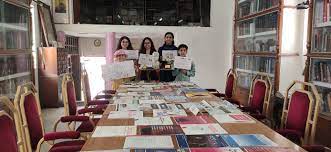
Children using the library
The academy has a library for students especially those preparing for competitive exams. The 100-seater library has the best of books from literature, agriculture, science, math, medicine, etc.
“There is no fee to sit in this library. It opens every day from 10 to 10. This section has over 28000 books including 56 of Professor Rehman on Tibbi and Unnani medicines. there are separate sections for Unani medicine and Sir Syed Movement, biographies,” Dr Aftab Alam, the coordinator of Ghalib Study Centre informed.
There is a reason why the library has most books in Urdu and Persian on Indian history, culture, language, society, education, politics, medicine, etc. “Not much work in English has been done on Muslims. Most work has been done in Urdu and Persian. So this is our helplessness. Our focus is on India – the Hindustan. Indian scholars have done immense work in any domain, philosophy, travelogues, and medicines, especially in Islamic history, the Quran, and hadith that is comparable to anyone in the world, especially the Arabic and Persian world. The problem is we don’t read because we don’t read Urdu,” rues the professor.
Why Ibn Sina was built has an interesting story. As a young man, Professor Rahman used to watch a bird who had made a nest and would bring food for her newborn, just as the routine was with a cat who had given birth to kittens – at his home. After some months, the birds flew, and the kittens grew and went away with their mothers.
“I thought to myself, ‘Is this the life God has created mankind for? Just be born, eat, sleep, and die like animals? God has created a man to not only take care of his family but also society, language, culture, community, and world.”
Ibn Sina Academy of Medieval Medicines and Sciences
So, he decided to create a legacy that he says would be useful for a generation after 80 years! “We are away from civilization by 80 years. A standard time to develop any civilization is 150 years. So, now people are not able to understand the legacy I have created but the students who read it 80 years later will know what it is. By then we would be a civilization.”
People get worried that the graph of Muslim development is going down. But the Professor feels it is nothing to be worried about. “Every civilization has to go through it. Our graph has risen. We were 10 crores in 1947. After Partition, 7 crore left for Pakistan had 3 crore stayed in India. We were nothing in 1947 but our buzurgs worked very hard to study and became scholars. Now we are making educational institutions, universities, hospitals, media houses, and so on. Most important is that girls are getting higher education and they will change the face of the nation,” he says, satisfied while emphasizing reading Urdu to know a legacy called India and the contribution of Muslims to it.
Rana Siddiqui Zaman is a Delhi-based senior columnist and art reviewer
source: http://www.awazthevoice.in / Awaz, The Voice / Home> Stories / by Rana Siddiqui Zaman / January 10th, 2024
Budhana Town (Muzzaffarnagar) / Meerut, UTTAR PRADESH / NEW DELHI:
Poet Azhar Iqbal has gained prominence due to his use of simple Urdu language mixed with Hindi and his reach on social media.
QUICK RISE:
Azhar Iqbal has suddenly risen to fame in the last two years
Saying Urdu/Hindi couplets (shayri) in the language of the common man and usage of social media has raised Delhi’s Azhar Iqbal to a level he had never imagined.
The famous saying bhagwaan jab deta to chhappad phaad ke deta hai (when God decides to bestow His bounty, He showers it all) seems to have come true for Delhi’s Urdu poet (shayar), Azhar Iqbal.
He suddenly rose to fame in the last two years. He is seen in almost all domestic as well as prestigious mushairas (poetry sessions) in Europe, Middle East and Dubai. The limelight-hungry, from literary to television world, have suddenly started showing a sense of belonging to him and their pictures together adorn several social media accounts.
Those who had not even known him remotely, have started commenting on his posts, expecting few seconds of a shared fame! His recent claim to fame is his presence at the famous Kapil Sharma Show on Sony LIV television.
The shayar has to thank two factors that worked wonders for him, social media and couplets he wrote in simple Urdu projecting relatable truths of peoples’ life.
For instance, Ghutan si hone lagi uske paas jaate hue, main khud se rooth gaya hoon usey manate hue or Parindo ko shajar acchha laga hai, Bohot din baad ghar acchha lagta hai, Gale main hai teri bahon ka ghera, Ye bike ka safar acchha laga hai.
Iqbal is not new to shayri but to the fame. The 45-year-old is yet to sink it in.
He admits, “Social media’s wide reach is a magical reality. My seniors and buzurg shayars (experienced poets) would not have imagined reaching that far globally with their genius. I don’t think I do shayri as well as them. But I wouldn’t mind taking credit for the fact that I do shayri that common man understands. From students to youth, females to those battling crises of various kinds in their daily grind.”
Substance too
It not just the miracle of social media but a life of hard work, interest in shayri, taleem-o-tehzeeb and patience that Azhar’s poetry is made of. He isn’t a product of an aristocratic school or family either. Azhar, one among 11 siblings, is a father of two, and homemaker wife. His father, a literary person and an avid Urdu reader, had a tea shop in Meerut where he would go to help him in his holidays as a child and in his youth.
A fertile background plays the most significant role in the making of a poet. Azhar is no exception. Remarkably, in western UP, educated people in small towns like Budhana, Kairana, Gango, Jhinjhana, Nakod among others had immense affinity with literature and religion – adab and deen. Women would always find time to read good novels during the day and even narrate them to their children and siblings. Menfolk would find catharsis in nashist or baithak (poetic gatherings) almost every evening.
Azhar comes from Budhana town in Muzaffarnagar where such novel narrations and nashisht were regular.
“We were surrounded by these adab-loving people, qawwals and their mehfils (gatherings). The zauq (interest) for shayri was getting into the system automatically.”
Here, senior shayars would say a couplet and ask young boys to write the next on that analogy. The teenagers would spend much of their time in reading good poets and evolve themselves to do the task.
Azhar recalls famous shayar Dushyant Kumar’s sher (couplet) which was given to him for an analogy to create his own.
Vo mutmayeen hai ke paththar pighal nahi sakta, Main intezar main hoon awaz main asar ke liye.
(They are certain that the stone cannot melt away, Restless yet I am, for a voice to hold sway.)
Azhar could create one in bahar (rhythm). And it went like this
Vo phool banke mere pass hi mehakta raha,
Main sochta hi raha apne humsafar ke liye.
(It lingered like the scent of a flower beside me, Yet, I longed for my companion to be.)
This was his first couplet that showed his poetic pen at 13.
Alongside writing ghazals and studying, Azhar would help his father run his tea shop. In late 90s, to help the family financially, he joined as lab assistant at Noida, on a salary of Rs 3,000. He would go to the mushairas by spending from his own pocket.
“The mushairas wouldn’t pay young poets like me during those days.”
By 2013, he met famous dastango Mehmood Farooqui and soon wrote the poetic part of his classic dastans.
“I also used to host some of his dastan shows and mushairas at Delhi’s India Habitat Centre — a favourite haunt for arts and literary luminaries.
“The visits helped me expand my circle and meet geniuses in the creative arts.”
FAME:
Iqbal also featured in the Kapil Sharma show and often gets thronged at airports
The Almighty answered
Around the first Covid lockdown, Azhar got an invitation to go to Bahrain. “That was my first foreign trip. But the lockdown spoiled it. In pain, I complained to Allah that this was my first such prestigious trip and l can’t even go. As if Allah was free then. He heard me so well that I never looked back after that. It happened like that.
“Someone picked up a sher from one of my old videos and posted it on his Youtube channel. Within no time, it received 50 million views. Soon, people started finding my other ashaar (couplets), and did the same. Some 10 to 12 such couplets got so popular that billions of people watched them and I became famous instantly.”
The fame helped the poet not only with offers of mushairas at domestic but also international levels, and to preside over them too. Prestigious spaces like Sahitya Akademi, Sangeet Natak Akademi also started inviting him to host programmes.
The icing on the cake was an invitation from Kapil Sharma show which is viewed by crores of people. It changed his life completely. The mushaira venues have often got him standing ovation for long.
“Now at times it takes me over an hour to reach the venue as people gather for autographs at the airports. I often get shockingly surprised and think, ‘they have come for me?’”
Shared language
A creative person is known for diversifying, without which he risks his pen to boredom.
Azhar also decided to be a bit more creative and mix Urdu-Hindi to say couplets that would emanate fragrance of a shared co-existence.
Though use of Hindi words in Urdu shayri and Urdu words in Hindi kavita is not new but his initiative of a different kind was lapped up by “both Left and Right ideologists”. One of these goes as:
Maroosthal se jaise jungle ho gaye hain,
Tera sanidhya pa kar, hum mukammal ho gaye hain.
(With your proximity, I am metamorphosed from a desert to green) or
Nadi ke shaant tut par baith kar mann,
Teri yadain visarjan kar raha hai;
Bohot din ho gaye hain tumse bichhde,
Tumhe milne ko ab mann kar raha hai.
(On the silent banks of a river, immersing your memories; long alienated, my heart is aching to meet you).
The poet credits it to the gap that came after Dushyant Kumar’s demise in 1975 at a young age of 42.
“There was a gap in the Hindi poetic arena after Dushyantji. Most were doing lateefebazi (frivolity). Geet and nazm had suffered in the hands of mediocre writers. So, I decided to experiment the mix and it worked out, again, thanks to the social media.”
Breaking monopoly of seniors
Most creative domains have some authoritative forces who wouldn’t let their juniors grow, unless they belonged to their coterie. The world of shayri isn’t an exception. Some senior poets and known lyricists who are also a part of the film world, often started dominating the biggest mushairas.
“If you see the mushairas before 2000, you will notice that same 20-odd shayars would be seen in all mushairas in the country or even abroad. Aik poora giroh thaa jo kisi ko aage aane hi nahi deta thaa. (There was a gang of senior shayars who wouldn’t let any newcomer break their monopoly).”
The social media boom, however, did the needful, especially during Covid and subsequent lockdowns.
Those who were not in any reckoning, started making small videos of their own couplets, or other Youtubers would select couplets of any shayar and upload them for hits. This slowly opened vistas for several hidden talents. Azhar is one of them.
“If you scroll through social media, every second video is about a new shayar or his shayri uploaded by someone to get hits on his Youtube channel. The seniors who once ruled the game, have no role to play in promoting them.”
However, like any pros and cons of a boom, excessive use of social media also popularised mediocrity and exposed the difference between the great poets and weak writers, the originals and copy cats.
The “husn-parast” (esthete) Azhar is a new age craze for the generation which is turning towards simple shayri to understand the heavier later. “I think I have done my job if any youth has started taking interest in reading and creating couplets in simple Urdu.”
And one couldn’t agree more.
(The writer is Delhi-based senior journalist, co-author of ‘Muslims in Media’, poet, an art and music curator.)
source: http://www.thepatriot.in / The Patriot / Home> Profile / by Rana Siddiqui Zaman / August 12th, 2024
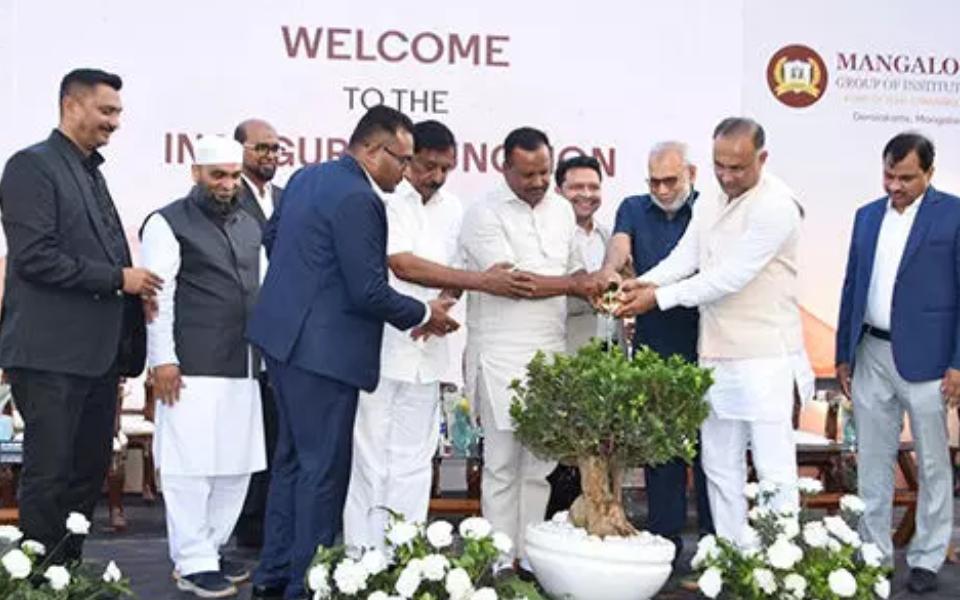
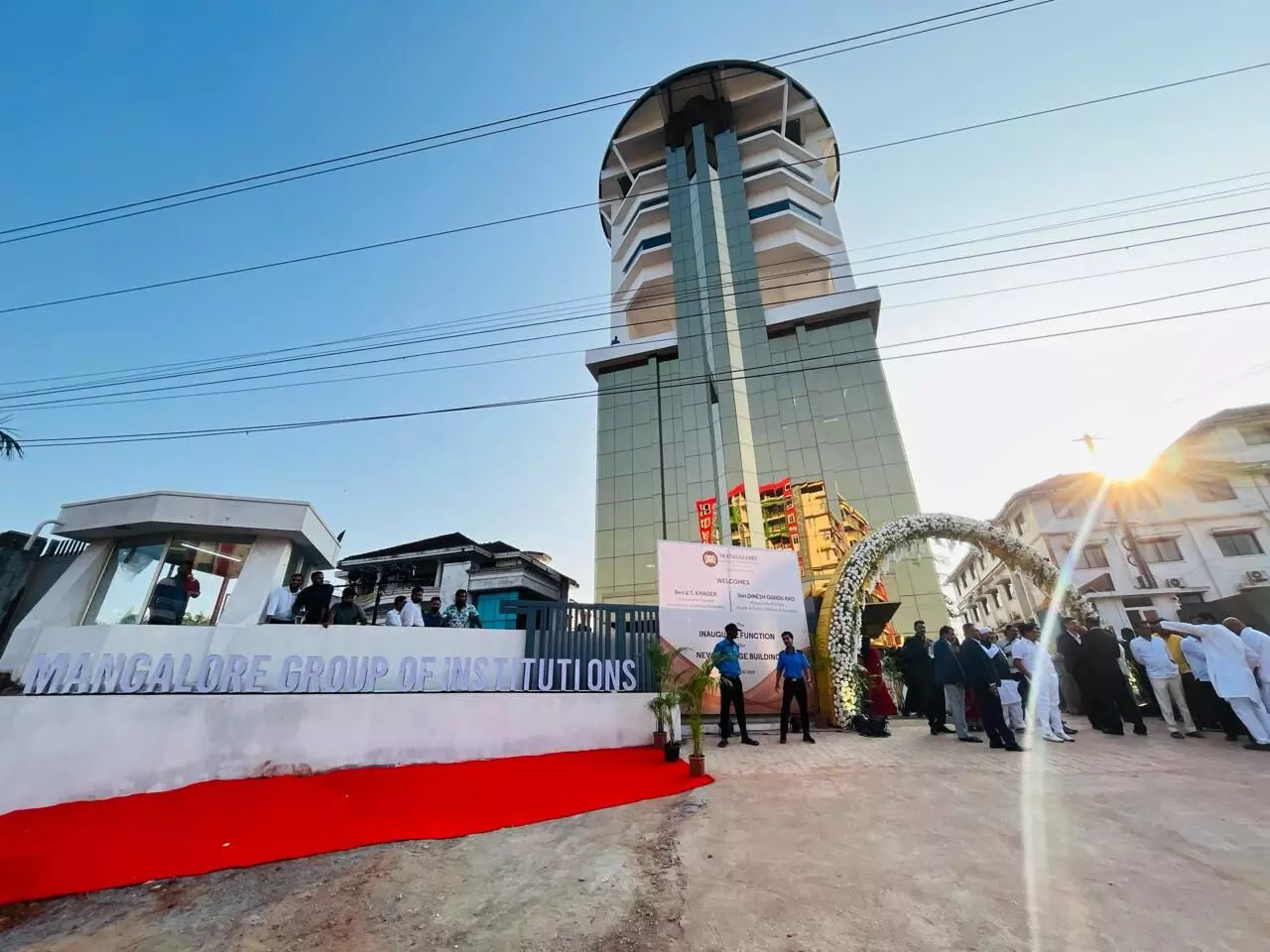
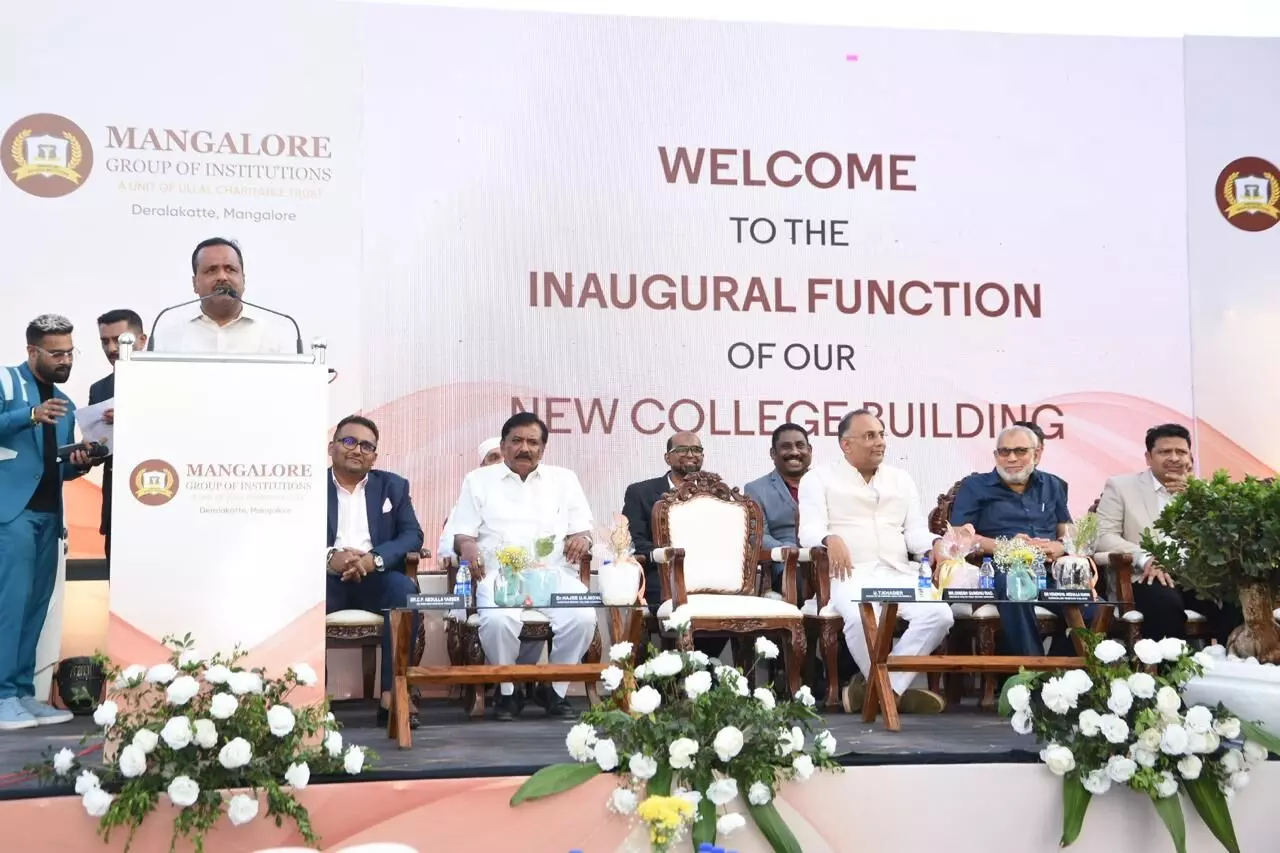
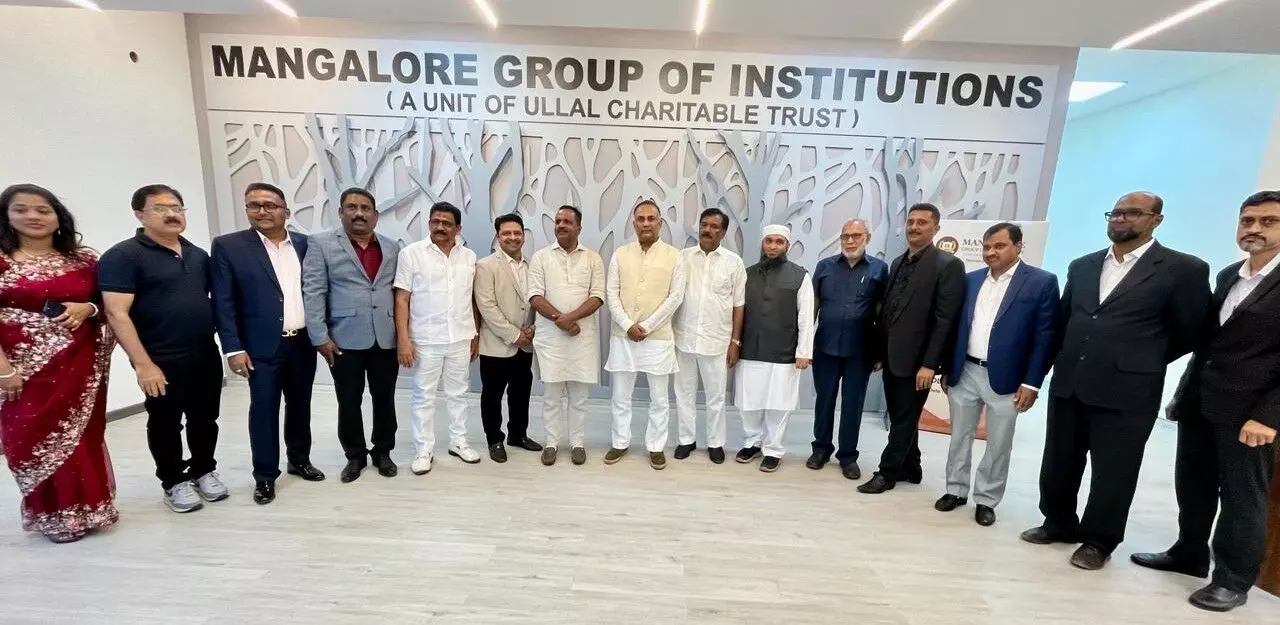
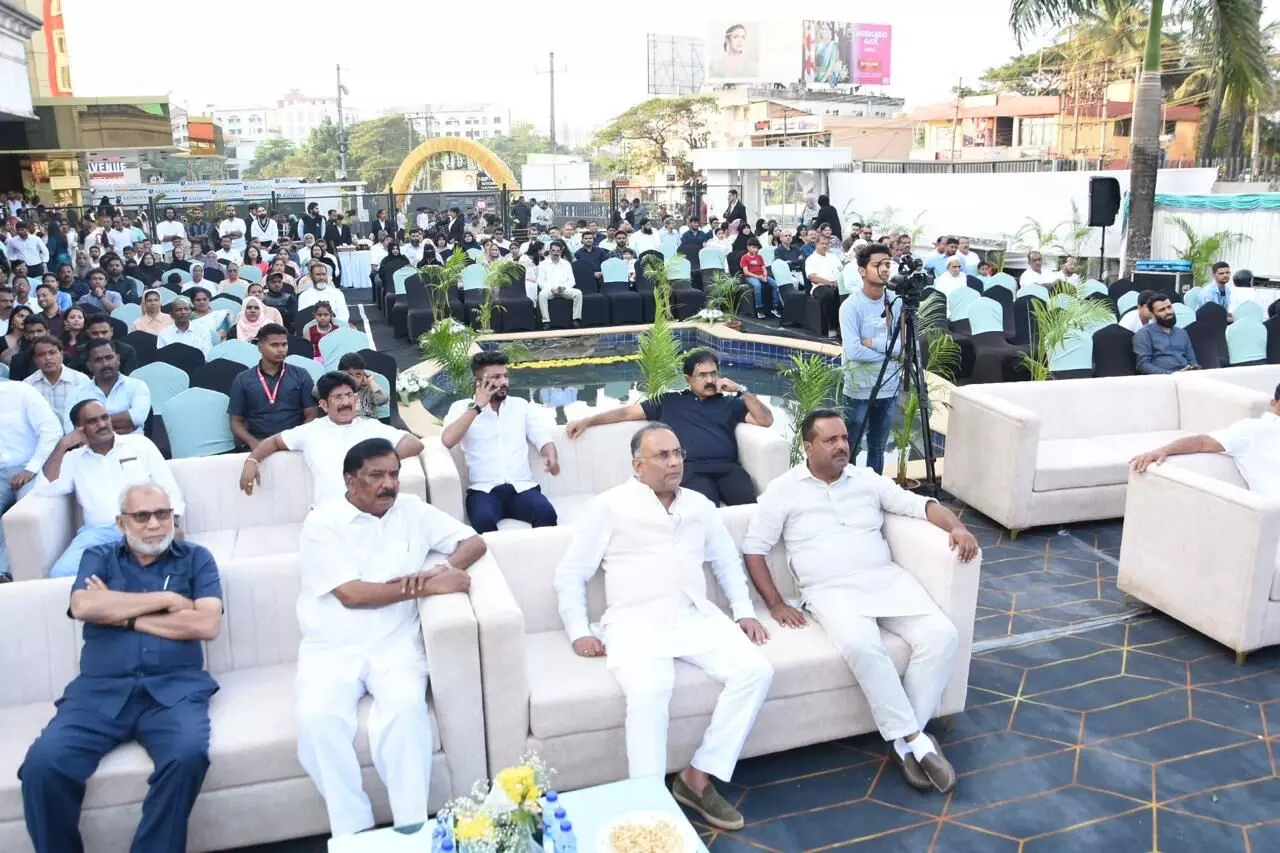
The inauguration of the new college building for the Nursing College at Deralkatte, part of the ‘Mangalore Group of Institutions’ under the Ullal Charitable Trust, took place on Friday.
The inauguration ceremony was jointly led by the State Health and Family Welfare Minister and DK District In-charge Minister, Dinesh Gundu Rao, and Constituency MLA and State Legislative Assembly Speaker UT Khader.
Addressing the gathering after the inauguration, UT Khader expressed satisfaction with the growth of the education and health sectors in the Deralkatte area. He referred to the new building of the Nursing College as a crown jewel by ‘Mangalore Group of Institutions’ run by the Ullal Charitable Trust to the growing reputation of Deralakatte. Khader urged the institute to introduce new courses that would invigorate and inspire students, emphasizing the importance of serving the community locally after obtaining medical education.
Dinesh Gundu Rao, the DK District In-charge Minister, stressed the need to introduce new courses to harness the youth resources in the country effectively. He suggested recognizing students’ skills from the outset and creating an environment conducive to their development. Gundu Rao highlighted the high demand for nursing graduates, both nationally and internationally, and encouraged nursing students to capitalize on these opportunities.
Dr. Sayyid Mohammed Khilar, Chairman and Managing Trustee of ‘Mangalore Group of Institutions,’ noted the organization’s significant milestone in healthcare. He emphasized the priority given to starting new courses in health and education to benefit the next generation and leverage evolving opportunities in the field.
The saw the participation of prominent figures such as Dr. Habeeb Rahman, Chairman and Medical Director of Unity Care and Health Service Pvt. Ltd., and UK Monu, Chairman of Kanachur Medical College. Trustees and directors of the institution, including Dr. C.P. Abdulla Yasser, Dr. N.A. Mohammad, Dr. Mohammed Sameer, Mohammed Yoonus, and Titto Mathew, were also present.
Dr. Ahmed Rizwan C.M., a Trustee, and Administration Director recited the Qiraat.
Dr. Alam Nawaz, Vice Chairman and Trustee of ‘Mangalore Group of Institutions,’ extended a warm welcome to the attendees.
Speaker Khader highlighted ongoing developmental projects in Ullal taluk, including road development and 24-hour drinking water supply. He assured that measures would be taken to address the electricity problem with a forward-looking vision for the next 30 years.
source: http://www.english.varthabharati.in / Vartha Bharati / Home> Karavalli / by Vartha Bharati / January 26th, 2024