Dr Valli is the scientist who made the world realise the importance of food grains
He had a comfortable US job that he left to return to India and make it healthy. More than two decades since he launched his mission, India’s ‘Millet Man’ Dr Khadar Valli Dudekula was recognised by the government of India with the civilian honour Padma Shri during the 74th Republic Day celebrations on Thursday, January 26.
Dr Valli is the scientist who made the world realise the importance of food grains. He has numerous researches to his name and has worked extensively for revival of grains over 20 years. As per The Better India, Dr Valli woke up to the problem of diet-related consequences in society around 1986-87 when he came across the case of a girl who had started menstruating at 6 years of age. Shocked by this, he decided to return to his country in 1997 and settled in Mysuru to work towards a healthy society rather than in a foreign nation.
Dr Valli is an independent scientist and food expert. In his pioneering work, he has revived five types of disappearing millets. He is a leading advocate of Millet cultivation and use. He was born in a humble background in Kadapa District of Andhra Pradesh. He pursued his BSc (Education) and MSc (Education) from Regional College of Education, Mysuru before earning a PhD in Steroids from the Indian Institute of Science, Bengaluru. Besides being an agricultural scientist, he is also a homoeopath.
After completing education in India, he became a postdoctoral fellow in environmental science at Beaverton, Oregon for three years. He then worked as a scientist with Central Food Technological Research Institute (CFTRI) for four years before working with DuPont for a year in India and four plus years in the US. He discovered medicinal properties of grains during his research and named 5 specific types of grains he prescribed as “Siridhanyalu”.
source: http://www.dnaindia.com / DNA / Home> India / by DNA Web Team / January 28th, 2023
Khilorband (Patharkandi Village, Karimganj District), ASSAM:
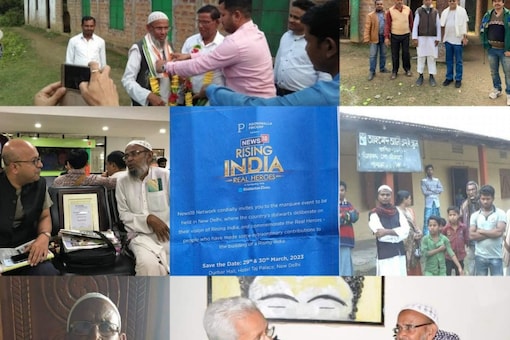
By establishing nine schools with the money collected from driving an autorickshaw, Ali has helped bridge the gap between education and poverty in his community.
Ahmed Ali, from Assam’s Karimganj district, is a true inspiration for many, especially those who are determined to make a positive difference in their communities. Despite facing financial challenges, the 87-year-old decided to take matters into his own hands and established schools in his village to provide education to underprivileged children.
By establishing nine schools with the money collected from driving an autorickshaw, Ali has helped bridge the gap between education and poverty in his community. He understands that education is the key to unlocking opportunities and breaking the cycle of poverty. His schools offer affordable education to students who would otherwise not have access to it.
He is a resident of Khilorband, a marginal village of Patharkandi in the Indian state of Assam, bordering Bangladesh. Ali started the first school in 1978 in his village Madhurband. He sold some of his land and donated a part of the land to the school, on which it was built. Out of his 36 bigha land, he donated 32 bigha land for the construction of the school. Funding of the school is also done from its deposits, daily earnings and donations.
His high School was set up in 1990. In addition to it, he also established three lower secondary schools, five secondary schools and one higher secondary school. He hopes to establish a college in the future.
Besides donating his own land for the schools’ construction, Ali also works hard to keep them running. He drives a rickshaw during the day to earn a living, and at night, he cuts wood to help maintain the school’s finances. His dedication and hard work have made a significant impact on the education of many children in his community.
Ahmed Ali’s work has not gone unnoticed. He was nominated for the News18 Rising India Real Heroes Award in the education category, and he will be conferred with the award at the News18 Rising India Summit at the Taj Palace Hotel in New Delhi on March 30.
His story has been shared by Prime Minister Narendra Modi on his radio programme ‘Mann Ki Baat,’ inspiring many others to take action in their own communities. Narendra Modi said, “I have come to know that a rickshaw puller named Ahmed Ali of Assam’s Karimganj district has opened nine schools for the education of poor children. It is a beautiful manifestation of the will of the people of our country.” Ali was also invited to Delhi as a speaker by an NGO Jookto.
source: http://www.news18.com / News 18 / Home> India / by Akhi Das, edited by Jessica Nani / March 29th, 2023
Sahaswan (Budaun) , UTTAR PRADESH / Kolkata, WEST BENGAL :
He could captivate the audience and eradicate the thin line between a structured format and the playfulness of a classical composition while his voice moved through the shades of ragas.
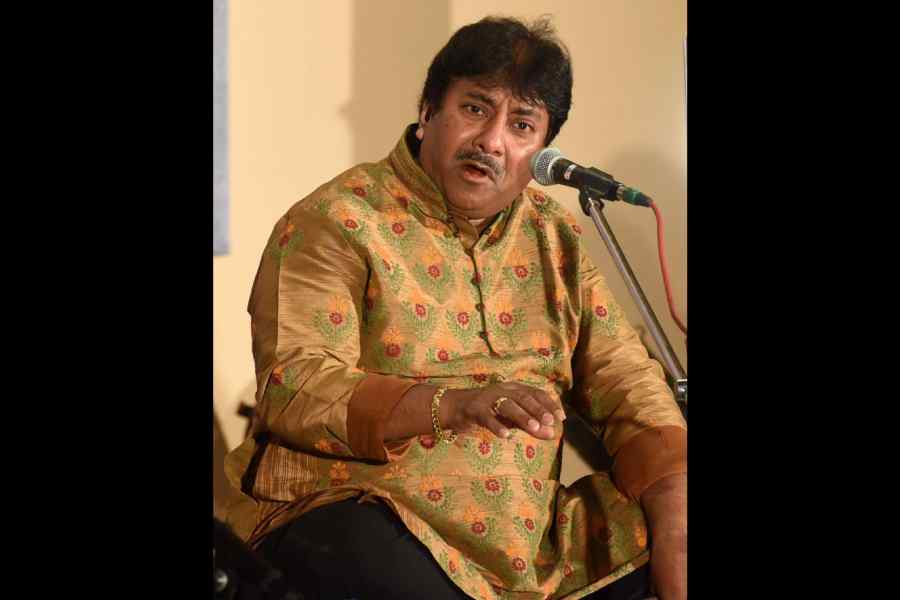
Rashid Khan./ Sourced by The Telegraph
The name of Ustad Rashid Khan reminds one of the words of T.S. Eliot: “Music heard so deeply/that is not heard at all, but/you are the music/while the music lasts.’’
A born genius, talented and extraordinary musician… adjectives are too limited to describe the golden voice of Rashid Khan.
The fulfilment of an art form touches immortality when the artist becomes the art, as the poet said. Diehard listeners of Rashid Khan and ardent music lovers know the truth because they have discovered the artiste’s voice in different genres of music and steeped integrated melodies.
The great-grandson of the legendary Ustad Inayat Hussain Khan, the founder of the Rampur Sahaswan Gharana, Rashid was born on July 1, 1968, at Badaun in Uttar Pradesh.
Memory and melancholy created the soul of the artiste, although he was completely unaware he would one day become one of the greats of Indian classical music. He lost his mother and younger brother at a very early age; he found solace in kabaddi and cricket.
Rashid studied in Mumbai for about a year and after coming back to his hometown, his tutelage was started under his illustrious granduncle and guru, Ustad Nissar Hussain Khan. He also carried the lineage of renowned vocalists like Mushtaq Hussain Khan and Ghulam Mustafa Khan. But the rather authoritarian Ustad Nissar Hussain Khan changed the course of his life and made him what he became over the years. He nurtured the latent potential of Rashid through his training, first at his own residence at Badaun and subsequently at the Sangeet Research Academy in Calcutta.
Young Rashid Khan, an assured voice of the future of Indian classical vocal music, certified by none other than Pandit Bhimsen Joshi, was to evolve into a formidable talent, especially with his prowess in taankari and gamak.
His full-throated voice was an exceptional amalgamation of depth and rhythmic generosity. He could captivate the audience and eradicate the thin line between a structured format and the playfulness of a classical composition while his voice moved through the shades of ragas. He was adept at the instrumental stroke-based style which he inherited from his gharana, as well as an expert at infusing emotion into an elaborate musical verse.
Probably this is the reason he was successful in different styles of singing and innovation despite being a rooted classical musician.
For example, when he sang Tagore songs based on various ragas, he focused on the rendition of the quintessential flavour; his command over the notes and tunes brought out the charm of the song with skilful originality.
Rashid had fond memories of the town of Badaun and its surroundings where he spent his early days. The river which flows by the town was a witness to the number of hours Rashid spent by its side singing.
He paid his respects on his visits to his hometown at the cemetery where his parents and young brother were laid to rest.
It may well be the inexplicable pain and loneliness of childhood filtered through his every rendition of ‘Yaad Piya ki Aye’ (composed originally by Ustad Bade Ghulam Ali Khan) — a Rashid reinvention that became very popular. As with the Bollywood hit ‘Aoge Jab tum o saajna’ from Jab We Met.
He skilfully obliterated differences between musical genres and was able to recreate a unique combination of love and exuberance with the full boom of his voice in three octaves, as manifested in each and every song. In numerous playback essays, he successfully broke traditional boundaries with his scintillating voice and evoked sensibilities even when he was out of his core expertise.
In the words of senior organiser of the Dover Lane Music Conference, Bappa Sen: “Rashid contributed an unparallel range to the music fraternity. We have seen him grow as a man as well as an artiste and witnessed his excellence in all spheres of music. He was an integral part of this music festival from a very young age and even performed in the periodicals. Along with his talent, he excelled himself to heights that required enormous hard work and open-mindedness. As a person he was as humble and respectful to all of us as he was from the very first day.”
Sarodiya Amaan Ali Khan thinks: “Unki voice mein to Ishwar hain.” He had countless memories with this senior artiste, fellow musician and co-performer who, Amaan says, was always an inspiration to him. “He was a person as clear as water,” said Amaan.
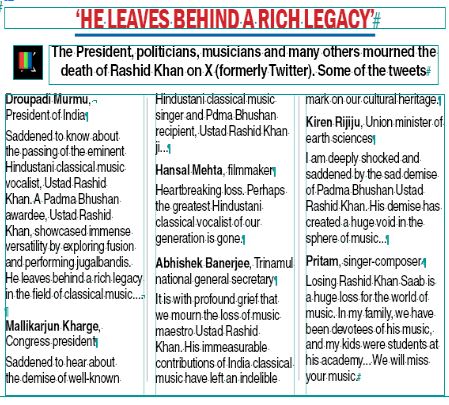
To his close friends and contemporary musicians, Rashid Khan was an irreplaceable voice and human being in every sense. The absence of Rashid’s mortal existence has now created a vacuum in the world of Indian classical music which is now devoid of his rich depth of voice.
Rashid’s son Armaan is carrying the torch of the legacy, his daughters Suha and Shaona are into Sufi music.
Rashid flourished as the breaking dawn with Lalit, Ahir Bhairon, Miyan ki Todi, returned to the root with Puriya Kalyan, Puriya Dhaneshree, Shree, sparkled with Sohini.
He has left behind an unforgettable repertoire of renditions and the gift of his unbridled imagination to lovers of his singular work.
source: http://www.telegraphindia.com / The Telegraph Online / Home> Culture> Music / by The Telegraph / January 10th, 2024
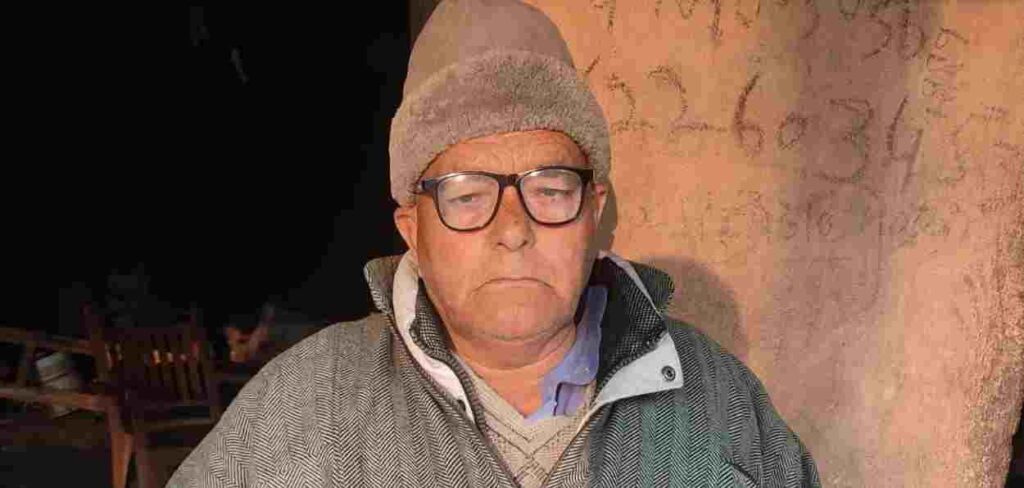
Ghulam Mohammad Mir at his house in Magam, Kashmir
This is the story of how a powerful lobby in Kashmir comprising men and women in politics, bureaucracy, media, and academia was allowed to spread fake narratives for years with the apparent motive of currying favours with pro-Pakistan terrorists and separatists, and it went unchallenged.
It’s interesting to note that the two Kashmiris, who were conferred India’s fourth highest civilian award—Padma Shri—for helping security forces in service of the nation, were poor and uneducated residents of Central Kashmir’s Tangmarg-Magam belt.
While Mohammad Deen Jagir of Tangmarg was conferred upon Padam Shri for foiling Pakistan’s “Operation Gibraltar” in 1965, Ghulam Mohammad Mir of Magam aka Moma Kanna, was honoured in 2010 for wiping out insurgency in its hotbed in the 1990s.
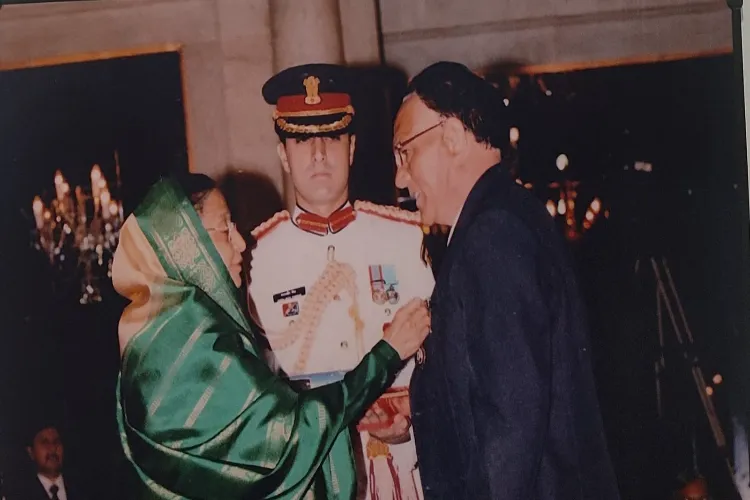
Ghulam Mohammad Mir receiving Padma Shri from President Pratibha Patil
Kanna, who claims to have neutralized “more than 5,000 militants”, also lost 10 of his relatives, including three family members, before his services to the nation were recognized in 2010.The announcement of Padma Shri to Kanna in February 2010 triggered controversy and prodigious reactions from the Valley’s mainstream politicians. In the era of competitive separatism being at its peak, the mainstream leaders outsmarted even the rank secessionists, raising questions about how a ‘collaborator of security forces’ had been selected for a prestigious national honour.
Interestingly, it was Farooq Abdullah, a Minister in Manmohan Singh’s cabinet, who had recommended the award for Kanna. Interestingly, his son, Omar Abdullah, then the chief minister publically distanced himself from the award. He denied that his party or government had recommended the name of a man who was seen as working against terrorists.
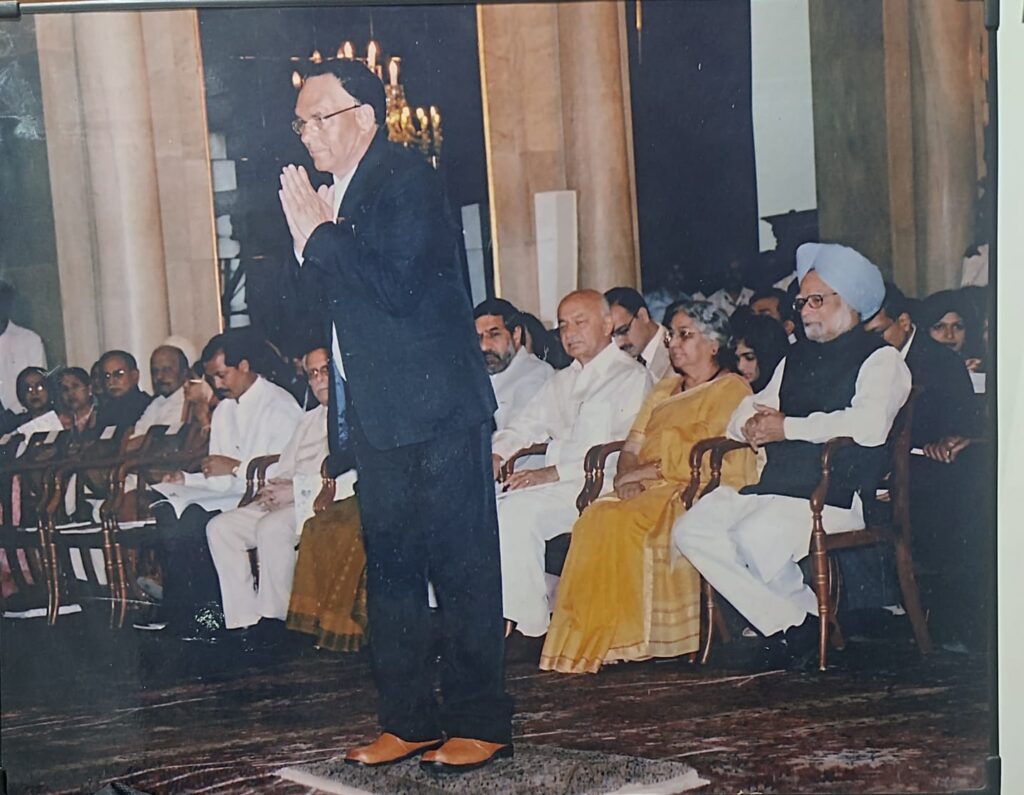
Ghulam Mohammad Mir at the Padma Awards ceremony
In an op-ed in the local newspaper Greater Kashmir, a top bureaucrat, who later held key positions in Mufti Mohammad Sayeed’s cabinet also blasted Kanna and those behind Padma Shree to Kanna.All those in power alleged that Kanna was behind the custodial killing and fake encounters of “hundreds of innocent civilians”. Reports in the media claimed that Kanna was a pro-Pakistan militant who subsequently became a pro-India ‘renegade’. However, Farooq Abdullah quickly admitted that he had recommended Kanna “on the merit of his services to the nation”.
Kanna’s name was recommended by top Army and BSF officers and also the then Chief Information Commissioner of India, Wajahat Habibullah. Habibullah was Kashmir’s Divisional Commissioner when Kanna helped security forces.
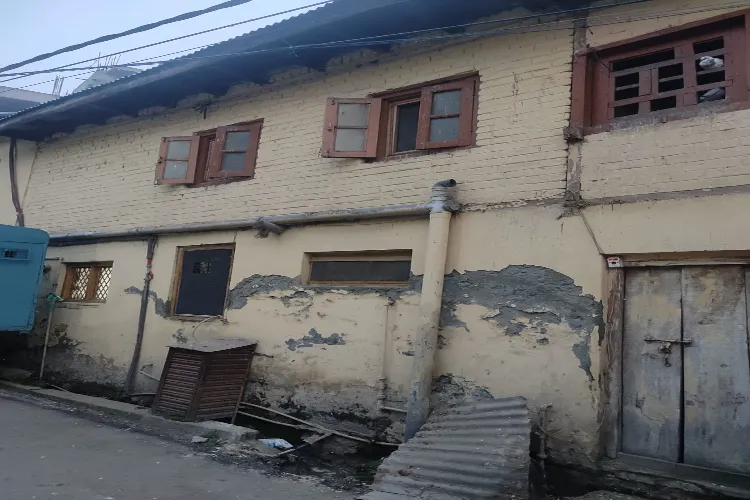
The house of Ghulam Mohammad Mir at Magam, Kashmir
The local and the national media demonized Kanna, buttressing the populist narrative that informers and counterinsurgents were not entitled to Padma awards. They conveniently glossed over the fact that the very first Padma Shree in Kashmir had gone to Mohammad Deen, who had informed the authorities of the presence of Pakistani intruders in Gulmarg in 1965-66.
In an interview with Awaz-The Voice at his Magam residence this week, 73-year-old Kanna claimed to have neutralized “more than 5,000 militants” in the first 10-12 years of the insurgency but asserted that he had never killed a civilian in custody, a fake encounter or otherwise. He said that thousands of militants got either killed or arrested even as hundreds more surrendered.
This 73-year-old man, who lives in a nondescript mud-plastered house under the Police and CRPF protection, and runs an ordinary sawmill on the premises to eke out his family’s livelihood, claimed he was never a militant.
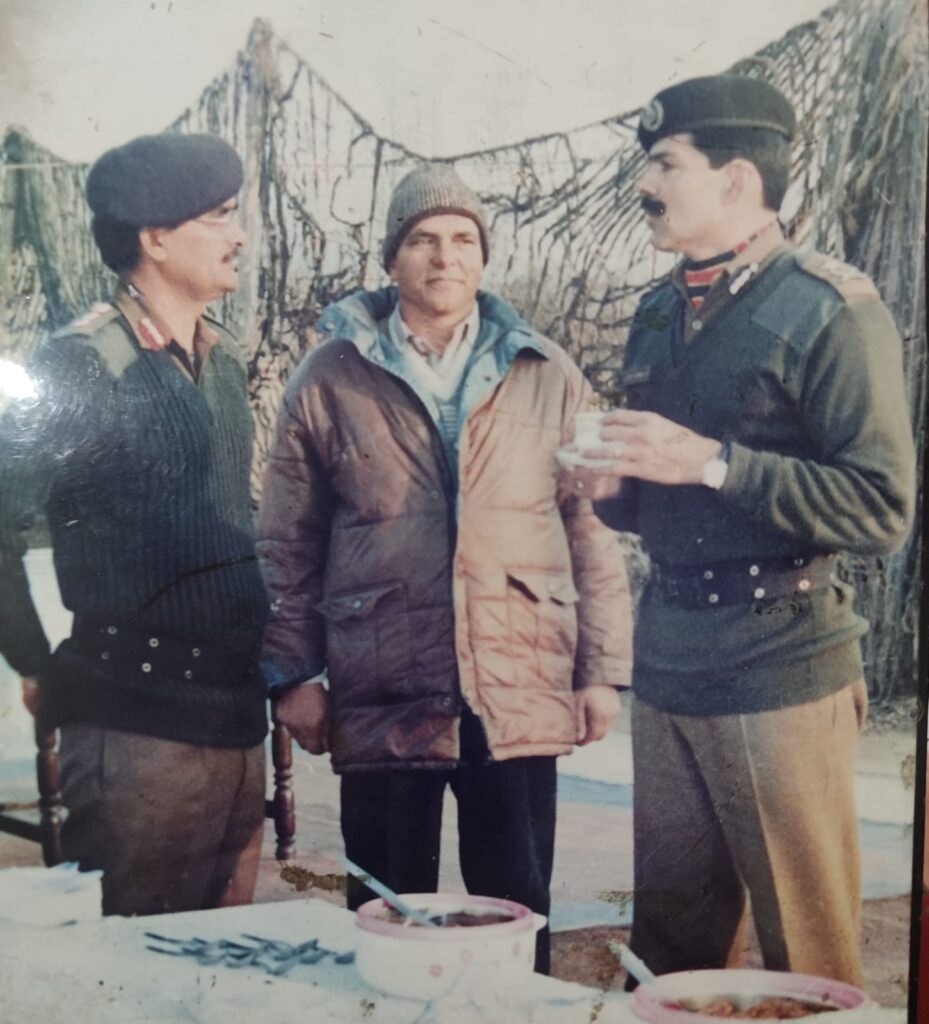
Ghulam Mohammad Mir with security forces in Kashmir
“All those politicians and journalists were lying to the world as they were darlings of (Syed Ali Shah) Geelani and (Mohammad Yasin) Malik and their job was limited to their glorification and appeasement. Go and check the records at all Police Stations. Not a single FIR for murder or any other crime was registered against me”, Kanna asserted.
“I began helping the security forces from day one of militancy in 1989 as I firmly believed that gun culture, violence, and terrorism, would lead us to nowhere. Since I was never a militant, there’s no question of my becoming a renegade. All those media reports about me were trash. I never killed a civilian in custody or encounter. I never committed any atrocities on any human being. That’s why there wasn’t any complaint against me”, Kanna added.
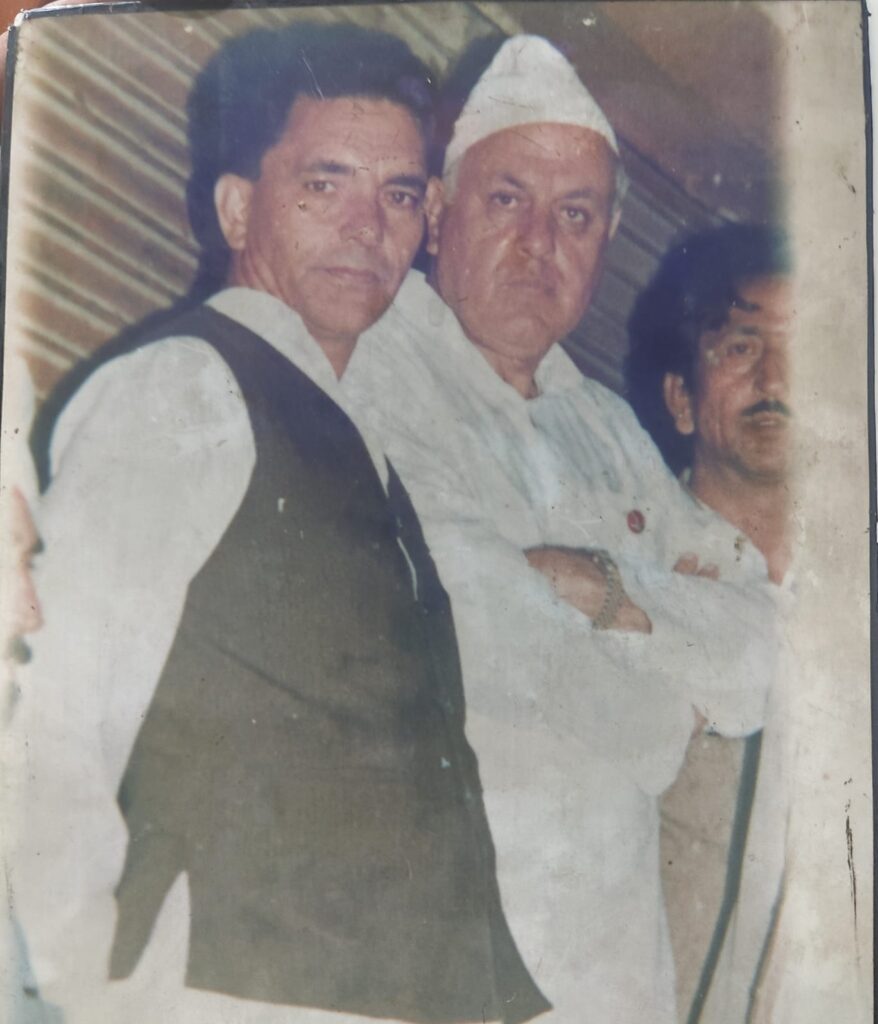
Ghulam Mohammad Mir with Dr Farooq Abdullah
“I didn’t kill anybody even after the militants killed 10 of my relatives including three of my family members”.
Kanna disclosed that being in the Congress party, he knew Mufti Mohammad Sayeed as J&K Pradesh Congress Committee president in the 1980s.
“I was given a temporary class-IV job in the Forest Department when Ghulam Mohammad Shah was the Chief Minister in 1984. In December 1989, when Mufti Sahab became India’s Home Minister and I heard about his daughter Rubaiya’s kidnapping, I did my bit to trace her to Uthura village of Baramulla with the help of a brick kiln owner who was my friend. Later, she was released when Mufti’s men struck a deal with the militants”, Kanna said.
“I met the Minister in charge of J&K in VP Singh’s government, George Fernandes, at Bakshi Stadium in Srinagar. He sought my help to contain insurgency. Ghulam Ahmad Itoo alias ‘Ama Kanna’ of Sultanpora was the first militant who surrendered before me”.
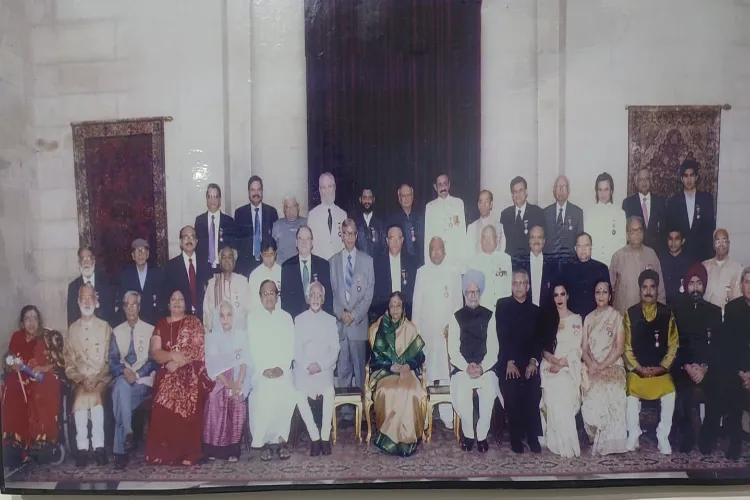
All the Padma awardees of 2010 with President Pratibha Patil in one frame
Later Qasim Khar of Nowgam and three militants of Dab Wakora surrendered before Kanna. This was the first group of Kashmiri youths who switched loyalties and helped security forces in counterterror operations. Within a year, it grew into a sizable network.
Kanna turned to the security forces’ side when some civilians and militants captured and killed Constable Samrat Singh of the CRPF 48th battalion. “They got him booby-trapped in our neighbourhood. They snatched away his .303 rifle. A government school teacher, who is still alive, set him on fire and burned him alive at Hagarpora. There was never any action against him and other killers”, Kanna said.
Unlike Moma Kanna, Amma Kanna indulged in human rights abuse and allegedly committed atrocities against the militant families. Over a year after his surrender, he was buying a lamb for sacrifice on the eve of Eid-ul-Azha near Magam when some militants seized him and chopped off his head with a butcher’s cleaver. It was carried to Budgam and hanged to a tree at Nasrullahpora to terrorize those daring to side with the forces.
source: http://www.awazthevoice.in / Awaz, The Voice / Home> Story / by Ahmed Ali Fayyaz, Magam (Budgam) / November 19th, 2023
The retired surgeon of Gauhati Medical College and Hospital traverses like a nomad to advocate birth control, especially among Assam’s rural Muslim populace.
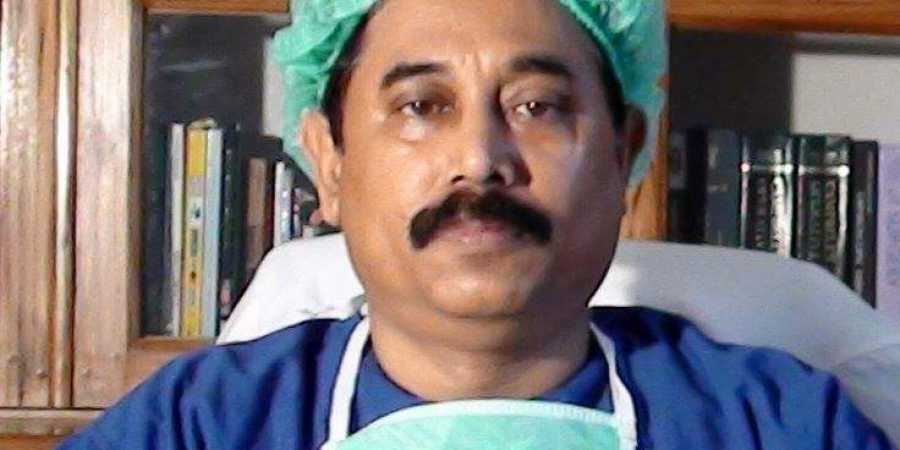
Dr. Ilias Ali. | Express Photo Services
Guwahati :
Assam’s “family planning jihadi”, who quotes from the holy texts, has finally got his dues, the Padma Shri.
For the past many years, Dr. Ilias Ali has been on a holy mission. The retired surgeon of Gauhati Medical College and Hospital traverses like a nomad to advocate birth control, especially among Assam’s rural Muslim populace.
The 63-year-old often adopts unusual but unique methods to motivate people to go for ‘No Scalpel Vasectomy’ (NSV). He quotes verses from the Quran and the Hadith to encourage people to go for NSV. He mostly works in the state’s Bengali Muslim settlements where people view NSV and the use of contraceptive pills as un-Islamic. Resistance is common, yet he has been able to motivate over 55,000 people to go for NSV.
“The first few years of my mission were very challenging. Those days, my family would get scared when I embarked on a journey to conduct an NSV camp. It feared for my life,” Dr. Ali, who is still a part of Assam’s NSV programme, told this correspondent.
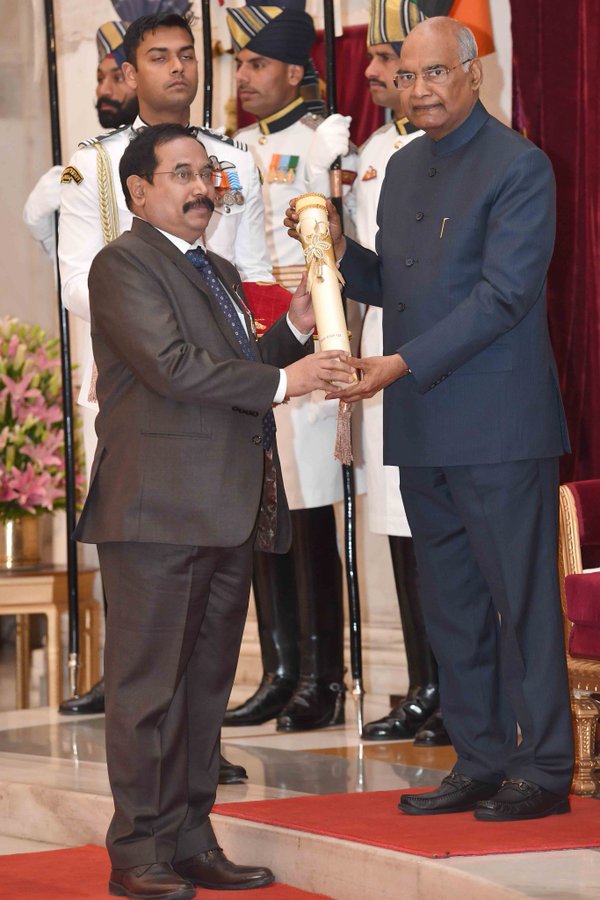
President Kovind presents Padma Shri to Prof Dr Ilias Ali for Medicine. A public health specialist, he has spread awareness about family planning and popularised different means of birth control / pix: rashtrapatibhvn
He is happy that the government has recognised his contribution to society.
“I am very happy that my contribution has been recognised. It is an honour to the entire medical team that I have been a part with for years,” he said.
Uddhab Bharali is the other person from Assam to be named for the award. The 57-year-old has to his kitty over 150 innovations.
Three decades ago, Bharali had to drop out of his engineering studies as he could not afford to pay fees and was required to take care of his family. However, that was hardly an obstacle. Riding on his passion for creativity and innovation, he started developing machines, mostly from scrap, for everyday use. The turnaround was when he created a polythene-making machine for surrounding tea estates.
Much of his inventions are today centred round agriculture. His machines for de-seeding of pomegranates, peeling areca nuts and cassava, cutting tobacco leaves to extracting passion fruit juice helped in speedy agricultural process and provided livelihood to many.
Earlier, the BBC had done a documentary on the innovations of Bharali who is a recipient of several awards including three from abroad. He said he was very happy to be honoured.
“I’m feeling very happy that I have got a national recognition. I will continue with my work,” the innovator who works with students from various IITs, said. Bharali takes care of 25 families with poor financial backgrounds and is widely known for his philanthropic works.
Two others from the Northeast to be named for Padma Shri are archer Bombayla Devi Laishram of Manipur and flutist Thanga Darlong of Tripura. The 99-year-old Darlong is the last tribal musician to play “Rosem” which is a bamboo-made flute-like musical instrument.
source: http://www.newindianexpress.com / The New Indian Express / Home> Nation / by Prasanta Mazumdar (picture edited) / Express News Service / additional photograph of Padma Shri Award introduced – pix: source: rashtrapatibhvn: / January 26th, 2019
Rashika Islam has topped the Combined Competitive Examination (CCE), 2022 conducted by the Assam Public Service Commission (APSC). The results of the CCE which were declared on Wednesday also saw 54 Muslim candidates crack the tough examination to become civil servants, police officials, and administrators in allied State services. Rashika Islam, daughter of Colonel (Retd) Saidul Islam and Raihana Islam, of Matiabag, Gauripur in Dhubr district, has secured the highest marks in the CCE exam conducted by the APSC. Rashika’s achievement has delighted the residents of Gaurpur and the entire Dhubri district.
“I am elated after seeing my name on the top of the APSC results. In 2020 I had cleared the final of the CCE. But my rank was low and I got the job of a Tax Inspector posted in Dhubri district. However, I was not happy and wanted to improve my rank in the APSC exam. Though it was tough to study for such a tough exam while serving the job of tax inspector, my husband and parents were supportive. I took no coaching in any institute to prepare for the CCE 2022. I prepare a lot for the exam by watching free YouTube channels and websites on success mantra in civil service examination,” Rashika Islam told Awaz-The Voice soon after the results were declared on Wednesday evening.
Rashika Islam has been selected for the Assam Civil Service (ACS) category. When asked about study tips to crack the exam like CCE Rashika said there is no definite answer to such a question.
“There is no shortcut but to study hard for the exam. Despite my hectic schedule as the tax inspector I managed to study four to five hours a day before the CCE-2022,” Rashika said.
Raashika’s husband who is also a bureaucrat with the Assam Government had been very supportive of his wife’s success. Due to her father’s pan-India job, Rashika studied in different army schools in different parts of the country, including the Army Public School, Narengi, Guwahati.
Besides Rashika, 53 other Muslim students cracked the APSC exam and have made it to the civil police and allies services of the government of Assam.
The Muslim candidates selected for the Assam Civil Services are Rashika Islam, Wahiduz Zaman, Zamanur Islam, Asfaq Laskar, Benazir Ilyas, Abu Saeed Mohammad, Golzar Hussain, Affan Khan, and for the Assam Police Service: Fayez Ahmed, Rubina Begum, Arshad Wasim Ahmed and SK Sajidur Islam.
Rashika islam
Shabnu Rahman and Shahjahan Ali have been selected as Superintendent of Taxes while Mohammad Abdul Wakil has been selected for the Assam Finance Services.
Others selected candidates are:
Block Development Officers: Mohsin Siddiqui, Zahid Hussain Hazarika Khorshida Khanam, and Antra Hussain.
Assistant Manager, District Industries Center: Farida Yasmin.
Assistant Registrar of Co-operative Societies: Pinaj Rahman. Tax Inspectors
Pakiza Begum and Javed Akhtar Laskar.
For Inspector of Excise posts Mohammad Tazim Ahmed, Imran Hussain, Sarnaz Mehboob. Sub Register, Mudrika Jhabiullah Hindi. Assistant AuditOfficers Shabiha Shabnam, Tanveer, Parvez, Hamidur Rahman, Salim Majid, Anjum Parbin, and Jahangir Alam Barbhuiya have been selected.
For Assistant Account Officers posts Philorina Begum, Tanveer Amin, Wasim Ahmed, Syeda Tamanna Yasmin, Manin Uddin Ahmed, Nekib Zaman Ahmed, Zaffrin Rahman, Firdaus Rahman, Jackie Ahmed, Rauchna Parbin Akand, Mirza Kausar Ahmed, Shamsur Rahman, Abdul Ullah Ahmed, Khandkar They are Khairul Islam, Shabana Rakia Ahmed, Mohammad Ali and Abu Bakar Siddique have been selected.
Ahmed Faraz will be a Research Assistant in the Transport Service Department. For Assam Urban Administrative Service Azharul Alam, Asif Ali Khan, Baitul Alam Rahman, and Ajmal Hussain have been selected.
So far, 68 Muslim candidates have cracked the CCE conducted by the APSC between 2013-18. This year, 54 Muslim candidates cracking the same exam in a single year is considered a very encouraging and positive development for the minority community in Assam.
The number of Muslim candidates selected for ACS and Allied Services would be more in the future provided quality education spreads among them,” eminent surgeon and Padmashri Dr Illias Ali said.
source: http://www.awazthevoice.in / Awaz, The Voice / Home> Story / by Ariful Islam, Guwahati / January 19th, 2024
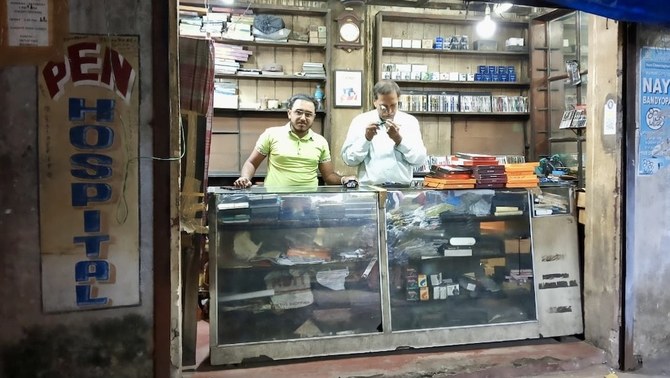
Mohammed Imtiaz, right, and his nephew Mohammed Shahbaz Reyaz are seen at their Pen Hospital in Kolkata on Nov. 30, 2023. (Mohammed Shahbaz Reyaz)
Pen Hospital in Chowringhee Lane in Kolkata was established in 1940s
It is increasingly catering to young people rediscovering fine writing instruments
The nondescript facade with a fading nameplate misses the attention of passersby at Chowringhee Lane in Kolkata, remaining a go-to place only for connoisseurs who still cherish the old-fashioned art of handwriting.
In its quiet and quaint interior, a visitor can try thousands of vintage and high-end fountain pens from brands like Montblanc, Parker, Pilot, Visconti, Wilson, Waterman, Pelikan, or Sheaffer, and watch as Mohmmad Imtiaz brings them back to life.
The Pen Hospital represents a bygone era in an age of instant electronic messaging, but it still draws lawyers, academics and collectors from across India and, lately, also young people who have been increasingly attracted to fine writing instruments.
Established in the 1940s by Imtiaz’s great-grandfather Mohammed Shamsuddin, the shop has stayed in the family ever since. Imtiaz’s partner behind the counter is Mohammed Shahbaz Reyaz, the son of his late brother.
“Despite the popularity of high-tech laptops and iPads, pens are also getting popular and that’s the reason I have roped in my nephew into the business. My son will join, too,” Imtiaz told Arab News.
“There is a renewed interest in fountain pens among the new generation. Today, half of my customers are younger people and this gives me hope.”
Depending on the model, it costs between 25 cents and $60 to have a pen “treated” at the Pen Hospital. Sometimes, parts of older or rarer pens need to be procured from different sources.
Imtiaz repairs seven to eight pens a day on his “operation table” — the shop’s counter.
“Sometimes the workload is so high that some customers have to wait a week for an appointment,” he said.
There used to be many such shops during the time of Imtiaz’s great-grandfather and grandfather, but most ceased to exist in the 1990s, when cheap, disposable ball pens hit the mass market in India.
Now, Imtiaz believes his Pen Hospital is the “only shop in eastern India” that still deals in the trade, which began to thrive again only a few years ago.
“Things started taking up after the COVID-19 pandemic. Long periods of lockdown forced many people to read and write, and people started coming with old fountain pens for repair,” he said. “Some people discovered vintage pens in their cupboards. They have not used them for decades.”
His shop has a special value for collectors like Sarthak Ganguly, a media professional, who has been visiting the Pen Hospital for almost 20 years.
“The Pen Hospital is the only place in Kolkata where you can look for some nice vintage pens,” he said.
“Here you will get a fountain pen that can cost you from $1.20 up to $1,200. Many fountain pen collectors, like me, have at least 1,000 old and new fountain pens. Most of my pens have been collected from the Pen Hospital.”
In a city like Kolkata, known as the cultural capital of India, writing with a pen brings together craftsmanship, style and a touch of nostalgia — something that younger people are increasingly fond of.
It is mostly the new generation of collectors that Ganguly sees at the shop in the morning.
“The young generation is buying fountain pens and that is really heartening,” he said.
“The Pen Hospital not only has nostalgic value, but also it is a pleasure to visit such an iconic shop. It reminds you of history.”
source: http://www.arabnews.com / Arab News / Home> World / by Sanjay Kumar / December 13th, 2023
Rana’s feat assumes significance in the wake of a rise in the number of drowning cases in the state.
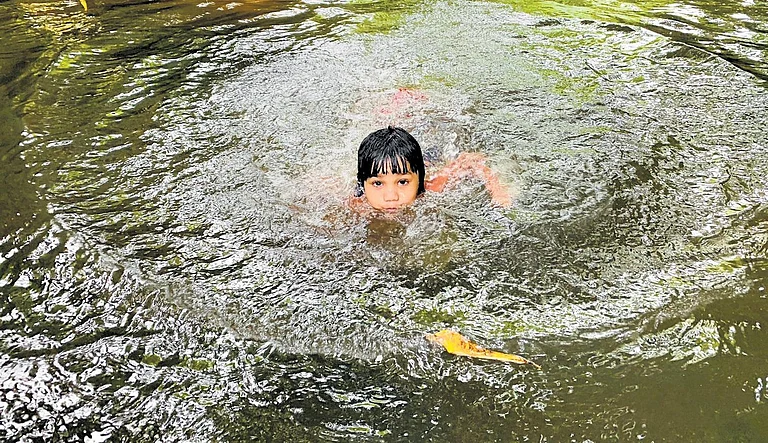
Rana Fathima shows off her skills in the water
Kozhikode :
Rana Fathima, a five-year-old swimming prodigy hailing from Kodiyathoor panchayat, has been enchanting denizens on the internet with her skills in the water for some years now. Now, as a brand ambassador of ‘Neenthi vaa Makkale’, an initiative organised by Mukkam municipality to impart swimming lessons to students, she is a role model, inspiring youngsters in the panchayat to take up swimming.
Rana learned to swim in a small river in Thottumukham under the tutelage of her grandmother, Ramla Manaf. She is the daughter of journalist Rafeeque Thottumukham and Rifana.“It is important for children to learn how to swim. It’s equally important for parents to encourage their kids to come out of their cocoons. Mobile phones and television are adversely affecting the young generation. Children should stay close to nature,” Rafeeque said.
After her videos went viral, Rana was frequented by social media influencers, all eager to capture her story in greater detail. Rahul Gandhi, too, had paid her a visit on one of his trips to the state.
Rana’s feat assumes significance in the wake of a rise in the number of drowning cases in the state. “Most of the drowning cases happen during the vacation. People who take to the water bodies here do not heed our warnings. You might have prior experience in swimming, but the rivers here have strong currents. Even the native swimmers are scared to get down sometimes,” said Muralidharan C K, assistant station officer, Fire and Rescue Services, Mukkam.
In the past five years, around 41 people have died by drowning in the region. Most of them were youngsters aged 15-28.
source: http://www.newindianexpress.com / The New Indian Express / Home> Kerala / by Alka Mariya & Heera Hari / May 22nd, 2023
‘I invite any Indian who claims to be a nationalist to the core to have a conversation with me,’ Rana wrote for The Wire in 2017.
Munawwar Rana (1952-2024). Photo: Youtube
New Delhi:
Urdu poet Munawwar Rana died on Sunday, January 14. He was 71.
Rana, who had been suffering from throat cancer, breathed his last at the Sanjay Gandhi Post Graduate Institute of Medical Sciences in Lucknow.
The poet is survived by his wife, four daughters and a son, PTI has reported.
Rana was an outspoken artist and was vocal against communal politics.
In 2021, Lucknow police registered an FIR against him for allegedly inciting religious feelings for his comments on Valmiki, who wrote Ramayan.
“Valmiki became a god after he wrote the Ramayana, before that he was a dacoit. A person’s character can change. Similarly, the Taliban for now are terrorists but people and characters change…When you talk about Valmiki, you will have to talk about his past. In your religion, you make anyone god. But he was a writer who wrote the Ramayana, but we are not in competition here,” Rana had said.
In 2017, the poet, who wrote the famous Maa, wrote for The Wire:
“I invite any Indian who claims to be a nationalist to the core to have a conversation with me. Let him decide the time and place. If Allah wills it, they will emerge as traitors; and we will emerge as nationalist Indians. You say ‘Bharat Mata ki jai’. My friend, we kneel on earth and kiss this soil 94 times in veneration while offering our prayers.”
On social media, many have condoled his passing.
source: http://www.thewire.in / The Wire / Home> Books / by The Wire Staff / January 15th, 2024
Rukhsana Jabeen (Second from right) at a poetic symposium
Rukhsana Jabeen is one of the very few female litterateurs in Jammu and Kashmir who carved a niche in the Subcontinent’s vast domain of Urdu poetry at the intersection of the 20th and the 21st century. An overarching and unceasing armed insurgency, that muted all expressions in art and literature in the Valley failed to silence her for 33 years.
After serving All India Radio for over 30 years, Jabeen retired as a Director at Radio Kashmir Srinagar in 2015. The participation of a Kashmiri woman in the annual All India Mushaira on the eve of Republic Day or Independence Day was fatally proscribed by terrorists. Jabeen did so without break.
“Whatever came to my mind, I wrote and expressed without thinking a bit about its consequences”, Jabeen revealed to Awaz- the Voice at her winter residence in Jammu.
Born in a family of the decedents of the revered saint and Kashmiri-Persian poet Syed Meerak Shah Kashani in the Khwaja Bazar neighbourhood of downtown Srinagar in 1955, Jabeen did Master’s in Urdu followed by MA and M Phil in the Persian language and literature at the University of Kashmir. In 1983, she joined AIR Srinagar as a program executive.
Rukhsana Jabeen at a poetic symposium
“I was not the first woman to enter the station for an all-India job”, Jabeen said “but in our family setting it was like breaking the glass ceiling. Getting selected for the job in a tough patriarchal competition was like a big success for me. Knowing well that I wouldn’t be permitted to apply for it, I kept it all discreetly concealed from my family”.
“I was also selected as a teacher in the State Education Department. As my father learned about my getting a job at the AIR, he insisted I should join as a teacher. I agreed with him that the AIR officers could be transferred to any Indian State, but I lied that female officers were not posted outside their home States. Thereupon my family relented, and I joined as a program executive”, Jabeen said.
In 1994, Jabeen established AIR’s Poonch station close to the Line of Control in Jammu where she served for three years. In 1999, she was promoted to Assistant Station Director (ASD).
Unlike many of her tribe, Jabeen’s tryst with creative literature began late during her university days. A prominent Urdu poet and literary critic and the head of the Urdu Department, Prof. Hamidi Kashmiri, encouraged Jabeen to write prose and poetry in Urdu. “I was thrilled when Hamidi Sahab refined my first Ghazal and got it published in the annual edition of his department’s magazine ‘Baazyaft’. Under his tutelage, I learned about modern sensibility and the post-modernist literary trends”, Jabeen recalled.
Rukhsana Jabeen recording a radio programme
She narrated how affectionately some celebrated litterateurs like Hamidi at the University of Kashmir and Zubair Rizvi at Radio Kashmir Srinagar gave her select books and literary magazines to hone her talent and faculties as a creative writer.
“One day, incredulously I found five of my poems published together, alongside my profile, in Kumar Pashi’s journal ‘Satoor’. Later, Zubair Sahab disclosed that he had got the same published in the prestigious Urdu magazine. It was an incredible encouragement and my recognition as a poet. Thereafter, a number of my poems were published in the top representative journals like ‘Alfaaz’, ‘Shayir’, ‘Mafaheem’ and ‘Asri Agahi’. Hamidi Sahab and Zubair Sahab steered me to the extensive studies of Shaharyar, Rajinder Manchanda Bani, Nasir Kazmi, and Mohammad Alvi. I am still deeply under the influence of Mohammad Alvi and a few others”, Jabeen added.
Kishwar Naheed, Parveen Shakir, and Fahmida Riaz inspired Jabeen into some new experiments. She was initially also influenced by female Urdu litterateurs like Rafia Shabnam Abidi, Aziz Bano Darab Wafa, and Sajida Zaidi and later shared the stage with them at AIR and all-India poetry symposiums. For over three decades, Jabeen was a regular guest poet at Delhi’s Red Fort and other literary rendezvous, integrating a Sub-continental network of the intelligentsia and defying a hostile ambiance at home.
For several years, Jabeen translated poetry from 22 Indian languages into Kashmiri as a project of the Sahitya Akademi. She participated in many such all-India poetry symposiums at Varanasi and other Indian cities. She remained closely linked to top-notch Urdu poets like Shaharyar, Bashir Badr, Nida Fazli, Makhmoor Saeedi, Ali Sardar Jafri, Kaifi Azmi, Qateel Shifai, Ahmad Faraz besides literary critics like Shamsur Rahman Faruqi, Naiyer Masud and Malikzada Manzoor Ahmad.
“Many of them organized Mushairas in my honour at their homes. It was a unique recognition and hospitality as never before has anyone from Kashmir been entertained to such honours”, Jabeen said. “I invited many of these doyens of Urdu literature to our programmes at Radio Kashmir”.
Ghazal in Urdu and Kashmiri is Jabeen’s forte even as she also tried her pen at the popular genre of ‘Nazam’. “But I no love lost for blank verse and free verse. I believe those who can’t write in Urdu’s traditional meters have little right to write in free verse. Besides, I have seen how many of the aspirants, particularly females, get free verse written by others and read the same as their poetry. They perform such poor poetry at stage. Contrarily, nobody gives out a Ghazal. A Ghazal and Nazam writer is often an authentic poet”, Jabeen said.
In addition to volumes of the translation of short stories from different languages into Kashmiri and a translation of the collection of Hafiz Shirazi, which she accomplished with Dr. Syed Raza of Budgam, Jabeen has three of her collections—two in Urdu and one in Kashmiri—ready to publish.
“But I’m unbelievably indolent. I never get after awards and accolades. I can’t fulfill those formalities. Every year, I decided to publish these three volumes of my poetry but my laziness spoils my endeavour.”
source: http://www.awazthevoice.in / Awaz, The Voice / Home> Story / by Ahmed Ali Fayyaz, Jammu / January 14th, 2024
)