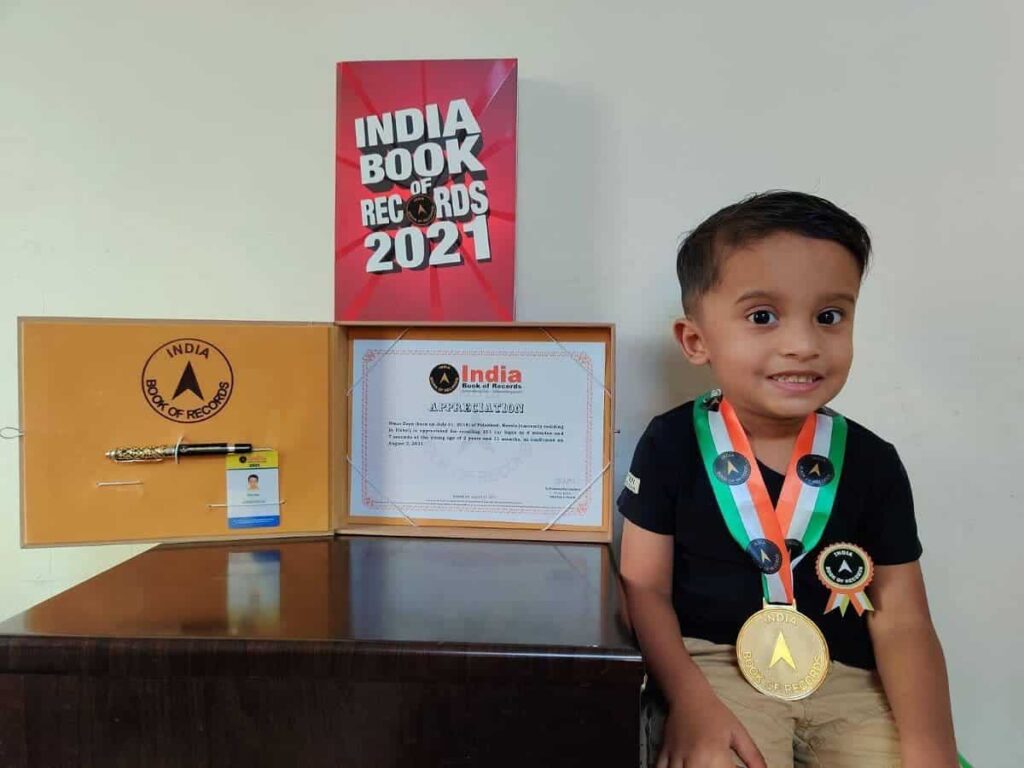
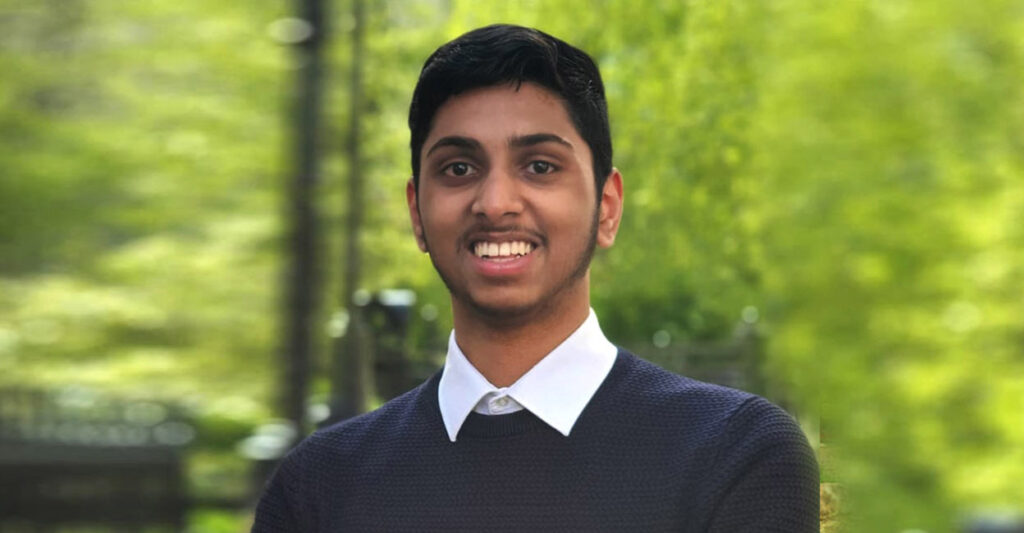
Omar is now preparing to improve his skills by memorizing 150 car logos and brand new logos within one year to create another record.
Abu Dhabi:
A two-and-eleven-months-old United Arab Emirates (UAE) based boy of Indian origin has been recognised by the India book of records for his amazing grasping and memory skills.
Omar Zayn was born on July 31, 2018, in the Palakkad district of Kerala; has become the youngest person to recall 101 car logos in 4 minutes and 7 seconds.
While most children his age struggle to speak properly, this prodigy has answered many questions related to cars.
Zayn’s interest in cars has grown since he landed in UAE last year and his passion for car logos took a new turn when he learned it online. He has currently memorized more than 110 logos.
“His sole learning came from YouTube. He sat for hours just to understand and memorise logos,” Omar’s father Zainul Abid told Khaleej Times.
A video of Omar memorizing the names of car logos was submitted to the India Book of Records last month, and the family recently received the coveted certificate and recognized his extraordinary talent.
Omar is now preparing to improve his skills by memorizing 150 car logos and brand new logos within one year and hopes to create another record.
source: http://www.siasat.com / The Siasat Daily / Home> News> Middle East / by Sakina Fatima / September 05th, 2021
THE Muslims-stirred to the acknowledgment of their actual situation in India especially after the Mutiny of 1857. The exit of the last Mughal monarch from the throne of Delhi was not only a symbol of their downfall but also an end to their existence as a separate and dominant group in Indian political life. A new phase in India’s history opened after the 1857 rebellion and the consequent dissolution of the East India Company. The era of the colonial Raj began with Queen Victoria’s proclamation of 1 November 1858. This benign document set a new tone of authority and conciliation. The post-Great Revolt period was probably the gloomiest period in the history of the Muslim community in the Indian Subcontinent. Muslims had created and taken an unmistakable part in the events of 1857, in the British eyes, whereas Hindus kept a low profile. Therefore, the Muslims were to bear, alone, the fault. Two factors influenced the creation of this image: the first was, of course, the nature of the movements led by Shariatullah and Syed Ahmad decades before the Mutiny; and second was the lingering imagery in the West of Muslims authored by European Christian perseveres during the Crusades (1095-1291). Quick and savage responses were to be incurred by the British administration, which would bring about a cruel reality for the Muslim people group. They lost their moorings, their confidence, their hope. And, for the first time, they realized with the anguish of bitterness that they were nothing but a weak, powerless, supine minority. This was the first casting of the seeds of nationalism, the first kindling of a feeling of loneliness and prostration, the first awakening to the need of solidarity. It was a period of gigantic political, social, economic, and social change that stirred a feeling of nationalism in the people groups of India. It was a period when a modernized Muslim scholarly and political initiative came to characterize and explain fundamental Muslim community and political necessities under the Raj, simultaneously as a beginning nationalist development was being fashioned by a more extensive working-class tip-top challenging British absolutism. The pressure among Hindus and Muslims started to arise in this period. At the point when it turned out to be extraordinarily disturbed after the mid-1920s, a practically unrecoverable hole opened up between what we may call Indian nationalism and Muslim rebellion, prompting the decisive division of Pakistan from the remainder of India in 1947.
It was a period when questions began emerging among the Ashraf classes about how Muslims could approach obliging western social impacts without negating the religious statutes of Islam. It was an issue stacked with subtleties, owing more to singular inclinations than a communitarian agreement. There were tones and layers of dark in trades between Muslims of various leanings on the suitable Islamic reaction toward the western experience. Modernity itself was a challenging thought, open to many fluctuated understandings. One of the main courses through which modernity contacted the Muslim people group of India was through the press. Also, it was one of the main channels through which educated Muslims aired their perspectives on the degree to which a social system informed by Islam could serenely get the inundation of western thoughts and innovation.
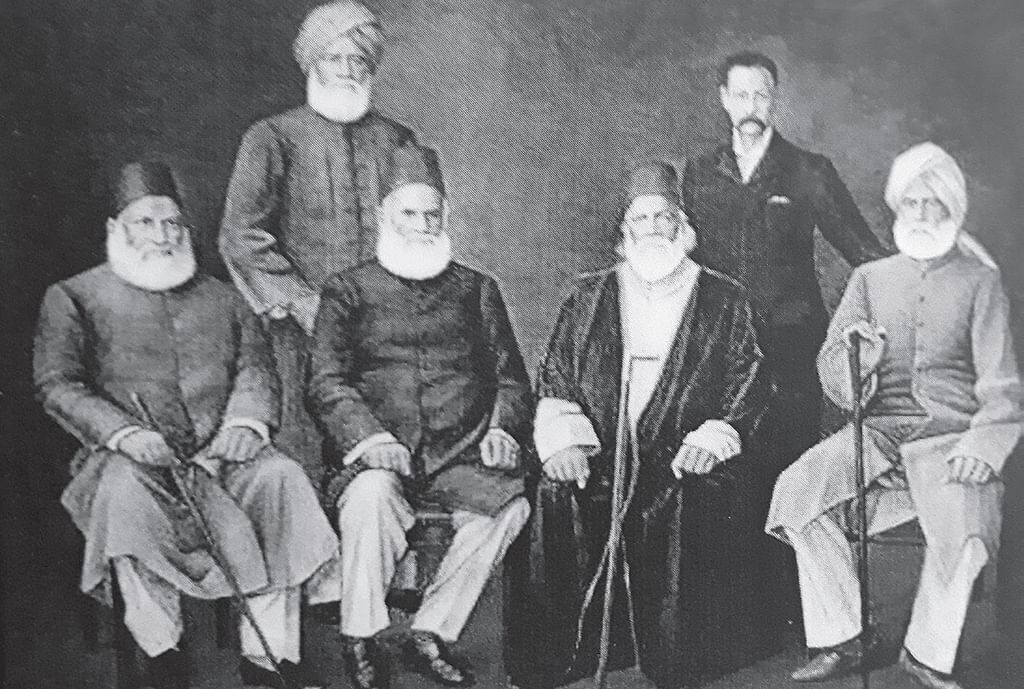
It was also a time when an extremely important character came into the frame, which went by the name of Sir Syed Ahmad Khan. The founder and intellectual pioneer of Muslim nationalism. And it was this nationalism that evolved into becoming a movement that strived to carve out a separate Muslim-majority country in the subcontinent, and then further evolve to become Pakistani nationalism. Sir Syed is the one who acted with the tide of functions and established the Aligarh’s framework in the unfriendly, undoubtedly threatening milieu of the 1880s. Sir Syed, though by no means consciously made possible the emergence of two most outstanding Muslim leaders who had enthusiastically started out as staunch Indian nationalists, ended up finally at the threshold of Muslim nationalism. Belonging to a family which had roots in the old Muslim nobility, Sir Syed’s prolific authorship on the Muslim condition in India (during British rule) and his activism in the field of education, helped formulate nationalist ideas in the Muslims of the region. These ideas went on to impact and influence a plethora of Muslim intellectuals, scholars, politicians, poets, writers and journalists who then helped evolve Syed’s concept of Muslim nationalism into becoming the ideological doctrine and soul of the very idea of Pakistan. It was Sir Syed that had initiated the educational, intellectual, ideological, cultural and political trends and engendered tendencies that laid the groundwork for a Muslim renaissance in India. It is certainly true to say that Sir Syed was too much impressed by western rationalism and wanted to show that every doctrine of Islam could measure up to all principles of science, reason, and common science. In doing this, he was trying to be both rationalist and a good Muslim. He was one of the first Muslim scholars to offer a point by point answer to British authors who were presenting and introducing the tradition of Islam as something which was damaging and retrogressive. Sir Syed reminded the British that Islam was inalienably a progressive and modern religion, and it had empowered and encouraged the study of philosophy and the sciences. He actively campaigned for the adoption of modern Western education in India, particularly for Muslims. He both started and joined a number of organizations whose purpose was to make European knowledge accessible to young Muslims and other Indians in Urdu vernacular. In 1870 the appearance of Sayyid Ahmad Khan’s Tahzib-ul-Ikhlaq exhorting Muslims to reform their religious worldview had a catalytic effect on the newspaper business. Sir Syed reprimanded ulema for compelling the Muslims to dismiss science. He composed that Muslims needed new religious philosophy of Islam, which was discerning and dismissed all doctrinal ideas that were in conflict with good judgment and reason. Threatened by Sayyid Ahmad’s bold forays into the domain of Islam, many of his co-religionists ventilated their outrage by resorting to the print medium, colonial modernity’s most attractive gift for instantaneous self-promotion. The response to Sayyid Ahmad’s arguments on the compatibility of Islamic teachings and modern ideas was similarly sharp in the North-Western Provinces and Punjab. While in the North-Western Provinces numerous new names arose on the guide of Urdu journalism as pundits of the Aligarh school, Sayyid Ahmad’s religious thoughts were given an extreme dressing down in Punjab by the Ahl-I-Hadith’s Ishaat ul Sunnat. Sayyid Ahmad’s way to deal with Islamic religious philosophy and statute acquired him the gashing maltreatment of “orthodox” Muslim ulema. His advancement of ijtihad or free-thinking and dissatisfaction with regards to taqlid or adherence to the four definitive schools of Islamic statute set him at loggerheads with the ulema who effectively found in it a scarcely masked attack on their pre-famous status as the strict watchmen of the Muslim people group. His support of western knowledge and culture as well as loyally to the raj drew astringent remarks from Muslims joined to their cultural moorings and the ideal of an all-inclusive Muslim ummah. Among Sayyid Ahmad’s fiercest critics was the Persian scholar Jamaluddin al-Afghani who lived in India somewhere in the range of 1879 and 1882 and called for Hindu-Muslim solidarity as the initial step to dislodging British imperialism.
Jamal Al-Din Al-Afghani — a bright young political activist, journalist, reformer, and Afghan ideologist who showed up in India in 1855. He one of the most prescient of modern Muslim thinkers, who had travelled and preached across British India. In contrast to the conventional ulema, Afghani didn’t perceive any great in turning inwards and drastically dismissing the modernity associated with British rule. His belief in the potency of a revived Islamic civilization in the face of European domination fundamentally impacted the development of Muslim thought in the nineteenth and early twentieth centuries. He recognized the matchless quality of Western education, however, accentuated that Muslims should grasp it to improve their parcel and afterward reverse the situation against Western imperialism by ousting it and setting up a worldwide Islamic caliphate. Al-Afghani held that Hindus and Muslims should work together to overthrow British rule in India. He worked to transform Islam into a lever against western imperialism. Afghani was the prototype of the modern fundamentalist. Like Sir Syed, he also had been influenced by western rationalism and the ideological mode of western thought. Afghani welded a traditional religious hostility towards unbelievers to a modern critique of western imperialism and an appeal for the unity of Islam, and while he inveighed against the west, he urged the adoption of those western sciences and institutions that might strengthen Islam. Afghani saw Western innovation as a solution to recover regenerate the Muslims, not as an approach to assist them in discovering a spot inside colonial settings yet to completely comprehend and afterward eradicate imperialism. Afghani was rather progressive and modernistic in his thinking. A contemporary English admirer described Afghani as the leader of Islam’s liberal religious reform movement. The pan-Islamist thought which he spearheaded esteemed the significance of changing and reforming the Muslim mentality through modern scholarly methods, and afterward utilizing the transformed as a weapon against the political incomparability of Western imperialism.
Another prominent sage of the modern Muslim intellectual movements of the time was Justice Ameer Ali. His History of the Saracens and Spirit of Islam enjoyed a wide readership both in India and Britain, but his target audience was the Western public. He wished to familiarize this public with the history and religion of Islam, and he was successful at that. He accepted that there were issues that made it problematic for his Western contemporaries to appreciate Islam as a religion suited to the needs of the modern world, but he remained unapologetic on central Islamic beliefs. Chiragh Ali (1844–95), a lawyer from Hyderabad, argued for the reform of Muslim civil law and the establishment of a humane Islamic law based on the Quran rather than on later accretions and interpretations. Altaf Husain Hali’s The Musaddas described the drama of Islam, its glories and its tragedies, in simple, sensuous, and passionate poetry; and, at the same time, he highlighted the need for the reform of Muslim society. The Musaddas became a best-seller in Urdu-speaking India, and it is still read and enjoyed by thousands even today. The scope and spirit of Urdu literature augmented during this period. Akbar Allahabadi (1846–1921), acclaimed for his gnawing parody, censured Sir Sayyid Ahmad Khan’s zing for Western culture and analyzed Muslims aping Western ways of life as ‘playing out monkeys’ for their British coaches. The Urdu weekly by Agra Akhbar, distributed by Khwajah Asif Ali denounced the Muslim Anglo-Oriental University conspire at Aligarh as ‘eccentric and illusory’. Much good Urdu prose was being written in this period; however, three specific improvements significantly advanced its reach and quality. The first one was the development of journalism. Despite the fact that the Urdu press returns to the late eighteenth century, it started genuinely to thrive and flourish from the 1870s onwards. Papers like Akhbar-e Am in Lahore (1870), Oudh Punch in Lucknow (1877–1936), and Paisa Akhbar in Delhi (1888) revolutionized journalism by receiving new patterns, for example, eye-getting features, notices, modest value, newspaper design, alongside the publication aptitudes of ironical composition, spontaneous extemporization, and powerful questioning. Hostile to British assessments were regularly communicated in such political papers as the Zamindar of Lahore, the Al-Hilal, and Al-Balagh, began by Maulana Abul Kalam Azad in 1912 and 1915, and the Hamdard edited by Muhammad Ali. The second significant advancement in Urdu writing was the introduction of the novel. Finally, we must record the rise of Urdu drama in this period.
To sum up, Sir Syed received harsh criticism. His religious naysayers remained positioned in their mosques and madrassahs. Thus, the greater part of his religious adversaries couldn’t discover a spot in the school that he set up in Aligarh. This school evolved into becoming a college and then an institution which began to produce a specific Muslim world-class and metropolitan bourgeoisie who might go on to dominate Muslim nationalist thought in India and eventually decide the course in 1906 when the consciousness of Muslim nationalism took practical form when a deputation of Indian Muslims – Shimla Deputation – held a meeting with the Governor-General Lord Minto in Shimla and secured the viceroy’s consent in respect of separate electorate for Muslims.
The views expressed in this article are the author’s own and do not necessarily reflect the editorial stance of Kashmir Observer
The author is a student at University of Hyderabad
source: http://www.kashmirobserver.com / Kashmir Observer / Home / by Inayathullah Din, Guest Author / December 18th, 2020
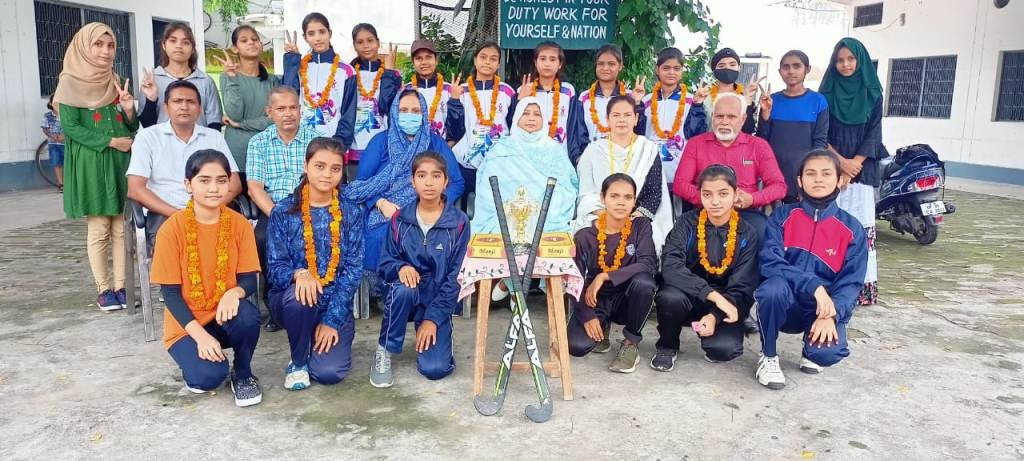
The undeniable girl power of Aligarh Muslim University (AMU) in sports came to the fore in Hockey as a team of AMU ABK High School-Girls clinched a decisive win in the final of the National Hockey Tournament in Goa to bag the Gold Medal.
Team members Aliya Rashid, Simran Shakeel, Rabia Khatoon, Shafiya Shakeel, Amreen Malik, Zenab Mohsin, Saniya, Shaby and others were felicitated in a special function at the school on their return.
Congratulating the team members, Dr Samina (Principal) said that the School hockey team has not only capped an excellent performance in the tournament, but also inspired other girls to take up sport and bring laurels.
Wishing the team more success in the future, Dr Saba Hasan (Vice Principal) said that the team’s performance shows that dreams can come true as long as you work hard.
School teachers, Mr Nadeem Ahmad, Mrs Shaheen Khan, Mr Mahtab Ahmed, Mr Najmur Rahman Faridi, Mr Shamshad Nisar (Sports teacher) and Md Imran Khan (Coach) delivered motivating speeches to encourage the hockey team for more success.
source: http://www.amu.ac.in / Aligarh Muslim University / AMU Public Relations Office / August 24th, 2021
Punzwa Village (Kupwara District),JAMMU & KASHMIR :
Srinagar:
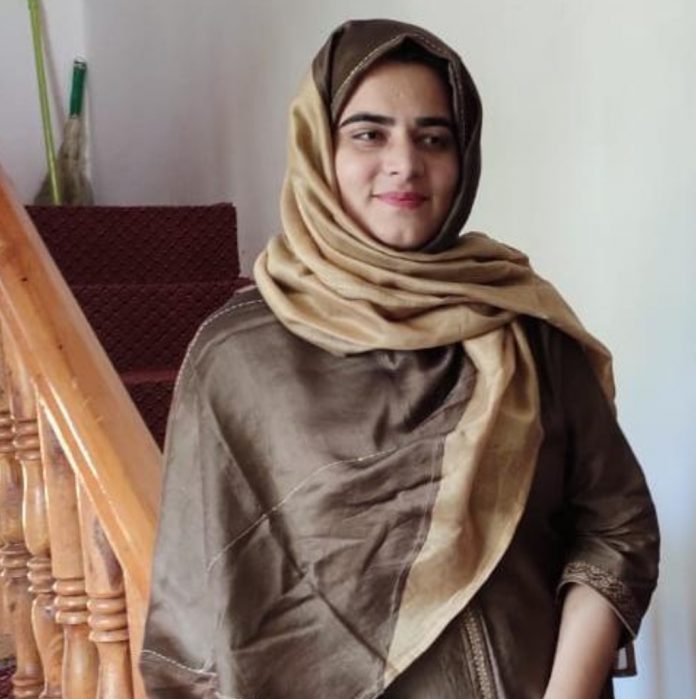
Twenty-three-year-old Nadia Beigh hailing from Punzwa village in Kupwara district of North Kashmir is the first girl from her village to crack the prestigious Civil Services Examination in her second attempt.
Ranked at 350, Nadia credits her success to her family.
To escape the recurrent internet shutdowns in the valley, Nadia enrolled herself in Residential Coaching Academy, Jamia Millia New Delhi which provides free coaching to selected students who are chosen through a rigorous entrance exam. Thirty students from the academy cleared the civil services exam this year.
“If I had stayed back in Kashmir last year, I don’t think I would have been able to prepare for my exam. The internet is extremely important if you are preparing for civil services. Other than that, I live in a remote area where newspapers reach late and a single newspaper will cost you 20 or more rupees. So, I thought it was better to move to Delhi,” says Nadia.
When asked about what service she would prefer to choose, Nadia, a graduate in Economics (Honors), told TwoCircles.net that she is keen about working in administration or foreign services. But her rank doesn’t allow her to be allotted to those ranks. She now plans to sit for the civil services exam again next year and is hopeful of scoring a better rank.
“I know I have potential to do better. Though I’ll be joining services this year, I’ll sit for the exams next year as well. It is a safe option,” she says.
Fighting all the odds, 16 candidates from Jammu and Kashmir managed to clear the exam. With the abrogation of Article 370, a complete communication and security lockdown was imposed in the erstwhile state of J&K. This was followed by a massive influx of students to different states of India, especially those preparing for various competitive examinations.
“I could spot a Kashmiri on every corner of Delhi. Some students in my locality who could not afford to move out of Kashmir, unfortunately, could not clear the exams,” she says.
Nadia has two sisters who are doctors by profession and a brother, a civil services aspirant himself. Her parents are government school teachers, the reason why she believes she has been able to excel in her education.
Since the news of her cracking the exam has come out, scores of people have flocked to her home to congratulate her. She is particularly overwhelmed by the number of girls who have approached her to procure information about the examination pattern.
“If because of me more girls are inspired to appear for the exam, I believe that would be the biggest achievement. People of Kashmir are very talented. Once they set their minds to it, they can achieve anything,” she says.
Just a day after clearing the exam, somebody created a fake Twitter profile using her name and picture and posted controversial tweets that could cause problems for her, she said.
“Since I am going to be a government official now, the tweets were against the government. I have spoken to the Cyber Police Srinagar and the account has been taken down but the screenshots of those tweets have been circulated widely. I am very anxious about it,” she said.
Despite all this, Nadia wants to work for the upliftment of her people. She believes that with a high position in the administration she can serve the people of Kashmir. Her plans consist of working diligently and aiming for a better rank next year.
source: http://www.twocircles.net / TwoCircles.net / Home> Indian Muslim / by Asma Hafiz, TwoCircles.net / August 08th, 2020
Muslim dominated Mewat, one of the most backward regions of the country, will now also be known for producing 11 daughters who strived hard – braving the patriarchal set up – to realise their dream of obtaining higher education and choose their own lifestyle.
All of them are well qualified and work in different sectors. Four of them are government school teachers. One of them, who is named Nusrat is a lecturer at Government Polytechnic, Malab, Mewat. Apart from them, sister Razia is an MBA and works in a private firm while Nazia has done Diploma in architecture and is employed in the private sector.
They hail from Chandeni, a village in Haryana’s Muslim-dominated Mewat area.
Shabnam, who is a government school teacher, told Muslim Mirror that she along with her sisters had gone through a long struggle to realise their dreams of education.
She recalled that her sisters had to travel a lot and move to different locations due to the lack of good colleges in nearby areas.
Locals used to tell her elders that they should not give higher education to their girls because they will have to face difficulties to marry them.
Shabnam believes that in the 90s when she and her other sisters were in schools, it was difficult to find a perfect match for educated girls in Mewat. ”However, that situation has changed nowadays,” she added.
Sometimes, the sisters have to face ‘troubles’ at the workplace due to their Muslim identity. ”We meet troubles, more specifically in private sectors,” Shabnam added.
”However, they gradually change their behaviour with us when they come to know about us,” she stated.
In her message to society, Shabnam said, ”Apart from getting degrees, people should try to be open-minded and good human beings for the society.”
Indian parents, more commonly in villages, hesitate to send their daughters to colleges and universities. That’s why a large number of girls fail to be independent financially as well as mentally. In such an atmosphere, the success story of ’11 sisters’ is encouraging.
Their Qualifications:
1: Nafeesa: J.B.T and B.Ed and working as govt.teacher.
2:Shabnam: M.A, J.B.T and working as a govt. teacher.
3:Afsana: J.B.T, M.A, B.Ed.
4:Farhana: J.B.T, M.A, B.Ed and working as a govt.teacher.
5:Shahnaj : J.B.T, M.A, B.Ed and working as a teacher in private school.
6:Ishrat: B.A.
7:Nushrat: J.B.T, M.A, M.Ed and working as a lecturer in Malab Polytechnic.
8:Ana: J.B.T, M.A B.Ed and working as a govt. teacher.
9: Razia: M.B.A and working in private sector.
10:Nazia: Diploma in architecture and working in private sector.
11:Bushra: M.A, B.Ed
source: http://www.muslimmirror.com / Muslim Mirror / Home> Featured / by Hasan Akram / March 13th, 2021
Anisa Mohammed is the interim captain as Stafanie Taylor is unavailable for the T20I series due to serving a period of isolation in Antigua
Anisa Mohammed to lead West Indies team as Stafanie Taylor in isolation.
St John’s (Antigua):
A 13-member West Indies women’s squad led by interim skipper Anisa Mohammed for the opening T20 International against South Africa Women at the Sir Vivian Richards Cricket Ground on Wednesday (IST) was announced by the Cricket West Indies (CWI) Women’s Selection Panel on Tuesday.
Anisa Mohammed is the interim captain as Stafanie Taylor is unavailable for the T20I series due to serving a period of isolation in Antigua, after being identified as a primary contact of a COVID-19 positive case in Jamaica.
The women’s chief selector, Ann Browne-John said in a statement:
“The T20I and ODI series against South Africa gives another opportunity for the team to play international matches ahead of the upcoming ICC World Cup qualifiers (In March-April next year in New Zealand). It is unfortunate that Stafanie will not be available for this series but there are a number of experienced players who we would be looking to, to fill any void.
“The young player Qiana Joseph brings another left-hand batter option as well as left arm orthodox bowling which has been lacking in the team. This will be a good test coming out of the recent Pakistan series, since South Africa is one of the higher ranked teams.”
The West Indies women’s team returns to the field after a successful double series win over Pakistan women, where they took the T20I series 3-0 and the ODI series 3-2. The West Indies women’s squad has been preparing in a high-performance camp in Antigua prior to the upcoming series.
The second and third T20Is will take place at the Sir Vivian Richards Cricket Ground on September 2 and September 4 respectively. The five ODIs will be played from September 7 to 19, with the first three matches being played at the Coolidge Cricket Ground (CCG) and the last two at the Sir Vivian Richards Cricket Ground.
Muhammad Fadi (18), who has roots in Niramaruthoor in Thirur, Kerala, has secured admission in the prestigious London School of Economics (LSE), the alma mater of Indian stalwarts like Dr. BR Ambedkar, Nobel laureate Amartya Sen and former Prime Minister Manmohan Singh.
Interestingly, the youngster had studied in regular schools that are run by the government in Britain, from class four.
Fadi attributes his splendid achievement to his systematic approach to academics and active participation in co-curricular activities too.
An academically bright student, Fadi had scored ‘A’ stars for two subjects and an ‘A’ for another in the sixth form, which is equivalent to the higher secondary course in India, to secure a place at the iconic institution.
This indeed is an amazing feat when the criterion for admission was just ‘A’ for two subjects and ‘A’ star for one paper.
From age 15, Fadi had been dreaming of pursuing his higher education at either one of the three premier institutions in London – University of Cambridge, University of Oxford or at the London School of Economics.
The youngster says that he had even changed schools in the sixth form to help him achieve this dream. He shifted to the well-known Harris Westminster Sixth Form School which specifically trains the students to secure admission at some of the high-profile universities and institutions in the UK.
At this school, Fadi was an active member of the football, badminton, geography and economics societies. He regularly took part in the weekly discussions and debates that were conducted by these clubs. He had mentioned this in his personal profile that he had submitted along with his application to the universities. Besides this, an excellent evaluation note by his teachers too had helped him secure a seat for the famed BSc Economics graduate course at the LSE.
Life goal
Fadi says that his life’s mission is to study about the modern economic techniques that are widely used in the developed nations and to adopt these to the social and cultural scenario of the developing countries like India to alleviate poverty.
Family’s Indian roots
Fadi is the son of Niramaruthur native Valappil Shareef who had completed an MBA course from the London School of Commerce in 2004.
After completing his studies, Shareef had settled in London.
Meanwhile, Fadi had studied until class three at the MES schools in Mangalam and Thirur. He then migrated to London with his family.
As his family had permanent residency certificate, Fadi easily got admission at the public schools in London.
There, education up to the sixth form is completely free. Fadi says that there aren’t many private schools in London and most students attend government schools as they offer quality ducation.
His mother is Fousia and has a sister, Marwa.
source: http://www.onmanorama.com / OnManorama / Home> Career & Campus / by Naseeb Karattil / September 01st, 2021