Fifteen years of dedication, resilience, and hope led to a school that uplifts underprivileged children and their families in Karnataka.
New Delhi:
In the heart of Bijapur in Karnataka, one woman’s belief in the transformative power of education has changed the lives of countless children and their families. Saira Bano Khan, who started the New National High School 15 years ago, remains unwavering in her mission to offer children from slum areas a brighter future through learning.
Bijapur city is well known for its historical monuments of architectural importance built during the rule of the Adil Shahi dynasty.
“It all started when I saw the children around my neighbourhood,” Saira Bano said. “Most of them were school dropouts, working odd jobs like selling flowers or working in garages. It pained me to see them wasting their potential,” Sanmarg Hindi newspaper cited her as saying.
With the support of her husband, Saira Bano began a small school in a room of her own house, with only four students and one teacher. Today, New National High School serves 200 students and offers education up to the 12th grade. The school has become a beacon of hope for children from the local slums, particularly those from marginalised communities.
New Path
When Saira Bano started the school, many of the students had no basic manners or discipline. “The children used foul language and had difficulty sitting still,” she recalls. “It took months of patience and guidance to help them change. But now, they are polite, well-mannered, and eager to learn. It’s our greatest success.”
Parents have also become part of the process. Saira Bano organises regular meetings to educate them on their role in shaping their children’s behaviour. “We tell them that building a good life starts with teaching good values at home,” the report quoted her as saying.
Despite these successes, the school faces numerous challenges, especially when it comes to finances. “We struggle with funding,” Saira Bano said. “I dream of building a proper school with a laboratory, library, and playground, but for now, we make do with what we have.”
Commitment to Community
Beyond the classroom, Saira Bano has committed her resources to support the school. She and her husband donated their old family home, consisting of seven rooms, to be used as classrooms. She has also invested her savings in buying land for future school expansion. “I didn’t save much for my children. Instead, I saved to build a wall around the land, hoping one day to construct a proper school,” she said.
Her involvement doesn’t stop at education. During the Muslim fasting month of Ramadan, she and her husband distribute groceries and clothes to the students’ families. “Around 40% of the children in our school are orphans or come from extremely disadvantaged backgrounds. My dream is to open a hostel for them.”
Hope Amid Hardship
The COVID-19 pandemic added extra difficulties, with several boys dropping out of school to support their families. “We found some of them working odd jobs during school hours,” Saira Bano recalled. “Our headmistress spoke to their parents and told them they didn’t have to pay any fees, just send their children back to school.” The boys returned, excelled in their studies, and some even achieved distinctions in their exams.
Saira Bano’s work has touched many lives, including a student named Misbah, who was diagnosed with a serious health condition. With no money for surgery, Saira Bano and her headmistress paid for the procedure. “Now, she’s doing well and studying in college,” Saira Bano said with pride.
Instilling Values
Saira Bano’s vision for her students extends beyond academics. She emphasises respect for all religions and cultures. “I teach them about the Gita, Quran, Bible, and other holy books,” she said. “We encourage them to participate in each other’s festivals and to spread love and tolerance. This is how we build a harmonious society.”
The school also focuses on life skills. “We teach boys to respect women, and girls to maintain their dignity,” Saira Bano noted. Her influence on the students’ moral development is reflected in the way older students now correct younger ones when they use inappropriate language. “When I see that, I feel like my work is bearing fruit,” she said.
Looking to the Future
Despite all the challenges, Saira Bano remains hopeful for the future of her school and her students. “I want at least four students from this school to become IAS officers,” she said with a smile. “In sha Allah (God willing), my daughter might also become an IAS officer soon, as she has cleared her CSE exams.”
For Saira Bano Khan, the journey has been one of sacrifice, perseverance, and a deep belief in the power of education. “Our work is rewarding. I love my students, and they love me. Watching them grow into disciplined, responsible individuals is the greatest joy of my life.”
As she continues to nurture the school and its students, Saira Bano’s dream remains clear: to see the children she’s helped grow into adults who will change not only their destinies but that of their entire community.
source: http://www.clarionindia.net / Clarion India / Home> Editor’s Pick> Indian Muslims / by Mohammad Alamullah, Clarion India / September 19th, 2024
Mufti Ismail Menk is a renowned Islamic scholar, preacher, and motivational speaker from Zimbabwe. He is known for his lectures on various Islamic topics, including the importance of understanding the Quran and the Hadith, and how to apply Islamic teachings in daily life.
Early Life and Education
Mufti Menk was born in Harare, Zimbabwe, in 1975. He comes from a family of Islamic scholars, with his grandfather and father both serving as imams. From a young age, Menk had a strong interest in Islamic studies and began studying the Quran and Hadith under the guidance of his father and other scholars in his community.
In 1992, Menk traveled to Saudi Arabia to further his studies in Islamic theology and jurisprudence. He studied at the Islamic University of Madinah, where he earned a degree in Islamic studies.
Personal Life
Mufti Menk is married and has children. He is known for leading a simple and humble lifestyle, and is dedicated to spreading the teachings of Islam to as many people as possible.
Career
After completing his studies in Saudi Arabia, Menk returned to Zimbabwe, where he began giving lectures and leading Friday prayers at the mosque in his hometown of Harare. He quickly gained a reputation as an inspiring and knowledgeable speaker, and began giving lectures and leading workshops across the country.
In addition to his work in Zimbabwe, Menk is also a popular speaker at Islamic conferences and events around the world. He has delivered lectures and led workshops in countries such as the United Kingdom, the United States, South Africa, and Australia. He has also been invited to speak at many universities and Islamic institutions worldwide.
Mufti Menk is also active on social media and has a large following on platforms such as Twitter, Facebook, and YouTube. He regularly posts videos and articles on various Islamic topics, and is known for his concise and easy-to-understand explanations of complex concepts.
Mufti Menk is also the director of the Daarul Ilm of Zimbabwe, a non-profit organization that runs madrasahs, orphanages and schools in Zimbabwe.
Overall, Mufti Menk is a respected and influential Islamic scholar and preacher, known for his ability to make Islamic teachings accessible and relevant to people of all backgrounds. His work has helped to promote understanding and harmony within the Muslim community, and his lectures and writings continue to inspire and guide people on their spiritual journey.
Mufti Menk on Social Media
source: http://www.thecognate.com / The Cognate / Home> Business / by The Cognate News Desk / January 12th, 2023
Syed Iqbal Zaheer was born in 1944 in India. He is an Indian Islamic scholar, writer, and engineer. He received his Islamic training from traditional scholars and has proficiency in English, Arabic, and Urdu.
As a polymath and prolific writer, Zaheer has a wide range of interests and writes journalistically on advanced scientific topics such as cellular biology, quantum physics, and astrophysics. He adopts a new writing style in each of his books, making his works unique and engaging.
Zaheer has been editing the monthly magazine “Young Muslim Digest” for 35 years, which is issued from Bangalore. His editorials and answers to readers’ letters are widely followed in several countries.
Books
Zaheer is the author of several books, including “Islam: The Religion You Can No Longer Ignore,” “Fake Pearls,” “A Short History of Israel,” “Bilal, the Abyssinian Out runner,” “Muhammad the Unlettered Prophet Who Changed the World in 23 Years,” “An Educational Encyclopedia of Islam,” “Abul Hasan Ali Nadwi,” “Fundamentals of the Islamic Creed,” “A Voice to Hear,” and “Tafsir Ishraq al-Maani.”
In addition to his writing, Zaheer is known for his weekly Quranic Dars and lectures, which are well attended by the educated class. However, he follows the fatwa of classical Deoband scholars and does not allow filming of his talks, does not believe in globe-trotting, and strongly objects to any praise directed at him.
Zaheer runs an Islamic Institute for Girls, in the town of Hassan near Bangalore, that emphasises the Arabic language. The institute’s syllabus is designed for teenage girls and older.
Overall, Syed Iqbal Zaheer is a well-respected Islamic scholar and writer who has made significant contributions to the Islamic community through his works, lectures, and social work.
source: http://www.thecognate.com / The Cognate / Home> Business / by The Cognate News Desk / February 02nd, 2003
Ahmeda Calcuttawala’s son in their manufacturing unit.
For Abdul Tayeb Saifee, a 58-year-old Bengaluru-based industrial adhesive manufacturer, surviving and supporting his family was the only priority after a major economic setback. During this trying time, when he could not get sufficient financial help from friends and family, Qardan Hasana helped him sustain and rebuild his life.
Qardan Hasana, literally translated as ‘the good loan’, is a Dawoodi Bohra institution that offers interest-free loans in keeping with the Islamic injunction to refrain from all forms of interest. The objective of this institution is to assist community members in improving housing and quality of life, supporting education and enabling business growth. Over the last 45 years, hundreds of Qardan Hasana branches have been set up throughout South Asia, where the majority of the Dawoodi Bohra community resides, and across the rest of the world.
Abdul Tayeb from Bengaluru
“The timely loan was like an elixir, a single drop of water that revived me and gave me a new lease on life,” says Saifee. He adds that choosing to repay the loan instalments on time has instilled a sense of responsibility in him and motivated him to push beyond his comfort zone to work harder. He expresses gratitude to the late 52nd leader of the Dawoodi Bohra community Syedna Mohammed Burhanuddin, on his 11th death anniversary, for having established the Qardan Hasana institution in 1979.
The Working Mechanism
The primary contribution to any Qardan corpus is provided by Syedna of the time, currently by Syedna Mufaddal Saifuddin (the leader of the Dawoodi Bohra community), along with secondary contributions from local community members. The Syedna continues to infuse new funds, especially on important anniversaries or celebrations. His efforts to promote and implement the concept of Qardan Hasana inspire his followers to emulate him. There are no limitations to contribution; members can give as little or as much as they like according to their capacity. As a result, these organisations are well equipped to cater to the socio-economic needs of any community member.
Interest Loans – A slow death
Every other day we read stories about interest-bearing loans that resulted in unpayable debts and bankruptcy or people feeling buried, almost as long as they live while paying off their interest on housing or education loans. The economic effects of the pandemic and period of extreme global banking systems have exacerbated the lives and livelihoods of millions across the globe. However, studies have shown how important cash reserves are in times of uncertainty, as well as for fostering future growth
Qardan Hasana – Fuelling entrepreneurship and growth
Ahmed Calcuttawala, 94, owns a marine supplies business in Kolkata. For his capital-intensive nature of the business, he requires a regular infusion of cash which he avails from the Kolkata Qardan Hasana office. This, he says, “proved highly beneficial for my working capital especially during and post pandemic business recovery.”
Three generations of Calcuttawala family
He recalled a recent incident while bidding for an order from the Ministry of Defence for which heavy investment was required. They were offered loan options from the bank however, Ahmed chose to raise money from Qardan Hasana to fulfil his order.
Ranging from large-scale amounts for industrial and commercial growth, to small-scale amounts to venture into businesses, Qardan Hasana has provided aspiring entrepreneurs with the financial wings they need to soar. “With the support of money I received, I was able to turn my dream into reality,” shares 32-year-old Zahra Aliasgar, a teacher from Coimbatore who transitioned from working in a private school to starting her own kindergarten. “The institution’s assistance gave me the confidence and resources to pursue my ambitions without the burden of interest.”
source: http://www.thecognate.com / The Cognate / Home> Business / by The Cognate News Desk / September 18th, 2024
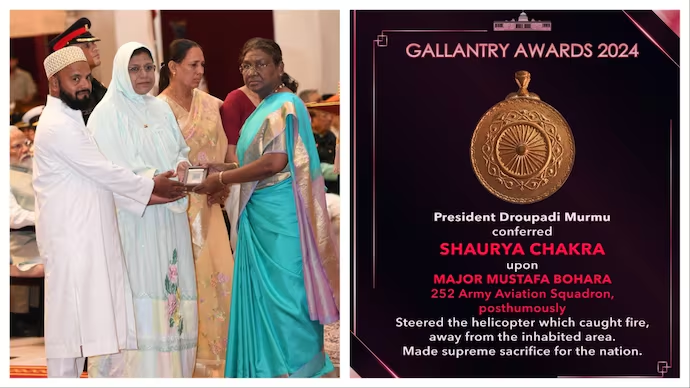
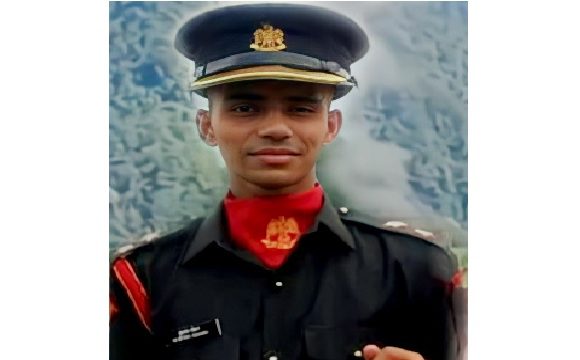
Major Mustafa Bohara, an esteemed officer of the Indian Army Aviation Corps, was posthumously awarded the Shaurya Chakra at a solemn ceremony held at Rashtrapati Bhavan on July 5, 2024. President Draupadi Murmu presented the prestigious award to Major Mustafa’s grieving parents, Fatima and Zakiuddin Bohara, recognizing their son’s exceptional courage and sacrifice.
Major Mustafa Bohara SC / pix: honourpoint.in
Born on May 14, 1995, in Kheroda village, Udaipur district, Rajasthan, Major Mustafa Bohara’s journey was defined by unwavering dedication to his country. Educated at Uday Shiksha Mandir Higher Secondary School in Kheroda and later at St. Paul’s School in Udaipur, he harboured a childhood dream of serving in the armed forces. His ambition led him to the National Defence Academy (NDA), where he excelled in the 128th course and was part of the distinguished November Squadron. Graduating from the Indian Military Academy (IMA) in Dehradun, he was commissioned as a lieutenant before specializing as a helicopter pilot in the Army Aviation Corps.
Major Mustafa’s mother, Fatima Bohara, spoke with both pride and sorrow, saying, “Martyrdom is not just a word but a true testament. Mustafa always aimed for excellence and believed in swiftly moving forward towards success.”
On October 21, 2022, Major Mustafa and Major Vikas Bhambhu, alongside three crew members, undertook a mission in Arunachal Pradesh’s challenging terrain. Unfortunately, their helicopter encountered an emergency near Mugung in Upper Siang district, known for its hostile weather and difficult conditions. Despite their extensive training and experience, the helicopter caught fire, compelling Major Mustafa and Major Vikas to manoeuvre the aircraft away from populated areas and ammunition depots. Their valiant effort to land safely ended tragically at 10:43 am, claiming their lives.m,
The ceremony at Rashtrapati Bhavan, attended by Vice President Jagdeep Dhankhar, Prime Minister Narendra Modi, Defence Minister Rajnath Singh, and Opposition Leader Rahul Gandhi, honoured both Major Mustafa and Major Vikas Bhambhu with the Shaurya Chakra. Their exemplary bravery in the face of grave danger was acknowledged, underscoring their selfless dedication to duty.
Deputy Secretary of the Shaheed Major Mustafa Trust, Virender Singh Solanki, announced that Major Mustafa’s family would return to Udaipur on July 7, 2024. They will receive a heartfelt welcome at Dabok Airport from Vallabhnagar MLA Uday Lal Dangi, political dignitaries, members of the Bohra community, and various social and religious organizations.
Major Mustafa Bohara’s legacy remains an enduring symbol of courage, dedication, and sacrifice. His heroic actions serve as a profound inspiration, embodying the unwavering spirit of India’s armed forces.
source: http://www.clarionindia.net / Clarion India / Home> Editor’s Pick / by Mohammad Alamullah, Clarion India / pix source: replaced with (Photo: X/@rashtrapatibhvn) (2) pix added source: honourpoint.in / July 07th, 2024
CIVILIZATIONS thrive on foundations crafted by unassuming individuals devoted to their communities. Often overlooked, these selfless souls, akin to the bricks in a foundation, play a crucial role. Emulating their courage and sincerity is essential for sustaining a just and morally upright society.
Twenty-two years ago, on 5 February 2002, Indian Muslims lost a brave and selfless activist, fine writer, author and lawyer, but an enviably humble and reticent man who never wanted to hog the limelight and always shied away from publicity. Sadly, his paramount legacy has started fading from public memory. This writeup is a respectful tribute to Syed Ameenul Hasan Rizvi on his death anniversary.
Seven years ago, when I was sifting through archives and collecting material for my book Muslim Majlis-e-Mushawrat: Ak MukhtasarTareekh (published by Pharos Media & Publications, Delhi), I came across several articles and analytical pieces penned by Rizvi Saheb published in the Radiance Views Weekly and Urdu monthly Afkar-e-Milli.
These eye-opening and informative pieces gave me some idea of Rizvi Saheb’s love for Islam and his uncompromising stand on Islamic principles enshrined in Shariah. He wrote fearlessly, and judiciously. These writings left me with awe and after reading each piece I would ask myself: “Where have these gems disappeared who dedicated their lives to the service of this community, shattered and almost uprooted in post-independent India?”
Although I had heard a lot about Rizvi Sahab through Dr Zafar-ul-Islam Khan (editor Milli Gazette), Syed Nooruzzaman (former senior editor at The Tribune) and London-based journalist Mohammad Ghazali Khan, I came across even rarer treasure of information about him after talking to his sons Syed Athar Rizvi and Syed Amir Rizvi. Most of this article is based on documented information provided by them and some of the old boys of Aligarh Muslim University (AMU) who knew Rizvi Saheb very well.
I fail to understand why rare information about such a humble-natured and great man has not been published yet. The documents I have seen include his correspondence, articles and translations. While sifting through these unpublished documents I came across many letters that reveal Rizvi Saheb’s good command not only of Urdu and English but his deep taste for Persian and Arabic languages too.
Rizvi Saheb was born in the small town of Raichur, Karnataka, on 12 February 1925. He was merely 23 years when India achieved independence and, therefore, had witnessed the country putting away foreign slavery as well as the tragedy of the partition. He saw the partly forced and partly self-inflicted uprooting of the community. Although a pragmatist by nature, perhaps this is why at times one feels the reflection of his pain and sharpness in his writings.
He was closely associated with a number of Muslim organisations like the All India Muslim Personal Law Board, Muslim Majlis-e-Mushawrat, All India Council for Muslim Economic Upliftment, Peoples Movement of India, Institute of Objective Studies and Milli Council. Despite not being a member of Jamat-e-Islami, he served the organisation more loyally and with more dedication than a formal member. On one hand, he worked on the writing front and at the same time helped the poor and needy people by providing free legal services and representing them in the high court and Supreme Court pro bono.
Second of the nine siblings, Rizvi Saheb got his early education in Raichur and joined AMU for graduation moving to Osmania University in Hyderabad to complete his LL.B. After obtaining the law degree he joined his elder brother, a lawyer himself, and started practicing in the courts of Raichur and adjoining districts.
In 1965 he came into contact with Syed Abul A’laMaududi and was imprisoned for his association with the famous Islamic thinker. He was again arrested and sent behind bars in 1975 during Indira Gandhi’s emergency, three times under the ignoble Defence of India Rules (DIR). Despite these hardships, he remained steadfast, never showing any trace of losing his courage and forbearance. After emergency was lifted in 1977 and the dark period of persecution ended, in view of his God-gifted talents Rizvi Sahab was entrusted with the responsibility of editing Radiance Views Weekly, published by Ishate-e-Islam Trust, a role which he performed with unmatchable dedication making the weekly a reputable publication. In 1985, due to ideological differences, he parted ways with Radiance and upon the request of late Hakeem Abdul Hameed, the founder of Hamdard, he accepted the position of publication officer at Jamia Hamdard’s Institute of Islamic Studies.
Rizvi Saheb penned thousands of essays and research papers and published several books including Supreme Court and the Muslim Personal Law, Dialogue Between Hindus and Muslims, Battles by the Prophet in the Light of Qur’anand Three Major Errors in 12 English Translations of the Qur’an. He also started translating into English Syed Abul A’laMaududi’s seminal translation and interpretation of Holy Qur’an—the famous Tafheemul Qur’an—into English and had completed a large part of Surah Baqarah but his ill health did not let him continue and complete this important project he had taken upon himself. Rizvi Saheb has talked about it in his book, “Maulana Maududi Ke Khutoot”. Based on his correspondence with the great Islamic thinker, this book is a masterpiece and proof of Rizvi Saheb’s deep love for Islam and respect for Maulana Maududi.
By profession, Rizvi Saheb was a lawyer and also took to journalism, but did not stop practicing law altogether. For many years he served Jamat-e-Islami Hind as legal advisor and also represented the All India Muslim Personal Law Board in the Shah Bano case explaining fearlessly Islamic point of view before the apex court. He actively participated in the movement for the restoration of the minority character of Aligarh Muslim University (AMU) and also played a prominent role in the commission constituted to probe the 1989 Bhagalpur anti-Muslim riots. He did not only fight his own lawsuit after the lifting of emergency imposed by Indira Gandhi in 1970 but represented many others detained and implicated in fabricated cases and got them released.
Very few people know that Muslim youths arrested for their association with the Students Islamic Movement of India (SIMI) had no means to hire lawyers and represent them. At this juncture, Rizvi Saheb offered his services pro bono and travelled to Madras at that old age. It was during this journey that he had a massive heart attack and he departed for his heavenly abode on 5 February 2002 and Indian Muslims were deprived of a selfless and dedicated individual.
After his death his children — Syed Amir Rizvi, Syeda Farhat Jahan Rizvi and Syeda Talat Jahan Rizvi — published their memories in a diary entitled: Woh ek dil jo damakrahathakhuloos-o-Iman ki tabishon se (The radiant heart that glittered with the light of sincerity and Iman). In her tribute to Rizvi Saheb, his daughter Farhat Rizvi writes: “All of us had gathered for our evening meal and sat around the Dastarkhwan. Addressing our dad, our grandfather, whom we used to call Mianjan, said: ‘You look very happy today.’ To this, Dad answered: ‘Yes. By the grace of Allah and as a result of your prayers today I got a huge success as I have won three cases.’ Hearing this Mianjan and Dadi [paternal grandmother], both of whom were very pleased, exclaimed: ‘Masha Allah! Masha Allah! ‘Then Mianjan asked him: ‘But how much fee were you paid?’ Dad just smiled and lowered his gaze. Repeating his question Mianjan asked again: ‘You have not told us how much you were paid?’ Dad paused a bit and replied: ‘These were the cases of very poor people. They could not afford to pay any fee. That they have got their properties back is a big thing.’ Hearing his response Mianjan laughed and [jokingly] said: ‘Now you should hang a signboard outside your office with a message: We fight cases free of cost.’ Then Dadi interjected: ‘You talk strange! Good deeds should be encouraged. Now that you are advising him to hang a signboard, add a sentence in it saying: we only accept prayers.’ Hearing this Mianjan was very pleased and added: ‘You have done a very good thing. I am very pleased. Remember, this is how you pay the zakah [charity] on your knowledge and skills.’”
This diary is full of such incidents and one is tempted to copy all of these but space constraints won’t allow this. However, some of his experiences deserve to be quoted and recalled.
When Rizvi Saheb was arrested under DIR his mother wrote him a letter. Here is an excerpt from that letter which is a testimony to the greatness of a great mother. “Listen! And convey this to your mates too on my behalf.” She wrote, “We do not wish your freedom at the cost of shackling your pen and silencing your tongue. Although I am sure none of you will do so [and compromise on your principles], I am fearful lest Satan puts cowardly thoughts in your minds, using your love for those whom you have left behind. Although you are not here, Allah T’ala has arranged sustenance for your households. There may be times when we are helpless, but His power is not helpless. Have faith in Allah and do not seek mercy from anyone.”
What a great mother indeed! Those who have read the life history of Maulana Mohammad Ali Jauhar must have been reminded of his great mother who told the English police officer that if any of her two sons showed signs of cowardice she would strangulate him with her own hands. Surely great mothers like these give birth to great sons. May Allah SWT reward them hugely.
To quote another incident from this book: “One night Mom saw Dad sitting very concerned and dejected. ‘Is everything fine?’ She asked. Dad replied: ‘I am upset with myself. One week ago I gave a friend, who works for a bank, Rs 1000 to get me new notes of Rs 10. About three or four days ago he came and handed me a bundle of 20 rupee notes. I took it from him without paying attention that these were 20 rupee notes. As I was about to retire for the day, I remembered that these were 20 rupee notes. I wonder what he must be thinking about me. And out of respect, he did not say anything. Until I return him one thousand rupees, I will keep feeling embarrassed.’ With these thoughts, he could not go to sleep. In the morning when my elder brother went to the mosque for Fajr prayer, he sent the money for his friend with a written apology. Anyway, only after sending the money back was he able to have some rest.”
Several of the articles written after his death by his well-wishers are testimonies of his self-respect and selflessness. Writing about his father in Saudi Gazette, his son Athar Rizvi says that once he wrote a critical article on Fakhruddin Ali Ahmad, President of India, for RSS’ weekly organ Organiser. The article was widely read and appreciated. However, he refused to accept any remuneration saying that he could not accept anything from an organisation opposed to his ideology and thinking.
According to his younger son Amir Rizvi in the last decade of the 1990s, Janata Dal Prime Minister Devi Goda, through his minister C.M. Ibrahim, and several AMU alumni, offered Rizvi Saheb Rajya Sabha membership. But Rizvi Saheb refused saying that having to tow the party line on the floor of parliament and not being able to express his views freely was not acceptable to him.
I must also cite an incident relating to Rizvi Saheb’s courage and boldness, as narrated to me by M Ghazali Khan. Says he: “During the vice chancellorship of late Sayyid Hamid Saheb, the students’ union launched an agitation against Prof. Irfan Habib for his controversial and defamatory comments on AMU and its students in a local Hindi newspaper. This movement dragged on. During the agitation some untoward and undesirable incidents also took place. On the other hand, despite his love, dedication and zeal to serve the community and work for its welfare, Hamid Saheb behaved and acted like a district magistrate trying to control a riot-torn city. He acted in a fashion typical of Indian bureaucracy and did not hesitate in repeatedly calling the police on the campus, so much so that despite the fresh tragedy of the Moradabad anti-Muslim riots, in which the notoriously Islamophobic Provincial Armed Constabulary (PAC) had massacred hundreds of Muslims returning after Eid prayers in 1980, he called it on the campus and gave it a free hand. True to its notoriety, as a brute anti-Muslim force, one of its officers opened fire and killed a student, Aftab, from Meerut, the only son of his elderly parents and only brother of four sisters, who had nothing to do with the agitation and just happened at the wrong place at a wrong time. As someone who held the welfare of his community and his alma mater close to his heart, Rizvi Saheb was one of those Aligs who always instantly reached Aligarh whenever any untoward incident took place. Hearing about the shooting and the death of Aftab, he rushed to Aligarh and went straight to the Vice Chancellor’s lodge where Hamid Saheb was holding a meeting with some senior members of the community of his liking. Outside the lodge, there was a heavy police presence. Rizvi Saheb showed them his journalist pass and barged into the meeting room. Perhaps Hamid Saheb and Rizvi Saheb were contemporaries and had known each other since their student days. Seeing Rizvi Saheb, Hamid Saheb stood up and came forward to shake hands with him. But, despite his known soft and courteous nature and cool temperament, Rizvi Saheb pulled his hands back and said: ‘You have the blood of an innocent boy on your hands. I cannot shake hands with you. I have come just to request you to have some mercy on this institution and the millat and resign immediately.”
Another AMU alumnus and Kashmiri academic Dr Sheikh Showkat Hussain
testifies the incident saying: “This happened the same day when Aftab was martyred. A notice was also circulated that Hamid Saheb was resigning. But it was followed by another note saying that upon Indira Gandhi’s and Maulana Ali Mian’s insistence his resignation had been withdrawn.”
That was one of the most testing times faced by AMU and it is better not to go into its details here.
Usually, those in public life get addicted to publicity and self-projection but Rizvi Saheb had treated himself with some special vaccine against this disease. He hated publicity and hardly talked about himself and his work. So much so that it is difficult to find a photograph of the man who was actively involved in public service.
I have refrained from including several incidents of his life. It is really hard to include all the details in a few pages of a man who served the community selflessly and impressed thousands of his readers.
I also avail this opportunity to request Rizvi Saheb’s survivors, especially his sons, who are well educated and well-resourced to make public all of Rizvi Saheb’s work and publish a book on his life and contributions. I am saddened to learn that much of his written work has got damaged. Whatever has survived it is better to publish and save it for future generations.
The author is a research scholar in Dr. K.R. Narayanan Center for Dalit and Minority Studies at Jamia Millia Islamia in New Delhi.
source: http://www.clarionindia.net / Clarion India / Home> Culture> Editors Pick> India / by Mohammad Alamullah, Clarion India / February 04th, 2024
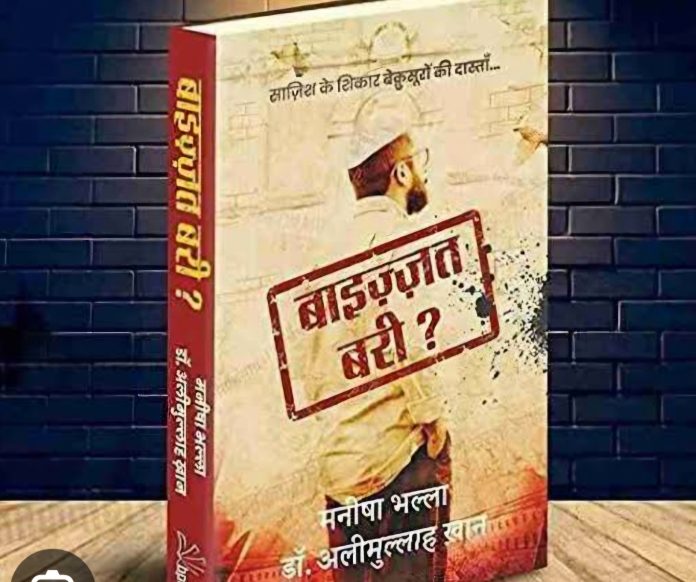
Book: Baa Izzat Bari / Written by Manisha Bhalla and Dr. Aleemullah Khan. Published by: Bharat Pustak Bhandar
“Baa Izzat Bari” by Manisha Bhalla and Dr. Aleemullah Khan is a compelling non-fiction account that explores real-life stories of individuals falsely accused in terror related cases in India, only to be acquitted after long legal battles. The title, which translates to “Honorably Acquitted,” captures the essence of the work—justice being served after a grueling fight, though often at the cost of the individuals’ dignity, time, and peace of mind.
This book sheds light on the flaws within the Indian legal system, particularly highlighting cases of wrongful accusations and the traumatic experiences of the innocent individuals who are caught up in these legal nightmares. Through detailed case studies, the authors offer an insightful look into the personal struggles of those who have been falsely implicated and their journey toward proving their innocence.
Judicial Delays and Systemic Flaws:
The delves into the chronic delays that plague the Indian judiciary. The individuals portrayed in the book endure years, sometimes decades, of legal proceedings before their names are cleared. This is a strong commentary on the systemic inefficiencies that prolong suffering for those falsely accused.
Emotional and Social Impact:
One of the most powerful aspects of “Ba Izzat Bari” is how it focuses on the emotional toll these accusations take. The accused face not only the trauma of legal battles but also the stigma of being labeled criminals in the eyes of society. The book captures how families are torn apart, careers destroyed, and reputations permanently damaged, even after an acquittal.
Resilience and Perseverance:
Amidst the grim reality of these stories, it highlights the resilience of those who continue to fight for justice. Their perseverance, often in the face of hopelessness, serves as a testament to human strength and the will to restore one’s dignity.
Questioning Legal and Ethical Norms:
Through these cases, it raises critical questions about the functioning of the police, judiciary, and society at large. How can the system be reformed to prevent such wrongful accusations? What mechanisms should be put in place to compensate those who are falsely accused? Bhalla leaves these questions open for debate, encouraging readers to think critically about justice in a democratic society.
The is journalistic yet empathetic, balancing factual accuracy with emotional depth. Writers provide meticulous details about each case, using interviews and official records to paint a full picture of the victims’ plight. The narrative style is engaging, keeping readers invested in the personal stories while also provoking thought on larger legal and societal issues.
While the book does an excellent job of bringing attention to the individuals who have suffered, it sometimes lacks a more in-depth exploration of potential legal reforms. The authors could have dedicated more space to discussing solutions or outlining actionable steps that could help prevent future cases of wrongful accusations.
However “Ba Izzat Bari” is a poignant and necessary examination of the human cost of wrongful accusations in India’s justice system. It is both a critique of the systemic flaws and a tribute to the individuals who have suffered under its weight. For readers interested in law, social justice, or human rights, this book offers an eye-opening look at the harsh realities faced by those who are wrongfully accused and ultimately “honorably acquitted.”
source: http://www.muslimmirror.com / Muslim Mirror / Home> Books> Human Rights> Indian Muslims / September 18th,2024
When Muslims first arrived on the Indian coast 1400 years ago, the land embraced them with the same grace bestowed on the Aryans, Africans, Zoroastrians, Tibetians, and others. These arrivals have uniquely imprinted their gems on our nation’s social, cultural, and architectural heritage. One such gem is the Zeenath Baksh Masjid built in wood.
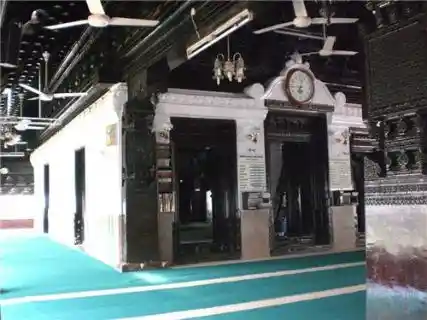
The exquisite and ornate wooden sanctum of Zeenath Baksh Masjid | Source: Wikimedia
History has proven time and again that old is gold, both figuratively for its preciousness and literally for the permanence of the shelf life of gold counted over centuries. But if something that is the oldest, counted over centuries, is in wood, wouldn’t it be more precious and rare? When wood that decays and crumbles away naturally survives the burn of time and political upheavals, then it becomes the golden grace of heritage. The Zeenath Baksh Masjid in Mangalore, Karnataka, is one such gem of Indian historical treasures. It has survived for centuries and is not just the only Masjid made of wood but also the oldest in Karnataka and the third oldest in India.
In the seventh century, Hazarath Mohammed Malik Bin Deenar and his small group arrived at the Malabar coast of Kodungallur, with a letter written by the former Cheruman Perumal, who passed away while returning from Mecca. The letter instructed his son, the contemporary raja (king), to provide every kind of hospitality and permission to preach the faith of Islam in the kingdom. After observing the pious and honest nature of the guests, the king granted lands and other amenities within his kingdom. Malik Deenar, the first-generation disciple of Prophet Mohammed, with his group, established ten masjids after the first in Kodungallur. Zeenath Baksh is the second out of the ten and was constructed in 643 AD, currently located in the Bunder area of Mangalore city. It was earlier referred to as Beliye Palli or Malik Dinar Valya Juma-ath Masjidand was built by the kith and kin of Malik Deenar, who continued preaching the tenets after the sahaba (companion) departed from our coast.
The carved wooden pillars attest that old can be golden in wood | Source: Wikimedia
The nayaab nature of the original structure is that, all those centuries ago, it was entirely made of wood. The pristine glory of the wooden sanctum is still maintained by the local people and sponsors. Owing to the historical nature of the religious site, the caretakers of the masjid hope to get the site its due recognition and funding for maintenance from the administration. As the Secretary of the Central Muslim Committee, Mr Hanif Ali, informs,
“We have written to the tourism department and the Wakf Board to develop the mosque into a tourist spot. They have shown interest, but nothing concrete is being done.”
Though the original structure, which now acts like the inner sanctum, is enclosed within stone walls after renovation, the ceiling of this part is also made of wood and protected with a brass sheet.
As Mr Ali states, “Even if the stone walls were removed, the structure would still stand.”
The water tank is ubiquitous to all religious sites in the region | Source: Wikimedia
The present structure holds the legacy of the Tiger of Mysore, Tipu Sultan, who renovated the medieval Masjid during the second half of the 18th century. Though he enhanced the serenity and aesthetics of the heritage, the original model was kept intact. He then renamed the structure after his daughter Zeenath Baksh, and for the past 400 years, it has retained the name. In the 19th century, it was given a new look by adding four minarets while earlier with its tiled roof it used to resemble the Malabar-styled mansion of a local chieftain.
The new look of the Masjid with the outer walls enclosing the original | Source: Deccan Herald
The sanctum is designed with typical Indian architectural blends with the tank within its grounds, keeping in sync with the traditional style of the nearby temples. The carvings on the sixteen pillars that form the perimeter of the prayer hall depict flowers, bells, and Arabic texts narrating anecdotes from the life of the Prophet. The art etched into the wood encapsulates the cultural blends of the region, and each pillar is made of a single block of wood. Despite the rain and humid conditions typical of the belt, the intricacy of the wooden designs has not faded into blurred lines, as usually expected. Even the floor, walls, and doors are adorned with teak wood and rosewood. As the manager of the Masjid shares,
“Every couple of years, we spend more than Rs. 1 lakh to rub in oil to preserve it. Apart from fixing small scratches, we have not modified or replaced any part of the structure.”
Where wooden art is revered in prayers | Source: Mangalore online
Records prove that this house for prayers was established in the Islamic month on the twenty-second day of Jumada al-awwal and approximately on 18 April 643 AD, with Moosa Bin Malik, the son of Malik Bin Abdullah, as the first Qazi (magistrate of the shari’a court). The site is not known just for its worthy heritage, but also for its community activities, which keep the people around bonded in gratitude and harmony. Attesting to the shared communal brotherhood is the Sharavu Ganapathi Temple. Contrary to propagated accusations, the well-known historian, A M Prabhu (who wrote a well-researched history of Tipu Sultan), recorded that the temple was developed by the Sultan, as a tribute to the local Tuluvas, who for centuries, protected the mediaeval Arabs and the Muslims.
The Shrine overlooking the Malabar-style verandah | Source: Mangalore Online
The Masjid is a hub of charitable activities with its sponsored yateemkhana (orphanage), funding the destitute during marriage ceremonies and even conducting funerals free of cost for the ones who cannot afford it. The wide verandah for the past eighty-seven years has also cradled the sacred shrine of the revered Qazi Hazrath Sheikuna Muhammed Moula Jalal Masthan Al Bhukhari.
All in all, the Zeenath Baksh Masjid is one of the gems that adorn our heritage of cultural blends and is a cocoon of brotherhood, serene piety, and harmony in diversity. A site that is the zenith of the glorious South Indian history.
source: http://www.thisday.app / Home / by Waheeda Bi Khan (headline edited)
There once lived a woman who epitomised the saying, ‘courage lies in compassion.’ Though born into the creamy tier of society, Bilkees Latif exemplified ‘living life large’ with regal grace, compassion, humility, and service to the downtrodden.
Bilkees Latif – The Enigma of Versatility | Source: You & I
Born to Nawab Ali Yawar Jung of Hyderabad and Alys Iffring from France, Bilkees grew up with a silver spoon that never got to her head or turned her into another conceited, snobbish socialite of the affluent society. Instead, she carved the path for her own legacy, decking it with added laurels for an already illustrious family that graced the halls of fame in professional careers and philanthropy alike.
The happily married couple whom even death could not keep apart for more than a few months | Source: You & I
Bilkees was married off in her early teens, as per norms of those times, to the son of another Nawabi family, the former Air Chief Marshall Idris Hasan Latif. Fortunately, she embarked on a happy marriage where the couple reached new heights of their family legacy, giving back to society with sophistication and empathy. He was one of the rare commissioned Air Force officers under the British Raj when she married him. Down the lane, Bilkees captured his illustrious life in her words, in a book titled The Ladder of His Life, an apt title, because he was the perfect stairwell through which she reached amazing feats*.*
They say greatness is not in lending help; it is in giving the downtrodden the best chance to lift themselves out of their howls. Tapping into the networking skills inherited from her family and her role in the Raj Bhavan as the wife of an Air Chief Marshall and the Governor of Maharashtra, she initiated her most lauded mission of improvising the largest slum of Asia, the Dharavi region in Bombay (now Mumbai). Among the many charitable and rehabilitator organisations she founded, The Society of Human Environmental Development (SHED), was the first. Embedded amongst the Godrej, Wadias, along with personalities like Sarojini Naidu, and Mahalaqa Bai Chanda of the society, she channelled their resources to the best purpose of giving hope of self-reliance to the helpless and discriminated.
A smile that never wavered along the slum dwellers or through the dignitaries | Source: You & I
Her life was a slide ranging from a diplomatic hostess for the likes of President Mitter as the wife of the Indian Ambassador in Paris or when Queen Elizabeth visited Hyderabad, with dexterous flair and culinary delights, to squatting with the slum children during her drive for hygiene or to understand the core issues of almost nil literacy rate, unemployment, drug addiction, etc. She has journaled her experience, which not only involved persistence to gain the dwellers’ trust but also a consistent tussle with the mafia and other powerlords, in her book O Dharavi.
Receiving Padma Shri from the President | Source: You & I
Today, the tourists who throng Dharavi do not go to witness the squalor of the slums. They visit to admire the very source of the largest economy of Maharashtra, generated from the 99 per cent of the hygienic houses that own some kind of home industry, may it be food, crafts, or hundreds of other options in the legitimate market. Her selfless strife to accomplish her solutions to the innate problems of the slums and not just hear them and forget once out of sight won her the much-deserving Padma Shri in 2008.
Cover pages of two of her books | Source: Penguin, Amazon
Mere words fail to encompass the versatility of Bilkees, as a seamstress of her enigmatic chiffon sarees with Banarasi borders. She was an exceptional artist, attested through one of her works, which was an 8-foot mural exhibited in Osaka, at the Japan Aero Exposition. Her elegance mirrored in her words as an author to her culinary skills and deep insight into the Deccan culture capsuled into “Essential of Andhra cookbook” apart from her other books like The Fragrance of Forgotten Years. She was the Founder member, Board member, President, and Trustee of many organisations like INTACT, the Indian Council for Child Welfare, Anjuman-e-Khawateen, the Board of Air India, and many others. She was the lamp of the literacy drive for children and had helped open 107 Bal Bhavans affiliated with the National Bal Bhavan as the Chairperson and Children’s Museum that organised creative activities for children all over India.
Just like her active life, she faced cancer in her painful last years with equal courage, poise, and humility, before she passed away in October 2017. Some people achieve so much and touch so many hearts that it becomes impossible to encapsulate their lives in just a few lines. Bilkees was one of them, her lifespan must have ended at eighty-six, but her legacy will be carried on, in each breath of Dharavi who are reaping the valorous efforts of her compassion, and in the memories of each of those whose lives she touched, one way or the other. She left behind two sons and a daughter.
Her lovely family of ‘hum do hamare teen’ | Source: You & I
Bilkees Latif was a woman who amalgamated an unaffected natural charm, grit, down-to-earth versatility, and kindness, into such a perfect blend, that it is seldom found in aristocracy. The words from her own pen in her book seem to resonate with the prayers of all those hearts she had touched with her kindness – “Keep her happy wherever she is, please.”
source: http://www.thisday.app / Home / by Waheeda Bi Khan
The road unfolded before us like a ribbon, guiding our car through the lush greenery and coconut groves of Kerala. It was the sacred month of Ramadan, and we had embarked on a journey to the enchanting city of Kannur in search of a pious man. The road ahead promised a culturally rich, soul-stirring experience that would leave an indelible mark on our hearts.
We entered the city after a two-hour long drive; the streets bustled with pedestrians, the sound of traffic filled the air, buyers and sellers haggled in the marketplace. Amidst this vibrant chaos, an air of sanctity was palpable; it carried the essence of a bygone era, where the mingling of diverse traditions shaped the city’s identity. Our guide informed us of Kannur’s deep-rooted connections with the Islamic world, which dated back centuries.
Nestled along the coast of the Arabian Sea, Kannur holds a special place in the tapestry of Islamic culture. The arrival of Arab merchants, who had ventured to the Malabar Coast for trade, had a lasting impact on the locals. Legend has it that Islam took root in Kannur even before the arrival of Malik ibn Dinar, who is famously known as the first companion of the Prophet Muhammad ﷺ to arrive in India (though this cannot be verified historically). The tales passed down through generations speak of King Cheraman Perumal, ruler of the Chera kingdom, who was drawn to Islam after witnessing the miracle of the split moon. He embraced Islam, took the name Tajuddin, and ventured to Mecca, where he shed his worldly concerns. His story, engraved in verse on a wooden tablet at the Arakkal Palace, is a testament to the city’s historical connection with Islam.
Over the centuries, Kannur flourished as a centre for Islamic scholarship and culture, particularly Sufism. It became a hub of spiritual seekers, earning the moniker ‘Baghdad of India’. One notable figure in Kannur’s Sufi tradition is Ghawth al-A’zam (the Greatest Helper), Shaykh Abdul Qadir Al-Thani, whose presence lingers in the serene village of Puratheel, just a short distance from Kannur city, and whose grave we were destined to visit that day.
After parking our car near Varam Kadavu Bridge, we were drawn to a nearby river, its cool, sparkling waters beckoning us under the scorching summer sun. Seeking respite from the heat, I cupped my hands and splashed the cool water on my face, feeling rejuvenated in both body and soul. My colleague, who had visited Puratheel before, remarked that this river served as a natural border for the village, fortifying the sacred site with its life-giving waters. It was this very river that earned Puratheel the epithet dweep, or ‘island’. The flowing waters represented a boundary that was not only physical, but also spiritual, separating this land from the rest of the outside world.
Puratheel. Image credit: Salz Graphy
Standing on the river’s edge, engrossed in its serene beauty, I felt a profound sense of peace wash over me. At that moment, I understood why Puratheel was revered as a place of spiritual import. It provided a sanctuary, a space where seekers could disconnect from the outside world and embark on a meaningful journey of self-discovery. Even as we reluctantly left the riverbank, the serenity of that moment remained with us, and we cherished this reminder of the intense connection between nature, spirituality, and the pursuit of inner peace.
As we wandered through the village, faint sounds of devotional music played from afar. Our guide, prayer beads in hand, began to narrate the story of Shaykh Abdul Qadir Al-Thani.
There once lived an extraordinary man in Afghanistan by the name of Shaykh Uthman Hamdani. A Persian ruler and descendent of the esteemed first Caliph, Abu Bakr Al-Siddiq, this Sultan of Hamadan left all his riches behind to go on a quest for truth. He wandered tirelessly across distant lands, his footsteps guided only by his faith and a thirst for spiritual knowledge.
Shaykh Uthman eventually arrived in Valapattanam, a tranquil village in the northern province of Kerala. One night, during his stay in the village, he experienced a vision. This vision promised him that, should he marry on that very night, he would sire a miraculous child. A year later, in the nearby kingdom of Chirakkal, royal astrologers uncovered a celestial secret. They revealed to their king that a child had been born in the Valapattanam province — a child destined to become the greatest of all miraculous beings. They further prophesied that if the King provided protection and support to this child, his kingdom would prosper.
Intrigued by this prophecy, the King of Chirakkal set out to meet the newborn child, who had been named Abdul Qadir. Recognising the infant’s extraordinary potential, the King assumed responsibility for his upbringing, ensuring that he grew into a virtuous and revered figure. As such, the child was brought to the King’s palace at the tender age of five or six, where he continued his spiritual journey surrounded by the kingdom’s grandeur. His princely childhood abruptly ended at the age of sixteen, when his fortuitous encounter with four strangers changed the course of his life forever.
The strangers had arrived at his family home in a famished state while Abdul Qadir was away at the palace. With his mother’s permission, they slaughtered cattle she had originally set aside for her son, and chopped down a jackfruit tree in front of the house. They cooked their meal, ate, and saved some of the food to be given to Abdul Qadir when he returned. As the strangers departed, the family were astonished to find that both the cattle and jackfruit tree had been miraculously restored to their original state. When Abdul Qadir eventually came home, his mother informed him of their unusual visitors. Realising that these were no ordinary beings, he set off to find them, eventually encountering four people from Bhatkal, Karnataka. Amongst them was the distinguished Sufi shaykh, Mahmoud Al Khabooshani, who bestowed Abdul Qadir with an ijaza in the Suhrawardi tariqa. This was a licence that would formally permit him to instruct his own disciples in the teachings and practices of the Suhrawardi Sufi order.
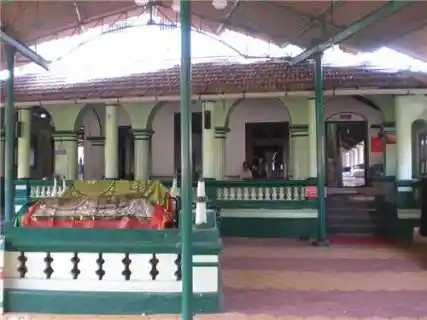
Mosque built by the Shaykh himself
Inspired, Shaykh Abdul Qadir abandoned all material pursuits and devoted himself to worship. When the King grew concerned at the Shaykh’s sudden withdrawal from the palace and other worldly affairs, the Shaykh expressed his desire to continue this path, furthermore requesting that the King grant him a portion of the land to be reserved for regular worship and seclusion. The King assented, and named this land ‘Puratheel’. There, the Shaykh built a mosque and established a settlement, fostering a culture of spiritual seclusion and growth. He eventually became known as Abdul Qadir Al-Thani (‘the Second’), as people reverentially associated him with Ghawth al-A’zam Abdul-Qadir Al-Jilani, esteemed scholar and saint of Baghdad.
Despite my efforts, I found little information about Abdul Qadir Al-Thani in my research. Even in Malayalam, the native language of Kerala, references were scarce. Only in Arabic did I find a single work, entitled The Holy Maulid, by Shaykh Valappil Abdul Azeez Musliyar. Shaykh Abdul Qadir’s obscurity in the digital realm was, to say the least, disappointing. However, as I stepped into the sacred sanctuary of Puratheel, I was astounded to see its pathways abound with visitors, their footfall echoing with purpose and a yearning for the blessings of a shaykh unknown to Allama Google. This was a realm beyond the age of digital information, where human souls longed for a connection unencumbered by the pretensions of media and search engine rankings. I felt an enigmatic current that drew people to a shaykh who, while evading fame and renown in written histories, had claimed his place in living hearts and memories.
Tombs of Shaykh Abd al-Qadir al-Thani’s descendants
With the setting sun, a melodious call to prayer echoed through the misty valleys, summoning the faithful to gather in the sanctum of the mosque. Inside, the golden glow of flickering lanterns danced across the walls, and the congregation united in prayer between them. The rhythmic recitation of sacred Qur’anic verses rose and fell, followed by murmured supplications emanating from each devotee’s lips.
After the Maghrib (sunset) prayer, a serene calm enveloped the community. We had just shared an Iftar meal to end the day’s fast, replenishing both body and soul with food and prayer. However, the night was far from over. At 12.30am, as moonlight filtered through the mosque’s stained glass windows, bathing the prayer hall in its soft glow, the call to prayer would recommence. As the rest of the world slept on, these worshippers would perform the Taraweeh prayer until 2am, a night prayer reserved for the blessed month of Ramadan, followed by more supererogatory prayers and whispered invocations hoping to forge a bond between this earthly realm and the Divine.
Though Muslims the world over perform these rites every Ramadan, Puratheel has its own unique customs. The Qunut, a special supplication, is recited with every prayer except Maghrib. On Mondays, Thursdays, and Fridays after Maghrib, devotees gather for a dhikr halaqa, or gathering of remembrance, chanting the Divine’s sacred names in melodious union. After the Jumu’ah (Friday) prayers, which are led by a descendent of Abdul Qadir Al-Thani, a ritual of repentance takes place; the Shaykh recites words of istighfar, invocations that seek Divine mercy and forgiveness. Believers repeat the Shaykh’s istighfar, and disclose their struggles and shortcomings to a spiritual mentor as a means of guidance, purification, and self-reflection.
As Ramadan nears its end, the anticipation of seeking Allah’s blessing in the final ten nights of the Sacred Month swells, culminating in the sought after ‘Night of Power’, or Lailat ul Qadr. This is the twenty-seventh night of Ramadan, where in Puratheel, the adhan (call to prayer) resounds seven times to herald the Night of Power’s arrival. The mosque transforms into a radiant beacon, drawing the servants of Allah from near and far.
Puratheel Juma Masjid
When the final sun sets on Ramadan, and Eid ushers in the Sacred Month’s end, the Isha (evening)prayer is delayed until 2am to encourage the faithful to immerse themselves in worship until dawn. Although these customs may seem arduous to some, they are embraced with an unwavering devotion in Puratheel, keeping the legacy of the Shaykh alive. In our age of information and instant gratification, Puratheel reminds us that there are still enigmas to unravel, hidden domains waiting to be explored, and extraordinary souls whose influence transcend the virtual realm. True enchantment lies not in its digital presence but in the transformative encounters that await those who embark on this journey with an open heart and a yearning for the Divine.
Before our trip came to its end, our guide led us inside the mausoleum that housed Shaykh Abdul Qadir Al-Thani’s tomb, where he rested adorned in royal green clothing. Mausoleums of his children, grandchildren, other family members, and companions abound, both in Puratheel and all throughout India.
As we left Puratheel, a sense of tranquillity washed over me, dispelling, for the moment at least, all of life’s uncertainties. I felt that an inner peace had permeated my being, reminding me that we are never truly alone. For a moment, the world stood still and breathless, before exhaling a gentle breeze that brushed against me. I felt tears spring to my eyes, and wondered if nature possessed its own soul.
I left marvelling at the interconnectedness of the human spirit and the natural world. With the wind divulging its secrets and the land preserving ancestral tales, our souls are inextricably tied to that of nature’s. Through timeless bonds, we find solace, guidance, and an earnest understanding of our place in the cosmos. I journeyed forward, guided by whispers of the unseen, embracing the beauty and mystery bestowed upon us by nature.
Edited by Asma
source: http://www.sacredfootsteps.com / SacredFootsteps.com / Home>Asia> India / by Swalih Kuzhinholam / edited by Asma
____________________________________
Swalih Kuzhinholam
Swalih is a writer, Islamic tutor, and cultural explorer based in Kerala, India. He is a graduate of Darul Huda Islamic University in Chemmad, and a former Associate Editor at Thelitcham monthly magazine. His interests lie in culture, society, Sufism, aesthetics, literature and the arts.