While the origin of Mygurudu is unknown, it is believed that the word originated from ‘Mozhi Kurudu’, which means misleading with words.
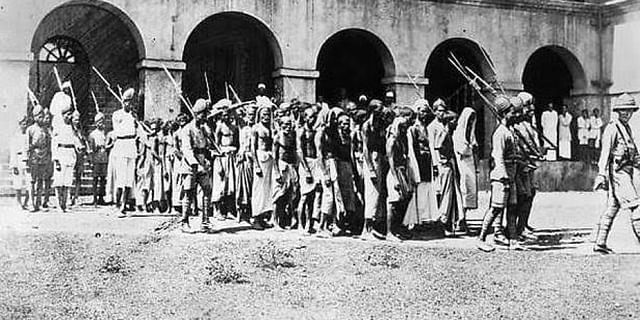
The 1921 revolt grew as an agitation against the feudal lords who aided the British. (Photo | Special Arrangement)
Kozhikode :
The centenary observations of the Malabar rebellion of 1921 are also becoming an occasion to retrieve many forgotten things part of local history. Mygurudu, the secret language that was prevalent in some parts of Malabar, is among them. For the coded language was used widely by the rebels to hoodwink the British during the rebellion.
While the origin of Mygurudu is unknown, it is believed that the word originated from ‘Mozhi Kurudu’, which means misleading with words. The language was developed by swapping Malayalam alphabets. For example, Malayalam alphabet ‘Aa’ is replaced by ‘Sa’ and ‘Eee’ by ‘See’.
In his book ‘Anglo-Mappila War 1921’, historian A K Kodoor recorded that the rebel leaders had instructed that all messages should be communicated through Mygurudu. He added that rebels’ meeting at Vellinezhi had decided to teach all group members the language, and that the Mappilas of Malabar used the secret language from 15th century AD when they were battling the Portuguese.
The Students Islamic Organisation (SIO) recently organised an exhibition ‘Al Jamia Mygurudu’ at the Al Jamia Al Islamia at Santhapuram near here. “The exhibition was part of a protest against the move from the Indian Council of Historical Research (ICHR) to delete the name of those who participated in the 1921 rebellion from the list of freedom fighters,” said Ayman M A, convener of the exhibition.
Dr Pramod Irumbuzhi, who has done extensive research on the language, said he first came to know about it when he was studying at the Calicut University. “I realised that some people can still speak the language. There will be around 500 people who can fluently speak Mygurudu in the seven districts of Malabar,” said Pramod, whose book on the subject has run into the fourth edition.
source: http://www.newindianexpress.com / The New Indian Express / Home> States> Kerala / by Express News Service / October 24th, 2021
The revolt of 1857-58 is largely considered and is widely seen as a ‘Popular Uprising’. The uprising had centres spread across North India as well as Central and Western India. The uprising in different centres had its own leaders. The most important names associated with the uprising that comes in one’s mind are those of the Indian soldier Mangal Pandey at Barrackpore, Rani Laxmibai at Jhansi, Veer Kunwar Singh at Arrah, Maulvi Ahmad Shah at Faizabad, Tantia Tope at Kanpur, Begum Hazrat Mahal at Lucknow.
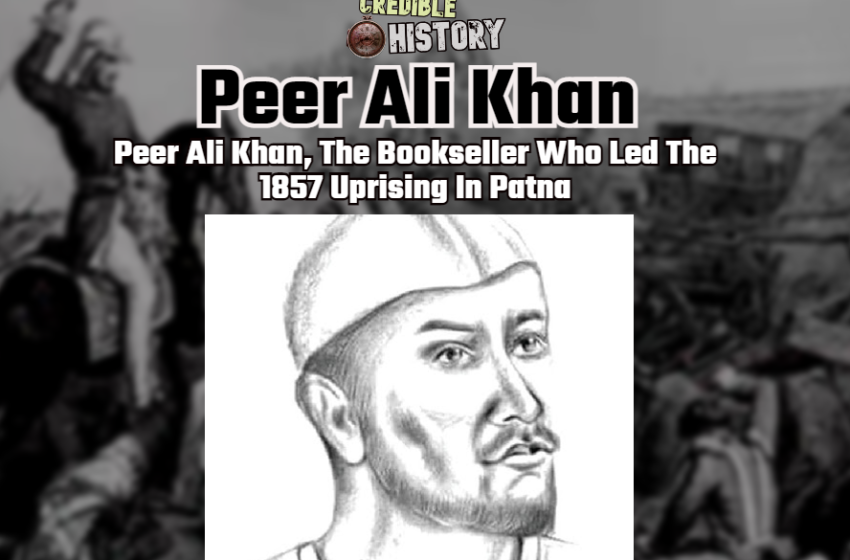
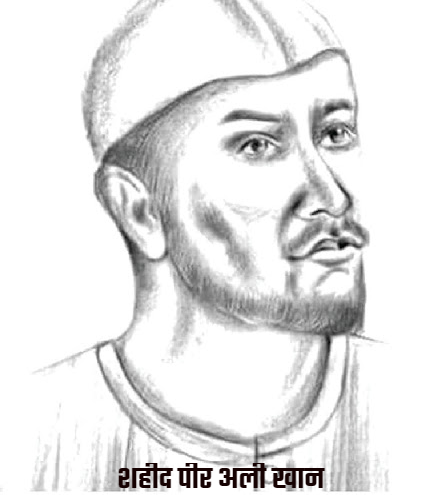
Peer Ali Khan
At the same time, there are many heroes who are largely unheard of or are often forgotten. One such name is that of Peer Ali Khan, a bookseller who led the uprising in Patna. Peer Ali Khan has been described as the “Chief Rebel of the city”[1] by William Tayler who was the Commissioner of Patna between 1855 and 1859.
Peer Ali Khan was born in Muhammadpur in Azamgarh district of Uttar Pradesh. Around the age of seven he ran away and arrived in Patna. In Patna he was provided shelter and refuge by a zamindar who brought him up along with his son and educated him.[2]Peer Ali Khan owned a bookshop in Patna. The bookshop became the meeting point for rebels and also a contact point for rebels and the disenchanted Indian soldiers in the British Army.
According to William Tayler:
“Peer Ali was a native of Lucknow, but had resided for many years at Patna; he was by trade, a Book-seller, and I strongly suspect that he may have originally established himself here, for the express purpose of carrying on the intrigues which issued in this abortive out-break.”[3]
Peer Ali secretly distributed important leaflets, pamphlets and coded messages to the rebels.
He regularly organised campaigns against the British, and became the leader of the July 1857 upsurge in Patna.
William Tayler in his narration of the events of 1857 in Patna says:
“Two days before the emeute at Patna, which will be described in a subsequent chapter, Ahmed Oollah’s father, Illahee Buksh, the blind man, whom I have above mentioned, sent a message to apprise me, that the leader of the Rebels, Peer Ali Khan, was collecting arms and men”.[4]
Uprising in Patna
The uprising in Patna took place on the 3rd of July 1857 and it was carried out by Peer Ali and the other rebels.
The rebels led by Peer Ali first attacked the house of a Roman Catholic priest in the heart of the city but the priest escaped. They then shot and killed Dr Lyell who was the principal assistant to an opium agent. When a reinforcement of British soldiers was sent to the scene of attack some of the rebels were shot and killed whereas others fled.
“The most serious affair at Patna, however, occurred about the close of the period to which this chapter more particularly relates. At about eight o’clock in the evening of the 3d of July, a body of Mohammedans, variously estimated from eighty to two hundred, assembled at the house of one of their number, one Peer Ali Khan, a book-seller, and proceeded thence to the Roman Catholic Church and mission-house in Patna, with two large green flags, a drum beating, and cries of ‘Ali! Ali!’ The priest, whom they probably intended to murder, fortunately escaped. They emerged into the street, reiterated their cries, and called on the populace to join them. Dr Lyell, principal assistant to the opium agent, immediately went to the spot, accompanied by nine Sikhs. He rode ahead of his support, was shot down by the rioters, and his body mangled and mutilated before the Sikhs could come up. A force of Sikhs and nujeebs speedily recovered the unfortunate gentleman’s body, killed some of the insurgents, and put the rest to flight.”[5]
In the aftermath of the attack, Peer Ali’s house was searched by the British, where they found and seized arms and a number of letters. He was designated as the leader of the upsurge by William Tayler.
William Tayler describes it as follows:
“Somewhat later in the day, the deputy Magistrate, Moula Buksh to whom the Magistrate had entrusted the investigation of the case, came to me in great triumph with some murderous looking arms and implements (among which was an English fencing mask) and a large packet of letters, all of which had been found in the house of Peer Ali Khan, the leader of the outbreak and Captain of the rebels;”[6]
“The letters discovered in his house serve to show, that, for several years past, he had been in correspondence with different parties, principally with one “Musee” ool “zuman”, a Lucknow man, who followed the same trade, and that he had, in communication with these parties, deliberately discussed and matured seditious plans against the British Government.”[7]
Thereafter, Peer Ali Khan and the other rebels were arrested and tried. Most of the rebels were hanged within hours of sentencing. Peer Ali who was believed to be the murderer of Dr Lyell was also handed death sentence for his overall role as the leader in the uprising of 3rd July 1857.
“….. numerous accomplices were seized during the next few days, and among them, after a short resistance, in which he was wounded, Peer Ali himself; ample evidence was, by the exertions of Moula Buksh, obtained, convicting these men of active participation in the outrage, 21 were hanged, 23 imprisoned.”[8]
He refused amnesty
After being sentenced to death, Peer Ali was offered amnesty in lieu of providing more evidence and information regarding the nature of the uprising, but nothing could break him. History therefore stands witness to the fact that this ordinary bookseller did not concede to the demands of the British and refused the amnesty. He accepted the gallows rather than a life of disgrace.
William Tayler goes on to note:
“After capital punishment had been pronounced upon him, I sent for him (as I generally did with such criminals) and questioned him in my private room, in hopes of eliciting some further information regarding the plot.
Heavily fettered, his soiled garments stained deeply with blood from a wound in his side, confronted with myself and several other English gentlemen, the last hope of life departed, not for a moment did he betray agitation, despondency, or fear.”[9]
Declining the pardon being offered, Peer Ali proclaimed:
“On being asked whether he could do anything to make it worth while to spare his life, he answered with supreme coolness and some contempt: “There are some cases in which it is good to save life, others in which it is better to lose it”. He then taunted me with the oppression I had exercised, and concluded his speech by saying, “You may hang me, or such as me, every day, but thousand will rise in my place, and your object will never be gained.””[10]
William Tayler seems to be in awe of Peer Ali and says:
“….. men, whose unconquerable fanaticism renders them dangerous enemies, and whose sternresolution entitles them, in some measure, to admiration and respect”.[11]
The Hanging
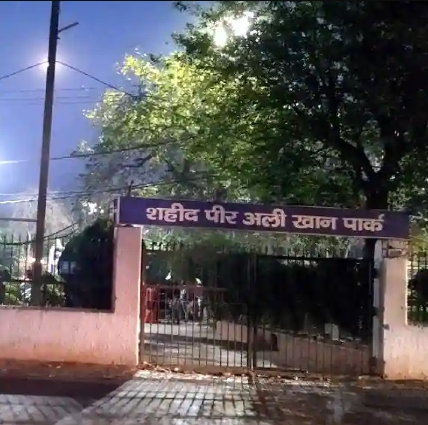
On 7th July 1857, Peer Ali was hanged in full public view in Patna. In present day Patna a children’s park opposite the DM’s office near Gandhi Maidan has been named the Shaheed Peer Ali Khan Park by the Govt. of Bihar to commemorate the sacrifice of this ordinary bookseller whose deeds made him extraordinary and memorable. The park is considered to be the place where Peer Ali was hanged in 1857.
Naming a park after a forgotten hero of the 1857 uprising goes a long way in making him and his contribution known to the people. Moreover, reading and writing about Peer Ali khan made me realize once again and ever more that our freedom is very hard earned. We cannot take it for granted. I and we all need to cherish it, nourish it and strengthen it.
[1] William Tayler, Our Crisis Or Three Months at Patna during the Insurrection of 1857, (2007 Reprint), Khuda Bakhsh Oriental Public Library, Patna, p.4
[3] William Tayler, Our Crisis Or Three Months at Patna during the Insurrection of 1857, (2007Reprint), Khuda Bakhsh Oriental Public Library, Patna, p.45
[4] William Tayler, Our Crisis Or Three Months at Patna during the Insurrection of 1857, (2007 Reprint), Khuda Bakhsh Oriental Public Library, Patna, p.30
[6]William Tayler, Our Crisis Or Three Months at Patna during the Insurrection of 1857, (2007 Reprint), Khuda Bakhsh Oriental Public Library, Patna, p.44
7William Tayler, Our Crisis Or Three Months at Patna during the Insurrection of 1857, (2007 Reprint), Khuda Bakhsh Oriental Public Library, Patna, p.45-46
8William Tayler, Our Crisis Or Three Months at Patna during the Insurrection of 1857, (2007 Reprint), Khuda Bakhsh Oriental Public Library, Patna, p.44
[9] William Tayler, Our Crisis Or Three Months at Patna during the Insurrection of 1857, (2007 Reprint), Khuda Bakhsh Oriental Public Library, Patna, p. 44
[10] William Tayler, Our Crisis Or Three Months at Patna during the Insurrection of 1857, (2007 Reprint), Khuda Bakhsh Oriental Public Library, Patna, p.44-45
[11] William Tayler, Our Crisis Or Three Months at Patna during the Insurrection of 1857, (2007 Reprint), Khuda Bakhsh Oriental Public Library, Patna, p. 45
source: http://www.thecrediblehistory.com / Credible History / Home> English> Freedom Movement> Others / by Kanupriya Gautam / October 20th, 2021
__________________
Kanupriya Gautam : Kanupriya has done her Master’s in Modern Indian History from University of Delhi and has deep Interest in History, Politics and Literature.
source: http://www.thecrediblehistory.com / Credible History / Home> English> Freedom Movement / by Kanupriya Gautam / October 20th, 2021
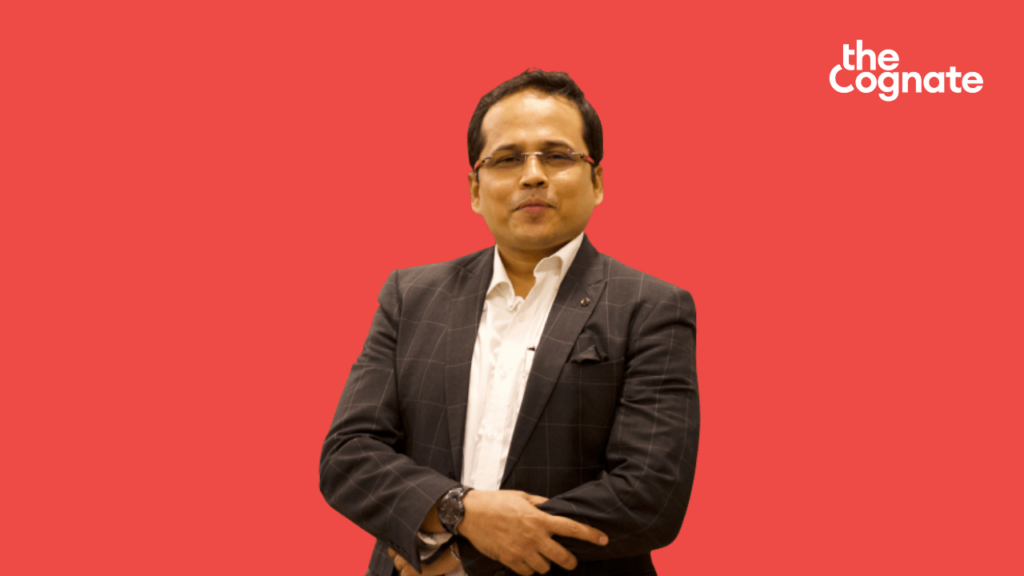
Bengaluru-based author and coach Mohammed Ali Athar Ahmed, also known as MD Ahmed, entered the Guinness World Records for memorising the most number of three-digit flashcards.
Ahmed bagged the world record for recalling 32 three-digit flash numbers. The previous record was held by an Iranian (30 three-digit cards).
Ahmed is highly trained in memory techniques and also trains others to use such techniques. He decided to attempt a Guinness World Records title to help inspire others who are also interested in memorising as a skill and sport, Guinness World Records noted.
A Neuro-Linguistic-Psychology (NLP) practitioner, Ahmed is the author of the book “Hidden Secrets Of The Topper’s Mind”.
source: http://www.thecognate.com / The Cognate / Home> News / by The Cognate News Desk / December 10th, 2021
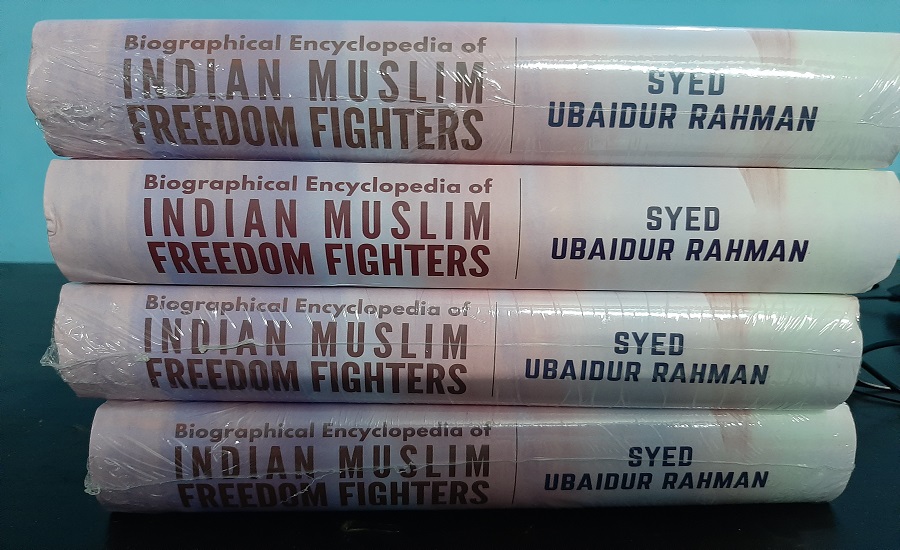
‘Biographical Encyclopedia of Indian Muslim Freedom Fighters’ is an exhaustive work that brings to the fore many unknown facets of the freedom movement beginning with Faraizi Movement to 1857 Mutiny and to later part of the freedom movement.
BE it 1857 Mutiny or the later freedom movements, Muslims have played leading role in all such efforts. British officials and historians have accused Muslims for the 1857 Ghadar. To be true, both British historians and officials have named Muslims as the most important rebels and termed the Mutiny as a sinister plot by Muslim ulema and mujahideen to reclaim their lost powerhouse in India.
Here are excerpts from a chapter on Imam Baksh Sahbai, a great scholar of his time:
Imam Bakhsh Sahbai was one of the most renowned scholars of the 19th century Mughal India. He was among the best scholars of the Persian language and had earned respect as poet and litterateur of the Persian language. At a time when Urdu had almost replaced Persian as lingua franca in much of north India, he was still one of the greatest supporters of the Persian language and spent all his resources in its propagation.
He authored more than thirty books on Persian and Urdu literature that includes three books that were part of the curriculum in the famed Delhi College. He was reportedly appointed a professor of the Persian language there. However, he had a tragic end when after the 1857 Mutiny he and his entire family, including his two sons, who were also renowned scholars in their respective fields, were hauled, taken to Yamuna and shot dead from point blank range. At least 21 members of his family were slaughtered in this most horrendous fashion.
Imam Bakhsh Sahbai was among the most respected scholars of the time and, therefore, every prince wanted to study under him. He was very close to Ghalib, Zauq, Mufti Sadruddin Azurdah, Fazle Haq Khairabadi and even the last Mughal Emperor Bahadur Shah Zafar. Many top scholars of the time were taught by him not just at Delhi College but also at his home. However, the slaughter of his family members including his two sons, and digging of his home by the British thugs had shocked the people of Delhi even during the worst phase of brutality. This digging of his house and the complete destruction of his library also destroyed much of his work. The destruction of his massive library that he had built over a period of decades must have been a huge loss for academia and scholarship. This is the reason that not much has survived on him.
Some twenty years after his macabre killing, when a Hindu disciple of Sahbai, Munshi Deen Dayal thought of collection and publication of his he couldn’t lay his hands on anything substantial. There was not much available on his life or work. Whatever he could gather, he published it in three volumes as Kulliyat-e-Sehbai.
Sahbai was born in the year 1805 in a respected family of Delhi. His father, Maulana Muhammad Bakhsh settled in Delhi from Thanesar, Punjab. Sahbai’s elder brother Hakim Peer Bakshi was a famed physician of his time. His early education was under Maulvi Abdullah Khan. Sehbai had two sons, Muhammad Abdul Aziz and Molwi Abdul Karim Soz. Both were accomplished scholars and well-known poets. Both were killed along with their father and other relatives after 1857 Mutiny.
While in the mid-19th century the power of Mughal Empire had diminished and its influence confined to the Old Delhi quarters, the capital of the Mughal empire still boasted a huge galaxy of scholars, poets and artists of all sorts. There is no denying the fact that the biggest draw of all were the poets and intellectuals. Altaf Husain Hali said that Ghalib, Zauq, Sahbai and Azurda made the capital one of the best places for the scholars and academics. “There gathered at this time in the capital, Delhi, a band of men so talented that their meetings and assemblies recalled the days of Akbar and Shah Jahan”, wrote Hali.
Hali, who had merely heard the stories of high standards of scholarship in Delhi, its great scholars and poets and great madrasas dotting the town, escaped Panipat and came on foot to Delhi. He eventually got admitted to one of the best madrasas of the town and started frequenting the classes of great scholars of his time before his family tracked him down eventually. However, much before that happened, he had got admission in ‘very spacious and beautiful’ madrasa of Husain Bakhsh and had begun his studies there. He says that he was witness to ‘this last brilliant glow of learning in Delhi, the thought of which now makes my heart crack with regret’.
William Dalrymple while describing the destruction and killing in Delhi in the aftermath of Mutiny says:
Worse still was the slaughter in Kucha Chelan, where an estimated 1,400 Delhiwallahs were cut down. Here Nawab Muhammad Ali Khan had attempted to resist the plundering and had shot dead three British soldiers who had climbed over his haveli wall and entered his zenana. Their companions went back to get the rest of their regiment, and returned with a field gun with which they blew the haveli apart.
Sahbai was respected by fellow scholars including Mughal Emperor Bahadur Shah Zafar, who himself was a top of the line poet and whose respect for scholars and poets was legendary. While Sahbai is not known to have directly fought in the 1857 Mutiny, however, what is known is that he was with Bahadur Shah Zafar and supported his revolt. This was the reason that the rampaging British forces, full of feeling of retribution and revenge were led to his home and the homes of other supporters of Mutiny. These spies were paid Rs 2 for every such input.
When after relentless killing and rapine the British and their allies got tired of killing and bayoneting the inhabitants, they marched forty survivors out to the river Yamuna, lined them up below the walls of the Fort, and shot them. Among the dead were some of top of the line scholars who would have been the pride of the place for any world class capital. While writing about this ghastly massacre Mirza Zahir Dehlavi says, “They were well-known and well-off people, men who were the pride of Delhi…They had had no parallels in their own day, nor will we ever see their like again.’
Mirza Zahir Dehlavi in his Dastan-e-Ghadar writes:
“For example, there was Miyan Amir Panja-kash, the great calligrapher, who had no one comparable to him on this earth. Then there was one of our greatest poets, Maulvi Imam Bakhsh Sahbai and his two sons, and Mir Niyaz Ali, the celebrated story teller of Kucha Chelan. About fourteen hundred people of that Muhalla were killed. Some were arrested and taken through the Rajghat gate to the river side and there they were shot. The bodies were all thrown into the river. Meanwhile, many of their women were so disturbed by what they saw that they left their homes with their children and jumped into the wells. For months afterwards, all the wells of Kucha Chelan were stacked with dead bodies. My pen refuses to describe this further.
“One of the survivors of Sahbai’s family was his nephew Qadir Ali who apparently lived with him in Delhi. He is reported to have told his escape to the Delhi historian Rashid ul-Khairi. “Delhi resembled a place of Judgment. A huge number of prisoners were being shot as hanging them was ‘tiresome’ for their killers.
As the soldiers readied their guns a Muslim officer came forward and told us that ‘your death is imminent. You will be shot to death immediately, so those people who know swimming should immediately jump in the river to survive.’ I knew swimming and was good at it, but Mamun Sahib [Sahbai] and his son, Maulana Soz, didn’t know how to swim. I was not ready to abandon Mamun Sahib and my cousins but he forced me to do so. Ultimately, I jumped in the river and swam away. I kept looking back, and after I had gone fifty or sixty yards, I heard the gunshots and saw the line of people falling dead”.
_______
Excerpted from: Biographical Encyclopedia of Indian Muslim Freedom Fighters by Syed Ubaidur Rahman; ISBN: 81-88869-51-1, PP 626 (Hard Bound), Price Rs 1195, Publisher: Global Media Publications, Tel: 9818327757
__________
source: http://www.clarionindia.net / Clarion India / Home> Books / by Syed Ubaidur Rahman / December 13th, 2021
The Jawad Memorial Prize for Urdu-English translation was instituted to honour the literary legacy of poet and scholar Ali Jawad Zaidi (1916-2004).
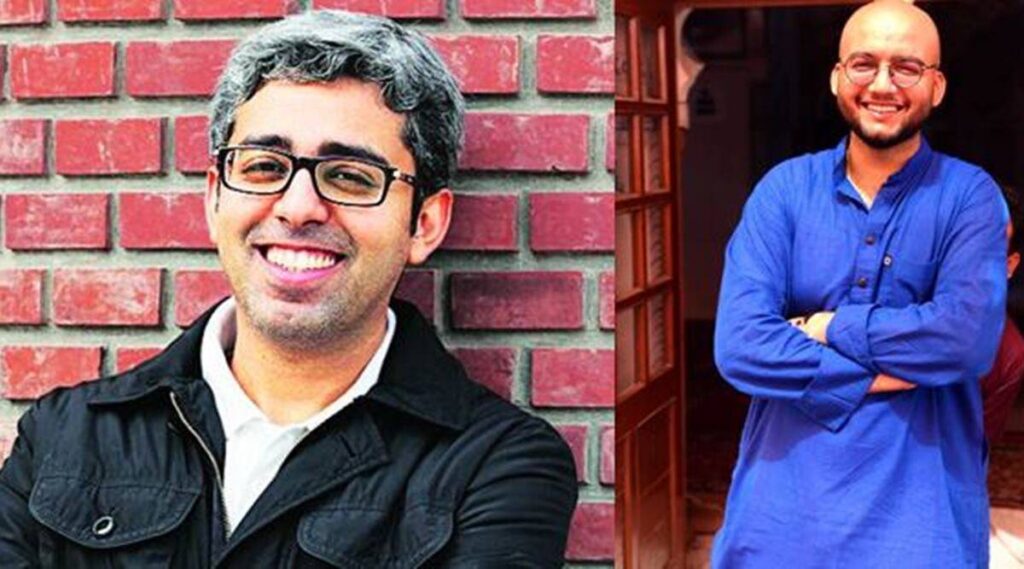
Bilal Tanweer (left) and Aalim Akhtar (right)
This year’s Jawad Memorial Prize for Urdu-English translation has been given jointly to Aalim Akhtar’s translation of Hari Bol, written by Zakia Mashhadi, and Bilal Tanweer’s translation of Parasite (Keera), written by Bilal Hasan Minto.
The Jawad Memorial Prize for Urdu-English translation was instituted to honour the literary legacy of poet and scholar Ali Jawad Zaidi (1916-2004). People from across the world can apply with an unpublished translation into English of an (already published) Urdu short story or essay. All submissions are judged blind.
While there are no runner-ups, the jury — comprising authors M Asaduddin and Aakar Patel — had commendations for two translations. Nazia Akhtar’s translation of Chhottam Jaan, written by Zeenath Sajida, and Fathima M’s translation of Shadows (Saaye), written by Khalid Jawed.
In its comments, the jury called Akhtar’s translation of Hari Bol “lucid and accessible”. It remarked that the language was direct and the translation was close to the original text. “Mashhadi’s Hari Bol depicts life lived at a most basic level. The story examines the complexity of human relationships with an unsentimental, even pitiless gaze,” the jury noted.
Tanweer’s translation of Parasite was applauded by the jury for drawing both major characters with great skill, panache, and a clinical eye for detail. “The translation is free-flowing, an elegant rendering from the original,” it said. The jury mentioned that Manto’s Parasite is an unusual and enjoyable story, bordering on surreal. “It draws its strength from the portrayal of characters, which include a tapeworm,” it added.
Akhtar is a PhD scholar at the Center for English Studies, Jawaharlal Nehru University (JNU), New Delhi. After pursuing a Bachelors’ degree at Delhi University’s Kirorimal College and a Masters’ degree at JNU, Akhtar has taught undergraduate students at JNU and at Zakir Hussain Delhi College, DU. As part of the translation studies course at his current centre, Aalim has translated over 25 micro-fictions by Manto, a play, Anarkali by Imtiaz Ali Taj, and some nazms by Jaun Elia. He has also reviewed Srikant Verma’s Relapse: A Novel, translated by Krishna Baldev Vaid, for The Book Review (Sept 2020).
Tanweer’s novel The Scatter Here Is Too Great won the Shakti Bhatt First Book Prize and was shortlisted for the DSC Prize for South Asian Literature, and the Chautauqua Prize (US). The novel was also translated into French (Editions Stock) and German (Carl Hanser Verlag). His translation of Muhammad Khalid Akhtar’s novel and stories, Love in Chakiwara and Other Misadventures, received the PEN Translation Fund Grant.
source: http://www.indianexpress.com / The Indian Express / Home> Books & Literature / by Aditya Vaddepalli / December 05th, 2021
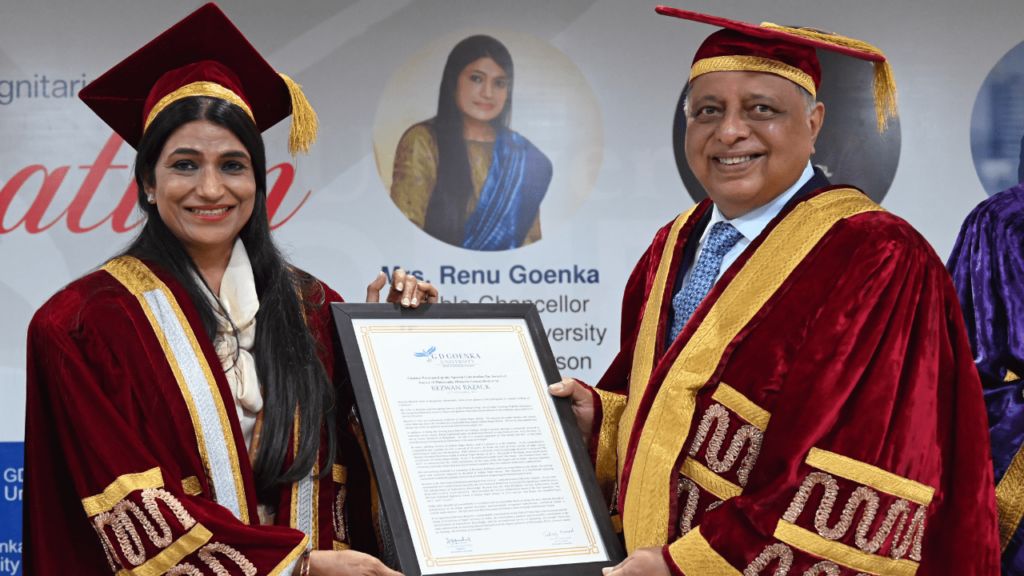
Numismatists and real estate mogul Rezwan Razack was conferred an honorary doctorate on Tuesday by GD Goenka University.
The honorary doctorate was conferred on him during a special convocation attended by Chancellor of the GD Goenka University Renu Goenka, Pro-Chancellor Nipun Goenka, Vice-Chancellor Prof. Dr Tabrez Ahmad, Chairman of M3M group Basant Bansal, and Registrar of the university Dr Dhirendra Singh Parihar. Prof. Dr Tabrez Ahmad, Vice-Chancellor of the GD Goenka University, praised Razack for his contribution to numismatic studies and research.
Rezwan Razack is Co-Founder and Joint MD of Bangalore-based Prestige Group and is hailed as the largest collector of Indian currency. He is also the founder of South India’s first currency museum in Bengaluru, one of the largest and most authentic collections of Indian paper money and coins. He is co-author of the Revised Standard Reference Guide to Indian Paper Money.
After receiving the honorary doctorate from the GD Goenka University Razack said it was an honour for him. A graduate of prestigious St. Joseph College Razack is also the current chairman of the International Bank Notes Society-India Banknote Collectors’ Chapter.
source: http://www.thecognate.com / The Cognate / Home> Business / by The Cognate News Desk / November 25th, 2021
Two women, one war. What sets them apart? Professor Lakshmi Subramanian explores Rudrangshu Mukherjee’s ‘A Begum and A Rani’.
The focus of this work, as evident in the title, is two women who fought the same war in 1857 but who never met, whose lives were strangely similar and yet were recalled very differently. Why this was so, what made for a particular telling of their afterlives and how in course of the retrospective retelling, one became a legend and the other a mere trace, forms the core of Rudrangshu Mukherjee’s narrative.
It departs from his earlier work on the Revolt of 1857, where he placed emphasis initially on the diverse structural elements that made up the popular uprising in Awadh and subsequently on explaining the violence that characterised the actions of both the insurgents and their suppressors. Here, in contrast, Mukherjee prefers to focus on the individual as the actor of history and on the politics that animated the reconstruction of individual lives. He does so with elegance, ever attentive to the dictates of Clio, in unravelling the complexity of the context in which the two protagonists found themselves as they were sucked into the vortex of real politics and popular expectations.
(A Begum and A Rani was published by Penguin Allen Lane in July 2021. Buy it here.)
The first two chapters of the book give the reader a taste of the Revolt in its early stages, when a series of military mutinies collapsed into agrarian rebellion, bringing myriad elements into the fray, ranging from the aggrieved taluqdar to the oppressed peasant, from the disenfranchised ruler to the urban dweller. Amidst the clamour of the rebels for a return to Mughal rule and for an end to the unholy power of the hated firang, emerged a slow political front to embark on campaigns against the British forces and coordinate military activity.
Two parallel centres of authority
In Lucknow, the discarded wife of Wajid Ali Shah found herself at the epicentre of protest, whereas in Jhansi, Lakshmibai was urged by the rebels to take up their cause. While the latter was found in active combat, Hazrat seems to have attended to the day-to-day requirements of the troops, making sure that they were provisioned and supported. Hazrat seems to have also been pitted against one of the most charismatic leaders, Maulvi Amir Ali, who insisted on Hazrat becoming his disciple — which Hazrat herself resisted.
That these two individuals represented two parallel centres of authority is clear but what this implied in terms of differing conceptions of freedom is not readily apparent. However, in the analysis of the ishtahars or proclamations that were issued, Mukherjee makes the important point that religion was the integral and unifying idiom in the Mutiny.
The Afterlife
It is in the chapter titled Afterlife that the book really comes into its own. Here, Mukherjee tracks the moments in the emergence of a nationalist historical consciousness in Maharashtra, Bengal, and subsequently in North India, in which the status of the martyr queen gained traction. Analysing poetry, local memories, eulogies and early historical work on the Rani of Jhansi, Mukherjee tracks the making of a very particular historical memory and its amnesiac other, thereby engaging with the complex relationship between myth and history.
He suggests that these categories were not necessarily oppositional. Rather, both were exercises in remembering and forgetting and reconstructing. It is to his credit as a practitioner of history that he reconstructs as well as he does the lives of two women — one of whom was subsequently pushed on to the centre-stage while the other was relegated to the margins.
Lakshmi Subramanian is professor of History in BITS Pilani, Goa. She is the author of several works on music and nationalism as well as on India’s maritime history. Her latest book is Singing Gandhi’s India: Music and Sonic Nationalism. When she is not steeped in teaching and research, she likes to travel to the hills.
source: http://www.telegraphindia.com / The Telegraph, Online / Home> My Kolkata / by Lakshmi Subramanian / December 03rd, 2021
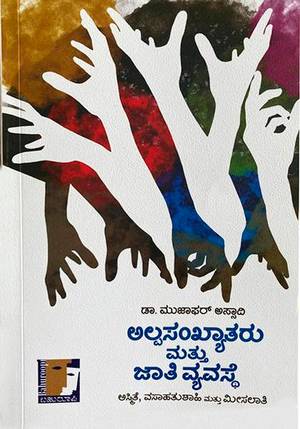
Muzaffar Assadi’s book examines the ways in which the social space was documented during colonial times
The cover of the book written by Muzaffar Assadi.
Muzaffar Assadi, professor of political science in the University of Mysore, has brought out a new book on caste among Muslims, a relatively unexplored area.
In the book Alpasankyakaru Mattu Jati Vyavaste: Asmite, Vasahatushahi Mattu Meesalati (Minorities and Caste System: Identity, Colonialism and Reservation), the author argues that Islam, one of the semitic religions known for its established rules and framework, is now tested against the remnants of caste practices.
Multiple factors
The book, which runs into 264 pages and is published by Bengaluru-based Bahuroopi, explores practices of caste that are not just the result of conversion but inherent in the logic of trade, the class interest of retaining property, social mobility from Central Asia, social identity, and political expansionism.
The author says that colonialism, while documenting various castes, did make a distinction between Hindu social order and Muslim social order. In the latter case, social space for internal mobility, spaces for enlisting as ‘Ashrafs’ (Sheikh, Sayyed), and for continuing traditional occupation was available. And social hierarchy and social distancing continued to perpetuate.
Noting that colonialism created new castes, Prof. Assadi pointed out that the larger agenda of documenting, enlisting caste was ultimately meant to hegemonise, control, and dominate. The book focuses significantly on the way Muslims became subaltern classes during the colonial rule.
“With the experience derived from colonial encounters, Indian Muslims were castigated and condemned again and again for their social backwardness. This was backed by enlisting hundreds of castes among Muslims, although enlisting remained incomplete,” the author argues.
Post-Independence
The legacy continued after the Independence with reports on backward classes/ethnographic studies identifying and enlisting social groups, known for practising caste. “This culminated in identity politics, demand for affirmative action and reservation policy,” Prof. Assadi notes.
The author painstakingly unearths issues of caste among Muslims by referring to material from history, including the colonial census reports, gazetteer, travelogues, missionary works, police records and writings of Muslim scholars. The book comes at a time when there is a demand to re-enumerate castes and a growing urge for enhanced reservation.
source: http://www.thehindu.com / The Hindu / Home> News> States> Karnataka / by Naghesh Prabhu / Bengaluru – November 28th, 2021
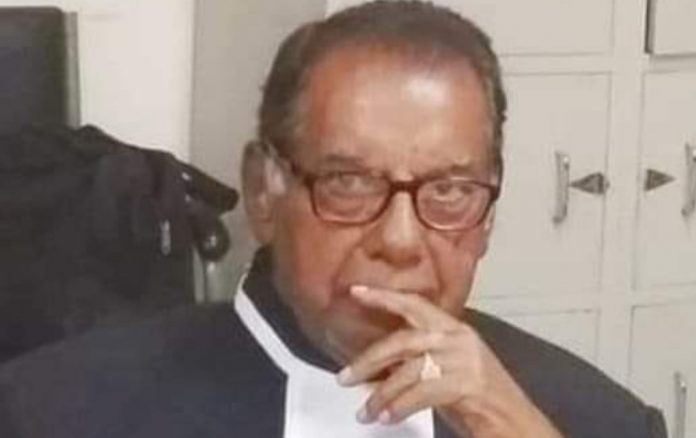
Abdul Muhib Mazumder, former Law Minister of Assam, breathed his last at the wee hours of Wednesday. He was suffering from old age ailments. Mazumder was born in Hailakandi town of Assam on August 20, 1932. His father, Abdul Matlib Mazumder, was a leading freedom fighter and a Cabinet Minister of Assam during 1946-1970.
After studying at Government Victoria Memorial High School in Hailakandi he obtained his B Sc (Hons) degree from Cotton College, Guwahati, and his MA and LLB from Aligarh Muslim University. While in college and university, he was an outstanding debater and won many awards in debating competitions. He married Alamara Mazumder on June 3, 1962 and had three daughters.
Mazumder was a Senior Advocate of Gauhati High Court as well as the Supreme Court of India. He initially worked with Fakhruddin Ali Ahmed, former President of India and a senior lawyer of Gauhati High Court, and Jagadish Medhi, a leading legal authority. He was Senior Government Advocate for several years. He was also a Lecturer in Economics and Political Science at Pragjyotish College, Guwahati (1956-1961) and at Gauhati University Law College (1961-1980).
He became Advocate General of Assam in 1980 and served in that capacity up to 1983. Later, he also served as the Advocate General of Arunachal Pradesh (1991-1996).
Mazumder entered politics in 1970s and represented LA-6 Hailakandi four times as Member of Legislative Assembly (MLA), during 1983-1991, 1996-2001 and 2011-2016. Incidentally, the same constituency had been represented by his father from 1946 to 1972. He became a Cabinet Minister of Assam in 1983 in the Congress Ministry headed by Hiteswar Saikia looking after law, power and municipal administration departments till 1985.
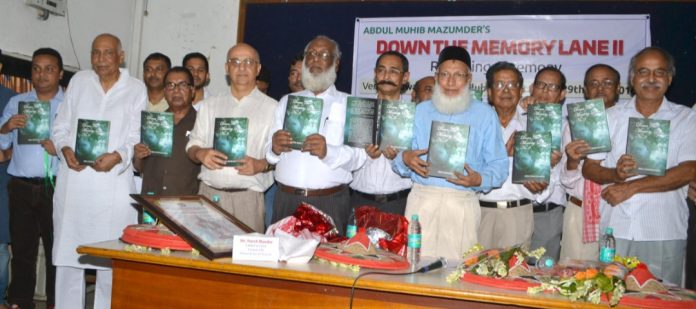
Abdul Muhib Mazumder (3rd from left) at the launch of his autobiography in Guwahati on July 29, 2016. Harsh Mander, Hafiz Rashid Ahmed Choudhury, and Justice Aftab Hussain Saikia are 4th, 5th, and 7th from left in the photograph. (File Photo)
In 1990s, Mazumder formed a new party called UPPA (United Peoples Party of Assam) and again became a Cabinet Minister of Assam in 1996 in the AGP-led coalition ministry headed by Prafulla Kumar Mahanta, looking after irrigation department till 2001. Subsequently he disbanded UPPA and became the President of Samajwadi Party in Assam. Later he came back to Congress. Mazumder was Deputy Leader of Opposition (1986-1991) and formerly Vice Chairman, State Planning Board of Assam. Other posts held by him were Member, State Security Commission; Member, AICC; Vice President APCC; Chairman APCC Minority Cell; and Adviser Minority Department of APCC among others.
Among his landmark cases was his defence of the late Prime Minister Indira Gandhi against her prosecution by the Tirkha Commission in 1977-78 in the High Court. Two other landmarks in his career were drafting of the IMDT Act (Illegal Migrants Determination by Tribunal Act) 1983 and Assam Accord 1985 as the then Law Minister of Assam.
Mazumder’s autobiography, Down the memory Lane, was published in four volumes. At one of the launches of the autobiography in Guwahati on July 29, 2016, Harsh Mander, then Director of Centre for Equity Studies & Special Commissioner to the Supreme Court of India in the Right to Food Case, was the chief guest. Interestingly, all the legal stalwarts on the dais that day including Justice Aftab Hussain Saikia, former Chief Justice of the J&K High Court, happened to be all his students at one time or the other.
Commenting on the demise of Mazumder, Hafiz Rashid Ahmed Choudhury, Chairman of the Bar Council of Assam, Nagaland, Mizoram, Arunachal Pradesh, & Sikkim, said, “Many successful lawyers of today learnt their ABCD of law under the guidance of Abdul Muhib Mazumder. Whenever any lawyer went to him for guidance, he was always ready to help them. His absence will be felt by everyone connected in any way with the legal process in the region.”
source: http://www.muslimmirror.com / Muslim Mirror / Home> Indian Muslim / by Nurul Islam Laskar / November 03rd, 2021
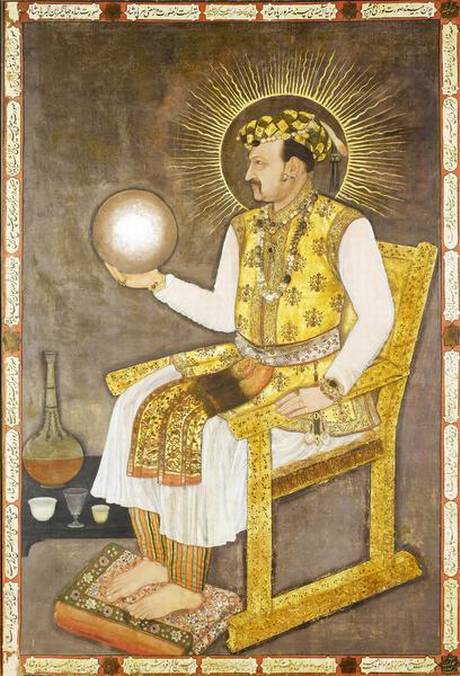
Emperor Jahangir’s inquisitive mind is revealed in his conversations with Mutribi al-Asamm Samarqandi
The 18 decades of the Great Mughals (1526-1707) produced some first-rate literature.
Many fine books came from the rulers themselves, steeped in a tradition of high culture that required them to be literate. The Baburnama, the first memoir/ autobiography of the subcontinent, is as readable today and as modestly written as Julius Caesar’s books (Cicero said of Caesar’s prose that it is unadorned, like a classical statue). The Tuzuk of Jahangir is filled with bombast, vanity and anger, but it is so honest and has so much detail, particularly on the side of his interests as a naturalist, that it is a work of the highest order.
And then there are the works that are smaller but sparkling, like little jewels. One such is the life of Humayun by his sister, Babur’s daughter and Akbar’s aunt, Gulbadan Begum. Written in Persian, as opposed to the Chagatai Turk that Babur wrote in, it is clear and direct, and as thorough a portrayal of Babur and Humayun as what they produced themselves. The story we know of Babur circumambulating the bed of a very ill Humayun and asking, in pagan fashion, to be taken instead of him, is from her book.
Courtly manners
The work we are looking at this time is from a lesser noble, a traveller from Samarqand called Mutribi al-Asamm, who spent time in Jahangir’s court. It is available in translation as Conversations with Emperor Jahangir. The Mughals loved having people over from their ancestral lands, which they would never see again, and lavished them with gifts and honours. Mutribi came to India (Jahangir was based in Lahore) roughly 400 years ago in 1627, when he was 70 and the emperor 58, only a few months away from his death.
Mutribi’s writing reveals a lot about the flowery manner of the court. He visits Jahangir a month after arriving in India and the emperor asks why he has waited this long. Mutribi refers to himself in the text as the “incompetent narrator” and Jahangir as possessing “a tongue of pearls”. At that first meeting, Jahangir gives him a thousand rupees and Noor Jahan (“may her chastity be preserved”) another five hundred, possibly the equivalent of crores in our time.
At their next meeting, Jahangir inquires about the hue of the black stone from which his ancestor Timur’s sepulchre is made in Samarqand. The emperor produces stones which Mutribi compares unfavourably to the original (“it is so bright you can see your face in it”).
Lord bountiful
The transactional manner of the exchanges is apparent from another meeting in which Jahangir asks Mutribi which of the Iraqi thoroughbred horses on display he would like to be given. Mutribi says, “whichever is more expensive,” possibly to make the emperor feel that he is being generous rather than his supplicant greedy. Again, when Jahangir offers him a choice of saddle — velvet or broadcloth — the answer is velvet, because it is more expensive. Jahangir says velvet gets wet easily, to which Mutribi says that the monsoon is far off. The two meet 24 times in two months before Mutribi returns. Towards the end, the following conversation is held:
“The pleasantness of Samarqand was being discussed. The Emperor asked me, ‘Is Samarqand spelled with a ‘q’ or with a ‘k’?’
‘Either way is correct,’ I replied. ‘In Tabari’s history and several other books it is referred to as Samarkand, but in popular usage it has become known as Samarqand. Some say that the name comes from Samar and Qamar, two slaves of Alexander the Great who built the city which was then named for them. Their graves are situated in the main market square of Samarqand.”’
Then Jahangir inquires about an ancestral tomb, asking how much it requires to be maintained. ‘“If you want to do it properly, 10,000 rupees,’ I [Mutribi] said, ‘otherwise 5,000 rupees just to keep it going.’
‘If 10,000 rupees will maintain it,’ he said, ‘then we have decided that in accordance with your information we will send 10,000 rupees, in order that that blessed station be maintained.’
I said, ‘O God, as long as the Sun and the Moon shall be, may Jahangir son of Akbar remain King.’”
Aakar Patel is a columnist and translator of Urdu and Gujarati non-fiction works.
source: http://www.thehindu.com / The Hindu / Home> Books / by Aakar Patel / November 13th, 2021