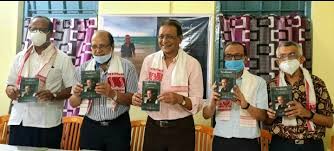
“Barakhmba And The Journey Ahead, Autobiography” authored by senior lawyer Nazrul Islam was released at an austere but dignified function in Guwahati on Tuesday. The release coincided with the centenary celebration of Modern School, Barakhmba, New Delhi, the alma mater of the author.
The autobiography chronicles the author’s memories of childhood in Assam, schooling in Delhi, two decades of community service mainly through the Rotary International, and three decades and more as a lawyer. Many incidents, many adventures, interactions with clients and interesting cases dealt by Islam form an exhilarating part of the book.
Following a minute of silent invocation at the beginning of the function, the welcome address was delivered by Nazia Islam, executive at Invest India, New Delhi. Delivering his address as the chief guest on the occasion, BP Todi, former Advocate General of Meghalaya, said, “I’m an admirer of Nazrul Islam since the time I got to know him as a lawyer. There is something to learn from everybody, but when it comes too Nazrul Islam, there’s always a lot to learn from him.” He expressed the hope that the book will quest the thirst for knowledge to a great extent. Among others who spoke on the occasion were PK Kedia, former District Governor of Rotary International; BM Choudhury, former Principal, JB Law College Guwahati; and Gitanjali Kalita, advocate, Gauhati High Court.
Following the release of the book, Nazrul Islam, shared his experiences about writing the book. He completed the entire book within a very short time, making the best use of the pandemic situation. He said, “Today there are many lawyers who practise on the TV channels, so I decided let me do it by writing a book!”
The book has been brought out by the North Eastern Justice Baharul Islam Foundation for Law, Justice & Social Welfare (NEJBIF), founded in memory of the author’s late father who was a Member of the Parliament and a Justice at the Supreme Court of India.
The function ended with a vote of thanks offered by Rosida Begum.
source: http://www.muslimmirror.com /Muslim Mirror / Home> Indian Muslim / by Nurul Islam Laskar / Guwahati – October 22nd, 2020
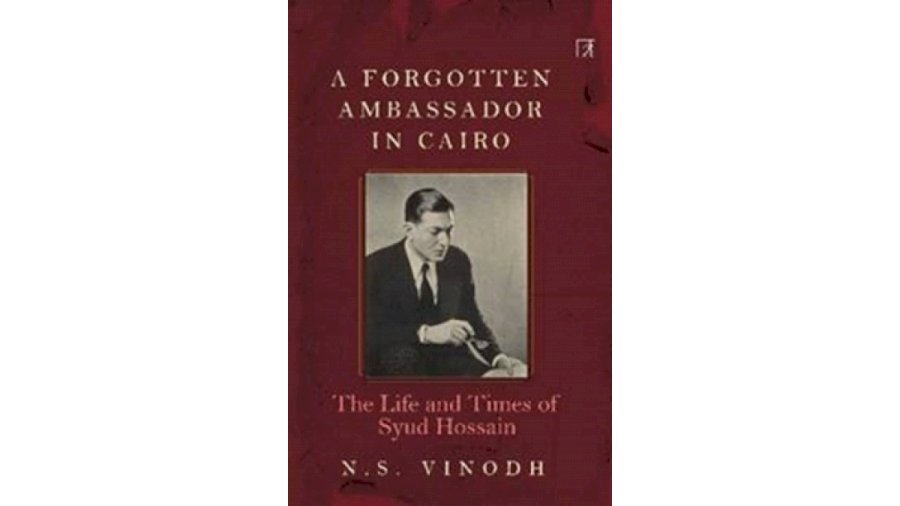
Among the multitudes of tombs in the City of the Dead in Cairo, there lies buried a lone Indian — an eminent scholar, writer, debonair statesman and a leader of the Indian freedom movement. Who is he? How did he get there? For a man who used both the lectern and the pen to devastating effect in the cause of the Indian Independence movement led by the likes of Mahatma Gandhi, Sardar Patel and Jawaharlal Nehru, very little is known of Syud Hossain.
Born to an aristocratic family in Calcutta, he started a career in journalism early in life and became the editor of Motilal Nehru’s nationalist newspaper, “The Independent”. After a brief elopement with Nehru’s sister, Vijaya Lakshmi Pandit, Hossain, under immense pressure from Motilal Nehru and Gandhi, annulled the marriage and was asked to stay away from the country for a few years. Thus began several years of exile.
Eventually, he landed in the US where he imparted Gandhi’s message far and wide across the country. Gathering a group of Indian freedom fighters around him, he fought for India’s freedom from afar, decrying British oppression and garnering support in the US for his cause. Flitting from one place to another, making homes of hotel rooms, Syud Hossain inspired and irked in equal measure. With every speech he delivered and every editorial he penned, he sent a shiver down the spine of the colonial rulers.
Adding to his formidable list of causes, Hossain also took on the fight for Indian immigrant rights in the US, one that successfully culminated in President Harry Truman signing the Luce-Celler Bill into an Act in 1946. He returned to India to witness the triumph of her Independence, as well as the tragedy of Gandhi’s assassination. He was appointed the first ever Indian ambassador to Egypt, where he died while in service and was laid to rest in Cairo.
“A Forgotten Ambassador in Cairo” (Simon & Schuster) offers an illuminating narrative of Hossain’s life interspersed with historical details that landscapes a vivid political picture of that era. Through primary sources that include Hossain’s private papers, the British Intelligence files, letters of his friends and contemporary newspapers, N.S. Vinodh brilliantly brings to life a man who has been relegated far too long to the shadows of time. Vinodh, is a civil engineering graduate from IIT, Madras, and a M.B.A. from IIM, Lucknow. In a corporate career spanning 25 years, he has held senior positions in corporate real estate with leading multi-national financial services companies such as ANZ Grindlays Bank, HSBC, and Fidelity Investments. He opted for early retirement to start his own boutique real estate company, as well as pursue his passion of travelling and history. He is married to Sheela and they have two sons, both based in the United States. He is based in Bangalore.
IANS
source: http://www.thehawk.in / The Hawk / Home>Lifestyle / by IANS / December 30th, 2020
He moved away from politics in 1962 and resumed his academic career at Aligarh Muslim University.
Aligarh (UP):
Noted scholar Jamal Khwaja, one of the last surviving members of the 2nd Lok Sabha, passed away at the age of 92 after a prolonged illness, according to his family.
Khwaja died on Thursday and his last rites were performed the same night.
He was elected to Lok Sabha from Aligarh in 1957.
He led the Indian cultural delegation to Afghanistan in 1960.
He moved away from politics in 1962 and resumed his academic career at Aligarh Muslim University.
Khwaja joined the department of philosophy at AMU in 1953. He was the Dean of Faculty of Arts at AMU in 1980.
He authored more than a dozen books, including Five Approaches to Philosophy, Quest For Islam and Living the Quran in Our Times.
Khwaja is survived by three sons and a daughter.
source: http://www.thewire.in / The Wire / Home / by PTI / December 25th, 2020
The legendary Urdu critic and Padma Shri awardee has contributed immensely to modern literary discourse
New Delhi :
Legendary Urdu writer and critic Shamsur Rahman Faruqi died in Allahabad, Uttar Pradesh, on Friday. His death came after a month of recovering from Covid-19. Faruqi, 85, was discharged from a hospital in Delhi on November 23.
“He had been insisting to go back to his home in Allahabad. We reached here only this morning and within half an hour he passed away at around 11,” Faruqi’s nephew and writer Mahmood Farooqui told PTI.
He used to live in Delhi after retiring as a chief postmaster-general and member of the Postal Services Board in 1994.
Faruqi was born on 30 September 1935 in Uttar Pradesh.
Author of several books, Faruqi has contributed to modern literary discourse with a profundity rarely seen in contemporary Urdu critics. His books of fiction, The Mirror of Beauty (translated into English from the Urdu Kai Chaand The Sar-e-Aasmaan in 2006), and The Sun That Rose From The Earth (Penguin India, 2014), have been highly critically acclaimed.
He used to edit a literary magazine Shabkhoon which he himself had launched. He is also credited with reviving “Dastangoi”, a 16th century Urdu oral storytelling art form.
Faruqi was the recipient of numerous honours including Padma Shri, Sahitya Akademi award and Saraswati Samman award.
His burial will take place at Ashok Nagar cemetery in Allahabad at 6 pm on Friday.
Writer William Dalrymple took to Twitter to mourn the demise of Faruqi.
“RIP, Janab Shamsur Rahman Faruqi saheb, one of the last great Padshahs of the Urdu literary world. This is such sad news,” Dalrymple said.
Sanjiv Saraf, the founder of the famous Rekhta portal, also condoled the death of “the century’s most iconic figure in the realm of Urdu literature”.
“His demise has left us bereaved as an entire generation of literature lovers mourn this loss. I extend heartfelt condolences to his family and loved ones,” Saraf said.
source: http://www.clarionindia.net / Clarion India / Home> India / by Team Clarion / December 25th, 2020
Syed Jamaluddin Quadri who was known among his friends and family members as Khusro passed away last year in Hyderabad, his hometown.
He wasn’t keeping well for quite some time. I had been told that he has developed difficulty in walking owing to serious knee problem.
I remember Jamal as Jamaluddin and not as Jamalullah that he is referred to by many of his friends.
When his close friend and companion Sheikh Ibrahim said his organization is bringing out a special issue on him and wanted me to pen my own thoughts, I agreed immediately.
His demise had triggered a stream of memories ranging from his childhood to the time he spent in Jeddah. I had attended his funeral prayers that were held at Abdullah Shah Saheb mosque in Hussaini Alam.
I first came to know of him when I was admitted to Modern Kinder Garten, a new English medium school in Hussaini Alam, the area in which I too lived. I was not alone in not knowing the meaning of Kinder Garten. We always thought it was Kinder Garden. And no one took pains to explain to the students the meaning of the school’s name. It was much later in life that I came to that Kinder means children and garten means garden.
Khusro was two years senior to me in the school. Traditionally, the juniors do not get the attention of the seniors. But circumstances at the school were such that I came to know of him and his family in the first few weeks of entering the MKG. His father Janaab Imaduddin sahib, a salt and pepper bearded gentleman was committed to the cause of education. He was looked at with tremendous respect by his peers, teachers and students. Khusro was his only male child. He had sisters, older and junior to him. Some of them taught at the school. We the students called them Bajis. One such sister, Rafia Baji, later became the Principal of the school. That of course was much later than I left the school. Interestingly, the school is still working.
I distinctly remember two incidents from the MKG days. The first was a Kabbadi tournament where we the fourth or fifth class students were pitted against the eighth class boys in the finals. Khusro was in that team which won the tournament. We had no regrets in losing to the big boys because we had given them a tough competition. In fact, we won more appreciation as we were the underdogs.
The second incident belonged to the annual day function that was organized in the mid-sixties. The war with China was still fresh in the minds, therefore, the management decided to present a play on that subject. The play showed the dedication of the people to sacrifice their lives for the country. The story revolved around a family that had just celebrated the wedding of its son who was on vacation from his army duty. Khusro played the bridegroom wearing an impressive army uniform. Since the girls were not allowed to take part in the play on stage, especially with the boys, the management was looking for boys who could play the female characters. My friend and classmate Abdul Wahab Abid played the role of Khusro’s mother and I was cast as his newly wed bride. As I was being prepared in a red bridal dress and jewelry for the stage a senior student, Nayeem, suddenly entered the room, stared at me intently for a few moments and suddenly kissed on my cheek and ran away. He left me red-faced and bewildered. I believe he was punished for the ‘mischief’ later.
It was a great show where the beautiful bride asks her handsome husband to attend to the call of the nation and fight against the enemy. But she does it with lots of weeping. That patriotic play was a hit.
A few years after I left the MKG I was invited by Khusro and his group of dedicated friends to teach younger students at a mosque during early morning hours every day. I accepted the offer and joined the group. That was a great social initiative led by Khusro. I saw in him at that age the leadership qualities that blossomed further during his long stint in the Kingdom of Saudi Arabia to which he had migrated in the middle seventies. Incidentally, many of those who had worked in that mosque also left for the Kingdom. These young men and their families lived in a neighbourhood located on way to King Abdul Aziz University in Jeddah. It was perhaps called Kilo Six or Seven.
After joining Saudi Gazette, one of the two English language newspapers published from Jeddah, in early 1982 I started meeting some of the members of that group. I found that in his own way Khusro had kept his tradition of social activism alive. He was helping the newly arrived Indians to find jobs and settle down. He was holding weekly classes on social and religious norms of the Kingdom and explained to them matters pertaining to religion.
He began working for the preservation and promotion of Urdu by helping students. He also started the tradition of celebrating The Education Day in commemoration of the birth anniversary of Maulana Abul Kalam Azad, every year on November 11. To coincide with the occasion he was regularly bringing out a souvenir on Maulana Azad. While I was working with Maulana Azad National Urdu University in Hyderabad as its Consultant/Advisor he used to phone me asking for my articles for the souvenir. I contributed a couple of write-ups on Maulana Azad for the souvenir.
His another area of interest was Jamia Nizamia, the 135 years old Islamic institution in Hyderabad. He invited Aalims and scholars to Jeddah to be part of the celebrations he would organise to sustain the interest in religious education among Indians, especially students, who were missing a lot by being away from their homeland.
A Sufi by the belief he never hesitated in working with different groups. I remember his regular meetings with Janaab Maslehuddin Saadi with friends to gain more knowledge about Sufi philosophy and practices.
I also remember the deep sorrow in his eyes when one of his sons drowned in the sea near Visakhapatnam. That boy was spending his vacation there. But Khusro managed to control it and did not allow the tragedy to deter him from his regular work.
I truly believe that people like Khusro come from are a rare breed. They do not forget that they have to play their role, however small or insignificant it may sound. I hope his friends in Hyderabad as well as those who are still in the Kingdom of Saudi Arabia or in other parts of the world would carry forward his positive work.
Mir Ayoob Ali Khan is a Senior Journalist who has worked with Saudi Gazette, Deccan Chronicle and Times of India. He is currently associated with Siasat.com, an English language news portal.
source: http://www.siasat.com / The Siasat Daily / Home> Featured News / by News Desk / December 28th, 2020
Karnataka is mourning the demise of KM Shareef, the former National President of Popular Front of India. With his demise, the community has expressed grief and a great sense of loss for he was a voice that spoke in favour of the oppressed.
Since the year 2000, KM Shareef – known in the public sphere as a writer, critic, translator, author, orator, and journalist – has been working tirelessly on the social front.
After graduating with a BSc degree, he spent four years in Dubai as a career person.He was a student of Mittabailu Jabbar Ustad, the general secretary of the Samasta Kerala Jamiatul Ulema, from whom he secured religious education.His father, the late Abdullah Haji, served as a Mudarris for 30 consecutive years in the Mittabailu Jamath.
KM Shareef, who advocated towards creating a united struggle for the empowerment of Dalits, Muslims, and other marginalized communities, sought to unite these communities and struggled towards realizing this objective throughout his lifetime in the organizational setup.He emphasized the need to politically empower these communities and stressed the importance of alternative politics in this regard.
In 2003, he served as the convener of Coastal People’s Union, an organization that was established as a coalition of various Muslim social organizations across Coastal Karnataka.
He played a prominent role in establishing ‘Prastutha’, a fortnightly news magazine in 2007, and also served as the editor-in-chief of the publication.Through this media publication, he constantly wrote on behalf of exploited communities.
His writings delved into issues affecting the country, through which he warned that the country was endangered by communal fascism, capitalism, and imperialism.
He has been instrumental in bringing new press campaigns through the Prastutha publication and introducing newfacets of journalism to the press.He was constantly encouraging and inspiring budding young talents to read and write.
Opposing the exploitation of women in society, he has consistently asserted that dowry is a social evil and one of the main causes contributing to women’s atrocities and exploitation in the country.
His Kannada research work, ‘ಶಾಂತಿಗಾಗಿವಿವಾಹ'(Marriage for Peace), is by far the most prominent among his written works. In this book, he objectively outlines how dowry is in effect across the country and in what manner it is weaponized to commit atrocities against women.
When he was the President of the Karnataka Forum for Dignity (KFD), he organized a series of state-wide, anti-dowry campaigns and encouraged young people to organize simple weddings and dowry-free marriages.
In 2006, KM Shareef spearheaded theKFD campaign ‘ಕೋಮುವಾದಿಫ್ಯಾಶಿಸ್ಟರಿಂದಕರ್ನಾಟಕವನ್ನುರಕ್ಷಿಸಿ'(Protect Karnataka from Communal Fascists), across Karnataka. When the ‘VidhanaSoudhaChalo’ convention was held in Bangalore on the occasion ofconcluding the campaign, a delegation headed by KM Shareef had met with the then Chief Minister Kumaraswamy and filed an appeal.This historic campaign, which occurred amid a series of sustained attacks against minorities in coastal Karnataka, resulted in the KFD organization becoming a household name in Karnataka.
KM Shareef, who sought no limelight or fame in the public sphere, was known for his straightforward, simple personality and disciplined disposition.
He was in constant contact with other leaders who were activelyfightingtowards social justice in the activism circle.He continued to hold close associationswith Dalit leaders, progressive figures, human rights activists, thinkers, and writers.
He was a man who had already possessed farsighted vision and ideas towards Muslim empowerment, when he presented his paper titled, ‘Education and Empowerment of Muslims’ during the Second Beary Literature Conference.
KM Shareef is survived by his wife, three sons, three daughters, and a multitude of relatives, friends, and well-wishers.
source: http://www.prasthutha.com /Prasthutha.com / Home / December 22nd, 2020
The Rehnuma centre in Mumbra, a suburb of Mumbai, offers young Muslim women – many from migrant families – a space to chat, relax with a book, learn English or dream about their village homes
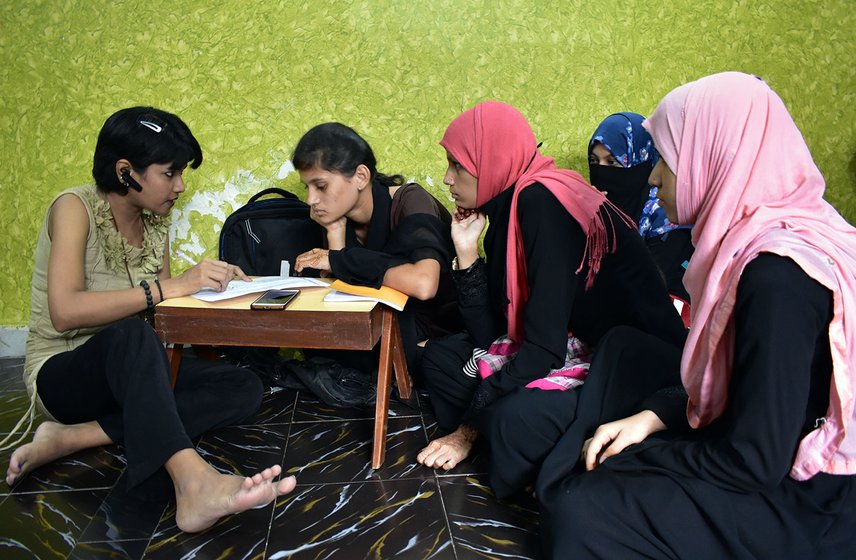
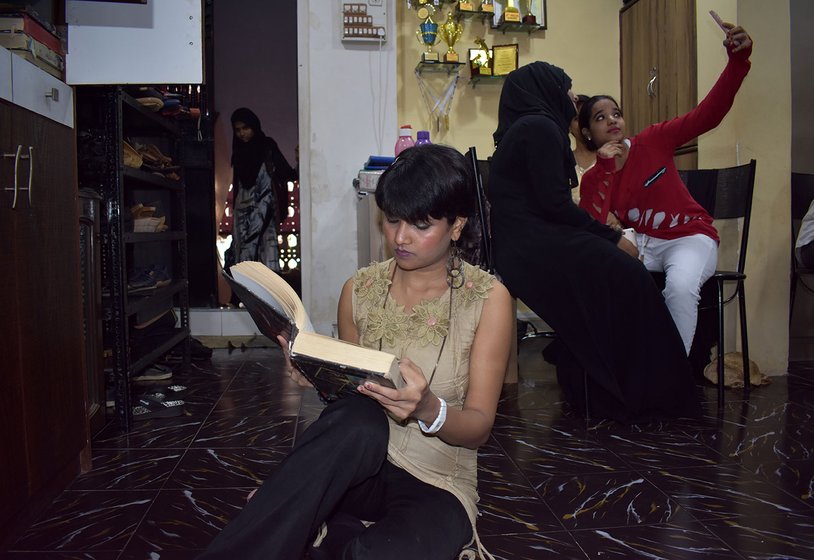
“Shall I compare thee to a summer’s day?” says 19-year-old Faiza Ansari in a low voice, almost a whisper. We are sitting cross-legged on the tiled floor of the only library for women in Mumbra – the Rehnuma Library Centre.
More young women come and go from the two-room apartment turned library on the first floor in a decrepit building near the Darul Falah mosque. They hang their burkhas on idle plastic chairs and sprawl on the cool floor. It’s 36 degrees outside in this northeastern suburb roughly 35 kilometres from central Mumbai.
As Faiza recalls Shakespeare’s Sonnet 18, I insist on hearing more. All eyes turn towards her, including her sister Razia’s. Faiza paraphrases a line from Romeo and Juliet, “A beautiful heart is better than a beautiful face.” Razia looks at her sister coyly. The other girls hoot, nudge each other, and bashfully giggle. The joke is anybody’s guess.
Razia Ansari, 18, is not as shy. She presents to me an intriguing summary of the only Shakespeare story she has read. “Twelfth Night is like a Hindi film. Viola has a double role,” she says of Viola’s disguise as Cesario. Razia is trying to improve her English and has joined the spoken English class at the library. Classes are conducted here five days a week in numerous one-hour batches from 11 a.m. to 6 p.m.
Faiza and Razia Ansari, from Asansol in Jharkhand, are regulars at the libraryLibrarian Faiza Khan also doubles up as an English teacher
Faiza and Razia’s family moved to Mumbra from Asansol village in Dumka district of Jharkhand around 18 months ago. The sisters dislike Mumbra. “There’s garbage everywhere,” Razia says. Faiza agrees: “There are more eateries than bookshops.” The sisters were not expected to wear a burkha in their village. “We had a lot of freedom back home,” Razia says. “But here,” Faiza continues, “our mother says that the mahol [environment] is not good.”
Their father owned a wholesale groceries shop in Asansol and decided to come to Mumbai, where their grandmother and other family members already lived, “to make more money and for better education for the children,” Razia says. He has since set up a groceries shop near their house.
The sisters spend a majority of their day at the nearby A.E. Kalsekar Degree College, where they are studying in the first and second year BA, respectively. But it’s in the Rehnuma library, a short walk from their home, that they are reminded, Razia says, “of the home they left behind [in the village].”
For Bashira Shah, from Babhnan village in Harraiya tehsil of Uttar Pradesh, the library is where she can stop thinking about home. Bashira got married when she was around 14 years old and moved to her husband’s house in Ashokpur village near Gonda city. Her husband was a construction labourer in Saudi Arabia. Now 36, she has been widowed for two years and lives with her mother, her four children, and two younger sisters in Mumbra.
Her parents moved here in the 2000s but in October 2017, her father passed away. He had a dry fruits shop in Masjid Bunder which is now leased out. Two of Bashira’s sons, 16 and 15 years old, have dropped out of school. But Bashira, who received a religious education and studied Urdu till Class 3, has decided to study more. “My dream, she says, “is to be able to talk to Shamshir and Shifa in English.” Shamshir, 12, her youngest son and her daughter Shifa, 9, study at the Mumbra Public School in English.
Since the Rehnuma Library – rehnuma means a ‘guide’ in Urdu and Hindi – was started in 2003, women come here throughout the day to converse, laugh, relax, or curl up with a book. The library was set up with donations and a crowd-funding campaign by Awaaz-e-Niswaan, a non-governmental organisation. The space is also the NGO’s Mumbra centre, where they focus on literacy for women and legal aid – many women come here with issues related to divorce, polygamy and domestic violence, among others.
The locality was chosen because of its predominantly Muslim population and, as Yasmeen Aga, Awaaz-e-Niswaan’s coordinator for Mumbra says, “the lack of spaces for women to take off their burkha, interact with each other and relax.” The library initially acquired members by telling schoolgirls and their mothers about it, but as college girls found out, they too wanted to join.
The library’s 350 patrons – all women, many of them from families that have migrated to Mumbai from various villages – renew their Rs. 100 membership every year to return home with books or magazines and occasionally participate in book club meetings and workshops.
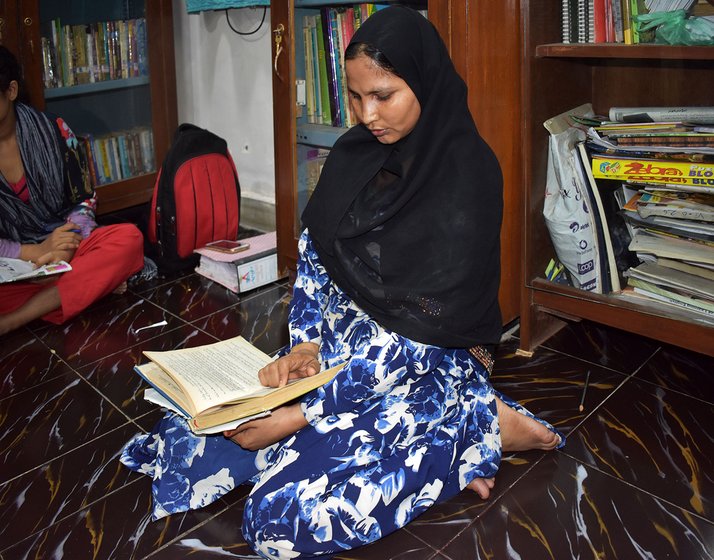
At the library, Bashira Shah, from UP’s Babhnan village, can stop thinking of home. Faiza, the librarian, also helps visitors become members
In the last book club meeting in mid-January, 12 young women discussed the poems of Mirza Ghalib and Faiz Ahmed Faiz. Librarian Faiza Khan says, “The readers were divided into two camps – each wanting the other to concede and admit that the poet they admired was the best.” Faiza, was in the Ghalib camp, but chose to remain sternly neutral.
Faiza, now 28, started coming to Rehnuma when she was 19. She was born and brought up in Mumbra, has a degree in Management Studies, and was offered the librarian’s job in 2014. “The public spaces are dominated by men,” she says. “And women are locked inside their houses”. But at the library, she says, “women can be unabashed and sit and talk like men do.”
She not only holds the key to the library, but also helps wandering visitors become members, and nurtures their reading tastes. “Urdu books,” she says, “are the most sought after.” These make the majority of the 6,000 books stocked in the library’s five wood cabinets.
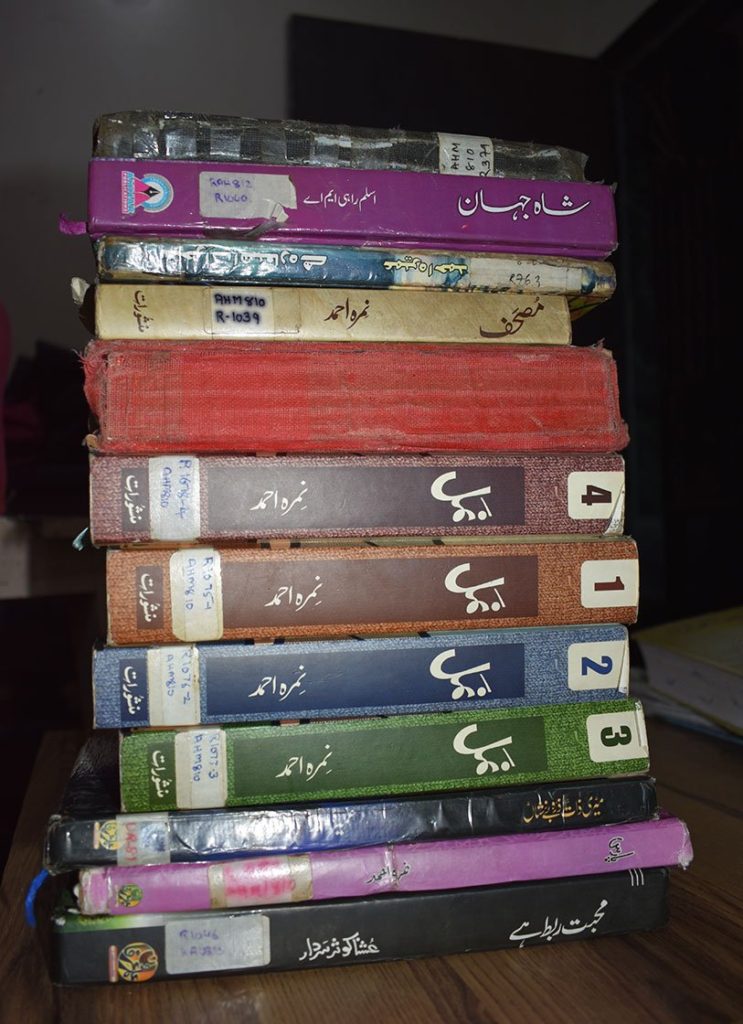
Some of the most popular books are by Pakistani authors that have been on long journeys. The pages of Ibn-e-Safi’s Imran series and Jasoosi Duniya, highly popular spy novels, have turned yellow. The library has a collection of 72 Ibn-e-Safi novels.
The plaque at the entrance of the building that houses the Rehnuma centre
And the pages of the novels of Umera Ahmad (the library’s most-read author), to Faiza’s utter dismay, are dog-eared with plenty of margin notes. There are also books by Razia Butt, Ismat Chughtai, Munshi Premchand, Saadat Hasan Manto, along with the Urdu translations of Shakespeare. And there is Harry Potter, and of course, Chetan Bhagat too.
Zardab Shah, 20, who came to Mumbra from Khizirpur Ali Nagar village in Ghazipur district of Uttar Pradesh, has been reading Ujaale ki Talaash, a thriller in Hindi by Sharad Pagare, but wistfully looks at the World Book Encyclopaedia placed at the top of a cabinet. “We are not allowed to take these home,” she says, regretfully. “I like to look at the maps and imagine going on an adventure to Switzerland.”
The closest Shah has got to a sense of adventure was when she secured admission at Banaras Hindu University for an MA in English last year. But her parents didn’t let her go. Her father is a truck driver, her mother a homemaker. “They didn’t want me to live in a hostel,” she says. Instead, they moved Zardab from her uncle’s home in the village – where she was staying while studying – to be with them in Mumbra. She is now trying to get admission in a Mumbai college. When someone in her building told her about Rehnuma, she immediately joined.
“I was wasting my time in the village… here, at least, I am reading and learning,” she says. It took her some time to get used to Mumbra, but Zardab doesn’t miss her village. “There are no opportunities,” she says. “It’s a place you can love as a child but not as a grown-up.” And now she has forged an attachment so strong with the Rehnuma Library, that, she confides, “this might be all the adventure I need”.
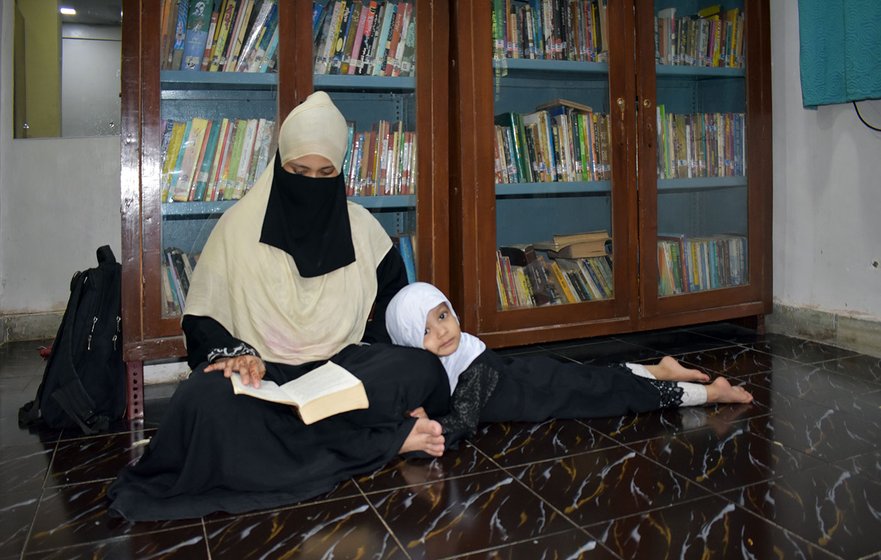
Shafiya Shaikh, one of the library’s most voracious readers, often reads aloud to her daughterThe novels of Nemrah Ahmed are a hot favourite
A large number of Muslim families moved to Mumbra after the 1992 riots in Bombay. Shafiya Shaikh’s family too shifted at that time, distraught but physically unharmed, from Worli in south Mumbai. The first time she came to Rehnuma was when she was seeking help to get a divorce from her husband. He had abandoned a pregnant Shafiya after eight months of marriage. But when she saw the stacked books, she was confused, “I thought that like everything else for women in our society, even books were out of reach.”
Soon, Shafiya and her mother Haseena Bano became members. Shafiya, now 27, also reads some of the books out to her four-year-old daughter Misbaah Fatima. The Shaikhs are now among the most voracious readers the library has seen – they check out 2-3 books and 2-3 magazines per week while others read and return one book in a couple of months.
Shafiya is currently reading Jannat Ke Pattay by Nemrah Ahmed, an acclaimed Pakistani novelist. It’s about sexual violence against a girl, and the story’s male lead doesn’t save her. “It’s not like a hero will come to save everyone,” she says.
Apart from the lure of the books, the library brings women together to enjoy the company of others. Here, Zardab says, “We can sit however we like, laugh, play, or chat. There’s freedom here that we don’t find at home.” A current hot topic is the popular Zee TV show about triple talaq – Ishq Subhan Allah.
Librarian Faiza has also become a role model for the young women – a job she has reluctantly accepted. She now takes it upon herself to gather them and discuss books they may not read themselves. The last book she discussed was Rana Ayyub’s Gujarat Files – on the investigations in the 2002 riots in the state – and unlike the Ghalib-Faiz session, this discussion remained utterly sombre.
source: http://www.ruralindiaonline.com / PARI – People’s Archive of Rural India / Home> Things We Do> The Rural in the Urban> Women / by Apekshita Varshney / July 04th, 2018
Deora Village (Dharbanga District) , BIHAR / Mumbai, MAHARASHTRA :
Sadiya Shaikh is an undergraduate student getting her bachelor’s in Sociology-Literature in English from Rizvi College in Bandra.
It was the startling lack of discernment of the privileged and the problem of illiteracy in India, especially in Bihar, that prompted her to come to the aid of the community in any which way she could.
Eighteen-year-old Sadiya Shaikh was born in Darbhanga district of Bihar. Sadiya’s parents had decided to move their family to Mumbai, Maharashtra when she was only a toddler, to ensure that the children got the life and education they deserved.
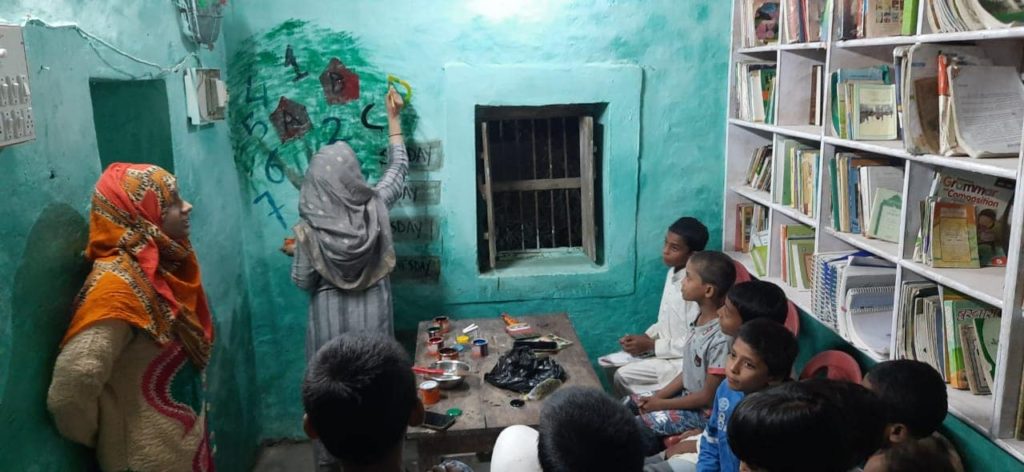
She was visiting her hometown during the lockdown when she managed to establish the accessible, well-stocked, and only library her village has.
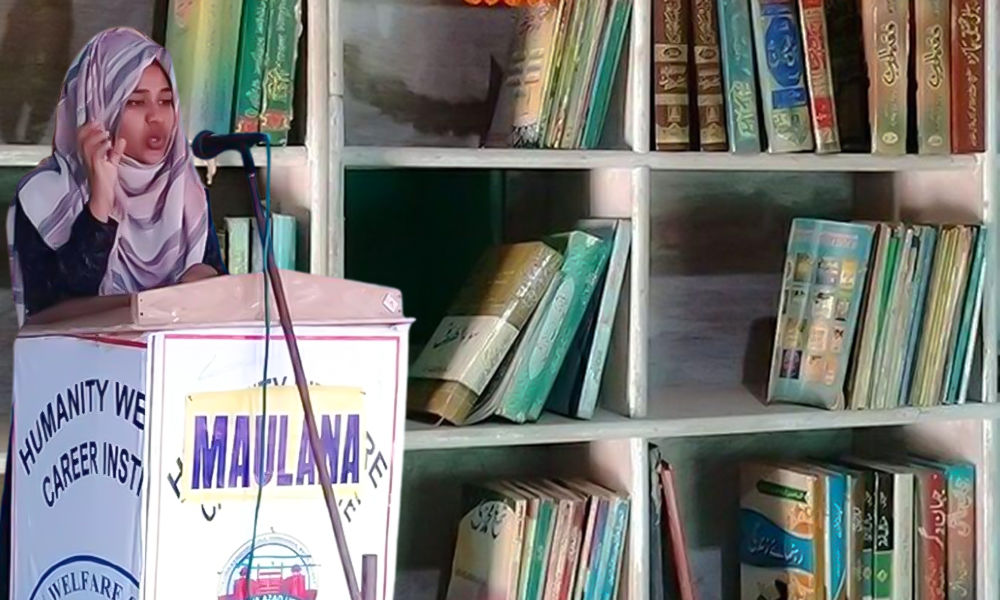
The Maulana Azad Library in Deora village of Darbhanga District is an initiative taken up by young Sadiya with help from her family and friends to sow the seeds for inclusive education for all the students in the community who cannot afford the luxury of getting appropriate and established means of instruction.
Deora stands at a total population of 3,446 persons and 631 houses. While the village literacy rate stands at 40.9%, the female literacy rate is a staggering 18.6%.
The close linked relationship between illiteracy and poverty has challenged the development of the people of Deora for a long time therefore, the library is of service to the students of all grades along with school textbooks, there is accessible material for aspirants of competitive examinations, along with a couple of trained professionals who help to tutor the children, who, even though, are enrolled in schools, cannot afford to go and own the required textbooks and other study materials.
“Few sections of our society have benefitted the most from the library, the youth who used to wander during the evening, now sit in the library and study, along with them, the elderly also use the library as a space to sit and read the daily newspaper,” Nawaz, a resident of Deora and a daily visitor of the library said to Maktoob.
The library has books pertaining to the school boards in the state and NCERT (National Council of Educational Research and Training) books from standard one to 12.
Nawaz said his village doesn’t even have a well-established government school.
“Even though there is a private school just out of the village, most families cannot afford to send their children there, and even when they somehow arrange to pay the high-end fee they still cannot afford to buy the books and other school material, so the public library has ensured the well-being of such children by providing them these books at zero-cost along with the facility of issuing the required textbooks and taking them home to read,” he added.
The library has books pertaining to the school boards in the state and NCERT (National Council of Educational Research and Training) books from standard one to 12.
Akbar Ali, a second year BCom student told Maktoob that with the establishment of Maulana Azad Library, an atmosphere to study has been created in his village.
Sadiya Shaikh is an undergraduate student getting her bachelor’s in Sociology-Literature in English from Rizvi College in Bandra. She aspires to get her Postgraduate Degree from the Jamia Millia Islamia (JMI), Delhi.
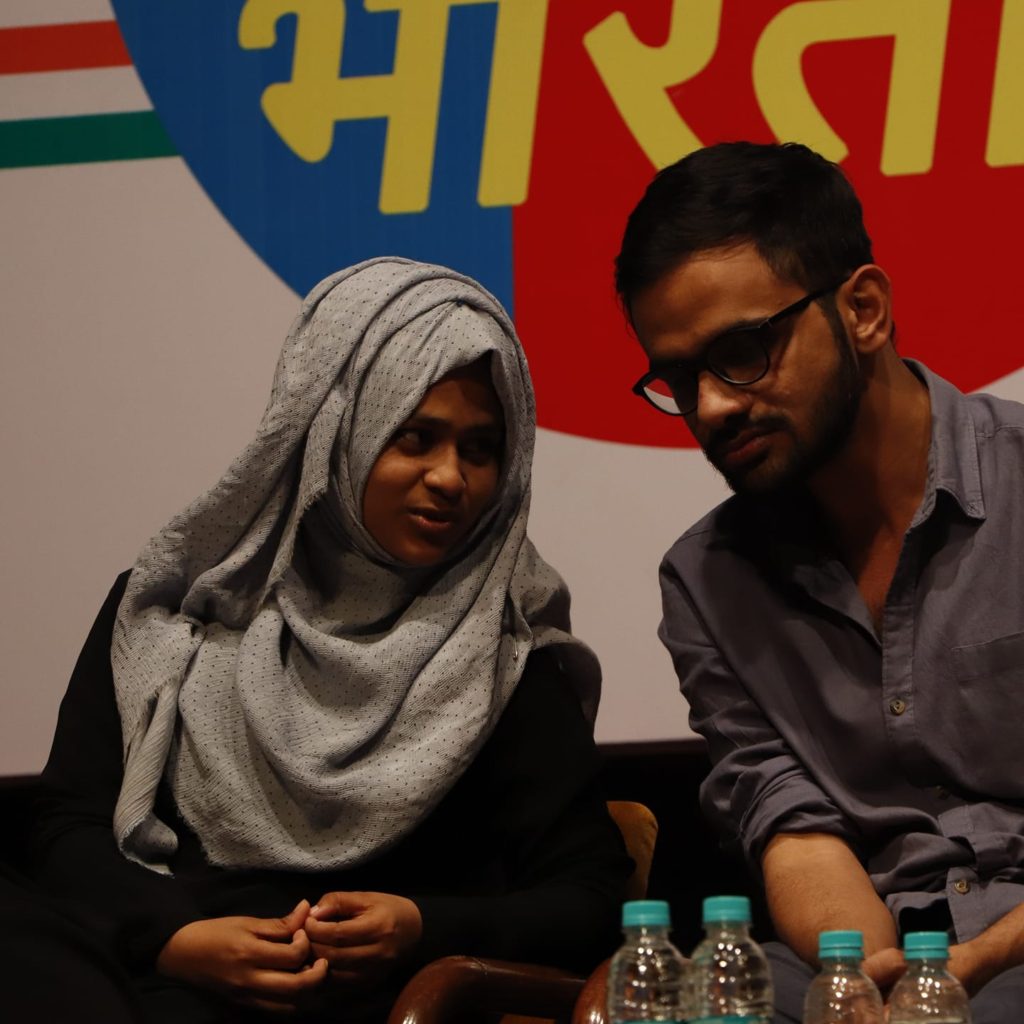
She considers her education to be the informant that made her acquainted with the social and political predicament that threatens the minorities and women in India. Sadiya was an active participant in the anti-CAA-NRC-NPR protests and has been applauded for the various speeches she delivered disputing the law at various public-speaking events, one of which was in company with activists Umar Khalid and Kanhaiya Kumar.
Sadiya was an active participant in the anti-CAA-NRC-NPR protests and has been applauded for the various speeches she delivered disputing the law at various public-speaking events, one of which was in company with activists Umar Khalid and Kanhaiya Kumar.
Moving forward, Sadiya has her sights set on helping the women in her community and creating employment for the ones who are bound to the four walls of their household.
Sadiya believes that for any social change to be brought about, it’s the privileged and the educated members of the community who need to step up and stand in allyship with the marginalised, and only through education, can they stand a fair shot with the favoured class.
“Development of one person in a society consisting of under-privileged is no development at all. It is when the fortunate ones uplift the disadvantaged and curb inequality, does real development take place,” Sadiya told Maktoob.
“During the lockdown, many children didn’t have access to any regular means of instruction so the books from the library proved to be very beneficial, they also provided newspapers for older students and adults at Maulana Azad Library”- Rahela who lives near the library says.
source: http://www.maktoobmedia.com / Maktoob / Home> Features / by Sania Javed / December 04th, 2020
Bhopal, MADHYA PRADESH /Lucknow, UTTAR PRADESH / NEW DELHI :
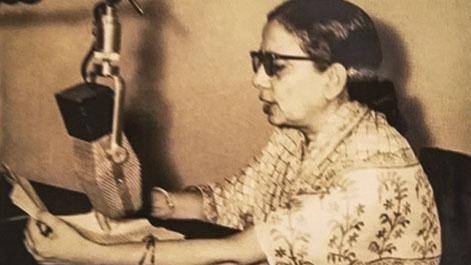
Saaeda Bano in her glory days
Saeeda Bano’s Dubai-based granddaughter, Shahana Raza, tells WKND about rediscovering her ‘Bibi’ when she took on the task of translating her memoir.
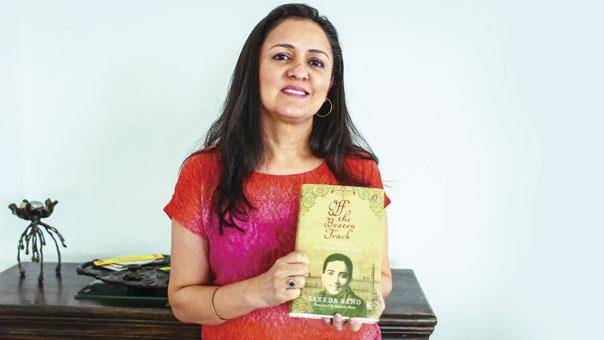
Shahana Raza, Indian writer and journalist and granddaughter of Saeeda Bano (Shihab)
One of the pioneering women of the 20th century who probably didn’t get the recognition she deserved in her lifetime was Saeeda Bano, the first woman in India to work as a radio newsreader on All India Radio (AIR) in 1947. However, Bano (fondly known as Bibi) did leave behind a poignant autobiography called Dagar Se Hat Kar in Urdu that was published in 1994. The book has now been translated into English by her granddaughter, Shahana Raza, a Dubai-based writer and journalist, and is titled Off the Beaten Track.
In a chat with KT, Raza reveals that she translated the Urdu memoir into English so that more people could read about the unconventional yet inspiring journey of a woman of indomitable spirit — her grandmother Saeeda Bano. Excerpts from the interview:
What led you to translate your grandmother’s memoir into English after so many years?
Dagar Se Hat Kar was published in 1994 in Urdu. My grandmother, whom I fondly called Bibi, suffered a paralytic stroke soon after. During that time, when I visited her in New Delhi, she asked me if I could translate the book into English for her. I told her that it was written in a language that I understood, but couldn’t read or write. She remained quiet then, but a few days later when I was leaving for the US to make a life for myself, I received a parcel containing eight audio cassettes from her close friend, who told me, “Bibi asked me to read and record the entire book onto these tapes, just so that you could translate them into English.”
The tapes travelled with me to the US and stayed with me till I settled down in Dubai in 2000. I did try transcribing them once before, but was intimidated by the heavy Urdu vocabulary. I delayed it until three years ago, when my dad motivated me to try again.
What is the story behind Bano becoming India’s first female voice on All India Radio?
An excerpt from the book tells us that, in 1938, a radio station was set up in Lucknow that also held shows for women and children; these were also hosted by women. My grandmother started participating in the radio shows regularly. When things on the personal front got a bit turbulent, she sent her application to BBC in New Delhi for a news reader and she got accepted. She moved from Lucknow (her husband’s house) to New Delhi with her younger son and took up accommodation at the YWCA and began working at AIR full time.
What made her life an unconventional one?
Although I always saw Bibi as a bold, independent woman who was truly ahead of her times, it was after reading and translating her book that I understood she was truly a force to reckon with.
Back in 1947, she had walked out of her marriage and decided to lead life as a single, working woman, which was unheard of at that time. She had all the possible comforts of life when she lived in the ancestral house in Lucknow with her husband and in-laws — but when she realised it wasn’t going in the right direction, she took the bold step of walking out of it along with her two boys, Asad and Saeed. She moved to New Delhi after putting her elder son in a boarding school and stayed in a women’s hostel in Delhi. Apart from making professional strides where her career soared as she started doing more shows on All India Radio, she was also quite candid about her relationship with a married man — something not many would do even today.
What are some of your favourite chapters in the book and what did you like about them?
The initial few chapters of the book are captivating, as Bano gives a very vivid description of the way people lived in the early 20th century, beginning with the life of her mother, who got married when she was 14. She gives a riveting description of how people traveled in palanquins and how the palanquin bearers communicated with each other; how homes were lit with oil lamps, and the way they were designed to keep women away from the public eye. Since the purdah system was practised by both Muslims and non-Muslims of that time, homes were designed in a way that there were no openings (windows) towards the façade of the house. It simply transports you to that era and gives you a glimpse of the socio-cultural setup of that time.
What aspects of Bano’s personality did you think stood out? Who or what shaped her ideas?
Bibi’s early days were spent in Bhopal, which I believe played a crucial role in moulding her personality, as the city was run and ruled by women (Nawab Begums) for four generations. The women of Bhopal were very empowered and were aware of their unique identity; they were encouraged to study and go out to women’s clubs, where they learnt how to live a life independently without the need for male approval.
She lived her life on her own terms and never bowed down to societal pressure. I never saw her doing anything that a traditional grandmother would do, like cook or oil our hair. I always saw her as a gutsy, fearless woman who drove around the city on her own, lived alone, and didn’t seek support from anyone — even in the lowest phases of her life. Her sheer determination always stood out, as she never looked back and regretted any of her decisions.
What are the key takeaways from the book? What would you want to imbibe from her?
Something that I really understood from her book was the importance of individuality. There is more to us than we are socially. We always try and slot ourselves into relationships — mother, daughter, sister, wife etc. Bibi taught us how to claim our identity. She never went back to her parents when her marriage didn’t work. She just used whatever skills she had to find a job and support herself. Even today, not many have the courage to take such a step. To me, the step that I would call the defining moment of Bibi’s life would be leaving her extremely comfortable life in Lucknow, where she would drive a convertible car, to move to a new city, New Delhi, where she would mostly commute on foot because she wanted to save money. The most invaluable lesson I learnt from this book is how, sometimes, to reclaim your identity, you may have to forgo the comfort and security of being in a family.
(Off The Beaten Track is available at Ciel bookstore in Dubai.)
saman@khaleejtimes.com
source: http://www.khaleejtimes.com / Khaleej Times / Home> WKND> Interview / by Saman Haziq, Dubai / November 27th, 2020
(Following is an excerpt from the autobiography of Shaukat Kaifi, wife of Kaifi Azmi. The autobiography, Yaad Ki Rahguzar, is originally written in Urdu. English translation is done by Nasreen Rehman.)
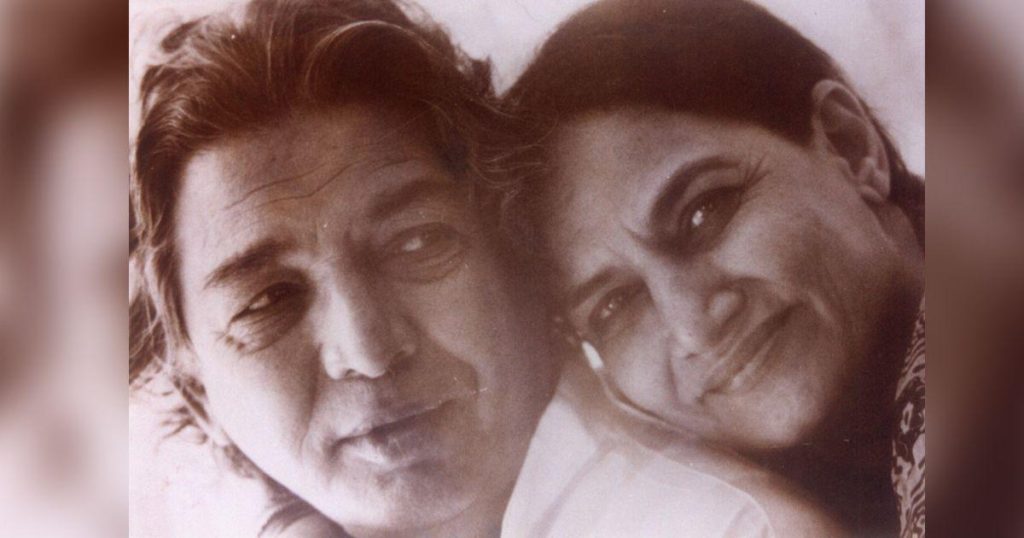
Kaifi Azmi & Shaukat Kaifi with their daughter Shabana Azmi.
Choti Apajan was married to Akhtar Hasan, a Progressive writer and poet who was invited to Hyderabad in 1946 by Qazi Abdul Ghaffar, of Laila ke Khatut (Laila’s letters) fame, to join him as editor of the Urdu daily, Payam. Akhtar Bhai was a gracious host and Choti Apajan was always by his side in their open house where writers from the Progressive Writers’ Movement, such as Makhdoom Mohiuddin, were regular visitors.
In February 1947 a Progressive Writers’ conference was organized in Hyderabad and Akhtar Bhai arranged for the poets Kaifi Azmi and Majrooh Sultanpuri to stay with his elder sister, Baji. His youngers sister Rabia Burney lived next door, and it was here that Sardar Jafri was staying with her friend Sultana, who later became his wife. Fortuitously, this was during the long school holidays, and as I happened to be visiting my sister in Hyderabad, I was able to attend the conference and meet the Progressive Writers about whom I had heard so much. In Hyderabad it was not uncommon for writers with slightest claim to fame to put on airs and treat with disdain those whom they considered less fortunate or famous than themselves. The young progressive writers were a refreshing change; they wore their fame so lightly that I was overwhelmed. Little did I know that this chance encounter would change my life forever.
One night there was a mushaira. I was sitting in the front row with Bade Bhaijaan. The air was filled with expectation. Finally, I was going to hear the celebrated poets. I had spent hours before a mirror trying on one kurta after another and head settled on a white kargah kurta, a white salwar, a dupatta skillfully dyed in the colours of the rainbow and golden salimshahi shoes. I was determined to overshadow all the other young women. When Kaifi began to recite his poem Taj, I felt impelled to fix my gaze on this tall, slim and charismatic young man, whose voice, God help me, had a timber like the Rumble of storm clouds. How brave of him to recite a powerful poem against monarchy and injustice in the Nizam’s city! Bade Bhaijaan turned to me and said, ‘Such a bold poem from one so young; these people are truly fearless’. after the Mushaira people rushed towards the three poets with their Autograph books. College girls swarmed around Kaifi like flies but I preferred to wait my turn, and giving him an arch look, I turned towards Sardar Jafri and asked for his Autograph instead.
After the crowds had dispersed, I walked up to Kaifi with great confidence and held out my autograph book to him. From the corner of his eye Kaifi had caught me going towards Sardar Jafri; and to my dismay he scribbled some meaningless couplets in my book.
The flaming cloud that seems to shine
The earth of the nightingale’s honour
Come into my domain like a secret
My heart bell rings and lightening swings
Grab the beauty and come into my heart
I was miffed. Kaifi has inscribed a charming couplet for my friend Zakia who was beaming with delight and I was consumed with envy. When we returned to Chhoti Apajan’s, I joined Kaifi on the steps leading to the house and demanded petulantly, ‘Why did you write such silly couplets for me?’
‘Why did you ask for Jafri Sahib’s autograph first?’ Kaifi asked mischievously. He was pleased to see that I was amused in spite of myself and we sat right there on the steps, slipping into a conversation as though we were old friends. The eagle eyed Chhoti Apajaan descended upon us announcing, ‘Dinner is served.’ Then she continued, ‘and yes, Kaifi don’t forget to congratulate Shaukat; she is getting married in three months time to Usman, our Mamu’s son. Kaifi’s crestfallen expression mirrored my dismay as we made our way to dinner. I had learnt from Sardar Jafri that Kaifi was getting married to some lady in Bombay who wanted to have a sherwani made for him and that two of hemru, a rich brocade, which was the speciality of our region. I could not help but feel a twinge of envy.
After dinner Kaifi and I returned to sit on the steps. ‘In three months you will be married and you won’t even think of me.’ Kaifi said in a very subdued voice.
‘And you will go back to Bombay and get married,’ was my rejoinder.
‘Now, I will never get married, not for the rest of my life,’ Kaifi declared.
‘ Marriage is a must,’ I counselled him like an agony aunt, ‘without marriage life is incomplete…… human being remains unfulfilled…’ I was rambling on when I caught Kaifi staring at me. Avoiding his gaze, I rushed off to my room! Something had stirred in me – an emotion unfamiliar but exciting. I could not wait for Dawn to break.
Next morning, I went into Kaifi’s room. He was standing there, wearing a pair of grey trousers and a white shirt. Fresh from his bath, there were drops of water glistening on his long black hair. I had with me the perfume ‘Evening in Paris’ which was all the rage at the time. Purposefully, I rushed up to Kaifi and daubed some on his test. As I turned around and ran I could sense his eyes full of laughter following me out of the room.
Kaifi went for a meeting after breakfast and disappeared for the whole day. In the evening, Akhtar Bhai and Baji were hosting a dinner party; Zakia and I flitting around preening ourselves. It was eight o’clock and there was no sign of Kaifi. Zakia said, ‘I think, Kaifi is asleep at Rabia’s house.
‘Go, go and wake him up,’ I need her.
‘Why should I?’ She asked. I was just saying, ‘Indeed, and why would I….’ when Kaifi walked into the room.
I was standing by a window, near and earthenware pot of cold water, covered with an engraved silver bowl. Kaifi walked up to me and said, ‘I am very thirsty.’ I filled the bowl with water and offered it to him.
He said, ‘More.’
I refilled the bowl. He said, ‘More,’
I poured some more,
‘More,’ said Kaifi.
I looked at him questioningly.
He said, ‘My thirst is unquenched.’
Flushed, I hurried away. My world was transformed into a kaleidoscope of colours.
source: http://www.heritagetimes.in / Heritage Times / Home> Urdu> Writer / by Saquib Salim / January 14th, 2020