Baroda, MADHYA PRADESH / Paris, FRANCE / London, UNITED KINGDOM :
If the proposal is passed, it will be the first time that non-white people will be featured on British coins or notes.
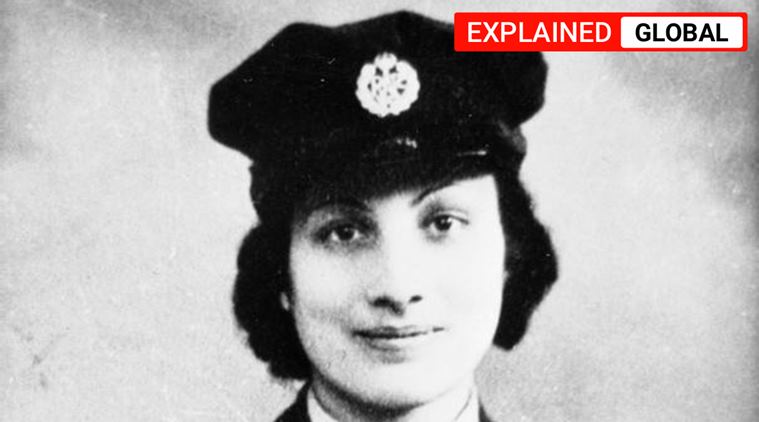
Born in Moscow to an Indian father and an American mother, Noor’s family moved to London and then to Paris during the First World War. (Source: Wikimedia Commons)
British media reported this week that Rishi Sunak, the Chancellor of the Exchequer, is considering a proposal to feature historical figures from the Black, Asian and minority ethnic (BAME) community of the country on a set of coins titled ‘Service to the Nation’.
If the proposal is passed, it will be the first time that non-white people will be featured on British coins or notes. The plan has been submitted to the Royal Mint, which is to come up with proposals and designs.
Zehra Zaidi of the advocacy campaign ‘Banknotes of Colour’, along with a group of historians and MPs, had written to the Chancellor proposing some historical figures. Among them were the Indian-origin British spy Noor Inayat Khan, as well as Khudadad Khan, the first soldier of the British Indian Army to receive the Victoria Cross. Khudadad Khan, who belonged to the Chakwal district of Punjab in present-day Pakistan, died in 1971.
The continuing Black Lives Matter protests in the United States , triggered by the killing of George Floyd by a police officer in Minneapolis in May, which have put a spotlight on the lack of BAME representation in the UK, and have compelled authorities to take appropriate steps.
Who was Noor Inayat Khan?
Born in Moscow to an Indian father and an American mother, her family moved to London and then to Paris during the First World War. Although Noor started working as a children’s writer in Paris, she escaped to England after the fall of France (when it was invaded by Germany) during the Second World War.
In November 1940, she joined the Women’s Auxiliary Air Force, an arm of the UK’s Royal Air Force to train as a wireless operator. She then did a stint at the secret intelligence organisation set up by Winston Churchill called Special Operations Executive (SOE).
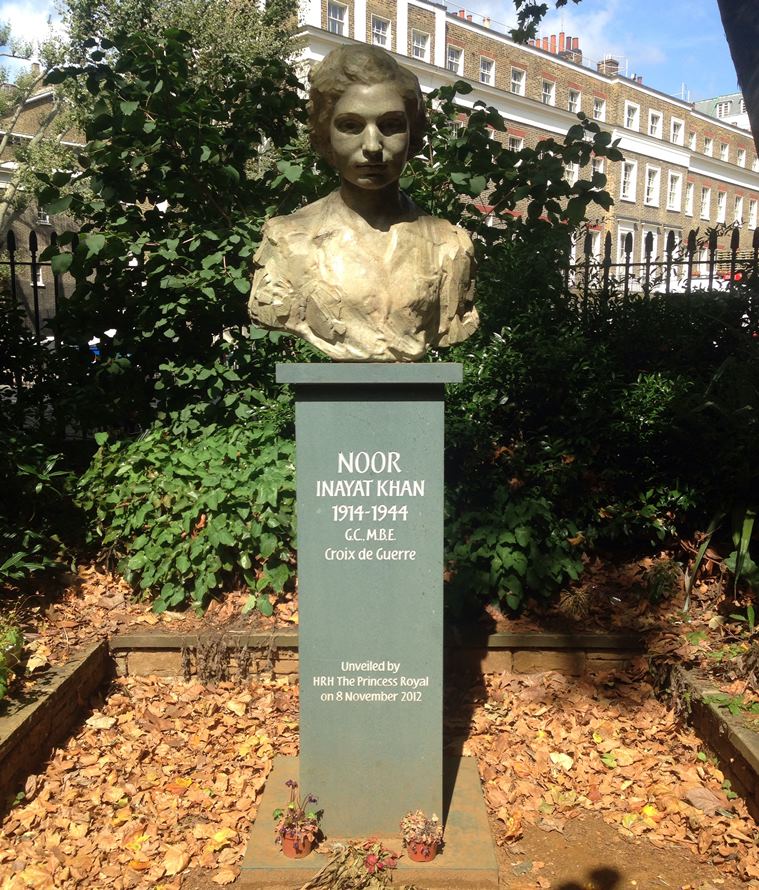
A bust of Noor Inayat Khan in Gordon Square, London. (Source: Wikimedia Commons)
She became the first radio operator to be sent to Paris to work for SOE’s Prosper resistance network under the codename Madeleine. She was just 29 then, and had signed up for a job in which people were not expected to be alive for longer than six weeks.
Even as many members of the network were being arrested by the Nazi secret police Gestapo, Noor chose to stay put — and spent the summer moving from one place to another, sending messages back to London, until she was arrested in 1943.
She was executed at the Dachau concentration camp in southern Germany near Munich. Noor was awarded the highest honour in the UK, the George Cross, in 1949, and the French Croix de Guerre with the silver star posthumously.
What was Noor’s connection to India?
She was connected to India through her father Inayat Khan. He was founder of the Sufi Order of the West, which is now known as the Inayati Order. He had migrated to the West as n Hindustani classical musician, and then moved to teaching Sufism.
Inayat Khan was born in Baroda. His maternal grandfather was the noted musician Ustad Maula Bakhsh Khan, who founded the music academy Gyanshala, which now serves as the Faculty of Performing Arts at Maharaja Sayajirao University. Maula Bakhsh’s wife, Qasim Bibi, was a granddaughter of Tipu Sultan of Mysore.
Inayat returned to India in 1926 and chose the site of his burial at the Nizamuddin Dargah complex in New Delhi. The Inayat Khan dargah still stands in a corner of the complex.
Besides being a GC, what other honours has Noor received?
In 2014, Britain’s Royal Mail had issued a postage stamp in honour of Noor as part of a set of 10 stamps in the ‘Remarkable Lives’ series. In 2012, a memorial with a bust of Noor was unveiled in London by Princess Anne. Shrabani Basu, author of ‘Spy Princess, The Life of Noor Inayat Khan’, and Chair of the Noor Inayat Khan Memorial Trust, had campaigned for the memorial.
In February 2019, Noor’s London home at 4 Taviton Street in Bloomsbury, the house that she left for her final mission, was honoured with a blue plaque. She was the first Indian-origin woman to be awarded the plaque.
How has Noor been represented in popular culture?
Various documentaries on women agents and the SOE have featured her story, such as Netflix’s ‘Churchill’s Secret Agents: The New Recruits’. In 2018, a play titled ‘Agent Madeleine’ premiered at the Ottawa Fringe Festival.
In 2012, Indian producers Zafar Hai and Tabrez Noorani obtained the film rights to the biography by Basu. In the film ‘Liberté: A Call to Spy’, an American historical drama, actor Radhike Apte played the role of Noor. The film had its world premiere at the Edinburgh International Film Festival last year.
source: http://www.indianexpress.com / The Indian Express / Home> Explained / by Surbhi Gupta / New Delhi / July 29th, 2020
Zaheer was best known for his satirical work and wrote regular columns for various publications. He was furiously popular among readers and has made a lasting impression on Urdu literature.
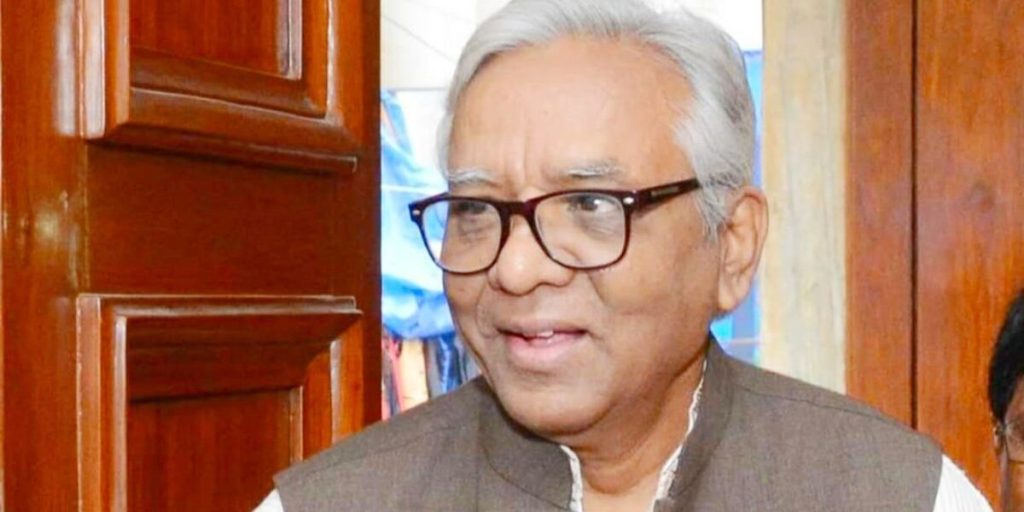
Nursat Zaheer. Photo: Special arrangement
New Delhi:
Renowned Urdu writer and translator Nusrat Zaheer passed away in Saharanpur in Uttar Pradesh on Wednesday evening at the age of 69. Zaheer had been ill for the last few months. He is survived by his wife and four daughters.
Best known for his satirical writings, he wrote regular columns for various publications. Until recently, he used to write a regular weekly column titled, ‘Nami Danam’ (‘I don’t know’) for the Urdu daily Inquilab.
According to Yameen Ansari, resident editor of Inquilab (Delhi edition), his column was published across all north Indian editions of the newspaper and was very popular with the readers. “We regularly received letters and emails from readers in appreciation of his columns,” Ansari told The Wire, and added that the columnist had to stop the column due to his flailing health.
Author and translator of several books, Zaheer had been writing columns for decades for different publications. When news of his demise emerged on Wednesday, many Urdu lovers recalled his satirical columns which had appeared in the now-defunct Urdu daily, Qaumi Awaz, a newspaper founded by Jawaharlal Nehru in 1937, which ceased publication in 2008. As a journalist, Zaheer worked with Qaumi Awaz, Sahara Urdu, Doordarshan and All India Radio in different capacities.
Speaking to The Wire, senior journalist Iftikhar Gilani said, “I had been an ardent fan of Nusrat Zaheer’s satire filled columns that were published every day in Quami Awaz in the early 90s. It is not easy to write satire and to find puns in every topic around you every 24 hours.”
According to Gilani, Zaheer was a genius who didn’t get his due, like most writers of Urdu.
The late writer also helped Gilani in translating and editing his jail memoir My Days in Prison in Urdu from English. In Urdu, it was titled Tihar Mein Mere Shab o Roz and both the original as well as the translation were published by Penguin India. The translation won the Sahitya Akademi award and Gilani remembers travelling to Bangalore with Nusrat Zaheer to receive the Award.
“I wrote the first draft in Urdu, but it needed a lot of editing as I was not well versed with writing in Urdu. The publisher chose Nusrat Bhai for editing the draft. We sat down and spent many evenings to make the Urdu draft lucid and perfect,” recalled Gilani and added that “he remained a friend and a guide. I will miss his wit and humour.”
Some of his books include Tehtul Lafz, Ba-Qalam-e Khud and Kharraton Ka Mushaira. He also wrote satirical pieces for the children’s magazine Payam e Taleem, published by Maktaba Jamia, the publication division of Jamia Millia Islamia and one of the best Urdu publishing houses of India. He was also the founding editor of children’s magazine Bachon Ki Duniya, published by the National Council for Promotion of Urdu Language (NCPUL), an autonomous body of the government of India and was associated with its research journal, Fikr-o-Tahqeeq as its editor for a brief period.
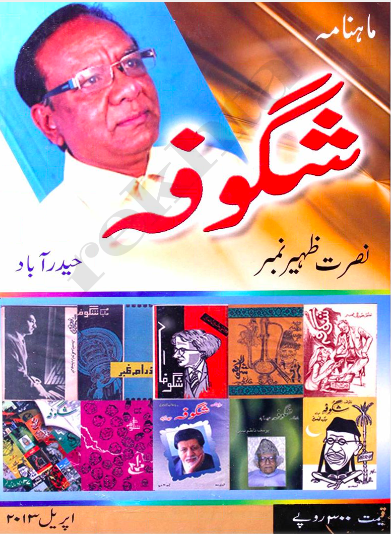
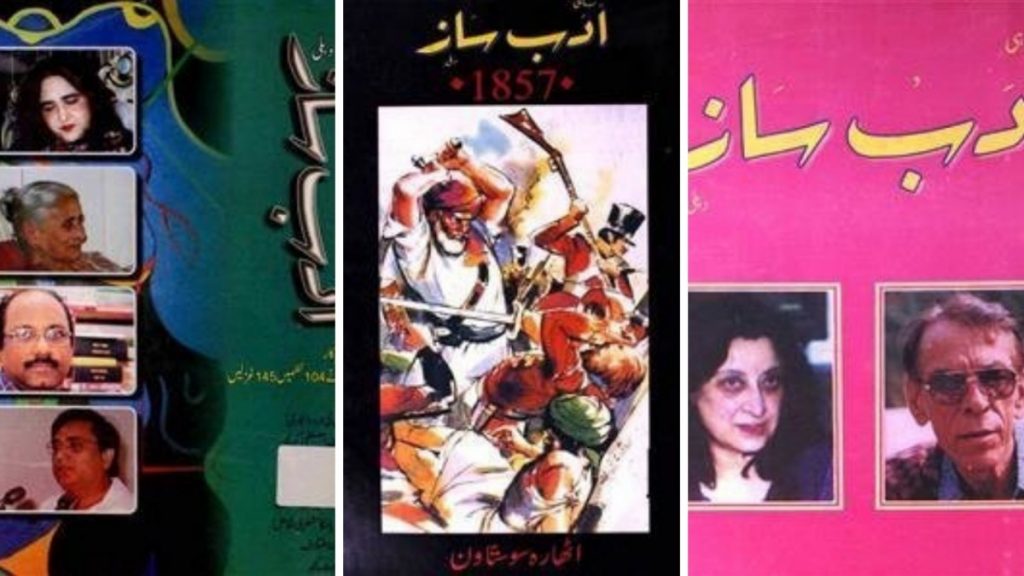
Cover of a special issue of ‘Shagoofa’ on Nusrat Zaheer. Photo: rekhta.org
In 2013, Shagoofa, a monthly magazine of Urdu satire and humour writings, published from Hyderabad brought out a special issue in his honour. His book Kharraton Ka Mushaira, a collection of articles written for Payam e Taleem won an award from the Delhi Urdu Academy.
However, many believe that Zaheer will also be remembered for Adab Saaz, a quarterly literary journal founded and edited by him. According to Ather Farouqui, general secretary of Anjuman Taraqqi Urdu (Hind), it was one of the best literary journals for quite a few years.
Cover of Adab Saaz. Photo: rekhta.org
Nusrat Zaheer was associated with the Communist Party of India (CPI) in his early years. However, “he had to go to jail during the emergency as he refused to toe the party line of supporting the emergency,” Farouqui told The Wire. “He was a low profile person and committed to the values he cherished, which included his opposition to all kinds of communalism,” added Farouqui.
According to Farouqui, before falling ill, Nusrat saheb was involved in the wonderful work of translating the history of English to draw parallels between the politics of Canon and the historiography of Urdu and English. This was apart from his regular writings for several publications. “Unfortunately, he took up the job quite late in his life, without knowing that he was about to complete his journey,” Farouqui told The Wire with a great sense of loss.
In the latest issue of Urdu Adab, a journal published by Anjuman Taraqqi Urdu (Hind), Zaheer’s translation of Andrew Sanders’s Poets’ Corners: The Development of a Canon of English Literature has been published. It is the introduction of Sanders’s book, The Short Oxford History of English and the Urdu translation of it can be read here.
source: http://www.thewire.in / The Wire / Home> Books> Culture / by Mahtab Alam / July 23rd, 2020
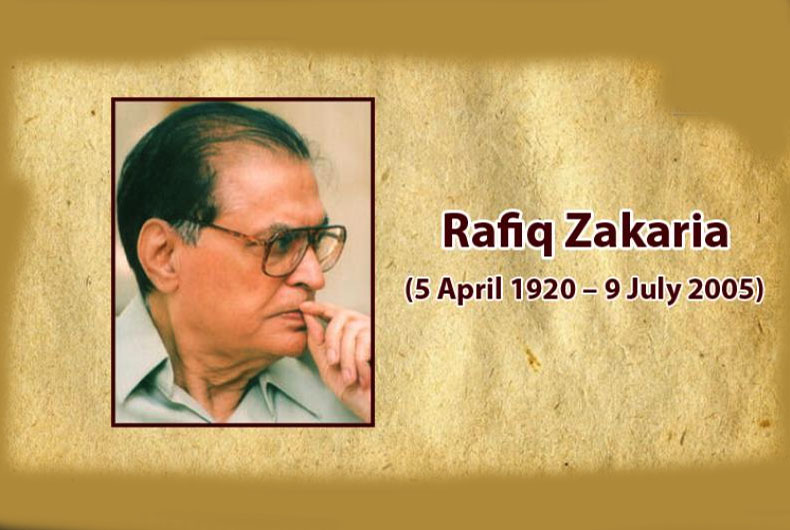
Sadly today there is no one of Dr Zakaria’s caliber, scholarship and forceful articulation to bat for Indian Muslims
One evening in the late 1990s, as a cub reporter working for The Asian Age, founded and then edited by eminent journalist M J Akbar, I landed at the iconic Nehru Centre in Mumbai. It was a lecture by Samuel Huntington, the famous American scholar who had stirred a huge controversy with his Clash of Civilizations hypothesis. After Huntington’s speech, Dr Zakaria spoke and, while acknowledging the renowned scholar’s debt in mentoring the Zakarias’ son the famous author and journalist Fareed Zakaria, Dr Zakaria disagreed with Huntington’s hypothesis and attacked him for spreading fear among the peace-loving section of the world community.
That was the first time I saw Dr Zakaria. Subsequently, I attended a screening of a documentary made by a British channel on the eve of 50 years of India’s Independence in 1997. The documentary, complained Zakaria, had truncated version of his interview and post-screeing Dr Zakaria was understandably disturbed and livid. In my excitement to have got a “hot” story about a leading Islamic scholar like Dr Zakaria trashing a documentary by a British channel I reported it in the paper but wrongly said that it was produced by the BBC. Next day the BBC sent a letter to my editor denying its ownership. It was a huge embarrassment for me, the editor and the paper and, the then resident editor, rapped me for such a lapse and carelessness while reporting. To my pleasant surprise Dr Zakaria didn’t pull me up, forgetting and forgiving with a remark that it was a misreporting.
Dr Zakarai and his wife Madam Fatma Zakaria were very close to M J Akbar, and he could have got me fired for the blunder that I had committed. But Dr Zakaria saw it as a minor mistake on the part of a young, fledgling reporter and didn’t make it into a big issue. I fell in love with the scholar-politician for his magnanimity and sense of justice.
For the next one decade or so I remained immensely close to the Zakarias. Hardly a week passed when I didn’t call doctor sahib or he didn’t inquire about my progress as a journalist. I can’t remember the number of times I quoted him for stories or interviewed him for The Asian Age or The India Express, the paper I left in 2005 to join The Times of India. He was happy that I joined TOI, the newspaper he had contributed to for decades. Sadly, he didn’t live long to see my works in TOI, except the first story which announced my arrival to the Times. It was about Sare Jahan Se Accha completing a century and doctor sahib, as always, was effusive in his praise for me for this front-page story which in a way also announced my arrival to the Times of India.
I cannot forget a note that he wrote on one of his books he gifted me. Seated at his spacious study at the Cuffe Parade House in South Mumbai, in long hand, doctor sahib wrote:
“To Mohammed Wajihuddin for whose bright future I am genuinely concerned.”
It was a big compliment for me. I felt adopted by the Zakarias who showered unreserved love and affection on me. There was no artificiality in doctor sahib’s expression of concern and love for a boy who had arrived in the city from the backwaters of Bihar without a godfather. After his passing away, I missed him a lot and miss him every day, every moment.
Dr Rafiq Zakaria: An Impressive Journey
Dr Zakaria belonged to a generation which had not only witnessed the horrors of partition but had deeply felt pained at the vivisection of India into Islamic Pakisan and Secular India. Son of a maulvi in Nala Sopara, Zakaria scaled the height of scholarship and politics mainly because of his love for reading and a drive to excel.
A brilliant student, he devoured books on history, fiction, law, religion and everything between them. He had befriended Bernard Shaw, heard Harold Laski and met Bapu the Mahtma who always remained a paragon of truth and non-violence to Zakaria. Even as a student, both in Bombay and in London, he wrote for some leading newspapers of the day. An argumentative mind, he would not take things on their face value. He would question the status quo and side with the victims.
A patriot to the core, Zakaria never lost hope in the Hindu-Muslim unity and never forgave Mohammed Ali Jinnah for formulating the Two-Nation Theory which caused immeasurable damage to the sub-continent’s Muslims. In his autobiographical book The Price of Partition, the release function of which I had the fortune to attend, he has detailed the circumstances leading to the partition of India. He would often quote the famous Urdu couplet about the disaster that partition brought: Lamhon ne khata ki thi/sadiyon ne saza payee.
Dr Zakaria’s views about Muhammad Ali Jinnah
In his lucid prose which, as Zakaria confesses in almost all his books that he authored, was fine-tuned by the veteran editor and his better half Madam Fatma, Zakaria has quoted several interesting anecdotes about Jinnah whom his supporters called Quaid-e-Azam (the leader) but who actually misled the sub-continent’s Muslims. The pork-eating Jinnah who loved his whisky had nothing to do with the genuine concerns of the Muslims. He was authoritarian, egotist and desperate to see his dream of carving out Pakistan, the so-called Pure land for Muslims. One of the anecdotes in Zakaria’s immensely readable book goes like this:
“Jinnah had started reorganizing the League after the assembly elections in 1937; he was on an enticing spree. Hasrat Mohani, who was a firebrand, went to see Jinnah on some urgent work at his bungalow. He had not taken an appointment. It was after dusk; Jinnah was enjoying his peg of whisky. He called Mohani to his room and thinking then that he was more a revolutionary than an orthodox Muslim, offered him a drink. Mohani, somewhat baffled, said that he wished he had as little fear of God as Jinnah had. Jinnah retorted: “No, Maulana! You are wrong. I have more faith in His mercy than you have.”
Dr Rafiq Zakaria: A Successful Politician
He was a successful politician who even represented India at the United States to counter the arguments of Zulfiqar Ali Bhutto, then Pakistan’s foreign minister and later the Prime Minister, on the dispute over Kashmir. Besides, Zakaria was a passionate scholar of Islam. His seminal work Muhammad and the Quran, written in response to Salman Rushdie’s The Satanic Verses, is a labour of love for which Muslims will be eternally indebted to him. About the huge positive response this book received from noted scholars from across the world, Dr Zakaria once told me:
“After reading this book, a big Pakistani Maulana said, “Mujhe nahim maloom Dr Zakaria ne kitni neki or aur kitne gunah kiye hain lekin main gawahi deta hoon key eh kitab unki bakhshayesh ka zariya banegi. [Truly, if nothing else, at least this book will inshallah help our late doctor sahib find a place in jannah.]
Dr Rafiq Zakaria’s love for Allama Iqbal
His love for the poet-philosopher Allama Iqbal was immense. He defended Iqbal like few in India did. His book on Allama Iqbal, penned to prove that Iqbal was wrongly credited with fathering the idea of Pakistan, is testimony to Zakaria’s love and respect for Iqabl who was undoubtedly a great poet but a failed politician. Dr Zakaria never failed to quote the famous line from Iqbal’s Naya Shivala –Pather ki moorton mein samjha hai tu khuda hai/khake watan ka mujhko har zarra devta hai–whenever he needed to show Iqbal or other Indian Muslims as nationalists.
One thing that is of great relevance to us today is Dr Zakaria’s unshakeable faith in Kashmir’s accession to India. He had even penned a poem on Kashmir, expressing his love for the valley and why it needed to be with India. He justifiably believed that, if Kashmir secedes from India, it will not only be ruinous for the Kashmiris, but Muslims in the rest of India will have to pay heavily for this crime. As anti-Muslim hysteria grips parts of India in the aftermath of the recent terror attack on the Amarnath Yatri, Dr Zakaria’s fears only seem true. It is in the interest of Indian Muslims that Kashmir remains an integral part of India.
Sadly today there is no one of Dr Zakaria’s caliber, scholarship and forceful articulation to bat for Indian Muslims either in the media or in the corridors of power, the two arenas that are increasingly getting poisoned. As majotarianism marches ahead, threatening to turn the secular India into a Hindu rashtra, the absence of a patriot, politician and scholar like Zakaria is greatly felt.
(The author, a journalist with The Times of India, presented this paper at the one-day seminar on Dr Rafiq Zakaria on July 15, 2017 at Aurangabad. The article is reproduced here with the permission of the writer on the occasion of the 15th death anniversary of Dr Rafiq Zakari on July 9.)
source: http://www.ummid.com / Ummid.com / Home> India> Views & Analysis / by Mohammed Wajihuddin / July 17th, 2020
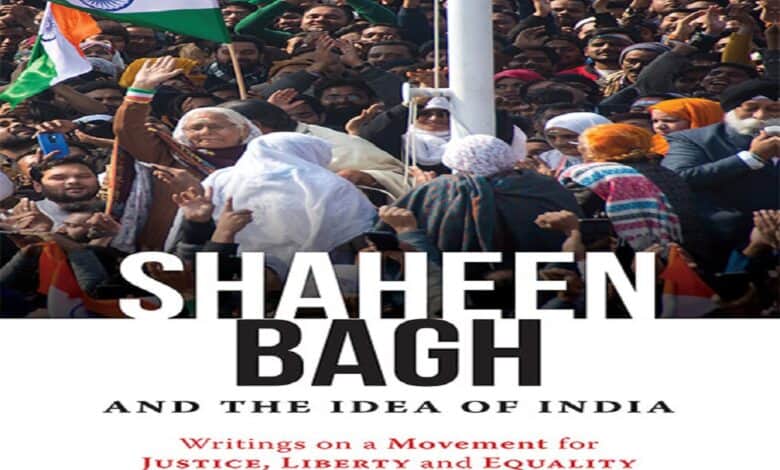
The first comprehensive book on one of the most important civil rights movements in the history of Independent India.
On 15 December 2019, police in riot gear stormed Delhi’s Jamia Millia Islamia University and attacked unarmed students protesting against the Citizenship (Amendment) Act (CAA), which makes religion a factor in the process of granting Indian citizenship. In neighbouring Shaheen Bagh, mothers and other relatives and friends of the students came out into the streets in outrage and anguish.
They sat on a main road demanding repeal of the CAA, which, twinned with the National Register of Citizens (NRC), could make Indian Muslims aliens in their own homeland. Within days, similar protests broke out across the country. Free India had never seen anything like it.
Shaheen Bagh and the Idea of India examines how the sit-in by a small group of Muslim women—many of whom had stepped out of their homes alone for the first time—united millions of Indians of different faiths and ideologies in defence of the principles of liberty, equality and secularism enshrined in our Constitution.
It also throws up many important questions: Can the Shaheen Bagh protests reverse the damage done to our democracy in recent years? How did the non-violent movement sustain itself despite vilification, threats and persecution by the establishment? Is this movement the beginning of new solidarities in our society? Will it survive the aftermath of the communal violence that devastated northeast Delhi in February 2020, and the witch-hunt that was launched under cover of the Covid-19 pandemic and lockdown.
This necessary collection comprises interviews with some of the brave women at the core of the protests; ground reports and photographs by journalists like Seema Mustafa, Seemi Pasha, Nazes Afroz and Mustafa Quraishi; and essays by thinkers, writers, lawyers and activists, including Nayantara Sahgal, Harsh Mander, Subhashini Ali, Nandita Haksar, Zoya Hasan, Apoorvanand, Enakshi Ganguly, Sharik Laliwala and Nizam Pasha. It is a book that must be read by everyone who cares about India’s democracy and its future.
About the Editor:
Seema Mustafa has been a journalist since the age of nineteen. She has worked in or written for a number of major Indian newspapers—including The Patriot, The Pioneer, The Indian Express, The Telegraph, Economic Times and Asian Age—and travelled across the globe on assignments. She also worked for a couple of years as the National Affairs Editor for the News X television channel. She has covered conflict in Assam, Punjab and Kashmir; communal violence in different states of India; and was the first Indian journalist to cover the first war in Beirut. She is presently the Founder-Editor of The Citizen, an online initiative.
source: http://www.siasat.com / The Siasat Daily / Home> News / by Sana Sikander / July 05th, 2020
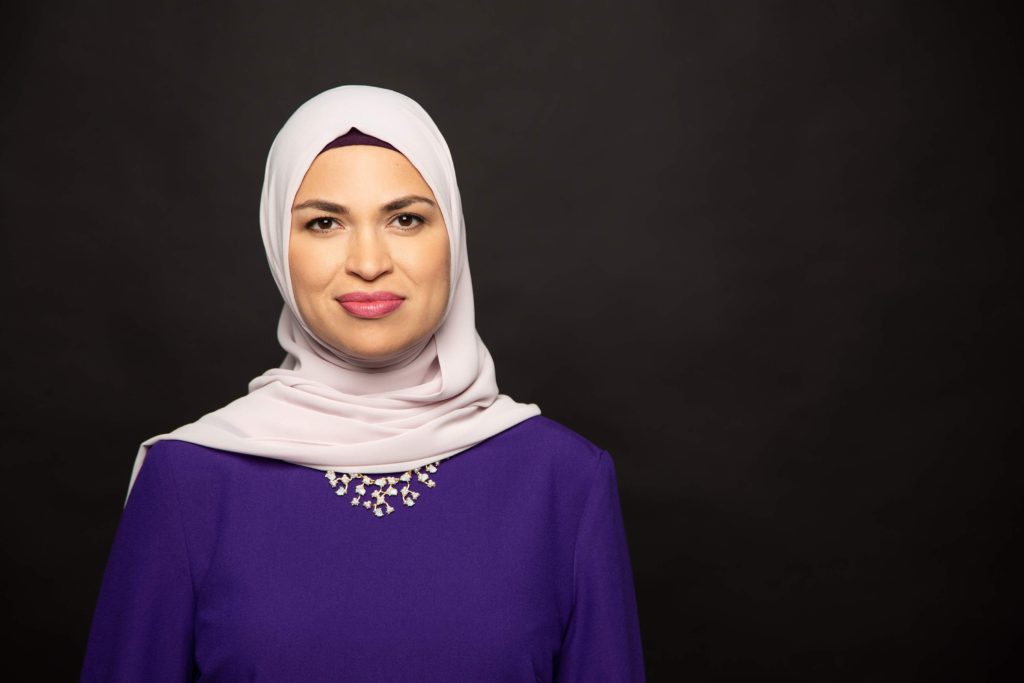
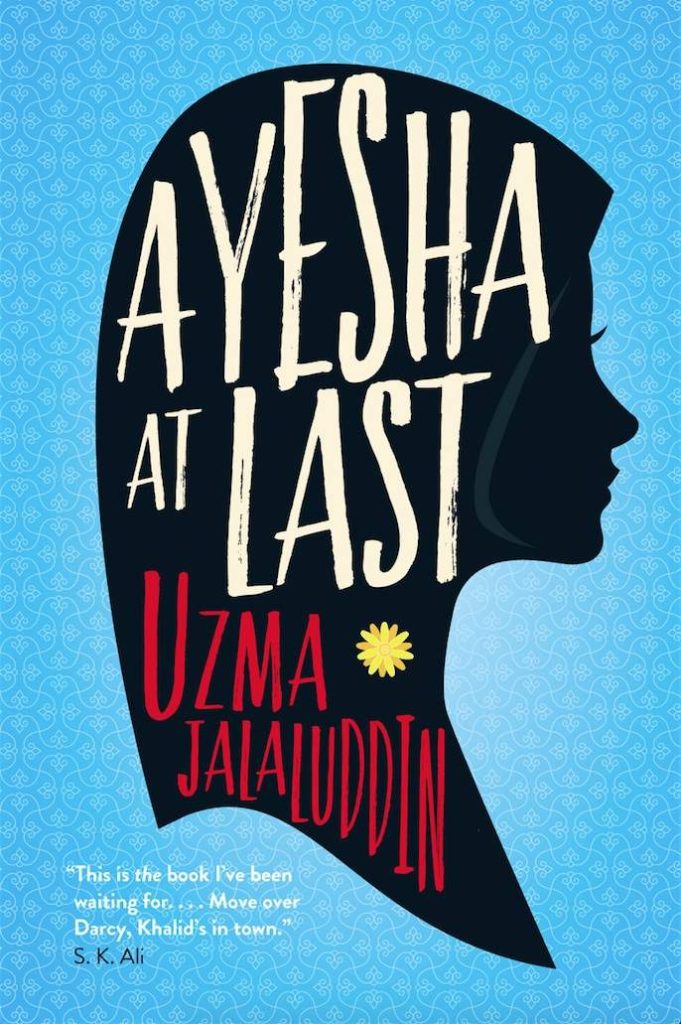
Ayesha At Last‘s Muslim characters are a far cry from the stereotypes we often come across. There are no gun-wielding terrorists in this debut novel by Uzma Jallaluddin. Instead the author’s characters are real, believable people. The protagonist Ayesha and her family are immigrants in Canada who are living regular lives dealing with their own tiny battles, and there’s Khalid, Ayesha’s love interest who is putting up with his bigot boss, even as he lives up to the demands by his unreasonable mother.
There’s a lot of drama happening in this narrative that’s inspired from the classic Pride and Prejudice. Uzma without trivializing anyone’s ethnicity throws light on the idiosyncrasies of people from different nations. Although this book can be classified into the chick lit genre, it brings to fore some critical questions about the changing dynamics of the contemporary world. Yet, the easy and effortless writing makes it a fun and light read.
In an email interview, Uzma answers questions about what made her write this story, her approach to prejudices and way forward for Ayesha At Last.
Is this to a certain extent an autobiographical account? I am asked this question all the time, and I can say that this book is definitely not autobiographical! However the themes within are mined from my own life. Like Khalid, I am a second generation Indian Muslim Canadian. Like Ayesha, I have lived in an extended family, with grandparents and aunts and uncles. Like many of the characters, I have tried to reconcile my identity as an Indian, as a Muslim, as a Canadian. And of course, I had my share of rishtas when I was younger!
Most of the women in your story – Ayesha, Farzana, Zareena (and I guess even Ayesha’s mum and Hafsa too) are terrible cooks – why did you want your characters to be like this? Was it just on a lighter note or did you want to highlight Khalid’s cooking talent? Only Ayesha, Zareena and Farzana were bad cooks. I assume the rest of the women characters were decent at meals. Growing up, my mother never really emphasized that I should learn to cook. It wasn’t until I was married and had children of my own that I tried to learn, from her and my mother-in-law, both of whom are excellent home cooks. However, AYESHA AT LAST has one excellent female home cook – Nani, Ayesha’s grandmother. In fact, Nani teaches Ayesha and Khalid an important life lesson, while also teaching them how to make delicious parathas. I wanted to make Khalid an excellent cook to dismantle stereotypes. There is something so loving and nurturing about the act of cooking, and I wanted my male lead character to have that quality.
However, all your women characters are quite strong-willed and forthcoming, a few are breaking stereotypes, while others are reinforcing those stereotypes – Ayesha and her family versus Khalid’s mum – could you explain why you wanted to bring out this contrast? As a writer, my primary responsibility to readers is to write a story that is entertaining, and authentic. I wanted to write about characters who felt true to life, while also providing a way for readers to laugh at the foibles of others. Some of my characters are foolish, some are wise and kind, others are shallow and misguided. That’s how regular people behave too, and in fact we all cycle between many different ways of being. My book is set in Canada, and it was also important to me that I showcase how much diversity there is within diverse communities. Sometimes books set in the West only have few characters who are not White, and those characters are limited in their presentation. My book is mostly populated by characters whose families hail from India, the Middle East, Afghanistan, etc., and I took this opportunity to play around with character types, to emphasize how no matter where you are from or where your family is from, people come in all different flavours.
Why is it that all the characters who have roots in the Asian subcontinent have run away from some kind of a disturbance – be it the Babri Masjid issue or the bombing in Afghanistan – this seems like a typecasting Indians, Afghanis etc? Was it because your readership in Canada isn’t aware of how the countries are now? I disagree with this assessment. Sulaiman Mamu, Ayesha uncle, and his family immigrated to Canada without any dramatic events precipitating this move, same with Khalid’s family, and Tarek’s family, the Imam, etc. I think it is fair to say that readership in Canada has a somewhat limited understanding of the way that regular life in India, or Afghanistan is today. At the same time, Canada, and Toronto in particular, has a very diverse immigrant population that maintains close ties with their roots. In Scarborough, the suburb where Ayesha At Last is set, 85-90% of the population is first or second generation; they or their parents were born outside of Canada, mostly from Asia in fact. Though Ayesha’s immediate family and one other character were running from something, I wanted to highlight that many others move to a country like Canada for a variety of reasons, and must figure out how to all get along and live in their new environment. The focus of the book is not on immigration, or refugee status, however – it is about what life is like for the children of immigrants/refugees in this new place, how to navigate between two worlds and cultures, and how they find love.
There is similarity to the classic, Pride and Prejudice. Your thoughts on this. My novel has been described as Pride and Prejudice remix set in a close-knit Toronto South Asian Muslim community. I love Jane Austen, and Pride and Prejudice is one of my favourite books, so I am pleased and honoured at this comparison. While I did not set out to write a straightforward retelling, I think the themes in P&P are echoed in my book, namely class differences, family expectations, and the search for identity mixed in with the search for love.
Eventually, the idea that being glamorous is equivalent to being frivolous (reference-Hafsa) and being focused and determined means you cannot be glamorous (reference-Ayesha) gets reinforced in the end… was it intentional? Glamour is certainly not equivalent to frivolity, as Ayesha has her fun moments – such as when she passionately performed poetry in a bar, or when she dressed in a beautiful sari at the end of the book. Ayesha and Hafsa have different family situations, and through their contrasting characters, I wanted to explore the effect of wealth disparity even within a single family. Mostly, I hope my story will make readers think about the dangers of snapping to quick judgements about others, as people are quite complicated and cannot simply be described as being only either ‘glamorous’ or ‘determined’!
The book is quite insightful and offers an understanding about the Muslims living in Canada, this is something that I truly enjoyed and was informative – through this book would you say you are trying to show the world that Muslims can be normal (and are not all are terrorists)? When I set out to write Ayesha At Last, my aim was to tell a fun, joyful, and romantic story about Muslims in the West. Unfortunately, most stories about Muslims contain negative stereotypes that reinforce xenophobic, one-sided narratives that can cause real harm to vulnerable populations. I hope that more stories about Muslims, or Hindus, or Buddhists, etc., set in the West, will help readers understand immigrant communities better, but most importantly will also allow those immigrant communities to see themselves as worthy of being featured in all types of stories, not just highly politicized ones. Your question reinforces the dangerous effect of this lack of representation – and yes, Muslims are normal. We are people, like everyone else.
How long did you take to complete this book, how many drafts did it go through? The book took a long time complete, because like most people, I wear many different hats. I am a parent to two sons, I teach high school English, and I also write a column for The Toronto Star, Canada’s largest daily newspaper. So I wrote Ayesha At Last in stolen moments over many years – about eight years in total. I’m not sure how many drafts I went through, because after a while I simply lost count. More than a dozen for sure.
Where did you write this – at home, in the kitchen, on the dining table or at a coffee shop? Since the book took so long to draft and revise, I can honestly say I have written Ayesha At Last everywhere: in coffee shops, in waiting rooms, on my desk at home, the kitchen table, while waiting for my children to finish soccer, baseball, swimming, and Scouts.
What are your writing rituals and how does your atelier look like? I like to write in the mornings if I can. This is tough with teaching, so I make use of any time off and my weekends. I have a small office in my basement, which has an old desk, a monitor, and speakers for music (I love pop music and Top-40 hits). It also has a large bulletin board where I pin ideas for my book, plot details, and inspiring quotes.
What are you working on next? My second novel is also a romantic comedy set in Toronto, featuring Muslim Indian characters and takes place in the restaurant world.
What about Ayesha At Last being adapted to the screen? Any updates? Ayesha At Last was optioned for film by Pascal Pictures last fall, which was a very exciting development. Right now a screenwriter is working on the adaptation.
Rs 399. Published by Penguin Random House.
ayeshatabassum@newindianexpress.com @aishatax
source: http://www.indulgexpress.com / The New Indian Express – Indulge / Home> Culture / by Ayesha Tabassum / June 04th, 2020
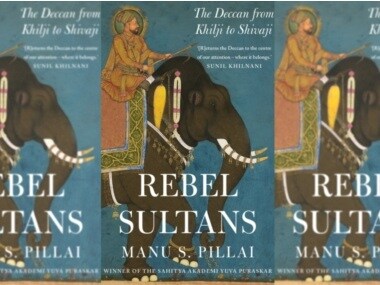
In Rebel Sultans, Manu S Pillai traces the history of the Deccan from the end of the 13th century to the dawn of the 18th, punctuated by tales of drama, betrayal and murder.
Editor’s note: The Deccan, miles away from the empire of the Mughals, was eyed with envy by rulers such as Aurangzeb, so much so that it is said to have contributed to his downfall. Its kingdoms had much to offer; in their courts were Persians and Marathas, in their ranks were African nobles, and in their treasuries were gold and fortunes.
In Rebel Sultans, Manu S Pillai traces the history of the Deccan from the end of the 13th century to the dawn of the 18th. He tells the story of the Vijayanagar empire, the court of the Bahmani kings, and the Rebel sultans — punctuated by drama, betrayal and murder. The book features characters such as Malik Ambar, Chand Bibi and Krishnadeva Raya, and is published by Juggernaut Books.
The hero of the Deccan had skin the colour of coal. Emperors snarled at him from afar, while enemies at home rattled in fear when he marched into their neighbourhoods. Many were those who despised him, but many more still were the masses who discerned in him a champion. His story was certainly unusual, though he was neither the first of his people to serve in the Deccan, nor extraordinary in his antecedents. And yet he emerged as the strongest of them all, reigning indeed as king in all but name. ‘He has a stern Roman face,’ wrote one traveller, ‘and is tall and strong of stature’ though his ‘white glassy eyes’, it was added, ‘do not become him.’ His charities were legendary, as was the valour of the men who pledged themselves to his service. When at last he died, not on the battlefield but secure in a formidable fortress, the Mughals admitted that this enemy was ‘an able man. In warfare, in command, in sound judgment, and in administration he had no rival or equal… He kept down the turbulent spirits of [the Deccan], and maintained his exalted position to the end of his life, and closed his career in honour. History,’ the obituary concludes, ‘records no other instance of an Abyssinian slave arriving at such eminence.’ It was high praise, coming as it did from the imperial court, where two generations of emperors revealed nothing but spite for the man called Malik Ambar.
The Deccan, as we know, had long attracted foreigners to its shores, offering them wealth and a future in these eastern lands. Persians arrived, as did Arabs and Central Asians. Some graduated to princely ranks, while others soared to gratifying aristocratic heights. But among the legions of men absorbed by the Bahmanis and their heirs were also Africans who came primarily from the land we now call Ethiopia. And they too would thrive in the Deccan far above the stations where they began their lives. Some were associated with tales of treachery – Mahmud Gawan’s confidant, who struck his seal on the forgery that delivered him his death warrant, was a habshi (an African) as was his executioner. When Yusuf Adil Shah died, one of the regents who ruled in the name of his son was a black man from Ethiopia – the latter was stabbed to death for displacing Westerners and favouring the Sunni faith. When years later Chand Bibi was imprisoned, her liberator who briefly stood at the forefront in Bijapur was a habshi, as was the man Ibrahim Adil Shah II rejected after eight years of living under his guard. In Ahmadnagar, during the wars of succession in the 1590s, one ruler, whose reign lasted less than a year, found himself without support from his nobles because his mother was ‘a negress’, though when Chand Bibi was besieged by the Mughals, the man who led Bijapur’s and Golconda’s troops to her rescue was also a habshi called Suhail Khan. And many years later, on the eve of the final Mughal conquest of the Deccan, in Bijapur once again would rise a habshi exercising as a short-lived vizier the full and tragic authority of power.
The habshis had almost all of them begun their careers as slaves. And there certainly was a thriving market for men from Ethiopia in the courts and demesnes of the east. Writing as early as the 14th century, Ibn Batuta reports how habshis were ‘guarantors of safety’ for ships sailing in the Indian Ocean, with such fearsome reputations that ‘let there be but one of them on a ship and it will be avoided by… pirates’. Centuries later a Portuguese missionary noted how ‘all the country of Arabia, Persia, Egypt, and Greece are full of slaves’ who made for ‘great warriors’. In India too, this was true. The favour and affection shown by Raziya Sultan in the 1230s to Jamal al-Din Yakut, an Abyssinian warrior, provoked a rebellion and contributed to her brutal murder in Delhi at the close of that decade. At the end of the 14th century, a habshi servant of the Delhi Sultans had established a near-sovereign state in Jaunpur, in present-day Uttar Pradesh, which sustained itself till 1479. Firoz Shah Bahmani in the early 15th century had habshis in his harem, while in that same century a 1487 coup by Africans in the court of the ruler of Bengal led to the rise of a short-lived ‘Habshi Dynasty’ hundreds of miles away, on the other side of the Indian subcontinent. The exquisite Siddi Saiyyed Mosque in Ahmedabad was built by a habshi in 1572, and generations later the Mughal emperor Aurangzeb would appoint the African lord of the fortress of Janjira his naval commander, allocating to him an annual grant of 400,000 rupees to maintain the imperial fleet. In the old quarter of Delhi there is even an area by the name of Phatak Habash Khan, named, evidently, after a habshi courtier who bid farewell to the Deccan, embracing the cause of the Mughal emperor.
While these are episodes that stand out, where Africans from humble origins arrived at positions of honour and power (and sometimes infamy), the beginning of their journeys on this path were never happy. The habshis were often taken as children and sold at a price to be transported abroad. Ethiopia, at the time, was called Abyssinia in the trading world, and the very word ‘habshi’ is a derivation denoting the origins of these slaves. Malik Ambar, too, emerged from this commercial exchange of human goods. Born around 1548 into the Oromo tribe, he was captured as a boy and sold to an Arab for 20 gold ducats. In Baghdad he passed, temporarily, into the hands of another owner, who then sold him to the man who would bring him to India – and to his destiny. It was this master who educated him, though by now he had renounced his name, Chapu, and converted to Islam. ‘Whether he assumed a Muslim identity at the time as an act of genuine faith or simply as a practical matter of assimilation is not known.’ But it certainly helped him in his life ahead, to share faith with the powerful kings and noblemen of the east, in whose service lay his ascent.
Around 1571, now in his early 20s, Ambar, as he was known, arrived in the Deccan where his long-time master sold him to the peshwa (chief minister) of Ahmadnagar. The sale itself was not unusual – though his master had brought him up, the ‘bottom-line was never in dispute: Ambar was property’ and not ‘an heir or son’. However, the man who had just purchased the slave must have opened Ambar’s eyes to a world of possibilities, for the peshwa was himself black and had arrived in the Deccan under similar circumstances. He would, in due course, be assassinated, but to Ambar it must have been clear that in India it was possible to rise beyond slavery and to come into great power and wealth – he himself was merely one of a thousand habshis the peshwa possessed.
Rebel Sultans by Manu S Pillai is published by Juggernaut Books
source: http://www.firstpost.com / FirstPost / Home>Living News / by Manu S Pillai / June 21st, 2018
The author and academic says science fiction, whether set in the near future, a nearby planet or even in an alternate universe, is almost always about our today
Chatting with Sami Ahmad Khan is always fun. When he said he was re-reading Douglas Adams’ seminal Hitchhikers Guide to the Galaxy as he was including the increasingly inaccurate trilogy of five in an elective course, one’s curiosity was naturally piqued. Sami teaches at the University School of Humanities and Social Sciences, GGS Indraprastha University. “We run MA, MPhil and PhD programmes in Literary and Culture Studies,” says the 34-year-old author of Red Jihaad and Aliens in Delhi.
“The senior faculty members are quite receptive to new ideas, and constantly seek strategies for the school to stay updated with a rapidly-mutating world. Consequently, we are encouraged to undergo frequent syllabus revisions, especially for our MA (English) course.”
Science fiction electives
The latest revision Sami says was in 2019, and gave the faculty the opportunity to engage with their core areas of research in a classroom setting. “These teacher-specific courses (offered in MA second year) range from exploring multiple dimensions of art, philosophy, gender, drama and culture, temporal/event excavations (such as Partition studies) and trans-media (cinema) to area and genre studies (such as Science Fiction). Under this paradigm, I am pleased to offer two electives on SF in the upcoming semesters: the first course is on global SF and introduces learners to stalwarts such as Jules Verne, H.G. Wells, Isaac Asimov, Ray Bradbury, and Phillip K. Dick and recent films such as Christopher Nolan’s Interstellar to study the origins and theories of SF in the Global North.
The second course is on Indian SF, and utilizes, as starting points, select works by Satyajit Ray (Bangla) and Jayant Narlikar (Marathi) among others, and Shankar’s Enthiran, to explore how our own SF traditions operate across different narrative forms (short stories, novels, films, web-series etc). These courses simultaneously function as introductory primers for those interested in knowing more about SF as a genre/mode, and also address the textual/contextual depths and theoretical complexities an MA student must navigate.
Don’t panic
The author says he included The Hitchhiker’s Guide to the Galaxy in the course on global SF “the same ways dolphins don’t. What better novel to study about the end of world during the end of the world? It questions the philosophical underpinnings of our world and exhibits how SF toys with semantics/syntax of the narratives around it. Like a timeless classic, it doesn’t fail to respond to our contemporary material realities. Above all, it “has the words DON’T PANIC inscribed in large friendly letters on its cover.” We could use this helpful advice in the maddening times of COVID-42”— Could it possibly be the answer to the questions of life, the universe and everything?
Sami says the lockdown has been treating him better than expected. “I’m privileged enough to have a full belly, a roof over my head, a broadband connection, a Netflix subscription, and a gargantuan reading list. Usually, too, I’m happy being left to my own devices. I just need a book/film/web-series (i.e. a text) and the time/space to construct (and deconstruct) random ideas in my head, which this lockdown has given me. If only the circumstances weren’t so grim. This is when we begin to “question the nature of our reality” (as per Westworld), and start looking for our towel.”
Descriptive not predictive
These are troubling times and Sami hits the nail on the head when he says it is easier to read about dystopia than live it. “Through its monsters, future wars, zombie apocalypses, rogue AI, invading aliens, environmental fiascos, and alternate histories etc., SF, whether set in the near future or on a nearby planet or even in an alternate universe, is almost always about our today. Even Ursula Le Guin finds SF ‘descriptive’ and not ‘predictive’.”
The Delhi-based author says, “SF foregrounds and amplifies the feedback we receive from these dystopian narratives to our present(s), which then radically changes the way we approach our own lives and societies. SF’s dystopias and their hapless characters translate into an almost quasi-utopian connotation for us (the readers). A shared nightmare in/of the future suddenly awakens us to the lacunae of our times.”
Opposite sentiment
A real dystopia, according to Sami, portrays the exact opposite sentiment. “It is built on the premise that the SF dystopia (and its feedback) has failed to warn us, and in doing so, birthed an actual one in our lived reality. All that we are doing to this planet today – and what it is doing to us in return – makes it clear that the present has been colonized by the future. The age of men is over; the age of superbugs has begun.”
When we last spoke, Sami had spoken of a sequel to his 2017 SF thriller Aliens in Delhi, where reptilian creatures take over the capital. “I am a fanboy who has been lucky enough to not only get the opportunity to teach SF but also research and write it. I just finished a short story called Biryani Bagh, which brings aliens (and this time I may use this word differently) to a Bagh that has haunted contemporary popular imagination. I’ve been told it would appear in the second Gollancz Book of South Asian Science Fiction (Sami’s last story, 15004, appeared in the first volume). My next full-length project is an academic monograph, a critical catalogue of Indian Anglophonic SF for a university press. After that, perhaps, I might start writing the sequel of Aliens in Delhi – but only if the world hasn’t produced it already, not as fiction, but as a lived reality.
source: http://www.thehindu.com / The Hindu / Home> Life & Style / by Mini Anthikad Chhibber / June 16th, 2020
In Ira Mukhoty’s narrative, Emperor Akbar is an able reformer, the earliest advocate of inter-religion dialogue, and marked for greatness because of his quality of empathy
Charismatic, curious, catholic, compassionate — Emperor Akbar (1542-1605) has long exercised the imagination of Indians of all hues. For the lay person, he is the lumbering giant with the booming voice and grand moustache as depicted by the actor Prithviraj Kapoor in K. Asif’s magnum opus Mughal-e-Azam (1960); while ostensibly a love story between Akbar’s son, Salim, and Anarkali, the film belongs to the father in the eponymous role of the Great Mughal.
For the liberals, Akbar is the embodiment of pluralism, multiculturalism and the earliest advocate of inter-faith dialogue.
For the right-wing ultra-nationalists he is the most ‘tolerable’ of all the Muslim rulers for his reverence for all faiths and abolition of the religious tax, jiziya, from non-Muslims.
An Indian icon’
From school textbooks to the Akbar-Birbal qissa-kahani to popular culture, Akbar has consistently remained an Indian icon.
Several books too have been written on him, both by the professional historian and by non-academic but extremely engaged and passionate writers. In the latter category are two recent books, both eminently readable and both written by journalists: the simply-titled Akbar by Shazi Zaman and Allahu Akbar: Understanding the Great Mughal in Today’s India by Manimugdha Sharma. Ira Mukhoty’s gargantuan book is nevertheless a welcome addition.
However, her assertion that “few full-length biographies have been written in recent times” is not entirely true. One is also wary of the sub-title; “definitive” biography sounds like a publisher’s overkill, for a book’s size alone (over 600 pages) cannot define its scope nor ward off any future explorations on the subject.
Given the absence of Endnotes, Bibliography and Index in the uncorrected proof copy sent for review, one is unable to fully gauge the extent of sources and primary texts studied by the author and whether, if at all, she has accessed Persian sources that have largely been beyond the reach of non-academic writers relying as they do on English translations.
One is, however, struck by two curious omissions by the author. One: footnotes to indicate where quoted matter is sourced from.
Two, a similar omission in the photographs of Mughal miniatures; more detailed captions and information about sources would have been helpful given, especially, that the book focuses on the role played by the royal ateliers (tasvir khanas) in chronicling the lives of the royal patrons and leaving behind a vast visual archive of Mughal history, a rich load that is now being mined by art historians as a supplement to recorded history.
Access to a king
Mukhoty’s strength as a writer lies in her ability to recreate a scene, flesh out characters, find the human element, in a word, narrate history.
Her previous book, Daughters of the Sun: Empresses, Queens and Begums of the Mughal Empire, contained ample evidence of her sophisticated prose and her felicity in providing a luminous account of the many women who lived in the shadow of their men yet led remarkable lives during the Mughal period. Here, too, she impresses with her ability to make history accessible in ways that professional historians sometimes don’t, or can’t.
Mukhoty shows her mettle as a narrator virtually from the opening paragraph where she describes two young hostages, a young Akbar and his sister, on their way to meet their uncle Kamran: “In the frigid mid-winter of 1544, two children were sent north from Kandahar to Kabul, 500 kilometres away. While the snow fell silently and relentlessly on a desolate landscape, the small party stumbled on through the mountain passes and ravines, their horses’ steaming breath loud in the night.”
She goes on to chart the growth of that terrified child upon whom the weight of being Emperor of Hindustan is thrust at the tender age of 13 when his father, Humayun, dies unexpectedly: “In fact, Akbar was a distracted, undisciplined, rambunctious child and youth who, in the parlance of the twenty-first century, may have suffered from an attention-deficit disorder. So unruly and self-willed was Akbar that no tutor was able to hold his attention and he grew up effectively unschooled and practically illiterate.”
Pioneering genius
And yet this young emperor would evolve into a fine human being, a patron of the arts, initiator of some of the greatest works of translation not to mention a pioneer in ship-building, metallurgy, alchemy, military technology as well as administrative reforms. Mukhoty shows us the man behind the emperor who brought in the largest territory — after Ashoka and his Mauryan empire — under his control.
Despite Akbar’s intellectual curiosity, his epiphany at the age of 36, his visionary idea of sulha kul (universal peace), it is his compassion and empathy that marks him for greatness. As he said in one of his proclamations: ‘The best prayer is service to humanity.’
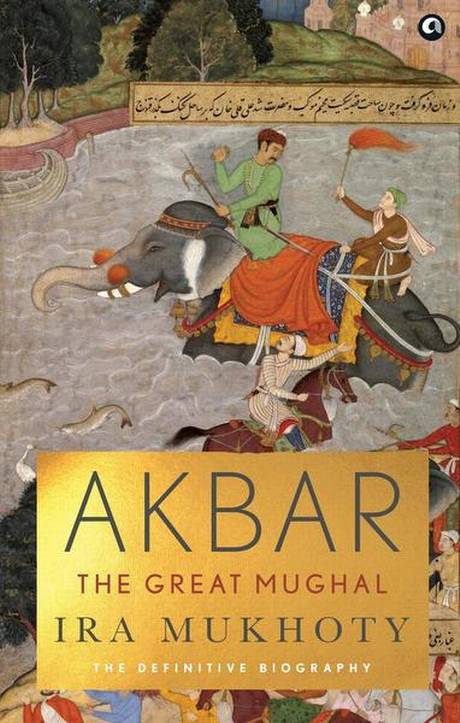
Akbar The Great Mughal: The Definitive Biography; Ira Mukhoty, Aleph, ₹999.
The reviewer is a writer, translator and literary historian.
source: http://www.thehindu.com / The Hindu / Home> Books> Reviews / by Rakshanda Jalil / June 13th, 2020
The Bollywood lyricist and poet says freedom of expression means staying within prescribed limits
People try to be politically correct, but that’s the problem. I have never tried to be: Irshad Kamil
For a lyricist, Irshad Kamil sure has a sense of irony. His caller tune is a song from the Ranbir Kapoor-starrer Rockstar, sung by Mohit Chauhan. It goes: “Jo bhi main kehna chahun, barbaad kare alfaaz mere… Whatever I want to say is ruined by my words.”
Perhaps even more ironic: these words belong to Kamil himself.
I meet Kamil at a five-star hotel in east Calcutta. The 48-year-old is in town to talk about his book — Kaali Aurat Ka Khwab. It is about his first Filmfare Award and the journey to it. He is wearing a T-shirt and ripped jeans, and a jacket with shiny buttons. Perched on his nose are rimless glasses and there is a string of sweat beads on his forehead.
This is the man who has written songs such as Nadaan Parindey, Agar Tum Saath Ho, Patakha Guddi and Baby Ko Bass Pasand Hai. Life. Melancholy. Woman power. Dhinchak. As we get past the exchange of pleasantries and into small talk about how his lyrics are the stuff of social media posts, the soft-spoken Kamil orders another black coffee — his third in an hour.
If moved by his songs you have ever tried or are planning to google the man, know this: you are not getting to know much beyond his work. Discreet, I ask. He replies, “I am not an advertisement.”
But that does not make him reticent either. He is happy to talk about his poetry — turns out he wrote his first one in the late 1980s. He says without sounding the least bit pompous, “The reason people like my poems and lyrics is because I don’t talk about fake emotions. I put myself in the shoes of the audience. And I talk about the real life. Aap samajh rahe hain na? Yeh reality ke zameen se nikle hue shabd hain…”
It seems no one in Kamil’s family had an ear for music. His father was a chemistry teacher at Government College, Malerkotla, and he pushed all his children to study science. Kamil, alas, was an arts enthusiast. He wrote poetry and acted in school plays. In college, he tells me with some pride, he was the prolific writer of love letters for self as well as others. He quotes Urdu poet Bashir Badr as if in a toast to those days, “Jis par hamari aankh ne moti bichhaaye raat bhar, bheja wahi kaagaz usse, humne likha kuch bhi nahin.”
Eventually, our conversation shifts to political correctness in the creative arts, in day-to-day life. “People try to be politically correct, but that’s the problem. I have never tried to be,” he waves his hands animatedly to make his point.
I nudge Kamil towards specifics before he floats away on another rivulet of verse. As a lyricist, does he have freedom of expression? He unleashes a torrent of thoughts, “Of course, there is pabandi [restriction]. What the sarkar calls unrest is basically kranti [revolution] and kranti comes through the pen, through words and writings. People know there are particular forms of art and culture where it all comes from. And this is not new. It has been there since Safdar Hashmi’s times. We have expression of freedom but there are limits too. Till you praise them or agree with them, you have the freedom…”
Kamil wrote a song called Mere Achchhe Din Kab Aayenge for the 2018 film, Fanney Khan — Do roti aur ek langoti/Ek langoti aur woh bhi chhoti/ Isme kya badan chhupayenge/Mere achchhe din kab aayenge. “Just because of this song, the movie was put on hold by the Central Board of Film Certification,” he says. The song was tweaked and later released as Achchhe Din.
Kamil talks about how he dropped out of engineering. He fled to Shimla from his hometown in Punjab. Decided not to return for the next nine months. Joined theatre and earned Rs 45 a show. On returning, he decided to pursue Hindi for his graduation. The writer Irshad Kamil was in the making. His dimples nearly swallow his cheeks as he says, “Some people say I am a closed-door rebel.”
I tell Kamil that for someone who goes by that epithet, he is surprisingly controversy-free and he furrows his brows. “Do you know about Pahal patrika,” he asks. Seeing my expression, he starts to talk about how he is the only “filmi geetkar” to have poetry published in this Hindi literary magazine. He takes out his phone from his jacket pocket and reads out loud a poem titled Jootey — a journey of the shoes by the shoes.
His poem Tum Mujhe Tanaav Do talks about problems of the increasing population and the government and ends with an altered version of the famous line by Subhas Chandra Bose. It reads, “...tum mujhe tanaav do, main tumhe khadi dunga. Tum mujhe khoon do, main tumhe abadi dunga.”
source: http://www.telegraphindia.com / The Telegraph, online edition / Home> People / by Manasi Shah / May 30th, 2020
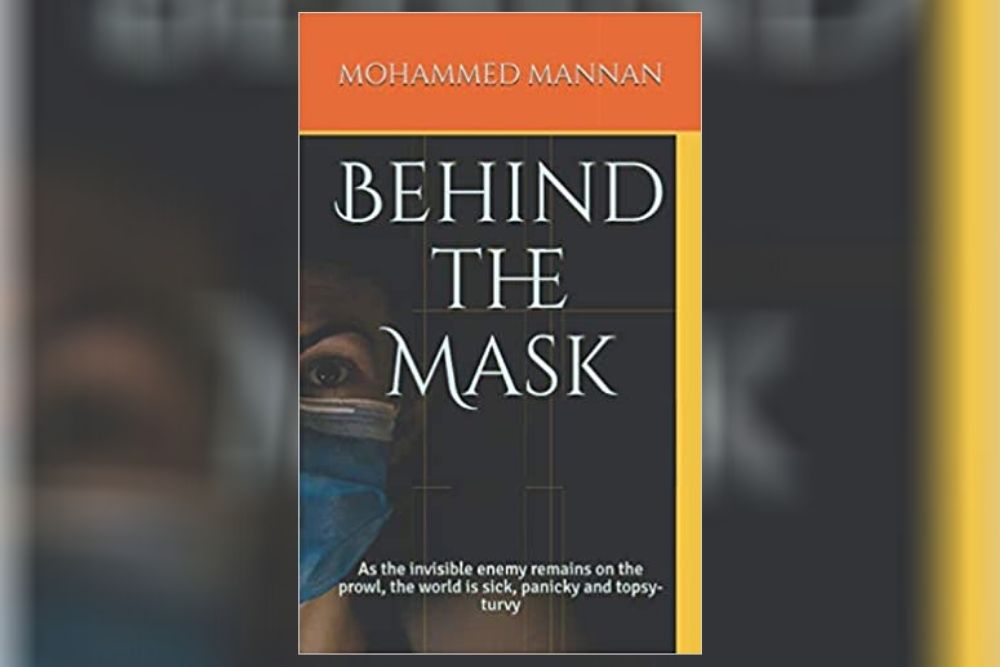
Mohammed Abdul Mannan’s ‘Behind the Mask’ details the origin and spread of the coronavirus and how it has made the world sick, panicky and topsy-turvy.
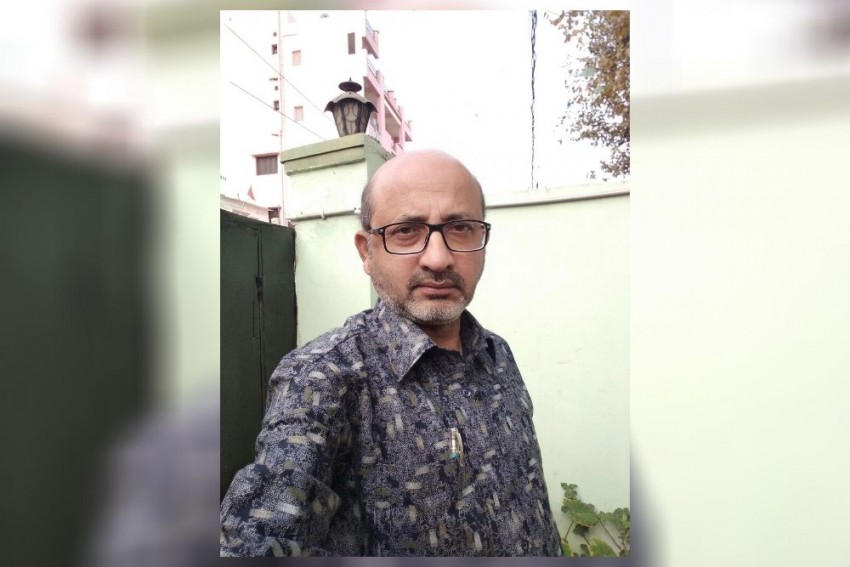
Mohammed Abdul Mannan
The novel coronavirus has infected over 5.5 million people across the world. As countries grapple to contain the Covid-19 crisis, it’s important to discuss the socio-economic fallout of the pandemic.
Mohammed Abdul Mannan’s Behind the Mask answers these questions. The book details the origin and spread of the coronavirus and how it has made the world sick, panicky and topsy-turvy.
How a virus one billionth of a metre size could trigger the 21st century’s second pandemic and why the 15th largest pandemic since the 14th century is massively disruptive on all-fronts. Can the world handle a ‘biblical proportions’ famine and will the world recoup from the US$9 trillion economic impact? The book discusses every aspect of socio-economic impacts of the global pandemic.
This is the eighth book by Mannan who has worked for Deccan Chronicle, Indian Express and India Today, Doordarshan and Zee TV in the past. He also worked as the launch News Editor of Qatar’s second English broadsheet daily, The Peninsula, and later joined Khaleej Times in Dubai. He took a plunge into PR and Corporate Communications with Dubai and Abu Dhabi tourism regulatory bodies. Winner of the first Qatar Tourism Award, his best-seller book had been Dubai – A City Making History.
Behind the Mask is available in print and digital format on Amazon.
source: http://www.outlookindia.com / Outlook / Home> Website / May 27th, 2020