“My biographer has written the book so well I almost did not recognise myself. In order to be a big poet, the poet has to be a crazy lover. I could not become a big poet because I could not reach that stage.” – Rahat Indori, Poet
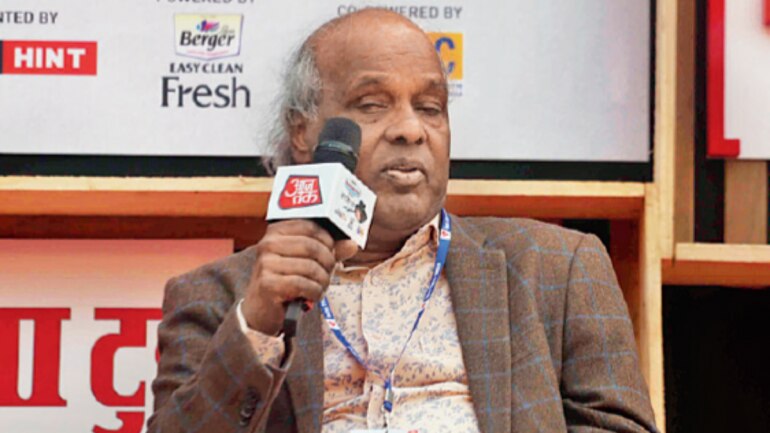
Celebrated poet Rahat Indori at Sahitya Aaj Tak on Sunday
Apne haakim kee fakiri par taras aata hai, jo gareebon se paseene kee kamaee maange, Saara din jel ki deevaar uthaate rahiye, aisee aajaadee ki har shakhs rihaee maange.
This was just one of the couplets recited during the unveiling of the biography of iconic poet and lyricist, Dr Rahat Indori, on the final day of Sahitya Aaj Tak on Sunday. The biography, Rahat Sahab: Mujhe Sunte Rahe Log Waqiya Mere has been written by Dr Deepak Ruhani. The author discussed the making of the biography with his subject, as well as singer-turned politician Hans Raj Hans.
Commenting on the association between Indori and Ruhani, Hans complimented Ruhani on his speed. “You have finished this biography in two years, when many writers take their time writing the and cannot complete them in one decade.”
Ruhani said his association with Indori goes back 17 years. While researching the book, one of the fringe benefits was listening to unforgettable shayari from Indori, he said. “I used to wait for a long time to come and hear him and sat on the grass while he recited the couplets.” Rahat Sahab will be officially released on November 10.
source: http://www.indiatoday.in / India Today / Home> News> Mail Today / by Mail Today Bureau / November 04th, 2019
Eid ul Fitr celebrations take a multitude of forms in our society. As the holy month of Ramzan nears the end, markets all across the country glitter with Eid paraphernalia: confectionery, clothes, bangles, mehendi, objects typically associated with this festive occasion.
But one object is usually missing: Eid cards, because the practice of sending them out has dwindled over the years. It was once routine for most families to spend time selecting, writing and posting Eid greeting cards to friends and families.
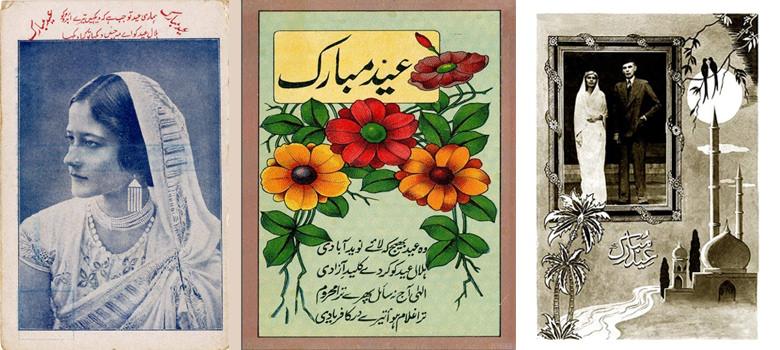
“Eid Mubarak,” an Eid card showing two girls on a swing. The printed message starts with a salutation of a young girl to her elder sister: Muhtarma aapa saheba… (Dear respected sister, my salutations. Despite the distance between us, your favours and love still provide tranquillity to my heart. While extending the Eid greetings to you, I request you to remember me forever in your prayers). Printed by Eastern Commercial Agency, Bombay. Unused, circa 1930. From the Priya Paul Collection, New Delhi. Courtesy: Tasveer Ghar
In the digital age, people prefer to take a faster route to greeting one another. On the eve and day of Eid, they send out a vast number of mobile text messages.
But what were those cards like? Wouldn’t it be interesting to look at some of the old ones, especially when the practice began in this country?
Here are samples from the collections of Yousuf Saeed, a filmmaker, author and archivist based in Delhi, who runs the Tasveer Ghar archive, Ally Adnan, a Dallas, US-based engineer, writer and antique collector, and Omar Khan, who runs Imagesofasia.com, a collection of vintage postcards and lithographs.
“Eid Mubarak,” a floral Eid postcard, published by Hafiz Qamruddin & Sons, Lahore (probably printed in Bombay), and posted from Lahore (sender’s name undecipherable) on 24 December 1935 and arrived at Delhi’s General Post Office on 29 December the same year for the addressee Mr Noor Elahi. The season of Eid-ul fitr or Eid-ul Zuha coinciding with Christmas in these years might have had a bearing on the use of early Eid cards. The sender’s message in Urdu is mostly damaged due to a torn corner of the card. But it basically starts with a salaam and asks about the addressee’s good health etc. Note the British India postage stamps worth half anna and three pies used on the card. From the Priya Paul Collection, New Delhi. Courtesy: Tasveer Ghar
On the Indian subcontinent, the tradition of sending greeting cards on Eid started in the late 19th century, when mass-printed cards started becoming available off the shelf, although some well-off Muslim families continued to sent their own hand-produced cards, sometimes with calligraphy and artistically decorated greeting message.
The trend of sending cards was probably fuelled by the expansion of the railway network, which had increased to 25,000 km in 1880 from just 34 km in 1853, when the first passenger train service was inaugurated in India. With the expansion of railway, people began travelling far away from their homes, for employment and business. It also improved the postal service. In addition, advanced printing facilities improved the quality of cards.
“Eid Mubarak, Hamari Eid to jab hai…” Eid greetings and an Urdu couplet likening the eyebrows of the beloved to Eid’s crescent, featuring Indian actress and singer Kajjan Begum, Unused, circa 1930. Distributed by Sultan Husen Bookseller, Bombay. From the collection of Reena Mohan. Courtesy: Tasveer Ghar
We can see that the early cards resembled European-made Christmas cards, albeit modified for Eid.
In the early years of the 20th century, Eid cards began being printed with India-specific images and illustrations. Hafiz Qammaruddin & Sons, H Ghulam Muhammad & Sons and Muhammad Hussain & Brothers in Lahore, Mahboob Al Matabah in Delhi, and Eastern Commercial Agency, Shabbar T Corporation and Bolton Fine Art Lithographers in Bombay were amongst the earliest companies that came into the business of printing Eid cards in India. Postcards with Indian Muslim architecture, produced by Raphael Tuck in London, were also used for Eid.
No discussion of these vintage Eid cards would be complete without mentioning the Urdu poetry on them written for the occasion.
“Guldasta-e Eid” (a bouquet for eid) title of the chapbook published by Rashid-ul Khairi in 1927, Delhi. Although the chapbook is not a part of greeting correspondence, such literature was produced and circulated in Muslim homes for general reading and reform in late 19th/early 20th century. From the Yousuf Saeed collection. Courtesy: Tasveer Ghar
میرے یاروں کو مبارک عید ہو غمگساروں کو مبارک عید ہو عاشق و معشوق رندو پارسا آج چاروں کو مبارک عید ہو
Eid greetings to my friends, Eid greetings to my sympathisers, Eid greetings to the lovers and the beloveds, the drunks and the pious, Eid greetings to all four of them today.
ہماری عید تو جب ہے کہ دیکھیں تیرے آبرو کو ہلال عید کو اے مہ جبیں دیکھا تو کیا دیکھا
Eid is when I see your eyebrows Just seeing the crescent, my dear, is no Eid.
سب لوگ تو دیکھتے ہیں کھڑے چاند عید کا مشتاق ہوں میں رشک قمر تیری دید کا
While everyone is interested in sighting the moon, I only desire to see your face.
یہ شام عید ہے اے میرے ناقہ محمل چمک کے چل کہ دیار حبیب تک پہنچیں
It is the eve of Eid, oh my camel, Run fast and take me to the city of my beloved.
The tradition of Eid cards continued till the end of the 20th century, diminishing with the surge of mobile and online communication.
Yet those of us who have experienced the joy of handpicking, writing, sending and receiving Eid cards cannot find a substitute in the click of buttons.
This article was originally published on Dawn.com
source: http://www.scroll.in / Scroll.in / Home> Holy Month / by Aown Ali / July 18th, 2015
Actor-turned-producer Sanjay Khan speaks about his second book ‘Assalamualaikum Watan’ and what he is doing during the lockdown
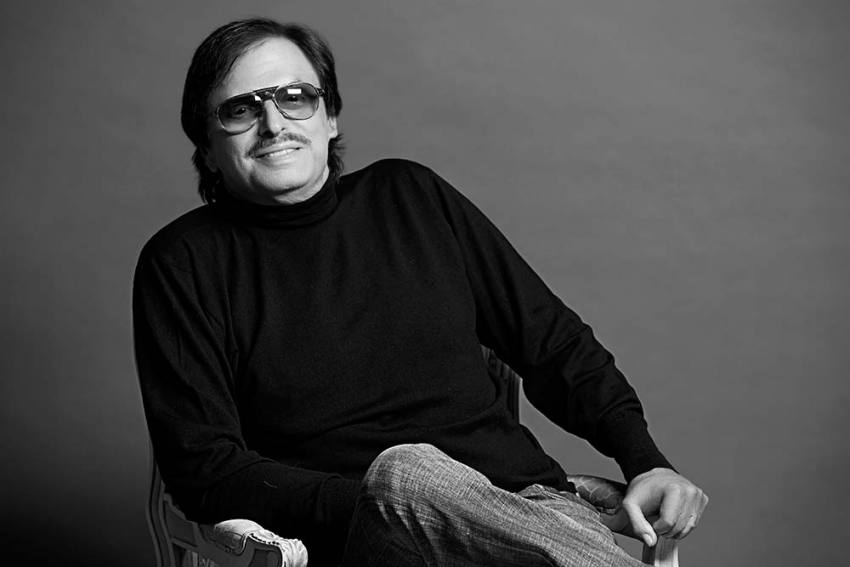
Actor-turned-producer Sanjay Khan’s second book Assalamualaikum Watan dwells on Islam’s history in India’s multicultural society, the role Muslims have played in nation-building and the issues they face. In the book, Khan emphatically declares that he “considers himself an Indian first and then a person of the faith”. In a conversation with Lachmi Deb Roy, he talks about the book and what he is doing during the lockdown.
What is Assalamualaikum Watan about?
Muslims in India number around 200 million. They contribute significantly to the cultural vitality and vibrancy of India. This number represents the second-largest mass of Muslims in any nation in the world. As Indian Muslims, we should feel tremendous pride, a sense of empowerment and responsibility because we contribute to the achievements of Muslims in the world. The age-old saying is ‘safety in numbers’, but there is also ‘inspiration in numbers’. Our social responsibilities should serve as the spark for the guiding light that Indian Muslims can provide. Through the power of education, I would like all Muslims to illuminate their path and contribute to the exchequer by joining the mainstream as involved citizens. This vast human resource can certainly propel the country’s economic growth.
How is your second book different from your first?
They are poles apart. Assalamualaikum Watan deals with the need for education in the Indian Muslim community, while my autobiography The Best Mistakes Of My Life is just my story.
You have had a successful career as an actor. How does it feel to be a writer?
God’s greatest gift to mankind is the art of writing. I feel fortunate to have authored two books.
What are your favourite films?
My favourite film is Raj Kapoor’s Awara, David Lean’s Lawrence of Arabia and Doctor Zhivago. Among recent films, I liked Aamir Khan’s Dangal.
What do you like about world cinema?
The professional finesse, technical excellence, remarkable performances and extraordinary scripts. James Cameron’s Avatar is one of my favourite films.
Which directors do you like?
David Lean, Steven Spielberg, Ridley Scott and James Cameron.
Any plans of returning to acting?
In the past couple of years, I have been offered quite a few roles, but I am waiting for roles that excite me. In the meantime, I have just finished writing the script of a major biopic that I will direct and produce.
What are you doing during the lockdown?
I am keeping myself busy by reading, exercising and talking to friends and relatives. I am trying to reach out to the people working with me and those who are in need. I love watching Hollywood classics. I am also studying new technologies in filmmaking. I listen to Mohammed Rafi, who sang a total of 48 numbers for my films, and Lata Mangeshkar.
source: http://www.outlookindia.com / Outlook / Home> Magazine> Arts & Entertainment> Interview / by Lakshmi Deb Roy interviews Sanjay Khan / May 08th, 2020
Born on February 5, 1936 at Devanahalli on the city’s northern outskirts, Ahmed was a prolific writer in Kannada and penned poems, plays, short stories and novels.
KS Nissar Ahmed
Bengaluru :
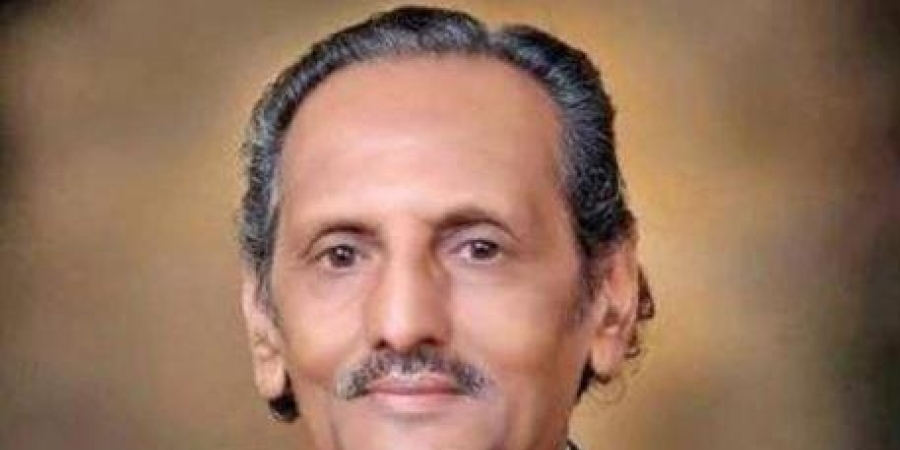
Eminent Kannada poet and writer K.S. Nissar Ahmed passed away here after prolonged illness, an official said on Sunday. He was 84.
“Ahmed died at his residence in the city’s south-west suburb after prolonged illness due to age-related complications,” a state information department official told IANS here.
Born on February 5, 1936 at Devanahalli on the city’s northern outskirts, Ahmed was a prolific writer in Kannada and penned poems, plays, short stories and novels.
A post-graduate in geology, Ahmed worked in the mines and geology department of the state government at Gulbarga in the state’s northern region in the 1950s-60s before moving to Bengaluru to teach the subject (geology) at the state-run central college in the city centre and later at Chitradurga and Shimoga in the state’s Malnad region during the 1970s.
“Ahmed is a recipient of several awards and honours, including Padma Sri and Sahitya Academy award in 2008 and state awards like Pampa in 2017, Nadoja in 2003 and Rajyotsava in 1981,” the official recalled.
Kuvempu University at Shimoga awarded honorary doctorate to Ahmed in 2010.
Ahmed is well known for his poems “Nityotsava” and other popular works such as “Manasu Gandhi Bazaru”, “Sanje Aidara Male” and “Manadondige Mathukathe”.
source: http://www.newindianexpress.com / The New Indian Express / Home> States> Karnataka / by IANS / May 03rd, 2020
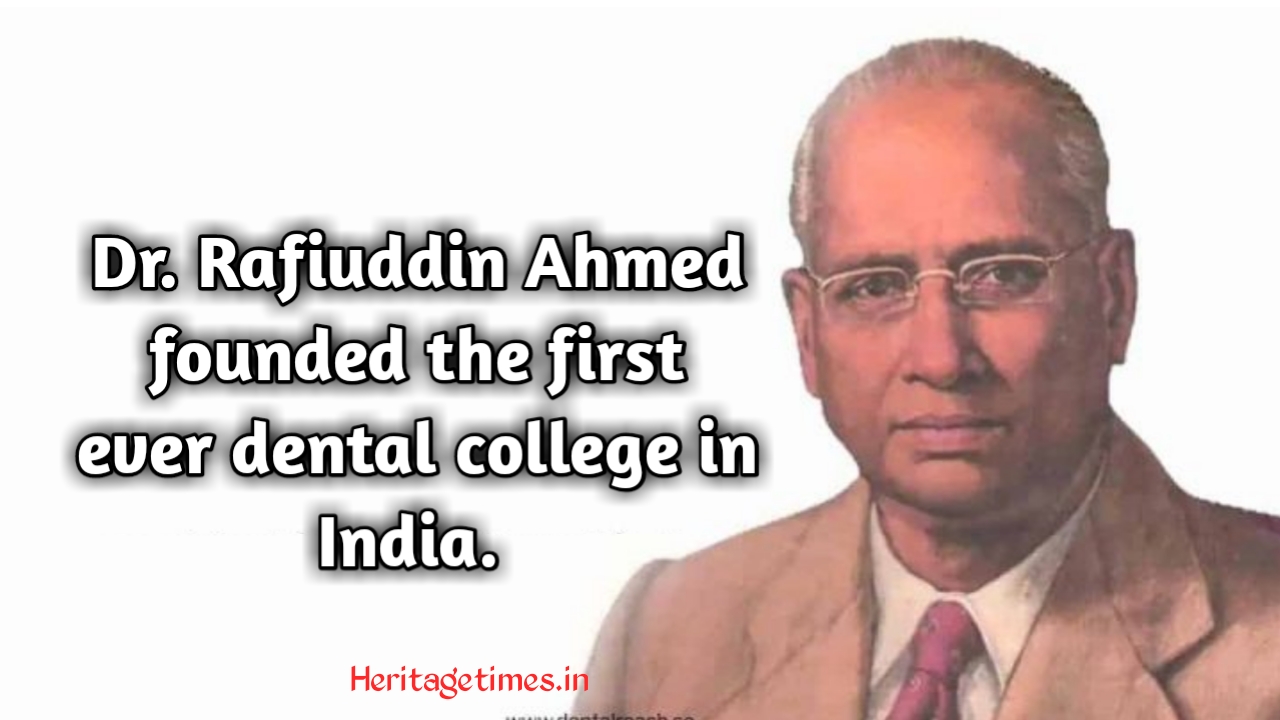
The beginning of this decade, 2020 marks the centennial anniversary of the very reputed Institute, R. Ahmed Dental College in Calcutta, West Bengal, India which was established solely by the effort of the “Father of modern dentistry” of India, Dr Rafiuddin Ahmed in the year 1920.
Dr Rafiuddin Ahmed established the Indian Dental Journal in 1925 and served as an editor till 1946. He published the first student handbook in Operative dentistry in 1928.
It was due to his constant efforts and endless endeavour that the year 1946 witnessed the formation of the Bengal Dental Association which was later renamed as the Indian Dental Association, as it is known today.
Dr Rafiuddin has an exemplary achievement in his professional career. After completing his alma mater from Aligarh Muslim University, He earned his D.D.S (Doctor of Dental Surgery) degree from the University of Iowa School of dentistry, USA in 1915. During the world war- I, he worked at the Forsyth Dental Infirmary for children in Boston, Massachusetts.
In 1919, a year after the war ended, he returned to India to open a dental institute in Calcutta. Initially, the college was run on an experimental basis with only eleven students from 1920 to 1923. Dr R Ahmed took the responsibility of teaching the student both theoretical and practical alongside other dedicated teachers. By 1928, this college was a well- organised institution for scientific dental education in India.
In 1947, Dr Ahmed was awarded a fellowship at the international college of dentistry. He also received a fellowship at the royal college of Surgeons of England and the Pierre Fauchard Academy in 1949.
The founding father of IDA became a minister of the Bengal Government and supervised the Department of Agriculture, Community Development, Co-operation, Relief and Rehabilitation until 1962.
This great personality is an epitome of excellence. His entire life revolved around providing services to the communities. His contribution in the field of dentistry is something to be remembered and truly appreciated. Dr R. Ahmad proved to be an all-rounder. He wasn’t just a dentist, but also was a publisher, an editor, a dedicated teacher, a minister, a president (of IDA). These are just to name a few.
The distinguished achievements of this great personality was recognised by the Government of India and in 1964 Dr Rafiuddin was awarded with the prestigious Padma Bhushan, making him the first Indian Dentist to be honoured with the third highest civilian award of the republic of India.
source: http://www.heritagetimes.in / Heritage Times / Home> Education / by Dr.Zareen Fatima / January 24th, 2020
For years, Akram Allahabadi’s detective novels that were once a rage, had become rarer to find.
Finally, there is good news, as his family has decided to print his novels once again and bring them in public domain.
The website AkramAllahabadi.com has also been put up for the fans of the late author who wrote spy fiction for well over three decades.
Many today may not be aware about the magical world of Urdu detective fiction that was weaved by him.
It was in the post-independence era (starting from 1952-53), when detective fiction in the sub-continent reached dizzy heights.
Akram Allahabadi, who was born in Allahabad, and who had later settled in Mumbai, was among the most popular writers of the era.
In those days, his novels sold like hot cakes. Today, it is unimaginable the kind of following Akram Sahab or Ibn-e-Safi, had among masses.
Akram Sahab created many famous characters. Among them were Inspector Khaan and his assistant Baalay, Madhulkar and Raazi were most popular.
The novels were published in Urdu and Hindi, and were awaited every month by fans in India and Pakistan. But by 1990s, the novels were hard to found, except in libraries or personal collections.
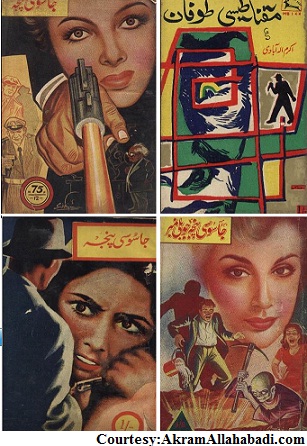
In my childhood, I have seen almirahs full of Jasoosi Panja and Mahnama, in towns in UP. While Ibn-e-Safi novels were republished, Akram Allahabadi’s (or Ilahabadi) works became rare to find.
Sometime back I spoke to a Delhi-based publisher who prints digests that has 2-3 old [Ibn-e-Safi’s] detective novels every month [of course, without caring about royalty].
The publisher said that he tried hard but couldn’t get Akram Sahab’s novels. He asked me if I had any and said that he would love to purchase them and re-publish them.
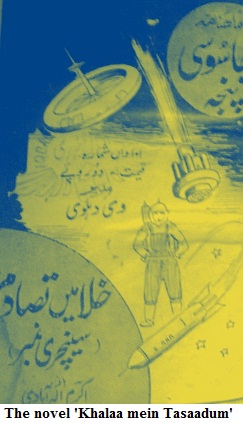
Till recently, Akram sahab’s famous novels like ‘Sputnik’, ‘Junction Bilara’, ‘Salazar Series’ and ‘Operation Venus’ were remembered. His forte was science fiction.
The website brings back the memories of the era. As an ardent fan, I expect at least of his famous novels to be made available [entire text, for free] for visitors to the website.
This would be a ‘tabarruk’ for his fans. Also, those who haven’t read him before, will get to read at least one of his complete work.
The photographs of the master writer and his family, apart from covers of his novels, are treat to his fans. As a fan of the late writer, I am thankful to all those who helped create the website. Hope, they will keep updating and adding more novels to it. It’s very important to keep his legacy alive.
Oxford University Press launched ‘Poetry of Belonging – Muslim Imaginings of India 1850-1950’ by Ali Khan Mahmudabad. The book engages with the question of Muslim rootedness in India
Oxford University Press, the world’s largest university press, launched ‘Poetry of Belonging – Muslim Imaginings of India 1850-1950’ by Ali Khan Mahmudabad on Wednesday. The book engages with the question of Muslim rootedness in India.
The book launch took place in the presence of the author Ali Khan Mahmudabad, Ali Khan Mahmudabad is an academic, columnist, and public speaker. This was followed by a panel discussion and remarks on the books with eminent panellists.
The Poetry of Belonging is an exploration of north-Indian Muslim identity through poetry at a time when the Indian nation-state did not exist. Between 1850 and 1950, when pre-colonial forms of cultural traditions, such as the mushairas, were undergoing massive transformations to remain relevant, certain Muslim ‘voices’ configured, negotiated, and articulated their imaginings of what it meant to be Muslim. Using poetry as an archive, the book traces the history of the mushairas, the site of poetic performance, as a way of understanding public spaces through the changing economic, social, political, and technological contexts of the time.
The book seeks to locate the changing ideas of ‘watan’ (homeland) and hubb-e watanī (patriotism) in order to offer new perspectives on how Muslim intellectuals, poets, political leaders, and journalists conceived of and expressed their relationship to India and to the transnational Muslim community.
The volume aims to spark a renegotiation of identity and belonging, especially at a time when Muslim loyalty to India has yet again emerged as a politically polarizing question.
The Author is currently an assistant professor of history and political science at Ashoka University, Sonipat.
source: http://www.nationalherald.com / National Herald / Home> Reviews & Recommendations / by NH Web Desk / February 27th, 2020
In the anxiety to label Indian architecture as Hindu, Buddhist, British imperial and Islamic, the buildings lost some of their power to evoke wonder and surprise.
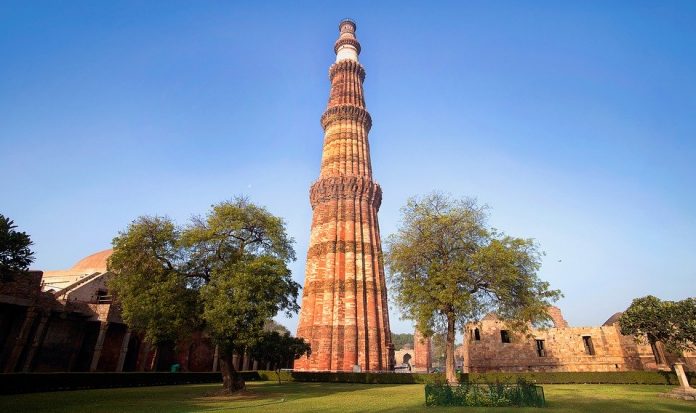
Qutub Minar in New Delhi | Commons
In the 1950s and ’60s, visitors to Delhi’s Qutub Minar often saw a crowd of schoolchildren following an unlikely Pied Piper, a frail man in a white kurta and pyjama, wearing a Gandhi cap, and giving them their first lesson in art history. Mohammad Mujeeb was one of those iconic professors who communicated just as easily with schoolchildren as he did with college students and his colleagues. He instilled in them a love for historic cities, made them see the places as works of art.
In those years, the Delhi skyline and groundline were dominated by monuments. For many families, these landscapes were synonymous with Sunday picnics. For art historians, these spaces became popular hunting grounds, and a number of case studies on architecture took shape in the 1970s.
But the lay reader was more familiar with surveys of Indian architecture. Of these, Percy Brown’s books were the most sought after. His volumes, Indian Architecture (Buddhist and Hindu), and Indian Architecture (The Islamic Period), published in 1942, contain amine of information. However, because he divided the theme in a binary, he missed out on capturing the special quality of the 14th-17th centuries — the cosmopolitanism in architecture — when rich and powerful rulers, irrespective of religion, engaged skilled artisans and engineers from across south and west Asia to design beautiful public spaces.
Architectural crossover
In that era of increasing globalisation, artisans met and exchanged recipes for architectural design, and travelled great distances, confident of their patronage. Guilds from the Middle East were employed to design the great pillars of Yorkminster, and Indian stone-masons learned structural engineering from Uzbek architects. Chinese porcelain gave its name to the funerary monument Chini Ka Rauza (China Tomb) in Agra. British tourists to Italy brought back fragments of Roman sculpture to display proudly in their country estates, while Feroz Shah Tughlaq had two Ashoka pillars (only no one knew what they were) ferried to Delhi from Meerut and Topra (Haryana), to embellish his mosque and his estate on the Ridge.
James Fergusson, in the mid-19th century, had sought to make sense of the myriad buildings in India. He found it simplest to classify them by ‘style’. Function, it was assumed, shaped the form, and buildings were labelled ‘Buddhist’, ‘Hindu’ or ‘Islamic’. The term ‘Indo-Saracenic’ was coined to describe styles with elements of both, as well as for the British imperial style, which deliberately included decorative Indian elements. In this anxiety over labels, the buildings lost some of their power to evoke wonder and surprise, to speak to the hearts and minds of the people.
Indian-Muslim architecture
Both mosques and tombs adopted from and adapted to the local environment, which is why Mujeeb insists that they be described not as ‘Muslim’ but as ‘Indian Muslim’. They, and other public areas — streets and walled gardens — made for beautiful cities, with a quality of repose and of camaraderie. Soaring arches and minars (towers) connected the earth to the sky, to heaven. (Mujeeb was too much of a rationalist to fall for the belief that djinns lived in historic buildings and could fulfil people’s prayers.)
Communal practices do shape houses of worship — and there is a fundamental difference of form between a congregational masjid (‘beauty without mystery’) and a mandir, where there is mystic communion between deity and worshipper. As for the tomb: “[It] was a symbol of unifying life, death and eternity; primitive beliefs associated with kingship gave the royal tomb a mysterious significance…The tomb of a ruler was the expression of personality, of a force which the community needed to maintain its self-confidence in a world of conflicts,” Mujeeb wrote in The Indian Muslims (1967). He was not averse to sounding tongue-in-cheek while describing Humayun’s mausoleum: “There is nothing we know of Humayun that would justify our regarding him as an outstanding personality; his tomb is much greater than he.”
The urban architecture of early modern India has some of the features of Persian or Turkish cities, but is most similar to those of Rajput kingdoms, contemporary with those of the Mughals. Both were shaped by the climate, conditioned by topography, the fact that they were built by skilled stone-masons rather than brickworkers, and by the deliberate choice of Indian ornamental motifs.
The Indian-Muslim architect rejoiced in being “free from the beginning, free from fear and hatred, from law and custom, from the conflicts of ideals and interests. There were no limits fixed except those of his own aptitude and means, and the nature and availability of structural material.” They created an architecture that was not just frozen music, but also frozen poetry. It was both the architecture of Urdu poetry and the poetry of our architecture that made cities in India the grandest in the early modern age.
This article is the seventh of an eight-part series on ‘Reading A City’ with Saha Sutra on www.sahapedia.org, an open online resource on the arts, cultures and heritage of India.
Dr Narayani Gupta writes on urban history, particularly that of Delhi. Views are personal.
Srinagar, JAMMU & KASHMIR / London, UNITED KINGDOM :
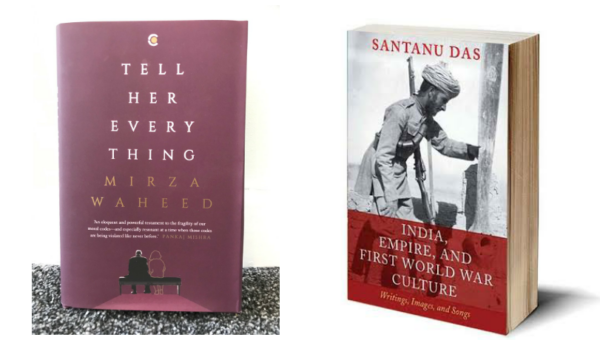
The Hindu Prize for Fiction and Non-fiction for 2019 have just been announced. Mirza Waheed for Tell Me Everything (Context) and Santanu Das for India, Empire, and First World War Culture: Writings, Images and Songs (Cambridge University Press) have been awarded the literary prize, in the fiction and non-fiction categories, respectively, by the jury.
The citation for Waheed’s award read: “An extraordinary work of fictionwhose complexity, depth and narrative mastery would be hard to match in contemporary world literature.” According a report in The Hindu, the panel described the book as “a compelling novel, both a narrative tour de force and an exploration of a profound existential and moral conundrum.” The fiction jury panel had Navtej Sarna, Nilanjana Roy, Pradeep Sebastian, J Devika and Rajeswari Sunder Rajan.
The citation for Das’ award read “a sensitive exploration of the human dimensions of a major modern war that reshaped global politics and culture in fundamental ways,” and “helps to re-examine the scholarly and popular imaginations of the First World War which have tended to ignore the involvement of close to over a million Indians in it, and in particular, the tens of thousands among them who lost their lives.” The non-fiction jury panel included Kamini Mahadevan, Chandan Gowda, Harsh Sethi, Rustom Bharucha and Shiv Visvanathan.
The shortlist for the awards announced earlier included (apart from the winning books):
Fiction: The Assassination of Indira Gandhi by Upamanyu Chatterjee, The Queen of Jasmine Country by Sharanya Manivannan, Latitudes of Longing by Shubhangu Swarup and Heat by Poomani, tr. Kalyan Raman.
Non-fiction: Early Indians by Tony Joseph, Polio by Thomas Abraham, The Transformative Constitution by Gautam Bhatia and The Anatomy of Hate by Revati Laul.
The Hindu, in its report on the award , has also said that “The prize is usually awarded at a ceremony during The Hindu’s annual literature festival Lit For Life. However the 2020 edition had to be cancelled due to a challenging environment. An award ceremony to be held on March 28 was also cancelled because of the COVID-19 pandemic. The Hindu Lit For Life will be back in January 2021″.
source: http://www.silverscreen.in / SilverScreen India / Home> News / by Silver Screen India Staff / March 26th, 2020
Today, we remember these 5 powerful Indian Muslim feminist writers, who wrote boldly of issues that were considered taboo, shattering gender roles and stereotypes in their fierce writing and the politics they advocated for.
Watch this video detailing the life and times of luminaries like Ismat Chughtai, Rashid Jahan, Begum Rokeya, Wajida Tabassum and Qurratulain Hyder. #IndianWomenInHistory
source: http://www.youtube.com /
source: http://www.feminisminindia.com / Feminism In India (FII) / Home> History / by FII Team / November 09th, 2017