Category Archives: Books (incl.Biographies – w.e.f.01 jan 2018 )

Another historical for Kannada

KARNATAKA :

MahmoudGawanMPOs26ocy2018

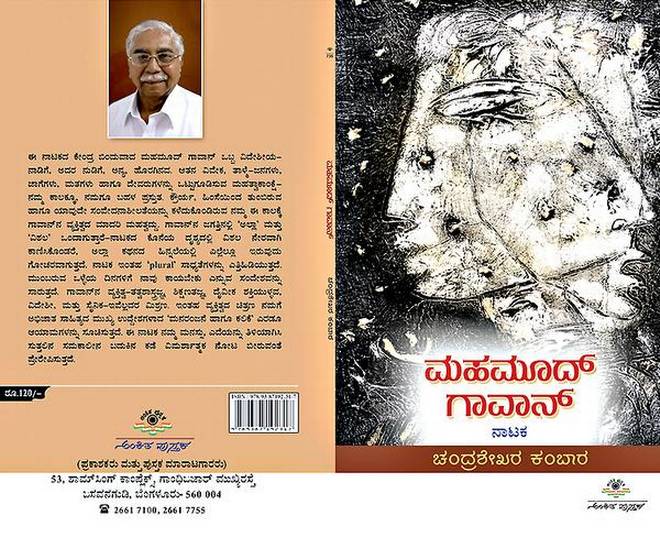
Chandrashekhar Kambar’s new historical play, Mahmoud Gawan, based on the life of the merchant who arrived in Bidar and later became the Prime Minister of the Bahmani Sultanate, will be released on Sunday

The word “global” is something that we come across not infrequently in literary discussions in recent times. It seems to be used in a very complimentary manner too. When we study it more closely, we see its multiple uses, ranging from the highly complimentary to the particularly disturbing connotations (especially, in the political and economic aspects of the so-called “globalization” phenomenon). Depending on the context, the philosophy implied in this use is vastly interesting.

In this context, dipping into pardonable autobiography, I must confess that my early acquaintance with the kind of writings I found in Chandrasekhar Kambar (this was back in 1964) was very new to my navya taste-buds of those days. This was around the time he wrote Helatini Kela . But, by the time Jokumaraswami arrived, I had begun to sense the fascinating spread of his literary intentions. The play seemed to insist on a message of passion (closely related to sexuality, the body, as well as the body politic!). The legitimacy of this passion was far more powerful than any petty legal correctness, or any mundane understanding of what constitutes the “moral” in our society. I was of course reminded of Lawrence. Kambar was utilizing passion as a powerful motive-free force, and constantly pushing at obstructions in its way. I became an avid follower of Kambar’s growth as a writer. His use of “sexuality” as a central and powerful theme and his struggle out of its grasp.

The latter part of his career witnesses an attempt to cover areas of creativity which could not be accommodated inside the constrictions of this strong force (note, however, a sliver of this sexuality is noticeable even in his latest play,Mahmoud Gawan ). I would assert that it is this constant and consistent presence which turns all of Kambar’s writing into his legitimate oeuvre.

Here was a writer, who, on the one hand was close to the North Karnataka folk and at the same time could engage the political and the modern predicament of our lives. You see this everywhere beginning from Helatini Kela , Rishyashringa , or Jokumaraswamy to the recent works like Shikharasoorya , Shivana Dangura orMahmoud Gawan . I would like to go back to what I began with, the idea of the “global” in relation to Kambar’s works. In what sense is Kambar global? It is true that at least in one of the recent novels globalisation and neo-colonialism figure predominantly (in Shivana Dangura ).

Could we try to identify an effort, more indirect, and subtler perhaps, to highlight an earlier moment in history, a moment that marked the international and inter-cultural ferment that characterised North Karnataka in his play, Mahmoud Gawan ? Interestingly, the choice of language in Gawan is not the kind of North Karnataka folk that Kambar worked with in say Helatini Kela or Jokumaraswami. I would describe the language of Gawan as Kambar’s idea of “neutral” Kannada, a conscious avoidance of the folk dialect. Again, look at the choice of the central figure in this play, Gawan. Hee is a foreigner, a non-Kannada person. He enters the world of Bahamani politics in the North Karnataka of fourteenth and fifteenth centuries. All these, I would venture to suggest, point towards a movement, a possibility, beyond the strictly local and Kannada contexts. In other words, Kambar is found testing his talent in handling something beyond what could be identified as exclusively Kannada, Karnataka. The significance of this kind of language use is for Kambar like playing a field without his arch-player—the folk tongue! Does he succeed in working this language, playing in this new field? Perhaps in a manner that is different from say Jokumaraswamy , where he is using sexual passion in order to design and project the drama experience, he is trying to move into other spaces in which his choice of an “other” Kannada could function adequately. This kind of language lends itself more easily to translation across other linguistic contexts. The absence of localism in itself is a strong pointer towards achieving such a global presence.

Could we simply say perhaps that Kambar moved from passion to politics—apparently, it seems so. This also begs the question, why? It is my opinion that an author like Kambar, a writer of immense literary imagination, constantly feels the need to move out of his familiar area of creativity and attempts to work in other new areas. As a result, politics becomes the main driving force in a play like Gawan . Overall, he succeeds in creating a layered experience of such historical and political play-fields. In Gawan , you see an extension of the literary Kambar, of Kambar’s entire literary oeuvre. And to say that is to acknowledge a serious happening in contemporary Kannada literature.

Finally, I invite my reader to look at Mahmoud Gawan, the protagonist. Here is a foreigner, theoretically foreign to the land and its language. His wisdom and his calming presence, his overarching ambition to unite people, places, religions, and gods—these are things crucially and painfully relevant to us and our times, times of cruelty and abhorrent insensitivity. In times where you see the cream of the population failing to respond to the degradation of all that is human, all that is noble and valuable in human experience.

In Gawan’s cosmos, Allah and Vitthala still fuse brilliantly—one as the implied presence and the latter as the explicit presence in the final scene. The play moves towards a certain sense of legitimization of this conclusion, the hope of better times to come. In a way, the encompassing presence of Gawan—the philosopher, educator, the saint, foreigner, and a soldier—should take us back to the classical idea of the function of literature, what literature should do—“to educate and entertain.” A closer look at the play would also perhaps clear our hearts and minds, making us look around at our own times with a sharply critical eye.

(Mahmoud Gawan by Chandrashekhar Kambar will be released on October 28 at 10. 30 a.m., Indian Institute of World Culture, B.P. Wadia Road, Bangalore).

(The author is a critic and musician of repute)

source: http://www.thehindu.com / The Hindu / Home> Features> Friday Review / by Dr. Rajeev Taranth / October 26th, 2018

Amer Ali Khan releases book on ‘Karbala’

Hyderabad, TELANGANA :

KarbalaMPOs24oct2018

Hyderabad:

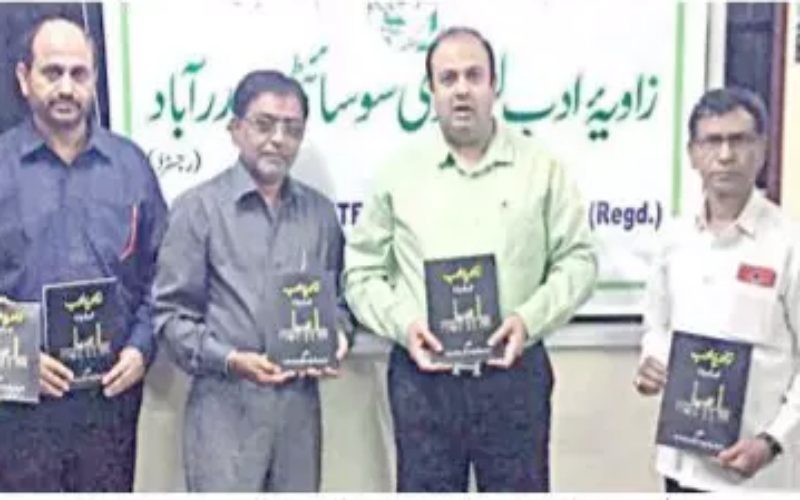
Mr. Amer Ali Khan, News Editor of Siasat Urdu Daily released the Sovenir of “Zawia Adab” society.

It is the first book of the society. In his speech, Mr. Amer Ali Khan told that the incident of Karbala is the eradication of evil forces and support of the values of Islam.

On this occasion, he made a references to various literary books published in English, Hindi and Urdu right from Meer Taqi Meer to the present day.

At the beginning of the function, Mr. Mazharul Haq, President of the society highlighted its aims and objectives.

Present on the occasion were Mr. Ali Anjum Sadiq, Mr. Ali Inayat, Mr. Baquer Mehdi Abedi, Mr. Akhtarul Hasan and Mr. Meer Haider Ali.

Mr. Faraz Rizvi thanked Mr. Amer Ali Khan and the audience.

source: http://www.siasat.com / The Siasat Daily / Home> Hyderabad / by Sameer / October 23rd, 2018

‘Nur Jahan is the history of India’: Historian Ruby Lal on her new book

INDIA :

In an interview with Indianexpress.com, Lal spoke about the incredible achievements of Nur Jahan. Remnants of imperial orders issued by her, coins minted in her name, paintings that paid ode to her sovereignty and bravery are all evidence of the enormously powerful figure she was.

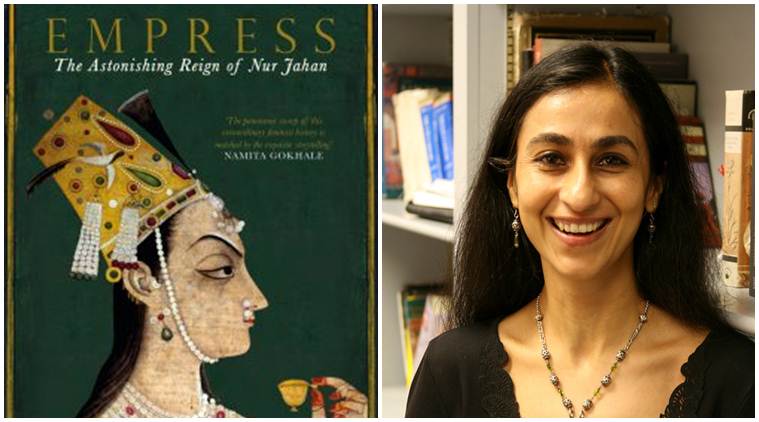
Left- Cover of the book ‘Empress: The astonishing reign of Nur Jahan’ (wwnorton.com) Right- Historian Ruby Lal (personal website of Ruby Lal)

For four centuries, from when she was at the centre of one of the largest empires of the world, Nur Jahan, the twentieth and supposedly the most loved wife of Mughal emperor Jahangir, has been a household name in the Subcontinent. Though she was not officially the ruler of Mughal India, Nur Jahan has been noted by historians to be the real power behind the throne. A politically astute and charismatic figure, she ruled Mughal India as a co-sovereign of Jahangir and is known to have been more decisive and influential than he ever was. Historian Ruby Lal in her latest book, ‘Empress: The astonishing reign of Nur Jahan’, dives deep into the intriguing world of the only woman to have helmed the Mughal empire. Tracing her life in great detail, Lal attempts to rip apart narratives of romance and exoticism that surround the image of Nur Jahan and focus upon what made a Muslim woman living in seventeenth-century India, one of the most authoritarian figures in Indian history.

In an interview with Indianexpress.com, Lal spoke about the incredible achievements of Nur Jahan. “People say she always sat right next to Jehangir in the court and that if some cases or decisions came up and if she agreed with him, she would pat him on the back and he would say yes to that decision,” says Lal who is Professor of South Asian Studies at Emory University in Atlanta. Remnants of imperial orders issued by her, coins minted in her name, paintings that paid ode to her sovereignty and bravery are all evidence of the enormously powerful figure she was. Charting the life history of Nur Jahan, and placing her in the background of the pluralistic cultural space that Mughal India was, Lal puts together an evocative biographical account of the queen.

Here are excerpts from the interview with Lal.

Popular perception of Nur Jahan is somehow constricted to the romantic relationship she shared with Jahangir. Why is that the case?

There is a very long history of the erasure of Nur Jahan’s power that I chart in the book. As she traveled through the length and breadth of the country with Jahangir – issuing imperial orders, hunting a killer tiger near Mathura, discussing the expansion of the empire- she rose to being the co-sovereign. This does not mean that in her own time people did not raise eyebrows. In 1622, her stepson and Jahangir’s son Shah Jahan had risen in revolt. The catalyst for his revolt was the moment when Nur Jahan arranged a match for her daughter from her first marriage, Ladli; she chose the youngest prince, Shahriyar for her. About that time, Shah Jahan went into rebellion against Jahangir. And its is very clear that he felt threatened; he knew about the power of Nur Jahan. In fact, Shah Jahan and Nur Jahan had been closely aligned. The year 1622 is when certain chroniclers begin to write about the chaos that Nur Jahan Begum had raked up between the father and son.

“There is a very long history of the erasure of Nur Jahan’s power that I chart in the book,” says Ruby Lal. (Wikimedia Commons)

So the early criticism appears to begin around this time. The other major moment of critique of Nur’s power was when they were on their way to Kashmir and Mahabat Khan (who went on to capture Jahangir later in 1626) goes on the journey with them to a certain distance and according to one of the chroniclers he says to Jahangir that a man who was governed by a woman is likely to suffer from unforseen results. In 1626, she, completely visible, goes to save Jahangir (sitting upon an elephant on a roaring river), commanding all men including her brother Asaf Khan. She stratergises and eventually saves the emperor. After this, we begin to come across a word called Fitna, in the records.

Fitna is a very loaded term in Islamic history. It is used for the first time during the Shia-Sunni split for civil strife. It was also used against Ayesha, Prophet Muhammad’s favourite wife, when she went on a battle against Ali who was eventually the leader of the Shias. Over time, the word came to be used against women’s visibility, their sexuality and so on. Following 1626, this is one word that is used repeatedly against nur – that is to say that her power produced chaos.

Later, in the Shahjahanama, we find that at one point that the chronicler lists her power as a “problem”: the Shahjahanama reverts to the male inheritance of power and completely undoes her co-sovereignty with Jahangir.

Then there were also visitors to India like Thomas Roe, the ambassador of James I of England who follows Nur and Jahangir through the camps in Gujarat and Malwa. He calls her the Goddess of heathen impiety.

In the 19th century orientalist renditions of the romance of Nur and Jahangir become very important in the histories of the time; later, the colonial renditions highlight and forward such stories. Nur Jahan becomes classic oriental queen. Thus, a long-standing history of the erasure of the power of an astonishing emperess. It is certain that the erasure of Nur’s power travels into modern times and we only hear about her romance with Jahangir, not about her work as co-sovereign of the empire.

Jahangir is often compared with Akbar and criticised for being an uncompetitive, flamboyant king, who spent much of his time in drinking and merrymaking. But the fact that it was during the reign of Jahangir that a woman became so powerful, what does it say about his attitude towards women?

You are right, this is how Jahangir has come to be imagined. There are a range of scholars who for sometime now have been rethinking Jahangir’s reign, his philosophical and artistic engagements. My book foregrounds the ways in which Jahangir seeks to go differently from how Akbar articulated his sovereignty. If you look at the reigns of Babur and Humayun, there was no stone harem: the kings were nomadic and forever on the move. During Akbar the Great, for the first time in Mughal history, the imperial harem is built in stone in Fatehpur Sikhri. For the first time in the Ain-e-Akbari, women are declared as ‘pardeh-giyan’ which means “the veiled ones.”

“My book foregrounds the ways in which Jahangir seeks to go differently from how Akbar articulated his sovereignty,” says Ruby Lal. (Wikimedia Commons)

But what Jahangir does is that he goes back to the ethics of Babur. He was constantly wandering, he was constantly moving. The ethics of a peripatetic life and movement, which contributed to the co-sovereignty of Nur Jahan. Nur Jahan is the biggest example of Jahangir’s attitude towards women. An 18th-century chronicler that advances the Jahangirnama to the end of Jahangir’s death had suggested that the emperor had once claimed that he had given the sovereignty to Nur Jahan Begum and that he was quite content with his wine and meat. It’s an allegorical statement: and one indicates his admiration of Nur, something that he chronicles in his own memoir

Would Nur Jahan be this powerful had she not been married to Jahangir or had she not been part of the Mughal empire?

I think, Nur Jahan, looking at her whole life history and context, would have expressed her power differently in other circumstances. Her life history shows her dynamism and boldness. Of course, as I have been saying, and detail in the book that the plural landscape of Hindustan was very important- in that that it fostered experimentation and all sorts of ways of being (alongside war other challenges of co-existence of multi-confessional identities). We should also remember that she comes from an important Persian family background, deeply invested in poetry, arts, calligraphy. Then her own initiative must be highlighted: there were other women in the harem – and indeed Nur walks in the tracks of these women’s power – but no one becomes a co-sovereign. That speaks something about her boldness, her endeavours and of course her ambition.

Islamic societies are often noted to be more regressive compared to others in their treatment of women. In your book do you try to subvert this notion?

I Am trying to suggest that Nur Jahan is the history of India. She was a Shia married to a Sunni Muslim who was also half Hindu Rajput. Further, Nur Jahan is the only woman ruler among the great Mughals of India (there are technical signs of being a sovereign and informal signs, both of which I detail in the book). That is the history of India. As far as Islam is concerned, people should know that there were incredible and powerful women in Islamic history all the way through. We have Ayesha, Raziya, we have Nur Jahan Begum, we have any number of powerful women. It is also the multicultural world. In the modern world, we tend to think in terms of fixed identities. People in early modern times were much more open. Jahangir was engaging with Siddichandra, a Jain monk. Nur Jahan used to tease him about the pleasures of the flesh.  What does this tell you? It tells you about an open engagement. It tells you about how experimental Islam is, how mixed Islam is, how vibrant Muslim women are and how Islam is so deeply attached to India.

‘Empress: The astonishing reign of Nur Jahan’ has been published by W.W.Norton in the United States earlier this month and will be published by Penguin Books in India soon.
source: http://www.indianexpress.com / The Indian Express / Home> Research / by Anrija Roychowdhury, New Delhi / July 11th, 2018

Shahryar — A Life in Poetry review: Dream merchant

Aonia,Bareilly / Aligarh – UTTAR PRADESH :

ShahryarMPOs14oct2018

Why a flag-bearer of modern Urdu poetry chose to be moderate

In 1936, Munshi Premchand made a seminal speech, Sahitya ka Uddeshya(‘The Aim of Literature’), to the Progressive Writers’ Association. While asserting that literature is meant to critique society, the novelist said it can never regress into propaganda. The point applies to the work of Shahryar, who was born, reportedly, in the same year. For, while being a self-avowed Marxist, he refused to be bracketed into the categories of ‘modernism’ or ‘progressivism’. Finding his voice in the post-Nehruvian period of disillusionment in the 1960s, he turned his gaze inward, into the inner struggles of an individual, while not remaining oblivious of the external environment.

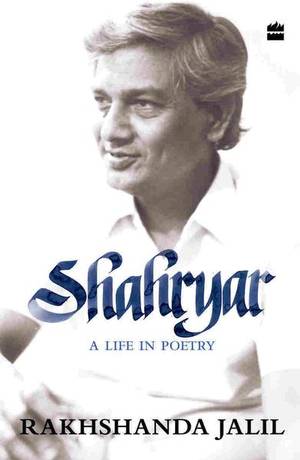
Rakhshanda Jalil stresses in Shahryar: A Life in Poetry that his tone was one of moderation. The poet, who was among the flag-bearers of the jadeed (modern) shayari, did not declaim, he whispered into the reader’s ears his thoughts on social issues. One example is Ek Siyasi Nazm (A Political Poem), where he gently chides a neighbour who has passed on his communal hatred to his children.

Some of the leitmotifs that occupied the poet’s imagination were sleep, dreams and night. His most famous collection, Khwab ke Dar Band Hain (The Doorway to Dreams is Closed), paid tribute to his favourite theme, khwab (dream). In its title nazm, he presents the night as freeing the eyes of the protagonist not only of all ‘sins’ but also of dreams, an act that he calls a punishment.

The poet, among the four Urdu writers to have been given the Jnanpith, is remembered outside Urdu literary circles, and especially among cinephiles, for his association with filmmaker Muzaffar Ali. The partnership resulted in Gaman, Umrao JaanAnjuman and the incomplete Daman and Zooni. It is when Jalil delves into this side of Shahryar that her arguments become a bit problematic, especially when she says that there exists a dichotomy between film lyrics and poetry.

Here, Sahir Ludhianvi’s write-up to his fellow poets is instructive. While Ludhianvi acknowledged that a nagma nigar (lyricist) doesn’t have the freedom of an adabi shayar (poet), as he is constrained by the film’s screenplay and characters, he added that his own attempt was to elevate film lyrics to the status of high art. It is when a film’s lyrics rise above its mere narrative that they take the form of art. What Jalil ignores is that a poetry lover would use such lyrics as a trigger to delve deeper into a poet’s corpus. An appreciation of Seene Mein Jalan won’t stop at listening to the song; it would progress to a reading of Ism-e-Azam, the collection from where the ghazal was taken.

Shahryar: A Life in Poetry; Rakhshanda Jalil, HarperCollins, ₹599.

source: http://www.thehindu.com / The Hindu / Home> Books> Reviews / by Hari Narayan / October 13th, 2018

The palace of delights

Mandu (Dhar District), MADHYA PRADESH :

ManduMPOs13oct2018

No rainy day can be better spent than roaming around Mandu’s Jahaz Mahal, with Jahangir’s words as guide

“What words of mine can describe the beauty of the grass and green flowers? They clothe each hill and dale, each slope and plain. I know of no place so pleasant in climate and so pretty in scenery as Mandu in the rainy season,” wrote Jahangir in his memoirs.

On a misty morning in July, we entered the hilly kingdom of Mandu with these words echoing in my mind.

In 1401, Dilawar Khan, the governor of Malwa who was appointed by the Delhi Sultans, took advantage of the chaos resulting from Mongol attacks and declared his independence. He shifted the capital from Dhar to Mandu (Mandav) and renamed it Shadiabad, or City of Joy. When Ghiyasuddin Shah (1469-1500 AD) came to the throne, he decided that his father, Mahmud Shah I, had expanded the kingdom enough. All he wanted to do was enjoy life. Handing over the affairs of the kingdom to his son and heir, Nasir Shah, Ghiyasuddin Shah gave himself up to a life of delights. He was a connoisseur of food, and his recipes are sealed in an illustrated book, Nimatnama, that is with the British Library and has been translated into English by Norah M. Tiley as The Sultan’s Book of Delights.

A life of pleasure

Ghiyasuddin Shah wasn’t joking when he declared that he wanted to devote himself to a life of pleasure. He filled his harem with women who were trained in various disciplines for which they had an aptitude. While some were singers, dancers, painters and chefs, others were trained to be his guards and personal soldiers. He established a madarsa and educated the women to be proficient in religious as well as secular subjects. There were Qazis, schoolmistresses, hunters, scholars, embroiderers, and accountants among them.

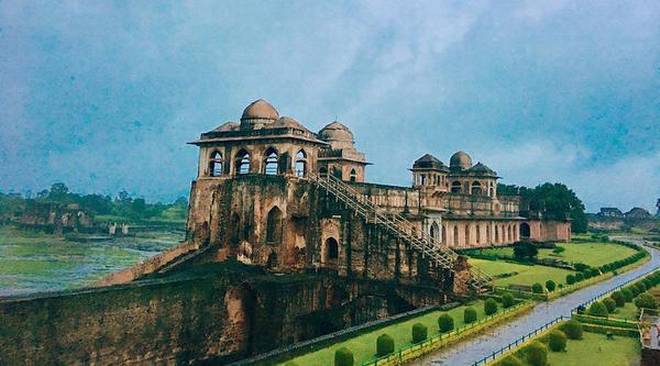
We drove straight to Jahaz Mahal, a stunning building, named as such because its shape, when it fell on the water tanks surrounding it, looked like a ship.

All the guides and stories will tell you that Ghiyasuddin Shah built it to house his harem. A probably exaggerated figure of his harem was given by Jahangir, who wrote it as 15,000. That figure is gleefully quoted by local guides, with perhaps a hint of envy on their faces.

After Dilawar Khan established the Malwa dynasty he got architects and craftsmen from Delhi. The early buildings bear a stamp of the Tughlaq and Khilji architecture of Delhi.

The Jahaz Mahal, however, is a flight of imagination and takes yours along with it. I could see girls dancing and singing in the rain on the rooftop and in the courtyards, their shadows reflecting on the Munj Talao and Kaphur Taloo surrounding it.

The strains of Megh Malhar were flooding my senses, and in my mind’s eye I could see the arcades being lit up by the lanterns and lamps that were floating on the water, glimmering and dipping along with the wind, glowing like fireflies.

I could smell the heavily laden kadhais (woks), with samosas and baras being fried. As the illustrations of the Nimatnama show, the Sultan took a keen interest in, and was perhaps supervising, the correct temperature of the oil, the salt in the filling. How golden was the result?

Who knows? All I know is that I was transported back to the 15th century as soon as I entered the long, double-storied Jahaz Mahal through its main arched, marble entrance. At the back, every arch of the continuous arcaded 360-feet building opens on to Munj Talao. I don’t know how close it was originally to Kaphur (Camphor), now called Kapoor Talao, but now this is quite a distance from it. There are manicured lawns between it.

Initially it was decorated with glazed tiles and colourful friezes. Now we have the unfortunate graffiti that people are wont to inscribe on monuments. The cool corridors and pillared compartments were made for dancing and singing.

Nur Jahan accompanied Jahangir to Mandu in 1617 and the palace complex of Mandu enchanted the royal couple.

A magical bubble

Jahangir sent Abdul Karim in an advance party to repair the buildings. He was so pleased with the result that he rewarded him with the title of Ma’mur Khan (architect Khan). Mandu is a treasure house of water harvesting. There are also bathing tanks. There are two in this palace, on both the floors, shaped like a tortoise with steps going in. Now devoid of water, one can imagine women going to the toilet there, with roses and lotus flowers floating in the perfumed waters.

The roof has a few open pavilions and kiosks on its four corners. While I was there on the wet, open terrace, the mist came and blotted out everything around. We were trapped in our very own magical bubble.

source: http://www.thehindu.com / The Hindu / Home> Opinion – Where Stones Speak / by Rana Safvi / September 03rd, 2017

Victoria’s secret: Karim’s great grandson lives in Bengaluru!

Bengaluru, KARNATAKA :

The family had moved to England at the Queen’s behest, bringing great solace to an increasingly homesick Karim, said Mahmood.

 Javed Mahmood, Abdul Karim’s great grandson
Javed Mahmood, Abdul Karim’s great grandson

It was an April morning in Bengaluru and Javed Mahmood, as was his custom, sat down to flip through the newspapers. The year was 2010, nearly two decades since he had moved to the city to live a quiet retired life. His relatives were scattered between Bengaluru and Karachi, as they had been since Independence. Very little remained of the family’s rich history, much of what they had left was lost in the traumas of Partition and mostly forgotten. That summer morning in 2010, however, everything changed. Mahmood found, to his astonishment, that Indian author Shrabani Basu’s Victoria and Abdul: The True Story of the Queen’s Closest Confidant had uncovered the truth behind his great grandfather Abdul Karim telling a tale of friendship and loyalty. Mahmood talks to Darshana  Ramdev about a family that has been steeped in history since, with his father, Anwar being a founding member of Bata in 1933.

“I rushed at once to the British Council and asked them to help me contact her,” said Mahmood, whose grandfather, Abdul Rashid, was Karim’s adopted son. “We didn’t actually know he was adopted until Karim’s death in 1909 and the inheritance had to be dealt with.” The family had moved to England at the Queen’s behest, bringing great solace to an increasingly homesick Karim. “The Queen made them feel very much at home my grandfather received the same education that Edward VII and the rest of her children had earlier received.” The Queen, who was aware of the couple’s inability to have children, sent her personal physician, Dr. John Reid, to examine (much to his horror) Karim’s wife.

Abdul Karim with his adopted son, Abdul Rashid in England

“Abdul Karim had been greatly maligned by historians the Queen’s family may have wanted to destroy all trace of his presence in the court. Ms Basu had gained access to hidden archives, however. Our family still had a few documents – the diary being one of them, so Shrabani and I hopped on a plane to Karachi at once!” Karim’s descendants there were understandably wary, but Mahmood succeeded in coaxing them to part with the diary. Like most people of the time, Karim maintained meticulous written records into his life, which helped set the record straight on the stream of allegations that had been made against his character. “The diary proved beyond doubt that their relationship was marked by great affection, but had remained platonic always,” said Mahmood.

Javed Mahmood’s father, Anwar Mahmood, was one of the founding members of Bata in 1933. He started the Trot Shoe Company in 1963, setting up a second factory in Whitefield in 1970.

It contained valuable insights into Queen Victoria’s much loved Munshi, or teacher, the prepossessing young man who won the affections of a foreboding monarch with a reputation for a heart of stone. He was presented as an orderly to the Queen, which he didn’t like it was not a fitting position for the son of a landed ‘doctor’.  He soon found himself promoted to Munshi, leading the now ailing Empress to a discovery of India. The Queen’s love for her young munshi drew jealousy, hatred and racial prejudice in a society known for its repressive puritanical leanings. Neither cared, however, with the Queen sticking her neck out on numerous instances to defend her young friend. “She was always caring and appreciative of our customs every Eid, she would walk across the grounds to Karim Cottage (on the Osborne House estate) to visit the family.” They were, in turn, invited up to the palace for tea during Christmas “The Queen would even have the windows covered with silk curtains so Karim’s family could keep the purdah. He was also a wonderful cook  he would cook for her on occasion, as an act of love.”

Little was known of his life after the Queen’s death in 1901: Karim and his family were unceremoniously deported, almost at once, by a jealous Edward VII, who been aroused to such fits of rage that he had even attempted to force his mother to abdicate from office, on grounds of insanity. “Soon after the Queen’s death, King Edward arrived at Karim Cottage in Osborne House and ordered Rashid, who was a teenager at the time, to scour the house for any heirlooms or documents that contained the royal insignia. The little they could salvage, including Karim’s diary, returned with him to Agra in 1901, where he died eight years later. “He died at the age of 48 and the family was given his inheritance,” said Mahmood.

These remained with the family for some decades, until talk of Partition began to do the rounds. “We were a fairly prominent family and were advised at the time to shift temporarily to Bhopal, until the trouble blew over,” said Mahmood. This they did, greatly underestimating the scope of the problem and packing only the essentials. When the Partition took place, the family was evacuated to Mumbai, but many of the treasures were lost in transit. “The diary was with my grandfather, who was the custodian of Karim’s things.” The family moved to Karachi, save for Mahmood’s mother, Begum Qamar Jahan and two sisters. The diary went to Pakistan with them. “One of the sisters eventually shifted to Pakistan too,” he explained.

Meanwhile, in 1933, Bata, which was a burgeoning Czech company, found itself in hot water after the nation was declared Communist. The company decided to set up a factory near Calcutta, where leather was widely available. The large Muslim population in the area was another perk, providing the tannery services they so badly needed. “My father, Anwar Mahmood, was one of the founding members of the company,” he said. He joined the company at the age of 16 and worked there for nearly 30 years before he started his own business, the Trot Shoe Company. The first factory was set up in Kolkata in 1963 and the second in Whitefield, in 1970. “The organised shoe industry didn’t exist in South India and the Karnataka government had offered businesses a number of benefits, which led us here,” said Mahmood. Natural rubber, an important raw material and was grown abundantly in Kerala, making it easily accessible.  “My elder brother managed the factory here, I handled the one in Kolkata and my parents shuttled between the two cities. When my younger brother was ready to start work, we established a third branch in Hosur.” Javed Mahmood and his younger brother still call Bengaluru home.

Mahmood tells his story from San Francisco, where calls have been pouring in from across the world since the release of the film, Victoria and Abdul. “The film is doing very well, it’s being shown at local theatres here as well and friends have been getting in touch to tell me how much they enjoyed it,” he smiles.

“My great grandfather’s relationship with the Queen had been presented as scandalous and sleazy he was falsely accused of every imaginable sin. Ms Basu read Karim’s diary cover-to-cover and brought those insights into the second edition of her book.” And that’s how Abdul Karim’s story received its long overdue re-telling, well over a 100 years after his death in 1909. “Queen Victoria was a woman far ahead of her times, rising well above the prejudices that so plagued her society, to defend the young Indian man she called a friend. I think there’s a lesson in it for all of us even today.”

source: http://www.deccanchronicle.com / Deccan Chronicle / Home> Nation – In Other News / by Darshana Ramdev, Deccan Chronicle / October 14th, 2017

Mosques in Dravidian-Islamic style: About the Islamic architecture in Tamil Nadu

TAMIL NADU :

The 17th Century Kilakarai Jumma Mosque

The kallupallis are reminders of the region’s cultural and architectural traditions

Among the many inscriptions at the Vaishnavite shrine of Adhi Jagannatha Swamy at Thirupullani, about 10 km from Ramanathapuram in southern Tamil Nadu, there is one about a grant for a mosque. This particular inscription of the late 13th Century by the Pandya King Thirubuvana Chakravarthy Koneri Mei Kondan, describes the grant made to the Muslim Sonagar, to build a mosque at Pavithramanikka Pattinam. While no one today has a clue as to the exact location of Pavithramanikka Pattinam, the region has many ancient mosques like the rest of Tamil Nadu. What is unique about these mosques is that they were all built of stone, in the Dravidian architectural style with Islamic sensibilities.

Unlike north India, Islam came to the south through maritime spice trade even as it was spreading across Arabia in the 7th Century. The Muslims who were traders enriched the country with precious foreign exchange, and hence were accorded a special place by the Tamil rulers of the day, and often received grants to build mosques, like the one at the Adhi Jagannatha Swamy temple.

As mosques are called Palli Vaasal in Tamil, and they were built of kal, the Tamil word for stone, they came to be locally known as kallupallis. These kallupalliswere essentially built more like mandapams, better suited to Islamic requirement for the congregation to assemble and stand together in prayer.

Engraving of Tamil calendar for prayer found inside the mosque

With guidelines for the construction of mosques being simple – such as prayer facing Mecca, no idol worship and clean surroundings, the masons who worked on these mosques under the supervision of religious heads restricted themselves to carving floral and geometrical motifs instead of human figures as in a temple. “While the raised ‘Adisthana’ of the Hindu temple was retained, there were no ‘Garbha Grahas’ and no figurines carved on any of the pillars” says Dr.Raja Mohammad, author of Islamic Architecture in Tamil Nadu.

For more than a millennium, hundreds of such mosques built in the Dravidian Islamic architectural style came up across Tamil Nadu, often with the help of grants from the rulers of the day, ranging from the Cheras, the Pandyas, the Venad kings and the Nayaks to the Sethupathis of Ramanathapuram. Across Tamil Nadu, wherever Tamil Muslims lived in large numbers, from Pulicat near Chennai to Kilakarai, Kayalpatnam, Kadayanallur, Kottar, Tiruvithancode, Madurai, etc., one finds these beautiful kallupallis.

Amongst these kallupallis, though not the oldest, the most beautiful mosque is to be found at Kilakarai, near Ramanathapuram. A medieval port town with a predominant Tamil Muslim population, Kilakarai has many mosques built during different eras spanning many centuries. The one built towards the end of 17th Century is the most beautiful of them all. It is believed to have been built by the great merchant and philanthropist Periathambi Marakkayar, also known as Seethakkathi, whom the Dutch records speak of as a great trader having considerable influence with the Sethupathis, the then rulers of Ramanathapuram.

The mosque built in the Dravidian architectural style of the late Vijayanagara period, has elements that are specific to native traditions. Like many other kallupallis, this mosque too has Podhigai, the floral bud detailing on the pillar corbels, which represent positivity and auspiciousness, an essential part of the cultural beliefs of the land. An interesting engraving found in this mosque is the Tamil calendar for prayer.

What is unusual about this calendar is that, timings for prayers in the various Tamil months are marked in Tamil numerals, a rarity, found in just a few other mosques in southern Tamil Nadu.

These mosques, deeply embedded in the Tamil culture, were also places where Tamil flowered. Further down south, at the Kottar mosque in Nagercoil, an early Tamil Islamic literary work, Mikuraasu Malai, was presented to the assembled congregation by Aali Pulavar in the late 16th Century.

Mikuraasu Malai, a palm leaf work

Mikuraasu is a Tamilised form of Mihraj, and narrates a significant event in the life of Prophet Muhammad (Pbuh), his ascension to the heaven. Even after 400 odd years, the tradition of singing Mikurasu Malai on the eve of Mihraj continues to this day at the Kottar mosque. Other literary works such as Seera Puranam, a Tamil epic on the history of the Prophet, are also recited across mosques in Tamil Nadu.

The Kallupallis in Tamil Nadu stand as proud reminders of not just an architectural tradition but also of cultural traditions, where Islam effortlessly adapted itself to the native customs.

source: http://www.thehindu.com / The Hindu / Home> Society> History & Culture – Anwar’s Trail / by Kombai S. Anwar / November 23rd, 2017

Second Lucknow ‘fixed’ in sepia

WEST BENGAL :

Liveried servants of the Nawab of Oudh wait with a palanquin in one of the rare photographs of Metiabruz, during Wajid Ali Shah’s time. The royal insignia is embroidered on the back of one of them. Copied from the original by Rashbehari Das

A portfolio of fast-fading photographs that provides possibly the only pictorial document of the second Lucknow that Wajid Ali Shah had created in Metiabruz, after he was exiled there, is urgently in need of preservation. The photographs are, moreover, some of the earliest examples of the art as practised the world over.

Amjad Ali Mirza of Garden Reach Road, in his 60s, who is a great-great-grandson of the ruler of Oudh, possesses the photographs. But he doesn’t know how to preserve these friable prints whose sepia has, in some cases, turned a ghostly shadow of its former self. Says Mirza: “I have no doubt about the authenticity of the photographs. The portfolio is ancestral property. It was handed down to me by my uncle, Yaqub Ali Mirza, who died in 1973.” Some of the photographs are captioned in Urdu. But the identity of the photographer shall always remain a mystery. Oscar Mallitte, a French commercial photographer, we know, had captured a view of the village at Garden Reach, circa 1864, but there is no evidence he did this assignment.

Abdul Halim Sharar (1860-1926) tells the story of Oudh in his book Lucknow: The Last Phase of an Oriental Culture. In it, he has also documented the last days of Wajid Ali Shah in Metiabruz, where he set up a city whose splendour surpassed Lucknow’s glory in the pre-Mutiny days. The palaces, pleasure gardens and zoo that the Nawab had created on the banks of the Hooghly come alive in these photographs, not much larger than postcards. It is as if chemicals and light had “fixed” the scenes that Sharar’s readers conjure up in their mind’s eye.

Soon after the Mutiny had fizzled out, the Nawab was released from confinement in Fort William and he returned to Metiabruz. There, while turning abstemious, he developed a passion for animals and for building beautiful houses. Before the Zoological Gardens was established in Alipore in 1876, the Nawab had already acquired a large menagerie that included rare birds, deer, horses and an open-air snake-pit that left visitors awestruck. But after Wajid Ali Shah’s death in 1887, Metiabruz became a hell-hole almost overnight.

The photographs prove that Sharar, when he described Metiabruz, never deviated from reality. Unlike the Lucknow architecture, with its embarrassment of stucco ornaments, the buildings of Metiabruz are constructed on the lines of European bungalows. The lines are simple but no less grand than the palaces of Lucknow.

Overlooking the river or surrounded by expanses of water, they are connected by bridges. Flags flutter on their tiled roofs. There is hardly any Islamic influence in their architecture, save a low-rise with triple minarets. Ostriches, deer, sheep and horses were the showpieces of the Metiabruz parkland. The snake-pit resembles a giant termite hill. One can almost hear the harsh calls of the clumsy pelicans and cranes strutting around the aviary. The liveried servants wait outside the palace gate with a palanquin. The piscine insignia of the royal family of Oudh is stitched on to the back of one man’s coat. There are two significant photographs. In one, the gang of smiling labourers carry construction material on their heads as they create the new Metiabruz. Another shows the buildings of Metiabruz being demolished. An exquisite way of life being wiped away forever.

source: http://www.telegraphindia.com / The Telegraph / Home> West Bengal / by Soumitra Das in Mirza / July 14th, 2003

A Place for Us a ‘quintessentially American’ tale? Fatima Farheen Mirza answers

Hyderabad, INDIA / California, U.S.A :

Writing about an immigrant Muslim family in America, A Place for Us author Fatima Farheen Mirza says she wanted to place their lives and concerns at the centre of the narrative.

Visiting India for the first time five years ago, author Fatima Farheen Mirza visited the masjid (mosque) where her parents had her nikkah (wedding), in the city of Hyderabad. Fatima was then the same age that her mother was the same number of years ago.

“A man was sitting outside in the courtyard, threading flowers that would decorate one of the shrines. I asked if I could have one flower, because I wanted a souvenir of the place, and he denied me. I remember telling him, ‘But my mother got married here’. And he looked at me, asked me to wait for a minute, and then threaded an elaborate string of flowers that I could tie to wear in my hair. I’ll never forget it.”

This is how Fatima describes that moment. It is almost as if this passage has filtered out of the consciousness of one of the characters of her famous debut, A Place for Us. As a family gathers for the nikkah of their eldest child, the obedient, precocious doctor Hadia, their youngest, the delinquent, the errant Amar, cannot be found for the family photograph. This is a family, but the discord is unbelievable, and the silhouette of the elephant in the room grows darker and darker.

“I wanted to do my best [for] this family. I wanted to do justice to their lives, I wanted to understand their experience with as much complexity and care as I possibly could. I loved them, and it was a privilege to be able to write about them,” says Fatima about the book’s keenly felt impulses, its ability to pick up life’s mundane moments lying unnoticed in our midst and light them up with meaning. A Place for Us was recently chosen by Sarah Jessica Parker — Carrie Bradshaw of the hit American sitcom Sex and the City — for her publishing debut with her imprint for Hogarth Press. And while Parker has called it a “book about a quintessentially American family”, Pulitzer Prize-winner novelist Paul Harding has exalted it as “a work of extraordinary and enthralling beauty”.

Born and raised in California, it is natural to assume that Fatima not only spoke and wrote English for the majority of her life, but wrote about characters that belonged to a certain place, a certain way of life. How did the book come about? “Writing has always been a part of my life. Recently, I was surprised to find a story from when I was maybe seven or eight, because it was written in both Urdu and English—an impulse that returned when I was working on the novel. But throughout high school, I wrote about characters with names like Corrie, and now I wonder if my imagination had internalized the belief that stories belonged only to the kind of characters I’d grown up consuming. I remember pausing when I first wrote the name Hadia, how I not sure if I could proceed, but once I started writing about this family, I was committed,” says Fatima.

But conceptualising Hadia — which means the ‘guided one’, and is the ideal daughter, freethinking but also committed and devoted, and thinking for her — surely must have come somewhere from inside Fatima, who was once pursuing medicine, and has similar beliefs about religion and autonomy?

“Once seeds from one’s own life are planted into the novel, they are altered by the personality of the characters, and begin to take on their own significance. I might relate to the pressure Hadia feels to pursue a medical career path in order to make her parents proud, or Amar, keeping journals and looking to lines of poetry as a way to make sense of his own life — but the way these pursuits and pressures manifest in Hadia and Amar’s life is theirs alone,” Fatima shares.

At a moment in the novel, Hadia, soon to turn nine, contemplates intensely on the looming prospect of wearing the hijab, which her faith requires of her. With religious symbols coming under a lot of fire lately throughout the world, how does choosing or rejecting the hijab empower Hadia or her mother Layla? “Each character is aware of what the world wants from them. They have to navigate what their community, family, and faith want from them. It can be difficult, in the face of all of this, to know what they want for themselves. Figuring out their desires and attempting to make choices is what each of the characters contends with,” she says.

“[So], they are empowered when they make a choice that is aligned with their inner voice. This also applies to religious practices — Layla is empowered when she wears the hijab, and Hadia, when she decides not to.” And indeed, when not touching your deepest impulses about life and relationships, A Place for Us is a work about the significance of choices: An otherwise patriarchal father passes on a watch meant for a son, to his daughter. A deeply conservative mother gathers the courage to roll up her shalwar to meet her little son in the river. A young couple in love chooses to continue to meet in private, risking everything at stake for their families.

In this book about a quintessentially American family, white characters make short appearances as the immigrant minority dominates the focus, and their customs and sensibility — Sunday school, the significance of prayer, community gatherings — comes to the forefront of an American consciousness. Can one interpret this novel, then, as an attempt to envision a new America?

“This is rather [my way] of presenting the experience of living in America that is true to these characters. I wanted to place their lives, their concerns, at the centre of the narrative. If what results is a version of America that seems new, then what that speaks to is the lack of adequate representation in literature — because these lives are here, they have been here, and they have stories to tell,” Fatima says.

Modest though she may be — Fatima has undeniably mastered the art of sticking to describing life through memory. From the first scene, the narrative shifts into a series of flashbacks, in no particular sequence, from the collective consciousness of this family. From the parents’ wedding in India, their relocation to the US, the birth of their kids, the little moments as they grow up — the childhood stories, picnics, crushes, school, their rivalries and revelries — the narrative reveals itself both all at once and in parts.

And she explains the systematic revelation and withholding of information that take place through such a technique. “The [flashbacks] appear the way memories rise in a mind trying to understand something about one’s past — seemingly at random, skirting around a conflict, until enough context is understood that the centre of the conflict can be tunneled towards.”

Most of A Place for Us is poetry, and poetry is what moves its author. “I loved and returned to The Lover by Marguirite Duras and The Great Fire by Shirley Hazzard. I listened endlessly to Samuel Barber’s Adagio for Strings, trying to pay attention to the mood and movement in it, and how that could translate into the way I thought about the structure for the sections within the novel. I wrote and rewrote quotes by Muhammad Ali into my journal to stay focused,” says Fatima, who is learning boxing these days.

Interact with the author @Prannay13

source: http://www.hindustantimes.com / Hindustan Times / Home> Books / by Prannay, Hindustan Times / September 19th, 2018

Get the taste of a culinary story

KERALA :

UmmiAbdullaMPOs01oct2018

A Kitchen Full of Stories, a coffee table book on Mappila cuisine, released

Every ingredient has a story to tell, and the dishes are like a great story, as chef Regi Mathew described cooking in a nutshell.

Similar is A Kitchen Full of Stories, a coffee table book released on Saturday. The book, in a mix of stories and recipes of traditional Mappila cuisine, documents the culinary journey of its writer, Ummi Abdulla.

Alongside are anecdotes from her growing years and tips from her own kitchen. The book that has evolved over seven years was conceptualised by her grand-daughter, Nazaneen Jalaludheen.

Releasing the book, N. Ram, chairman, The Hindu Publishing Group, said, “It goes without saying that this book is indispensable to anyone interested in Mappila cuisine. At one level, it is a cookbook — a practical guide to and celebration of Mappila kitchen treasures. But it is more than that. It introduces us to the culture and tradition of a community.”

“In a wider sense, it is a celebration of the idea of India, the rich diversity and plurality and the secular spirit of its historical civilisation that has come under stress and challenge today. It is the celebration of the greatness of our historical civilisation, which has welcomed influences from anywhere in the world,” he said.

Nandini Rao, chairman and managing director, Orient Blackswan, said coconut, coconut oil and rice formed the foundation of all food from Kerala.

“But Arab influences in Mappila cuisine are clearly evident and provide an element of surprise. A Kitchen Full of Stories evokes not just the food of the community but also the customs and traditions of the community that has contributed to the richness and diversity of India,” she said.

Ms. Jalaludheen said being a self-published book, they used crowdfunding as a way for people to book in advance. S. Muthiah, historian, Geeta Doctor, author and S.R. Madhu, writer-editor were present.

source: http://www.thehindu.com / The Hindu / Home> News> Cities> Chennai / by Staff Reporter / Chennai – September 29th, 2018