Urdu writer Rahman Abbas on the challenges of being defiant
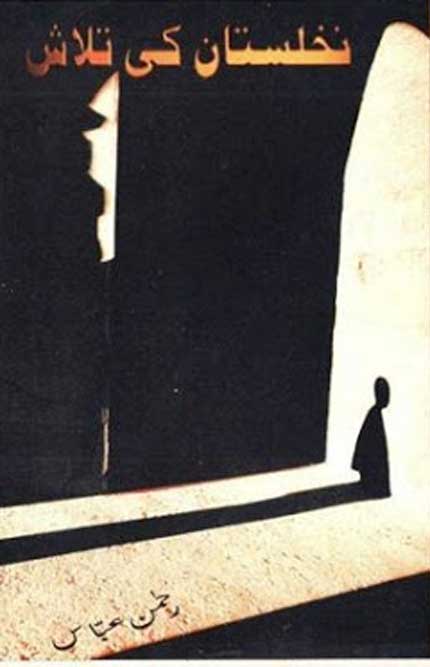
A few paragraphs were all it took for the trouble to start. Thirteen years ago, Urdu writer Rahman Abbas was booked for obscenity for his debut novel Nakhlistan ki Talash, a love story set in Bombay following the 1992-93 riots. The offending two or three paragraphs dealt with love and sex.
It’s been more than 10 years since that particular combination of words got him arrested and two since the case of obscenity was closed. But aside from polishing the rawness of a first novel, he probably wouldn’t change the words.
“I may [take] care about a few words; I will use those words but will try to use them more creatively,” he says, when asked what he would have done in hindsight. “But I don’t think there is any word we should hide. I, for one, cannot.” He continues, “As Manto said, you say ‘breast’ for ‘breast’, you can’t use another word. Or for a ‘chair’ you have to say ‘chair’, you cannot say ‘donkey’.”
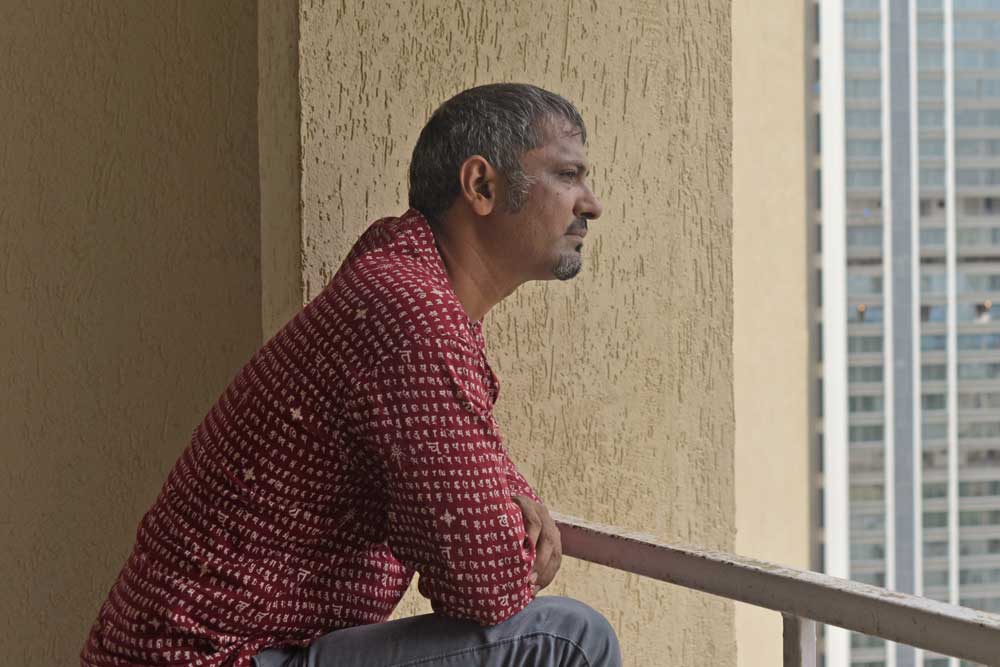
A medium-height man with a soul patch and a disarming frankness, Abbas, 46, is currently translating Nakhlistan into English, and expects it to be published next year. He has just come back from a tour of Germany with the German translation of his fourth and latest novel Rohzin—the first time any of his novels has been translated. Next month, Rohzin’s English translation, by Sabika Abbas Naqvi, is slated for release. Set in Mumbai, the love story opens with the flood of July 2005 and won a state Sahitya Akademi award in 2017.
But to a general audience Abbas, a former teacher, is still perhaps best known as the writer who found himself in the crosshairs of an outdated legal provision: Section 292 of the Indian Penal Code that punishes obscenity in writing and art.
“I don’t regret what happened,” he says. “These are the challenges you have to face as a writer or creative person. If your society is orthodox, it is your duty to challenge the orthodoxy.”
And that is precisely what he plans to do. Since the police case that changed his life, Abbas has left the teaching profession, won and returned a Sahitya Akademi award, won and retained a Sahitya Akademi award, and is in the incipient stages of launching a broader campaign against Section 292. That section, among others, has for years been a part of the restrictive free speech architecture that bedevils Indian writers and artists.
“There is freedom for people to protest against a book, to dislike a book. I respect that freedom. If I have the freedom to write, people have the freedom to criticise,” says Abbas, who won his first state Sahitya Akademi award for his third novel, Ek Mamnua Mohabbat ki Kahani . “But a [legal] provision that gives people an opportunity to send a writer to jail, that should be stopped.” He adds, “For a democracy, this is crucial.”
The first step, Abbas believes, is to galvanise public opinion through writing and advocacy against Section 292 in particular. A public interest litigation (PIL) opposing the use of this provision against writers and artists is already in the works.
Abbas is also busy working on a fresh piece of Urdu fiction, his first literary effort since the case against him was closed in 2016, liberating him in several ways. “For my next novel, I will try to explore the things I couldn’t explore in my previous three novels,” he says. “Since the case has ended, I feel I am free to write.”
Abbas denies the impact that fame— or infamy—can have on the reception of a work. “I think if you aren’t a good writer, it will not help,” he says. “Nothing can help.” He names Sadat Hasan Manto and Ismat Chughtai as illustrious Urdu predecessors who were prosecuted (though ultimately unsuccessfully) under the same law he was. Then he chuckles: “There is no single example of bad writers having any problem.”
Good or bad, Indian filmmakers and artists have consistently faced oppressive free speech laws, whether through criminal prosecution, government bans or threats from conservative factions.
In 2016, various groups protested against Tamil writer Perumal Murugan’s One Part Woman and sought a ban on it. In 2015, Jharkhand-based writer Hansda Sowvendra Shekhar’s The Adivasi Will Not Dance was banned by the state government on allegations of having violated Section 292, among others. Earlier this month, the Supreme Court dismissed a plea seeking a ban on the Malayalam novel Meesha. To Abbas, this is part of a wider pattern. “English writers enjoy more freedom than us. I don’t know why. Alice Walker’s novel was in our syllabus and used those same words that I did and went to jail for,” he says. “On the one hand, the Government makes you read a book; on the other hand, if you use the same word in your text, you are a criminal.”
Though he was let off without a trial—the complainant told the court she had misunderstood the offending passages and the case was closed—Abbas spent one night under arrest in Arthur Road jail until his lawyer was able to complete the bail formalities. “It was quite a humiliating process,” he says, its memory still fresh more than a decade later. “When you go to jail, you feel your whole freedom is gone, that you will never get out of there.”
The experience was both debilitating and transformative. “I remembered Manto and wrote about how I felt the pain of Manto,” says Abbas, a touch dramatically. “If you are a writer or journalist and you experience jail, you understand the importance of freedom. I had it when I was writing; when it is stopped, you realise the importance of maintaining it. It’s not only your struggle, but a struggle of humanity.”
Though he lost his job, was pilloried at the time by the Urdu media, and still faces the censure of conservative Muslims, he now has more enthusiastic readers, he believes. “Now my writing has been accepted in a big way. Urdu readers are not that narrow minded,” he says. “They are openly reading and I am happy when young people appreciate the work which the previous generation had condemned.”
Abbas taught at a Muslim institution for several years and was also the principal of one. He later decided to leave academia and joined a think-tank fulltime in 2012. “If you are liberal Hindu, you won’t work in an RSS shakha,” he says of leaving that minority institution. “It is very conservative. Through education, they want to promote their religious ideas. I believe education should be 100 per cent secular; there shouldn’t be any discussion on religion. But now both communities are insisting on preaching religion and morality, and that is antieducation, anti-scientific temper.”
In 2015, Abbas joined the awards return protests initiated by authors disturbed by the silence of institutions and the apathy of the Government to violence against free thinkers. Like many writers and intellectuals, he too is concerned about what he perceives as the shrinking space for dissent in the country and the rise of divisive politics. “The right-wing is gaining. And only because it is doing the same ugly, dirty propaganda and dividing people in the name of religion,” he says. “There is a feeling that Dalits, Muslims, Christians, Adivasis can be targeted. Yes, there is a fear. And people should speak up.”
source: http://www.openthemagazine.com / Open / Home> Salon > Web Exclusive: Books / by Bhavya Dore / September 21st, 2018
Shahid Amin, one of India’s most creative and learned historians, explores Indian syncretism through the legend of an 11th century warrior-saint.
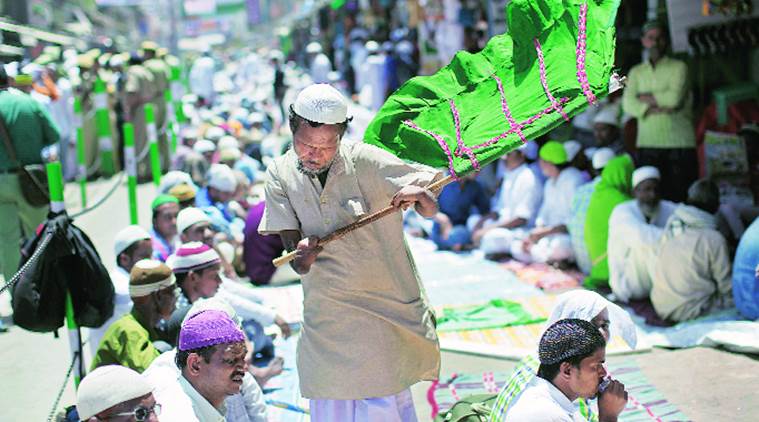
Dargahs such as the one in Ajmer (above) and Bahraich symbolise India’s syncretic heritage. Vishal Srivastav
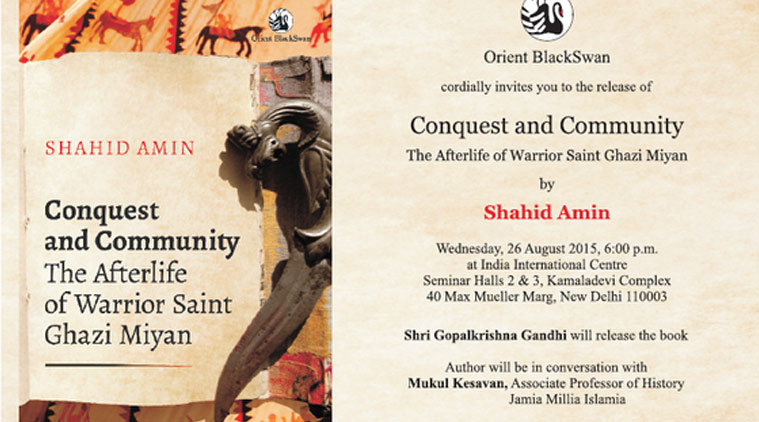
Book- Conquest and Community: The Afterlife of Warrior Saint Ghazi Miyan
Author: Shahid Amin
Publication: Orient BlackSwan
Pages: 348
Price: Rs 850
Three decades ago, the historian Shahid Amin wrote a brilliant piece, ‘Gandhi as Mahatma’, which is in many respects the locus classicus of what became the subaltern school of Indian history. What he offered was far more than what is ordinarily called “history from below”, showing that the masses made of Gandhi what they could, stepping outside the role habitually assigned to them by nationalist historiography. The Mahatma, Amin suggested, had been metamorphosed into a floating signifier.
In the present work, Conquest and Community, which cements Amin’s reputation as one of India’s most creative and learned historians, he extends this mode of analysis and turns his attention to Salar Masud or Ghazi Miyan as he is more popularly known, a warrior saint whose cult appears to have been well established by the 14th century.
The story of Ghazi Miyan begins, we may say, with Sultan Mahmud of Ghazni, whose name is calculated to turn the middle-class Hindu into a figure of rage: this early 11th century warrior made repeated incursions into India, “utterly ruined the prosperity of the country” and desecrated the shrine of Somnath. Folklore would inscribe a place for Salar Masud as Mahmud’s nephew, though contemporary records make no mention of such kinship, and representations of him as a warrior taking up arms on behalf of his uncle until he was felled in battle in 1034 against a confederation of Hindu kings began to proliferate.
More surprising still is the fact that the Ghazi was transformed into a Sufi saint, the extent of whose following and reputation might be gauged by the presence at his dargah of Mohammad bin Tughlaq, the Sultan of Delhi. Abdur Rahman Chishti’s 17th century hagiography, Mirat-i-Masudi, would displace Mahmud with Miyan Ghazi. To this day, the cult of the 11th century Indo-Turkic warrior saint thrives in north India, and Hindus and Muslims continue to be drawn in large numbers to his dargah at Bahraich.
Just how is it that the popular assent to the cult of Ghazi Miyan was garnered across the religious divide, and that too with respect to a figure associated in educated Hindu minds with the image of the rapacious Muslim invader? Amin says rather modestly that his “book eschews definitive explanations” and that he is not interested in asking why a 17th century Sufi wrote the text “at the time that he did,” or why “Hindu castes felt no compunction in installing a Muslim warrior on their domestic altar”.
He sets out, rather, to explore those aspects of the Ghazi Miyan narrative which took hold firmly in Gangetic popular culture. This leads him knee deep into some extraordinary anomalies. The commonplace view of Muslims in India renders them as beef eaters, but the Ghazi Miyan of folklore is a protector of cows, the saviour of oppressed cowherds, and a determined foe of the landlords who claimed as their prerogative the right to impregnate the virgin daughters of the Ahirs. In a similar vein, the ballads celebrate the story of the married Brahmin woman, Sati Amina, at whose home the sandalwood tree has dried up.
The family priest avers that the tree will regenerate upon the Ghazi’s arrival — and so it does. In gratitude, Amina washes the feet of the Ghazi and his followers, the Panchon Pir, and then serves them a lavish meal. What could be more violative of the social order than for a Brahmin woman to cook for a Muslim man? Yet, as the very name Sati Amina signifies — Amina is the Prophet’s mother — this is a story about in-between spaces and the risks (and pleasures) of transgressive and forbidden acts.
By the 19th century, as Amin shows, the cult of the Ghazi had become a source of acute anxiety to British, Muslim, and Hindu elites alike. Colonial ethnographers and officials had set out to clearly differentiate “Hindu” and “Muslim” communities, and the presence of a large number of Hindu worshippers at the sites associated with the Ghazi was immensely bewildering to them. On the specious ground that Bahraich was a “cosmopolitan” site and therefore not deserving to be characterized as a special religious endowment of the Muslims, the British sought to bring the dargah under their control and pocket the considerable donations left by devotees.
To the Ashraf or Muslim elites, their low-class and illiterate brethren who consorted with Hindu devotees were little better than idolaters, and the Muslim clergy had no difficulty in attributing the ignorance of Muslim devotees to their frequent social intercourse with Hindus. The zealots of the Arya Samaj and Hindu revivalists expressed alarm that “their” women were willing to surrender their dignity before a Muslim warrior saint, all too often in the hope of gaining male progeny. Such had been the consummate nature of Muslim dominance that, in Amin’s marvelously elegant and provocative rendering of the revivalist view, Hindus “partaking of holy unction” at “the altars of Muslim saints” were “virtually ingesting the leftovers from their Muslim neighbours’ kitchen.”
Few questions have animated Indian historiography, and discussions in the public sphere, as much as the relations between Hindus and Muslims. Amin’s study is a signal contribution to this literature, and he is particularly enlightening in his suggestion that while we cannot be dismissive of those who have posited a syncretic Indian past, it behooves us to view syncretism not only as a narrative of pluralism and accommodation but also in equal parts as a story of agonism, conflict and clash. His masterful study argues that while our narrative understanding of the Ghazi Miyan saga cannot stop at viewing him as “just a conqueror”, it must also contend with the fabrications and the verisimilitude engendered by local histories, ballads and folklore.
In what Amin calls “the quotidian culture of north India” reside perhaps our best hopes for neutralising those who would seek to homogenise the Indian past in the vain and dangerous quest to create the patriotic and “new Indian national”.
The writer is professor of history, University of California
source: http://www.indianexpress.com / The Indian Express / Home> Lifestyle / by Vinay Lal / October 10th, 2015
To commemorate the celebrations of 150th year of the `Sepoy Mutiny’ described by historians as the first war of Independence in India, the Institute of Objective Studies, New Delhi, will bring out next year, a book on the `Role of Muslims in Freedom Struggle’ focussing on the participation of freedom fighters belonging to the Muslim community in various struggles and their contribution in making our country free from the clutches of the British rule.
Divided into six chapters, the book will narrate the sacrifice of Muslims all over the country. Each chapter pertains to a cluster of the then Presidencies comprising a few states.
A team of professors and research assistants, led by one author, has been working on the book, identifying the descendants of Muslims who had participated in the freedom struggle.
The sixth chapter comprises three States, Tamil Nadu, Kerala and Karnataka. Details about contribution to the cause of freedom movement by Muslim freedom fighters hailing from these States are now being compiled by J. Raja Mohammed, former Assistant Director of Government Museums.
“I adopt a four-pronged strategy for compiling the data and details about the freedom fighters. Interviewing the family members, collection of details from the Madras Achieves, verification of fortnightly reports sent to the British Collectors between 1857 and 1947, and above all press clippings from newspapers including The Hindu , The Mail and Swadesamitran and a few Muslim journals, to present an authentic chapter in the book,” Dr. Raja Mohamed told The Hindu here on Wednesday
source: http://www.thehindu.com / The Hindu / Home> News> National> Tamil Nadu / by M. Balaganessin / March 23rd, 2006
The pages of this Sanskrit trestise eschew a story of timeless love, passion and the strife it accompanies
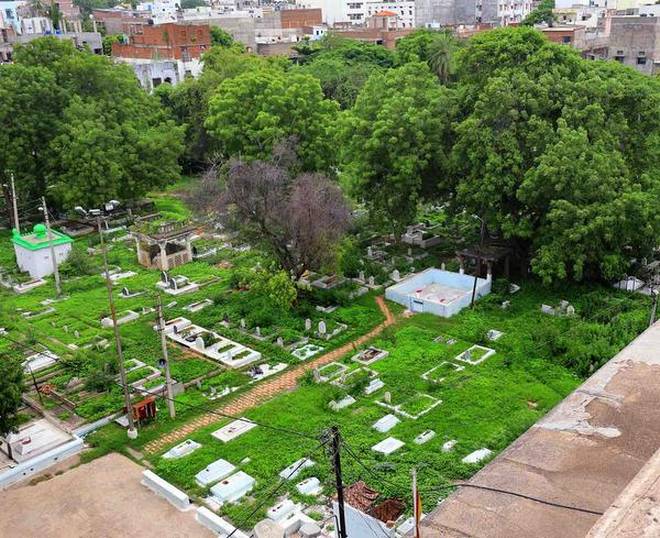
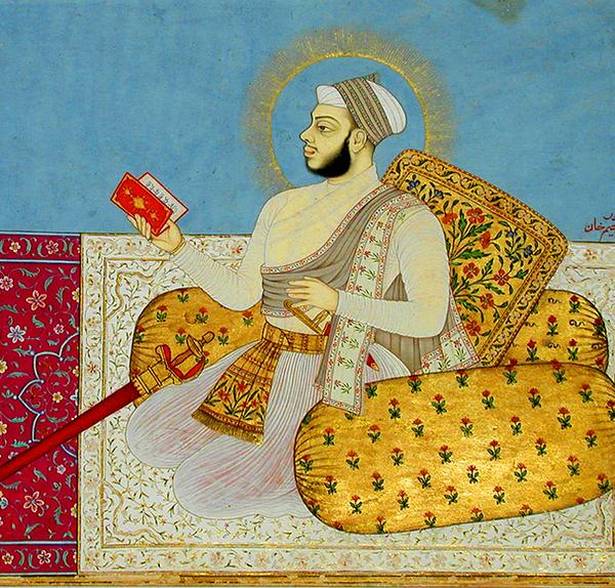
Misrigunj is one of the old city areas of Hyderabad where it is easy to get lost as the lanes and bylanes double back and are in no particular order. Even a compass will be of little use, forget about online maps. In one of the lanes that lead on from one of the biggest domes in the city is the grave of Syed Kalimullah Hussaini or, as he was known in his lifetime, Akbar Shah. Walking in the lanes and standing near his grave in Misrigunj, it is difficult to imagine that the young man wrote a Sanskrit treatise on love, heroines and their moods called Sringaramanjari. The treatise on the many moods of love begins with a Guru stuti.
Guru Ganapati Durga Vatukam Shivamachutam
Brahmanam Girijam Lakshmim Vanim Vande Vibhoteye
If Akbar Shah wrote the Sringaramanjari, credit has to be given to Sanskrit scholar Venkataraman Raghavan for resurrecting the book based on two manuscripts and giving insights into the life of Akbar Shah or Bada Akbar. Raghavan became curious in 1943 when he saw a Sanskrit manuscript in Government Oriental Library, Mysore. Using other material from Tanjore Library, Raghavan published a book with an exhaustive introduction leading to the adaptation of the work for Bharatanatyam and Carnatic music.
To understand how a book on love written in Sanskrit by a Muslim scholar living in a Sufi khankah came to be written about in the latter half of seventeenth-century Hyderabad would be a challenge. Akbar Shah was the son of Shah Raju Qattal who traced his lineage back to Gesu Daraz credited with bringing Sufism to Deccan. Akbar Shah grew up in his father’s khankah along with another young boy: Abul Hasan, or as Shah Raju called him Tana Shah(young king).
Painting of Akbar Shah
The lines of religion and language in Deccan were like lines drawn in the sand. It was in Deccan that a king moved his capital from Gulbarga down south to Bidar where the linguistic boundaries of Kannada, Telugu and Marathi met. The language and court practices were a blend of the Persian world and those from the native kingdoms. The taj worn by kings became the colourful pugree in course of time.
It is in this flexible world that a Muslim scholar could sit inside a Sufi khankahat the feet of his father and write a work that dwelt at length about the fickleness of love, heroines, beauty and attraction. If the love of your life is angry, Sringaramanjari has a recipe to solve the problem. It suggests a time and a place with a romantic mood like spring and moonlight. It also gives six ways to win over the love: pleading, gift, winning over her friends, indifference, falling at her feet or changing the circumstances.
One of the topics that Akbar Shah ponders is whether a courtesan is capable of real love and after much deliberation concludes that she has love for one person but feigns love with many so that she can carry on her life.
Unfortunately, Akbar Shah died young. Raghavan uses evidence in the book as well as a firman issued by Aurangzeb to prove that he died before 1675. Much before his playmate, Abul Hasan could rise to the pinnacle of giving one final burst of cultural efflorescence.
The mazar (grave) of Akbar Shah is in a much better shape now than it was in 1949.“People still come here and spread flowers,” says the mutawalli of the dargah of Shah Raju Qattal.
source: http://www.thehindu.com / The Hindu / Home> Society> History & Culture / by Serish Nanisetti / September 03rd, 2018
In the two volumes of ‘Asar-us-Sanadid’, Sir Sayyid combined anecdotes with rigorous measurements and descriptions.
IntroducingAsar-us-Sanadid
by Rana Safvi
Asar-us-Sanadid by Sir Sayyid Ahmad Khan is an important book for many reasons. It was the first time that a book on this scale describing Delhi’s monuments had been written. The first volume was published in 1847 and a second volume in 1854. Though both had the same name and were about Delhi, they were very differently written. The first was an anecdotal description of the buildings, while the second took a more scientific approach with historical references, and the dimensions of the monuments.
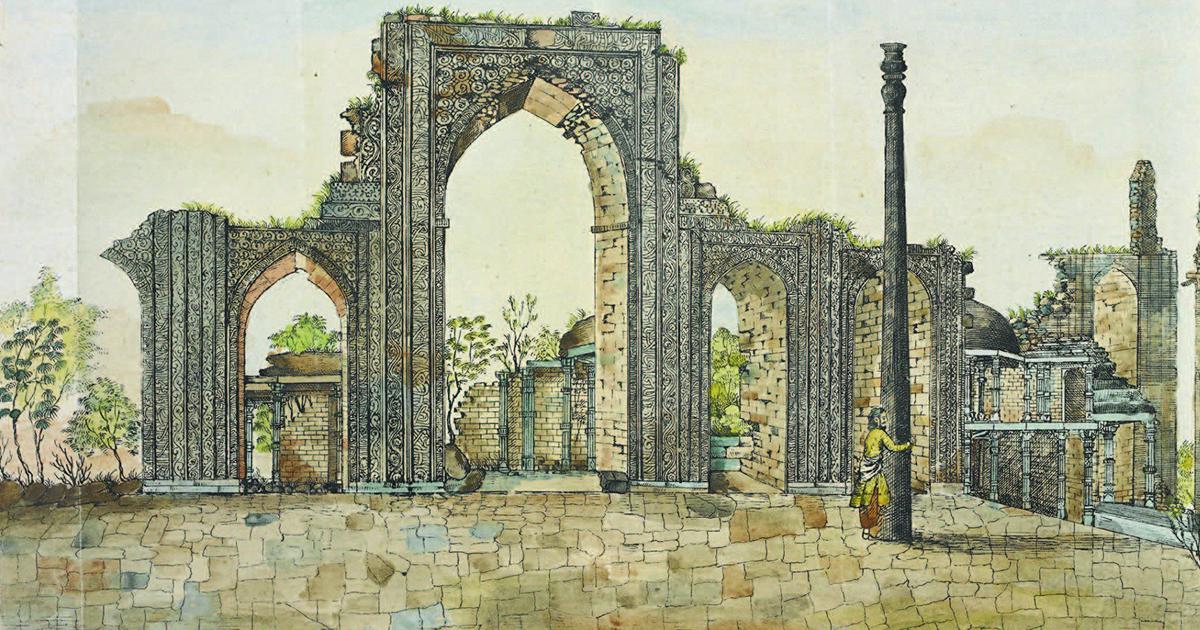
It was also the first time in India, that a book had lithographically produced illustrations. As many as 130 illustrations of Delhi’s monuments were drawn by Faiz Ali Khan and Mirza Shahrukh Beg. The drawings were probably based on rough sketches provided by Sayyid Ahmad Khan himself. He made many sketches – a fact he mentions in the book – and also copied the inscriptions on each of the monuments, often at great risk to life and limb, as in the case of the Qutub Minar, where he hung down from the top of the minaret in a basket held by ropes. It was the first time that inscriptions on the buildings were noted down.
Asar-us-Sanadid is an invaluable work. Both editions – Asar-1 and Asar-2 (published in 1847 and 1854, respectively) – were written before the Uprising of 1857. As is well known, much of Shahjahanabad changed during and in the aftermath of the events of 1857. The British broke down many structures to make governance easier and there was massive restructuring, in particular, of the Red Fort.
Later, when Lutyens’ Delhi was being built, many more changes were brought about, not to mention the changes that are still taking place today. Thus, in his descriptions of the buildings and monuments of Delhi prior to 1857, Sayyid Ahmad Khan gives us a glimpse of lost glory. For students of history and heritage this is where its greatest importance lies.
The partition and transfer of population in 1947 meant that the landscape of medieval Delhi was changed further. Today urban development has resulted in encroachment and destruction or alteration of many more monuments.
Mehrauli is the first documented city of Delhi and it was from here that the Tomaras, Chauhan and early Delhi Sultans ruled. As it was a hilly and wooded area it become a favourite of the Mughals too, with the last two emperors shifting here during the monsoons. The last Mughal building is the Zafar Mahal, situated in Mehrauli, which was the royal residence during those months.
A unique festival called Phool Waalon ki Sair was also celebrated in the monsoons under the last two Mughal emperors.
The excerpt below describes some of the buildings in Mehrauli.
The Bagh e Nazir is now Ashoka Mission. According to some monks I spoke to there, the family of Nazir Roz Afsun fared very badly in the riots which took place during the partition of India in 1947, and the lone survivor, a young boy, migrated to Pakistan.
In 1948 Prime Minister Jawaharlal Nehru gave the land as a gift to the famous Cambodian monk Dharmvara Mahathera on behalf of the Indian state for the purpose of opening a Buddhist institute. It was he who founded the Ashoka mission there. It is now the Official Buddhist Mission in Delhi, known as Ashoka Mission.
The Hauz e Shamsi is a poor reflection of what it was, and though the pavilions of the Jharna still stand forlorn, they are desolate. The water is a dirty and stagnant pool and gone are the diving competitions or sliding stones. The mango orchard has disappeared and there are only residences in the area. One can only thank Sir Sayyed for a glimpse into that era when emperors and their consort picnicked here.
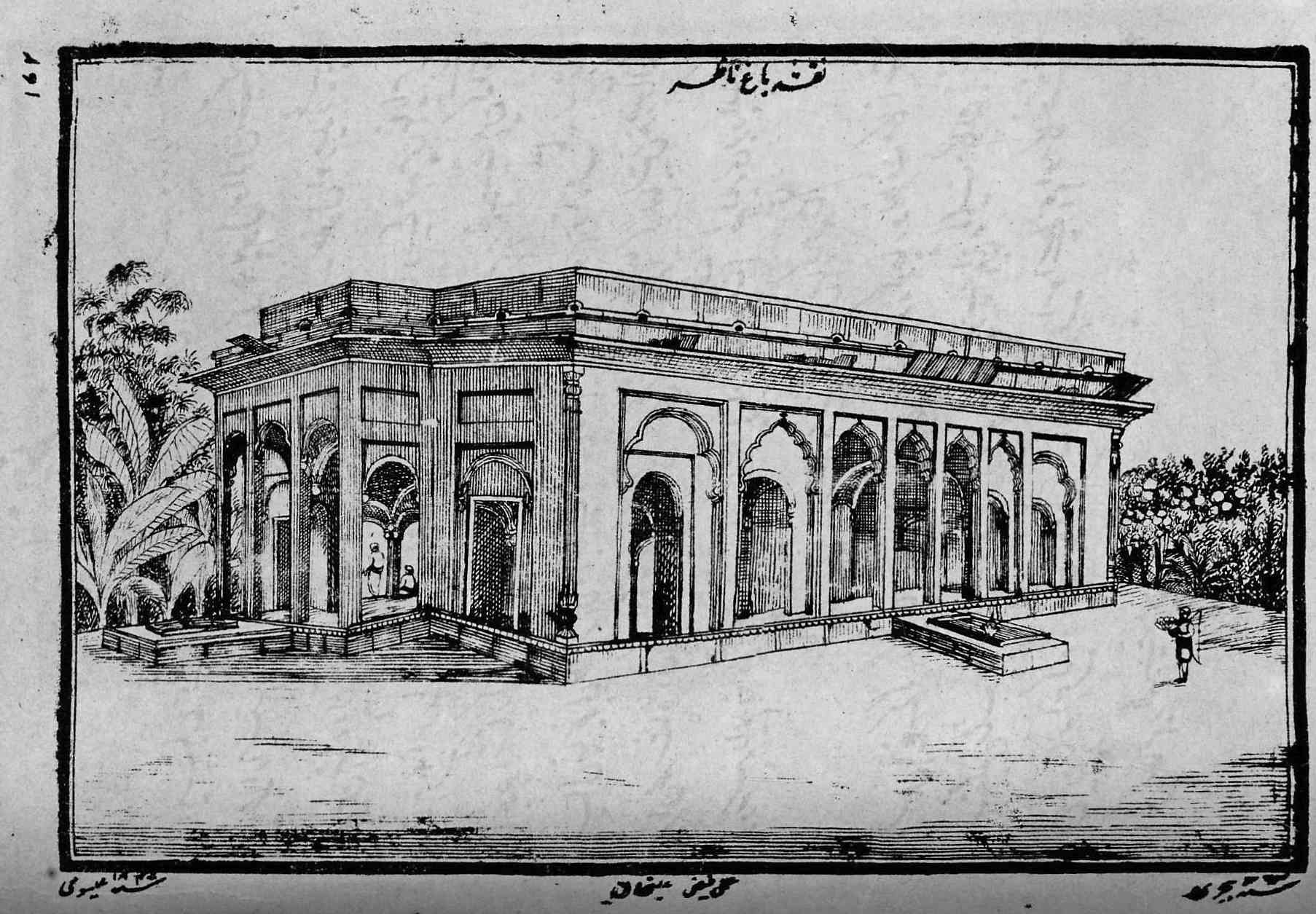
Bagh-E-Nazir
This is a beautiful, attractive, verdant and luxuriant garden near the waterfall of Qutub Sahib [in the Mehrauli area]. It is still very well maintained, with blooming flowers and green trees. The buildings around it are still intact and thousands of people come here during the Phool Walo’n ki Sair procession, to enjoy its beauty. The spectacle is as entertaining as though one were at a fair. This garden was built by Nazir Roz Afzun during the reign of Muhammad Shah Badshah. I will write down the verses inscribed on the entrance as they give the date of the construction and name of the builder:
By the orders of Muhammad Shah Adil,
Whose head bears the sacred crown.
He founded this garden near [the shrine and tomb of] Qutub Sahib,
And has adorned it with the flowers of paradise.
It should remain green till the Day of Judgment,
By the Grace of the Holy Quran.
The year of its construction,
Was found to be the blessed date,
AH 1116 in the thirty-first regnal year of Muhammad Shah.
Bagh-e-Nazir | Courtesy: National Archives of India, New Delhi
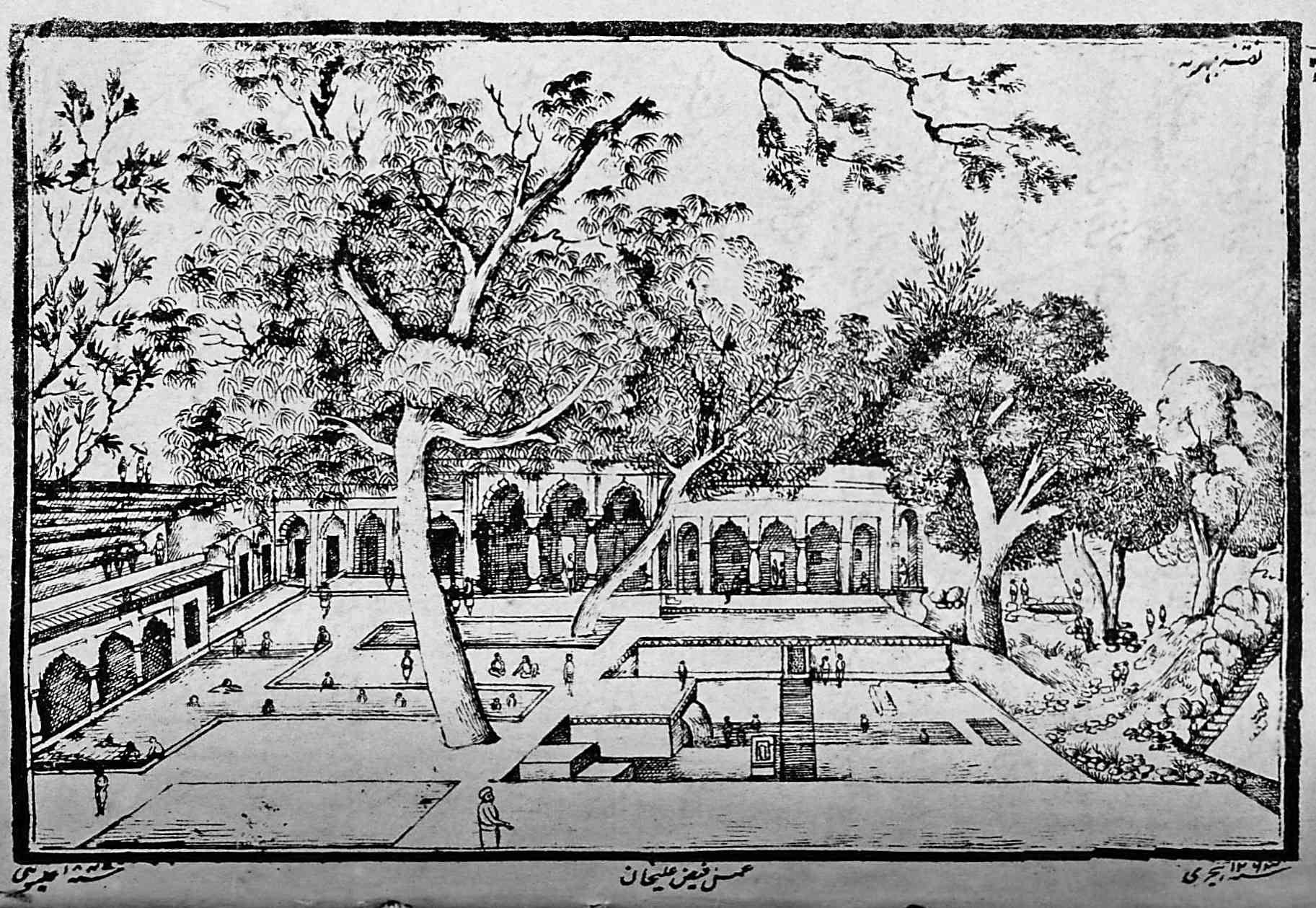
A wall surrounds the garden and there are red sandstone buildings of great attraction built all around, within the wall. There is one building in the middle of the garden that is the biggest and best of all the buildings there. Thus I am attaching its sketch here.
Jharna This is a place for recreation and pleasure; it is exotic and unearthly, elegant and refined, interesting and delightful, happiness-bestowing and heart-pleasing. Qutub Sahib’s waterfall [jharna] is famous for its verdant green trees and reminds one of heaven. Initially, Sultan Firoz Shah had constructed a dam here and the wall of the waterfall is that dam. It is still intact.
He had diverted the excess water of Hauz-e-Shamsi reservoir into Naulakh canal [nala] towards the moats of Tughlaqabad Fort. After some years however, the fort was abandoned and water stopped going to that area. The excess water from the Hauz-e-Shamsi then started flowing into the jungles from this dam and was wasted. Nawab Ghazi-ud-Din Khan Firoz Jung built a tank, water channels, and chutes for the water to flow through. The waterfall is an awesome spectacle and pleases the heart, causing the spectator to involuntarily exclaim in delight. There are various buildings around this waterfall which I will describe here.
Jharna | Courtesy National Archives of India, New Delhi
Pavilion on the western side On the western side, adjoining the wall of the dam stands a pavilion at an elevation of 11 feet and 5 inches. It has three arches, and the waterfall cascades down on it. There is an attractive tank in front of it, into which people jump from the roof of this building. During the Phool Walo’n ki Sair festivities people diving into this tank and swimming in it, make for a huge spectacle. They use various diving styles including somersaulting into the water, they also make a pyramid by climbing onto the shoulders of men standing below until the man at the top of the pyramid reaches tree-branch height. Then those at the bottom dive into the tank and all those on their shoulders plunge into the tank. This is called a “tree dive” [darakht kakudna] or a “wild growth dive” [jhad-jhankar ka kudna].
There are thirteen small water pipes under the roof of this building and water from the waterfall flows down through these, via the pavilion, and into the tank. There is a 3.2-feet wide water chute inside the pavilion which falls from a height of 4.3 feet into the tank. There are niches built under the chute in the pavilion wall, and water flows over lighted lamps that are placed within the niches.
This 25-feet square tank has an opening of 1.7 feet for water to flow into it and is 7.6 feet deep. There is a 22 feet long, 6 feet wide and 3.6 feet deep water-channel, which flows out of this tank in a 5.6 feet cascade and is joined by two smaller cascades from the north and south. There are beautifully carved stone chutes [salami pathar] measuring 3 feet 7 inches, to receive the cascade. The water winds its way down the carvings on the chute creating a mesmerising effect.
The water channel in front of this pavilion is 26 feet long, 6 feet wide and 2 feet deep, while the water channel in front of the smaller cascades is 15.3 feet wide, 2.9 feet wide and 8 feet deep. All the water collects at this point and flows into the jungle. The waterfall passes over all these pavilions and the water channel, and in reality it is a truly spellbinding sight. The sound of the flowing water mingles with the singing of the nightingale, the chirping of doves, peacocks dancing and the sounds of merriment of finely attired men and women. It is a mesmerizing scene, which could put Raja Indra’s assembly in the shade.
Pavilion on the northern side There is a very attractive double pavilion on this side. Muin-ud-Din Muhammad Akbar Shah Badshah built the double pavilion in his reign, around three years ago. These are the most attractive buildings in the place.
Pavilion on the southern side There is a three-arched pavilion in this area, with two smaller pavilions on its sides which gives it the impression of being five arched. In addition to this there are two doors next to it, thus making it seven arched. This pavilion was built around 50 years ago in the reign of Shah Alam by Shahji’s brother, whose name was Sayyid Muhammad.
Pavilion on the eastern side There are only mountains on this side and no buildings, but Muhammad Shah Badshah built a stone slide [phisalna pathar] 18 feet 3 inches long and 7 feet 7 inches wide.
The mango orchard There are many mango trees in this area. People tie swings to the branches and have fun swinging on them. Numerous dancing and singing girls gather here to enjoy themselves. In short, this place is magical and the mind boggles at its attractions. There is also a grave here with the following verse inscribed on it:
Abid who was wise, learned, pious and man of intellect,
Was martyred by a dishonest robber.
The invisible crier told me the chronogram of his death,
The soul of Abid, the martyr entered paradise [in] AH 1209.
Hauz-E-Shamsi This reservoir [hauz] was one of a kind. Sultan Shams-ud-Din Altamash built it during his reign and that is why it is famous as Hauz-e-Shamsi. Once upon a time this reservoir was made of red sandstone but now all the stone has been torn off and it is just a simple reservoir and that’s why people call it Qutub Sahib’s reservoir, while some still call it Hauz-e-Shamsi. The water from here feeds the waterfall and also fed the moats of Tughlaqabad in olden days.
It is difficult to imagine there is a reservoir of this size on the face of earth. It is spread across 276 bighas [a land measurement] and its water reaches eight provinces [subahs]! The pavilion has been built around the mark of a hoof which people call the hoofprint of the Prophet’s celestial steed Buraq, but to me it seems a made-up story. God alone knows the truth.
Auliya Masjid On the eastern side of the Hauz-e-Shamsi is a platform and on it another smaller platform about a gaz or so with a small wall. According to legend, Hazrat Khwaja Qutb-ud-Din Bakhtiyar Kaki and other Sufi saints undertook their spiritual retreat/penance [chillah] on it. They built the mosque with their own hands, bringing baskets [of mud from the reservoir] and that’s why it is called Auliya [The Saint’s] Mosque. Now people have plastered it with mortar and lime.
Excerpted with permission from Asar-us-Sanadid, Sayyid Ahmad Khan, translated and edited by Rana Safvi, Tulika Books.
source: http://www.scroll.in / Scroll.in / Home> Book Excerpt / by Sayyid Ahmed Khan & Rana Safvi / August 31st, 2018
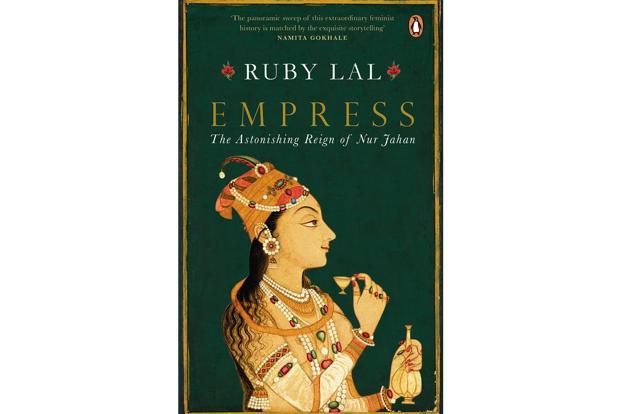
Ruby Lal’s book gives a new life to Nur Jahanas Jahangir’s co-sovereign, a position never held by any Mughal woman
While there may be more than a grain of truth in Jahangir’s devotion to his beloved spouse (it has been the subject of several movies), Nur Jahan’s political acumen and gallantry make her phenomenal career trajectory seem inevitable.
The polemical potential of Ruby Lal’s new book is apparent from its title, even before we get to the text proper. Empress: The Astonishing Reign Of Nur Jahan takes the spotlight away from Jahangir, one of the Great Mughals, to shine it on his 20th and favourite wife, who, as Lal proposes, not only scaled untold heights during his reign but also announced herself to be his “co-sovereign”.
“Scholars have for some time acknowledged her power, almost in bullet points, but never in any concrete way thought through it,” says Lal, who teaches at Emory University in the US, on email. “There is still the tendency in scholarly and other writings to lock Nur’s power in a romantic story with Jahangir: in fact, that romance becomes the explanation for her rise.”
While there may be more than a grain of truth in Jahangir’s devotion to his beloved spouse (it has been the subject of several movies), Nur Jahan’s political acumen and gallantry make her phenomenal career trajectory seem inevitable. Lal begins, for instance, with a spectacular scene of a hunt, in which a musket-bearing Nur Jahan kills a man-eating tiger in Mathura, where the royal cavalcade made a stop on its way to the Himalayan foothills in the autumn of 1619. Nur, 42 at the time, had been married to Jahangir, her second husband, since 1611. It was a fate her parents, Ghiyas Beg and Asmat Begum, could never have foreseen when their daughter, Mihr un-Nisa, was born in 1577 by the roadside outside Kandahar, as they fled their home in Herat.
Hounded out of Persia due to religious persecution, Beg sought Akbar’s patronage in the late 16th century, and it was generously provided. Eventually decorated as I’timad ud-Daula, or the Pillar of the State, by his regal son-in-law, Beg went on to assume the highest rank in Jahangir’s service. His family did well by the Mughal rulers too. Beg’s son, Asaf Khan, would turn out to be the future emperor Shah Jahan’s father-in-law. But it was Beg’s daughter, Mihr un-Nisa, honoured by her royal husband as Nur Jahan, or the Light of the World, who assured him a place in history.
If Nur was exemplary for being the first woman in the subcontinent to exercise direct executive privilege, she was doubly impressive for achieving such a status as a rank outsider. “Remember, she was not a Mughal by bloodline,” says Lal, “not like Queen Elizabeth I (of England) or Queen Christina (of Sweden), who were from royal families.” Nur’s elevation, in the context of her times, was certainly unprecedented, though women in the Mughal harem, especially the elders, often did act as confidantes, advisers and counsellors to the emperor.
Gulbadan Banu Begum, Babar’s daughter and Akbar’s aunt, and Hamideh Begum, Akbar’s mother, were matriarchs to reckon with. Nur’s mother, a lady of refinement and education, was credited with the discovery of an itar (perfume) while boiling petals to make rosewater. But no one went as far as Nur, who made appearances on the imperial balcony, issued firmans (orders) and had coins embossed with her own image—all of which were kingly prerogatives. A skilled marksman, Nur would also lead an army later in life in a failed attempt to rescue Jahangir when he was held hostage by one of his aggrieved officials.
Although the Mughal harem has claimed the attention of scholars, Ira Mukhoty’s recent feminist history, Daughters Of The Sun: Empresses, Queens And Begums Of The Mughal Empire, breathed fresh life into it, making it accessible and emotionally absorbing to the common reader. Lal’s book, replete with research but also narrated with a sense of drama befitting a novel, complements it beautifully.
With the paucity of first-person testimonies from the women of the era, it is not surprising that much of the narrative of Empress is pieced together from observations left behind by Nur Jahan’s contemporaries in the footnotes and interstices of archival documents. “The records are plenty and rich,” says Lal, emphatically, “it’s how you approach the courtly documents, paintings, poetry, coins, architecture, and even legends.”
The British diplomat Thomas Roe, for instance, who visited Jahangir’s court to woo him for exclusive trading rights, was piqued by Nur’s bossiness. But her charisma, intelligence and stately demeanour didn’t escape him. “Noormahel fulfils the observation that in all actions of consequence in Court, a woman is not only always an ingredient, but commonly a principal drug of most virtue,” he noted, “and she shows that they are not incapable of conducting business, nor her self void of wit and subtlety.” It’s not hard to imagine why tales were spun around Jahangir’s early infatuation with Nur, since the days he was Prince Salim. Some chroniclers even claim that young Mihr was married off to a fellow Persian nobleman, Ali Quli, to keep her away from the smitten crown prince.
Yet it would be patently unfair to reduce Nur’s influence to her “womanly wiles”. As an astute observer of court politics, she played her hand shrewdly. Initially, she forged an alliance with the ambitious Prince Khurram (later Shah Jahan), but then Nur got her only daughter, Ladli Begum (by her first husband), married to the younger Prince Shahryar, hoping to push the latter for the throne. With Jahangir’s health worsening due to his addiction to alcohol and opium and civil wars breaking out between factions of the royal family, Nur became increasingly anxious about her hold over the palace. The last straw was the ascension of Shah Jahan to the throne after Jahangir’s death when he stripped Nur of her privileges. She was packed off to live on a modest pension away from the court. In exile, too, she conducted herself with the dignity and grace suited to her station as a noblewoman. Known for her philanthropic work for the poor, she also built a tomb for her parents in Agra that would become the model for the Taj Mahal.
Nur Jahan was neither a Machiavellian dissenter nor a feminist rebel, as Lal writes tellingly. She seemed to have accepted the “emphatically patriarchal” norms of her time, the rules of the feudal, aristocratic world she spent her life in. “I do not believe feminist history should be one in which the woman is always a winner,” says Lal. “It is (rather) what she does, and how effectively she does it, despite all odds. Vulnerability is feminist history.”
source: http://www.livemint.com / Live Mint / Home> Lounge> Leisure / by Somak Ghoshal / August 31st, 2018
Of History and Gastronomy: Ira Mukhoty at Jaypee Vasant Continental’s Paatra restaurant in New Delhi | Photo Credit: SHIV KUMAR PUSHPAKAR
From the resilience of Khanzada Begum to the food habits of Akbar, author Ira Mukhoty reveals many Mughal secrets over a lavish vegetarian meal
Those who suffer from colonial hangover or know their Mughals through movies have an exotic notion about the haramam or harem – a place where many women were housed to please the most important man in the empire. Author Ira Mukhoty, who scans history and mythology to find the status of women in India, counters the perception through a well-argued book, “Daughters Of The Sun” (Aleph). “This idea of ‘oriental harem’ came through the British historians because they had a long association with Islam right from the times of crusades. For them, the Mughals, the Sultans and the Tughlaqs were all the same – part of one Islamic marauding entity. The idea was completely false.”
The whole harem space, she says, evolved from the time of Babur, who wanted his women to be well-educated and was pragmatic about women who ‘fell’ to an enemy. “Over a period of time, when Mughals absorbed some elements of Rajput culture, it became a little different but even then it was completely alien to the oriental idea of a sexual space. Most of these women were in no way sexually available to the Padshah. The harem had relatives, other noble men’s wives; there were servants and attendants…there was a huge collection of women but not to please the emperor,” says Ira, as we settle for an elaborate lunch at Jaypee Vasant Continental’s Paatra restaurant.
The catalyst came from Ira’s previous book, Heroines, where she wrote about powerful women in myth and history. “One of them was Jahanara Begum. I was interested in finding more women like her associated with the Mughal empire.” She found many. But the one story that is most compelling is that of Khanzada Begam, the sister of Babur, whom he left behind with Shaybani Khan as war conquest when he escaped from Samarkand. She remained with Khan for ten years but remained true to her brother’s cause. And when she eventually returned to Babur’s household, her sacrifice and resilience was celebrated. “In fact, she went on to be anointed Padshah Begum of Hindustan during Humayun’s reign,” says Ira.
Powerful women
Women are a neglected lot in our history. Ira says this is not specific to our country. “Around the world, women stories are neglected to a smaller space – it is not just about Mughals or India. You first talk about the kings and and rajas. Women were treated like wallpapers. It is not that I have found something special here. The resources have been there but they have seldom been used to join the dots. For instance, Gulbadan Begum’s biography of her father Babur and brother Humayun was translated from Persian into English in 1907.” She reminds how Jahanara Begum wrote about her Sufi masters in two books. “Her lines are very powerful and erotically charged for Sufis believe in erotic love as means for union with the divine. A 17th Century Muslim woman writing such a powerful language is extraordinary.” Ira has tried to find out first hand information about these women who engaged in diplomacy and patronised the arts. “ I have written about Mughal women who were highly educated, who advised emperors and traded with foreigners. Babur saw them as symbols of Timur legacy. He wanted them to engage in verbal repartees and write poetry.”
Ira says her study of royal firmans reveal that Jahanara Begum asked for permission to go for Haj but it was denied. “Years before her, Gulbadan Begum had made the famous journey that lasted seven years. But by the time of Jahanara, royal women were not encouraged to take this hazardous journey. But she did make a request. I looked at the date and it was one month after her sister Roshanara Begum had died. I wondered that did something come over her.” It is her ability to join these dots that makes Ira’s work much more engaging and accessible than academic works by the likes of Prof Ruby Lal, whom Ira has extensively quoted.
“I try to find a thread between these stories to make fully-rounded characters. With women’s stories you get that sense. However, I tell the reader where I am not sure and am talking about possibilities.” Ira, who studied Immunology in Cambridge University, says her science background has always helped her in research. “It gives me patience. History brings subtlety and nuances which interest me much more. Science is no good for that,” she chuckles. Having said that, she doesn’t believe in speculating. “You should tell the reader where you are not sure even if it breaks the rhythm of the story. If I say it could have happened, I expect the reader to make his own mind.”
A vegetarian these days, Ira undertook ‘walks’ to the Walled City to understand the fragrances and the language of the time gone by. “They might not help you with facts, but they definitely help in writing about a past whose remains are very much part of our ecosystem.” As she appreciates the lavish spread at Paatra, she remembers the meal she had at the Nizamuddin dargah.
Introduction to ghee
Ira hasn’t written much about the Mughal kitchen but she has mentioned some instances which give us an idea of what was cooking. For instance, she captures Humayun’s exile in Persia with Hamida Banu Begum after the embarrassing defeat to Sher Shah Suri. “At one point they were actually cooking horsemeat to survive. But when they went to Persia, they were greeted as kings. Suddenly, the meal changed from fibrous, overcooked horsemeat to the amazing food that the Shah would offer them. When they were leaving, Shah Tahmasp wanted a banquet in Hindustani fashion prepared by his guests. What he liked the most was something called dal khuske which was like matar ka pulao. He tasted ghee for the first time as Persians used to cook in fat.”
Over the years, Mughal food became more and more refined. “There came a time when hens were massaged so that the chicken would be soft and tender. Akbar was a frugal eater who used to have just one meal a day but the time for it was not fixed. At any given time around 100 dishes were kept almost ready for him so that they could be served to the emperor at a short notice.”
Ira, who is now working on a biography of Akbar, says the emperor turned vegetarian under the influence of his Rajput wives. “Luckily for us, we have the Akbar’s biography of Bada’uni. He was a conservative person and his account is not glowing with praise like that of Abu’l-Fazl’s. He could not do what Akbar expected of him. He wrote the biography in secret and it was published during Jahangir’s rule. It is fascinating because it tells truthful things about Akbar. He writes that Akbar is so influenced by his Rajput wives that he gave up meat and indulged in Hindu rituals.” Similarly, she says, Gulbadan Begum’s account is very honest in comparison to a male biographer because she is not looking for building an image for posterity. “She writes very candidly like she explains why Humayun was very angry one day. He believed in astrology and always made the journey when the stars were in right alignment. One day he told the women in harem that they would go on an expedition at such and such time. Unfortunately, his new wife fell off the horse. It took her some time to get back. He got furious. He said he would need some opium to calm down. A male biographer would not have put all this but Gulbadan mentions all these intimate details so that we would know the man not just as a king and a conqueror but also as a father, a husband and a son.”
Ira has emerged at a time when Akbar’s legacy is being questioned and anecdotal history is gaining currency in mainstream discourse. She says hers is not a political book. “I am not trying to push any agenda. However, in this atmosphere, it is not unimportant to hear these stories also to clear many of the prejudices that we may have had. When things remain in anecdotal form, it is easy to manipulate them.”
source: http://www.thehindu.com / The Hindu / Home> Society> History & Culture / by Anuj Kumar / August 31st, 2018
Bijnor, Rohilkhand (Mughal Empire) / BRITISH INDIA :
On India’s independence day we remember a forgotten hero from our history
Bakht Khan: Winner of a lost battle
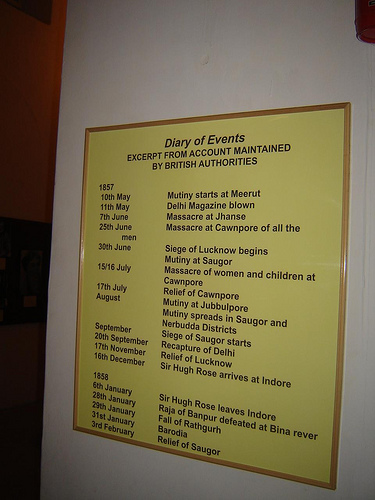
Second of July 1857, a hot humid day some one hundred and fifty-five summers ago, a contingent of about 250 men in their Bareilly regiment uniforms arrives in Dilli of the time, the world renowned Red Fort to be precise. Mounted on their horses, they march past the Laal Purdah [1][entrance to the private chambers of the last Mughal King]. The General of the regiment marches too albeit without the customary bowing down of his head; much to the outrage of those present at the court. But what happens next would seem rather more sacrilegious. That unbending commander of the arriving regiment, a tall and corpulent man of Rohilla stock appears least caring about the sensation he creates and the protest that comes his way, he moves forward and ‘salaams’ the King as if he is an equal.[2] But the King, Zille Sub-haani, Khaleefatur Rehmani, Khudawand e Majaazi, Hazrat Abul Zafar Sirajuddin Bahadur Shah Zafar is helpless.
The man in the eye of this little storm was General Bakht Khan, Commander of the Neemuch brigade, of the Army of East India Company, among the true heroes of 1857, who had arrived to make a fight against the Company which till now he had served.
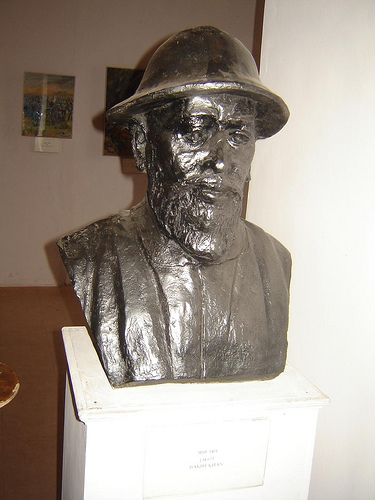
General Bakht Khan’s bust in Red Fort museum.
He was described as “a much garlanded and battle hardened veteran of Afghan wars, with huge handlebar moustache and sprouting sideburns…. Known personally to several of the British officers” [3] His reputation as an able administrator and a shrewd military strategist had reached Delhi much before his arrival.
The poor Mughal King, after much reluctance, decides to award the just landed General ,a royal sword and a buckle but Bakht Khan still refuses to present the ‘nazar’ (a mandatory monetary gift to be offered to the King) when meeting him. Soon after, this Khan then begins to give a piece of his mind to the king, he begins, “Your good for nothing princes [sons] enjoy full powers over your military. Give all the power to me as no one else but I know the norms of the English army, who knows them better than me?” This was blunt and undiplomatic at its best, but the man in question, meant business. He was duly appointed the Governor General of the army, effectively displacing Mirza Mughal the headstrong son of Zafar.
Reading literature about 1857 revolution became quite an obsession with me since a teenager, our shared history of the sub-continent, India, Pakistan and Bangladesh. A familiar heritage we possess, a common thread running through our past. History is journalism with hindsight and this special journalism about 1857 period transports us to a novel world inducing in us a sense of déjà vu. It was through these readings that I ‘discovered,/em>’ Bakht Khan. But it was not love at first sight; I must tell you, what with his being a man with a pot belly that did not make him a fine horseman! Add to it the derision he was subjected to contemptuously for the reason of his being a Wahabi. But more surprising were the contradictions that I began noticing in various descriptions about him. A few, mostly historians from the east, respected him as one of the bravest soldiers and the real hero of 1857 Ghadar while the rest seem to scorn him just for being a Wahabi. This term in itself is quite controversial, even today, just as it was in those days.
Wahabism is the name given to Islamic philosophy instituted by Muhammad ibn Abdul Wahab Najdi[1703-1792] in 7th Century Arabia; the intention was to practice Islam it in its purity just as Prophet Muhommad (peace be upon him) did. William Dalrymple elaborates General Bakht Khan‘s Wahabism thus, “Like a Wahabi ,” he says, “Bakht Khan disdained earthly rulers, whom he regarded as unIslamic, and longed instead for a properly Islamic regime.” [4] He cites his Wahabist thoughts to be a cause of his failure. Interestingly , Bakht Khan fought under a king who was the embodiment of everything a true Wahabi abhors.
What is astonishing is that in almost every account about the man, his being a Wahabi is essentially stressed, perhaps to draw attention to his real or imagined fanaticism. Some of the earlier prominent revolutionary figures like Syed Ahmed Shaheed and Shah Ismaeel Shaheed were self-proclaimed Wahabis. Let’s see what Bakht Khan‘s Wahabism was like.
His Wahabism was said to have been inspired by his spiritual mentor, Moulvi Srafaraz Ali, a master teacher of Algebra and Geometry and with a thorough knowledge of Tafseer[Quranic interpretations] and Hadeeth [Prophet Muhammad‘s sayings]. Moulvi Sarfaraz Ali was entitled as Imam of Mujahideen and his orations exhorted people to join this revolution. It was he who had motivated his initially reluctant disciple Bakht Khan to join this momentous struggle. In the pre- revolution time, Moulvi Sarfaraz Ali was regarded as one of the brightest jewels in Delhi’s intellectual crown, by no less than Sir Sayyed Ahmad Khan himself. So it was Moulvi Sarfaraz Ali who urged Bakht Khan to fight against the infidel Christians for the honor of his country. Interestingly this ‘accusation’ of his being a Wahabi also betrays probable renaissance Islamic nature of the revolution of 1857.
Being a Wahabi, Bakht Khan was against the veneration of Sufi shrines, which was/is quite a rampant practice among a large section of the Indian Muslims. The Wahabis disapprove of it as being nearer to idol worship and a tendency picked up from their Hindu brothers. What is important to be noted and not to be overlooked is; this Wahabism of Bakht Khan and his mentor Moulvi Sarfaraz Ali was borrowed not from Abdul Wahab Najdi of Saudi Arab but from Shah Waliullah Muhaddith Dehalvi [1703-1762], the father of Islamic reform movement in India. This reform movement aimed at eliminating all non-Islamic innovations and practices from the religion and restoring a strict Islamic monotheism, among Indian Muslims. Shah Waliullah, was the first one to translate Quran into Persian and anticipated many modern, social, economic and political thoughts, such as social reform, equal rights, labour protection, and welfare entitlement of all.
Where is Indian account of 1857 war of freedom?
P.C. Joshi in his work, Inquilab 1857 makes a significant observation about this term, Wahabi. He says that, “The use of the term Wahabi is not at all correct, because the political ambitions and social views of allegedly Indian Wahabis , were not based on Abdul Wahab of Najad but on the man who came before him. He was Shah Waliullah [died:1762]. That’s the reason, some supporters of Islamic renaissance like, Ubaidullah Sindhi [1861-1948], Ghulam Sarvar and [Hakeem]Ajmal Khan have preferred to call themselves as Waliullahi or the followers of Shah Waliullah. But I have maintained this word due to its popular use and historical importance.” [6] His Wahabism thus had Indian roots. Hence despising the Rohella Subedar as a Wahabi is to belittle the efforts he made for a unified fight against our former rulers. It is unfair to the man in question who is among the real heroes of the mutiny. Noted historian Irfan Habib too condemns the practice of labeling and cornering him as a Wahabi and describes Bakht Khan as, “the republican minded commander–in-chief in Delhi, who is most unfairly portrayed as a Wahabi in some modern accounts.” [7]. Wahabi or not, what is important to notice, is that he struggled for unity among the different religious sects and led the Fauj-e-Hindustani and fought for a unified and free India. Barun De admires this General of Bareilly for providing the quintessential unity that was severely lacking among the ranks of the rebels. He terms Bakht Khan a true leader and lauds his efforts at unifying different forces of the time, as worth studying. [8]
My attempt here is to present a brief sketch of this Great General as a figure who, till his last struggled for the dream of a Free and Unified India where harmony among the different ethnic groups was his top priority.
His Origins:
Bakht Khan was of Rohilla [Afghan] stock. His grandfather Ghulam Qadir Khan came to Lucknow to make a living. His father Abdullah Khan, said to be a very handsome man, was married to an Awadh Princess. Bakht Khan was formerly a Subedar in the 8th Foot Artillery at Bareilly and had served the British for over forty years and fought bravely in Afghan wars. He had progressed quite rapidly and was appointed in a high-ranking position there. Interesting to note, is his close friendship with many British officers, under whom he had served and imbibed the art of war. Colonel George Bourcheir was educated in Persian by him, and who describes his tutor as, “very fond of English society …..[and] a most intelligent character.”[9] But quite a few disagreed and called him, a fat guy, socially ambitious and an incompetent horseman, probably the worst insult for a soldier, in those times. His commanding officer, Captain Waddy [BHA], describes him thus, “ He is sixty years of age and is said to have served the Company for forty years; his height 5 feet 10 inches; 44 inches round the chest ; a very bad rider owing to a large stomach and thick thighs but clever and a good drill” [10] When the revolution began he was already in his native town of Bareilly and his fame as a fine administrator and a brave and especially able army commander had spread in the country. He had arrived in Delhi with a huge contingent of 7000 [according to another source, 14000] cavalry and hundreds of infantry and a treasure from Bareilly.
Bakht Khan as an Administrator:
It is indeed quite fascinating to know Bakht Khan’s efforts in trying to enforce some kind of sense and sensibility, onto the madness of loot, plunder and sheer chaos of the Delhi of 1857 uprising. He tried every trick in the book to restore law and order amid that disturbing pandemonium .Munshi Jeevan Lal, [11] the overweight Mir Munshi [Chief Assistant] of Resident of Delhi, Sir Thomas Metcalfe [who was working as a British spy, describes how General Bakht Khan went about restoring order amidst that unprecedented anarchy spread after the arrival of the rebels, in the capital. It’s a human thing to love admiration; but when it comes from the enemy, it becomes doubly significant.
Munshi Jiwan Lal in the notes to his British Masters appreciates measures taken by Bakht Khan. There were to be no taxes on salt and sugar, looting [by the just arrived rebel soldiers]had to be stopped else their plundering hands would be cut off, shopkeepers were to be given full protection and even encouraged to use weapons[if they had none, then would be duly provided from the state armory], soldiers were to be removed from the Dilli bazaars as it created difficulties for the general public and relocated in camps outside Delhi gate, their salaries were to be restored and promises of jagirs were made to them in return of their services to the army. He further informs that the General’s men had also killed three spies working for the British [M.Baqar Ali, father of Muhammad Husain Azad, the famous Urdu writer, too, had complained in his first report that, he is followed by the spies of Bakht Khan wherever he goes,[12]
The Metcalfe’s Munshi tells his masters that General Bakht Khan was soft spoken to his men but also remained firm that, they should not cross their line of duty even in the smallest measure. Impressive army parades were conducted by him from Delhi Gate to Ajmeri Gate. Many important petitions from various kings, Nawabs, Rajas, and officials of courts, were forwarded to the King and replies were received through the office of Governor General Bakht Khan; chief among them were, Qudratulla Khan, Risaldar of Awadh, Khan Bahdur Khan, Rao Tula Ram. A ruqqah was also addressed to the Patiala Rajah, conveying pardon of the King for his faults, many other such instances of accessing the King through the General can be found in different accounts of history. [13] Here he was playing the role of a keen diplomat. His honest and sincere attempts at running the administrative affairs efficiently at court and his diplomacy with the men of importance are discernible from these accounts. The steps he took to restore a sense of sanity in those insane times are evidently commendable but somehow go unnoticed by his critics.
Bakht Khan as a military strategist:
The General was a shrewd military strategist. What he achieved at the battle field of Delhi becomes more significant considering the dire circumstances he worked in. He had little support from his own army factions and was constantly attacked and maligned by some hostile elements from within. His strategies on the battle field, his trying to sabotage the passages that took supplies to their camp, invention of rota system and his playing the mind games with the enemy, all are indeed splendid. Richard Barter gives tribute to this great man thus: “Thanks to the system organized by Bakht Khan…..We were scarcely able to stand….” [14] He was speaking, worn out at the battle ground along with his soldiers, thanks to the new General’s machinations. Their frustration grew to the extent that some of the British soldiers seeing no sign of relief wanted to kill themselves on purpose, and some even did.
Be it propelling a contingent to Alipore or setting up a new rota system intended to engage the British forces on a daily basis, and which meant leaving them no respite from the combat, General Bakht Khan always worked on new strategies to defeat his enemy. Soon after his arrival, on the ninth of July he made a massive attempt to destroy the British forces and one of his strategies was to clothe his men in British white uniforms. This took the opponents by surprise and a deep access was gained into their camp. Such regular expeditions by Bakht Khan frustrated the enemy to the extent that, they began losing all hope of capturing Delhi again. He succeeded as he knew the British tactics inside out .His long service to them had at last, paid off.
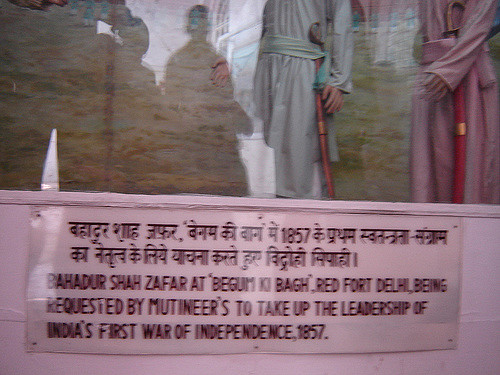
“Mutineers” or Freedom fighters?: Museum at Red Fort continues to insult our heroes by calling them “mutineers.”
But unfortunately the fact that Bakht Khan’s attempts had been gaining success went unreported, unrealized at Delhi court due to the absence of a parallel intelligence system like their adversary had. The British had knit an intricate network of spies throughout the city and at the Red Fort. Reports about every single move of the King, the parleys held at the court, the movements of the rebel forces and their strategies planned for the future attacks, reached the British ears without fail. Many prominent and respected people were on their payroll. But sad to say, no such system was in place, at the other end of the battle camp. W. Dalrymple observes sharply, “The lack of intelligence reaching the city meant that no one among the rebels realized how successful Bakht Khan’s tactics were proving” [15] They didn’t know how fragile the British forces had become and what a tremendous pressure Bakht Khan‘s tactics had put on them. Unfortunately this ignorance about his success was perceived to be his seeming failure and this set his detractors buzzing. Mirza Mughal had nursed a grudge since the General caused his removal from the military affairs. Bakht Khan’s undiplomatic ways too didn’t help. He was ruthless enough to ask the princes to keep away from military and administrative affairs as he believed ‘everyone knew that they were good for nothing fellows’. It was but an ugly truth.
Bakht Khan informed the king that Prince Khizar and others were stashing away the taxes collected from the city traders and due to this salaries of the army could not be paid. Prince Khizar was asked to return the booty. The commoners were pleased with him while the Mughal princes vowed vengeance. Undoubtedly Bakht Khan was a man of the world but he was not at all, worldly. He frequently failed to decipher his detractor’s nasty plans and eventually became a victim to their malice.
The Neemuch brigade-his force- was well-known for its valor; but the two of its generals Ghaus Khan and General Sidhari Singh [supporter of Mirza Mughal] parted ways, from Bakht Khan, as they couldn’t digest the fact that, an officer of the similar rank as theirs should get so much importance from the King. During the battles he was left alone to fend for himself. A most ridiculous charge of his being a British spy also came along. All this put him under great pressure and he had to issue a statement denying all these charges. Whether it was failure to capture the army bastions at Alipur, Manali Bridges and the Ridge and almost all the failures were wrongly attributed to the General. Zafar too now was infected with doubt and the devious designs of his foes resulted in Bakht Khan’s removal as Governor General by the end of July. A Court of Administration was established to run the affairs of the Mughal Darbar. The General and his Bareilly brigade kept their distance from it but their assaults grew weaker and the tremendous pressure that he was able to put on the British began to diminish. Dalrymple remarks, “…the end of Bakht Khan’s military system brought instant relief to the British on the ridge”. [16]. It is indeed saddening that such lowly games of selfishness and rivalry did the good General in and ultimately caused the struggle for freedom, a catastrophic damage, giving a boost to the enemy. Richard Barter joyously announced that, “And so, when we were scarcely able to stand, the attacks ceased, as if by a dispensation of Providence, and gave our force the repose they so much needed.”[17]. The one man who possessed the potential for defeating the enemy was thus, rendered impotent.
As no intelligence about the success of the good General’s methods reached the court and Delhites, it led to huge misgivings about his military forays. Resentments, against this good soldier soon began to build up. As mentioned earlier, he was accused of being a British stooge himself. His own colleague from the Neemuch Brigade Sidhari Singh accused him thus. Other former co-workers too were not far behind. Gauri Shankar [who was himself a British spy] and Talyar Khan, on 20th August, arranged for a Sikh to proclaim that Bakht Khan provides all information about the court happenings to the enemy. But the truth was found out and the witness was rejected for his false claims. The General himself issued a public statement denying this in the presence of Mirza Mughal and other army generals.
The ever eternal quintessential factors of jealousy envy and contempt did this great warrior in. Quite perceptibly his disenchantment began to grow. He became more cautious but continued to be at the forefront of the war and the biggest headache for the British. He marched towards Najaf Garh separate from the Neemuch brigade as his own soldiers refused to take orders from him (and resultantly was smashed by their rivals). Like before, the General was unjustly blamed for this fiasco, as well. Nevertheless Bakht Khan still remained defiant. He was unrelenting and rejected Zafar’s suggestion of opening the gates of Delhi, if the British could not be defeated. He elaborated on some new strategies and it was quickly reported by the spies present at the court to the Gora Sahibs. Needless to add this rendered his plans useless. His failures thus began mounting up. Yet he succeeded in defeating the opponents at the Delhi Gate even in those final hours, and kept a strong vigil at the Ajmeri Gate till the last moments of the war.
Despite his failures, more due to the non co-operation of his team than his own faults, what he did achieve was the delay in recapturing of Delhi by the British, as long as he could. The erstwhile Dilli would have been rounded up, quite early in the day, had it not been for the efforts of General Bakht Khan Rohilla.
Memorial for British soldiers at Delhi Ridge. No memorial for Indian soldiers though.
His military achievements despite the hostilities he faced were amazing; be it capturing three hundreds of British horses taking supplies to their masters, or one of his final determined attacks with his Bareilly and Neemuch troops, which forced the British to make a hasty retreat, from Hindu Rao’s house. Bakht Khan’s advance up to the house of Hindu Rao was no mean achievement; it threatened to cut off the British troops from their camp.[18] Had he been supported efficiently by his own people at the time, his success rate would have been much higher. Miyan Muhommad Shafi , in his famous work, Pehli Jang-e-Azadi-Waaqeyaat wa Haqaayeq, blames this sorry state of affairs on the conspiracies hatched against Bakht Khan by the unfortunate and unreasonable Mughal Princes, who conspired against him, unaware of their approaching terrible end. He says, “The courtiers created havoc each and every time and put blame on him for everything going wrong, without providing him with any kind of general support. All this and the corruption at the court and among the army rank and noncompliance of the troops, disheartened this most able of the fighters, Bakht Khan and after being relieved from his various significant positions , he got reduced to taking care of his own original regiments alone. This turn of events and colossal difference of opinions, among the different elements at the court, led eventually to the downfall of Delhi, the arrest of Zafar and slaughtering of his sons, not to mention hundreds and thousands of Delhites being butchered and displaced, forever.”[19] But in the mayhem of 1857 mutiny what was more tragic perhaps, was the ruin of Shehar e Dilli and its uniquely rich Ganga –Jamuni Tehzeeb. It died forever.
It was but for Bakht Khan‘s efforts that the rebel forces cold hold on for a longer period. It is an irony that they all blamed him; his enemies could be found easily on both sides of the divide. When the scene grew bleaker and the British forces entered the city gates, he continued persuading Zafar to join him in the inevitable retreat as the area outside Delhi was still under the rebel control and help could be at hand. The former Subedar in his last ditch attempt, insisted to Zafar, that, the name and status of Mughal King would surely bring victory to the Indians. Never say die spirit of Bakht Khan is here for all of us to see. The fragile eighty year old King Zafar, last descendant of the Timuri lineage had even agreed initially. But schemers like Hakeem Ahsanullah Khan, the court physician and Mirza Ilahi Bakhsh, father in law of Zafar’s deceased heir Mirza Fakhru, superseded the Khan one more time, eventually leading the last Timur to be a hapless royal British prisoner.
At this juncture, Bakht Khan speculated on the reasons of their defeat. He explicated that, their choosing of Delhi as their bastion of the battle was erroneous from the day one. He also faulted the princes and especially Mirza Mughal who’s imprudent handling of the affairs at the battle field did greater damage to the cause. This Prince was the one who possessed no experience of any war and had taken up the cudgels only for bragging about his bravery.[20]
Bakht Khan’s administrative skills added to his superb military zeal had proved to be a deadly combination for the enemy. Alas, his spirit was broken by his own men and he had to retreat and disappeared. There are different theories about his departure. It is said he went to Awadh and fought against the British, one more time. A few others opine that he was killed in a battle and a few more say he escaped to Nepal, never to be seen again. This last version seems more authentic.
The Hindu-Muslim equation of the time and Bakht Khan’s role in it:
In his legendary fight at Delhi of 1857, Bakht Khan’s zealous efforts at maintaining Hindu-Muslim unity are outstanding. More so as he is accused of being a Wahabi; this becomes doubly significant.
A general peace had always prevailed among the Hindus and Muslims of Delhi. Turmoil seemed to brew when Hindu sepoys killed five butchers for slaughtering some cows. The fear of inter-communal clashes strengthened the already existing general disillusionment among the Delhi masses [especially among the Ashraaf or high class people] about the rebellion and the uncouth rebels, popularly called, Purabiya or Tilanga. The British were sitting with their fingers crossed, hoping for a bloody game to begin on the day of approaching Baqrid. They expected violence, as Muslims would slaughter the cow which would anger Hindus as it is deemed holy in their religion. But to the disappointment of the British, Bahadur Shah Zafar himself assured a group of Hindu generals about his intention of banning the practice of sacrificing a cow, with immediate effect. Bakht Khan through his order of 30th July saw to it that this order was strictly implemented. He thundered that whoever was found guilty of slaughtering cow, ox, or buffalo, would be considered an enemy of the state and of the king respectively, and would be punished with death![21]
He didn’t stop at that. He sent out a written proclamation to Delhi’s Kotwal on 31st July and 2nd of August 1857 to the effect that, every morning and evening, it should be announced to the people that this order against cow slaughter should be strictly followed, and anyone found guilty would be severely punished. He also saw to it that an alleged fanatic Moulvi Muhammad Sayyed found enticing people for jihad was reined in. The restraining of the fanatic elements and banning cow slaughter were big steps towards restoring communal peace and harmony, at the time and proved a great boost to restoring trust. Hindu Muslim enmity had to be avoided at any cost, so as not to allow the enemy to make a profit out of it. Bakht Khan made it the central point of his fight and this is admirable.
However the Good General is also blamed for drawing together Delhi ulemas [supposedly against the wishes of King Zafar ]and making them sign a fatwa to urge the Muslims to fight against the British, taking it to be their religious duty. But it must be noted that, it was a call for a mutual struggle, for the honor of the motherland. Barun De makes a valid point, when he articulates, “All listened to the call of dharma or deen. In this sense, Christianity was the symbol of intrusive colonialism, seen as a bourgeois crusade for market globalization, much as it is being seen by neoconservatives today [22) This was something quite remarkable about the 1857 revolution. We can call it a golden period of proverbial Hindu-Muslim harmony.
1857, Ghadar
Here in lies an amazing story of the people, fighting an enemy hundred times stronger than them. These people were the poor, the workers, the weavers, the peasants; all joined hands together to resist the injustice they were subjected to, since last hundred years or so. More admirable is the fact that, despite huge caste disparities, clan conflicts, geo-ethnic varieties and most of all those bona fide religious differences, Hindus, Muslims and Sikhs became united for the cause of India/Hindostan. Esteemed historian Irfan Habib finds this assimilation exceptional. The astonishing fact, he says is that, “…on many occasions largely Hindu contingents elected Muslim officers and, similarly, contingents with a largely Muslim composition chose Hindus as their officers. The fact that this was not anywhere done consciously makes it a particularly notable example of inter-religious solidarity among the Bengal Army sepoys.” [23]
This message of unity in diversity is indeed the most outstanding lesson; we get to learn from 1857 uprising. The little armies from all over India grouping in Delhi to fight under the leadership of a Muslim King, is a grand testimonial in itself. This Muslim King had been a titular figurehead of the erstwhile India, for quite some time, but still thought to be a figure of authority. It was a matter of belief, of faith, for the Indians. They still believed or wished to believe in Bhadur Shah Zafar being Baadshah-e-Hindostan.
At the risk of digression, allow me to drift and explore this phenomenon a bit more. It was a fact that all army contingents, from all over the erstwhile British Raj territories, moved towards Delhi and gathered at the Lal Qilaa to win blessings from a Muslim king. Today this may seem beyond belief but back then, in 1857; it came most naturally to the Indians of the time. William Dalrymple astutely remarks that, “The rip in the closely woven fabric of Delhi’s composite culture, opened in 1857, slowly widened into a great gash, and at Partition in 1947 finally broke into two. As the Indian Muslim elite emigrated en masse to Pakistan, the time would soon come when it would be almost impossible to imagine that Hindu sepoys could ever have rallied to the Red Fort and the standard of a Muslim emperor, joining with their Muslim brothers in an attempt to revive the Mughal Empire.” [24]
It was due to the unmistakable aura that surrounded the Mughal Empire. Bahadur Shah Zafar possessed that unique trait of being a Benevolent Baadshaah who alone had the power of rendering a sense of strong unity among the varied regions and natives of India.
Now coming back to our General, he proved to be a perfect foil to Bahadur Shah Zafar. H.L.O.Garret, keeper of the records of the government of Punjab, in his 1933 account of the rebellion enlightens us that Bahadur Shah Zafar was only a nominal ruler of a dying Delhi; he duly informs, “The actual military operations were directed by Bakht Khan, on whom a royal decree conferred the title of Commander-in –Chief.” [25] C.T. Metcalfe notes that despite Bakht Khan’s removal from his post at the Delhi Durbar, King Zafar trusted him all along and used to urge him to put up a brave fight as before.[26] Bakht Khan’s endeavors in executing the commands of his king at putting up a unified frontagainst the colonizers, is something fascinating. But strangely enough we do not find many mentions to him in our history books.
The year 1857 strikes a resonance in our hearts even after one hundred and fifty five years. We identify with this first war of independence. The Mughal authority had eroded long before this date; but many critics say, what died in 1857 was hope; hope for freedom, for unity. After 1857, India could never be the same again. The unique aura of Mughal Mystique died too in September of 1857. This aura symbolized a most beautiful land, varied and various in so many ways yet presenting an amalgamation so unique so endearingly rich that the world still fails to offer another such prototype. Bahadur Shah Zafar was an unwilling and hesitant hero standing at complete disparity with the General. The General believed in action. It is this action that makes General Bakht Khan Rohilla a True Hero and those among us who wish to dismiss him as just a sundry character, for them let me quote T.S.Eliot here, They know and do not know, what it is to act or suffer,
They know and do not know, that action is suffering,
And suffering is action.
It is action, our striving for it and the resultant suffering that teaches us the ways of surviving/winning life. It is our action, our Karma that makes our destiny.
In this regard Bakht Khan became a winner of the war, despite losing the battle.
—
Asma Anjum Khan is Assistant Professor of English in Maharashtra
Bibliography:
1-Lal Purdah- the Red colored curtain at the doorway to the Mughal king’s private chambers.
2-Memoirs of Hakeem Ahsanullah Khan-p.8
From:The Last Mughal- William Dalrymple, 284
3-Bourchier, Eight Months,44n],from: The Last Mughal, William Dalrymple,285
4-Ibid-286
5-ibid-285
6-Inquilab 1857, P.C.Joshi, Urdu Translation, pub: Taraqqi Urdu Taraqqi Urdu Bureau ,secondedition1983,105[References]
7-Irfan Habib, History from Below- Frontline, issue dated, June 29,2007,pg.16
8-Baun De ,Frontline issue dated ,June 29,2007,Pg 9 (Scholars Iqbal Husain and Rajat Kanta Roy too endorse his views.)
9-Bourchier-Eight Months,44,[quoted in Last Mughal,285]
10- H.L.O. Garret, The Trial of Bahdur Shah Zafar,King by Committee,8[ quoted in Gimlette’s post script to the Indian Mutiny]
11–Metcalfe,Two Native Narratives, Narrative of Munshi Jeevan Lal
12-William.Dalrymple,The Last Mughal,302
13-H.L.O.Garret, The Trial of Bhadur Shah Zafar, The Physician’s Testimony ,[Hakeem Ahsanullah Khan was the royal physician]
14-Barter Richard, The Siege of Delhi,36, The Last Mughal.
15-William Dalrymple-The Last Mughal,292
16-Ibid,294
17- Barter Richard, The Siege of Delhi ,[from:William.Dalrymple, The Last Mughal, 294]
18-William Dalrymple, The Last Mughal,357
19-Miyan Muhommad Shafi,Pehli Jang e Azadi –Waqyaat wa Haqaayeq,Urdu,288-89, edition,2007
20- Ameer Ahmad Alavi,Bahadur Shah Zafar,[Urdu]Lucknow, 1955,138-9,[ through [P.C.Joshi, Inquilab 1857-112-114,Urdu , ed.1983,Taraqqi Urdu Bureau ]
21-Press List of Mutiny Papers, no.120/143, 7 Zilhaj,21-RY,29 July 1857
and
Press List of Mutiny Papers, no.111,[c] 332,8 Zilhajj 21 –RY,30 July,Spear,pg.207 [from Iqbal Husain]
22-Barun De, The Call of 1857,Frontline ,issue dated, June 29,2007,pg.8-9
23-Irfan Habib, History from below ,Frontline issue dated June 29,2007,pg.14
24-William Dalrymple, The Last Mughal, 484
25-H.L.O.Garret, the Trial of Bahadur Shah Zafar, King by Committee, 7
26-C.T.Metcalfe, Two Native Narratives of the Mutiny in Delhi,[1974] 213
The following books helped too in making of this essay:
1-1857 ke chashm e deed Halaat[Almaroof Daastaan e Ghadar]-Syed Zaheeruddin Dehalvi.ed:2006
2-The Other Side of Medal by Edward Thompson, translated by Shaikh Hassamuddin, first edition,1982,Urdu Academy New Delhi Publication
3-Bakht Khan [Marathi]–by Iqbal Husain,2008, National Book Trust ,edition 2010]
source: http://www.twocircles.net / TwoCircles.net / Home> Articles / by Asma Khan for TwoCircles.net / August 15th, 2012
Royal spread:The ‘Khwan Nemat-e-Asafia’ lists 15 types of biryanis such as Biryani Rumi, Biryani Mahboobi, Biryani Nargis, Biryani Hazar Afreen.
The world knows them for fabulous jewels and splendid palaces. But not many know that the erstwhile Hyderabad rulers had a weakness for a rich diet as well.
Sample this: Biryani Dulhan, Yeqni Palou Shirazi, Khorma Murgh, Qhalia Chamkura, Kabab Gul Khatai. A ‘shahi’ spread any which way. If your mouth is doing a tango, you are not to be blamed.
Now, one can try out these dishes. Urdu daily Siasat has stumbled upon a dog-eared copy containing a list of 680 formulae used by the royal kitchenette of the 6{+t}{+h}Nizam, Mir Mahboob Ali Khan (1866 – 1911). The newspaper plans to publish the recipes in Urdu and English on art paper shortly. The book, titled Matbaqe Asafia, is expected to hit the market in the next two months.
“It will be in time for Ramzan, the month of fasting,” Siasat ’s Editor Zahed Ali Khan says.
Tell me what you eat and I will tell you what you are. A look at the recipes and the ingredients that go into making these sumptuous dishes give an inkling of the royal taste — cuisine that is never clichéd. Every formula differs from the other in the set of instructions and ingredients.
The ‘Khwan Nemat-e-Asafia’ lists 15 different types of biryanis such as Biryani Rumi, Biryani Mahboobi, Biryani Nargis, Biryani Hazar Afreen. As the name suggests, the ‘Dulhan Biryani’ is highly decorated with a fried banana in covering of ‘warq’ (silver foil).
Besides, there are 18 kinds of pulav , 16 of khichidi , 48 of do-pyaza , 21 variants of khorma , 45 of kabab and 29 types of naan . Besides, there are 25 varieties of chutneys (condiments) and 33 types of achaar . Apart from an assortment of spices and dry fruits, the ingredients also include a generous sprinkle of perfumes and sandal.
But some of the formulas could be a recipe for sickness, given the heavy doze of ‘pure ghee’ suggested. There are also some recipes, which, if tried now could land one in trouble. For instance, the book contains formulas for cooking animals which now attract provisions of the Wildlife Act. “But we don’t propose to include such recipes since they are banned now”, Mr. Khan says.
So gourmets, get ready for a royal repast.
Come Ramzan and the Siasat daily plans to publish a list of 680 formulae used by the royal kitchenette of the sixth Nizam, Mir Mahboob Ali Khan
source: http://www.thehindu.com / The Hindu / Home> National> Andhra Pradesh / by J.S. Ifthekhar / Hyderabad – May 13th, 2013
In ‘Muslim Women Speak: Of Dreams and Shackles‘, activist-scholar Jamil tries to find these women’s real voices, instead of just presenting them as victims.
Fatima reads her Quran when her alcoholic father goes out for his daily jaunt. In public, the 15-year-old ‘woman’ can always be seen clad in a burqa. Does that make Fatima a devout Muslim or a victim first? She regrets having to drop out of school and take on the extra job of zari making. She quarrels with her mother about it. Is that a suggestion of Fatima’s latent feminism?
Ghazala Jamil’s analytically robust account of Muslim women is infused with voices of young women wrestling with Jamil across various workshops. They are trying to gain control over the narrative of their own lives from the oppressive and hegemonic stereotypes of women as victims. Worse even, the notion that Muslim women are victims of a special kind.
Chiselled over 10 chapters, the development worker, activist and scholar in Ghazala Jamil together fight her battles with scholarship on multiple fronts. As the cover from Baaraan Ijlal’s installation Birdbox suggests, the project tries to uncover and unshackle young Muslim women in discovering their real voices aside from their popular representation of them as victims.
First, Jamil takes on Indian feminists. She criticises their inability to imagine the experience of womanhood in the grips of minoritisation and marginality. By imposing an imaginary ‘universality’, they subsume religious, sensual, intolerant, para-civilised and violent specificities, to conceptualise an ‘Indian sisterhood’. Such broadstroke feminism, she observes, subsequently fails to account for communally charged alienation of Muslims in India.
From there, she directs her attention to methodological failures in academia, journalism and activism. They continually subject Muslims to quantitative enquiries, failing to unravel the qualitative complexities and multiplicities of Muslim lives. This is evident in the obvious lack of theoretical insights into Muslim lives.
This, she charges, is symptomatic of a global malady that tends to imagine Muslims worldwide as a singular category, indolently conflating religion with civilization.
Further, she tries to situate her work on intimate aspirations by trying to tease out a backdrop of national imaginary that forms an alternative to western imperialism. Following Gopal Guru’s arguments, Ghazala Jamil goes on to assert that theory making is a social responsibility. It restores agency to those deemed powerless and therefore is emancipatory, transformative and a political project in articulating an identity.
Jamil disavows the very notion of authentic knowledge and instead chooses to take recourse to Donna Haraway’s “situated knowledge”. She argues that the “worth of being an insider or outsider may be judged in its ability to deliver”. Thus, she adopts a novel method of engaging in workshops with her interlocutors where they play an active part in generating knowledge about their own lives.
In doing so, Jamila manages to excavate her interlocutors’ views on what they imagine as taking action or acts of agency. Within such a field of agency, silence, hesitation, tears and inaction begin to speak as loud as words do. She exposes her readers to a world of experience beyond words; adding rich denseness of experiences or marginality.
It is from this vantage point that Ghazala Jamil begins to delve into the dreams and aspirations, the shame and humiliation of young Muslim women in India. For instance, criticising quantitative studies that reduce aspirations to solely that of socio-economic status, Jamil attempts to broaden the horizon of aspirations to include educational status and career goals of young Muslim women.
The study also goes on to examine the simultaneously impeding and encouraging influence of faith and family attitude, gender roles, intimate relationships, socio-cultural and political milestones on aspirations of these young women.
Yet the cumulative effect of communalism and poverty infected patriarchy is that daughters often tend to grow up motherless. They seek motherly affection and protection in their marriages. This often does not fructify under the effect of communal violence that collides into their lives long after an incident itself.
Arpita Phukan Biswas holds a Ph.D. in Sociology from the Indian Institute of Technology-Bombay.
source: http://www.theprint.in / The Print / Home> Page Turner> Afterword / by Arpita Phukan Biswas / August 12th, 2018